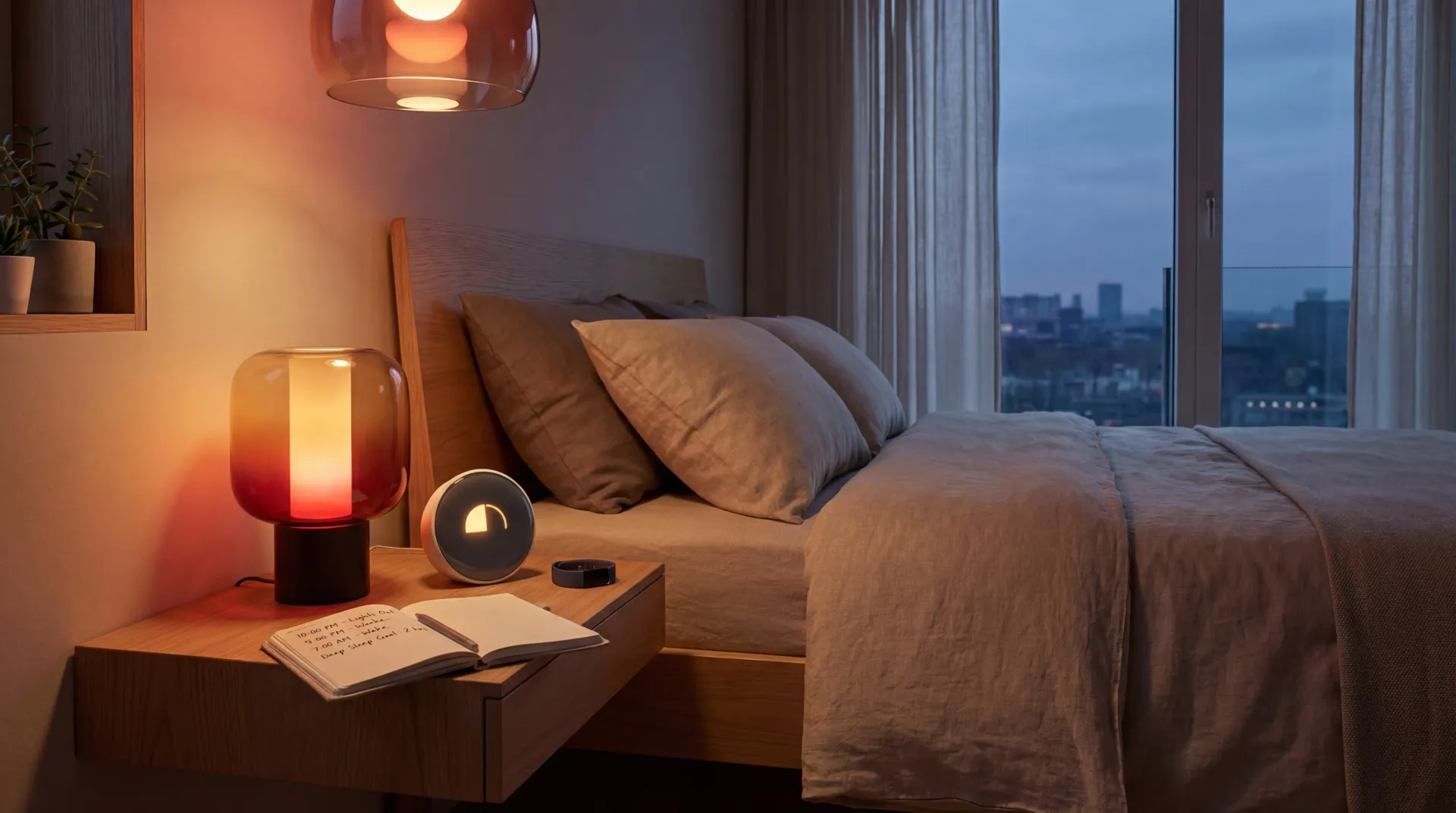
Quick take: Sleep optimization works best when you combine consistent timing, strategic light exposure, and simple technology that reinforces behavior instead of replacing it.
What Your Body Clock Controls Beyond Bedtime
Most sleep advice starts with bedtime, but your circadian system starts much earlier. The body clock in the brain, along with clock genes in organs and tissues, helps coordinate alertness, hormone timing, metabolism, immune activity, digestion, and body temperature. The National Institute of General Medical Sciences overview of circadian rhythms explains that these patterns are not just sleep-related habits; they are biological timing programs linked to light and regular daily cues.
That broader view matters because many people try to solve daytime fatigue by changing only one variable, usually bedtime. In practice, low morning light, late-night bright screens, inconsistent wake times, and irregular meal timing can all send mixed signals to the same system. Your sleep then becomes a downstream output of how coherent those signals are. If your day is biologically noisy, your night often is too.
Population data support this systems view. A prospective UK Biobank analysis found that lower sleep regularity was associated with higher mortality risk, even when accounting for total sleep duration in models, highlighting that timing consistency itself carries independent health value in real-world adults (Windred et al., eLife, 2023). A separate systematic review on sleep timing consistency similarly linked irregular sleep timing with adverse health markers (Chaput et al., 2020).
From a practical standpoint, this means you should define sleep optimization as a 24-hour timing strategy, not a nighttime rescue plan. The goal is to reduce circadian contradiction: bright and active when you want alertness, dim and predictable when you want sleep pressure to build naturally. If you already read our sleep foundations piece on 10 simple tips to improve sleep, think of this guide as the technology-enabled version of that same principle.
The good news is that circadian rhythm technology can help if it is used as a timing amplifier. The bad news is that too many tools are marketed as magic fixes. Before buying devices, you need a baseline, a target schedule, and a feedback loop that is simple enough to maintain for months, not just a motivated weekend.
Start With Data: Measure Sleep, Timing, and Variability
People usually track the wrong metric first. They chase perfect sleep scores while ignoring schedule drift. For circadian optimization, your core baseline should include four points: wake time consistency, sleep midpoint consistency, total sleep duration, and daytime energy blocks. If these are stable, many symptoms improve even before you optimize every detail.
Consumer wearables are useful, but only if you understand their limits. A meta-analysis of Fitbit wristband models found variable performance across sleep stages and stronger performance for broader sleep-wake trends than deep stage precision (Haghayegh et al., JMIR, 2019). In other words, the device is often better at pattern recognition than clinical diagnosis. Use it for behavioral guidance, not medical certainty.
A practical setup is a two-layer approach:
- Layer 1: wearable or app-based trend tracking for bed/wake timing and total sleep estimate.
- Layer 2: a short manual log for caffeine cutoff, evening light exposure, and perceived morning alertness.
Manual logs matter because they capture context most trackers miss. If your watch says seven and a half hours but you had intense late-evening light, a late dinner, and a delayed wake time, your circadian phase may still be drifting later. Your log explains the "why" behind the number.
| Metric | Why It Matters | How to Track It | Action Threshold |
|---|---|---|---|
| Wake time consistency | Anchors circadian phase daily | Wearable + alarm history | Keep within 30-45 minutes across week |
| Sleep midpoint | Shows phase drift earlier than bedtime | Sleep diary or app exports | Drift over 60 minutes for 3 days triggers adjustment |
| Total sleep time | Supports recovery and cognition | Wearable trend, not single-night score | Average under 7 hours signals capacity gap |
| Morning alertness | Functional output of timing quality | 1-5 rating at 90 minutes after waking | Score 2 or less for 4 days needs protocol reset |
If you are just getting started, run this baseline for 10-14 days before making major changes. That gives you enough data to see if the issue is duration, timing inconsistency, or poor wind-down structure. It also keeps you from overcorrecting after one bad night, which is one of the fastest ways to create sleep anxiety.
For people who train hard or do cognitively demanding work, add daytime performance markers: reaction speed tests, perceived focus windows, and afternoon energy dips. You can pair this with our article on physical exercise and brain health to identify whether your training timing helps or harms sleep recovery.
Light Is the Lever: How to Program Day and Night Signals
Light is the most powerful external timing signal for circadian phase. Sleep optimization technology should therefore prioritize light management before advanced biofeedback. If you ignore light and buy more gadgets, the gadgets usually lose.
Laboratory and field evidence show that evening light can delay circadian timing and suppress melatonin, with substantial inter-individual variability (Phillips et al., PNAS, 2019). A broader systematic review also concluded that light exposure meaningfully shifts circadian rhythms, with timing, intensity, and spectrum all contributing (Kervezee et al., Chronobiology International, 2019). Even ordinary room light in the evening can have measurable effects in sensitive individuals (Gooley et al., J Clin Endocrinol Metab, 2011).
Technology can operationalize this into a daily script:
- Morning: bright outdoor light exposure as early as practical, ideally paired with a short walk.
- Daytime: maintain well-lit workspaces for alertness and stable phase signaling.
- Evening: shift home lighting warmer and dimmer 2-3 hours before bed target.
- Night: minimize bright screens and overhead lighting in the final wind-down window.
If you use screens at night, reduce intensity first, then spectrum. Most people overfocus on blue-light settings and underfocus on brightness and viewing duration. For children, this may be even more important, as preschool-age participants have shown strong melatonin suppression responses to evening light (Akacem et al., 2022).
The objective is not to eliminate all evening light. It is to create a clear day-night contrast that your biology can interpret reliably. If your home environment is bright at midnight and dim at breakfast, your body clock has no reason to trust your intended schedule.
| Light Scenario | Likely Circadian Effect | Best Tech Support | Common Mistake |
|---|---|---|---|
| Bright morning outdoor light | Advances phase, improves alertness | Light reminder app + outdoor walk trigger | Checking phone indoors instead of going outside |
| Dim, warm evening lighting | Supports melatonin onset timing | Smart bulbs with automated warm schedule | Keeping ceiling lights at daytime intensity |
| Late bright screen exposure | Can delay sleep timing and onset | Device curfew + brightness cap + night mode | Relying on night mode alone |
| Night awakenings with bright lights | Disrupts return-to-sleep physiology | Low-lux motion path lights | Using full bathroom lighting at 2 a.m. |
Build a Circadian Technology Stack That Actually Helps
The best circadian technology stack is small. More devices create more noise, more notifications, and more opportunities to obsess over data instead of behavior. Start with one tool per function: measurement, light control, and schedule reinforcement.
Here is a practical stack that scales from beginner to advanced:
- Measurement: one wearable or bedside tracker for trend-level sleep/wake timing.
- Environment: programmable smart bulbs or automated scenes for evening dimming.
- Reinforcement: fixed wake alarm, wind-down reminder, and morning light prompt.
- Optional: sunrise alarm clock if you struggle with dark winter mornings.
That stack covers almost all behavioral leverage points. Advanced additions like skin temperature rings, HRV dashboards, and apnea-screening features can be useful, but only after your basic schedule is stable. If baseline regularity is poor, additional metrics usually increase stress without improving outcomes.
When comparing devices, score them on decision usefulness instead of feature count. Ask: does this data change what I do tomorrow? If the answer is no, it belongs in the "nice-to-have" category. This is the same minimalist philosophy we recommend in best ways to improve your sleep: make the friction low enough to stay consistent.
| Technology Type | Primary Benefit | Who Benefits Most | Where It Fails |
|---|---|---|---|
| Wearable sleep tracker | Long-term timing trends and behavior feedback | People building consistency habits | Overinterpreting stage-by-stage precision |
| Smart lighting scenes | Automates evening dimming and morning brightening | Busy households with irregular routines | Manual overrides every night |
| Sunrise alarm | Smoother wake transition and morning adherence | Late chronotypes and winter wake difficulty | Too short ramp duration or low light output |
| App reminders and focus modes | Protects wind-down and screen curfew windows | People with high evening device use | Ignoring notifications due to alert overload |
If insomnia symptoms persist despite good timing hygiene, do not treat consumer technology as therapy. Clinical pathways are different. Start with professional evaluation and evidence-based approaches. Public guidance from the CDC sleep health resources and NHLBI health effects overview can help you decide when to escalate care.
Daily Timing Blueprint: Meals, Exercise, Caffeine, and Wind-Down
Circadian optimization is not only light exposure. Meal timing, training time, stimulant cutoff, and evening arousal all interact with the same biological clock. A 2024 review on meal timing and obesity-related disease emphasizes that when you eat can influence metabolic outcomes independent of what you eat (Wang et al., 2024). Exercise timing research also suggests time-of-day effects on physiology and performance adaptation (de Assis et al., 2023).
A practical blueprint for most adults:
- Wake anchor: fixed wake time seven days per week, with modest flexibility.
- Morning signal: light exposure plus hydration and movement soon after waking.
- Caffeine window: keep caffeine earlier in the day and avoid late-day stacking.
- Exercise slot: place intense training away from your final pre-sleep window.
- Dinner timing: keep major meals reasonably distant from bedtime target.
- Wind-down block: low stimulation, dim light, repeatable sequence.
This blueprint works because it reduces phase conflict. Late intense workouts, late meals, and bright screens can each delay your internal night. Combined, they often produce a "tired but wired" state that people misinterpret as stress alone. In reality, it is often stress plus poor timing architecture.
If anxiety or stress spikes at night, pair timing interventions with calming routines. Gentle breathwork and relaxation transitions can be useful, and you can combine this with ideas from top breathing techniques to relieve stress. Technology should support this routine quietly, for example by auto-activating a low-light wind-down scene and silencing nonessential notifications.
Do not ignore social constraints. Parents, shift workers, and students may not achieve ideal timing every day. The goal is not perfection; it is reducing the amplitude and frequency of disruptions. Even partial regularity gains can produce better morning function and fewer crashes.
A 30-Day Sleep Optimization Plan With Decision Checkpoints
Most sleep plans fail because they try to change everything in 72 hours. Circadian systems adapt better to steady, repeatable signals than abrupt oscillations. Use a 30-day protocol with weekly checkpoints and only one or two new constraints per week.
| Week | Primary Focus | Tools | Success Marker |
|---|---|---|---|
| Week 1 | Baseline measurement and wake-time anchor | Wearable + short daily log | Wake time within 45 minutes on 6 of 7 days |
| Week 2 | Morning bright light and evening dimming protocol | Smart lighting schedule + reminders | At least 5 mornings with early light exposure |
| Week 3 | Meal timing and caffeine cutoff stabilization | Calendar blocks + meal reminders | Late caffeine reduced to rare exceptions |
| Week 4 | Optimize training/wind-down timing and stress load | Focus mode + wind-down automation | Improved morning alertness score trend |
Checkpoint questions each weekend:
- Did my wake time stay stable, or did it drift later?
- Did I maintain a clear day versus night light contrast?
- Which single behavior caused the biggest disruptions?
- What one adjustment gives the highest return next week?
If progress stalls, simplify. Remove one device, reduce one metric, and return to the essentials: timing consistency, light contrast, and wind-down predictability. More complexity is not automatically more effective. The highest-performing routines are often boring, repeatable, and protected from decision fatigue.
If you are pursuing fat loss or performance goals, align sleep protocol with nutrition and training periodization rather than running separate plans in conflict. Our article on living a healthy lifestyle can help you frame sleep optimization as one piece of a broader health operating system, not a disconnected hack.
Myths vs Facts About Sleep Optimization Technology
| Myth | Fact |
|---|---|
| "If I sleep seven hours, schedule does not matter." | Duration matters, but regular timing is independently associated with health outcomes and day-to-day function. |
| "Blue-light filters solve nighttime screen effects." | Spectrum helps, but brightness, duration, and timing of exposure are also critical drivers of circadian effects. |
| "A higher sleep score always means better recovery." | Consumer scores are useful trends, not clinical truth. Context and consistency are often more actionable than single scores. |
| "More devices produce better sleep outcomes." | Too many tools create friction and anxiety. A minimal stack tied to behavior is usually more effective long term. |
| "Weekend catch-up fully resets weekday sleep debt." | Extra weekend sleep can help, but repeated social jetlag still disrupts circadian alignment and Monday alertness. |
Technology is not the treatment. It is the delivery mechanism for timing signals and habits. If you keep that frame, you will select simpler tools, make faster adjustments, and avoid the common trap of replacing behavior change with dashboard watching.
For many adults, the most effective stack remains surprisingly low tech: fixed wake alarm, bright morning light, automated evening dimming, and one tracker for trend feedback. Add complexity only when a specific problem remains unsolved.
Frequently Asked Questions
How long does it take circadian rhythm technology to improve sleep?
Most people notice early changes in morning alertness and sleep onset within one to two weeks when timing is consistent. More durable changes in schedule stability usually take three to six weeks of repeatable cues.
Should I trust wearable sleep stage data when adjusting my routine?
Use stage data cautiously. Consumer devices are better for trend-level behavior decisions than precise sleep architecture. Focus first on regular wake times, total sleep trends, and daytime function.
Is it worth buying blue-light blocking glasses?
They can help some users, but they are not a standalone fix. You still need lower evening brightness, predictable wind-down timing, and reduced late-night stimulating activity for meaningful circadian benefit.
Can shift workers still use this approach?
Yes, but protocols need adaptation. Shift workers should create the strongest possible light-dark contrast around their target sleep window, stabilize meal and caffeine timing, and keep wake anchors consistent within shift blocks.
Related Articles
- 10 Simple Tips to Improve Sleep - Foundational behavior changes that pair well with circadian technology.
- Best Ways to Improve Your Sleep - Practical sleep hygiene upgrades to reinforce a stable schedule.
- Top Breathing Techniques to Relieve Stress - Wind-down tools that reduce nighttime hyperarousal.
- Physical Exercise and Brain Health - How movement timing supports cognition and recovery.
Medical Disclaimer
This article is for informational and educational purposes only and is not medical advice, diagnosis, or treatment. Always consult a licensed physician or qualified healthcare professional regarding any medical concerns. Never ignore professional medical advice or delay seeking care because of something you read on this site. If you think you have a medical emergency, call 911 immediately.