Creatine monohydrate is the most studied sports supplement in history, and most people still think it only builds muscle. That part works. But the research published over the last decade points somewhere else entirely: neurons, osteoblasts, mitochondria, and a set of benefits that have nothing to do with the gym.
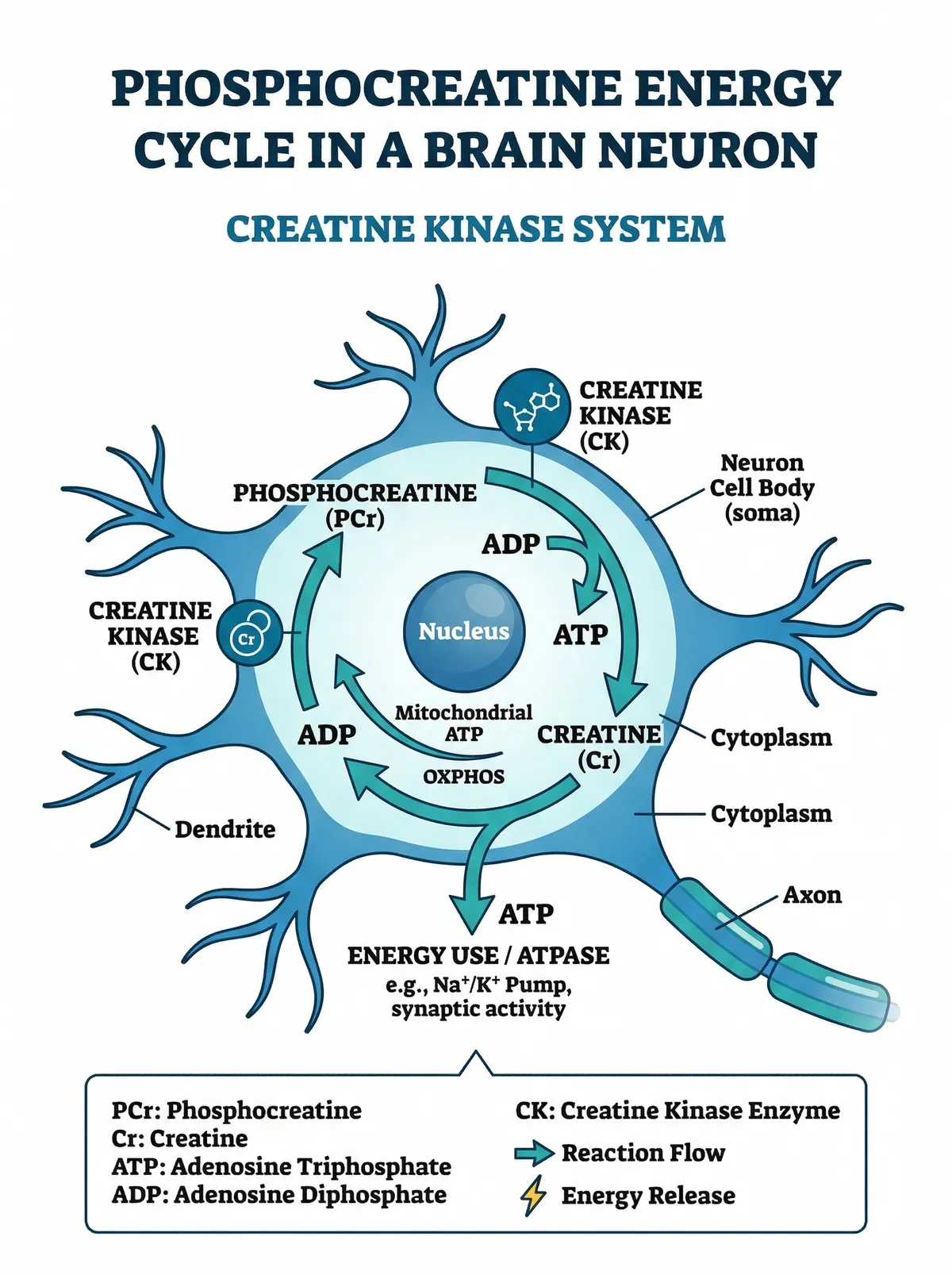
About 95% of the body's creatine sits in skeletal muscle. The remaining 5% is distributed across the brain, heart, kidneys, and liver, where it does the same thing: regenerating ATP, the molecule that powers cellular work. When tissues are metabolically stressed, whether from intense cognitive effort, bone remodeling, or cardiac ischemia, that phosphocreatine reserve becomes rate-limiting. Supplementation raises those reserves. What follows from that is more interesting than bigger biceps.
Your Brain Runs on Phosphocreatine (and Probably Doesn't Get Enough)
The human brain weighs about 2% of total body mass but uses roughly 20% of daily energy output. Most of that energy comes from ATP, and the brain's phosphocreatine system is its primary buffer against energy shortfalls during demanding tasks.
Creatine supplementation increases brain phosphocreatine content by 5 to 15 percent, according to magnetic resonance spectroscopy studies. That margin matters. In a 2003 randomized controlled trial by Rae et al., participants taking 5 grams per day for six weeks showed measurable improvements in both working memory and backward digit span tasks. A separate study by McMorris et al. found that 20 grams per day for seven days improved forward spatial recall and long-term memory performance in older adults.
The cognitive effects appear to depend on baseline creatine status. A 2011 study by Benton and Donohoe tested 121 participants and found that vegetarians experienced significant memory improvements from creatine, while omnivores did not. Makes sense: people who eat less meat start with lower brain creatine levels, so supplementation has more room to work.
Quick fact: Six randomized controlled trials involving 281 participants suggest that short-term memory and reasoning ability may improve with creatine supplementation, particularly in populations with lower baseline levels (vegetarians, older adults, sleep-deprived individuals).
Age is another variable. Young healthy adults with adequate creatine intake often show no cognitive gains from supplementation. Older adults, whose brains require more energy to complete the same cognitive tasks, tend to benefit more. A 2026 narrative review published in Frontiers in Nutrition examined this "muscle-brain axis," concluding that creatine's dual action on muscle and neural tissue makes it particularly relevant for aging populations.
Sleep deprivation is a third factor. When researchers subject participants to 24-36 hours without sleep, creatine-supplemented groups consistently outperform placebo on executive function tasks and reaction time. The brain under sleep debt behaves metabolically like an older brain: it struggles to maintain ATP turnover. Creatine supplementation buffers that deficit, at least partially, by keeping the phosphocreatine shuttle running closer to normal capacity.
Animal research tells a different part of the story. Prophylactic creatine supplementation reduced cortical damage by 36% in rats and 50% in mice prior to induced traumatic brain injury, prompting the International Society of Sports Nutrition to suggest creatine for athletes at concussion risk. Human trials on TBI outcomes are still limited, but the preclinical signal is consistent across multiple labs.
What Happens to Bone Density When You Add Creatine to Resistance Training
Bone responds to mechanical loading, and anything that helps you lift heavier probably helps your skeleton too. But creatine's bone effects may go beyond the indirect "stronger muscles, more load" pathway.
Chilibeck et al. conducted a 12-month randomized controlled trial in which postmenopausal women received 0.1 g/kg/day of creatine monohydrate alongside a structured resistance training program. The creatine group preserved femoral neck bone mineral density while also showing increased overall strength, a combination that matters because hip fractures are one of the leading causes of disability after age 65.
| Study | Population | Creatine Dose | Duration | Bone Outcome |
|---|---|---|---|---|
| Chilibeck et al., 2015 | Postmenopausal women | 0.1 g/kg/day | 12 months | Preserved femoral neck BMD |
| Sales et al., 2020 | Postmenopausal women | 3 g/day | 24 months | Attenuated bone loss vs. placebo |
| Candow et al., 2021 | Older men (59-77) | 0.1 g/kg/day + protein | 12 months | Decreased bone resorption markers |
Candow and colleagues published a complementary study in older men (ages 59-77) combining low-dose creatine with protein supplementation. The combination increased lean tissue mass and upper body strength while simultaneously decreasing markers of bone resorption, the biochemical process that breaks bone down. These are not dramatic rebuilding effects, but in osteoporosis prevention, slowing loss is half the battle.
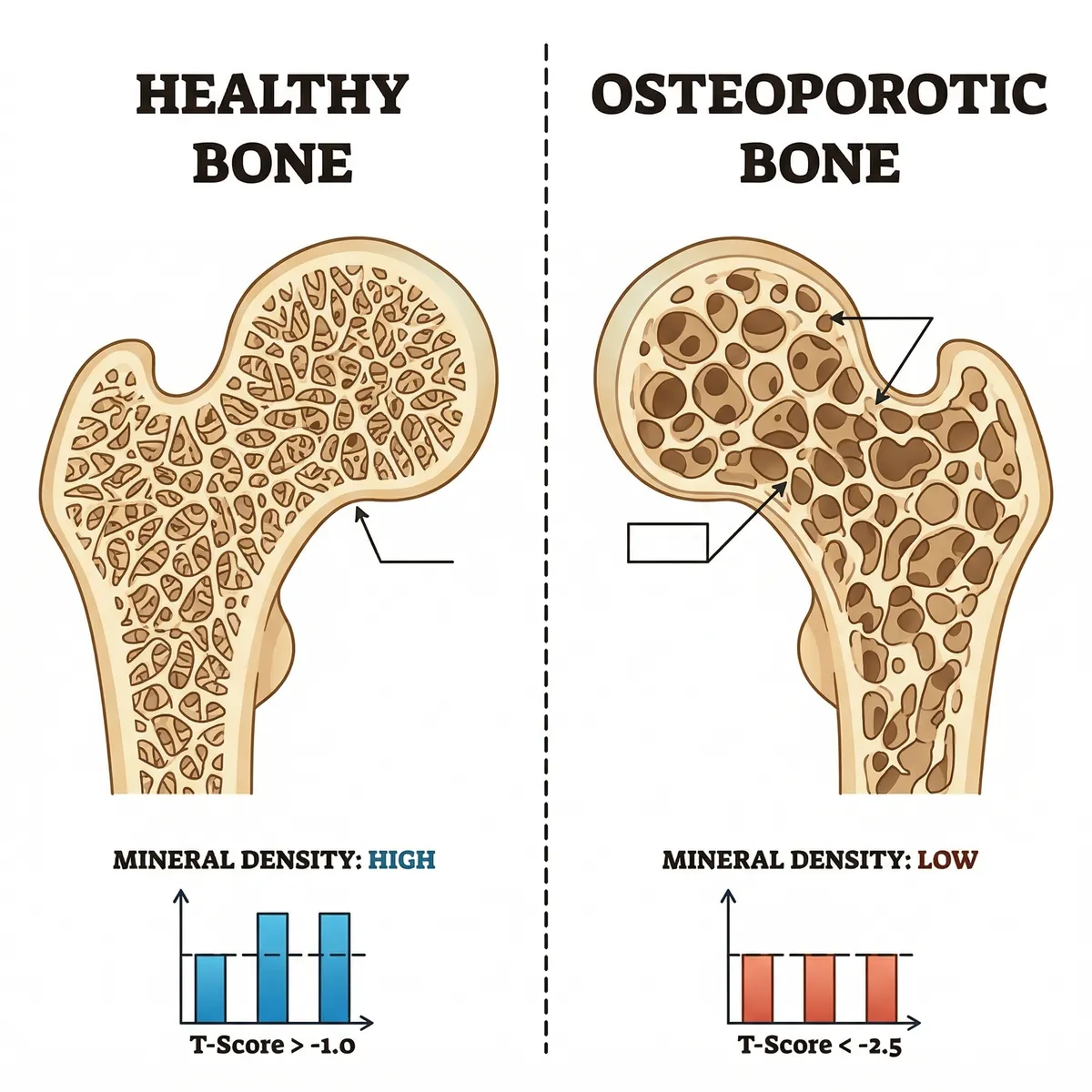
A 2024 Mendelian randomization analysis published in BMC Musculoskeletal Disorders examined potential causal relationships between creatine metabolism and musculoskeletal outcomes, adding genetic evidence to what the clinical trials suggest. The field is still sorting out whether creatine directly stimulates osteoblast activity or simply enables more effective training. Probably both.
Creatine and Depression: 66.7% Remission in One Trial
Brain energy metabolism and mood disorders are more connected than most people realize. Depressed brains show altered phosphocreatine levels on MRS imaging, and the hypothesis that replenishing those levels might improve symptoms has driven a small but provocative research program.
The most striking result came from a trial of bipolar disorder patients who received 6 grams of creatine per day for six weeks alongside their existing medication. The creatine group achieved a 66.7% remission rate compared to 18.2% in the placebo group. That is a large effect for an adjunct supplement, and it needs replication, but it got attention for good reason.
| Condition | Dose | Duration | Finding |
|---|---|---|---|
| Bipolar depression | 6 g/day | 6 weeks | 66.7% remission vs. 18.2% placebo |
| Major depression (open-label) | 3-5 g/day | 4-8 weeks | Improved depression scores |
| Treatment-resistant depression | 5 g/day | 8 weeks | Augmented SSRI response |
A 2026 systematic review in the Canadian Journal of Psychiatry evaluated all randomized controlled trials of creatine monohydrate across mental disorders. The review noted consistent signals for depression but emphasized that sample sizes remain small and follow-up periods short. Open-label trials using 3 to 5 grams daily have shown improvements in depression scores, and there is preliminary evidence that creatine may augment SSRI response in treatment-resistant cases.
The mechanism is plausible: if creatine increases brain energy availability, and depression involves impaired cellular energy metabolism in specific brain regions, then supplementation could address an upstream cause rather than modulating neurotransmitters directly. This does not replace psychiatric care. But it adds a low-risk tool to the conversation.
Women may respond differently than men to creatine's mood effects. Several of the depression studies enrolled predominantly female participants, and some researchers have hypothesized that estrogen-mediated changes in creatine kinase activity could make women more responsive to supplementation during certain hormonal phases. This remains speculative, but it has generated enough interest to spawn dedicated trial designs.
The Aging Muscle-Brain Connection That Most Supplements Miss
After age 30, humans lose approximately 3 to 8 percent of muscle mass per decade, accelerating after 60. This process, sarcopenia, correlates with cognitive decline in ways that go beyond shared aging. Muscle and brain tissue compete for the same metabolic substrates, and creatine sits at the center of both systems.
A meta-analysis of 357 adults over age 64 found that those supplementing with creatine during approximately 12.6 weeks of resistance training experienced greater gains in muscle mass, strength, and functional capacity compared to training alone. A second meta-analysis of 405 elderly participants confirmed greater improvements in muscle mass and upper body strength with creatine.
| Measure | Training Alone | Training + Creatine | Difference |
|---|---|---|---|
| Lean mass gain | Moderate | Greater | Statistically significant |
| Upper body strength | Moderate | Greater | Statistically significant |
| Functional capacity | Improved | More improved | Favors creatine |
| Brain phosphocreatine | No change | +5-15% | Supplementation effect |
What makes creatine unusual among supplements for aging is that it works on both sides of the muscle-brain axis simultaneously. You do not need separate supplements for cognitive support and muscle preservation. A single compound, at a single dose, addresses both tissue systems through the same biochemical mechanism: phosphocreatine buffering of ATP supply.
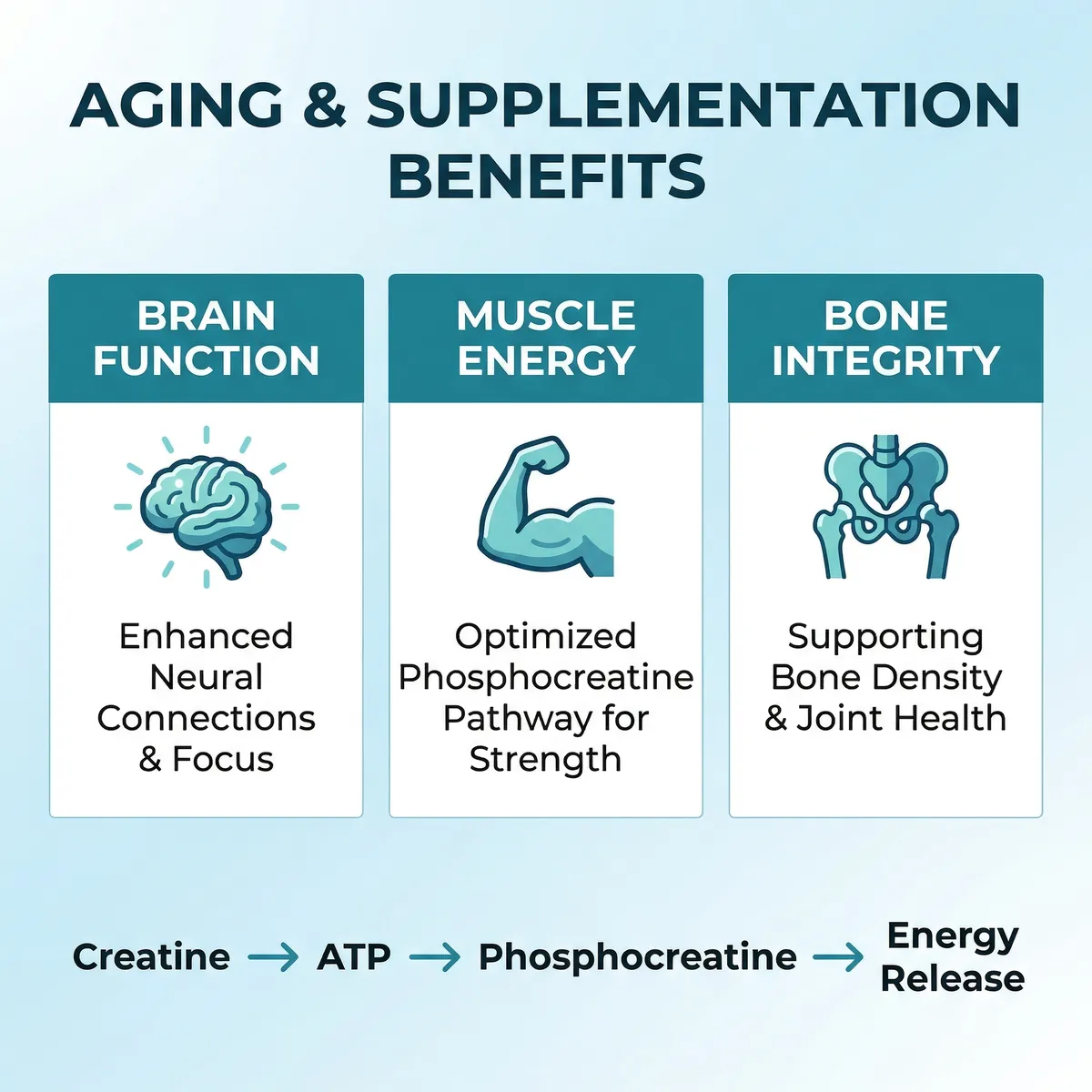
A 2026 review in the Journal of Dietary Supplements raised an important methodological point. The researchers argued that many cognitive studies fail to verify whether supplementation actually increased brain creatine levels via MRS imaging. Some null results may simply reflect inadequate dosing or duration rather than a true lack of effect. Future trials that pair cognitive testing with brain creatine measurement should give cleaner answers.
Glucose, Heart Tissue, and the Metabolic Case for Creatine
Creatine also turns up in places you might not expect. The evidence for glucose handling and cardiac protection is still developing, but what exists is worth knowing about.
In a study of type 2 diabetes patients, 5 grams per day for 12 weeks improved glucose tolerance and reduced HbA1c levels. The mechanism appears to involve GLUT-4 transporters, the proteins that shuttle glucose into cells. During muscle rehabilitation after atrophy, creatine supplementation increased GLUT-4 expression by approximately 40%, suggesting enhanced insulin sensitivity through AMPK signaling pathways.
Cardiac tissue is heavily dependent on phosphocreatine. During ischemic events (reduced blood flow), heart cells deplete their ATP reserves rapidly. Animal models consistently show that phosphocreatine administration protects heart tissue during ischemia. Some evidence suggests that oral creatine supplementation benefits heart failure patients in rehabilitation programs, though this remains an area where human data is thin.
Dosing summary for general health: Most research on non-muscle benefits uses 3-5 g/day of creatine monohydrate. There is no need for a loading phase at these doses, though loading (20 g/day split into 4 doses for 5-7 days) achieves tissue saturation faster. Cost is typically under $0.10 per day at maintenance doses.
Then there is immune function. Research published in 2020 demonstrated that creatine regulates CD8 T cell antitumor immunity. In mouse models, dietary creatine supplementation suppressed tumor growth across multiple cancer types and enhanced the effectiveness of immunotherapy. This is preclinical work, not a cancer treatment recommendation, but it means creatine's role in cellular energy reaches immune cells too, which was not on anyone's radar two decades ago.
Myths vs. Evidence: What Creatine Doesn't Do
Creatine carries more misinformation than almost any other supplement. Time to separate documented effects from gym lore and internet anxiety.
| Claim | Evidence | Verdict |
|---|---|---|
| Creatine causes kidney damage | Over 500 studies; no kidney damage in healthy individuals at recommended doses | Myth |
| Creatine causes hair loss via DHT | Based on one 2009 study; not replicated in subsequent research | Unsubstantiated |
| Creatine causes dehydration and cramps | Multiple studies show no increase in dehydration or cramping rates | Myth |
| Only creatine monohydrate works | Monohydrate is best studied; other forms lack comparative evidence | Mostly true |
| You must cycle creatine | No evidence that cycling improves outcomes; continuous use is safe | Myth |
| Creatine only benefits young athletes | Strongest non-muscle evidence is in older adults and vegetarians | Myth |
The kidney concern persists despite being the most thoroughly debunked claim in supplement science. Creatine does raise serum creatinine levels (creatinine is a breakdown product of creatine), which can trigger false positives on standard kidney function tests. But actual kidney function, measured by GFR and other direct markers, remains unaffected in healthy individuals across hundreds of studies spanning decades.
The hair loss worry traces back to a single 2009 South African rugby study that found increased DHT levels after creatine loading. No subsequent study has replicated this finding. The original study did not measure hair loss directly, only hormone levels, and the increase was within normal physiological range.
Safety data from the International Society of Sports Nutrition's position stand, updated in 2021, states that creatine monohydrate is safe for both short- and long-term use when taken at recommended doses. Minor side effects (bloating in some people during loading, slight water retention) exist but are clinically insignificant. No serious adverse events have been causally linked to creatine in healthy populations.
One legitimate caution: people with pre-existing kidney disease should consult their physician before supplementing, as impaired kidneys may struggle with the increased creatinine clearance. This is a specific medical concern, not a general safety issue.
The "only for young athletes" myth is worth dismantling separately. The strongest evidence for non-muscle creatine benefits comes from older adults, vegetarians, and people under metabolic stress. A 70-year-old woman doing resistance training three times per week arguably has more to gain from creatine supplementation than a 25-year-old who eats 200 grams of red meat daily. Her baseline stores are lower, her tissues are under more metabolic pressure, and the clinical endpoints that matter to her (bone density, cognitive function, independence) are exactly the ones where creatine has shown effects.
Frequently Asked Questions
How much creatine should I take for brain benefits?
Most cognitive studies used 5 grams per day of creatine monohydrate for at least six weeks. Some protocols used higher loading doses of 20 grams per day for shorter periods. For general maintenance of brain and body benefits, 3-5 grams daily is the standard recommendation supported by research.
Does creatine help older adults who don't exercise?
Most studies showing bone and muscle benefits combined creatine with resistance training. The evidence for creatine alone, without exercise, is weaker. For cognitive benefits, supplementation without exercise has shown effects in some trials, particularly in sleep-deprived individuals and vegetarians. The strongest overall evidence favors creatine paired with physical activity.
Is creatine safe for women?
Yes. Several of the bone density trials specifically enrolled postmenopausal women, and safety profiles were comparable to those seen in male participants. Creatine does not affect female hormones. The water retention effect is generally less pronounced in women than in men.
Can vegetarians get enough creatine from diet alone?
Creatine is found almost exclusively in animal products, primarily red meat and fish. Vegetarians and vegans typically have 20-30% lower muscle creatine stores than omnivores, and their brains show correspondingly lower phosphocreatine levels. Supplementation is the only reliable way for plant-based eaters to achieve the tissue saturation levels seen in the research.
How long does it take for creatine to work on non-muscle benefits?
Cognitive effects have been observed after as little as five days of high-dose loading (20 g/day) in some studies, though six weeks at 5 g/day is more typical. Bone density changes require months of consistent supplementation combined with resistance training. The bipolar depression trial showed results at six weeks.
Related Articles
- Best Supplements for Muscle Growth - A comprehensive look at evidence-based supplements that support strength and hypertrophy, including creatine's established role.
- Physical Exercise and Brain Health - How physical activity protects cognitive function through mechanisms that overlap with creatine's effects on neural energy.
- Omega-3 Benefits, Sources, and Supplements - Another well-researched supplement with brain, heart, and anti-inflammatory properties that complements creatine's profile.
- Foods for Thought: Natural Brain Supplements - Dietary strategies and natural compounds that support cognitive performance alongside targeted supplementation.
Medical Disclaimer
This article is for informational and educational purposes only and is not medical advice, diagnosis, or treatment. Always consult a licensed physician or qualified healthcare professional regarding any medical concerns. Never ignore professional medical advice or delay seeking care because of something you read on this site. If you think you have a medical emergency, call 911 immediately.