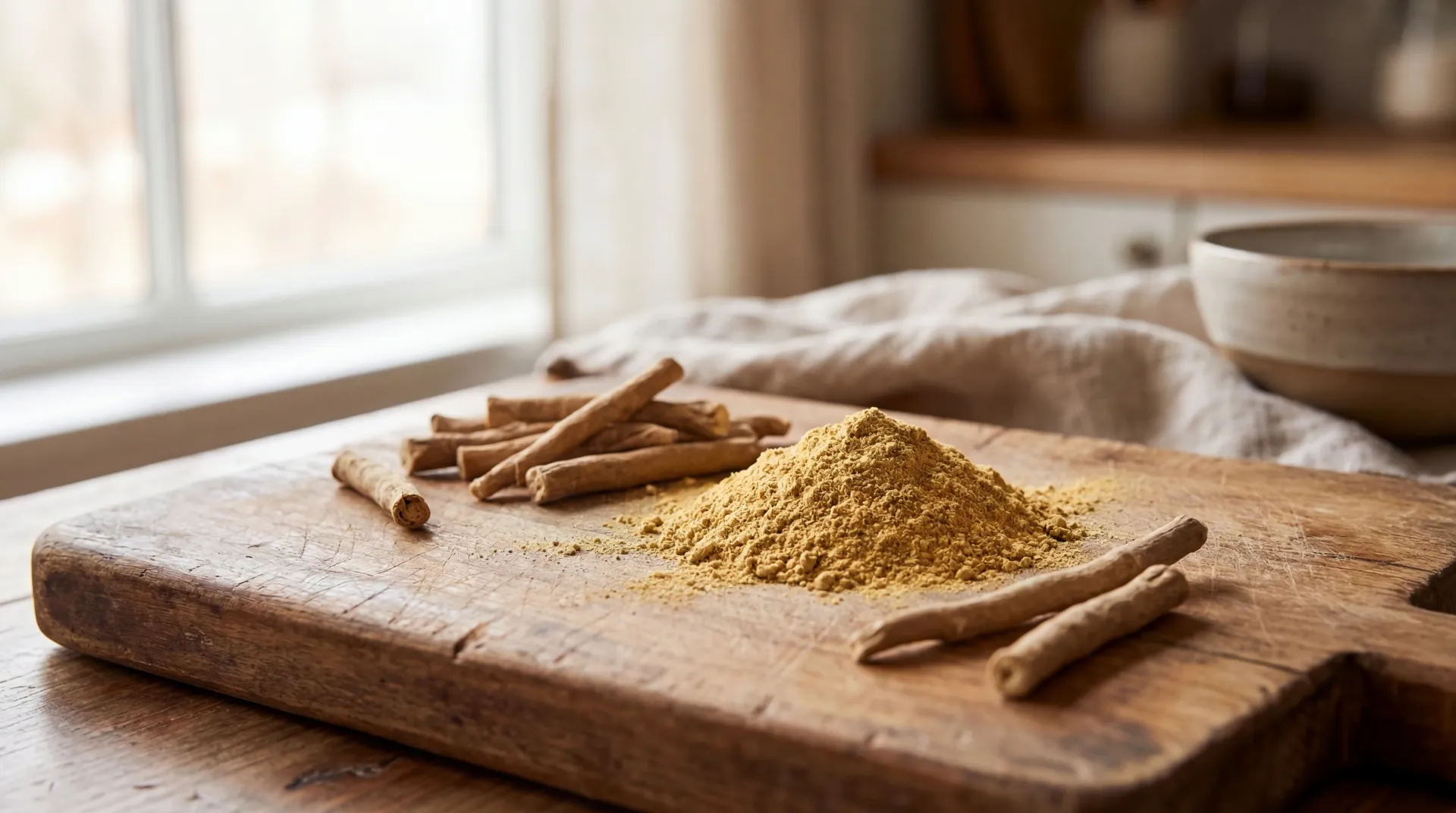
What is ashwagandha, and why does it keep showing up everywhere?
Ashwagandha (Withania somnifera) is a shrub native to India, parts of Africa, and the Middle East. The root has been used in Ayurvedic medicine for over 3,000 years, traditionally prescribed for fatigue, weakness, and what practitioners called "nervous exhaustion." The name translates roughly to "smell of horse," referring both to the root's distinctive odor and the belief that it confers the strength of one.
In supplement terms, ashwagandha is an adaptogen, a plant-based substance thought to help the body manage stress more effectively. The active compounds responsible for most of the studied effects are called withanolides, a group of steroidal lactones concentrated primarily in the root. Commercial extracts standardize withanolide content anywhere from 1.5% to 35%, which creates a real problem when comparing study results (more on that in the dosage section).
The supplement market has grown rapidly around ashwagandha. You can find it in capsules, powders, gummies, and blended into everything from protein bars to coffee. But the marketing often outpaces the evidence. Some claims hold up in randomized controlled trials. Others rest on animal studies or test-tube experiments that may never translate to humans. Below, I've tried to be clear about which is which.
What the cortisol and stress research actually shows
Stress reduction is the most researched benefit of ashwagandha, and the data here is stronger than for most herbal supplements. A 2024 meta-analysis pooling nine randomized controlled trials with 558 participants found statistically significant reductions in both perceived stress (measured via the Perceived Stress Scale) and serum cortisol levels compared to placebo.
One of the more cited individual studies involved 64 adults with chronic stress who took 300 mg of a full-spectrum root extract twice daily for 60 days. The treatment group showed significant reductions across all stress-assessment scales, and serum cortisol dropped substantially compared to placebo (p=0.0006). That cortisol finding is relevant because chronically elevated cortisol is linked to weight gain, impaired immune function, and disrupted sleep. If you're interested in how the HPA axis and chronic stress interact with your health long-term, that connection provides important context.
Researchers believe the mechanism runs through the hypothalamic-pituitary-adrenal (HPA) axis. Withaferin A, one of the key withanolides, appears to interact with glucocorticoid receptors in the brain, which modulate cortisol release. It doesn't block cortisol outright (you need cortisol to function). Think of it more as turning down the volume on an overactive stress response.
Quick summary: Across multiple trials, ashwagandha supplementation at 250-600 mg/day reduced cortisol levels by roughly 25-40% in stressed adults over 4-12 weeks. Effects were most consistent at the 300 mg twice-daily dose.
Some important context: most stress studies recruited participants who were already experiencing moderate to high stress. If your baseline stress is low, the effect may be smaller. The trials also lasted 6-12 weeks, so we don't have great data on whether the cortisol-lowering effect persists beyond three months.
Can it help you sleep better?
Sleep is where the dose question becomes especially important. A meta-analysis of five studies covering 372 participants found small but statistically significant improvements in sleep quality, sleep latency (how long it takes to fall asleep), sleep efficiency, and total sleep time. Benefits were stronger in people with diagnosed insomnia than in healthy sleepers, and more pronounced at 600 mg/day with treatment lasting at least eight weeks.
One trial with 150 participants stands out. The ashwagandha group reported a 72% improvement in sleep quality versus 29% in the placebo group, with measurable differences in sleep efficiency and latency confirmed through actigraphy (wrist-worn monitoring devices, not just self-reporting). That matters because people are terrible at accurately reporting their own sleep quality.
How does it work for sleep specifically? Ashwagandha contains a compound called triethylene glycol, identified in animal studies as a sleep-promoting agent. The cortisol-lowering effect likely helps too — people with elevated evening cortisol often struggle to fall asleep because the stress response keeps the body in an alert state. If you're working on sleep quality from multiple angles, the strategies covered in our sleep optimization guide pair well with supplementation.
Worth mentioning: the sleep benefits showed a clearer dose-response relationship than the stress benefits. At 120-300 mg/day, sleep improvements were inconsistent. At 600 mg/day, they were more reliable. This suggests the sleep mechanism may require a higher threshold of active compounds, or that the sedative properties of triethylene glycol need a certain tissue concentration to produce measurable effects.
Strength, endurance, and testosterone
Walk into any supplement store and you'll find ashwagandha positioned alongside creatine and protein powder. The hype is ahead of the evidence, but the evidence isn't nothing. Several studies show measurable improvements in strength, VO2 max, and exercise recovery.
Research on ashwagandha and sports performance using doses of 120-1,250 mg daily over 2-8 weeks showed improvements in aerobic capacity, strength output, and post-exercise recovery. Lower exercise-induced cortisol (which slows recovery) and mild anti-inflammatory effects likely explain why.
| Performance metric | Typical improvement | Study duration | Dose range |
|---|---|---|---|
| Muscular strength | Moderate increase | 8-12 weeks | 300-600 mg/day |
| VO2 max | Small-to-moderate increase | 8-12 weeks | 300-600 mg/day |
| Exercise recovery | Reduced soreness markers | 2-8 weeks | 120-600 mg/day |
| Testosterone (men) | Small increase | 8-12 weeks | 600 mg/day |
The testosterone question comes up constantly. Limited evidence suggests that ashwagandha at 600 mg/day over 8-12 weeks can produce a small increase in testosterone levels and improvements in sperm quality. However, "small increase" is the operative phrase. We're not talking about anything comparable to testosterone replacement therapy. The effect appears more relevant for men with stress-suppressed testosterone than for men with already-normal levels.
Women's hormonal health has received less attention, but one study using 300 mg of root extract twice daily found increases in estrogen, improvements in sexual function, and a reduction in menopausal symptoms including hot flashes. For more on supplements that support physical performance, our muscle growth supplement guide covers the broader category.
Recovery is an area where anecdotal reports and clinical data align fairly well. Several studies measured creatine kinase (a marker of muscle damage) and found lower post-exercise levels in ashwagandha groups. Practically, this might mean less soreness and faster return to training. Athletes using ashwagandha alongside a resistance training program appeared to gain slightly more lean mass and lose slightly more body fat than those on placebo, though the differences were modest.
Memory, focus, and brain function
Fewer studies have looked at cognition, and the ones that exist are smaller. A 2021 randomized controlled trial gave 125 healthy but stressed adults a 300 mg sustained-release capsule daily for 90 days. The ashwagandha group showed significantly improved recall memory (first-attempt memory scores of 12.9 vs. 10.1) and fewer total errors in pattern recognition tasks (17.5 vs. 27.7) compared to placebo.
That same study also found lower stress levels and better sleep quality in the treatment group, which complicates interpretation. Did ashwagandha improve cognition directly, or did it improve cognition by reducing stress and improving sleep? Both are plausible, and they could be happening at the same time. Chronic stress and bad sleep tank cognitive performance on their own, so fixing those issues might be the real mechanism here.
| Cognitive measure | Ashwagandha group | Placebo group | Difference |
|---|---|---|---|
| First-attempt recall score | 12.9 | 10.1 | +27.7% |
| Total pattern errors | 17.5 | 27.7 | -36.8% |
| Reaction time improvement | Up to 14% faster | No significant change | Significant |
Other trials using doses of 120-1,000 mg daily over 4-12 weeks have found improvements in attention, information processing speed, and executive function. The effects are modest. You won't feel sharper after a single dose the way you would with caffeine. Any cognitive benefit seems to build gradually over weeks of consistent use. If cognitive enhancement interests you, our piece on panax ginseng covers another adaptogen with overlapping research.
How much to take and which form to choose
Dosing ashwagandha is trickier than most supplements because extract standardization varies wildly across products. A product labeled "600 mg ashwagandha" with 5% withanolides delivers a different amount of active compound than one with 35% withanolides. This makes comparing products (and interpreting studies) harder than it should be.
| Health goal | Recommended daily dose | Extract type | Duration for effects |
|---|---|---|---|
| Stress and anxiety reduction | 300-600 mg | Root extract (5% withanolides) | 4-8 weeks |
| Sleep improvement | 600 mg | Root extract | 8+ weeks |
| Physical performance | 300-600 mg | Root extract (KSM-66 or similar) | 8-12 weeks |
| Cognitive support | 300 mg | Sustained-release root extract | 8-12 weeks |
| Testosterone support | 600 mg | Root extract | 8-12 weeks |
An international taskforce has provisionally recommended 300-600 mg daily of root extract standardized to 5% withanolides for generalized anxiety. Cleveland Clinic advises no more than 500 mg twice daily. Most clinical trials showing positive results used doses in the 300-600 mg range taken once or twice daily.
Regarding extract types, KSM-66 and Sensoril are the two most commonly used branded extracts in research. KSM-66 is a full-spectrum root extract standardized to at least 5% withanolides. Sensoril uses both root and leaf, standardized to at least 10% withanolides. Both have positive trial data. Raw root powder (not extracted) requires much higher doses — often 1,000-3,000 mg — to deliver comparable withanolide amounts.
Timing is less studied than dose, but most trials administered ashwagandha with food. Splitting the dose (e.g., 300 mg morning and evening) may reduce the mild gastrointestinal side effects some people experience. Taking it in the evening can make sense given the sleep-related benefits, though this isn't firmly established — some people take a single morning dose and still see sleep improvements weeks later.
One practical note on purchasing: third-party testing matters more than usual with ashwagandha. A 2020 analysis of commercial products found significant variation between labeled and actual withanolide content. Look for products tested by NSF International, USP, or ConsumerLab to reduce the risk of getting an under- or over-dosed product.
Side effects, drug interactions, and who should skip it
For most healthy adults, short-term use looks safe. A randomized study found that 600 mg/day of KSM-66 for eight weeks was well tolerated without significant changes in blood markers, liver function, or thyroid parameters. A longer 12-month observational study also reported acceptable safety.
Common side effects are mild and transient:
- Drowsiness (particularly at higher doses)
- Upper GI discomfort, nausea, or loose stools
- Decreased appetite
- Dry mouth
- Nasal congestion (less common)
The liver concern is worth digging into. The NIH has documented multiple case reports of acute liver injury at doses of 450-1,350 mg daily. In one case, a 20-year-old man in Japan developed liver dysfunction while combining ashwagandha with anti-anxiety medications. Symptoms resolved after stopping the supplement. These are case reports, not controlled trials, so they can't prove causation. But if you have pre-existing liver conditions, that's a red flag worth discussing with your doctor.
Ashwagandha can also affect thyroid function. Small increases in T4 have been observed, and there are three documented cases of thyrotoxicosis (overactive thyroid) in women using ashwagandha. All cases resolved after discontinuation.
Who should avoid ashwagandha: Pregnant or breastfeeding individuals (Denmark banned it in 2023 over safety concerns), people with autoimmune diseases, those with thyroid conditions, men with hormone-sensitive prostate cancer, anyone taking medications for diabetes, blood pressure, sleep, seizures, or immunosuppression, and individuals scheduled for surgery.
Potential drug interactions include thyroid hormone medications, diabetes drugs, antihypertensives, immunosuppressants, and sedatives. If you take any of these, talk to your doctor before adding ashwagandha. For a broader look at evidence-based approaches to daily mental health management, medication interactions should always be part of the conversation.
Common myths vs. what clinical trials actually found
Marketing copy for ashwagandha supplements tends to promise more than the research delivers. Here's how the most common claims stack up against published trial data.
| Claim | What the evidence says | Strength of evidence |
|---|---|---|
| "Ashwagandha cures anxiety" | Multiple RCTs show reduced stress and anxiety scores, but "cure" overstates the findings. It's a modest anxiolytic, not a replacement for therapy or medication in clinical anxiety disorders. | Moderate (consistent direction, modest effect sizes) |
| "It boosts testosterone dramatically" | Small increases observed in stressed men. Not comparable to medical testosterone therapy. Little data on men with normal baseline levels. | Low-to-moderate |
| "It's completely safe for everyone" | Well tolerated short-term in most adults. Liver injury cases documented. Thyroid effects observed. Multiple populations should avoid it entirely. | Moderate (good short-term data, limited long-term data) |
| "It prevents cancer" | Some in-vitro and animal studies show anticancer properties of withanolides. Zero controlled human cancer prevention trials. No oncologist would recommend it for this purpose. | Very low (preclinical only) |
| "It works immediately" | Most benefits appear after 4-8 weeks of consistent use. This is not caffeine. | Strong (consistent across trials) |
| "Higher doses are better" | Benefits plateau around 600 mg/day of standardized extract. Higher doses increase side effect risk without clear additional benefit. | Moderate |
The cancer claim needs special attention. Withaferin A does kill cancer cells in lab dishes and shrink tumors in mice. But hundreds of compounds do that and then fail spectacularly in human trials. The distance between "works in a petri dish" and "prevents cancer in people" is vast. Do not use ashwagandha as a substitute for evidence-based cancer treatment.
Frequently Asked Questions
How long does ashwagandha take to work?
Most clinical trials detected significant effects after 4-8 weeks of daily use. Sleep benefits may require 8 weeks or more, particularly at lower doses. Unlike stimulants, you're unlikely to feel an acute effect on any single day. Consistency matters more than dose timing.
Can I take ashwagandha with coffee or other supplements?
There are no documented interactions between ashwagandha and caffeine. Many people take it alongside other supplements without issues. However, combining it with sedatives (prescription or herbal) can amplify drowsiness. If you take medications for thyroid, blood pressure, blood sugar, or immune conditions, check with a healthcare provider before combining.
Is ashwagandha safe for long-term use?
Most clinical trials lasted 6-12 weeks. One observational study tracked participants for 12 months without major safety signals. Cleveland Clinic says it's "usually well tolerated for about three to six months." Beyond that, long-term safety data is sparse. Cycling (taking breaks every 2-3 months) is a common recommendation, though it's based on caution rather than specific evidence of harm from continuous use.
Should I take root extract or whole root powder?
Most positive clinical trials used standardized root extracts (KSM-66, Sensoril, or equivalent) rather than raw root powder. Extracts deliver a consistent and measured amount of withanolides per dose. Whole root powder requires much higher doses (1,000-3,000 mg) to approach similar withanolide intake, and the actual content can vary between batches.
Does ashwagandha cause weight gain or weight loss?
Neither, directly. By lowering cortisol, ashwagandha may reduce stress-related overeating and cortisol-driven fat storage, which could contribute to modest weight management over time. One study noted reduced food cravings in the treatment group. But it's not a weight loss supplement, and no trial has shown significant body composition changes from ashwagandha alone.
Related Articles
- Chronic stress, hormones, and HPA axis recovery — How prolonged stress reshapes your hormonal balance and what the recovery process looks like.
- Panax ginseng benefits, facts, and research — Another well-studied adaptogen with overlapping stress and cognitive effects.
- Sleep optimization and circadian rhythm technology — Evidence-based strategies and tools for improving sleep quality from multiple angles.
- Managing mental health daily: an evidence-based guide — Practical, research-backed approaches to stress, anxiety, and mood management.
- Best supplements for muscle growth — Where ashwagandha fits within the broader category of performance supplements.
Medical Disclaimer
This article is for informational and educational purposes only and is not medical advice, diagnosis, or treatment. Always consult a licensed physician or qualified healthcare professional regarding any medical concerns. Never ignore professional medical advice or delay seeking care because of something you read on this site. If you think you have a medical emergency, call 911 immediately.