Where GLP-1 drugs actually come from
If you spend any time on social media, you've probably seen claims that Ozempic and Wegovy contain toxic "reptile venom" designed to poison the public. By early 2026, these conspiracy threads had spread across fringe health forums and political commentary channels (AL-Noshokaty et al., Toxicology Reports, 2024). The actual history is far less dramatic and far more interesting.
In 1980, researchers at the National Institutes of Health were doing the kind of basic science that rarely makes headlines. Gastroenterologist Dr. Jean-Pierre Raufman and his colleagues spent their days dissolving powdered animal venom into water, adding it to guinea pig pancreatic tissue, and watching what happened (Zaleski, Popular Mechanics, 2025). They tested venom from bees, wasps, snakes, frogs, and lizards. The goal was simple: find compounds that stimulate the pancreas to release digestive enzymes more efficiently.
When they got to the Gila monster (Heloderma suspectum), a sluggish, venomous lizard from the American Southwest, something unusual showed up. A hormone in its venom, later named exendin-4, stimulated insulin production and regulated blood sugar with remarkable precision. More interesting still, exendin-4 shared 53% of its molecular structure with human GLP-1, a hormone your gut naturally releases after eating to suppress appetite and trigger insulin.
The problem with human GLP-1 is that it breaks down in about two minutes. An enzyme called DPP-4 chews through it almost instantly, making it useless as a drug. The Gila monster's version, however, resisted this enzyme. Pharmacologists used that molecular blueprint to build semaglutide, a synthetic peptide that stays active in your body for days instead of minutes. If you're interested in a deeper look at semaglutide's safety profile and side effects, we've covered that separately.
Modern GLP-1 drugs contain zero actual venom. They contain a synthesized peptide analogue that mimics a molecular structure originally observed in nature. The same approach gave us ACE inhibitors from pit viper venom and the painkiller ziconotide from cone snail venom.
Why the FDA cracked down on compounded GLP-1 drugs
Global demand for GLP-1 drugs has been outstripping supply for years. When a medication lands on the FDA's drug shortage list, Sections 503A and 503B of the Federal Food, Drug, and Cosmetic Act allow compounding pharmacies to produce copies to fill the gap (American Diabetes Association, Diabetes Care, 2026). That loophole was meant as a safety net. Instead, it spawned a multi-billion-dollar grey market of telehealth startups, medical spas, and mass compounders selling cheap GLP-1 alternatives through aggressive social media ads.
In February 2026, the FDA determined that brand-name GLP-1 supply had stabilized enough to close the shortage window. Commissioner Martin A. Makary announced enforcement priorities targeting companies mass-marketing non-FDA-approved GLP-1 drugs (FDA Press Announcement, 2026). The tools at their disposal: warning letters, court injunctions, and product seizures.
The clinical concerns are real. Compounded injectable GLP-1 medications skip the rigorous testing for bioequivalence, sterility, and stability that branded drugs undergo. Injectable GLP-1 formulations are temperature-sensitive peptide chains. Ship one through standard mail in summer, and you may get a degraded, ineffective product that could trigger immunogenic reactions.
The flashpoint came when Hims & Hers launched a compounded oral semaglutide pill for $49 per month. Novo Nordisk sued, arguing that oral semaglutide requires proprietary delivery technology to protect the peptide from stomach acid. Without it, the pill's absorption rates become unpredictable. Under combined pressure from the FDA, the Department of Justice, and Novo Nordisk's litigation, Hims & Hers pulled the product within days.
| Factor | FDA-approved GLP-1 drugs | Compounded alternatives |
|---|---|---|
| Federal approval | Full FDA approval for weight management and/or type 2 diabetes | Not FDA-approved; operates under temporary shortage exemptions |
| Manufacturing | Current Good Manufacturing Practices (cGMP) with federal inspections | Variable quality control; no standardized federal oversight for sterility |
| Clinical evidence | Multi-year randomized controlled trials proving metabolic outcomes | No bioequivalence testing; potential for altered absorption rates |
| Shipping and storage | Cold-chain integrity maintained through pharmacy distribution | Often shipped via standard mail; temperature degradation risk |
What "Ozempic vulva" really means for patients
The media covered "Ozempic face" (facial skin sagging) and "Ozempic butt" (gluteal flattening) extensively. By late 2025, a more intimate side effect entered the medical conversation: "Ozempic vulva."
The term describes a cluster of symptoms affecting the female external genitalia and pelvic floor after rapid weight loss: vaginal dryness, skin laxity, tissue volume loss in the labia majora and mons pubis, and weakened pelvic muscles. Women report that their intimate areas feel "deflated" and cause physical discomfort during daily activities.
This is not the drug attacking reproductive tissue. GLP-1 receptors exist in the gut and brain, not the vagina. What's happening is mechanical: when someone loses 15-20% of their body weight in a year, the fat pads that give the vulva its shape and cushioning disappear faster than the overlying skin can retract. The result is sagging, wrinkling, and increased friction.
Compounding the problem, many patients on GLP-1 drugs eat too little protein and skip resistance training, losing muscle mass along with fat. Weakened pelvic floor muscles can cause urinary leakage and a sensation of pelvic heaviness. For perimenopausal and postmenopausal women, the timing is particularly bad. Declining estrogen already thins the vaginal mucosa and reduces lubrication through Genitourinary Syndrome of Menopause (GSM). Rapid fat loss on top of estrogen depletion amplifies the discomfort considerably.
Treatment options range from pelvic floor physical therapy to topical estrogen creams, hyaluronic acid moisturizers, and in severe cases, surgical procedures like labiaplasty or autologous fat grafting.
How these drugs affect your sex drive
Beyond the mechanical pelvic changes, GLP-1 drugs may directly dampen libido through your brain chemistry. Clinical research published in 2025 and 2026 has started to explain a pattern that was previously just anecdote on Reddit threads (Pourabhari Langroudi et al., Systematic Reviews, 2025).
In the brain, natural GLP-1 is produced by neurons in the nucleus tractus solitarius (NTS) that project into the hypothalamus and reward centers. These pathways don't just control hunger; they modulate your entire reward system. As Endocrine News reported in February 2026, GLP-1 drugs are now being studied for reducing alcohol use, drug consumption, and even behavioral addictions to gambling and sex.
The mechanism involves serotonin. Between 50-80% of the brain's GLP-1-producing neurons are connected to serotonin pathways. GLP-1 drugs increase activity at the 5-HT2C serotonin receptor, which suppresses appetite but also suppresses sexual desire. This is the same biological mechanism that causes sexual dysfunction in patients taking SSRIs for depression.
Case reports have also identified peripheral effects. One clinical case described a 71-year-old woman who lost all clitoral sensation within two weeks of starting liraglutide. Her doctors theorized the drug caused vasoconstriction in the pelvic region, restricting blood flow needed for arousal and orgasm. Her symptoms resolved completely when she switched to tirzepatide, a dual GIP/GLP-1 agonist with lower GLP-1 receptor affinity. For more on how nutrition and lifestyle affect sexual health and function, see our separate guide.
So why doesn't everyone on these drugs report sexual problems? A 2025 Kinsey Institute survey of 2,000 U.S. adults found that men on GLP-1s were twice as likely to report increased libido and dating confidence compared to women, yet also twice as likely to report worse physical sexual function. The weight loss improves body image and confidence enough to mask the biological suppression underneath.
| Factor | Decreases libido/function (biological) | Increases libido/function (psychosocial) |
|---|---|---|
| Neurological | Increased 5-HT2C serotonin activity dampens reward-seeking and pleasure | Reduced systemic inflammation improves mood and energy |
| Vascular | Potential pelvic vasoconstriction impairing genital blood flow | Long-term cardiovascular improvements may aid erectile function |
| Hormonal | Increased Sex Hormone Binding Globulin may bind free hormones | Less adipose tissue means more circulating testosterone |
| Psychological | GI side effects (nausea, fatigue) and drug cost limit dating | Better body image, less weight-based stigma, more confidence |
A hidden ER danger: euglycemic ketoacidosis
While public conversation about GLP-1 drugs focuses on nausea and weight loss aesthetics, emergency physicians are encountering something far more dangerous in patients on complex diabetes regimens (Bagley, Endocrine News, 2026).
Standard diabetic ketoacidosis (DKA) announces itself with sky-high blood sugar. Euglycemic ketoacidosis (EKA) does not. The blood becomes dangerously acidic from ketone buildup, but glucose levels read normal on a monitor. Because the obvious warning sign is missing, diagnosis gets delayed, often until the patient needs the ICU (Louwagie et al., JCEM Case Reports, 2025).
The risk spikes when tirzepatide (a dual GLP-1/GIP drug) is combined with SGLT2 inhibitors like empagliflozin or dapagliflozin. Here's the chain reaction: tirzepatide causes severe nausea and appetite suppression, so the patient barely eats. The SGLT2 inhibitor keeps forcing glucose out through the kidneys. The body, starved of usable carbohydrates despite normal blood sugar, shifts to emergency fat breakdown. The liver floods the bloodstream with ketones, and blood pH drops to lethal levels.
The 2026 American Diabetes Association Standards of Care now explicitly warn clinicians to prescribe routine at-home blood ketone monitoring when combining SGLT2 inhibitors with dual incretin agonists, especially for patients experiencing severe GI distress or preparing for surgery or fasting.
Foods that naturally boost GLP-1 production
No food replicates the days-long, supra-physiological effect of a semaglutide injection. That said, your gut already makes its own GLP-1, and specific foods can meaningfully increase production. For a broader look at natural appetite suppressants, we have a dedicated guide.
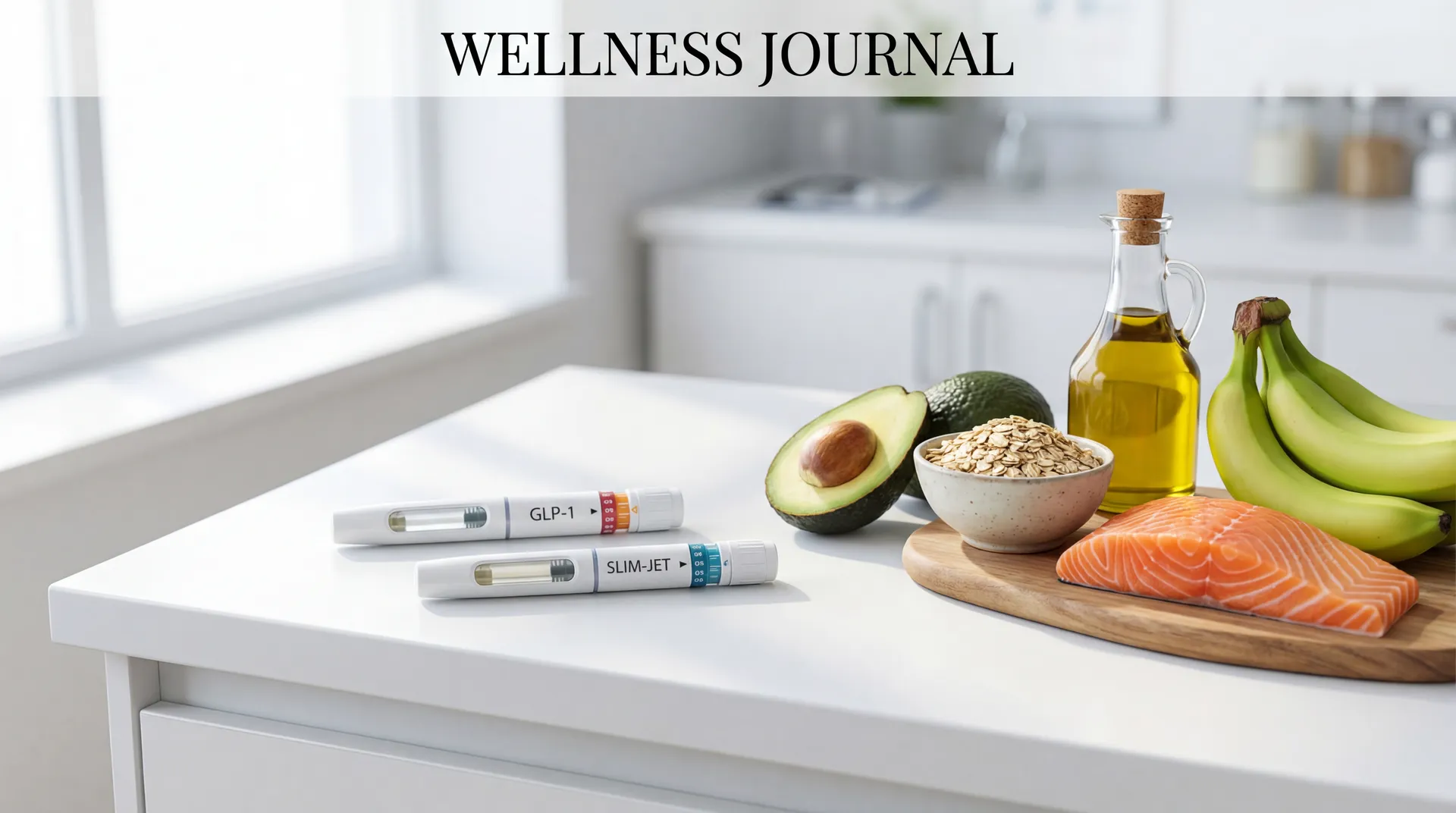
Your gut produces GLP-1 in specialized L-cells concentrated in the lower small intestine and colon. These cells act as nutritional sensors. When fermentable fibers from oats, barley, green bananas, and legumes reach the colon undigested, gut bacteria ferment them into short-chain fatty acids (SCFAs) like acetate, propionate, and butyrate. These SCFAs bind to receptors on L-cells and trigger GLP-1 release into the bloodstream (AL-Noshokaty et al., Toxicology Reports, 2024).
Healthy fats work through a different pathway. Olive oil, avocados, chia seeds, and omega-3-rich fatty fish activate G-protein-coupled receptors (GPR40 and GPR119) on L-cells. Unlike carbohydrates, which cause a rapid, short-lived GLP-1 spike, these fats prolong the hormone's release well after a meal ends.
| Compound category | Primary dietary sources | How it boosts GLP-1 |
|---|---|---|
| Fermentable and soluble fibers | Oats, barley, green bananas, lentils, Brussels sprouts | Gut bacteria ferment into SCFAs that bind FFAR2/FFAR3 receptors on L-cells |
| Healthy fats (MUFAs/PUFAs) | Extra virgin olive oil, avocados, chia seeds, walnuts, wild salmon | Activate GPR40 and GPR119 receptors to prolong hormonal secretion |
| High-quality protein | Whey, casein, soy protein, lean poultry, eggs | Specific amino acids directly stimulate L-cell receptors; synergizes with dietary calcium |
On the pharmaceutical side, researchers at Stanford and UC Berkeley published a landmark finding in Nature in March 2025. Using AI algorithms to scan databases of prohormones, they identified a 12-amino-acid peptide called BRP (BRINP2-related peptide) that rivals semaglutide for weight loss in animal models (Conger, Stanford Medicine, 2025). Unlike GLP-1 drugs, BRP bypasses the gut entirely and acts directly in the hypothalamus. In mice and pigs, it reduced food intake and body weight without triggering nausea, food aversion, or muscle loss. Combining dietary GLP-1 support with an approach like intermittent fasting may further amplify your body's natural satiety signals.
Common GLP-1 drug myths vs. clinical reality
Myth: Ozempic and Wegovy contain toxic reptile venom.
Reality: These drugs contain semaglutide, a 100% synthetic peptide manufactured in a laboratory. The molecular blueprint was inspired by a hormone found in Gila monster saliva in the 1980s. The finished product contains no animal material of any kind. This is standard biochemical biomimicry, the same approach that produced ACE inhibitors from pit viper venom research.
Myth: Cheap compounded semaglutide from telehealth sites is a regulated generic equivalent.
Reality: No FDA-approved generic versions of semaglutide or tirzepatide exist. Compounded versions are mixed in pharmacies using raw ingredients under a temporary shortage loophole. They bypass safety, efficacy, and bioequivalence testing, and carry documented risks of incorrect dosing, impurities, and temperature degradation.
Myth: GLP-1 drugs chemically damage female reproductive organs.
Reality: Symptoms like vaginal dryness and tissue sagging are mechanical consequences of rapid fat loss, not chemical damage to reproductive tissue. The drug targets receptors in the gut and brain. The pelvic changes result from losing the fat pads that provide structural support.
Myth: You can stop taking GLP-1 drugs once you reach your target weight and maintain results with diet alone.
Reality: The Obesity Medicine Association and American Diabetes Association classify obesity as a chronic, relapsing neurobehavioral disease. Clinical data consistently shows that stopping the medication brings back the neural appetite signaling in full force. Most patients experience substantial weight regain without continued treatment.
Frequently asked questions
Is switching from branded Wegovy to a cheaper compounded version safe?
Compounded GLP-1 drugs do not undergo the same federal testing for safety, purity, or dosing accuracy as branded medications. In February 2026, the FDA explicitly warned that many mass-marketed compounded versions contain unverified ingredients, incorrect dosages, or degraded peptides from improper temperature control during shipping. The risk is particularly high for injectable formulations that require strict cold-chain storage.
Can GLP-1 drugs permanently damage your sex drive?
Clinical evidence suggests GLP-1 drugs can suppress sexual desire by increasing serotonin activity at the 5-HT2C receptor, similar to how SSRI antidepressants work. Some case reports also describe temporary loss of genital sensation from pelvic vasoconstriction. These effects appear tied to the active presence of the drug, not permanent tissue changes. Many patients simultaneously report improved sexual confidence from weight-loss-related body image improvements, which can offset the biological suppression.
What foods naturally stimulate GLP-1 production?
No food replicates the intensity of a synthetic GLP-1 injection. However, fermentable soluble fibers (oats, barley, green bananas, legumes) are the strongest natural GLP-1 triggers. Your gut bacteria ferment them into short-chain fatty acids that directly activate GLP-1-producing L-cells. Pairing these with healthy fats like olive oil, avocados, and fatty fish prolongs the hormonal satiety response.
Why does rapid weight loss on GLP-1 drugs cause intimate pelvic changes?
The female pelvic region contains thick fat pads in the labia majora and mons pubis that provide shape and cushioning. Losing 15-20% of body weight in under a year depletes this fat faster than the skin can retract, causing sagging and increased friction. If protein intake is inadequate and muscle mass declines, the pelvic floor weakens further, potentially causing urinary leakage or a sense of heaviness.
What is euglycemic ketoacidosis, and who is at risk?
Euglycemic ketoacidosis (EKA) is a life-threatening condition where the blood becomes dangerously acidic from ketone buildup, yet blood sugar levels appear normal. Patients taking tirzepatide alongside SGLT2 inhibitors face the highest risk: severe appetite suppression combined with continuous urinary glucose excretion starves the body of carbohydrates, forcing the liver into emergency ketone production. The 2026 ADA guidelines now recommend routine at-home ketone monitoring for patients on these drug combinations.
Related articles
- Ozempic safety and semaglutide side effects - A focused look at semaglutide's clinical safety profile, common side effects, and what to watch for during treatment.
- Natural appetite suppressants - Evidence-based foods and strategies that help control hunger without prescription medication.
- Best weight loss supplements - A review of the most researched weight loss supplements, what works, and what the science actually supports.
- Fasting diet tips to lose weight - How intermittent fasting works, practical protocols, and the metabolic benefits behind timed eating.
- Understanding diabetes - The fundamentals of type 1 and type 2 diabetes, risk factors, and current management approaches.
Medical Disclaimer
This article is for informational and educational purposes only and is not medical advice, diagnosis, or treatment. Always consult a licensed physician or qualified healthcare professional regarding any medical concerns. Never ignore professional medical advice or delay seeking care because of something you read on this site. If you think you have a medical emergency, call 911 immediately.