Why eight hours of sitting hurts so much
Here's something that might surprise you: sitting itself probably didn't cause your back pain. A systematic review of sixteen longitudinal studies covering over 100,000 participants found that prolonged sedentary time, whether 3 to 6 hours or more than 8 hours daily, showed no statistically significant link to developing new low back pain. The odds ratios hovered around 0.92 to 0.95. In plain terms, sitting alone doesn't break a healthy back.
But that same analysis found something more troubling. For people already dealing with mild discomfort or prior spinal issues, sitting for three or more hours daily was significantly linked to worsening disability, with an odds ratio of 1.24. The chair didn't start the fire. It fans the flames.
The mechanism behind this is straightforward. When you hold the same position for hours, the soft tissues around your spine, including ligaments, tendons, and the thoracolumbar fascia, undergo a process called "creep." This is the slow, progressive stretching of tissues under sustained load. Meanwhile, the muscles along your spine lose blood flow. Without the pumping action that normal movement provides, they become ischemic, meaning blood-starved, and metabolic waste products like lactic acid build up. When you finally stand or shift position, those sensitized tissues flood your brain with pain signals. That stiffness and burning you feel after a long day? It's not from spinal damage. It's from starved, stiffened muscles that haven't moved in hours.
Your spinal discs are slowly dehydrating
Your intervertebral discs work as shock absorbers between vertebrae. They're mostly water, held inside a gel-like core called the nucleus pulposus and encased in a tough fibrous ring called the annulus fibrosus. These discs keep the spine flexible and resilient, but they have an unusual problem: they lack direct blood supply.
Without blood vessels, discs depend entirely on movement to get nutrients. The mechanism works like a sponge. When you move, the alternating compression and release squeezes out waste products and draws in fresh water and nutrients from the surrounding bone. When you sit motionless for hours, constant gravitational pressure forces water out with nothing to draw it back in. The discs lose height, become brittle, and grow vulnerable to micro-tearing and herniation over time.
Spinal discs have no blood supply. They rely on physical movement to absorb water and nutrients, exactly like squeezing and releasing a sponge. No movement means no feeding.
| Mechanism | Sedentary state | Active state | Consequence |
|---|---|---|---|
| Nutrient delivery | Severely restricted without pressure changes | Enhanced through mechanical pumping | Without movement, discs starve |
| Fluid dynamics | Constant pressure extrudes fluid; discs lose height | Alternating pressure draws fluid back in | Dehydrated discs become brittle |
| Waste removal | Metabolic byproducts accumulate | Waste squeezed out efficiently | Buildup causes local inflammation |
Advanced biomechanical studies show that lower water content reduces tissue permeability, cutting off the diffusion of smaller solutes and vital nutrients into the disc's inner regions. Over time, a dehydrated disc loses height and elasticity, becoming more susceptible to micro-tearing and herniation. Simple postural shifts or light walking every 30 to 60 minutes is the only reliable way to "feed" the spine and preserve disc integrity. If you have a desk job, this isn't optional. It's maintenance.
The five-minute walk that rivals medication
A 2023 crossover trial at Columbia University tested several "exercise snack" protocols on eleven participants during eight-hour sitting periods. They compared one-minute walks every 30 minutes, five-minute walks every 30 minutes, and longer intervals. The results were stark.
A five-minute light walk every 30 minutes reduced post-meal blood sugar spikes by 58% compared to uninterrupted sitting. The researchers noted this reduction was comparable to what certain diabetes medications achieve. The same protocol lowered systolic blood pressure by 4.3 to 5.2 mmHg, roughly equivalent to six months of daily cardiovascular exercise.
Even a one-minute walk every 30 minutes produced a 5.2 mmHg drop in blood pressure and modest glucose benefits. The takeaway is that a single evening workout cannot undo eight hours of complete stillness. Your metabolism and blood vessels need periodic movement signals throughout the day to function properly.
When stress at your desk becomes back pain
Psychological stress doesn't just make your mind tired. It shows up in your body, particularly as tension in the neck, shoulders, and lower back. When the brain is cognitively depleted, the autonomic nervous system tends to shift toward a low-grade "fight or flight" state, which unconsciously raises resting muscle tone and makes existing aches worse.
A meta-analysis of 22 studies covering 2,335 participants found that micro-breaks produced a statistically significant boost in vigor (effect size d = 0.36) and reduced subjective fatigue (d = 0.35). Breaks after clerical tasks or emotionally demanding work showed the strongest fatigue reduction. If you've ever wondered why breathing techniques and brief mental breaks reduce physical pain, this is the mechanism: a psychological reset lowers autonomic arousal, which relaxes the muscles along your spine.
The Columbia University study confirmed this connection. Participants taking five-minute movement breaks reported 25% less perceived fatigue, better mood, and fewer negative emotional states compared to the control group. Stepping away from the screen, even for a few minutes, lets the central nervous system reset, and relaxed nerves mean relaxed muscles.
Postural shifts you can do without standing up
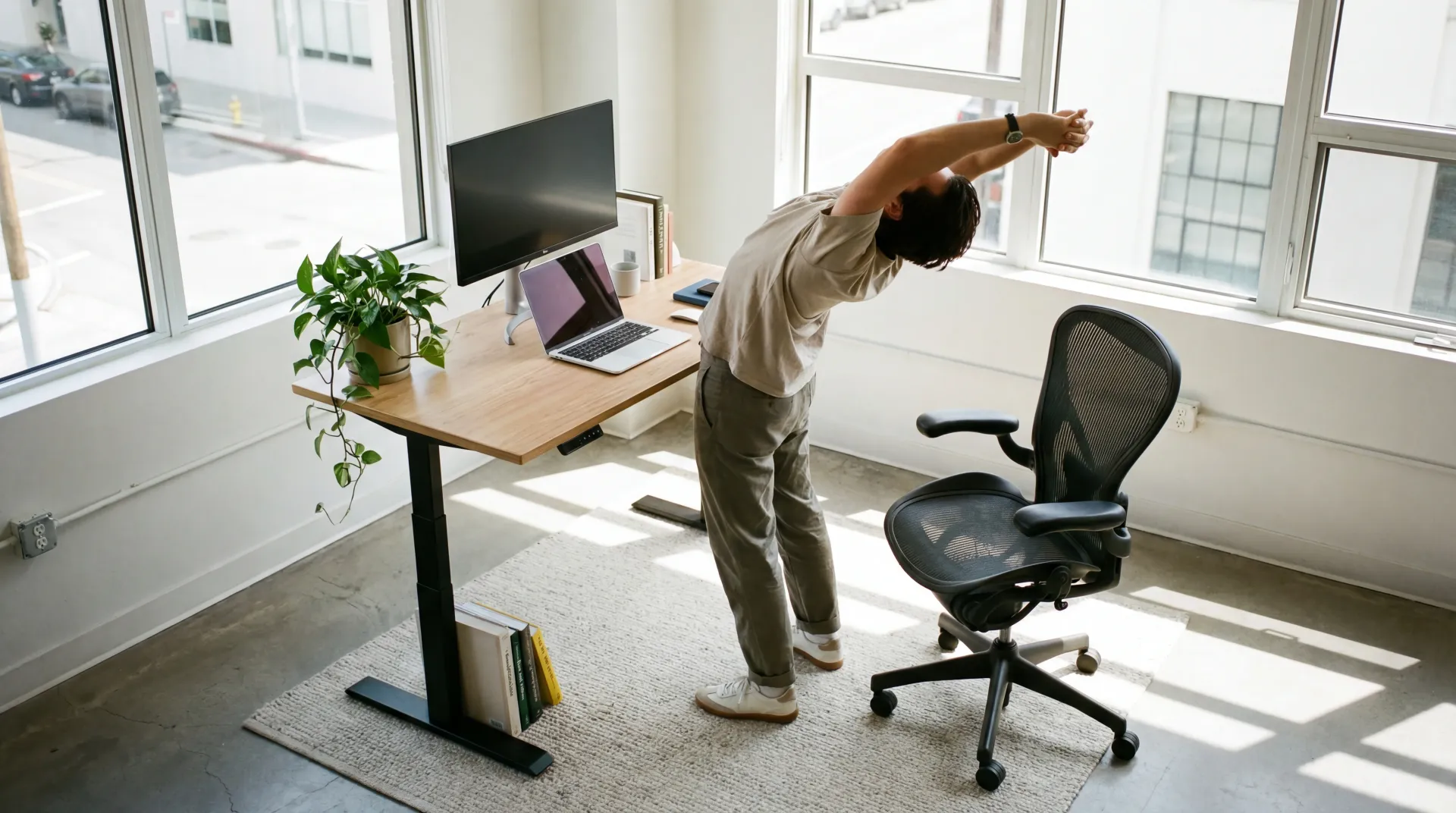
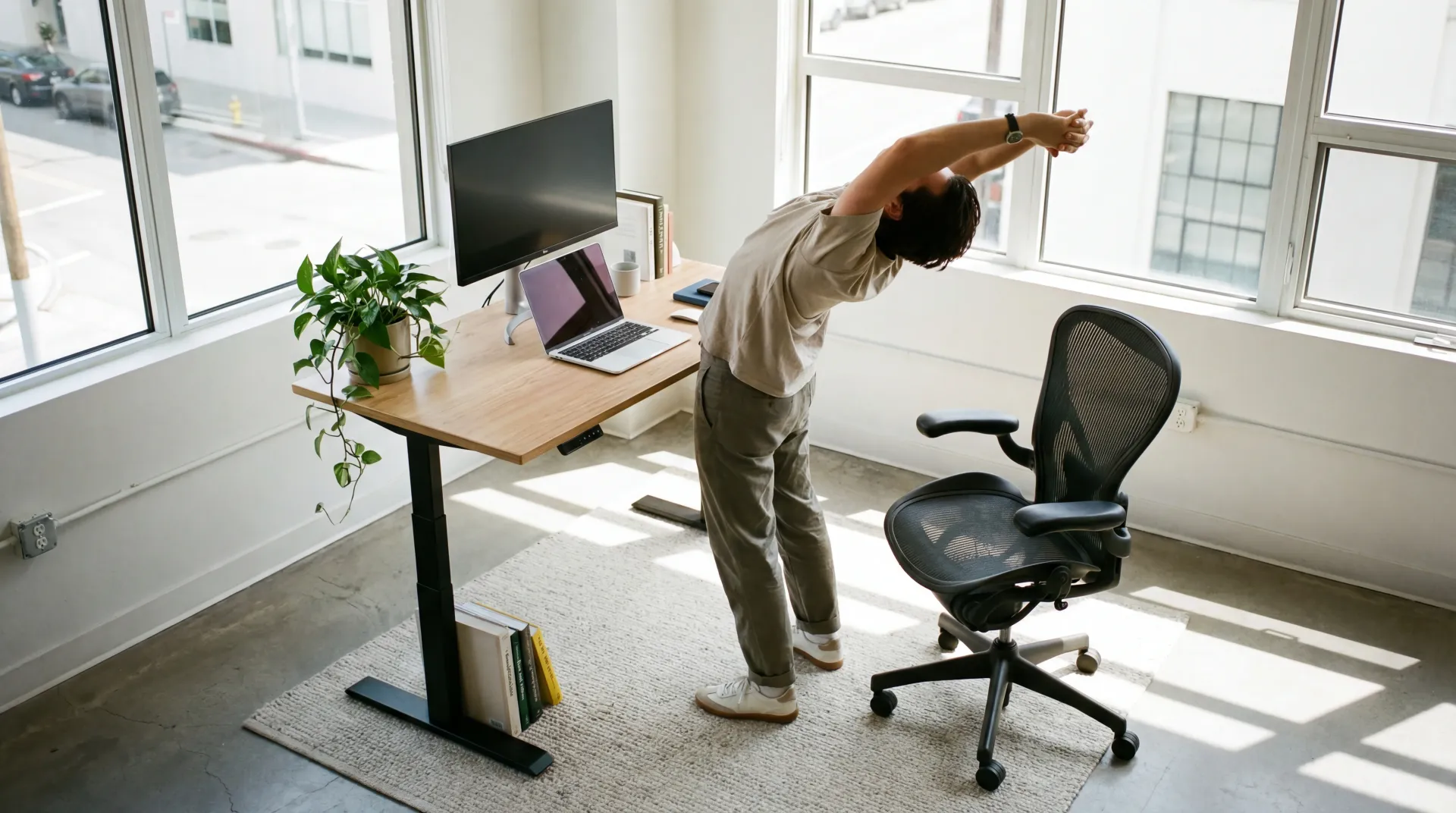
Walking breaks every 30 minutes are ideal, but workplace reality often makes that impossible. Meetings, deadlines, and rigid schedules can keep you pinned to your chair. Researchers have studied what happens when you move deliberately while seated, and the results are impressive.
A clinical trial with high-risk office workers in Thailand tested "postural shifts," defined as active body movements performed while seated that change the load on the sit bones across multiple planes. Over six months, workers who performed regular seated postural shifts had an 81% lower risk of developing new low back pain (adjusted hazard ratio 0.19). Those taking designated active breaks saw a 66% reduction (hazard ratio 0.34). In the control group, 33% developed new back pain during the same period.
A separate study found that performing lower back extensions and abdominal drawing-in movements, six repetitions within one minute, every twenty minutes during two hours of sitting, completely preserved lumbar flexibility. The control group showed significant loss of range of motion from tissue stiffening. Frequent, brief muscular activations counter the stiffening effects of prolonged sitting even when you can't leave your chair.
| Intervention | Blood sugar impact | Cognitive impact | Pain prevention |
|---|---|---|---|
| No breaks (8 hours) | Maximum glucose spikes | Highest fatigue and negative affect | Highest creep and ischemic pain risk |
| 1-min walk every 30 min | Modest glucose benefit | Slight fatigue reduction | Brief posture interruption |
| 5-min walk every 30 min | 58% reduced glucose spikes | 25% less fatigue; improved mood | Excellent disc rehydration |
| Seated postural shifts | Not measured | Minor cognitive reset | 81% lower new pain risk |
Three seated exercises that rebuild spinal health
When prevention alone isn't enough, targeted exercise becomes the gold standard for chronic back pain. A network meta-analysis of 118 randomized controlled trials involving nearly 10,000 participants found that Pilates and core stabilization exercises had a 93% likelihood of reducing pain and 98% likelihood of reducing disability. The effective dose was one to two sessions per week, under 60 minutes each, for three to nine weeks.
These three chair-based exercises target the areas most affected by desk work:
Seated cat-cow stretch
Place your hands on your knees. Alternate between arching your back while inhaling (cow) and rounding your spine while tucking your chin on the exhale (cat). This stimulates synovial fluid circulation in the vertebral joints and relieves the hip tightening that prolonged sitting causes. Do 5 to 10 breath cycles with slow, continuous motion.
Seated spinal twist
Sit tall with feet flat on the floor. Rotate your torso to one side, using the chair's backrest for gentle leverage. Hold for 20 to 30 seconds per side, deepening the twist slightly with each exhale. This stretches the rotational muscles of the spine (rotatores and multifidi) and restores mobility lost to static posture. For more options, check our guide to exercises for lower back pain relief.
Chin tucks
Pull your head straight back until your ears align directly over your shoulders, making a "double chin." Hold for 5 seconds and repeat 10 times. This strengthens the weak deep cervical flexors while stretching the overworked suboccipital muscles that drive "tech neck" pain. For every inch the head sits forward of the shoulders, the weight the neck must support roughly doubles.
| Exercise | Targets | How it works | Dose |
|---|---|---|---|
| Seated cat-cow | Erector spinae, hip flexors | Promotes synovial fluid and disc hydration | 5-10 breath cycles |
| Seated spinal twist | Obliques, rotatores, multifidus | Lengthens rotational muscles; decompresses joints | 20-30 sec per side |
| Chin tucks | Deep cervical flexors, suboccipitals | Corrects forward-head posture; breaks spasm cycles | 5 sec hold, 10 reps |
Why your ergonomic setup is a medical decision
Willpower-based interventions, like remembering to stretch or take walks, tend to fail in high-stress work environments. This is why the CDC and NIOSH treat ergonomics as applied science, not a furniture upgrade. The goal is to design the workspace around the worker's body rather than forcing the body to adapt.
A properly calibrated workstation follows specific geometric principles. Chair height should let your feet rest flat on the floor with thighs parallel to the ground, which reduces ischemic pressure on the posterior thighs. If armrests exist, they should allow shoulders to drop naturally. Armrests set too high cause chronic shrugging that leads to upper trapezius spasms. The keyboard and mouse should sit where wrists stay straight and forearms are parallel to the floor. Hard desk edges pressing against the wrists compress the median and ulnar nerves, eventually causing neuropathy.
NIOSH also emphasizes that ergonomic programs need to be ongoing and collaborative between management, workers, and healthcare providers. Employers should proactively identify risk factors, provide training so workers actually understand the mechanics of muscle fatigue and why problems develop, and foster a culture that encourages early symptom reporting. When injuries do occur, structured return-to-work programs with modified duties are a medical necessity, not a nice-to-have. Prolonged absences from work after a back injury exponentially reduce the likelihood of successful return. A minor diagnosis can cascade into permanent disability without proper reintegration. If your workplace treats fitness and pain management as an afterthought, the evidence says that's a medical problem, not a morale issue.
"Perfect posture" is a myth
The idea that there's one correct way to sit has been repeated for over a century, from 1920s Red Cross posture classes to modern wellness media warning that slouching will "wear away your spine." Contemporary research from Cambridge University Hospitals and others have dismantled these claims.
Myth: There's a single "perfect" sitting posture everyone should maintain.
The so-called "ideal alignment" was designed around unrealistic conditions like maintaining static standing without muscular support. It doesn't account for natural variations in body type, bone structure, or anatomy. There's no clear causal evidence that deviating from this standard causes pain. The real problem is time spent immobilized in any single posture. Your best posture is always your next posture.
Myth: You should constantly brace your core to protect your spine.
Long-term clinical studies found no association between trunk muscle size or strength and low back pain prevalence. Deliberately bracing the core restricts natural spinal movement and increases compressive forces by up to 45%. People with chronic back pain often unknowingly hold their core in constant tension, which makes things worse. Very little trunk contraction is actually needed to stabilize the spine during seated work. If yoga and similar movement practices help back pain, it's partly because they teach muscles to relax, not just contract.
Myth: "Correct" lifting technique is the best injury prevention.
Rigid lifting rules often override the body's natural motor patterns and can cause strain themselves. A comprehensive review of occupational health data found that attempting to move in a highly mechanized, unnatural way frequently leads to muscle strain. Relaxed trunk muscles, natural breathing, asking for help with heavy loads, and regular general physical activity protect against injury far more reliably than memorizing biomechanical instructions.
Frequently Asked Questions
Does "bad posture" directly cause back pain?
No. Research shows no clear causal link between relaxed or slouched posture and back pain in otherwise healthy people. The primary issue is how long you stay immobile in any position. Staying rigid in "perfect" upright posture for eight hours actually causes more ischemic pain and stiffness than regularly shifting between positions.
Will an expensive ergonomic chair cure my back pain?
A good chair optimizes joint angles and reduces nerve compression, but it cannot replace the need for movement. Spinal discs depend on physical motion to absorb water and nutrients. Even the best chair leads to disc dehydration and tissue stiffness without regular micro-breaks or seated postural shifts. It's a tool, not a solution.
How often should I take breaks from my desk?
Current evidence supports a five-minute light walk every 30 minutes for the best cardiovascular, metabolic, and musculoskeletal outcomes. If that's not feasible, seated postural shifts or dynamic stretches every 20 to 30 minutes still significantly reduce pain risk and combat cognitive fatigue.
Is Pilates the only effective exercise for desk-related back pain?
It has the highest statistical likelihood of reducing chronic back pain (93% in a network meta-analysis of 118 trials), but it's not the only option. Core stabilization, mind-body routines, and general strength training at one to two sessions per week are all effective. If Pilates isn't for you, any regular physical activity that you'll actually do consistently provides protective benefits.
Related Articles
- Exercises for Lower Back Pain Relief - Targeted movements and stretches to reduce chronic lower back discomfort.
- Putting Pilates in the Spotlight - How Pilates builds core stability and spinal flexibility for long-term pain prevention.
- 10 Health Benefits of Yoga - Why yoga improves flexibility, reduces stress, and supports spinal health.
- Top Breathing Techniques to Relieve Stress - Evidence-based breathing methods that lower muscle tension and autonomic arousal.
- Fitness, Pain Management, and Wellness Guide - A comprehensive look at exercise-based approaches to managing chronic pain.
Medical Disclaimer
This article is for informational and educational purposes only and is not medical advice, diagnosis, or treatment. Always consult a licensed physician or qualified healthcare professional regarding any medical concerns. Never ignore professional medical advice or delay seeking care because of something you read on this site. If you think you have a medical emergency, call 911 immediately.