617 billion euros: the annual price tag of workplace stress in Europe
That number comes from a comprehensive EU-OSHA report on psychosocial risks across the EU-28 member states. It accounts for absenteeism, presenteeism, lost productivity, healthcare costs, and social welfare disbursements. To put it bluntly, ignoring mental health at work costs more than most countries spend on defense.
The breakdown looks like this:
| Type of loss | Estimated annual cost (EU-28) | What it means |
|---|---|---|
| Absenteeism and presenteeism | 272 billion euros | Sick leave plus employees working while mentally unwell, producing subpar output |
| Lost productivity | 242 billion euros | Reduced innovation, operational friction, high turnover |
| Healthcare costs | 63 billion euros | Psychiatric treatment, medication, therapy sessions |
| Social welfare and disability | 39 billion euros | Disability pensions and long-term incapacity benefits |
These are European figures, but the pattern holds globally. The American Psychological Association reports that work stress causes roughly $500 billion in annual losses to the U.S. economy through similar channels. Small and medium-sized businesses absorb a disproportionate hit because they lack the buffer that larger corporations have when key employees burn out or quit. Academic research on SME workplace risks found that workers at smaller firms face worse psychosocial conditions than their counterparts at multinationals, often because there is no dedicated HR department designing mental health protocols.
This is where workplace mental health workbooks enter the picture. They are structured tools that give both employers and employees a systematic way to identify stressors, track mental health patterns, and build sustainable coping habits, without requiring a full-time psychologist on staff.
What a workplace mental health workbook actually is
A workplace mental health workbook is a guided document, either printed or digital, that walks individuals or teams through structured exercises for recognizing, measuring, and managing psychological stress tied to their jobs. Think of it as a combination of a self-assessment tool, a journaling framework, and a practical action plan.
The Workplace Mental Health Promotion Handbook, funded by the EU Health Programme, outlines four areas that any effective workbook should address:
| Intervention area | What it covers | Workbook exercises |
|---|---|---|
| Leadership impact | How management behavior affects team mental health, conflict resolution, prevention of bullying | Self-assessment prompts for managers, leadership style inventory |
| Communication | Establishing transparent channels, reducing stigma, mental health awareness messaging | Team check-in templates, stigma-busting discussion guides |
| Understanding stress | Identifying industry-specific stress dynamics, measuring workforce psychological needs | Stress mapping worksheets, diagnostic survey templates |
| Dealing with work-related stress | Stress risk analysis, workload adjustment, work-life balance promotion | Weekly stress logs, boundary-setting checklists, recovery planning |
Good workbooks are not one-size-fits-all motivational fluff. They require honest self-reflection. Managers using them should be asking questions like: "Are the demands I place on my team balanced by the support I provide?" and "Can I maintain professional empathy without overstepping ethical boundaries?" If the exercises feel comfortable, the workbook probably is not doing its job.
Quick fact: The World Health Organization dedicated its World Mental Health Day campaign specifically to "Mental Health at Work," emphasizing that psychologically healthy workplaces are directly linked to better collaboration, higher retention rates, and stronger organizational performance.
Burnout is a clinical condition, not a personality flaw
People throw around "burnout" like it means "tired after a hard week." Clinically, burnout is a state of profound physical, emotional, and mental exhaustion caused by chronic, unmanaged workplace stress. The World Health Organization included it in the International Classification of Diseases (ICD-11) as an occupational phenomenon. It is not the same as regular fatigue, and it does not go away after a vacation.
What drives burnout is a specific mismatch: when the effort and time you invest in your job consistently fail to produce proportional rewards, whether those rewards are financial, psychological, or social. That cognitive dissonance erodes your sense of self-worth and motivation over time. Physiologically, prolonged exposure to hostile or excessively demanding work environments keeps cortisol elevated, which increases the risk of cardiovascular disease, immune suppression, and psychiatric disorders.
A workplace mental health workbook addresses burnout at the identification stage, before it becomes a medical crisis. Typical workbook exercises for burnout include:
- Weekly effort-reward balance assessments (rating demands against support and recognition)
- Physical symptom checklists (chronic headaches, insomnia, appetite changes, muscle tension)
- Emotional depletion scales (rating cynicism, detachment, and irritability week to week)
- Recovery activity logs (tracking whether you actually take breaks, use vacation days, disconnect after hours)
The value of writing these things down rather than just "thinking about it" is measurable. Structured self-monitoring forces pattern recognition that casual introspection misses. You might not notice that your insomnia spikes every week your manager schedules Friday deadline reviews, but a four-week log makes that pattern obvious.
Most workplace wellness programs fail because they skip two steps
Organizations love announcing wellness initiatives. They host a stress management seminar, hand out a pamphlet about meditation techniques, and check the box. Then nothing changes, and leadership assumes the program "didn't work."
The problem is structural. The Plan-Do-Check-Act (PDCA) framework used in occupational health psychology explains why. Most organizations complete "Plan" and "Do" reasonably well. They draft a mental health policy, maybe launch a wellness app. But they completely skip "Check" (measuring whether the intervention actually changed anything) and "Act" (adjusting the program based on measured results).
Without measurement, employers have no idea whether their psychological safety interventions are working. A mental health workbook built on PDCA principles includes:
- Plan phase: Baseline stress surveys, identification of top psychosocial risks, goal-setting worksheets
- Do phase: Implementation tracking sheets, participation logs, resource utilization records
- Check phase: Monthly reassessment surveys, before-and-after comparison charts, absenteeism tracking
- Act phase: Program modification worksheets, lessons-learned templates, escalation protocols
Research on Romanian medical residents found that specific, practical training programs designed to build coping mechanisms and cognitive resilience significantly reduced stress levels, but only when subjected to the full PDCA cycle with continuous evaluation. The interventions that got measured got improved. The ones that did not got forgotten.
Small actions, measurable results: micro-interventions for daily stress
One of the most practical sections in any workplace mental health workbook covers micro-interventions. These are brief, repeatable actions that restore cognitive function and reduce cumulative stress throughout the workday. The Mental Health for Romania initiative compiled evidence showing that several of these interventions produce measurable results when practiced consistently.
Micro-breaks taken every one to two hours for deep breathing, physical movement, or complete screen disconnection significantly restore concentration and reduce cognitive fatigue. Skipping a dedicated lunch break of 30 to 60 minutes correlates with accelerated burnout trajectories and lower performance metrics. Muting work notifications outside business hours is a critical defense against the boundary erosion that remote and hybrid work create.
A good workbook turns these into trackable habits:
| Micro-intervention | Time required | What to track in your workbook |
|---|---|---|
| Breathing breaks every 90 minutes | 2-3 minutes | Number of breaks taken, stress level before and after (1-10 scale) |
| Protected lunch break | 30-60 minutes | Whether you ate away from your desk, did you check email during lunch |
| Post-work notification muting | 0 minutes (set once) | Did you check work messages after cutoff time, anxiety level if you did |
| Workspace ergonomics check | 5 minutes weekly | Chair height, monitor distance, lighting adequacy, clutter level |
| End-of-day decompression | 10-15 minutes | Activity used (walk, breathing exercises, journaling), effectiveness rating |
Some digital tools can support these habits. Forest, an app that gamifies phone-free focus time, operationalizes the Pomodoro technique by having users virtually plant trees during focused work intervals. Workflow management tools like Trello reduce the cognitive load from administrative disorganization, a known trigger for workplace anxiety. Mindfulness apps like Headspace and Calm provide guided meditations tailored for office breaks. None of these replace a structured workbook, but they complement it.
Environmental psychology also matters. A personalized, ergonomically sound workspace reduces both physical strain and psychological discomfort. If your workbook includes a weekly workspace audit, you create accountability for an environment that supports rather than sabotages your mental health.
Employee assistance programs: what works, what doesn't
Companies that take workplace mental health seriously eventually consider an Employee Assistance Program (EAP). These range from basic legal compliance to comprehensive digital platforms. Understanding the differences helps you assess whether your employer's program is adequate, or whether you need to supplement it with your own workbook-based approach.
| Service model | Primary focus | How it works | Limitations |
|---|---|---|---|
| Traditional occupational medicine | Legal compliance, basic aptitude testing, hazard prevention | Periodic clinic visits, standardized psychological testing | Purely reactive; assesses fitness for a role but does not build resilience |
| Premium corporate health subscriptions | Talent retention, rapid specialist access, preventive care | Hospital networks, dedicated HR portals, mobile screening | Expensive; usually available only at large corporations |
| Digital-first EAPs | Daily mental health maintenance, anonymous access, predictive analytics | Mobile apps, teletherapy, gamified wellness challenges | Engagement drops without organizational culture change |
The digital-first EAP model has grown rapidly. Platforms like Meditopia for Work offer libraries of over 1,000 mindfulness exercises plus same-day one-on-one therapy booking. They also provide anonymized usage analytics to HR departments, letting leadership identify departmental wellbeing problems before they turn into mass turnover events.
Holistic platforms combine mental health counseling with physical fitness programs, physiotherapy access, and chronic condition coaching. This approach acknowledges the bidirectional relationship between physical and mental health. Severe musculoskeletal pain from poor ergonomics does not just hurt your back; it degrades your mood, your sleep, and your cognitive performance.
Year-round wellness calendars with consistent low-intensity psychological interventions often produce better engagement and long-term outcomes than purely reactive acute care. This is the same principle behind workbooks: consistent, small-dose engagement beats sporadic crisis response.
Worth noting: If your employer offers an EAP, use it. But do not rely on it as your sole mental health strategy. A personal workbook fills gaps that organizational programs cannot, particularly around self-awareness, boundary management, and pattern recognition specific to your individual triggers.
How to build a workplace mental health workbook from scratch
You do not need to buy a commercial product. A blank notebook or a simple digital document works fine if you structure it properly. Here is a framework based on the evidence-based approaches discussed above.
Section 1: Baseline assessment. Before you can track improvement, you need to know where you stand. Rate yourself on a 1-10 scale across these dimensions: overall stress level, sleep quality, energy at work, motivation, social connection at work, and physical comfort at your workspace. Date it. This is your reference point.
Section 2: Stressor inventory. List every recurring source of workplace stress you can identify. Be specific. Not "my job is stressful" but "weekly status meetings run 90 minutes, I have no chance to speak, and my manager publicly criticizes incomplete tasks." Specificity makes stressors addressable.
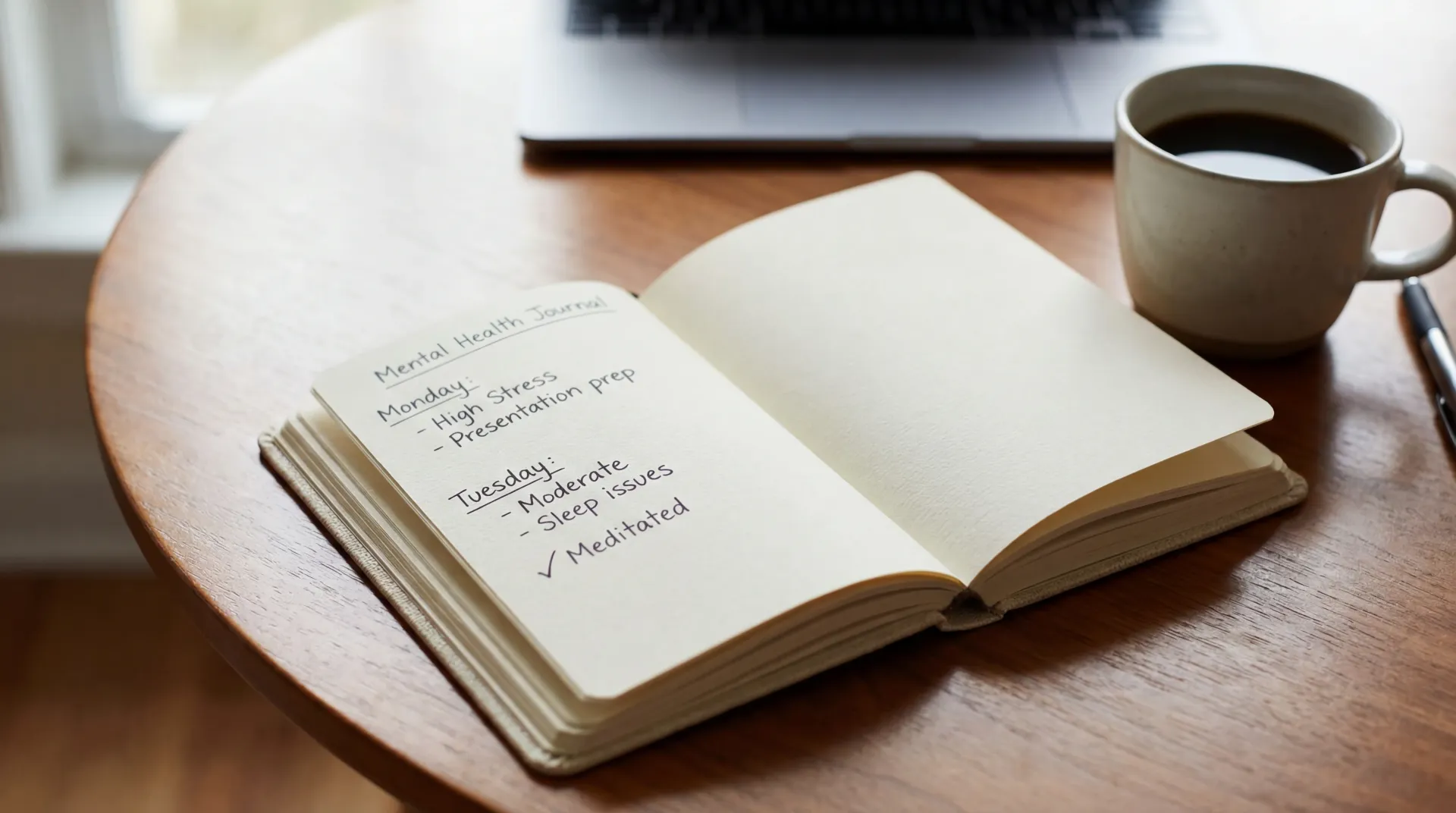
Section 3: Weekly logs. Each week, spend 10 minutes recording: your peak stress moment, what triggered it, how you responded, what you wish you had done differently, and one thing that went well. This is the "Check" phase of PDCA applied to your personal mental health.
Section 4: Micro-intervention tracker. Use a simple grid. Rows are days of the week, columns are your chosen micro-interventions (breathing breaks, protected lunch, notification muting). Check them off. After four weeks, look for patterns. Did the weeks with more check marks also have lower stress ratings?
Section 5: Boundary audit. Monthly, review: How many times did you work past your scheduled hours? How often did you check work messages during personal time? Did you use your vacation days? Managing mental health daily requires defending these boundaries deliberately.
Section 6: Communication and support map. Identify who you can talk to when stress escalates. This might include a trusted colleague, a manager, an EAP counselor, a personal therapist, or a partner. Write down their names and how to reach them. In a crisis, you do not want to be figuring out logistics.
The boss problem: why management style determines mental health outcomes
You can hand every employee a beautifully designed workbook and it will collect dust if leadership creates the conditions that cause burnout. Research on leadership styles and employee outcomes consistently finds that authoritarian, neglectful, or inconsistent management directly correlates with reduced workforce wellbeing, lower motivation, and higher turnover.
The European Workplace Mental Health Promotion Handbook dedicates an entire section to leadership impact because managerial behavior is the single strongest predictor of team mental health. A manager who resolves conflicts transparently, prevents bullying, and maintains consistent expectations creates an environment where workbooks and wellness programs can actually function. A manager who publicly shames employees for missing targets, changes priorities without explanation, or plays favorites creates an environment where no wellness initiative survives.
Workbooks designed for managers include different exercises than those for individual contributors:
- Monthly self-assessment of communication patterns (frequency, tone, channels used)
- Anonymous team feedback collection and analysis worksheets
- Conflict resolution documentation templates
- Workload distribution audits comparing actual hours across team members
- Personal empathy boundaries check (are you absorbing team stress without processing it?)
Academic research from Valahia University examined "mental sustainability," defined as the balance between an individual's required social adaptability and their psychological authenticity. When employees must constantly suppress who they are to fit organizational expectations, mental health degrades regardless of what wellness programs exist. Leaders who create space for authenticity, even small gestures like allowing personal workspace customization or respecting different communication styles, protect their teams more effectively than any formal program.
The credential verification issue matters here too. As mental health support expands in workplaces, organizations must verify that practitioners hold legitimate credentials. A widely reported case in Romania revealed that an individual practiced as a hospital psychologist for nearly 20 years using forged credentials, verbally abusing psychiatric patients and accusing them of faking illnesses. HR departments should verify every mental health professional through official registries before giving them access to employees.
Frequently Asked Questions
What should a workplace mental health workbook include at minimum?
A baseline stress assessment, a stressor inventory listing specific triggers, weekly tracking logs for stress levels and coping activities, a micro-intervention tracker for daily habits like breathing breaks and protected lunch periods, and a monthly boundary audit reviewing overtime hours and after-hours work communication. These five sections cover self-awareness, pattern recognition, and actionable habit building.
Can a workbook replace professional therapy for workplace stress?
No. Workbooks help with prevention, self-monitoring, and mild to moderate stress management. If you experience persistent insomnia, chronic fatigue, inability to concentrate, or thoughts of self-harm, you need professional clinical support. A workbook can help you recognize when you have crossed that threshold, which is itself valuable, but it cannot provide the clinical intervention that a licensed therapist offers.
How long does it take to see results from using a mental health workbook?
Most people notice improved self-awareness within two to three weeks of consistent daily tracking. Measurable changes in stress levels, sleep quality, and workplace satisfaction typically appear after six to eight weeks of structured use. The key variable is consistency. Filling out a workbook once a week during a crisis produces far less benefit than spending five to ten minutes daily during both good and bad periods.
Are digital workbooks better than paper ones?
Each has trade-offs. Digital workbooks offer automated reminders, data visualization, and easy sharing with a therapist or coach. Paper workbooks reduce screen time (itself a stress factor), feel more personal for many people, and eliminate the distraction of notifications. Some people use both: paper for daily entries and a monthly digital summary for pattern analysis. Use whichever format you will actually stick with.
Should employers mandate mental health workbooks for all employees?
Mandating workbooks tends to backfire because it transforms a personal reflection tool into a compliance exercise. Better approaches include making workbooks freely available, training managers to model their use, offering voluntary workshops on how to use them, and integrating workbook exercises into existing team rituals like weekly check-ins. The stigma around mental health means forced participation often increases resistance rather than engagement.
Related Articles
- Managing mental health daily: an evidence-based guide - Practical daily strategies for maintaining psychological wellness based on current clinical research.
- Mental health, memes, stigma, and coping - How online culture shapes our conversations about mental health and what that means for reducing stigma.
- Top breathing techniques to relieve stress - Evidence-backed breathing methods you can use during work breaks to lower cortisol and restore focus.
- Dealing with depression in 5 simple steps - Accessible first steps for recognizing and addressing depressive symptoms before they escalate.
- Chronic fatigue syndrome: causes, symptoms, and treatment - Understanding how persistent exhaustion differs from normal tiredness and when to seek medical help.
Medical Disclaimer
This article is for informational and educational purposes only and is not medical advice, diagnosis, or treatment. Always consult a licensed physician or qualified healthcare professional regarding any medical concerns. Never ignore professional medical advice or delay seeking care because of something you read on this site. If you think you have a medical emergency, call 911 immediately.