Electrons from below: what grounding actually means
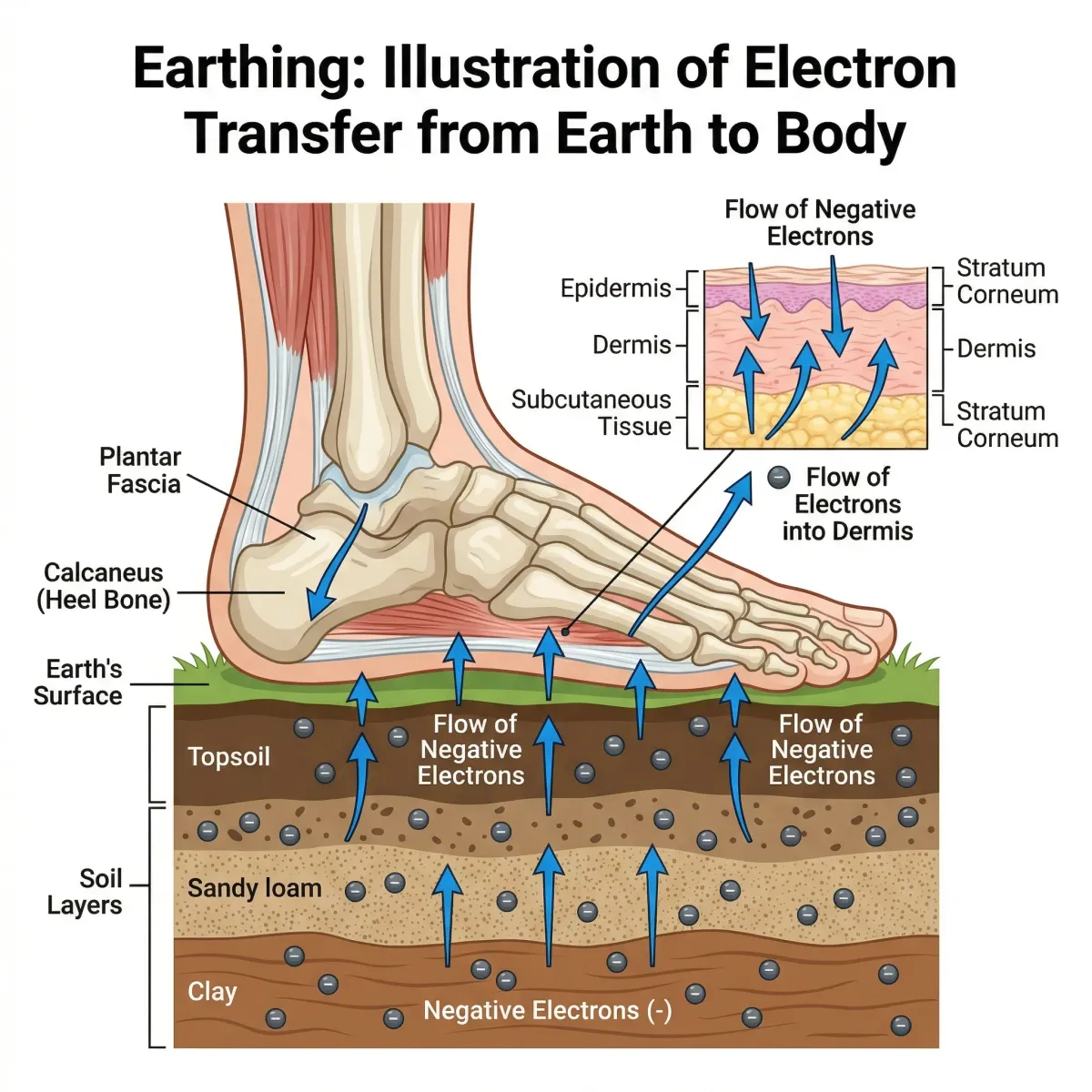
The Earth's surface carries a negative electrical charge, maintained by roughly 1,000 to 2,000 thunderstorms active around the planet at any moment. Thousands of lightning strikes per minute push positive charge into the upper atmosphere and deposit negative charge onto the ground. This makes the soil beneath your feet an enormous reservoir of free electrons.
Grounding (also called earthing) is the practice of placing your bare skin in direct contact with this surface. Walk barefoot on grass, press your palms into soil, wade through a stream. The physics is straightforward: when two conductive objects at different electrical potentials touch, charge transfers almost instantly until they equalize. The human body conducts electricity. So does moist earth. Touch one to the other and electrons flow.
Proponents of grounding take this a step further. They argue that modern life has severed a biologically important electrical connection. Rubber-soled shoes, elevated buildings, and synthetic flooring mean most people never make direct skin-to-earth contact during a normal day. According to a 2015 review in the Journal of Inflammation Research, this disconnection may contribute to chronic inflammation by depriving the body of electrons that could neutralize reactive oxygen species (ROS).
The hypothesis: when tissue is injured, immune cells deploy an "oxidative burst" of free radicals to break down damaged cells and pathogens. Those free radicals can spill over and harm healthy neighboring tissue. Earth-derived electrons, the argument goes, could act as mobile antioxidants, neutralizing excess free radicals before they spread.
A small group of researchers has been testing this for about twenty years. Their findings are genuinely interesting. They are also more complicated than the grounding product industry wants you to know.
The inflammation, blood, and cortisol studies
The grounding research literature contains about 20 to 25 published studies spanning from 2004 to the present. Three lines of evidence get cited most often.
Blood viscosity and red blood cell behavior
In a 2013 study published in the Journal of Alternative and Complementary Medicine, researchers measured what happens to red blood cells after two hours of grounding. Ten subjects sat in a darkened room with conductive patches on their hands and feet, connected by wire to a steel rod driven into the soil outside. Before and after the session, fingertip blood samples were examined under a darkfield microscope.
The numbers looked impressive. Zeta potential, the electrical surface charge that keeps red blood cells from clumping together, increased by an average factor of 2.70. Every single subject improved. Red blood cell aggregation dropped significantly. The authors concluded that grounding could reduce cardiovascular risk by lowering blood viscosity.
To put the zeta potential numbers in context: before grounding, the average was -5.28 mV, well below the normal range of -9.3 to -15.0 mV. After two hours, it reached -14.3 mV, within the normal range. The subject who improved the least (a 1.27x increase) was described as the healthiest participant, eating only raw food and exercising daily. The one who improved the most (5.63x) was taking weekly ibuprofen.
Cortisol rhythms and sleep
The cortisol study that started much of this research was published in 2004 by Ghaly and Teplitz. Twelve people with sleep problems and pain slept on grounded mattress pads for eight weeks. Saliva samples tracked their 24-hour cortisol profiles before and six weeks into the experiment.
Night-time cortisol levels dropped significantly. The overall daily rhythm moved toward a more normal pattern, with higher morning peaks and lower evening troughs. Participants reported sleeping better and feeling less pain. If you are interested in how cortisol rhythms affect health, our guide on phosphatidylserine and cortisol management covers the broader science of cortisol regulation.
Delayed-onset muscle soreness
Two studies used DOMS (the soreness you feel a day or two after unfamiliar exercise) as a controlled inflammation model. The larger and more rigorous of the two, published in 2015, randomized 32 young men into grounded and sham-grounded groups. After performing 200 half-knee bends, participants were grounded (or sham-grounded) for four hours on two consecutive days.
The key finding: creatine kinase (CK), a marker of muscle damage, rose significantly in the sham group the day after exercise (P<0.01) but did not rise significantly in the grounded group (P=0.14). The between-group difference was statistically significant (P=0.04). The grounded group also showed a different pattern of neutrophil response, with a significant between-group difference emerging on day three.
Numbers like these fuel the enthusiasm around grounding. But context matters, and the context here is worth examining carefully.
Sleep, pain, and recovery: what participants reported
Lab markers are one thing. What people actually feel is another. Across grounding studies, participants report sleeping better, feeling less pain, and being less stressed. In the 2004 cortisol study, nearly all twelve subjects said their sleep improved. Several said their pain went away entirely.
A 2019 randomized controlled trial in Explore journal looked at grounding in massage therapists who experience chronic occupational pain. Over four weeks, therapists who slept on grounded sheets reported improvements in both pain and overall quality of life compared to the sham group. Sleep quality is a recurring theme in the grounding literature. For more on how sleep patterns influence health outcomes, see our coverage of sleep timing and heart health.

A 2022 pilot study in Healthcare even examined grounding in patients with mild Alzheimer's disease. The grounded group showed improvements in sleep quality compared to the control group. This is preliminary work, but it suggests the sleep effects might extend to neurological populations.
What the studies consistently show: Grounding appears to reduce cortisol at night, improve subjective sleep quality, decrease markers of muscle damage after exercise, and increase the surface charge on red blood cells. These effects have appeared across multiple small studies using grounding mats, patches, and sheets.
Something is happening in these studies. The question is whether that something is what grounding proponents think it is.
The conflict of interest problem nobody talks about
Flip to the disclosure section of any grounding paper and a pattern shows up immediately. The 2015 review in the Journal of Inflammation Research states: "G Chevalier and JL Oschman are independent contractors for EarthFx Inc., the company sponsoring earthing research, and own a small percentage of shares in the company." The 2013 blood viscosity study carries a similar disclosure.
EarthFx Inc. sells grounding products. The researchers studying grounding are paid by and own equity in the company that profits from positive results. This does not automatically invalidate their findings, but it creates a structural problem that the field has not yet overcome.
The issue goes deeper than funding. The same four or five researchers, primarily Gaetan Chevalier, James Oschman, Stephen Sinatra, and Clint Ober, appear across nearly every published study. Independent replication by researchers with no financial ties to grounding product companies barely exists. The February 2023 special issue of Biomedical Journal devoted to grounding features articles almost exclusively by this same group.
| Study limitation | Why it matters | How common in grounding research |
|---|---|---|
| Small sample sizes | Results may not generalize to broader populations | Nearly universal (8 to 32 subjects) |
| Industry funding | Financial incentives may bias study design, analysis, or reporting | Most studies funded by EarthFx Inc. |
| Same research group | No independent replication of key findings | 4-5 authors appear across nearly all studies |
| Blinding challenges | Participants may sense electrical connection | Sham controls used but not always validated |
| Publication in CAM journals | Less rigorous peer review than mainstream medical journals | Most published in alternative medicine journals |
Medicine has a long history of treatments that looked promising in small, enthusiast-run studies and then fell apart under independent scrutiny. Grounding might be different. But right now, we do not have the evidence to know.
Chronic inflammation is a well-established driver of disease, and we cover the science comprehensively in our guide to inflammation and chronic disease. What grounding researchers are proposing, that direct contact with the Earth modifies inflammatory markers, is an interesting hypothesis. It has not yet been tested with the rigor it needs.
How grounding stacks up against established practices
The most popular grounding book carries the subtitle "The Most Important Health Discovery Ever." That is an extraordinary claim. Extraordinary claims need extraordinary evidence, and comparing grounding's evidence base against well-established health practices puts things in perspective.
| Practice | Evidence level | Sample sizes | Independent replication | Effect on inflammation |
|---|---|---|---|---|
| Regular moderate exercise | Hundreds of RCTs, meta-analyses | Thousands of participants | Extensively replicated worldwide | Reduces CRP, IL-6, TNF-alpha |
| Mediterranean diet | Large RCTs (PREDIMED), cohort studies | 7,447 in PREDIMED alone | Replicated across populations | Reduces CRP, improves lipid markers |
| Adequate sleep (7-9 hours) | Extensive epidemiological + RCT data | Tens of thousands | Global replication | Sleep deprivation increases CRP, IL-6 |
| Grounding/earthing | ~20 small pilot studies, reviews | 8 to 32 per study | Minimal independent replication | Reduced WBC count, cortisol, CK in small samples |
| Claim | What the evidence actually shows | Verdict |
|---|---|---|
| Grounding reduces inflammation | Small studies show changes in some inflammatory markers (WBC, neutrophils, CK) in grounded vs. ungrounded subjects | Plausible but not proven at scale |
| Grounding improves sleep | Subjective reports of better sleep; cortisol patterns shifted in one 12-person study | Consistent reports, weak objective evidence |
| Grounding reduces blood viscosity | One 10-person study showed significant zeta potential increase | Interesting pilot data, needs replication |
| Grounding cures chronic disease | No clinical trials on disease outcomes | No evidence supports this claim |
| Grounding is the "most important health discovery ever" | The evidence base is far too small to justify this | Marketing, not science |
This does not mean grounding is worthless. Walking barefoot in a park combines exercise, sunlight, nature contact, and potentially grounding. Every one of those has its own evidence base. The hard question is figuring out which ingredient is doing the work. When someone feels better after 40 minutes of barefoot time in the grass, was it the electron transfer? The fresh air? The break from screens? Probably some combination. The grounding literature cannot yet tease these apart.

If you want to try it: a practical guide
The risk profile here is about as low as it gets in wellness practices. You are walking barefoot or sleeping on a conductive sheet. A few practical cautions are worth knowing.
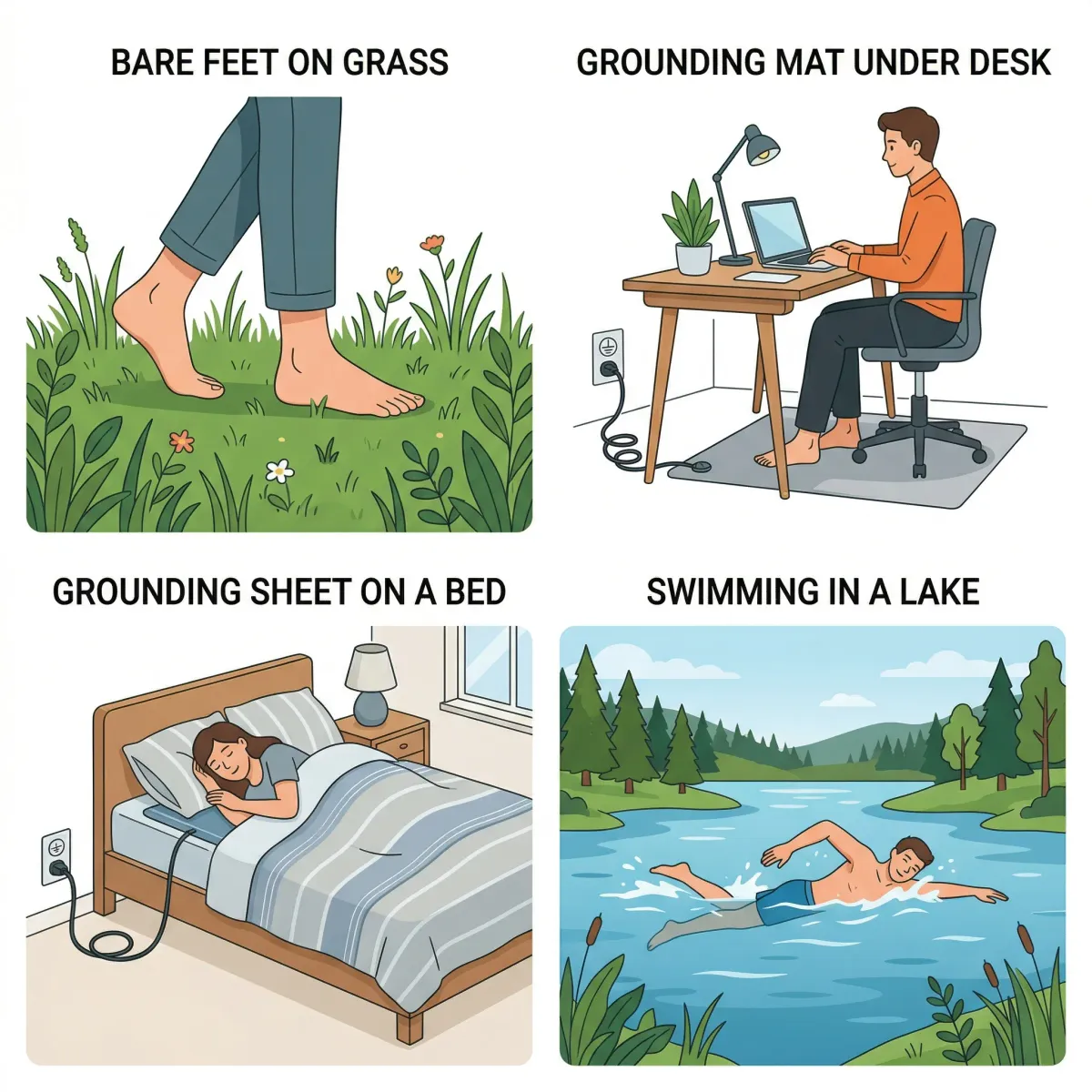
Outdoor grounding. Grass, soil, sand, and natural water are conductive. Asphalt and concrete are partially conductive if damp. Wood, rubber, and plastic are insulators. Walk barefoot on grass or soil for 20 to 40 minutes. Watch for sharp objects, hot surfaces, and areas that may have been treated with pesticides.
Indoor grounding products. The market includes grounding mats, sheets, patches, and wrist bands that connect to the ground pin of a standard electrical outlet or to an outdoor ground rod. Quality varies. Products from the original Earthing company are the ones used in most of the published research. Generic products may not maintain reliable electrical contact.
Blood thinning caution. The blood viscosity study showed that grounding affects how red blood cells interact. The study authors themselves note that "patients using blood-thinning drugs, such as warfarin (Coumadin), need to have their clotting time monitored when they begin to make more frequent conductive contact with the earth." If you take anticoagulants, talk to your doctor before starting regular grounding practice.
Thyroid medication note. Anecdotal reports suggest grounding may affect thyroid function. Again, no large studies confirm this, but if you take thyroid medication, monitoring is reasonable.
For people interested in complementary approaches to managing inflammation, our guide on castor oil packs for inflammation covers another traditional practice with a growing research base.
Frequently Asked Questions
Does grounding have legitimate scientific evidence behind it?
There are about 20 published studies showing measurable physiological changes from grounding, including shifts in cortisol patterns, blood viscosity, and markers of muscle damage. These studies are real and peer-reviewed. The limitation is that they are small (8 to 32 participants), mostly funded by a grounding product company, and conducted by the same handful of researchers. Independent replication at larger scales is needed before grounding can be considered evidence-based medicine.
How long do you need to be grounded to see effects?
The blood viscosity study showed measurable changes in zeta potential after just two hours of grounding. The cortisol study used eight weeks of grounded sleep. Some researchers report that skin conductance changes within seconds of contact with the ground. Practical recommendations from the research group suggest 20 to 40 minutes of barefoot ground contact as a starting point.
Can grounding replace medical treatment for inflammation?
No. The evidence does not support using grounding as a replacement for medical treatment. The studies are too small and the results too preliminary to justify that. Exercise, diet, adequate sleep, and stress management have far stronger evidence bases for managing chronic inflammation. Grounding may be a low-risk addition to an overall wellness routine, but it is not a substitute for proven interventions.
Is there any risk to grounding?
For healthy people, grounding carries minimal risk. The main safety note is for people taking blood-thinning medications like warfarin. Because grounding may affect blood viscosity and red blood cell behavior, clotting times should be monitored. Watch for sharp objects and hot surfaces when walking barefoot outdoors. Indoor grounding products should be properly wired and used according to manufacturer instructions.
Why do people feel better after walking barefoot in nature?
Multiple factors are probably at work simultaneously. Physical activity, sunlight exposure, stress reduction from being in nature, and potentially grounding effects all contribute. Research on "forest bathing" and nature exposure shows measurable health benefits independent of grounding. Attributing the entire benefit to electron transfer from the earth is an oversimplification that the current evidence does not support.
Related Articles
- Inflammation and Chronic Disease: A Complete Guide to Anti-Inflammatory Living -- A deep look at how chronic inflammation drives disease and what evidence-based strategies actually reduce it.
- How Sleep Timing (Not Just Duration) Affects Your Heart -- Research on circadian rhythms and cardiovascular health, connecting to grounding's reported cortisol effects.
- Senolytic Supplements: Fisetin, Quercetin, and Clearing Zombie Cells -- Another frontier in aging and inflammation science with a growing but still-preliminary evidence base.
- Phosphatidylserine for Memory, Cortisol, and Brain Health -- Evidence-based approaches to cortisol management through supplementation.
- Castor Oil Packs for Inflammation, Detox, and Skin Health -- Another traditional practice being examined through a modern research lens.
Medical Disclaimer
This article is for informational and educational purposes only and is not medical advice, diagnosis, or treatment. Always consult a licensed physician or qualified healthcare professional regarding any medical concerns. Never ignore professional medical advice or delay seeking care because of something you read on this site. If you think you have a medical emergency, call 911 immediately.