Americans now spend more on pet supplements than on coffee shops
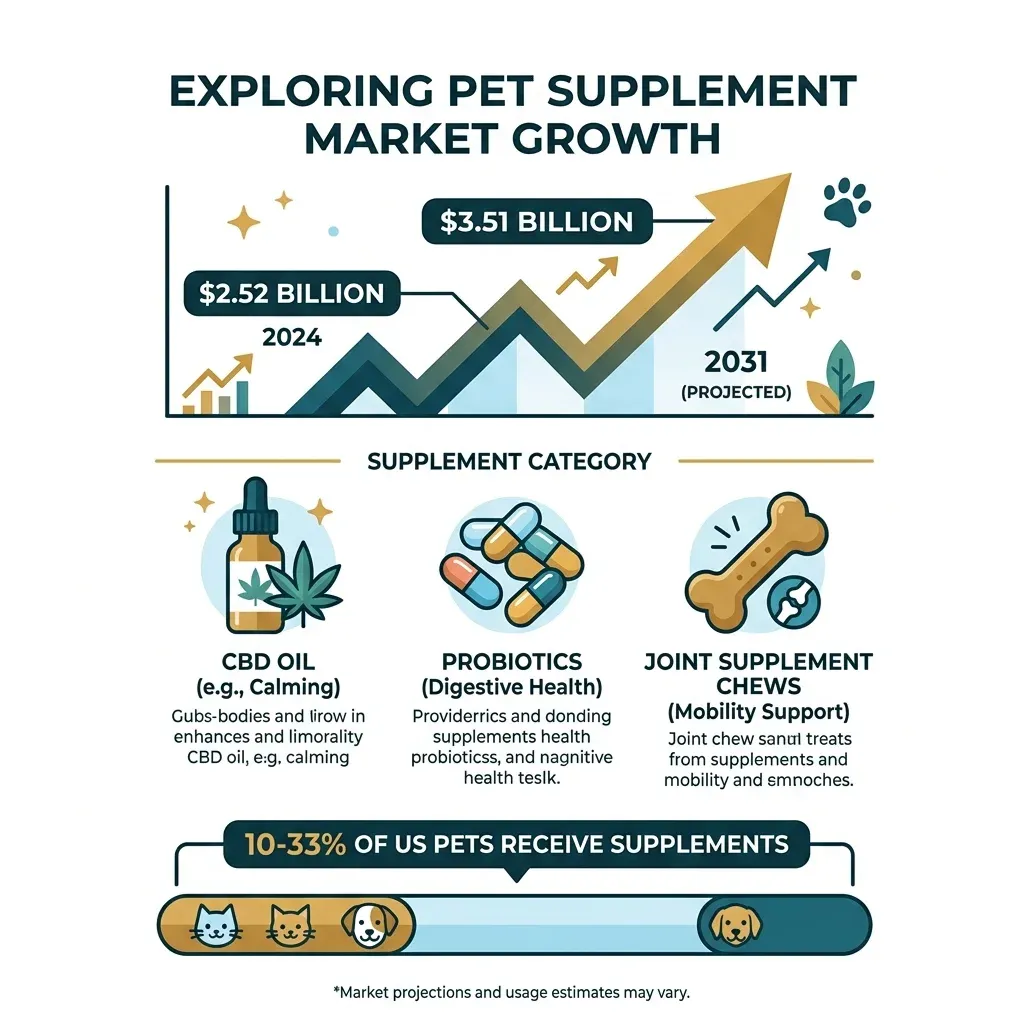
The global pet supplements market hit $2.52 billion in 2024, and analysts project it will reach $3.51 billion by 2031 at a compound annual growth rate of 5.0%. That growth is riding on a simple reality: people treat their pets like family, and family members get vitamins.
The numbers back this up. The American Pet Products Association reports that 95 million US households now own a pet, and Americans collectively spent $158 billion on their animals in 2024. Within that spending, the supplement slice keeps expanding. Between 10% and 33% of dogs and cats in the United States receive some kind of supplement or nutraceutical, with joint health and digestive aids leading the pack.
The motivations mirror what happened in human wellness about a decade ago. Owners who take fish oil, probiotics, or CBD themselves start wondering whether their arthritic Labrador or anxious rescue cat might benefit too. The 2023-2024 APPA survey counted 65.1 million dog-owning households and 46.5 million cat-owning households in the US. Chewable supplements, which dominate the market's format breakdown, make dosing feel less like medicine and more like treats.
The trouble is that popularity has outpaced the science. Some supplements have genuinely strong clinical evidence behind them. Others are coasting on owner testimonials and marketing claims that would never survive peer review. The rest of this guide separates the two.
One Colorado study changed how veterinarians think about CBD and seizures
CBD for pets generates more arguments than almost any supplement category. The research, however, is actually better than most people assume. A 2024 systematic review published in the Journal of Small Animal Practice analyzed 22 studies examining CBD-based formulations for osteoarthritis, epilepsy, atopic dermatitis, postsurgical pain, and behavioral issues in dogs and cats. The review found that products with cannabidiol as the primary active constituent demonstrated improvements in pain, behavior, and seizures, with no serious adverse events reported across the literature.
The epilepsy data is where CBD's case is strongest. Think of seizure medications like a team of bouncers at a nightclub -- they work by calming overexcited neurons before they cause trouble. About 30% of dogs with idiopathic epilepsy are drug-resistant, meaning standard medications fail to control their seizures adequately. Dr. Stephanie McGrath at Colorado State University led a double-blinded crossover study of 51 dogs with drug-resistant epilepsy. At a dose of 9 mg/kg/day, CBD decreased seizure days by 24.1% compared to a 5.8% increase in dogs receiving placebo (P=0.002). A lower dose of 5 mg/kg/day showed no meaningful effect, suggesting dosing precision matters.
Other studies referenced by researchers at Cornell's College of Veterinary Medicine found that broad-spectrum CBD products reduced seizures by 25-30% at 4.5 mg/kg twice daily, while a full-spectrum CBD/CBDA mix at 2 mg/kg twice daily achieved a 42% reduction in clinically significant seizures.
For pain, the picture is also promising. Multiple studies on osteoarthritic dogs showed improved mobility and reduced pain scores with CBD products at doses between 1-2 mg/kg body weight. Approximately 65% of dogs responded to a full-spectrum CBD/CBDA product with clinically significant reduction in itching when used for atopic dermatitis at 2 mg/kg every 12 hours versus placebo.
The side effect profile deserves honest attention. Decreased appetite and vomiting were significantly more common during CBD treatment compared to placebo in the Colorado State epilepsy trial. More concerning: 80% of dogs with normal baseline liver enzyme (ALP) levels saw those levels climb above twice the reference range while receiving CBD. Liver enzymes need monitoring during CBD use. That part is not optional.
Safety studies have tested CBD at doses up to 10 mg/kg/day for up to 36 weeks and found it largely safe for long-term use. The National Animal Supplement Council (NASC) reported fewer than 2 adverse event reports per million CBD products sold annually over the past decade. But "largely safe" and "no monitoring needed" are different things.
One critical gap: research on CBD in cats remains limited to just two studies. Most of the evidence base is canine, so cat owners are working with even less certainty. And while CBD shows promise for anxiety in dogs, the existing studies are weak and suggest only mild effects. No double-blind, placebo-controlled anxiety study has been published in the veterinary literature as of this writing.

Your pet's gut bacteria outnumber their cells, and probiotics try to tip the balance
The digestive tracts of dogs and cats host a community of bacteria, fungi, and other microorganisms that collectively weigh more than the animal's brain. This microbial ecosystem is dominated by four bacterial phyla -- Firmicutes, Bacteroidetes, Fusobacteria, and Proteobacteria -- and it handles jobs far beyond digestion. Think of it as a factory with multiple departments: one converts fiber into short-chain fatty acids that fuel intestinal cells, another trains the immune system to distinguish threats from food, and a third produces vitamins the animal cannot make on its own.
When this ecosystem falls out of balance (veterinarians call it dysbiosis), the consequences show up as chronic diarrhea, inflammatory bowel disease, allergies, and sometimes metabolic disorders. Probiotics aim to restore that balance by introducing beneficial bacterial strains. The challenge is that not all probiotic products are equivalent, because different strains do different things.
A 2025 study led by Dr. Mamoru Onuma tested a novel compound containing 26 biotic materials (2 prebiotics, 1 probiotic, and 23 postbiotics) in cats and dogs. The compound was safe in both species. In cats, the researchers observed significant increases in T and B immune cells (p<0.05). In dogs, fecal pH decreased significantly in the treatment group (p<0.01), and 60% of treated dogs showed increased total organic acids -- a marker of healthy fermentation. The supplement also decreased populations of potentially harmful Escherichia-Shigella bacteria while supporting beneficial Lachnospira genera.
Some dogs experienced soft stools during the first 3-7 days of treatment (mean 5 days), but this resolved on its own in all cases. That initial digestive disruption is common when introducing new bacterial populations -- the factory is reorganizing its departments, and things get temporarily messy.
The combination approach appears to matter. Research referenced in the same study found that symbiotics -- the combination of prebiotics and probiotics -- were reportedly more effective than antibacterial drugs for treating chronic diarrhea in dogs. When dogs received a mixture of three bacterial strains rather than a single strain, short-chain fatty acid production increased while counts of harmful bacteria decreased; the single-strain group did not see the same effects.
Research also shows that twelve species of dead bifidobacteria and lactobacilli proved effective as probiotics in dogs, increasing beneficial bacteria counts, decreasing anaerobic pathogens, and elevating both intestinal mucosal IgA and blood IgG -- markers of immune readiness. That dead bacteria can still have beneficial effects surprises many pet owners, but it makes sense: the immune system responds to bacterial components whether the organisms are alive or not.
For practical purposes, this means looking for multi-strain products with species that have been tested specifically in dogs or cats. What works in human guts does not automatically translate. Omega-3 fatty acids from fish oils can also support the gut microbiome by promoting anti-inflammatory bacterial populations like Lactobacillus and Bifidobacterium, which means a joint supplement and a probiotic might work better together than either alone.
The biggest joint supplement in America might not do what you think
Osteoarthritis is the most common degenerative disease in pet animals. It affects approximately 20% of dogs over the age of one and up to 90% of dogs older than five. Cats are similarly affected: a compilation of prevalence studies found that 25.6% of cats (454 out of 1,772 studied) showed radiographic evidence of OA in at least one joint, with rates climbing steeply with age. The true number is likely higher, since cats hide pain as an evolutionary defense against predators.
Faced with these statistics, veterinarians and owners have spent billions on joint supplements. Glucosamine and chondroitin have been the dominant players for decades, sold on the premise that providing cartilage building blocks would help rebuild damaged joints. The logic feels intuitive -- like adding mortar to crumbling brickwork. But a 2022 systematic review and meta-analysis from the University of Montreal, led by Dr. Eric Troncy's group, analyzed 72 trials across nine categories of natural health compounds and reached a conclusion that rocked the veterinary supplements aisle.
The meta-analysis found "evident clinical analgesic efficacy" for omega-3-enriched diets, omega-3 supplements, and (to a lesser degree) cannabidiol. It found weak efficacy for collagen. And for chondroitin-glucosamine nutraceuticals, it found a "very marked non-effect," leading the researchers to recommend these products should no longer be recommended for pain management in canine and feline osteoarthritis.
That finding is not isolated. A review from the University of Manitoba's College of Pharmacy noted that despite limited and conflicting evidence, glucosamine and chondroitin remain commonly recommended by veterinarians. The review highlighted that the majority of veterinary supplements contain glucosamine HCl, which already has poorer bioavailability and clinical effect compared to crystalline glucosamine sulfate (the form with the most human evidence).
Omega-3 fatty acids tell a different story. Multiple randomized controlled trials, summarized in the AVMA's comprehensive review, showed that dogs fed omega-3 enriched therapeutic diets containing 3.5% omega-3 fatty acids had significantly greater peak vertical force in affected limbs compared to dogs on standard diets. In plainer terms: the arthritic dogs walked better, bore more weight on painful legs, and needed less pain medication.
The feline evidence is newer but compelling. A 2025 review from the University of Montreal found that an omega-3 enriched diet demonstrated therapeutic efficacy comparable to standard pharmacological treatments for feline OA, with no side effects and high compliance. That last point matters -- getting cats to take pills is famously difficult, but they will eat a therapeutic diet.

The practical takeaway: if your dog or cat has joint issues, omega-3 supplementation has substantially stronger evidence than glucosamine-chondroitin combinations. This does not mean glucosamine is harmful -- it means the money might be better spent on fish oil or an omega-3 enriched therapeutic diet.
The FDA does not regulate pet supplements the way most owners assume
Most pet owners assume that if a supplement sits on a store shelf, someone verified that it contains what the label says and does what it claims. That assumption is wrong. Pet supplements do not fall under the Dietary Supplement Health and Education Act (DSHEA) of 1994, the law that governs human supplements. They undergo less regulatory oversight than even the loosely regulated human supplement market.
Dr. Carrie Finno at the University of California, Davis, detailed the regulatory situation in a review published through the National Institutes of Health. The FDA's Center for Veterinary Medicine (CVM) can take action against products that make disease treatment claims or pose safety hazards, but a standardized monitoring system is not currently in place. The practical result is that manufacturers can sell products with minimal pre-market scrutiny.
Label accuracy is a documented problem. One study found that chondroitin sulfate was inappropriately labeled in 84% (9 out of 11) of tested products, with mislabeling ranging from 0% to 115% of the claimed amount. Another study of equine joint supplements found glucosamine content ranged from 63.6% to 112.2% of label claims, while chondroitin sulfate varied from 22.5% to 155.7%. Your pet might be getting half the dose you think, or more than double.
CBD products have their own quality issues. A Cornell study examining commercial CBD products found concentrations of CBD ranged from 0 to 70 mg/mL, with most falling between 20-25 mg/mL. Beyond cannabinoid content, products can contain heavy metals, pesticides, extraction solvents, pathogenic bacteria, and mycotoxins.
The National Animal Supplement Council (NASC), formed in 2001, is the closest thing the industry has to self-regulation. The NASC Quality Seal program audits manufacturers for good manufacturing practices, label accuracy, and adverse event reporting. But NASC membership is voluntary, and NASC does not require companies to perform efficacy studies or verify that research data supports product claims.
| Quality indicator | What to look for | Red flag |
|---|---|---|
| NASC Quality Seal | Seal displayed on packaging | No third-party certification of any kind |
| Third-party testing | Certificate of analysis (COA) available | Company refuses to share lab results |
| Ingredient specificity | Named strains, specific dosages | Proprietary blends hiding individual amounts |
| Label claims | "Supports joint health" | "Cures arthritis" or disease treatment claims |
| Contact information | Phone number, address, vet consultation line | No way to contact manufacturer |
One often-overlooked risk: a veterinarian is legally liable if they recommend a supplement that leads to adverse effects. This is part of why many vets are cautious about supplement recommendations -- they carry the legal risk without the regulatory infrastructure that would give them confidence in product quality. The 47 dogs that experienced adverse reactions (including 8 deaths) from a weight loss supplement containing guarana and ma huang illustrate what can go wrong when ingredients marketed as "natural" bypass the scrutiny applied to pharmaceutical drugs.
Weight loss works better than most supplements, and your vet already knows it
Before spending money on joint supplements, consider the intervention with the strongest evidence that costs nothing: weight management. An estimated 59.5% of cats and 55.8% of dogs in the United States are obese or overweight, and that excess weight directly accelerates joint deterioration.
The most striking evidence comes from a lifelong study of 48 Labrador Retrievers. Dogs kept at a lean body weight lived a median 1.8 years longer (15% longer lifespan) than moderately overweight dogs, and the lean dogs needed osteoarthritis medications a full 3 years later than their heavier counterparts. Among obese dogs with existing joint disease, even 6% body weight loss was associated with measurable improvements in lameness, and 9% weight loss showed up on objective force-plate measurements.
That context matters for evaluating supplements. A glucosamine-chondroitin product that does nothing (per the meta-analysis evidence) being given to an overweight dog is money that could fund a weight management program with actual proven benefits. The supplement might feel like doing something; the diet change actually is doing something.
Supplements earn their place when they fill a gap that diet and weight management cannot close on their own. Based on the evidence reviewed in this guide, here is where each category stands:
| Supplement category | Evidence strength | Best use case |
|---|---|---|
| Omega-3 fatty acids | Strong (multiple RCTs, meta-analysis) | Dogs and cats with OA; general anti-inflammatory support |
| CBD (cannabidiol) | Moderate-strong for epilepsy/pain; weak for anxiety | Drug-resistant epilepsy; OA pain; atopic dermatitis in dogs |
| Multi-strain probiotics | Moderate (strain-specific evidence) | Chronic GI issues; post-antibiotic recovery; immune support |
| Glucosamine-chondroitin | Weak to non-effect (meta-analysis) | No strong clinical indication per current evidence |
The toxicity picture also deserves attention. Not all supplement overdoses are benign. Dr. Renee Schmid of the Pet Poison Helpline noted that L-tryptophan, a common ingredient in pet calming supplements, can cause body tremors, depression, and ataxia within 10 minutes to an hour at high concentrations. Glucosamine overdoses can lead to liver failure, and alpha-lipoic acid, found in many human supplements that pets access accidentally, is particularly dangerous for cats, which are 10 times more sensitive to it than dogs.

Talk to your veterinarian before starting any supplement, especially if your pet takes other medications. Bring the product container so they can read the actual ingredient list. If your pet is carrying extra weight, address that first. No supplement on the market matches what happens when a dog or cat reaches a healthy body condition score.
Frequently Asked Questions
Is CBD legal to give to my dog or cat?
Hemp-derived CBD products containing less than 0.3% THC are federally legal in the United States following the 2018 Hemp Farming Act. However, state laws vary, and the FDA has not approved CBD as a veterinary drug or supplement. The American Association of Veterinary State Boards has developed guidelines for veterinarians, but regulatory uncertainty means your vet may have different comfort levels recommending it depending on your state.
Can I give my pet the same probiotics I take?
Not recommended. Research shows that probiotic effects vary between species, and strains effective in humans may not colonize or function the same way in dogs or cats. Look for products containing strains tested specifically in companion animals, such as species within the Lactobacillus, Bifidobacterium, and Enterococcus genera that appear in veterinary research.
If glucosamine doesn't work, why do so many vets still recommend it?
The meta-analysis finding of "non-effect" for glucosamine-chondroitin is relatively recent (2022), and it takes time for research to change clinical practice. Some veterinarians also weigh the low risk of harm against the possibility of a modest placebo effect on owner perception. The evidence, however, increasingly points toward omega-3 fatty acids as a more effective investment for joint health.
How do I know if a pet supplement is safe?
Look for the NASC Quality Seal, request a certificate of analysis (COA) showing third-party testing, check for specific ingredient amounts rather than proprietary blends, and verify the manufacturer has a physical address and contact information. Avoid products making disease treatment claims, as legitimate supplements are legally restricted to structure/function claims like "supports joint health."
Should I give my pet supplements if they eat a complete and balanced commercial diet?
The American College of Veterinary Nutrition states that if your pet eats a complete and balanced commercially available food, supplements are not recommended unless specifically prescribed by your veterinarian. Supplements are most appropriate when addressing a specific clinical need -- such as osteoarthritis, epilepsy, or chronic GI issues -- rather than as general preventive care for healthy animals.
Medical Disclaimer
This article is for informational and educational purposes only and is not medical advice, diagnosis, or treatment. Always consult a licensed physician or qualified healthcare professional regarding any medical concerns. Never ignore professional medical advice or delay seeking care because of something you read on this site. If you think you have a medical emergency, call 911 immediately.