The Doses Researchers Actually Put in Capsules
A collagen label tells you to take 10, 15, maybe 20 grams a day. The number sounds precise. Researched. But what scientists actually tested in controlled trials looks nothing like what the packaging suggests.
A 2025 systematic review examining 36 randomized controlled trials on type I collagen hydrolysate found doses scattered across a wide range: five studies used 5g daily, eight used 10g, thirteen used 15g, seven went above 20g, and two tested below 5g. The average study ran for about 15 weeks, though durations swung from a single day to a full year. No standardized protocol. No agreed-upon dose. Just researchers picking amounts based on their best guesses and earlier pilot data.
For skin specifically, the evidence base looks different. A systematic review of 11 RCTs covering 805 patients found that collagen hydrolysate doses for dermatological outcomes ranged from just 2.5g to 10g daily, tested over 8 to 24 weeks. That is a narrower band than the joint and muscle literature, and the doses trend lower.
Then there is UC-II, which operates on a completely different scale. The standard research dose sits at 40 milligrams — not grams. That is roughly 100 to 375 times less than what hydrolyzed collagen studies use. The reason for that gulf matters enormously, and we will get to it.
So when someone asks "how much collagen should I take," the only honest response is another question: what are you trying to accomplish? The research never tested a single magic number for everything. It tested specific doses for specific tissues over specific timeframes.
2.5 Grams or 15? It Depends on What You Want Fixed
Forget the single-number recommendation. The data points toward different thresholds for different tissues, and the gaps between them are large enough to matter for your wallet.
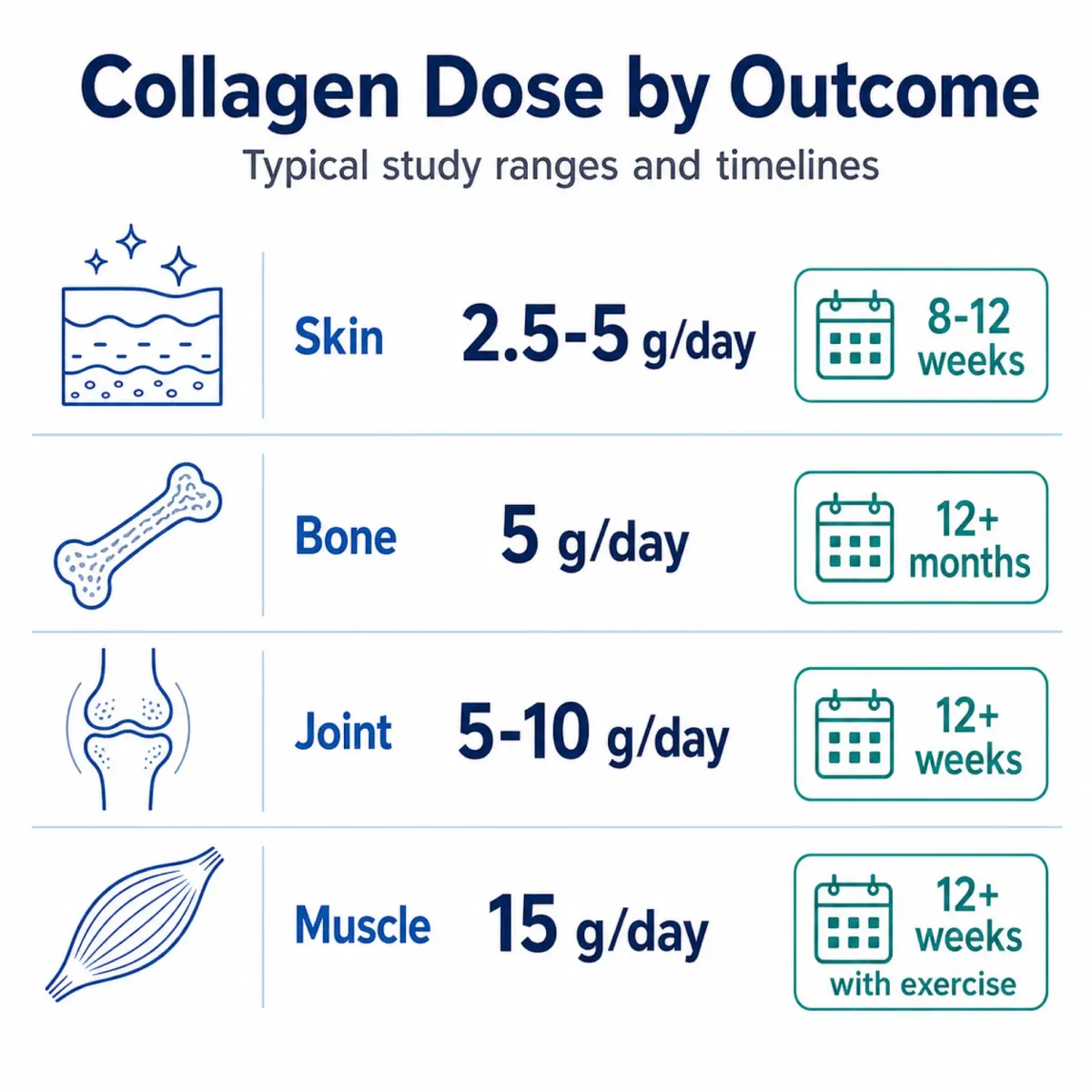
Skin: 2.5g to 5g
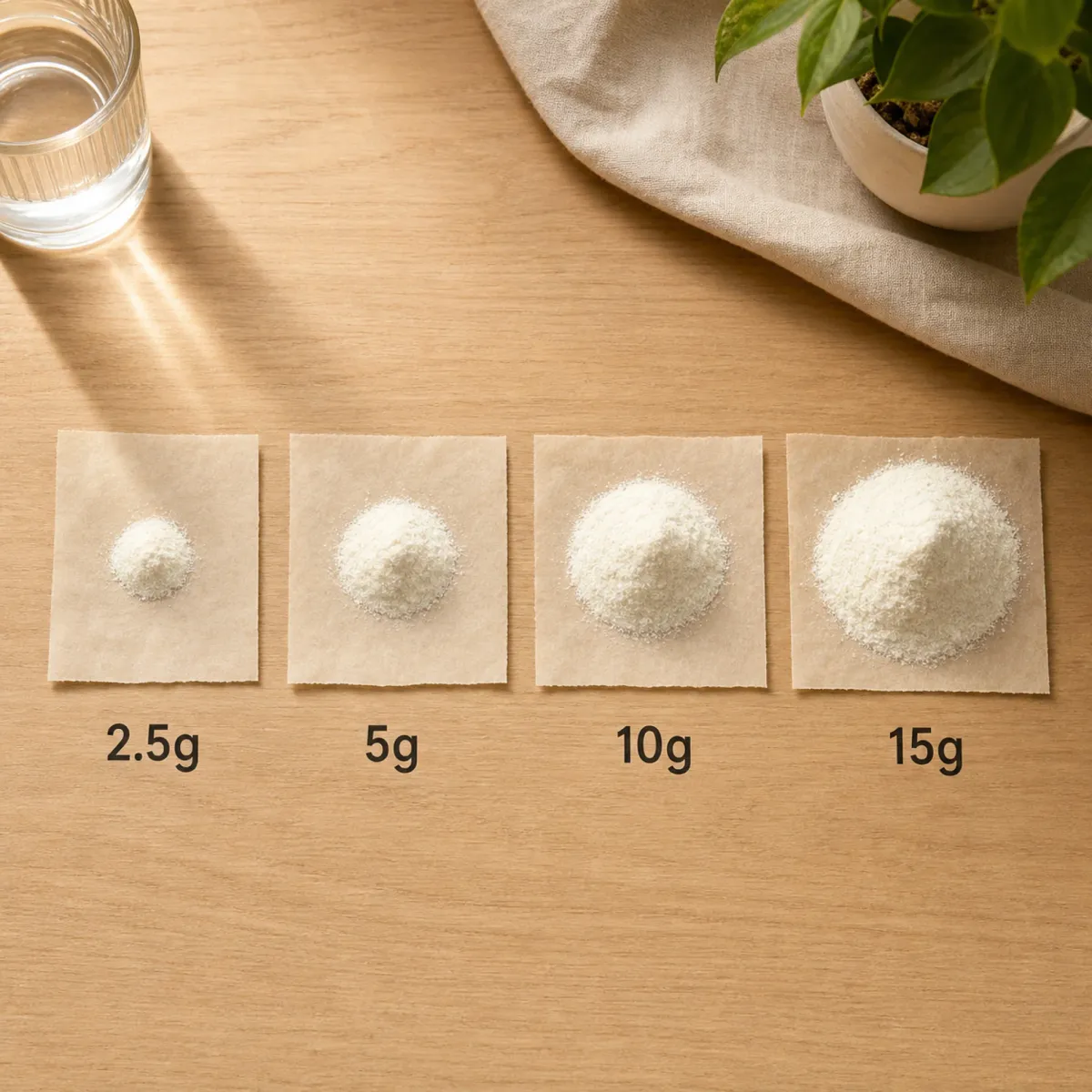
Skin is where the lowest effective doses show up. Proksch and colleagues at the University of Kiel ran a double-blind trial with 69 women aged 35 to 55, comparing 2.5g, 5g, and placebo daily for 8 weeks. Both collagen groups showed statistically significant improvements in skin elasticity compared to placebo. The improvement persisted through a 4-week follow-up period after supplementation stopped. Elderly participants showed particularly strong gains.
No meaningful difference between the 2.5g and 5g groups. Both doses produced comparable results. Skin elasticity appears to respond to a signaling threshold rather than a linear dose curve — your body needs enough collagen peptides to trigger fibroblast activity, and once that threshold is crossed, doubling the dose buys you nothing.
A separate trial with 52 women taking roughly 5g daily for 8 weeks measured more granular outcomes: 13.6% increase in skin moisturization, 7.8% improvement in elasticity, and a 7.3% reduction in wrinkle depth. Improvements were already measurable at day 28 — about 4 weeks in. Another study using 5g of hydrolyzed collagen daily found a 19% increase in collagen density around the crow's feet area and a 24% reduction in nasolabial fold depth over 60 days.
For skin specifically, the clinical evidence clusters tightly around 2.5 to 5g daily. No head-to-head comparison has shown higher doses producing better skin outcomes.
Bones: 5g (but give it a year)
Bone density moves slowly, and the research reflects that. The most compelling data comes from König and colleagues, who gave postmenopausal women 5g of specific collagen peptides daily and tracked them for four years. The results were substantial: spine bone mineral density increased by 5.79% to 8.16%, and femoral neck density rose by 1.23% to 4.21%. No osteoporotic fractures occurred during the follow-up period.
Those numbers took time. Statistical significance at the spine did not appear until year two. Bone remodeling runs on a different biological clock than skin turnover — think months and years, not weeks. A 2025 meta-analysis of 20 studies also found that collagen combined with calcium and vitamin D produced synergistic BMD benefits, with standardized mean differences of 0.40 to 0.56. For bones specifically, the trio outperforms collagen alone.
Joints: 5g to 10g (hydrolyzed) or 40mg (UC-II)
Joint outcomes split across two fundamentally different supplement types. For hydrolyzed collagen, the systematic review of 36 RCTs found that doses in the 5 to 10g range demonstrated significant pain improvements across 14 joint-focused studies. The Arthritis Foundation notes that a meta-analysis of 41 studies found collagen benefited osteoarthritis and aided cartilage repair regardless of dose, type, or brand — though most positive outcomes clustered in that 5 to 10g window.
UC-II is a separate conversation entirely, and it gets its own section below.
Muscle: 15g (and you have to lift)
Muscle is where doses climb highest. The systematic review found that 15g daily combined with resistance training produced the most consistent positive muscle outcomes. A separate analysis reported that 15g daily generated a 153% increase in collagen synthesis during exercise recovery, compared to 59.2% at 5g. That is a nearly threefold difference in synthesis rates between the two doses.
An important caveat: muscle benefits were predominantly observed when supplementation was combined with physical exercise. Fifteen grams of collagen without training did not produce the same results. Exercise creates the demand signal — stressed tendons and muscle fibers actively pulling in raw materials for repair. Without that demand, the extra peptides circulate without a destination.
40 Milligrams vs 15 Grams: Why the Scale Difference Is Not a Typo
One is dosed in milligrams. The other in grams. That factor-of-375 gap between UC-II and hydrolyzed collagen is not a labeling error and not marketing. It reflects two completely different biological mechanisms.
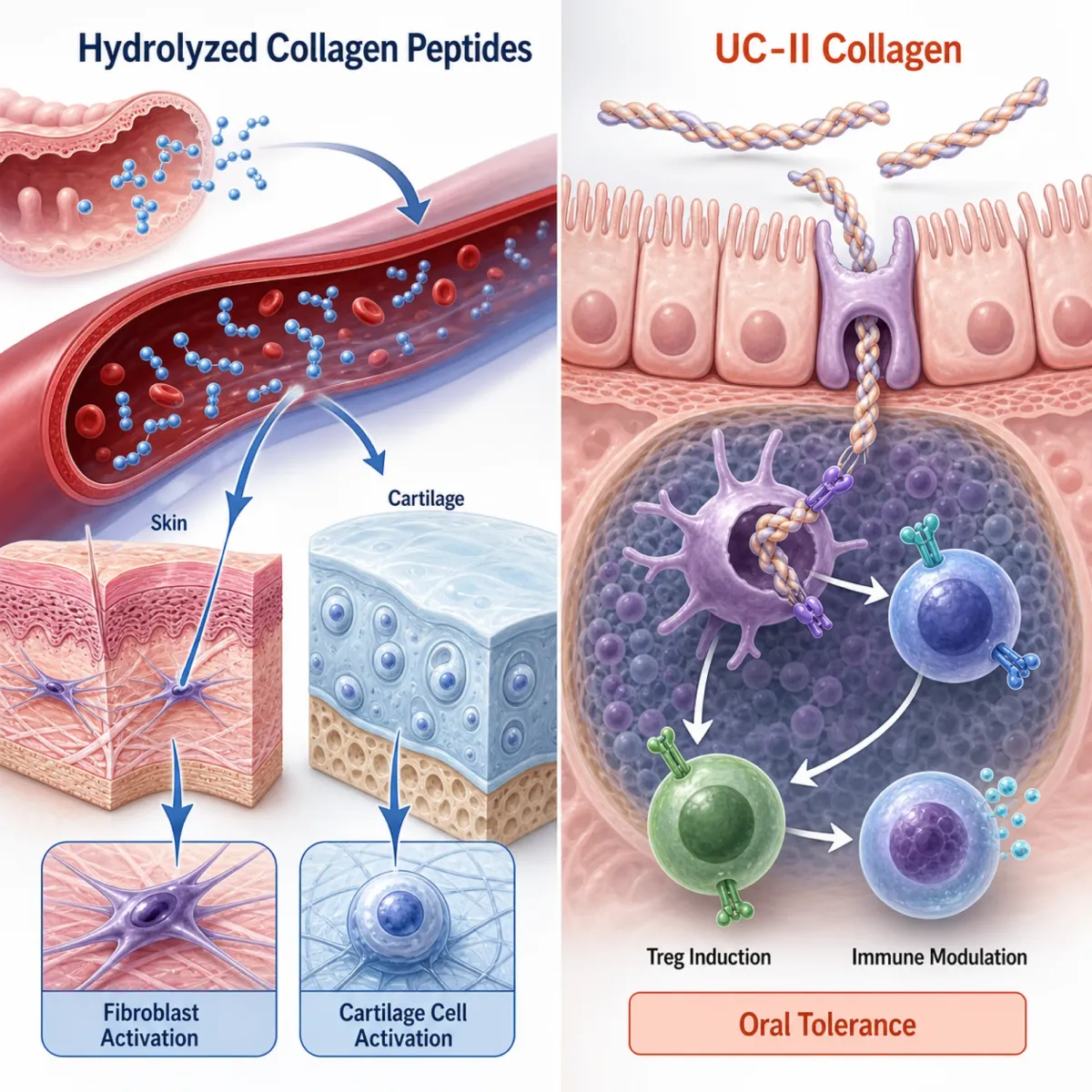
Hydrolyzed collagen works like a supply chain. Your digestive system breaks the protein into amino acids and small peptides. Certain peptides — particularly proline-hydroxyproline (Pro-Hyp) — resist complete digestion and enter the bloodstream intact. They travel to skin, cartilage, and bone, where they signal fibroblasts and chondrocytes to produce more collagen and hyaluronic acid. Think of it as sending a work order to a construction crew — you need enough messengers to make the signal heard. That is why you need grams: the system requires sufficient material to raise blood levels of these signaling peptides above the threshold where tissues respond.
UC-II works like a security badge. Small amounts of intact, undenatured type II collagen reach the small intestine and interact with Peyer's patches — clusters of immune tissue in the gut wall. The intact molecular structure preserves specific epitopes that the immune system recognizes. This triggers regulatory T cells, which then travel to joints and release anti-inflammatory cytokines when they encounter type II collagen in cartilage. The process is called oral tolerance, and it is closer to how allergy desensitization works than how protein supplementation works.
Forty milligrams is enough because the mechanism is immunological, not structural. In a 180-day trial of 191 people with knee osteoarthritis (Lugo et al., 2016), 40mg of UC-II outperformed both placebo and a glucosamine-chondroitin combination on joint pain, stiffness, and physical function. Doses exceeding 40mg provided no additional benefit. Once the immune system has the recognition signal, repeating it louder does nothing.
| Factor | Hydrolyzed Collagen | UC-II (Undenatured Type II) |
|---|---|---|
| Daily dose | 2.5g to 15g | 40mg |
| Mechanism | Signaling peptides boost collagen production | Immune tolerance reduces joint inflammation |
| Best for | Skin, bones, muscle, general connective tissue | Joint pain and osteoarthritis specifically |
| Time to effect | 4 to 12+ weeks depending on target | 12 to 24 weeks |
| Higher doses help? | Yes, up to tissue-specific ceiling | No benefit above 40mg |
| Source | Bovine, marine, porcine (hides, bones, scales) | Chicken sternum cartilage |
Mixing up these two types leads to real dosing errors. Someone taking 10g of UC-II is wasting money and stomach space — that is not how oral tolerance works. Conversely, someone taking 40mg of hydrolyzed collagen peptides is getting roughly 1/60th of the minimum dose shown to affect skin. The label should tell you which type you have, but not every brand makes the distinction obvious.
Where the Curve Flattens: Evidence for a Dosing Ceiling
If 5g is good, 20g must be four times as good. That is supplement-aisle logic. The research tells a different story.
Proksch's skin trial is the cleanest example. Doubling the dose from 2.5g to 5g produced no additional skin elasticity benefit. Both groups improved equally compared to placebo. That is a flat dose-response curve above 2.5g for that specific outcome. You do not need to spend twice as much for the same result.
For muscle and connective tissue synthesis, a ceiling does exist, but it sits higher. The review of 15 RCTs found no evidence that doses exceeding 15g daily provided additional benefits for most outcomes. Studies testing doses up to 60g daily — primarily comparing collagen to whey protein for body composition — did not demonstrate superior efficacy at those extreme levels. They demonstrated safety, which is useful information, but not enhanced performance.
The systematic review of 36 RCTs looked for a clean dose-response relationship across all tissues and came up empty. The authors blamed the "high degree of variability in dosage use" — studies used such different amounts for such different outcomes that no universal curve could emerge.
What the data suggests instead is tissue-specific plateaus. Skin fibroblasts respond to a lower peptide threshold than muscle tissue under exercise stress. Bone remodeling cells need sustained exposure over months at moderate doses rather than high acute loads. Each tissue has its own saturation point, and those points sit at very different altitudes on the dose curve.
The practical ceiling for most people: 2.5 to 5g for skin, 5g for bones, 5 to 10g for joints, and 15g for muscle with exercise. Going higher has not been shown to produce proportionally better results for any of these targets.
This also means the 20g scoops recommended by some protein-collagen blends are not harmful — collagen supplementation appears safe even at 60g daily with no adverse effects reported — but the extra grams above the tissue-specific threshold are expensive protein with no demonstrated additional benefit for the marketed outcome.
Vitamin C Gets the Credit, But the Details Matter
Almost every collagen brand now adds vitamin C to their formula or recommends taking it alongside. The science backing this is real. The marketing around it is mostly not.
Vitamin C is an essential cofactor for two enzymes — prolyl hydroxylase and lysyl hydroxylase — that hydroxylate proline and lysine residues in procollagen chains. Without that hydroxylation, collagen molecules cannot fold into their characteristic triple-helix structure or cross-link properly. Scurvy, at its core, is what happens when vitamin C drops so low that collagen production falls apart.
But here is what most collagen-plus-C products get wrong. Vitamin C does not improve collagen absorption. Peptides are absorbed in the small intestine regardless of vitamin C status. Vitamin C matters later, during synthesis — when your cells actually assemble new collagen from absorbed peptides. Confusing absorption with synthesis creates unnecessary timing anxiety about taking them together.
And the dose of vitamin C needed is far lower than supplement companies imply. A systematic review found that low-dose oral vitamin C around 60mg daily improved bone biomarkers, while megadoses at 1,000mg or above showed no additional clinical benefit over controls. Fifty to 100mg appears sufficient to support collagen synthesis. A single orange provides about 70mg. If you eat fruits and vegetables regularly, you already have enough.
One timing note worth knowing: consuming collagen and vitamin C roughly 30 to 60 minutes before tendon-loading exercise may enhance collagen synthesis during rehabilitation. For everyone else, consistency matters more than the clock. The megadose vitamin C packets stacked next to collagen at the supplement store are solving a problem that barely exists for anyone eating a normal diet.

The Label Says 20 Grams. The Research Says Something Else.
Walk through the collagen aisle and you will notice a pattern. Brands selling powder formats recommend 10 to 20g per serving. Brands selling capsules or liquid shots tend to recommend 2.5 to 5g. The difference has less to do with evidence and more to do with format economics — it is easier to fit 2.5g into a shot than 15g, and it is easier to sell a 20g scoop than explain why 5g might be enough for most people's goals.
Medical institutions land consistently lower. Cleveland Clinic standards cite 2.5 to 15g daily as well-tolerated. UCLA Health recommends 2.5 to 15g of hydrolyzed collagen, noting smaller doses for joints and skin, larger for body composition. Dr. Hardik Doshi, a hair restoration surgeon, puts it at 2.5 to 15 grams. Notice how the medical range tops out where many brand recommendations start.
The gap is widest for skin. Multiple clinical trials showed meaningful skin improvements at 2.5 to 5g daily. Proksch's trial found no additional benefit at 5g versus 2.5g for skin elasticity. A collagen skin product recommending 15g daily is not giving you evidence-based guidance. It is giving you a consumption rate that drives repeat purchases three times faster.
| Goal | Studied Dose | Typical Brand Recommendation | Gap |
|---|---|---|---|
| Skin hydration/elasticity | 2.5g to 5g | 10g to 20g | 2x to 8x above evidence |
| Bone density | 5g | 10g to 15g | 2x to 3x above evidence |
| Joint pain (hydrolyzed) | 5g to 10g | 10g to 15g | Modest overlap |
| Muscle (with exercise) | 15g | 15g to 20g | Close to evidence |
| Joint OA (UC-II) | 40mg | 40mg | Well-matched |
There is a time dimension that brands rarely emphasize. Skin improvements begin appearing around 4 weeks, with more substantial changes at 8 to 12 weeks. Joint and muscle benefits from hydrolyzed collagen generally require three months or longer. Bone density takes at least 12 months to show measurable changes. Most people who quit collagen after 2 weeks because "it didn't work" never gave their tissue enough time to respond, regardless of dose.
Dr. Christine Ko, a dermatology professor at Yale, recommends referencing manufacturer instructions given the wide variety of formulations — a pragmatic stance that acknowledges the field has not converged on universal dosing. The more useful approach: know your target tissue, find the dose that research supports for it, and commit to the timeline that tissue actually requires before deciding something failed.

Frequently Asked Questions
Can I take collagen and UC-II together?
You can, and some products combine them. They work through different mechanisms — hydrolyzed collagen provides signaling peptides for tissue building while UC-II modulates immune responses in joints. Taking both is not harmful, but you should dose each according to its own evidence: 2.5 to 15g for hydrolyzed collagen depending on your goal, and 40mg for UC-II. Do not count UC-II milligrams toward your hydrolyzed collagen gram target — they are addressing different biological processes.
Does marine collagen require a different dose than bovine?
Most clinical trials used bovine-sourced hydrolyzed collagen, so the dose ranges of 2.5 to 15g are best established for bovine. Marine collagen studies have generally used similar dose ranges and shown comparable outcomes, though fewer head-to-head comparisons exist. The key factor is molecular weight and hydrolysis quality rather than animal source. A 5g dose of well-hydrolyzed marine collagen should behave similarly to 5g of well-hydrolyzed bovine collagen for the same target tissue.
How long should I wait before deciding collagen is not working?
This depends on your target. Skin hydration improvements can appear within 4 weeks. Elasticity and wrinkle changes typically need 8 to 12 weeks. Joint and muscle benefits require at least 3 months. Bone density changes take 12 months minimum to measure. If you are taking collagen for bones and quit after 6 weeks, you never gave it a fair trial. Match your patience to your target tissue.
Is there an upper limit where collagen becomes unsafe?
Research has tested doses up to 60g daily without reported adverse effects. Collagen is generally considered safe and non-toxic. The practical concern is not safety but waste — doses above the tissue-specific threshold provide no additional benefit for that tissue while consuming protein calories and budget. Minor side effects occasionally reported include digestive fullness, bloating, and mild diarrhea, typically at higher doses.
Should I split my collagen dose across the day or take it all at once?
Most clinical trials administered collagen as a single daily dose, so that is the best-studied protocol. There is no strong evidence that splitting doses improves absorption or outcomes. For muscle-specific goals, the evidence leans toward taking collagen at least one hour before exercise to support connective tissue synthesis during recovery. For other goals, consistency matters more than timing.
Medical Disclaimer
This article is for informational and educational purposes only and is not medical advice, diagnosis, or treatment. Always consult a licensed physician or qualified healthcare professional regarding any medical concerns. Never ignore professional medical advice or delay seeking care because of something you read on this site. If you think you have a medical emergency, call 911 immediately.