
Open any fitness app or glance at your smartwatch, and there it is — the magic number: 10,000. Hit it and you've had a good day. Fall short and something feels incomplete. But where did this goal actually come from? And more importantly, does the science support it?
The short answer: no, you probably don't need 10,000 steps. Decades of research show that the biggest health gains come well before you reach that number. But the longer answer matters too. Walking more is almost always better, and benefits start accumulating from your very first steps above a sedentary baseline.
Below, we trace where the 10,000-step target came from, look at what the largest studies actually found, and work out a step count that makes sense for you, whatever your age or fitness level.
A Marketing Campaign, Not a Medical Recommendation
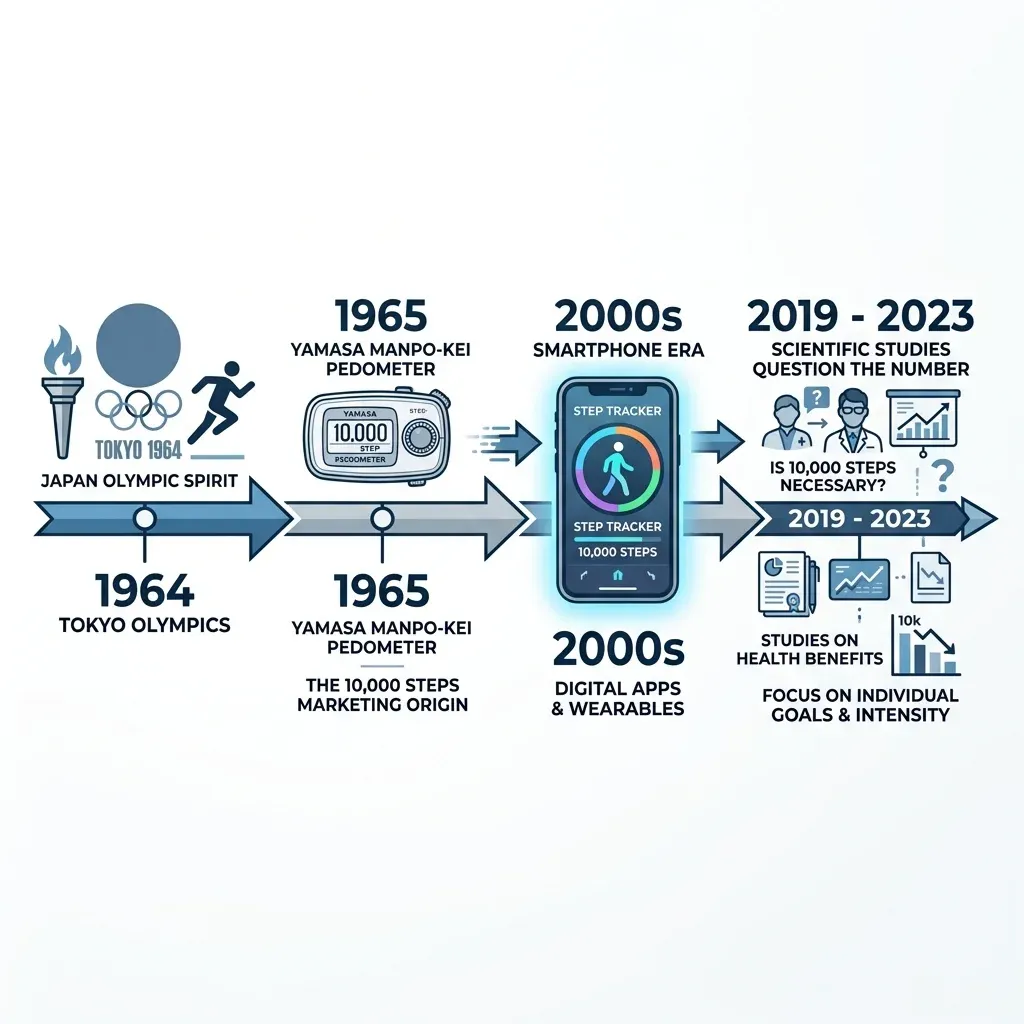
The 10,000-step goal has nothing to do with clinical research. It traces back to 1965, when a Japanese company called Yamasa Clock released a pedometer named the "manpo-kei" — which translates literally to "10,000-step meter." The name was chosen partly because the Japanese character for 10,000 (万) looks a bit like a person walking, and partly because the number sounded catchy. It was a branding decision, not a prescription backed by evidence.
The concept took hold internationally through walking clubs that became popular across Japan in the years following the 1964 Tokyo Olympics, when public interest in physical fitness surged. From there, it gradually migrated into global fitness culture, eventually embedding itself in the algorithms and default targets of modern activity trackers and smartphones.
Nobody questioned the number for a long time. Media outlets, health organizations, and fitness brands repeated it until it felt like established medical advice. Researchers didn't start systematically testing the relationship between daily step counts and hard health outcomes (mortality, cardiovascular disease, metabolic markers) until relatively recently. What they found tells a different story than the one on your watch face.
What Four Major Studies Reveal About Steps and Longevity
Since 2019, four major studies tracking more than 175,000 adults across multiple countries have produced a surprisingly consistent picture. Here's what each one found.
Key takeaway: Health benefits from walking begin well below 10,000 steps, follow a curve of diminishing returns, and vary by age — but more steps are never harmful.
The Lee Study (2019): Harvard researcher I-Min Lee and colleagues tracked 16,741 older women with an average age of 72 over approximately four years. They found that mortality risk decreased steadily as daily step counts rose — but the benefit curve flattened around 7,500 steps per day. Women who walked 7,500 steps daily had roughly the same mortality risk as those walking 10,000 or more. This was one of the first rigorous studies to directly challenge the 10,000-step threshold, showing that for older adults, fewer steps delivered comparable protection.
The Saint-Maurice Study (2020): Using data from NHANES, the nationally representative US health survey, Saint-Maurice and colleagues tracked 2,382 adults aged 40 and older over a decade. Adults averaging 8,000 steps per day had a 51% lower risk of all-cause mortality compared to those taking 4,000 steps. At 12,000 steps, the risk reduction reached 65%. Notably, step intensity — whether people walked slowly or briskly — had no independent effect on mortality after accounting for total step volume.
The Paluch Meta-Analysis (2022): This massive pooled analysis, published in The Lancet Public Health, combined 15 international cohorts totaling 47,471 adults with a median follow-up of 7.1 years and 3,013 deaths. The results revealed a key age split: for adults aged 60 and older, mortality risk plateaued at approximately 6,000 to 8,000 steps per day. For adults younger than 60, the plateau extended to 8,000 to 10,000 steps. Compared to the lowest quartile (around 3,553 steps daily), adults in the highest quartile (around 10,901 steps) had a 53% lower mortality risk.
The Stens Meta-Analysis (2023): Published in the Journal of the American College of Cardiology, this study pooled data from 111,309 individuals across 12 studies and produced perhaps the most precise dose-response picture to date. Risk reductions became statistically significant at just 2,517 steps per day for all-cause mortality and 2,735 steps for cardiovascular disease (compared to a baseline of 2,000). The optimal dose — defined as the point of maximum benefit for the least effort — landed at 8,763 steps for mortality and 7,126 for cardiovascular disease. Beyond these numbers, additional risk reductions were not statistically significant.
| Study | Sample Size | Key Finding | Optimal Step Range |
|---|---|---|---|
| Lee et al., 2019 | 16,741 women | Mortality plateau at 7,500 steps for older women | 7,500 steps/day |
| Saint-Maurice et al., 2020 | 2,382 adults | 8,000 steps = 51% lower mortality vs 4,000 | 8,000–12,000 steps/day |
| Paluch et al., 2022 | 47,471 adults | Age-dependent plateau: 6,000–8,000 (≥60 yrs), 8,000–10,000 (<60 yrs) | 6,000–10,000 steps/day |
| Stens et al., 2023 | 111,309 adults | Optimal mortality dose at 8,763 steps; CVD at 7,126 steps | 7,000–9,000 steps/day |
The Sweet Spot Isn't 10,000 — It's Closer to 7,000–9,000
Pull the data from all four studies together and the same pattern shows up every time. The relationship between daily steps and health isn't a straight line. It's a curve. The steepest part, where each additional step buys you the most benefit, sits between roughly 3,000 and 7,000 steps per day. After that, the curve gradually levels off. By the time you reach 8,000 to 10,000 steps, additional gains get smaller and smaller.
Think of it like zone 2 cardio for fat burning and longevity — the first dose delivers disproportionate value. A person who goes from 3,000 to 6,000 steps daily is making a far more consequential change than someone going from 10,000 to 15,000. Both are moving in the right direction, but the health return on investment is lopsided in favor of the person starting from the lower baseline.
This matters practically because it removes a common psychological barrier. The all-or-nothing framing of "10,000 or bust" can discourage people who are currently sedentary. If you're walking 2,500 steps a day, the research says that getting to 5,000 could reduce your mortality risk by roughly 40%. You don't need to double that again to get a meaningful benefit — though there's nothing wrong with doing so if you want to.
The bottom line: The JACC meta-analysis found that every additional 1,000 steps, equivalent to about 10 minutes of walking, provides measurable health benefits. The greatest returns come at lower baselines.
What about exceeding 10,000 steps? No study has found that high step counts carry health risks. Walking 15,000 or even 20,000 steps per day does not appear to increase mortality or injury risk in healthy adults. The curve simply levels off — you're not getting much additional protection against chronic disease, but you might enjoy other benefits like better mood, improved cortisol regulation and stress management, and greater cardiovascular fitness.
Does Walking Speed Change the Equation?
People often ask whether walking faster makes a bigger difference than simply walking more. The answer from the research: it helps a little, but less than most people assume.
The Paluch meta-analysis examined stepping rate (cadence) across seven studies and found mixed results. Peak stepping rate over any 30-minute or 60-minute window was associated with lower mortality even after adjusting for total step count. But the time spent walking at sustained moderate pace thresholds (40+ or 100+ steps per minute) showed no independent association with mortality once total steps were accounted for.
The JACC analysis by Stens and colleagues found a more definitive cadence effect. After adjusting for total daily step count, intermediate cadence (around 63 steps per minute) and high cadence (around 88 steps per minute) were each associated with roughly a 20-22% additional mortality risk reduction compared to a low cadence of about 25 steps per minute.
| Factor | Effect on Mortality | Independent of Total Steps? |
|---|---|---|
| Total daily step count | Strong dose-response curve, plateauing at 7,000–9,000 | N/A (primary factor) |
| Peak 30-min cadence | Associated with lower mortality | Yes (Paluch 2022, Stens 2023) |
| Sustained moderate pace (≥40 steps/min) | Associated with lower mortality | No (Paluch 2022) |
| Brisk walking (≥100 steps/min) | Weak association | No (Paluch 2022) |
What does this mean for your daily walk? Volume wins. If you have to choose between walking farther or walking faster, walk farther. But if you're already hitting a comfortable daily number and want to squeeze out more benefit, try mixing in a few five-minute intervals at a pace that leaves you slightly breathless. You'll boost your peak cadence without turning a walk into a workout.

Your Ideal Step Count Depends on Where You Are Right Now
One finding from the Paluch analysis stands out above the rest: the right step target depends on your age. Adults 60 and older saw their mortality benefit plateau at roughly 6,000 to 8,000 steps per day. Under-60 adults needed more, with the plateau sitting at 8,000 to 10,000 steps. Sex didn't matter. Men and women showed essentially the same dose-response curve in both the Paluch and Stens analyses.
Why do older adults need fewer steps? Probably because each step costs them more effort. Mobility decreases and aerobic capacity declines with age, so 6,000 steps for an 80-year-old is a bigger physiological ask than the same distance for a 40-year-old. The body's response to that effort, including improved cardiovascular function, better glucose regulation, and reduced systemic inflammation, kicks in at a lower absolute volume.
| Age Group | Suggested Step Range | Based On |
|---|---|---|
| Under 60 | 8,000–10,000 steps/day | Paluch 2022 spline analysis |
| 60 and older | 6,000–8,000 steps/day | Paluch 2022, Lee 2019 |
| Currently sedentary (<5,000) | Add 2,000–3,000 to current level | Stens 2023 (every 1,000 steps helps) |
Researcher Catrine Tudor-Locke's widely cited step index classifies adults into activity categories: below 5,000 steps per day is sedentary, 5,000 to 7,499 is low active, 7,500 to 9,999 is somewhat active, and 10,000 or above is active. The average American adult takes between 5,000 and 7,000 steps daily. So for most people, the goal isn't necessarily to hit 10,000 — it's to move meaningfully above wherever they currently sit.
This framework also applies if you're managing chronic conditions. The research participants in these studies included adults with varying health profiles, and the dose-response relationships held across body weights, chronic disease status, and fitness levels. For someone recovering from illness or dealing with anxiety and physical health challenges, even a modest increase in daily steps can deliver measurable benefit.
Six Strategies That Actually Work to Build Daily Steps
Numbers are easy. Habits are hard. The real challenge is fitting more walking into a schedule that already feels packed. These six approaches are grounded in behavioral research and work for people who don't have a spare hour lying around.
1. Stack walks onto existing habits. Habit stacking works better than willpower. If you already make coffee every morning, commit to a 10-minute walk while it cools. If you eat lunch at your desk, take 15 minutes afterward to walk. Linking new behaviors to established routines dramatically improves adherence over time.
2. Split your goal into two or three short walks. You don't need to do all your steps in one session. Three 10-minute walks scattered throughout the day add up to roughly 3,000 steps and 30 minutes of moderate activity — which aligns with the WHO's physical activity guidelines of 150 minutes per week. The metabolic benefits of walking are preserved whether the activity is accumulated in one block or spread across the day.
3. Use your commute as a walking opportunity. Park farther from the entrance. Get off transit one stop early. Walk to errands that are within a mile. These micro-decisions can add 1,000 to 3,000 steps without requiring dedicated exercise time.
4. Track, but don't obsess. Pedometers and fitness trackers increase daily step counts by an average of 2,000 to 2,500 steps in research studies. The act of measuring creates awareness, which drives behavior change. But fixating on the exact number can backfire — especially if missing 10,000 by a few hundred feels like failure. Set a range rather than a single target.
5. Walk with someone. Social accountability is one of the strongest predictors of exercise adherence. A walking partner, a dog, or even a phone call during your walk can transform it from an obligation into something you look forward to.
6. Start below your goal and ramp gradually. The 2023 JACC study found that each additional 1,000 daily steps — about 10 minutes of walking — produces meaningful health improvements, particularly for those at lower baselines. If you're currently at 3,000 steps, aim for 4,000 next week. Then 5,000. Slow, sustainable increases stick better than dramatic overhauls, and the research shows that even modest gains produce measurable risk reductions.

Frequently Asked Questions
Is 10,000 steps a day actually necessary for good health?
No. Large-scale meta-analyses show that significant health benefits — including reduced mortality and lower cardiovascular disease risk — begin at far fewer steps. The optimal range for most adults falls between 7,000 and 9,000 steps daily, and for older adults, as few as 6,000 to 8,000 steps may be sufficient. The 10,000-step target originated as a Japanese marketing slogan in 1965, not a medical recommendation.
How many steps should I aim for if I'm over 60?
Research from the 2022 Paluch meta-analysis of 47,471 adults shows that mortality risk reduction plateaus at approximately 6,000 to 8,000 steps per day for adults aged 60 and older. Walking more than that range doesn't appear to cause harm, but it yields progressively smaller additional health benefits. Start wherever you are and build gradually — even increasing by 1,000 steps from your current baseline produces measurable improvements.
Does walking speed matter more than total steps?
Total step count matters most. Multiple studies have found that step intensity shows little to no independent association with mortality once total volume is accounted for. However, the 2023 JACC meta-analysis found that higher peak cadence — brief periods of faster walking — may provide about a 20% additional mortality risk reduction beyond step volume alone. Walking at a comfortable pace is sufficient; brisk intervals are a bonus, not a requirement.
Can I split my daily walking into multiple short sessions?
Yes. The metabolic and cardiovascular benefits of walking are preserved whether you accumulate steps in a single session or across multiple shorter walks throughout the day. The WHO recommends 150 to 300 minutes of moderate-intensity physical activity per week without specifying session length. Three 10-minute walks accomplish roughly the same health outcomes as one 30-minute walk.
What's the minimum number of daily steps that actually helps?
The 2023 JACC meta-analysis found statistically significant mortality risk reductions beginning at approximately 2,500 steps per day compared to a 2,000-step baseline. Each additional 1,000 steps — about 10 minutes of walking — provides further measurable benefit. For people currently sedentary (below 5,000 steps), adding even 2,000 steps per day can reduce mortality risk by approximately 40%.
Related Articles
- Zone 2 Cardio for Fat Burning and Longevity — Understanding the heart rate zone that delivers many of the same benefits as walking.
- How Cortisol Drives Weight Gain and What Actually Helps — Walking is one of the most effective tools for managing cortisol levels naturally.
- Health Benefits of Turmeric: The Complete Evidence-Based Guide — An anti-inflammatory companion to your walking routine.
- Electrolytes Explained: Sodium, Potassium, Magnesium for Hydration — Proper hydration and mineral balance for daily walkers.
Medical Disclaimer
This article is for informational and educational purposes only and is not medical advice, diagnosis, or treatment. Always consult a licensed physician or qualified healthcare professional regarding any medical concerns. Never ignore professional medical advice or delay seeking care because of something you read on this site. If you think you have a medical emergency, call 911 immediately.