Your muscles work harder, but they probably won't grow
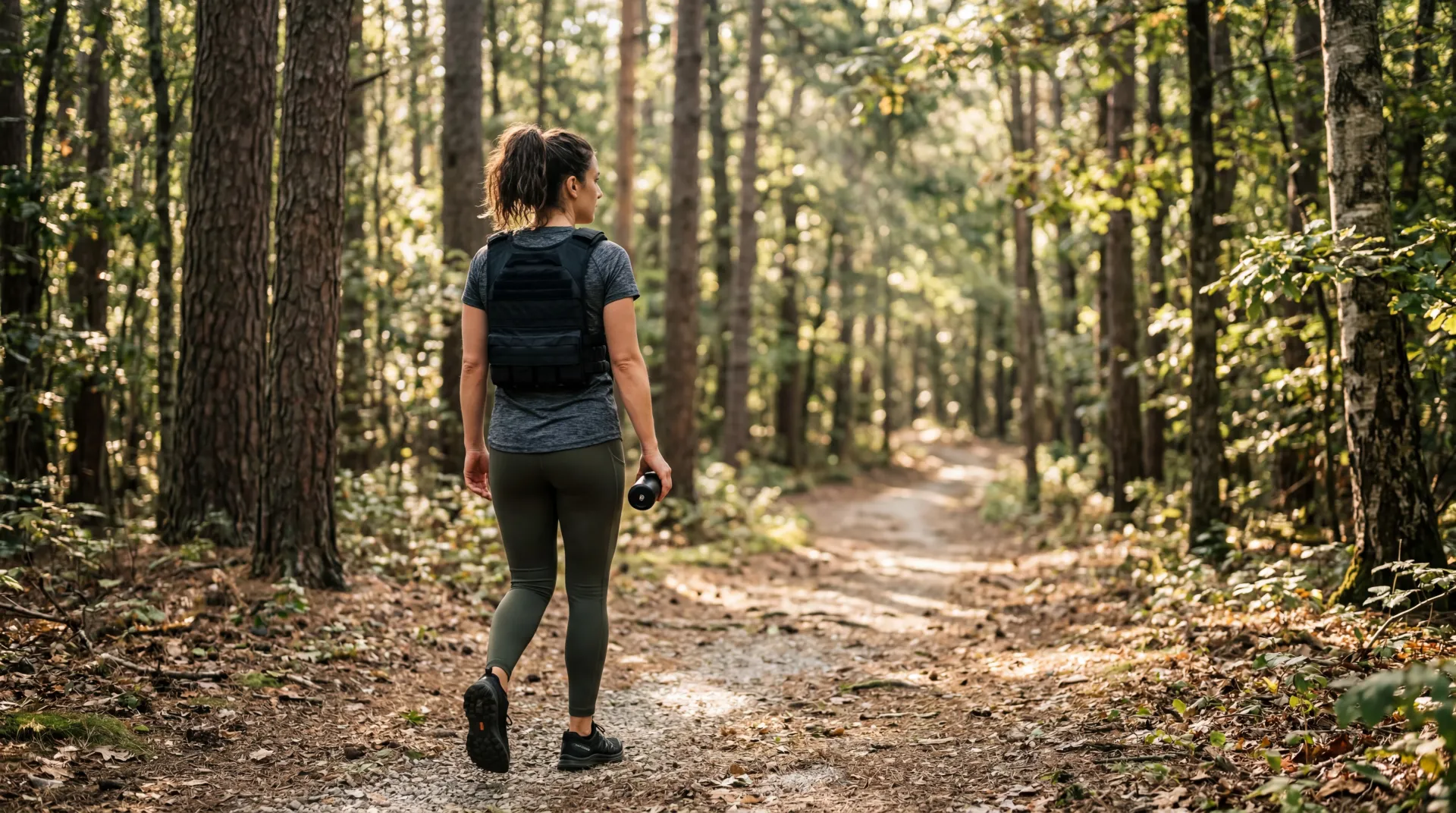
Strap on a vest loaded to 10% of your body weight and take a walk. Within the first few hundred meters, you'll notice your heart beating faster, your breathing picking up, and your legs working against resistance they didn't sign up for. That's basic physics: more mass means more force required per step.
A 2006 study in Medicine & Science in Sports & Exercise measured this directly. Researchers had 10 subjects walk on a treadmill at five speeds under four vest conditions: 0%, 10%, 15%, and 20% of body mass. Every loaded condition significantly increased vertical ground reaction forces compared to walking unloaded. Your legs are springs, and the vest is compressing them harder with every step. The heavier the vest, the more your skeletal system has to absorb.
Your cardiovascular system responds, too. Roger Fielding, who studies exercise science at Tufts University, put it plainly in an NPR interview: "It will increase your energy expenditure, your oxygen consumption -- all those vascular responses will go up." Your heart rate climbs, your lungs work harder, and over time, this can translate to improved cardiovascular fitness.
But there's a gap between what the vest does and what social media claims it does. Lauren Colenso-Semple, an exercise scientist at McMaster University, told NPR that walking or running with a vest doesn't stress muscles enough to make them grow. Building muscle requires moving a joint through its full range of motion under significant resistance -- a bicep curl with a dumbbell, a squat with a barbell. Walking is locomotion, not resistance training. A vest makes locomotion harder, but it doesn't turn a walk into a gym session.
What the vest does well is activate stabilizing muscles. Jared Laxner, a certified strength and conditioning specialist at the CU Anschutz Health and Wellness Center, described how the straps across the shoulders provide constant sensory feedback, prompting wearers to open their chest and reduce slouching. A 2026 Frontiers in Public Health mini-review of 15 weighted vest studies in adults over 60 confirmed that task-based vest training at 10% body mass produced significant improvements across all 12 neuromuscular measures assessed in one randomized trial -- balance, strength, walking endurance, and more. Those gains came from structured exercise sessions, not from wearing the vest around the house.
A 10% vest adds roughly 10% more calories per walk
The relationship between vest weight and calorie burn is roughly linear, and it works through a simple mechanism: moving more mass requires more energy. Researchers at the U.S. Army Research Institute of Environmental Medicine published a 2024 study in Medicine & Science in Sports & Exercise that developed and validated a metabolic model for vest-borne loads. They tested loads ranging from 0% to 66% of body mass at speeds up to 1.97 m/s and validated their model against 12 reference datasets covering 264 participants. The metabolic cost scaled predictably with load.
The Puthoff et al. study from 2006 provides the most useful snapshot for recreational walkers. At moderate walking speeds (around 3.5 mph), a 10% body weight vest produced a statistically significant increase in oxygen consumption compared to walking unloaded. A 20% vest increased VO2 even further, significantly more than the 10% condition. Speed matters, too: the calorie-burn gap between vested and unvested walking widened at faster speeds. Walk briskly with a vest, and the metabolic multiplier kicks in harder.
Quick math: A 160-pound person walking briskly for 45 minutes burns roughly 250 calories. Add a 16-pound vest (10% of body weight), and you can expect an increase of approximately 20-30 additional calories for that same walk -- not the "double your calorie burn" that some influencers claim, but a real boost that compounds over weeks of consistent training.
Benjamin Gordon, an exercise science expert at the University of Florida, offered a practical counterpoint: "If you want to burn calories with weighted vests, then you're talking about low-intensity cardio. Is that the most efficient way to burn calories? Probably not. There are other options -- instead of 30 minutes of a walk, go 40 minutes. Go at a higher intensity. Increase the incline on a treadmill." Walking longer, faster, or uphill achieves similar metabolic results without joint-loading risk.
Where the vest may have a unique metabolic edge is in long-term weight management. The research team behind the INVEST study at Wake Forest University reported that older adults who wore weighted vests for 10 hours per day while dieting regained less weight in the year following their diet compared to those who dieted without a vest. The mechanism appears to involve metabolic adaptations -- your body maintains a higher baseline energy expenditure when it consistently carries extra load. Whether that effect holds for people wearing vests only during 30-60 minute walks remains unstudied.
The bone density evidence is real but complicated
Bone responds to mechanical loading the same way muscle responds to resistance: stress it appropriately, and it adapts by getting stronger. This principle, known as Wolff's law, is why astronauts lose bone in zero gravity and why weight-bearing exercise has been a cornerstone of osteoporosis prevention for decades. Whether strapping on a weighted vest provides enough of that signal to actually change bone depends on how you use it.
The most compelling evidence comes from a landmark study by Dr. Christine Snow and colleagues at Oregon State University. They followed 18 postmenopausal women (average age 64 at baseline) for five years. Nine women performed weighted vest plus jumping exercises three times per week for 32 weeks each year. Nine controls remained active but didn't do the program. After five years, the exercisers had gained 1.54% bone mineral density at the femoral neck -- the most fracture-prone part of the hip -- while controls lost 4.43% at the same site. That's a 6-percentage-point gap. At the trochanter, exercisers lost only 0.24% versus 3.43% in controls.
A 12-week study showed similar promise on a shorter timeline: postmenopausal women who trained three times per week with vests progressively loaded to 15% of body weight showed a 14.5% decrease in NTx, a biomarker of bone resorption (bone breakdown), along with a 40% improvement in ankle strength. Their body fat dropped while fat-free mass increased.
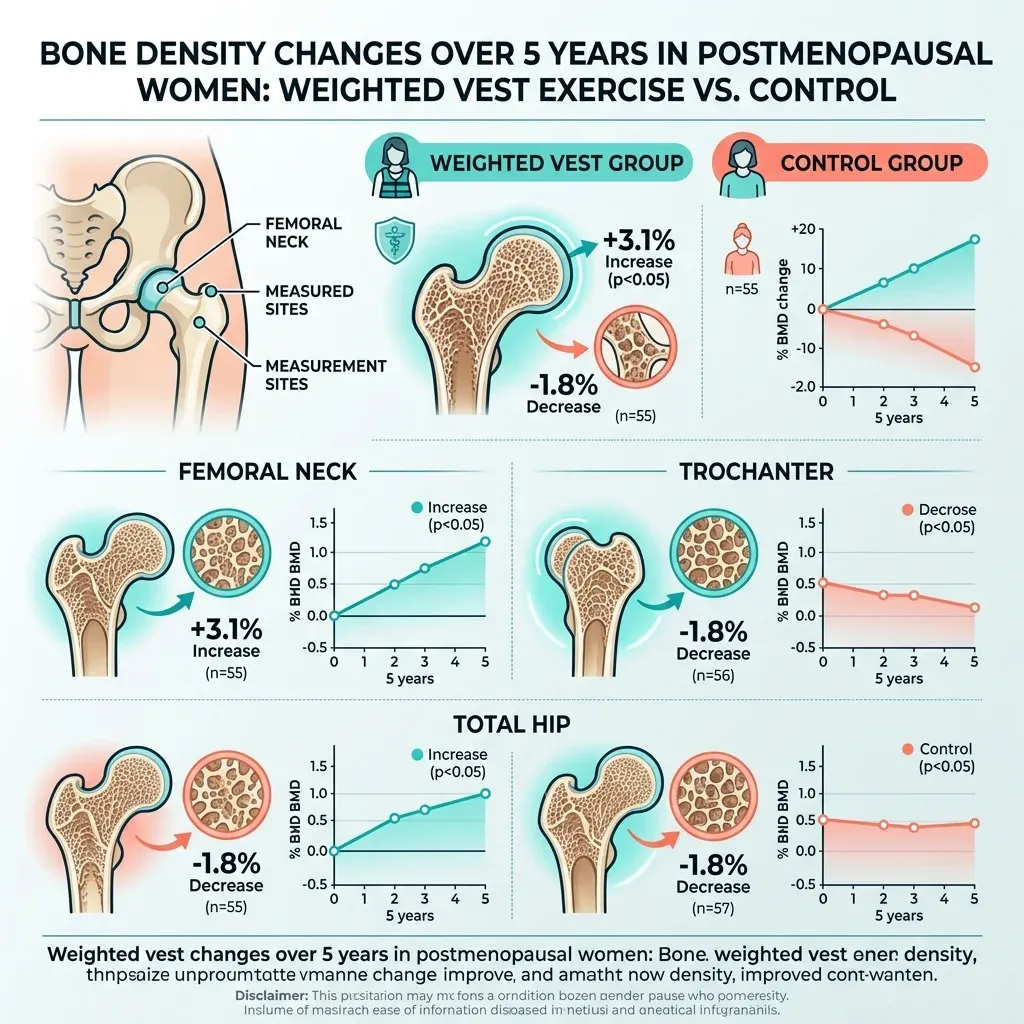
But the picture gets complicated with larger, more recent studies. The INVEST trial, led by Dr. Kristen Beavers at Wake Forest University and published in JAMA Network Open, enrolled 150 older adults with obesity (mean age 66.4, about 75% women). Participants were randomized to weight loss alone, weight loss plus weighted vest worn 8 hours daily, or weight loss plus supervised resistance training. After 12 months, all groups lost 9-11% of their body weight -- and all groups lost 1.2-1.9% of hip bone density. The vest didn't prevent bone loss. Neither did resistance training.
The critical distinction, as a 2026 Frontiers mini-review of 15 weighted vest studies spelled out: it's not whether you wear the vest that matters, it's what you do while wearing it. Studies where participants simply wore vests during daily activities at low loads (3-5% of body weight) showed no bone or muscle benefits. Studies where participants wore vests during structured exercise -- stepping, squats, jumping, stair climbing -- at loads of 5-10% of body weight showed measurable improvements. The vest is a tool that amplifies exercise, not a passive device that works while you sit on the couch.
| Study | Protocol | Bone outcome |
|---|---|---|
| Snow et al. 2000 | Vest + jumping, 3x/week, 5 years | Femoral neck +1.54% (controls -4.43%) |
| Shaw et al. 2007 | Vest to 15% BW, 3x/week, 12 weeks | NTx (bone resorption) decreased 14.5% |
| Beavers et al. 2025 (INVEST) | Vest worn 8h/day during weight loss, 12 months | No prevention of hip bone loss |
| Frontiers review: wear-only studies | 3-5% BW, 2h/day passive wear | No improvement in bone markers |
Dr. Sarah Wherry, a geriatrics researcher at the CU School of Medicine, added another layer of nuance: "Just because a bone is getting denser does not always necessarily directly translate into reduced fracture." The correlation between density and fracture risk is real but imperfect. People with normal bone density still break bones. And the INVEST team has preliminary conference data suggesting weighted vests may benefit bone health more in women than in men, possibly due to sex differences in how bone responds to mechanical loading.
The practical takeaway for postmenopausal women concerned about bone health: a weighted vest worn during structured exercises like step-ups, squats, and walking has some evidence behind it, particularly for the hip. But wearing one passively during the day, or relying on it as your only bone-health strategy, doesn't match what the research shows. Dr. Beavers at Wake Forest emphasized that "the most tried and true ways to prevent bone loss would be progressive resistance training with some degree of impact that will load the bone," combined with adequate protein, calcium, and vitamin D.
On the trail, a vest beats a heavy pack for balance
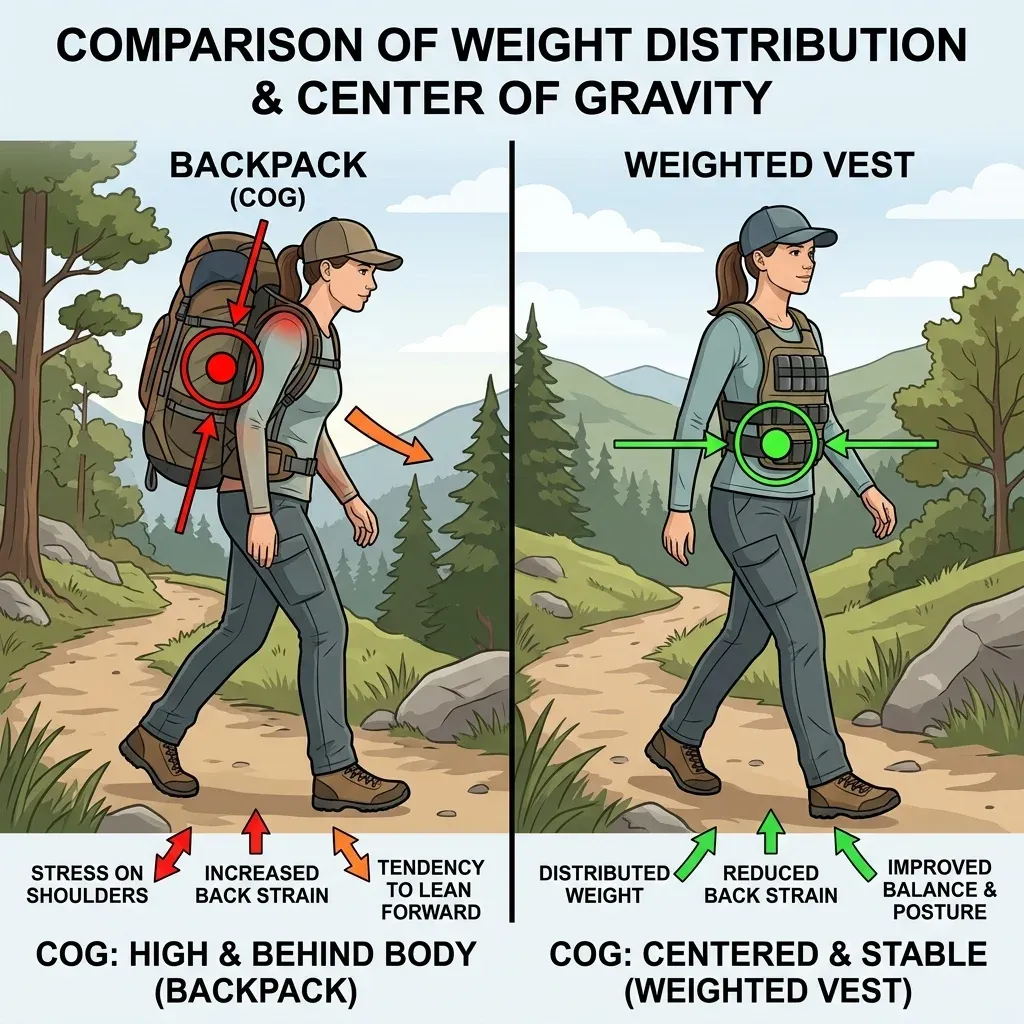
Hiking with a loaded backpack and hiking with a weighted vest are not the same biomechanical experience. The U.S. Army metabolic research team found that vest-borne load carriage has different energetic costs than backpacking -- the weight distribution changes how your body manages balance and energy expenditure. Dr. Sharon Hame, an orthopedic surgeon at UCLA Health, explained the key difference: "A weighted rucksack puts the weight on your back and shifts your center of gravity accordingly. A weighted vest distributes weight evenly on your torso."
On flat pavement, that distinction is minor. On a rocky trail with uneven footing, it matters. A backpack loaded to 20 pounds shifts your center of mass backward and upward, forcing you to lean forward to compensate. A vest at the same weight keeps the load close to your center of gravity, which means less compensatory leaning and more natural gait mechanics. If you've ever stumbled on a root while wearing a heavy day pack, you know how far forward momentum can carry you when your center of mass is off.
"If you are concerned about your stability or your back, a weighted vest may be the better choice," Dr. Hame said. That applies doubly on trail terrain where ankle rolls and balance saves happen regularly.
There are limits, though. Jared Laxner at CU Anschutz warned that agility-type movements with a vest -- quick pivots, lateral steps, hopping over obstacles -- "can increase rotational forces and may lead to an increased risk of knee, hip, and ankle ligament injuries." On a trail with constant direction changes, scrambling sections, or steep technical descents, the vest adds load to movements your joints may not be prepared for. Stick to well-maintained trails with moderate grades when you're starting out, and save the scrambling for unloaded hikes.
The Frontiers review recommended that vest training begin "on flat surfaces" and explicitly advise avoiding "complex or higher-risk terrain (e.g., stairs, uneven ground)" during the familiarization phase. Translate that to hiking: start with your easiest local trail before taking the vest up anything technical.
What to look for in a weighted vest
Weighted vests range from $40 to $300 and carry anywhere from 3 to 50 pounds. The wrong choice can mean discomfort, poor fit, or injury.
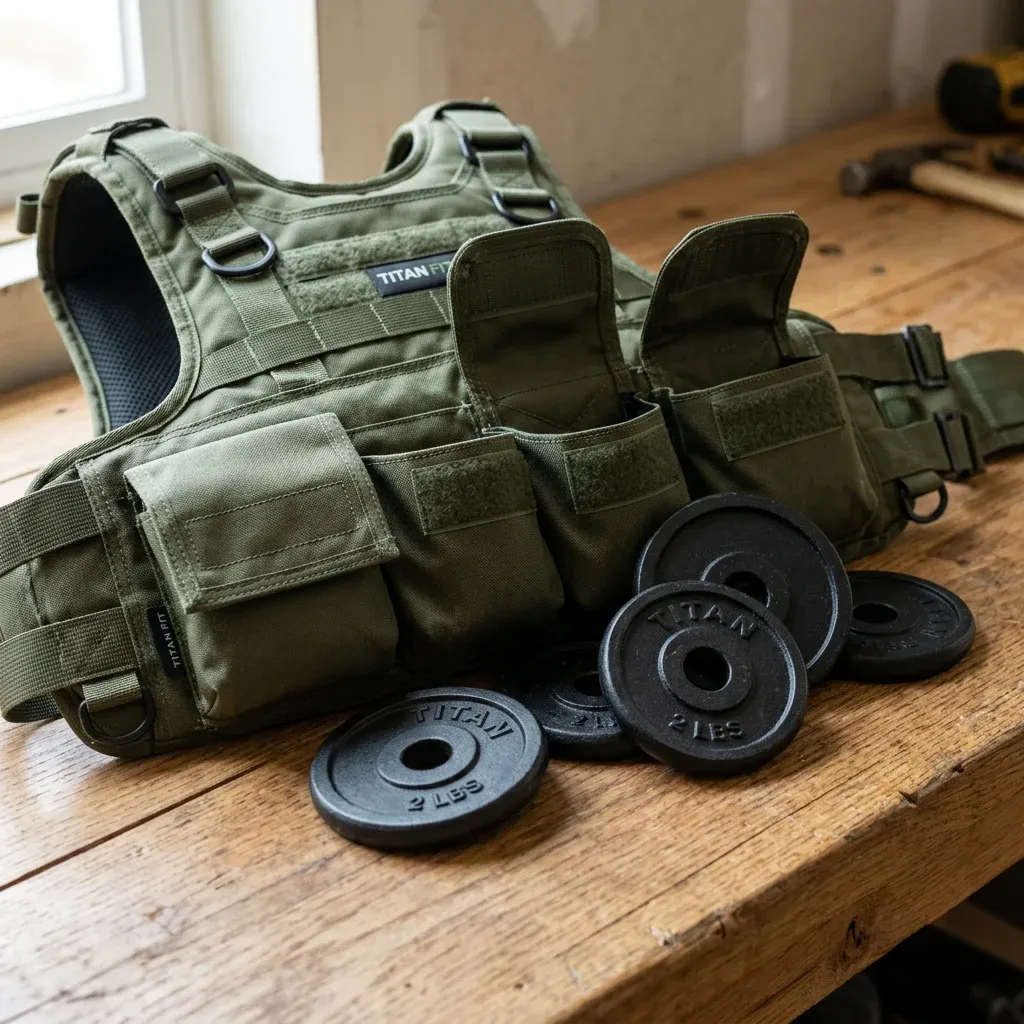
Adjustable weight is non-negotiable. Both Dr. Hame at UCLA and Laxner at CU Anschutz specifically recommend vests with removable weights so you can start light and add load incrementally. Fixed-weight vests lock you into one intensity level, which defeats the entire principle of progressive training.
Fit determines safety. A vest that shifts while you walk changes your center of gravity unpredictably. Dr. Hame emphasized getting a vest "that fits you properly" to ensure "the weight is evenly distributed on your body and the vest won't shift around as you move." Look for vests with both shoulder and waist straps that cinch down tight. If the vest bounces when you walk briskly, it's too loose or the wrong shape for your torso.
Don't overbuy on weight capacity. If you weigh 160 pounds, your ceiling is about 16 pounds of vest weight (10% of body mass, per Harvard Health's recommendation). Buying a 50-pound vest "for future growth" means wearing a poorly fitting, oversized shell with most of the weight pockets empty. A vest designed for a 10-20 pound range will fit better and distribute its weight more evenly at the loads you'll actually use.
| Feature | Why it matters |
|---|---|
| Removable weight plates/bags | Allows progressive loading from week to week |
| Shoulder + waist straps | Prevents shifting and bouncing during movement |
| Weight range matching your needs | A 150-lb person needs max ~15 lbs, not a 50-lb vest |
| Breathable material | Reduces overheating and skin irritation during extended wear |
| Front and back weight distribution | Keeps center of gravity neutral, reduces back strain |
One issue that rarely comes up in marketing but appeared in the research: about half of older adults in one study reported difficulty putting on and taking off their vest. If you have limited shoulder mobility or dexterity, look for front-opening vests rather than overhead pullover designs. The Frontiers review also documented one case of severe contact dermatitis from wearing a vest against bare skin during water exposure -- wear a base layer underneath, especially in hot weather when you'll be sweating.
A 6-week plan to start weighted vest walking
The universal advice from researchers and clinicians is "start low, go slow." The biomechanical reason, as Benjamin Gordon at UF described: when you add load to repetitive movements like walking (2,000 to 12,000 steps per session), "it exponentially increases the risk of injury" compared to doing those movements at body weight alone.
The Frontiers review recommends starting at 1-5% of body mass for older adults (1-3% for frail individuals, 3-5% for those with average function). Dr. Hame at UCLA recommends about 5% for the general population. Dr. Wherry at CU Anschutz suggests staying at that weight for two to three weeks before increasing, provided there's no pain.
Before you start: If you have back or neck problems, spinal stenosis, disc degeneration, arthritis in the hips, knees, or ankles, or poor joint health, talk to your doctor first. Multiple experts -- from Harvard to UCLA to UF -- flag these as conditions requiring medical clearance before adding external load.
| Week | Vest load | Walk duration | Frequency | Notes |
|---|---|---|---|---|
| 1-2 | 3-5% body weight | 15-20 min | 2-3x/week | Flat terrain only. Focus on posture: shoulders back, gait normal |
| 3-4 | 5-7% body weight | 20-30 min | 3x/week | Add gentle inclines if no pain. Monitor for hunching or stride changes |
| 5-6 | 7-10% body weight | 30-40 min | 3-4x/week | Can introduce step-ups or bodyweight squats wearing vest 1x/week |
The progression principle from the Frontiers review follows a specific order: increase duration first, then speed or terrain difficulty, then vest weight. Loading is the last variable you adjust, not the first. If you're tempted to jump straight to 10% body weight on day one, consider that the Shaw et al. study -- which achieved that 14.5% drop in bone resorption markers and 40% ankle strength gain -- took 12 weeks to progress to 15% body weight, with weekly incremental increases.
Dr. Hame offered one specific routing tip: start with small loops rather than out-and-back routes. "When you do an out-and-back route, it's easy to go too far and struggle to make it back." Walk a block from your house, assess how you feel, and turn around. You can always go farther next time.
Watch for the red flags that the INVEST researchers identified: hunching forward, a clipped walking stride (shorter steps than normal), low back pain, and spinal hyperextension. Any of those means the vest is too heavy, you've been walking too long, or both. Remove the vest, rest, and reduce the load next session. The Frontiers review's recommended stop rules: new or worsening pain, dizziness, or marked instability.
Frequently Asked Questions
Can I wear a weighted vest every day?
You can, but research suggests you probably shouldn't start there. The Frontiers mini-review found that daily passive wear at low loads (3-5% body weight) produced no measurable improvements in bone or muscle outcomes. Structured training sessions 3-4 times per week with adequate recovery days between produced better results. If you do wear a vest daily for household tasks, keep it light and watch for signs of overuse like persistent joint soreness.
Will a weighted vest help with weight loss?
It will increase calorie burn modestly during walking -- roughly proportional to the added weight. A 10% body weight vest adds approximately 8-12% more calories burned per walk. Over months, that compounds. The INVEST research team also found metabolic benefits that helped dieters maintain weight loss in the year after their diet. But Dr. Gordon at UF points out that walking longer or faster achieves similar results without joint-loading risk.
Is a weighted vest safe for someone with osteoporosis?
This requires a conversation with your doctor. Dr. Beavers at Wake Forest noted that hip fractures can be devastating for older adults -- "many people who experience a hip fracture are likely to die within the next year." While some research shows vest exercise can help maintain hip bone density, it also increases fall risk in some populations. The INVEST trial recorded more falls in the vest group (14) than in the diet-only group (10), though the trial wasn't designed to measure fall risk specifically.
How is a weighted vest different from rucking?
Dr. Hame at UCLA explained that the biggest difference is weight distribution. A rucksack loads your back and shifts your center of gravity rearward. A vest distributes weight evenly around your torso. For people concerned about stability or with back issues, the vest is generally the safer choice. On trails, the vest's balanced loading reduces the risk of forward stumbles that plague heavy-pack hikers.
At what body weight percentage should I cap my vest?
Terry Downey, a physical therapist at Harvard-affiliated Spaulding Rehabilitation Network, recommends not exceeding 10% of body weight. The Frontiers review cites 5-10% as the range where task-based training produced measurable bone and neuromuscular benefits. Going beyond 10% is territory reserved for progressive training protocols under supervision.
Medical Disclaimer
This article is for informational and educational purposes only and is not medical advice, diagnosis, or treatment. Always consult a licensed physician or qualified healthcare professional regarding any medical concerns. Never ignore professional medical advice or delay seeking care because of something you read on this site. If you think you have a medical emergency, call 911 immediately.