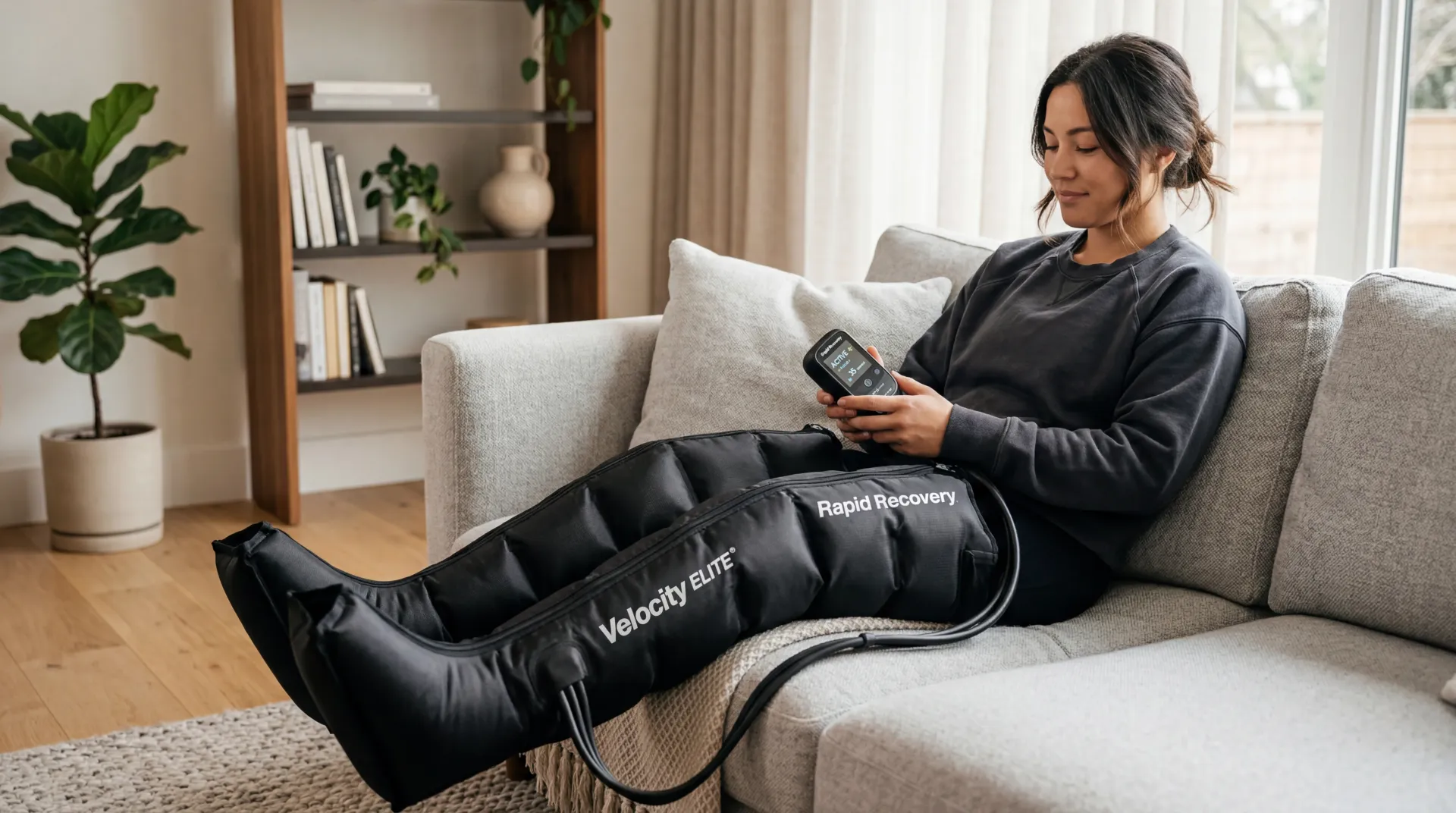
Your Legs Already Have a Drainage System — Compression Boots Just Speed It Up
Your circulatory system has a design problem. Your heart pumps blood down to your legs with no issue — gravity helps. Getting that blood back up is harder. The veins and lymphatic vessels in your legs rely on tiny one-way valves and the squeezing action of your muscles to push fluid upward against gravity, back toward your heart. When you stop moving — after a hard run, a long flight, or a day standing at work — that return flow slows down. Fluid pools. Metabolic waste from exercise sits in your muscle tissue instead of getting cleared out. Pneumatic compression boots try to solve this problem mechanically.
The technology is older than most people realize. Research into pneumatic compression devices began in the 1950s, originally designed to provide rhythmic compression for patients who couldn't move. By the 1970s, hospitals were routinely using intermittent pneumatic compression (IPC) to prevent deep vein thrombosis in post-surgical patients. The sports world caught on much later — Normatec launched in 1998 as one of the first athletic-focused compression systems, and the company was acquired by Hyperice in 2020.
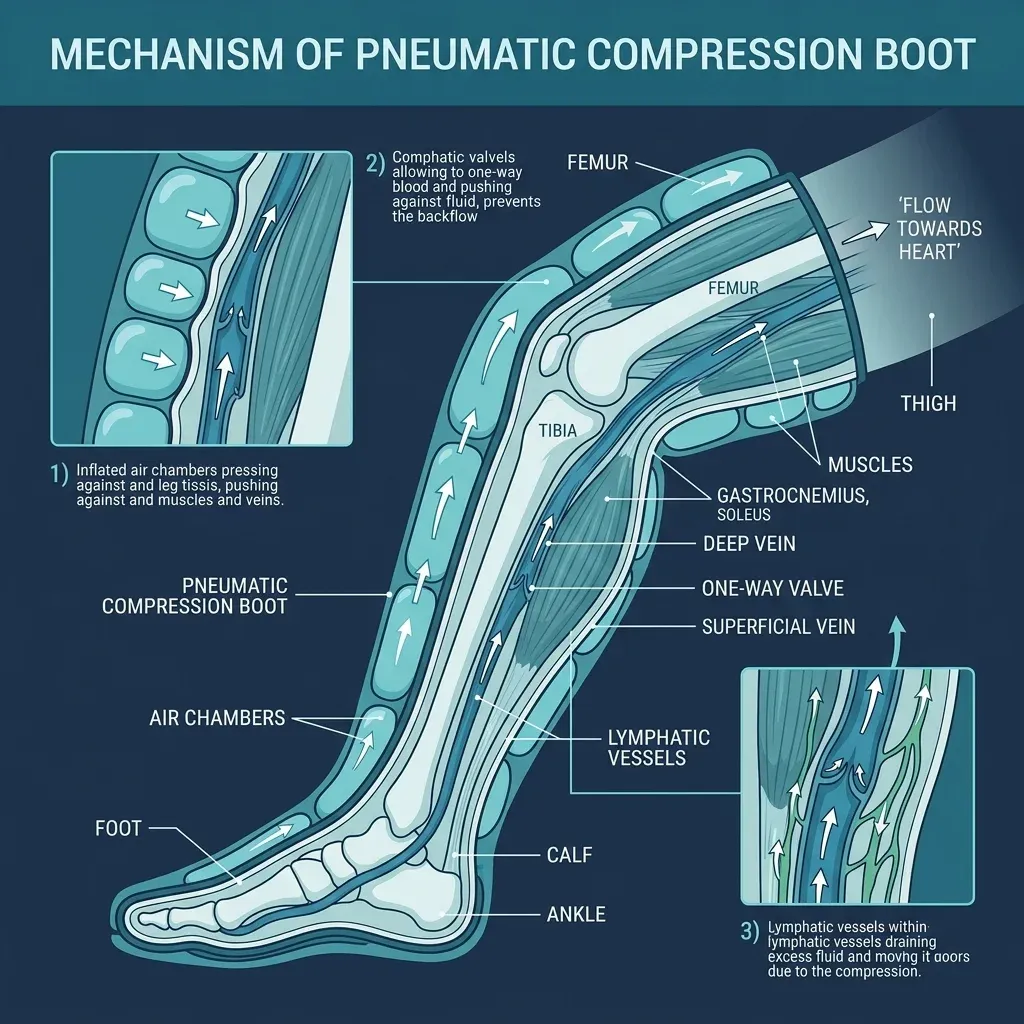
Think of your leg veins like a series of locks in a canal. Each valve is a gate that only opens one direction — upward. When compression boots inflate sequentially from your feet toward your thighs, they're acting like a wave pushing water through those locks. According to Cleveland Clinic, the sleeves inflate every 20 to 60 seconds and then deflate. During compression, blood moves through the veins toward the heart. During the release phase, oxygen-rich blood flows into the leg arteries. The devices also stimulate the body's release of natural clot-preventing substances.
The lymphatic system gets less attention but matters just as much for recovery. Unlike your blood vessels, lymphatic vessels have no pump — they depend entirely on muscle contractions and external pressure to move fluid. Your lymphatic system is responsible for maintaining fluid balance in body tissues and is a key component of immune function. When Kathleen Leninger, D.P.T., a physical therapist at Custom Performance in New York City, explains the rationale for compression boots to her patients, she frames it simply: "Because your legs are below your heart, it's harder for the heart to pump that waste from your legs to your lymph system, which helps get rid of it." Compression boots create that pumping action mechanically, forcing the fluid through vessels that would otherwise drain slowly at rest.
The practical takeaway: your body already knows how to drain metabolic waste from your legs. Walking, stretching, and muscle contractions do this naturally. Compression boots accelerate a process that would happen on its own — the question is whether that acceleration makes a meaningful difference for your recovery.
17 Studies, 319 Athletes, and a Surprising Answer About Soreness
If you ask compression boot manufacturers whether their products work, you'll get an enthusiastic yes. If you ask the clinical research, you'll get something more like "it depends on what you mean by work."
The most comprehensive analysis to date is a 2024 systematic review and meta-analysis published in Biology of Sport by Filipe Maia and colleagues. They pooled data from 17 randomized controlled trials involving 319 participants and calculated standardized effect sizes for three categories: muscle function, pain and soreness, and muscle damage markers.
The results split cleanly along a fault line that matters for anyone considering buying these devices. For perceived pain and soreness, IPC showed a statistically significant small effect immediately after use (effect size 0.486) and at 96 hours post-exercise (effect size 0.368). The peak benefit appeared at the 48-hour mark with a moderate effect size of 0.644 — which happens to coincide with when delayed onset muscle soreness (DOMS) typically peaks. In other words, boots seem to help most exactly when you hurt most.
For actual muscle function — the ability to jump, sprint, and produce force — the picture was less encouraging. The effect sizes were non-significant across every time point: 0.243 at 0-2 hours, 0.134 at 24 hours, 0.117 at 48 hours, and 0.089 at 72 hours. Translated from statistics to plain language: boots may make your legs feel better without actually making them perform better.
A 2025 randomized controlled trial published in Nature Scientific Reports added more texture to this picture. Researchers led by Trybulski studied 48 professional combat sports athletes split into four groups: pneumatic compression at 25 mmHg, pneumatic compression at 100 mmHg, cryo-compression therapy, and passive rest. The higher-pressure compression group maintained superior muscle elasticity at 48 hours post-exercise compared to all other groups. But here's the catch — full pain recovery wasn't achieved within 48 hours in any group, regardless of the intervention.
What about the studies that get cited most often in marketing materials? A 2016 JOSPT trial involving 72 ultramarathon runners found that post-exercise pneumatic compression offered the same benefits as post-exercise massage. A 2015 study on 24 highly trained Olympic athletes showed that a 15-minute IPC session after morning training reduced pain pressure threshold for the rest of the day. These are real findings — but they also reveal that the boots compete with, rather than exceed, a good sports massage.
There's a methodological problem worth acknowledging. Only 6 of the 17 studies in the systematic review used a placebo condition. That matters because subjective measures like "how sore do you feel?" are particularly susceptible to the placebo effect. When you strap on an expensive, impressive-looking device that squeezes your legs for 30 minutes, you expect to feel better — and expectation alone can shift pain perception. The researchers noted this limitation explicitly.
One more finding that rarely makes it into the marketing: IPC does not appear to significantly affect blood lactate clearance or heart rate recovery. The idea that boots "flush lactic acid" is one of the most common selling points, and the meta-analysis doesn't support it.
A $1,000 Recovery Tool That Performs Like a $0 Leg Elevation?
Professional athletes use compression boots constantly. You see them in NBA locker rooms, at Olympic training centers, and in NFL recovery suites. But professional athletes also have access to full-time athletic trainers, cold plunge pools, scheduled massage sessions, and carefully optimized sleep environments. For them, marginal gains from boots stack on top of an already comprehensive recovery program. The economics work differently when you're paid millions to perform.
For recreational athletes, the runners logging 30 miles a week and the CrossFitters training five days, the cost-benefit math shifts. Dr. Jeff Sankoff, an emergency physician and IRONMAN University certified coach who has completed six IRONMAN races including Kona, put it bluntly in his analysis for TrainingPeaks: "When advising the budget-conscious athlete, they shouldn't prioritize PCDs, as they simply do not provide any performance benefits or enhance recovery in any meaningful way."
That's a strong statement, and it warrants context. Sankoff's assessment aligns with the meta-analysis data: no statistically significant performance improvements. But the people who use boots regularly tell a different story. Kaysee Fulbright, a professional mountain bike racer, told Bicycling that she uses her Normatec boots specifically because they "incentivize" her to sit down and recover — something she wouldn't otherwise do. Ebenezer Samuel, Men's Health's Fitness Director, frames it differently: "The end result is definitely relaxing — thus allowing my nervous system to down regulate. That down regulation has recovery value."
| Recovery Method | Cost | Soreness Relief | Performance Improvement | Convenience |
|---|---|---|---|---|
| Compression boots | $80-$1,000+ | Small to moderate | Not demonstrated | High (home use) |
| Sports massage | $60-$120/session | Small to moderate | Not demonstrated | Low (appointments) |
| Leg elevation | Free | Mild | Not studied | High |
| Active recovery (walking) | Free | Small | Small positive | Medium |
| Compression socks | $15-$50 | Small | Minimal | High |
The comparison that matters most comes from academic research rather than marketing. Exercise, massage, and pneumatic compression all produce similar benefits in terms of draining fluid from tissues and enhancing return of blood and lymph to the heart. The key distinction is convenience: boots don't require a therapist, they work at home while you watch TV, and they deliver consistent pressure every time. One Reddit user in the r/AdvancedRunning community captured what many recreational users feel: "They make my legs feel immediately better and less sore, which is worthwhile to me, even if there is no measured effect on actual running performance."
If you're already sleeping well, eating properly, staying hydrated, and doing basic active recovery, compression boots add a marginal subjective benefit. If you're skipping those fundamentals, an $800 pair of boots won't compensate. But for athletes who value the enforced rest period and the subjective relief, and who can afford the investment, the boots work as an expensive but effective nudge toward better recovery habits.
Six Recovery Boots Under $500 That Weren't Available Three Years Ago
Three years ago, getting into pneumatic compression at home meant spending $800 minimum. The market has changed. Several models now sit below the $500 mark, and some budget options have dropped under $150. The technology itself hasn't fundamentally changed — sequential air chambers, inflating and deflating along your leg — but wireless capability, app connectivity, and manufacturing competition have driven prices down while expanding features.
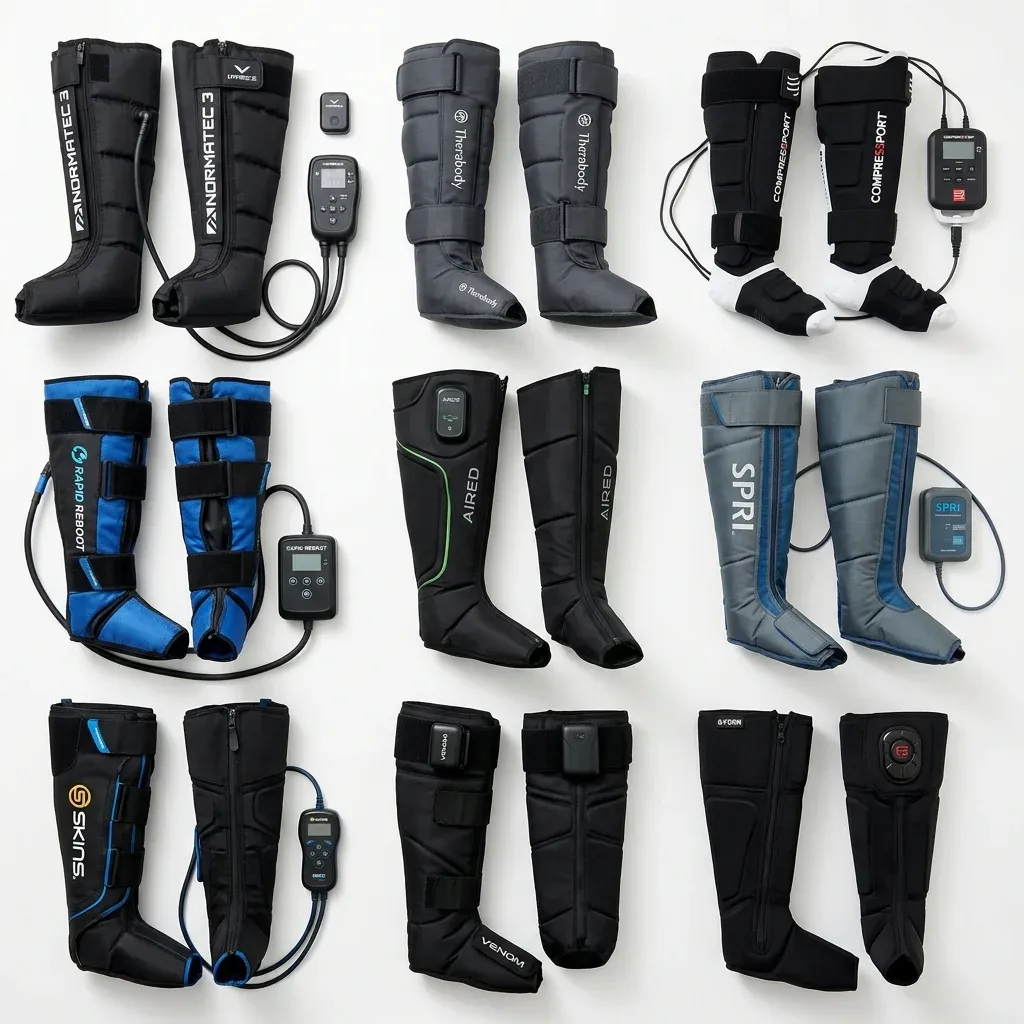
Here is what the market looks like for buyers watching their budget, based on testing and reviews from Forbes Vetted and Men's Health:
| Model | Price Range | Compression Levels | Wireless | Battery Life | Coverage |
|---|---|---|---|---|---|
| Aicutti Compression Boots | Under $100 | 3 modes + heat | No | N/A (wired) | Foot + calf |
| Sharper Image (Costco) | ~$130 | Multiple | No | N/A (wired) | Full leg |
| Air Relax | ~$250-350 | 4 modes | No | N/A (wired) | Full leg |
| Hyperice Normatec Go | Under $400 | 7 levels | Yes | 180 min | Calf only |
| Therabody JetBoots Prime | ~$550 | 4 levels (25-100 mmHg) | Yes | 180 min | Full leg |
A few things worth noting about this table. The Aicutti boots, at under $100, are the cheapest functional option. They include three massage modes, adjustable intensity, and a heat setting — a feature list that would have been unthinkable at that price point even two years ago. The trade-off: they're wired (you need an outlet), cover only foot and calf, and long-term build quality is uncertain.
The Sharper Image boots available at Costco for around $130 have attracted a vocal following among runners. Multiple users in the AdvancedRunning subreddit report they can't tell the difference from Normatec, though they acknowledge they're comparing against memories of Normatec sessions rather than side-by-side testing. The Costco return policy reduces the risk of trying them.
The Hyperice Normatec Go, at under $400, represents something new: a portable, wireless, TSA-approved system that weighs just 1.2 pounds. The limitation is that it covers calves only — no foot, knee, or thigh compression. For runners whose calves take the worst beating, that might be enough. If you need quad or hamstring coverage, look elsewhere.
For reference, the premium tier starts with the Normatec 3 at approximately $799 and climbs to the Normatec Elite at roughly $999, which adds wireless operation, seven compression levels spanning 30 to 110 mmHg, four hours of battery life, and Bluetooth app connectivity. Dr. Tonie Reincke, a vascular specialist consulted by Forbes, noted that "as technology continues to evolve, these devices are becoming more effective, user-friendly and accessible to a wider range of individuals."
One practical distinction that reviews rarely emphasize: the number of compression zones matters. More zones means smoother sequential compression that more closely mimics your body's natural fluid dynamics. Budget models tend to have fewer, larger chambers. Premium models divide the leg into more segments. Whether that difference translates to a detectable difference in recovery is something no study has tested directly.
The Medical Conditions That Make Compression Boots Dangerous
Compression boots are broadly safe for healthy people. But "broadly safe" comes with specific exceptions that manufacturers tend to bury in fine print and reviewers tend to skip entirely.
Johns Hopkins Medicine lists clear contraindications for IPC devices: people with leg ulcers, burns, or peripheral vascular disease face elevated risk. The Conversation, drawing on academic sources, adds severe congestive heart failure, arterial disease, and active deep vein thrombosis to the list. The irony is notable — IPC devices are routinely used to prevent DVT in hospitals, but should never be used when an active clot is already present, because compression could dislodge it.
Additional risks documented by Cleveland Clinic and Hopkins include skin irritation or breakdown (especially in older adults), discomfort and warmth beneath the cuffs, and rare cases of nerve damage or pressure injury. These are uncommon with proper use, but they become more likely with incorrect cuff sizing or excessive pressure.
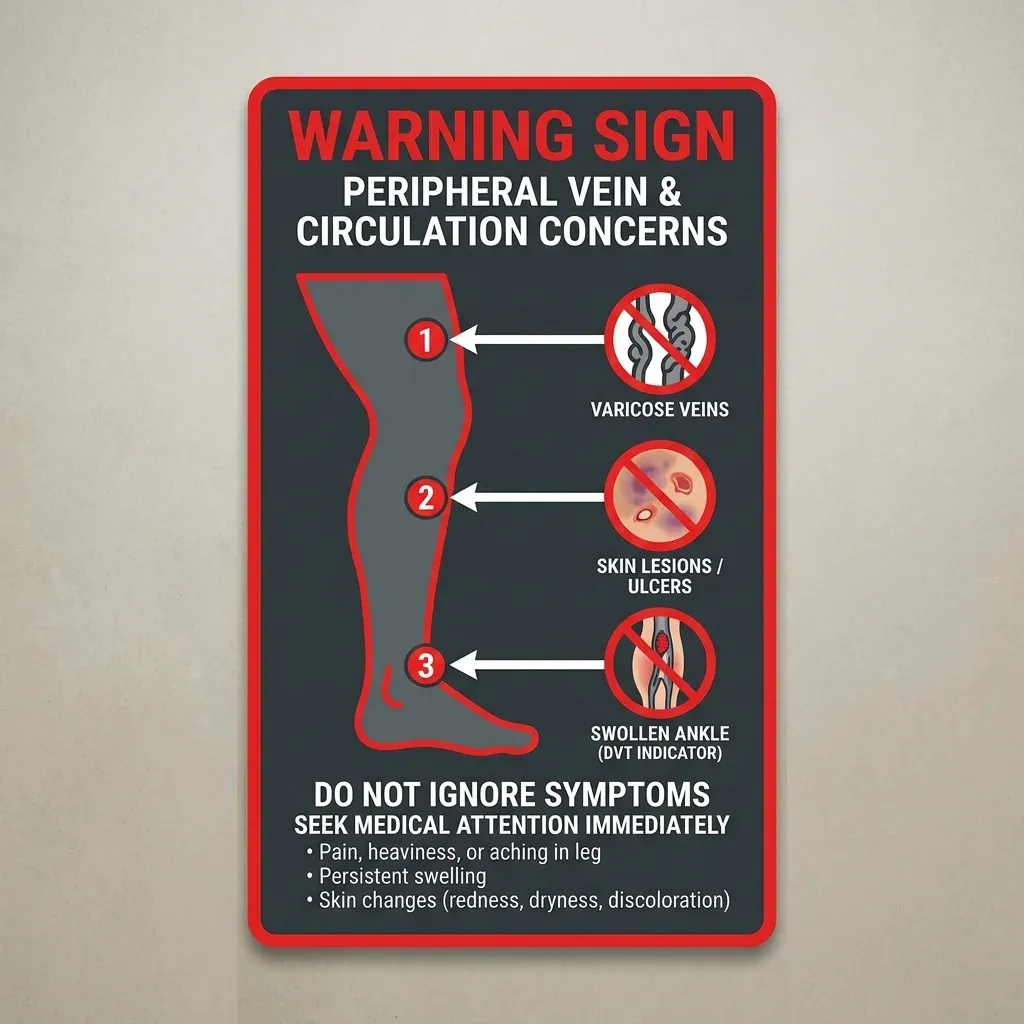
Beyond medical contraindications, there are several situations where boots simply won't deliver what people expect:
Compression boots will not flush lactic acid from your muscles. The meta-analysis of 17 RCTs found IPC does not significantly affect blood lactate clearance. This is one of the most common marketing claims, and it isn't supported by the pooled research data.
They won't prevent muscle damage from occurring. A 2021 review in the Journal of Sport Rehabilitation that examined IPC specifically for endurance athletes concluded the method was not effective for reducing exercise-induced muscle damage — though it acknowledged short-term subjective relief. The 2025 Nature study confirmed that LDH (a muscle damage marker) increased across all groups after exercise, including those receiving compression therapy.
They won't replace sleep, nutrition, or hydration. Eric Madia, a strength and conditioning coach interviewed by Bicycling, warns that higher pressures can cause discomfort and numbness — tingling in your feet signals the pressure is too high. If you can see a depression from the boot seams marked on your legs after a session, you've compressed too aggressively.
And they won't produce performance gains that show up in your next workout. The systematic review found non-significant effects on muscle function at every time point measured. You may feel fresher, but translating that subjective feeling into measurable performance improvements has not been demonstrated in controlled research.
The 30-Minute Post-Workout Window That Matters Most
If the research paints a complicated picture, the practical advice is straightforward. The most consistent finding across studies is that compression works best when applied soon after exercise, for a specific duration and pressure range.
The meta-analysis found that protocols of 20 to 30 minutes at approximately 80 mmHg were the most commonly used and appeared to optimize recovery outcomes. This aligns with what The Conversation reports about sports-specific compression protocols: 20-30 minutes at about 80 mmHg after high-intensity sessions.
Eric Madia, the strength and conditioning coach, is more specific with his athletes. He recommends using the boots three to four times per week, with sessions lasting 30 to 35 minutes. "That's usually one to two workouts, and then you flush your system," he explains. "That ratio has really shown the best amount of recovery in our athletes."
| Setting | Duration | Pressure | Frequency |
|---|---|---|---|
| Medical (lymphedema, DVT prevention) | 45-60 min | 30-80 mmHg | Daily |
| Athletic recovery (post-workout) | 20-30 min | ~80 mmHg | 3-4x/week |
| Pre-workout warm-up | 10-15 min | Lower settings | As needed |
| Travel/general wellness | 20 min | Moderate | As needed |
Timing matters too. Madia advises using boots after workouts rather than before, explaining that "before a workout, you want to get neurologically excited; afterward, you want the opposite effect, you want your nervous system to switch to that rest and digest response, which is what the boots induce." The exception is for people who spend long periods on their feet — nurses, servers, retail workers — where a 10-15 minute pre-workout session can help flush already-fatigued legs.
The 2025 Nature RCT confirmed that higher pressure (100 mmHg) produced better results than lower pressure (25 mmHg) for muscle elasticity recovery. But there's a ceiling. Forbes Vetted recommends capping sessions at 20 to 30 minutes daily when starting out, and checking with a doctor if you have circulation issues, blood clots, or other medical conditions.
One underrated benefit that multiple sources mention independently: the forced downtime itself has value. Kathleen Leninger, the DPT from Custom Performance, told Bicycling that even if the only benefit is "sitting down and relaxing for 20 minutes while you use them, that's still worth it." For athletes who struggle to sit still and recover — which is most of them — compression boots function as a structured excuse to stop moving. That behavioral nudge might be worth more than the compression itself.
Frequently Asked Questions
Do compression boots actually speed up muscle recovery?
They reduce how sore you feel, but don't demonstrably speed up how quickly your muscles regain full function. A 2024 meta-analysis of 17 RCTs found moderate effects on perceived soreness (especially at 48 hours post-exercise) but non-significant effects on actual muscle function measurements like jump height, sprint speed, and force production. The subjective relief is real — the performance acceleration is not proven.
Are cheap compression boots as effective as Normatec?
No controlled study has compared budget and premium compression boots head-to-head. The core mechanism — sequential inflation and deflation — is the same across price points. Premium models offer more compression zones for smoother pressure transitions, wireless operation, and app connectivity. Whether those features translate to better recovery outcomes is untested. Multiple users in running communities report they can't distinguish the recovery effect between $130 Costco boots and Normatec, though these are subjective comparisons from memory.
Who should not use compression boots?
People with active deep vein thrombosis, severe congestive heart failure, peripheral arterial disease, leg ulcers, or burns should not use pneumatic compression devices, according to Johns Hopkins Medicine and academic sources. Older adults face higher risk of skin breakdown. If you have any circulatory condition, consult a physician before using these devices.
How long and how often should I use compression boots?
Research and practitioner recommendations converge on 20-30 minutes at approximately 80 mmHg after intense exercise, three to four times per week. Start with moderate pressure and increase gradually. If you feel tingling or numbness in your feet, the pressure is too high.
Can compression boots replace a sports massage?
A 2016 clinical trial with 72 ultramarathon runners found that pneumatic compression offered the same recovery benefits as post-exercise massage. The advantage of boots is consistency, convenience, and lower per-session cost over time. The advantage of massage is that a skilled therapist can adapt to specific problem areas in ways a machine cannot.
Medical Disclaimer
This article is for informational and educational purposes only and is not medical advice, diagnosis, or treatment. Always consult a licensed physician or qualified healthcare professional regarding any medical concerns. Never ignore professional medical advice or delay seeking care because of something you read on this site. If you think you have a medical emergency, call 911 immediately.