What Exactly Is Myo-Inositol, and Why Does Your Body Already Make It?
Myo-inositol has exploded across wellness spaces recently, but it is far from new. Your kidneys synthesize roughly two grams of it every day, and it has been part of clinical research since the 1980s. Chemically, it is a six-carbon sugar alcohol -- a cyclic compound structurally similar to glucose that sits inside nearly every cell membrane in your body.
Despite sometimes being labeled "vitamin B8," myo-inositol is not actually a vitamin. Your body can produce it on its own, and you also get it from foods like grapefruit (about 470 mg per four ounces of juice), cantaloupe, oats, beans, almonds, and walnuts. The typical American diet delivers somewhere between 250 mg and 1,650 mg daily, depending on food choices.
What makes myo-inositol far more interesting than an ordinary dietary compound is its role as a second messenger. When hormones like insulin, follicle-stimulating hormone (FSH), or thyroid-stimulating hormone (TSH) arrive at a cell, they need a way to relay their instructions inside. Myo-inositol provides the raw material for that relay system. It is converted into phosphatidylinositol, which then generates signaling molecules like inositol triphosphate (IP3) -- the molecular couriers that actually execute hormonal instructions within cells.
That single function -- enabling hormones to communicate -- helps explain why myo-inositol keeps appearing in research on conditions as different as anxiety disorders, sleep difficulties, insulin resistance, and polycystic ovary syndrome. When the supply of myo-inositol drops or gets disrupted, the downstream effects can ripple across multiple body systems at once.
Quick takeaway: Myo-inositol is not a trendy newcomer. It is a naturally occurring molecule your body already depends on for cell signaling, hormone communication, and metabolic regulation. Supplementing simply ensures the supply meets demand -- especially when factors like high blood sugar, caffeine intake, or insulin resistance increase your body's need for it.
The Anxiety Connection: How Myo-Inositol Influences Brain Chemistry
The interest in myo-inositol for anxiety did not begin on social media -- it began in neuropsychiatry labs studying the brains of people with mood disorders. Multiple magnetic resonance spectroscopy (MRS) studies have found that individuals with depression and anxiety have significantly lower myo-inositol levels in the anterior cingulate cortex, a brain region central to emotional regulation.
In one study of young adults with unipolar depression, brain myo-inositol concentrations in the anterior cingulate cortex averaged 0.84 compared to 0.96 in healthy controls -- a statistically significant difference. Lower myo-inositol also correlated with higher anxiety scores and worse insomnia symptoms, suggesting that the deficit is not confined to depression alone.
Why would a sugar alcohol matter so much to the brain? The answer lies in concentration. Brain myo-inositol levels reach 10 to 15 times the concentration found in blood, and the brain has limited ability to pull myo-inositol from the bloodstream. Instead, it depends heavily on local production. When that production falters -- whether because of inflammation, oxidative stress, or disrupted circadian rhythms -- the second messenger pathways that regulate serotonin and dopamine signaling can suffer.
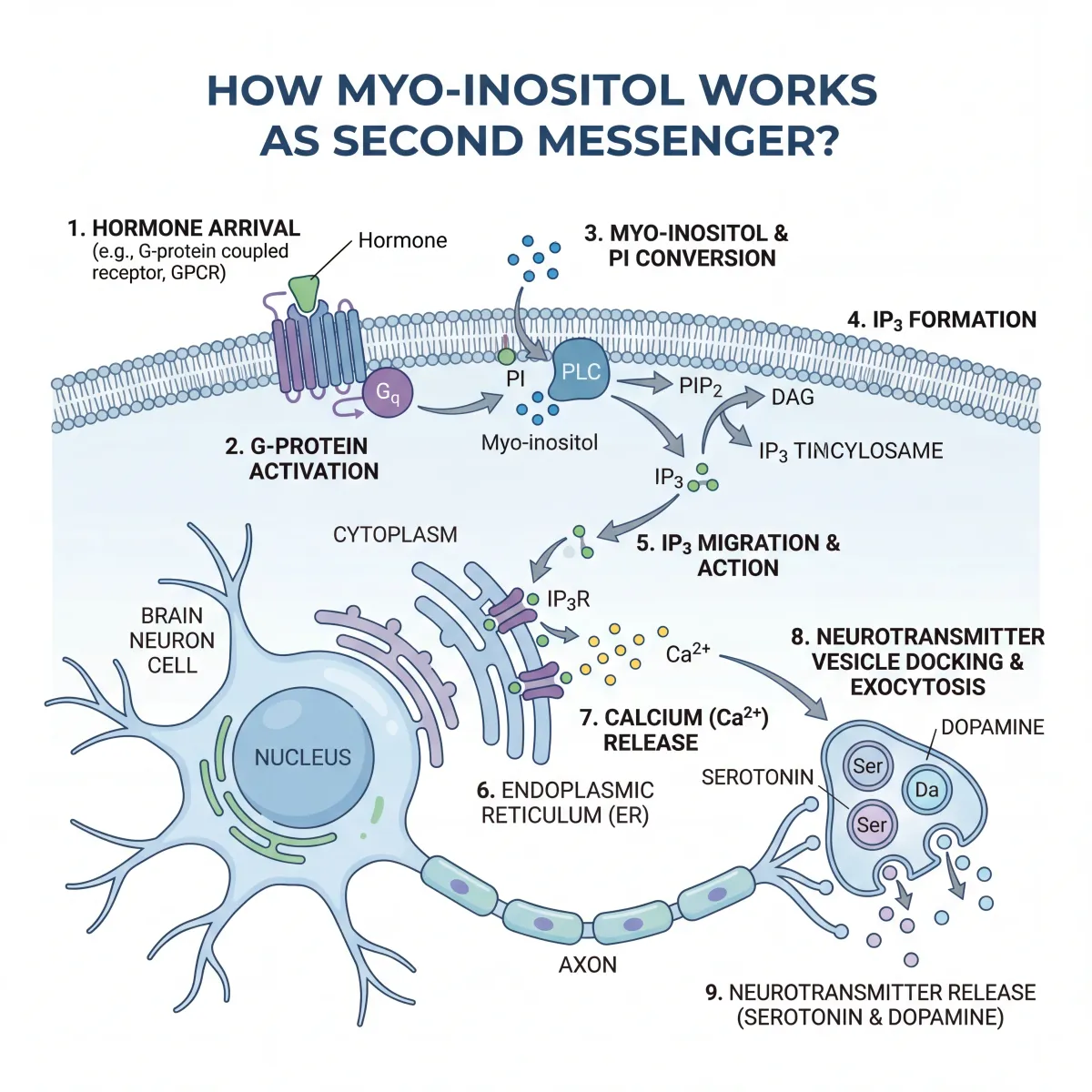
The Cleveland Clinic notes that inositol may influence brain chemistry by helping balance serotonin and dopamine, and that preliminary studies show potential for reducing the frequency and severity of panic attacks. Early clinical trials in the 1990s used doses of 12 to 18 grams daily for panic disorder and obsessive-compulsive disorder, with some showing benefits comparable to the SSRI fluvoxamine.
That said, the evidence for anxiety specifically remains a work in progress. The brain-imaging studies are observational -- they show an association between low myo-inositol and mood symptoms, not proof that supplementing reverses those symptoms. The panic disorder trials were small and have not been widely replicated with modern trial designs. What we can say with reasonable confidence is that the biological plausibility is strong: myo-inositol sits at the heart of the very signaling cascades that antidepressants and anxiolytics aim to modulate. Larger, well-designed trials are needed before myo-inositol can be recommended as a standalone anxiety treatment.
Why Myo-Inositol Keeps Showing Up in Sleep Research
Sleep and myo-inositol have a relationship that runs deeper than most people realize, and it centers on a hormone you already know: melatonin. Melatonin does not just tell your body when to feel sleepy -- it actively promotes myo-inositol production in the brain. When melatonin secretion shifts later (a phenomenon called delayed dim light melatonin onset, or DLMO), myo-inositol levels in the frontal cortex tend to drop right along with it.
A proton magnetic resonance spectroscopy study in adolescents found that frontal cortex myo-inositol correlated positively with total sleep time and negatively with daytime sleepiness and insomnia symptoms. These correlations persisted even after researchers statistically controlled for depression severity -- suggesting that the myo-inositol-sleep relationship is not simply a byproduct of feeling depressed.
This makes physiological sense when you consider the molecular details. Inositol triphosphate (IP3) receptors play a direct role in circadian entrainment -- the process by which your internal clock synchronizes with the 24-hour light-dark cycle. If your myo-inositol supply is low, your IP3-mediated circadian signaling may weaken, which could contribute to the kind of clock drift that manifests as trouble falling asleep, poor sleep quality, and excessive daytime sleepiness.
| Sleep Measure | Correlation with Brain Myo-Inositol | Significance |
|---|---|---|
| Total sleep time | Positive (higher MI = more sleep) | p < 0.05 |
| Daytime sleepiness | Negative (higher MI = less sleepiness) | p < 0.05 |
| Insomnia severity | Negative (higher MI = fewer symptoms) | p = 0.009 |
| Melatonin onset timing | Negative (higher MI = earlier onset) | p = 0.014 |
The practical question is whether oral supplementation can raise brain levels enough to influence sleep. Because the blood-brain barrier limits myo-inositol transport from the bloodstream, the brain largely depends on local synthesis. However, the fact that high-dose supplementation (12-18 grams daily) has shown neuropsychiatric effects in other contexts suggests some amount does cross over. This is an area where the mechanistic evidence is strong and encouraging, but direct sleep-focused clinical trials on oral myo-inositol supplementation are still scarce.
Where the Evidence Is Strongest: Hormonal Health and PCOS
If there is one area where myo-inositol has moved from "interesting" to "evidence-based," it is polycystic ovary syndrome. PCOS affects an estimated 5 to 21 percent of reproductive-age women worldwide, and insulin resistance drives most of its downstream problems: irregular cycles, elevated androgens, difficulty ovulating, and metabolic complications.
A meta-analysis of nine randomized controlled trials found that myo-inositol supplementation produced significant decreases in fasting insulin and HOMA index (a standard measure of insulin resistance) in women with PCOS. There was also a trend toward reduced testosterone levels and, in studies lasting at least 24 weeks, a significant increase in sex hormone-binding globulin (SHBG) -- a protein that helps keep free androgens in check.
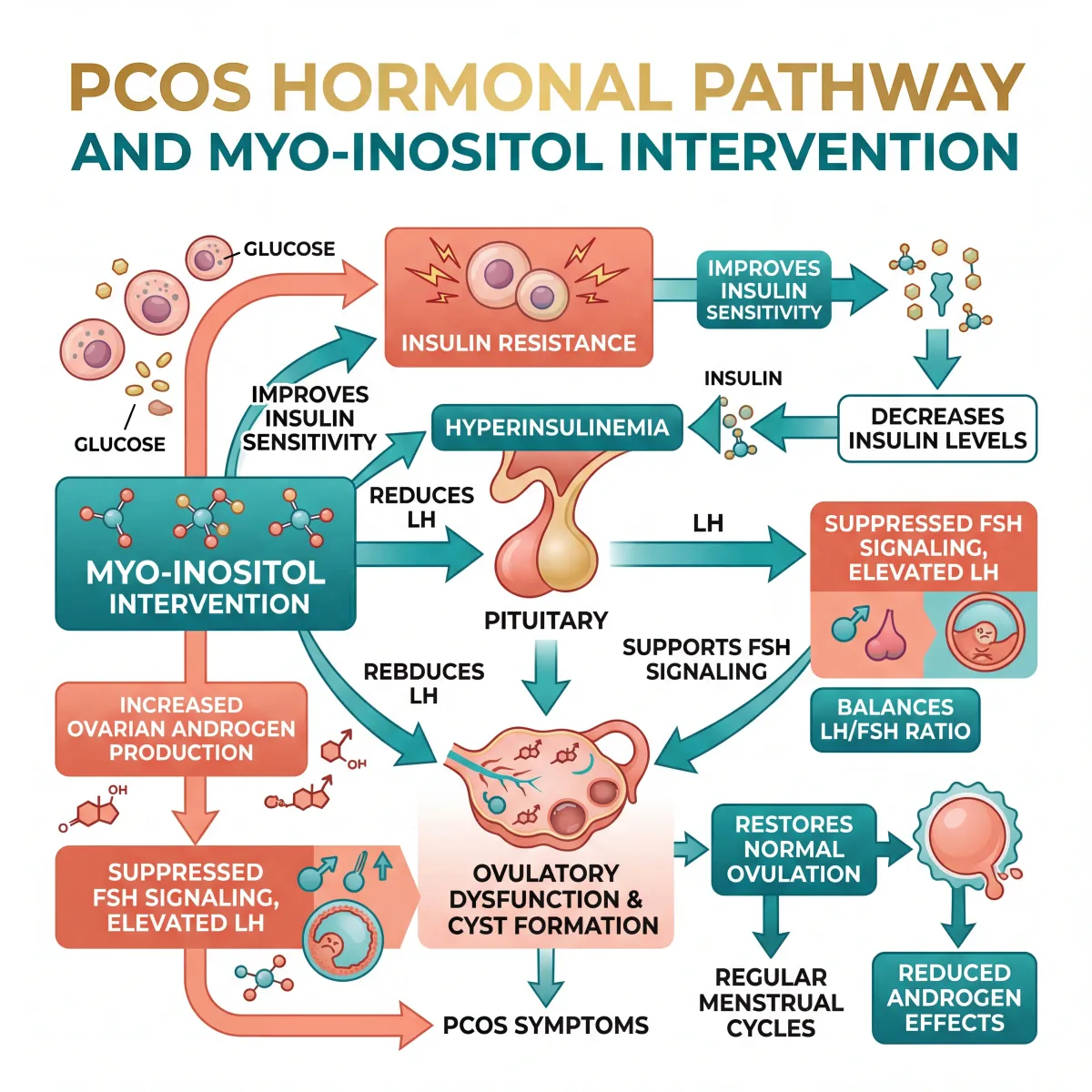
A prospective clinical study of 90 women with PCOS who took myo-inositol (1 gram twice daily) for six months tells a compelling real-world story. By the study's end, 68 percent had restored regular menstrual cycles. Among those who had complete amenorrhea at baseline, 79 percent experienced spontaneous return of menstruation. Luteinizing hormone dropped from 10.31 to 7.42 (p = 0.002), and fasting insulin fell from 16.71 to 13.18 (p = 0.041). Eighty-five percent of participants reported no adverse effects.
| Parameter | Before Treatment | After 6 Months | P-value |
|---|---|---|---|
| LH (mIU/mL) | 10.31 | 7.42 | 0.002 |
| LH/FSH ratio | 2.34 | 1.19 | <0.001 |
| Fasting insulin (uIU/mL) | 16.71 | 13.18 | 0.041 |
| HOMA-IR | 4.52 | 2.74 | 0.048 |
The mechanism is elegant. Myo-inositol works as a second messenger for both insulin and FSH -- two hormones that are centrally disrupted in PCOS. By improving insulin sensitivity, it reduces the compensatory hyperinsulinemia that ramps up ovarian androgen production. At the same time, it supports FSH signaling in the ovary, promoting aromatase activity (the enzyme that converts androgens to estrogens) and helping restore the follicular maturation process needed for ovulation.
This dual action is why a review in the European Review for Medical and Pharmacological Sciences called myo-inositol the most promising option for PCOS women because it improves hormonal parameters without the side effects of metformin, and it also appears to benefit the psychological symptoms commonly experienced by women with PCOS -- something most other treatments overlook.
Beyond Hormones: The Insulin and Metabolic Benefits Most People Miss
The conversation around myo-inositol tends to focus on PCOS and mental health, but the metabolic evidence deserves its own spotlight. Insulin resistance is not just a PCOS problem -- it sits at the foundation of metabolic syndrome, type 2 diabetes, gestational diabetes, and cardiovascular risk.
When insulin arrives at a cell, it does not magically open the doors for glucose on its own. It triggers a signaling cascade that includes inositol phosphoglycans (IPGs) derived from myo-inositol. These IPGs help mobilize GLUT4 transporters to the cell surface, allowing glucose to enter. If myo-inositol supplies are depleted -- which happens in insulin-resistant states due to increased urinary excretion and reduced cellular uptake -- this entire chain weakens.
The clinical results reflect that biology. In a randomized, placebo-controlled trial, 80 women taking myo-inositol (2 grams twice daily) experienced an 11 percent reduction in diastolic blood pressure, a 75 percent improvement in HOMA-IR, a 20 percent drop in triglycerides, and a 22 percent increase in HDL cholesterol. In postmenopausal women with metabolic syndrome, 12 months of myo-inositol supplementation improved blood glucose, insulin, lipid profiles, blood pressure, BMI, and waist circumference -- with 20 percent of treated women no longer meeting the criteria for metabolic syndrome by the study's end.
For gestational diabetes, the numbers are even more striking. Myo-inositol at 2 grams twice daily throughout pregnancy reduced the incidence of gestational diabetes by 40 to 87 percent across multiple studies, while also lowering the need for insulin therapy, improving fetal outcomes, and reducing rates of macrosomia.
| Condition | Key Finding | Dose Used |
|---|---|---|
| Metabolic syndrome | HOMA-IR improved 75%; 20% no longer met diagnostic criteria | 2g twice daily, 12 months |
| Gestational diabetes prevention | Incidence reduced 40-87% | 2g twice daily throughout pregnancy |
| PCOS insulin resistance | Fasting insulin reduced; HOMA-IR dropped from 4.52 to 2.74 | 1-2g twice daily, 3-6 months |
| Postmenopausal metabolic health | Improved glucose, lipids, BP, BMI, waist circumference | 2g/day, 12 months |
One comparison worth noting: in research reviewed by DiNicolantonio and colleagues, myo-inositol improved insulin resistance approximately twice as effectively as pioglitazone or metformin, which are considered the gold-standard pharmaceutical interventions for impaired glucose tolerance. That comparison does not mean myo-inositol replaces prescription medications -- but it puts the supplement's metabolic impact in perspective for anyone wondering whether a natural compound can genuinely move the needle on metabolic health markers.
Myths vs. Evidence: Separating Hype from What the Studies Actually Show
Social media loves a silver bullet, and myo-inositol has been positioned as one. But the research tells a more nuanced story. Here is what the evidence actually supports -- and where the claims outrun the data.
| Claim | What the Evidence Says | Verdict |
|---|---|---|
| "Myo-inositol cures anxiety" | Brain imaging shows lower MI in people with anxiety/depression. High-dose trials (12-18g) showed some benefit for panic disorder. No large RCTs for generalized anxiety. | Promising but unproven as standalone treatment |
| "It will fix your sleep" | Brain MI correlates with sleep duration and insomnia severity. No direct clinical trials testing oral supplementation for insomnia. | Mechanistically plausible; clinical evidence lacking |
| "It reverses PCOS" | Multiple RCTs and meta-analyses show significant improvements in insulin, hormonal parameters, ovulation, and menstrual regularity. | Strong evidence -- one of the best-supported uses |
| "It replaces metformin" | Head-to-head data suggest comparable or superior insulin-sensitizing effects with fewer side effects. Most studies use MI as an alternative, not a replacement. | Viable alternative for some; discuss with your doctor |
| "Anyone can take 18 grams safely" | Up to 18g for 3 months and 4g for 12 months shown safe. Higher doses may cause GI symptoms (nausea, diarrhea). | Safe at common doses; GI side effects at very high doses |
| "Myo-inositol and D-chiro-inositol are the same" | They are different stereoisomers with different functions. MI supports FSH signaling; DCI handles insulin-mediated androgen synthesis. High DCI can worsen ovarian function. | False -- the ratio matters significantly |
One of the most persistent myths is that more is always better, particularly with the myo-inositol to D-chiro-inositol (DCI) ratio. In reality, the body maintains these two stereoisomers in a precise balance -- approximately 40:1 in plasma and 70-100:1 in ovarian tissue. Taking excessive DCI can actually worsen PCOS symptoms by suppressing aromatase activity in the ovaries and increasing testosterone production. Studies in mice found that only the 40:1 ratio produced a full recovery from PCOS features; other ratios were less effective or actively harmful.
Another important caveat: about 30 to 40 percent of people may experience what researchers call "inositol resistance" -- a phenomenon where oral supplementation fails to raise tissue levels sufficiently. This may be due to impaired intestinal absorption, and preliminary research suggests that co-administering alpha-lactalbumin (a whey protein fraction) can help overcome this barrier. If you have tried myo-inositol without results, absorption issues rather than inefficacy may be the explanation.
Dosage, Forms, and What to Know Before You Start
If you are considering myo-inositol, the research provides fairly clear guidance on dosing -- though the right amount depends on what you are taking it for.
For PCOS and metabolic health, the most-studied dose is 2 grams of myo-inositol taken twice daily (4 grams total), usually combined with 200-400 micrograms of folic acid. Some formulations add D-chiro-inositol in a 40:1 ratio. Treatment durations in clinical studies typically range from three to six months before significant hormonal and metabolic changes emerge.
For mental health applications, the doses studied have been considerably higher -- 12 to 18 grams daily for conditions like panic disorder and OCD. These doses are safe based on available data but may cause gastrointestinal side effects such as nausea, gas, and diarrhea.
Myo-inositol is available as a powder (easily mixed into water or smoothies), capsules, and soft gels. The powder form allows more flexible dosing and is generally more economical at higher doses.
Several factors can increase your body's need for myo-inositol or deplete existing stores. Being aware of these can help you understand whether supplementation might be particularly relevant for you.
| Factor That Depletes Myo-Inositol | Mechanism |
|---|---|
| Insulin resistance / diabetes | Increased urinary excretion, reduced cellular uptake |
| Elevated blood glucose | Competitive inhibition of MI transporters |
| Caffeine (especially coffee) | Increases renal MI excretion |
| Low sodium intake | Sodium required for MI transport into cells |
| Magnesium deficiency | Mg required for MI biosynthesis |
| Certain medications (lithium, valproic acid) | Inhibit MI-related enzymes in the brain |
| Kidney damage | Kidneys are the primary MI production site |
Safety-wise, myo-inositol has a reassuring track record. Doses of up to 18 grams daily for three months and 4 grams daily for 12 months have been documented as safe and well-tolerated. The most common side effects at standard doses are mild gastrointestinal symptoms -- diarrhea, nausea, and abdominal discomfort -- reported in about 15 percent of participants in clinical studies. It is considered safe during pregnancy, where it has been specifically studied for gestational diabetes prevention.
One important note: myo-inositol is a supplement, not a substitute for prescribed medication. If you are taking medications for anxiety, depression, diabetes, or PCOS, talk to your healthcare provider before adding myo-inositol. It can be combined with many treatments, but adjustments may be needed -- particularly for insulin-sensitizing medications where the combined effect could lead to hypoglycemia. Ensuring adequate adaptogenic and supplement support works best as part of a conversation with your care team, not a solo experiment.
Frequently Asked Questions
How long does it take for myo-inositol to work?
Most clinical studies report meaningful changes in hormonal and metabolic markers within three to six months. For PCOS-related menstrual regularity, some women notice improvements within the first one to two months. Mental health effects at higher doses (12-18 grams) were observed within four to six weeks in the limited trials available. Consistency matters more than speed -- myo-inositol works by gradually restoring cellular signaling pathways, not by producing an immediate pharmacological effect.
Can I take myo-inositol if I do not have PCOS?
Yes. While PCOS is the best-studied application, myo-inositol has demonstrated benefits for metabolic syndrome, gestational diabetes prevention, and insulin resistance regardless of PCOS status. The brain-imaging studies linking myo-inositol to mood and sleep quality were conducted in populations without PCOS. Anyone with insulin resistance, high caffeine intake, or elevated blood sugar may have increased myo-inositol needs.
What is the difference between myo-inositol and D-chiro-inositol?
They are different stereoisomers of inositol with distinct functions. Myo-inositol supports FSH signaling and glucose transport into cells, while D-chiro-inositol modulates insulin-mediated glycogen synthesis and androgen production. The body maintains a natural 40:1 ratio (myo to DCI) in plasma. Taking excessive D-chiro-inositol can suppress aromatase in the ovaries and increase testosterone -- the opposite of what most PCOS patients need. Supplements that respect the 40:1 ratio have the best clinical support.
Are there any drug interactions I should know about?
Myo-inositol may enhance the effects of insulin-sensitizing medications like metformin, potentially increasing the risk of low blood sugar. It may also interact with lithium, which works partly by reducing inositol levels in the brain. If you take SSRIs, anti-seizure medications, or diabetes drugs, consult your healthcare provider before starting supplementation. No serious adverse drug interactions have been reported in clinical trials, but the studies were not specifically designed to assess interactions.
Is myo-inositol safe during pregnancy and breastfeeding?
Myo-inositol has been studied specifically during pregnancy for gestational diabetes prevention and is considered safe at doses of 2 grams twice daily throughout gestation. Multiple trials have shown it reduces gestational diabetes incidence while improving fetal outcomes. Its safety during breastfeeding is less well-studied, though myo-inositol is a natural component of breast milk. As always, discuss supplementation with your obstetrician or midwife before starting.
Related Articles
- PCOS Natural Management: Diet, Supplements, and Lifestyle Strategies -- A comprehensive look at evidence-based approaches to managing PCOS beyond medication.
- Magnesium Types Explained: Glycinate, Citrate, Threonate, and More -- Magnesium is required for myo-inositol biosynthesis, making this an essential companion read.
- Ashwagandha Benefits, Dosage, and Side Effects -- Another adaptogenic supplement with overlapping benefits for stress and hormonal balance.
- Best Ways to Improve Your Sleep -- Practical strategies for better rest, which may complement myo-inositol's emerging sleep benefits.
- Signs You May Have Anxiety -- Understanding anxiety symptoms is the first step before exploring supplemental support.
Medical Disclaimer
This article is for informational and educational purposes only and is not medical advice, diagnosis, or treatment. Always consult a licensed physician or qualified healthcare professional regarding any medical concerns. Never ignore professional medical advice or delay seeking care because of something you read on this site. If you think you have a medical emergency, call 911 immediately.