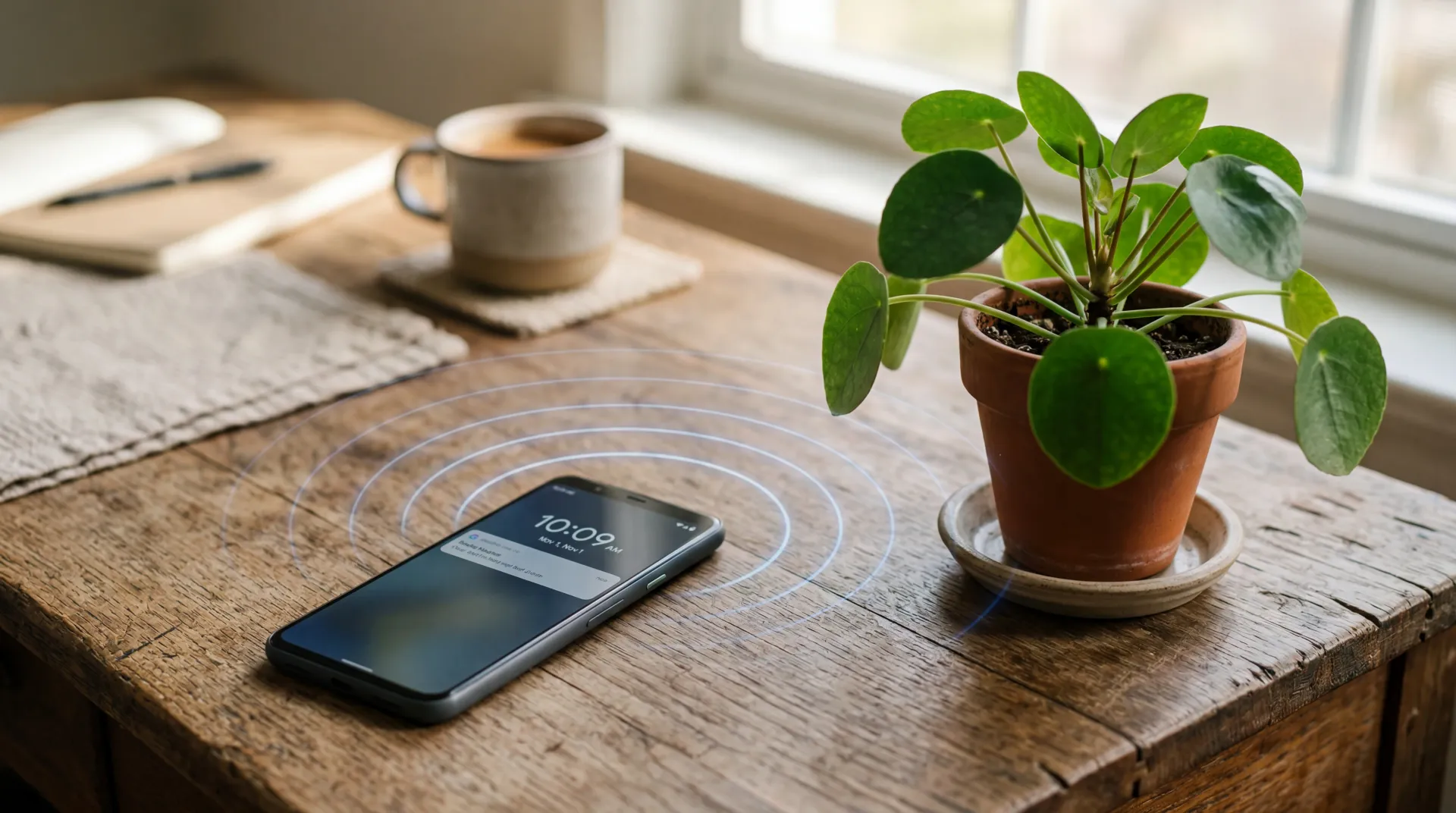
Your Phone Produces the Same Type of Energy as a Flashlight — Almost
Every electronic device around you produces electromagnetic fields. Your WiFi router, your phone, the power lines outside your window — they all generate invisible waves of energy that travel at the speed of light. But lumping all electromagnetic radiation together is like comparing a garden hose to a fire hydrant.
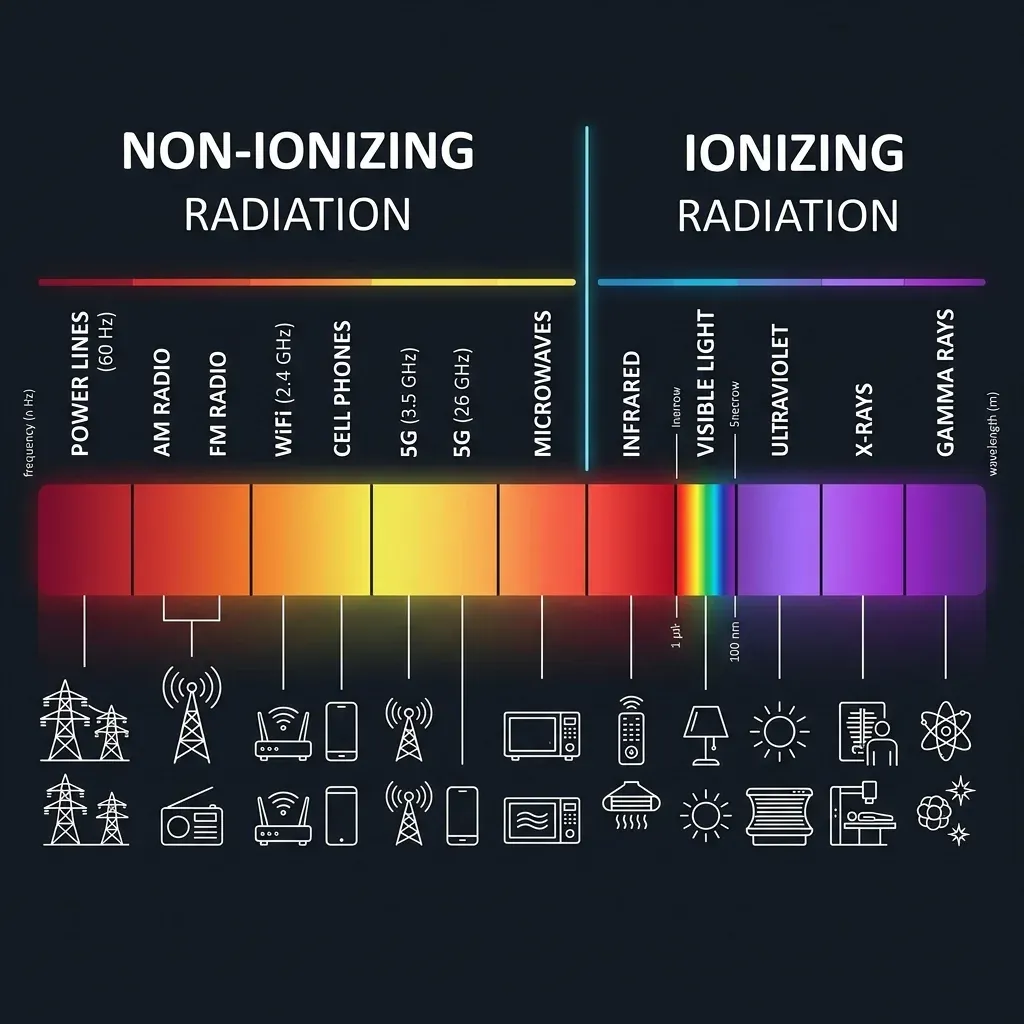
The National Institute of Environmental Health Sciences divides EMFs into two categories based on their energy level. Non-ionizing radiation sits at the lower end of the electromagnetic spectrum: extremely low frequency fields from power lines, radiofrequency waves from phones and WiFi, microwaves, and visible light. Ionizing radiation occupies the upper end: ultraviolet rays, X-rays, and gamma rays. The distinction is straightforward. Non-ionizing radiation lacks the energy to knock electrons off atoms — the mechanism that allows ionizing radiation to damage DNA and cause cancer directly.
Think of it like a bowling alley. Ionizing radiation is the ball — it has enough force to knock pins (electrons) off their bases. Non-ionizing radiation is more like rolling a tennis ball down the same lane. It reaches the pins, but it doesn't have the mass to topple them. That analogy holds for direct DNA damage, but it leaves a question hanging: could that tennis ball cause problems through some other mechanism if you rolled it often enough?
The answer depends partly on frequency. The World Health Organization notes that tissue heating is the main way radiofrequency fields interact with the human body, though current technology produces negligible temperature changes. Higher frequencies behave differently than lower ones. 5G networks operate at around 3.5 GHz for most current deployments, with some bands reaching into the tens of gigahertz. At those higher frequencies, as GOLIAT researcher Lisa Michelant at INERIS explained, the signal has "limited penetration into the skin" — it behaves more like a surface phenomenon than something passing deep into tissue. The WHO confirms this: as frequency increases, absorption becomes more confined to the skin and eyes.
For practical purposes, the RF energy from your phone or router falls firmly in the non-ionizing category, alongside the visible light from your desk lamp. Whether that energy could affect health through mechanisms other than heating is the question researchers have been chasing, at a cost of billions of dollars, for decades.
The Invisible Cloud You Live In
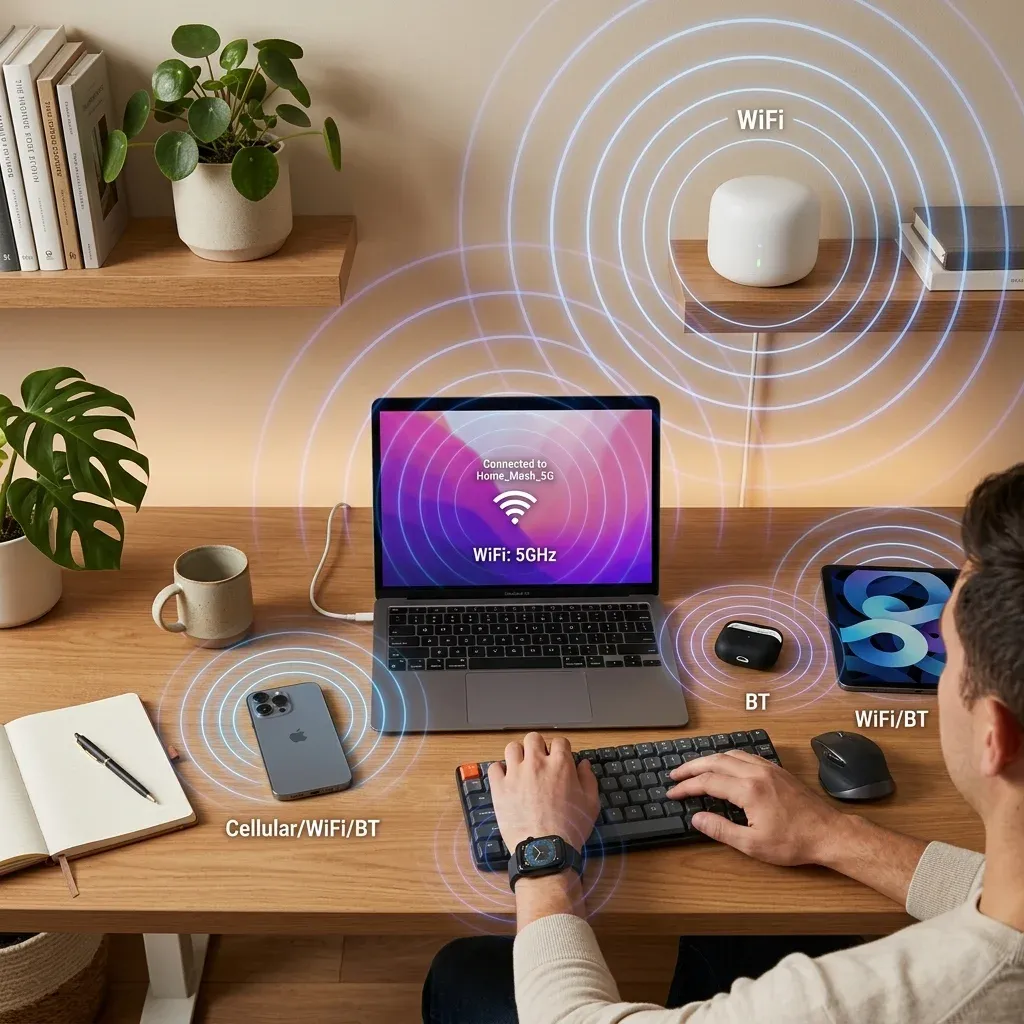
A typical home in 2026 contains more RF-emitting devices than a telecommunications lab would have held thirty years ago. WiFi routers, cell phones, Bluetooth earbuds, smart meters, baby monitors, smart speakers, laptops, tablets — each one generates its own electromagnetic field. Add nearby cell phone towers and power lines outside, and you're bathed in overlapping layers of non-ionizing radiation every minute of every day.
How much exposure does that actually produce? Professor Mònica Guxens, who coordinates the EU-funded GOLIAT project at the Barcelona Institute for Global Health, led a team that took more than 800 measurements across urban and rural locations in eight EU countries using portable exposimeters and smartphone-mounted sensors. Their finding: exposure to RF-EMF in everyday environments remains well below international safety limits in all settings measured.
But those levels aren't constant. Your phone's output depends heavily on context. Mobile phones generate significantly more electromagnetic waves when used in a fast-moving subway or train, or when searching for a base station signal, according to research published in Clinical and Experimental Pediatrics. The Australian Radiation Protection and Nuclear Safety Agency (ARPANSA) confirms that a phone in an area with good reception transmits at much lower levels than one struggling to find a signal in a lift or deep inside a building.
The GOLIAT measurements revealed a geographic pattern too. In dense urban areas, signals from mobile base stations tend to be higher. In rural locations, short-lived peaks occur when phones upload large data, because weaker coverage forces devices to transmit at higher power. Your phone works harder to compensate for distance from the tower.
A phone call in a moving elevator can produce more RF exposure than an hour of WiFi browsing at your desk. Signal strength, movement speed, and data demands all change your phone's output in real time.
5G adds another variable. The technology uses beam-forming antennas that focus signals toward the device in use, rather than broadcasting in all directions like older base station antennas. This means exposure is more variable depending on where you are relative to the beam. The National Toxicology Program reports that 95% of American adults now use cell phones, making RF exposure essentially universal in developed nations.
The $30 Million Question — and What We Got for the Money
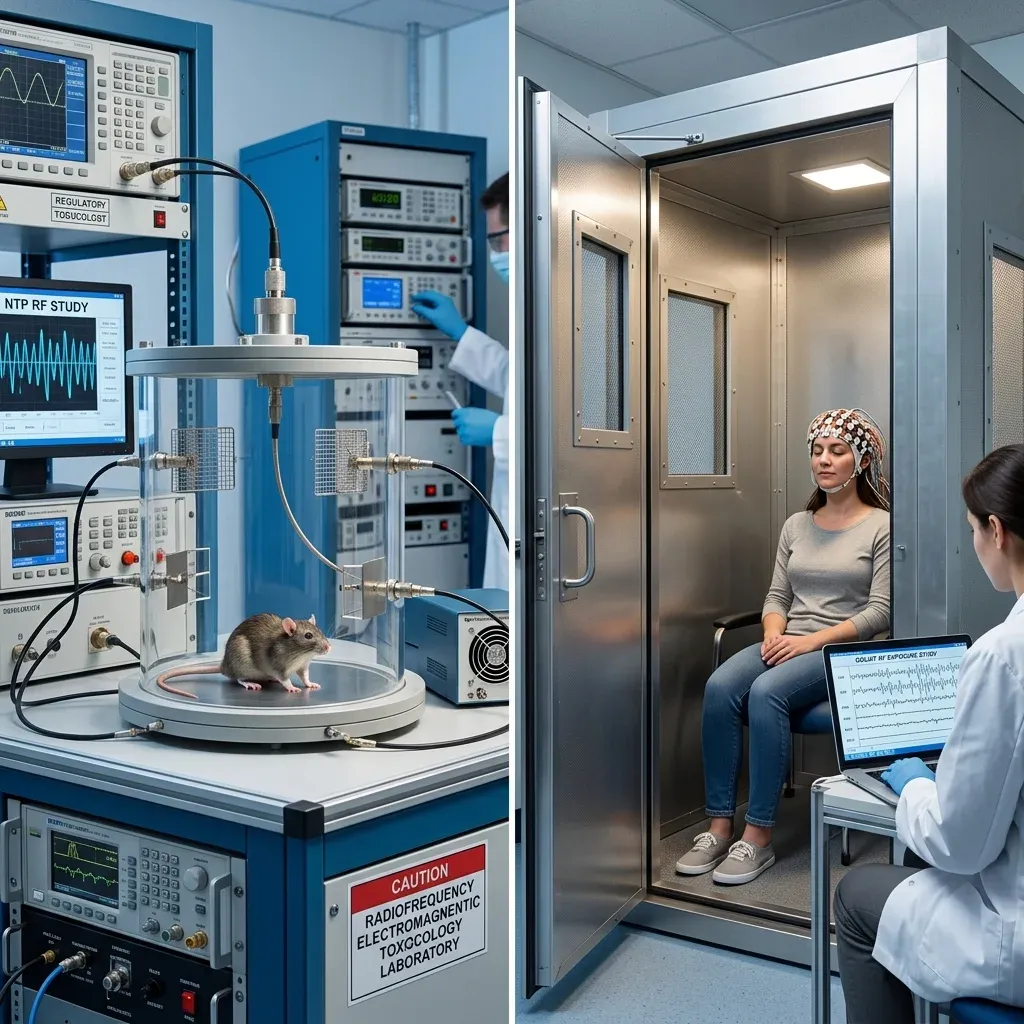
The most expensive animal study ever conducted on cell phone radiation cost $30 million and took 10 years. The U.S. National Toxicology Program exposed nearly 3,000 rats and mice to radiofrequency radiation resembling 2G and 3G signals, evaluating 40 different tissues for damage.
The results were not simple. NTP found clear evidence of an association with heart tumors — malignant schwannomas — in male rats. They also found some evidence linking exposure to brain tumors (malignant gliomas) and adrenal gland tumors. A follow-up study detected DNA damage in the frontal cortex of male mice, blood cells of female mice, and the hippocampus of male rats.
Those findings sound alarming in isolation. But the numbers tell a more nuanced story. Heart cancer appeared in roughly 2% of rats at lower exposure levels, and 5-6% of rats exposed at four times the maximum level permitted for human exposure. The animals received whole-body radiation for most of their natural lives — a scenario with limited resemblance to a human holding a phone to one ear for thirty minutes. Italy's Ramazzini Institute ran a parallel study and found the same type of heart tumor in male rats, lending weight to the NTP findings through independent replication.
The International Agency for Research on Cancer (IARC) had already classified radiofrequency electromagnetic fields as "possibly carcinogenic to humans" — Group 2B — based partly on the INTERPHONE study. That large international investigation found no overall increase in brain tumor risk from mobile phone use, but in the highest category of cumulative call time (1,640 hours or more), the odds ratio for glioma reached 1.4. Gliomas also tended to appear on the side of the head where the phone was typically held.
The Group 2B classification puts RF-EMF in the same category as pickled vegetables and talc-based body powder. It means the evidence suggests a possible connection but falls short of probable or confirmed. More than 5,000 publications now exist on bioelectromagnetic effects below 6 GHz, and IARC is coordinating a new 5G-specific risk assessment through the EU-funded SEAWave project involving 16 research partners.
Meanwhile, the GOLIAT project has been producing the first controlled human studies specifically on 5G frequencies. In 2025, researchers at INERIS (the French National Institute for Industrial Environment and Risks) ran two triple-blind studies with 31 healthy adults exposed to real 5G signals at 26 GHz — the highest frequency band planned for 5G. After 26.5 minutes of exposure at levels matching the upper range of real-world measurements in France, researchers found no changes in cortisol, alpha-amylase (stress markers), or brain electrical activity across any frequency band.
Dr. Brahim Selmaoui, the senior author, offered measured reassurance: "These findings are consistent with previous scientific evidence showing no acute biological effects at commonly encountered radiofrequency exposure levels. While more research is still needed on long-term and repeated exposures, our results provide reassuring data for this new 5G band."
The Swedish Radiation Safety Authority's twentieth annual scientific review, published in February 2026, surveyed all EMF research from 2024 and reached a blunt conclusion: "No new established causal relationships between EMF exposure and health risk have been identified." But the same report flagged something that complicates the reassurance. Observations of increased oxidative stress from RF-EMF continue to appear in animal studies, some at exposure levels below current safety limits. Whether that oxidative stress translates to any meaningful health consequence in humans remains unknown.
Smaller Heads, Bigger Antennas
A child's skull is thinner than an adult's. Their brain tissue contains more water. Their nervous system is still forming connections that will determine cognitive function for the rest of their lives. These physical differences directly change how electromagnetic energy interacts with developing biology.
Dr. Jin-Hwa Moon, a pediatric neurologist at Hanyang University, published a comprehensive review in Clinical and Experimental Pediatrics documenting what makes children different. The core finding: a developing child's nervous system is more conductive and absorbs more electromagnetic energy than that of adults. The GOLIAT project echoes this, noting that young people are "potentially more vulnerable to possible harmful effects because they are at a critical stage in their development, especially brain development."
Animal research on prenatal exposure adds concern. Studies cited in Dr. Moon's review found that prenatal exposure to 900 MHz RF caused substantial loss of granule cells and significant reduction in pyramidal neurons in developing brains. Mice exposed to cellular phone radiation in utero were hyperactive and demonstrated memory impairment after birth. These are animal studies with exposures that don't replicate typical human use, but they identify a biological vulnerability that doesn't exist in fully developed adults.
The GERoNiMO project — the EU-funded predecessor to GOLIAT — produced some of the most detailed epidemiological data on children. Their results showed that higher brain exposure to RF-EMF from multiple sources and phone calls was associated with lower non-verbal cognition at ages 9-11. In children aged 12-17, higher RF-EMF exposure was associated with reduced non-verbal memory after one year of follow-up, especially in those holding the phone next to the right hemisphere. Evening phone use was also linked to shorter total sleep time.
The GOLIAT team is careful to flag the limitations: these associations could be explained by confounding factors. Children who use phones more may also stay up later, exercise less, or have different home environments. Reverse causality — that children with pre-existing problems use devices more, rather than devices causing the problems — cannot be ruled out from these data alone.
| Risk Factor | Children | Adults |
|---|---|---|
| Skull thickness | Thinner, less shielding | Thicker bone provides more attenuation |
| Brain tissue water content | Higher, more conductive to RF | Lower, less absorption |
| Nervous system development | Active myelination and synapse formation | Development complete |
| Lifetime cumulative exposure | Decades more exposure ahead | Shorter remaining exposure window |
| Device proximity | Smaller hands hold phones closer to head | Larger anatomy creates more distance |
IARC's analysis of ELF magnetic fields found an even more specific risk in younger populations. Their 2002 pooled analysis showed a 2-fold excess risk for childhood leukemia at ELF magnetic field levels above 0.4 microtesla, with a relative risk of 1.7 above 0.3 microtesla. The Swedish Radiation Safety Authority's 2026 report confirms that this association remains unresolved after two decades of additional research — not confirmed, but not dismissed either. The WHO recommended in 2004 that EMF exposure should be minimized in schools, kindergartens, and locations where children spend substantial time.
The Gap Between How We Test and How We Live
Safety standards for electromagnetic radiation share a fundamental limitation: they measure one thing at a time. The FCC's SAR limit of 1.6 watts per kilogram for cell phones tells you how much energy a single device deposits in tissue during a controlled test. It doesn't account for the WiFi router five feet away, the Bluetooth earbuds in your ears, the smart watch on your wrist, or the cell tower down the street — all operating simultaneously.
This is like testing how much alcohol is safe by studying beer in isolation, while people actually drink beer, wine, and cocktails in the same evening. Each individual source may fall well within limits. The combined, continuous, decades-long exposure has never been tested because it's extraordinarily difficult to study.
The most expensive and comprehensive animal study — the NTP program — was designed to study frequencies and modulations used in 2G and 3G devices, but is not representative of newer technologies such as 4G/LTE, or 5G. The agency concluded that further work with its exposure system would not be conducted, and NIEHS has no further plans to conduct additional RFR exposure studies. The most relevant animal data we have comes from technology two generations old.
ICNIRP — the body whose guidelines most countries follow — published a formal statement in January 2025 acknowledging knowledge gaps in its own 2020 radiofrequency guidelines. The Swedish Radiation Safety Authority's 2026 review underscored that very few studies exist on the 26 GHz band that 5G is beginning to use, and that intermediate frequency range research (300 Hz to 10 MHz) remains scarce despite increasing use.
Professor Mònica Guxens identified another measurement problem that gets overlooked. "The phone doesn't only bring radio frequency electromagnetic fields exposure," she explained. "It also brings screen light exposure, mental arousal or device dependency. Separating the effects of the different factors related to the use of the devices is challenging." If a child sleeps poorly after phone use before bed, is it the RF energy, the blue light, the stimulating content, or the disrupted routine? You cannot answer that with a SAR measurement.
| What Current Standards Measure | What They Don't Measure |
|---|---|
| Single device energy absorption (SAR) | Combined exposure from multiple simultaneous sources |
| Short-term thermal effects | Chronic non-thermal biological effects |
| Adult male body model (standard SAM head) | Children's smaller, more conductive anatomy |
| 2G/3G frequency ranges (historically) | 5G millimeter wave bands (26+ GHz) |
| Peak exposure from a single call | Lifetime cumulative dose from all wireless sources |
Professor Martin Röösli at the Swiss Tropical and Public Health Institute is building a tool to address part of this gap. His team is developing a freely accessible online "dose database" expected to launch in spring 2026, where users can input their device habits and location to get a picture of their typical exposure levels. It won't resolve the long-term cumulative question, but it will replace guesswork with data for individual behavior patterns.
Distance Is Your Best Tool
The physics of electromagnetic fields offers one reliable piece of good news: field strength drops rapidly with distance. The NIEHS cites WHO data showing that a 230-kilovolt transmission line produces 57.5 milligauss immediately beside it, but only 7.1 milligauss at 100 feet and 1.8 milligauss at 200 feet. The same inverse-square relationship applies to your phone and router, just at much smaller distances.
GOLIAT researchers quantified this for the most common overnight scenario. A phone placed 30 to 40 centimeters away overnight, with minimal activity, results in virtually no exposure — far less than that generated during even a very brief phone call. Moving your phone from your pillow to the far side of your nightstand makes a meaningful difference in measurable RF levels.
ARPANSA recommends three straightforward strategies: increase the distance between your phone and your body, reduce the time your phone is transmitting near you, and use your phone in areas with strong signal. The FDA's recommendation aligns: reduce the amount of time spent on calls and use speaker mode or a headset.
| Action | Why It Works | Effort Level |
|---|---|---|
| Use speaker mode or wired headset for calls | Moves phone away from brain | Low |
| Keep phone on desk, not in pocket during day | Reduces body-adjacent exposure | Low |
| Charge phone across the room at night | Eliminates overnight head-proximity exposure | Low |
| Place WiFi router away from bedrooms and workspaces | Distance reduces field strength substantially | Low |
| Avoid extended calls in elevators, cars, trains | Phone transmits at maximum power in poor signal areas | Medium |
| Use wired ethernet where practical | Eliminates WiFi RF for that connection entirely | Medium |
| Text instead of calling when possible | Brief transmission vs. sustained head-adjacent RF | Low |
The Swedish Radiation Safety Authority maintains its hands-free recommendation for mobile phone calls despite finding no increasing trend in glioma rates — their reasoning being that observed biological effects and uncertainties about long-term consequences justify the precaution. The WHO recommended in 2004 that EMF exposure be minimized in schools, kindergartens, and locations where children spend substantial time.
One counterintuitive point for parents: limiting phone use reduces exposure not because of any proven health risk, but because the exposure genuinely drops to near zero when the device is at arm's length or more. The precautionary principle works here because the cost of the precaution — charging your phone across the room — is essentially zero.
The Conspiracy Trap and the Legitimate Questions
The 5G health debate occupies unusually hostile territory. On one end: conspiracy theories linking 5G towers to COVID-19, claims of government coverups, and a cottage industry of untested "EMF protection" products. On the other: dismissive assurances that all concerns are baseless fearmongering. Neither position serves anyone well.
Start with what the evidence clearly shows. The World Health Organization states unambiguously: "To date, and after much research performed, no adverse health effect has been causally linked with exposure to wireless technologies." The FDA states that "the weight of scientific evidence has not linked cell phones with any health problems." ARPANSA confirms there is no scientific evidence supporting adverse health effects below established RF safety limits.
The condition called electromagnetic hypersensitivity (EHS) — where individuals report headaches, fatigue, and nausea that they attribute to EMF exposure — has been tested rigorously. Well-controlled double-blind studies have shown that EHS individuals cannot detect EMF exposure any more accurately than non-EHS individuals, and their symptoms were not correlated with actual EMF exposure. The WHO's assessment is that symptoms may be due to stress reactions from worrying about EMF health effects, rather than the EMF exposure itself — a textbook nocebo effect, where the belief that something is harmful produces real physical symptoms.
The "EMF protection" product market deserves particular skepticism. ARPANSA warns that so-called protective devices often make the problem worse: shielded cases and absorbing buttons force the phone to transmit at higher power to maintain signal, increasing rather than decreasing the RF energy output. Products claiming to "neutralise" harmful effects are, in ARPANSA's words, "not consistent with current scientific knowledge."
But dismissing all concern would mean ignoring genuinely open questions. The NTP found tumors in rats. The INTERPHONE study found elevated glioma risk in heavy users. Animal studies continue to show oxidative stress from RF-EMF at levels below current safety limits. The childhood leukemia association with ELF magnetic fields persists after twenty years of investigation. The Swedish Radiation Safety Authority's 2026 report noted that many studies were excluded from review due to poor quality — which cuts both ways, weakening both reassuring and alarming conclusions.
The scientific consensus lands somewhere uncomfortable for people who want a clean answer: at current exposure levels, no causal harm to humans has been demonstrated, but the long-term effects of chronic exposure from multiple simultaneous sources remain an open question that decades of research have not closed.
One finding from the NTP study rarely gets mentioned in either camp. The rats exposed to cell phone radiation actually lived longer than the unexposed control group. NTP scientists attributed this partly to reduced chronic kidney disease in the exposed males. Nobody is suggesting cell phone radiation promotes health — but the finding illustrates how biological responses to RF are more complex than any simple narrative accommodates.

Frequently Asked Questions
Does 5G cause cancer?
No causal link between 5G and cancer has been established. The WHO states that no adverse health effect has been causally linked with wireless technologies after extensive research. The IARC classifies all radiofrequency radiation as "possibly carcinogenic" (Group 2B), meaning the evidence is limited rather than conclusive. GOLIAT's 2025 triple-blind studies at 26 GHz — the highest 5G frequency band — found no measurable biological effects on stress markers or brain activity in healthy adults.
Should I keep my phone away from my body while sleeping?
It's a low-cost precaution with measurable benefit. GOLIAT researchers found that placing a phone 30-40 cm away overnight results in virtually no RF exposure, compared to significant exposure during calls with the phone against your head. Sweden's radiation authority maintains its hands-free recommendation as a precautionary measure. Charging across the room also removes the temptation to check notifications, which disrupts sleep independently of any RF effects.
Are children more vulnerable to EMF than adults?
Physically, yes — their developing nervous systems are more conductive and absorb more electromagnetic energy. Whether this translates to health effects at typical exposure levels is unproven but under active investigation. The WHO recommended in 2004 that EMF exposure be minimized in environments where children spend significant time, and the GOLIAT project is currently studying 5G effects specifically in young populations.
Do EMF-blocking phone cases work?
They tend to be counterproductive. ARPANSA found that shielding products force the phone to transmit at higher power to maintain signal, which can increase rather than decrease RF output. The agency recommends only approved hands-free accessories — wired headsets or speaker mode — as effective methods of reducing exposure.
Is WiFi radiation in my home dangerous?
Current evidence says no, at the exposure levels produced by household routers. GOLIAT measurements across eight EU countries found all everyday RF-EMF levels well below international safety limits. WiFi routers operate at much lower power than cell phones. If you want to minimize exposure further, placing the router away from areas where people spend extended time is the most practical step.
Medical Disclaimer
This article is for informational and educational purposes only and is not medical advice, diagnosis, or treatment. Always consult a licensed physician or qualified healthcare professional regarding any medical concerns. Never ignore professional medical advice or delay seeking care because of something you read on this site. If you think you have a medical emergency, call 911 immediately.