A Substance Designed for Newborn Calves Is Now in Your Smoothie
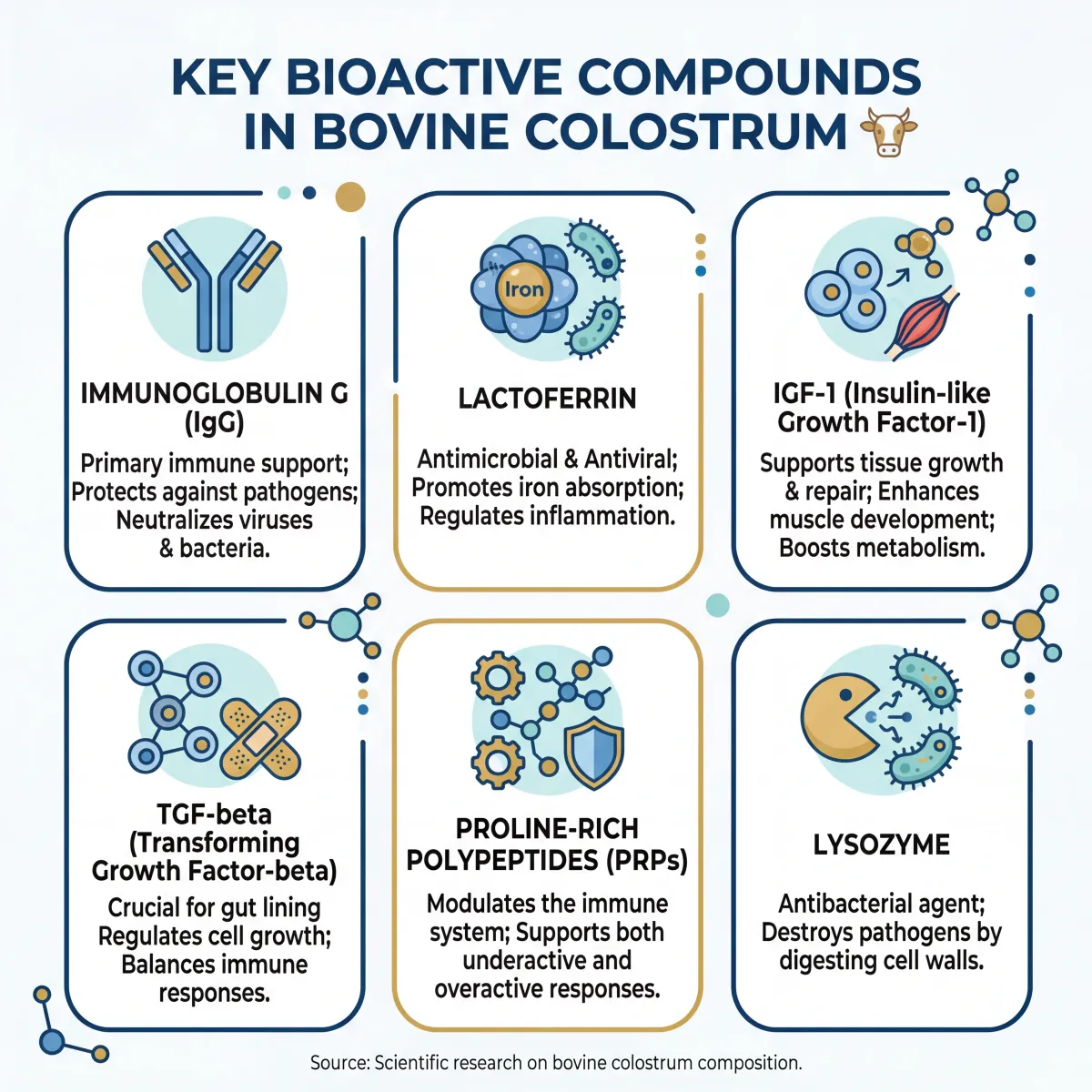
Every mammal on the planet produces colostrum. It is the thick, golden-yellow fluid that flows from the mammary glands in the first 24 to 72 hours after birth, and it exists for one reason: to hand a defenseless newborn the biological toolkit it needs to survive its first days of life. For calves, that toolkit includes a concentrated dose of immunoglobulins (particularly IgG), lactoferrin, growth factors like IGF-1 and TGF-beta, and antimicrobial peptides that collectively seal the gut lining and prime a nascent immune system.
Bovine colostrum contains these bioactive compounds at concentrations 100 to 1,000 times higher than what appears in mature cow's milk. That concentration is what caught the supplement industry's attention. The pitch writes itself: if colostrum is the most potent immune package nature makes for newborns, maybe adults can tap into it too.
The logic sounds reasonable. But the distance between something that works in a two-day-old calf and something that measurably helps a 35-year-old human is much larger than most supplement labels let on. That gap is where the real questions start.
From $612,000 to $19 Million in Two Years
Here is how fast this market moved. According to NielsenIQ data, American consumers spent more than $19 million on colostrum supplements in the past year alone. Just two years earlier, the figure was $612,000. That is a 3,000 percent increase, a trajectory that makes even the collagen boom look measured by comparison.
Quick numbers: U.S. colostrum supplement sales went from $612,000 to over $19 million in roughly two years, a jump of more than 3,000%. Bloomberg data puts the figure even higher, at $22 million.
Brands like Armra, Cowboy Colostrum, and Bloom Nutrition are the ones driving most of those sales, positioning bovine colostrum as a daily ritual for gut health and immunity. Jennifer Aniston and Dua Lipa both endorse it. TikTok did the rest, with wellness creators filming their morning colostrum scoops right next to their matcha and collagen supplements.
But the question that NielsenIQ data alone cannot answer is whether these sales numbers reflect genuine health value or the familiar shape of a supplement hype cycle. That question requires us to look at what colostrum actually contains and what the clinical research shows when you strip away the marketing.
The Bioactive Compounds That Make Colostrum Unique
To understand why researchers have studied colostrum at all, it helps to know what makes it biochemically distinct from regular milk. This is not simply concentrated dairy protein. The composition is fundamentally different.
| Component | Role in Colostrum | Concentration vs. Mature Milk |
|---|---|---|
| Immunoglobulin G (IgG) | Primary antibody for passive immunity | 50-100x higher |
| Lactoferrin | Antimicrobial and iron-binding protein | 5-10x higher |
| IGF-1 | Growth factor for tissue repair | Significant levels (absent in mature milk) |
| TGF-beta | Tissue regeneration and immune regulation | Present only in colostrum |
| Proline-Rich Polypeptides | Immune system modulation | Unique to colostrum |
| Lysozyme | Lytic enzyme against gram-positive bacteria | Higher than mature milk |
Nobody disputes that these compounds are biologically active. What people argue about is whether they survive an adult's digestive tract in amounts large enough to do anything useful, and whether the doses in commercial products (typically 500 mg to 3 g per day) actually deliver enough to matter.
Research conducted for a 2021 review in Nutrients noted that many study protocols used doses of 10 to 25 grams per day, yet commercial suppliers typically recommend just 500 mg to 1 g daily. That is a gap of one to two orders of magnitude. If a study demonstrates a benefit at 20 grams and the product on your shelf delivers 1 gram, the translation is far from straightforward.
Intestinal Permeability: Where the Science Is Most Promising
If colostrum does anything meaningful for adults, gut health is probably where it happens. The most consistent evidence connects bovine colostrum to improvements in intestinal permeability, sometimes called "leaky gut."
A 2017 double-blind, placebo-controlled study published in Nutrients tracked 16 competitive athletes during peak training. Athletes are an ideal test population because intense physical exertion reliably increases intestinal permeability. The colostrum group received 500 mg twice daily for 20 days. At baseline, 75 percent of the colostrum group had measurably elevated permeability. After supplementation, their values returned to the normal range, and the improvements were statistically significant compared to the placebo group when measured by both the lactulose/mannitol test and stool zonulin concentrations.
That study is encouraging, but small. Sixteen participants is barely enough for a pilot trial. A much larger 2024 systematic review in Systematic Reviews examined 22 clinical trials encompassing 1,427 patients and found that bovine colostrum consistently reduced stool frequency across all seven studies that measured that outcome. Diarrhea frequency decreased in 15 of 20 interventional arms. However, most studies showed no effect on the duration of diarrhea, and abdominal pain results were split almost evenly, with relief reported in four interventional arms and no improvement in five others.
| GI Outcome | Studies Showing Benefit | Studies Showing No Benefit | Verdict |
|---|---|---|---|
| Diarrhea frequency | 15 of 20 arms | 5 of 20 arms | Promising |
| Stool frequency | 7 of 7 studies | 0 | Consistent benefit |
| Diarrhea duration | Minority | Majority | Not supported |
| Abdominal pain | 4 arms | 5 arms | Inconclusive |
What this tells us: colostrum does seem to reduce how often people have loose stools, and it may help with intestinal barrier integrity. But the effects are modest, and across many other GI measures the results are a coin flip. Every review paper I found concluded by calling for larger, better-designed trials.
If you are already working on your gut-brain connection through diet and stress management, colostrum might add something at the margins. It is not the game-changer the marketing copy describes.
Upper Respiratory Infections: The Athletic Connection
The other area with decent research is immune function, specifically whether colostrum can prevent upper respiratory tract infections (URTIs) in athletes. Hard training beats up the immune system, and competitive athletes catch colds more often during heavy training blocks.
A meta-analysis of seven randomized controlled trials found some evidence that bovine colostrum supplementation may reduce the occurrence of upper respiratory tract infections in physically active individuals. A separate 2021 systematic review of 28 studies confirmed that colostrum showed interesting effects in preventing upper respiratory illness in sportsmen, modulating immune system response, and reducing intestinal permeability in both healthy and sick subjects.
But when researchers measured specific immune markers, things got confusing. A review in Nutrients analyzed the immunological outcomes of colostrum supplementation in trained and physically active people and found that colostrum had no or fairly low impact on improving serum immunoglobulin levels, lymphocyte counts, or salivary IgA. A 24-week randomized controlled trial in elite female basketball players found no significant changes in immune parameters like IL-1 alpha, IL-2, IL-13, TNF-alpha, or white blood cell counts between the colostrum and placebo groups.

So we get a strange result: athletes taking colostrum seem to catch fewer colds, but their blood work does not show immune improvement. If the benefit is real, it might work through the gut barrier rather than through direct immune stimulation. Either way, these studies used athletes training at elite intensity. For someone going to the gym three times a week, the relevance is unclear. If immune resilience is your goal, well-established strategies like strengthening your immune system through nutrition and lifestyle have a much deeper evidence base.
Myth vs. Reality: Separating Marketing from Science
The distance between what colostrum supplements promise and what clinical evidence actually supports is enormous. Here is how the claims stack up.
| Marketing Claim | What the Evidence Actually Shows |
|---|---|
| "Boosts your immune system" | May reduce URTIs in elite athletes. No significant improvement in measurable immune markers (IgG, IgA, lymphocytes) in human studies. |
| "Heals leaky gut" | One small study (n=16) showed improved intestinal permeability in athletes. Cedars-Sinai physicians note studies on gut sealing are "sparse and contradictory." |
| "Gives you glowing skin and hair" | No clinical studies support this claim. The American Academy of Dermatology recommends established interventions like sun protection and retinoids. |
| "Improves athletic performance" | Two small studies linked colostrum with slight lean mass gains. Other findings contradict this. Cedars-Sinai: "The jury is very much still out." |
| "Anti-aging properties" | No human trials demonstrate anti-aging effects from oral colostrum supplementation in adults. |
| "Supports cellular health" | Theoretical mechanism based on growth factors. No direct evidence in healthy adults at commercial supplement doses. |
Timothy Caulfield, a professor at the University of Alberta who has watched supplement trends come and go for decades, put it bluntly: "There's immediate interest, a huge amount of hype. The supplement is portrayed as having benefits for a whole host of ailments and health-optimization strategies." But once rigorous research accumulates, he notes, positive effects "become small or nonexistent."
Jeffrey Bland, co-founder of the Institute for Functional Medicine, was even more direct, calling the clinical proof "very limited to build a legitimate mass-market product" and noting that for general gut health, more affordable interventions like dietary fiber have stronger evidence.
Three Medical Centers, One Consistent Message
Strip away the influencer endorsements and brand narratives. What are the actual doctors saying? Three major medical centers have weighed in publicly, and they are all saying more or less the same thing.
At Cedars-Sinai, sports medicine physician Tracy Zaslow, MD, cautioned: "We're still at the early stages of any evidence to support supplementing with bovine colostrum. We're learning." She added that the jury is "very much still out" on impacts to body composition and strength.
Cleveland Clinic's registered dietitian Beth Czerwony was blunter: "As a dietitian, I look at the science and there isn't enough for me to recommend trying bovine colostrum." She called the current dosage situation "the Wild West," with people taking whatever amount they want because nobody has figured out what a proper dose even looks like.
MD Anderson Cancer Center's wellness dietitian Lindsey Wohlford acknowledged some early promise but said it is "too soon to say for sure" whether bovine colostrum supplements can benefit humans. She does not currently recommend taking them.
The bottom line from medical professionals: Colostrum is not dangerous for most people, but there is not enough evidence to recommend it. Spend your money on a balanced, anti-inflammatory diet, quality sleep, and regular exercise instead.
What You Need to Know Before You Buy
If you are considering colostrum despite the lukewarm medical consensus, here is what you should understand about safety, dosage, and regulatory realities.
Side effects are generally mild. Reported adverse effects include nausea, bloating, and gas. No serious adverse events have been documented in clinical trials, which is a legitimately positive finding.
There is no standardized dosage. Clinical studies have used doses ranging from less than 1 gram to 100 grams per day, with the most common research doses falling between 10 and 25 grams. Most commercial supplements provide 1 to 3 grams. Whether that is enough to produce meaningful effects is genuinely unclear.
It is not FDA-regulated. Like all dietary supplements in the United States, colostrum falls under the Dietary Supplement Health and Education Act of 1994. Manufacturers do not need to prove their product works before selling it. The FDA steps in only after safety concerns arise. The agency has already issued warning letters to colostrum supplement companies for making unapproved drug claims, including claims about Alzheimer's disease prevention.
Quality varies dramatically. Cleveland Clinic's Czerwony emphasized that without regulation, "you don't necessarily know that you're getting 100% bovine colostrum because there's no testing, so the potency can change from batch to batch." When you are spending $40 to $120 per jar, the lack of quality assurance is particularly frustrating.
Who should absolutely avoid it:
- Anyone with a cow's milk allergy (bovine colostrum contains the same proteins that trigger milk allergy reactions)
- People who are pregnant or breastfeeding (effects on a fetus are unknown)
- Those with lactose intolerance may experience gastrointestinal symptoms, though some colostrum products claim low lactose content
The IGF-1 question. One concern that Cleveland Clinic flagged deserves special attention. Bovine colostrum contains insulin-like growth factor 1 (IGF-1), a hormone designed to help newborn calves grow rapidly. Cleveland Clinic's dietitian noted that by exposing yourself to growth factors designed for newborn cows, "you may run the risk of turning on certain cells through these growth factors." While no direct causal link between oral colostrum supplements and cancer has been established, the theoretical concern about growth factor exposure in adults, particularly those with a history of hormone-sensitive cancers, is worth discussing with your physician.
Frequently Asked Questions
Is bovine colostrum the same as regular cow's milk?
No. Colostrum is produced only in the first 24 to 72 hours after a cow gives birth and has a fundamentally different composition than mature milk. It contains 50 to 100 times more immunoglobulin G (IgG), 5 to 10 times more lactoferrin, and significant growth factors like IGF-1 that are absent in regular milk. This biological distinction is real, even though the health implications for adult humans remain under investigation.
Can colostrum supplements replace probiotics for gut health?
They work through different mechanisms and should not be considered interchangeable. Probiotics introduce beneficial bacterial strains into the gut microbiome, while colostrum theoretically supports the gut barrier and provides antimicrobial compounds. The evidence base for probiotics in specific conditions is substantially larger than the evidence for colostrum. If gut health is your primary concern, a fiber-rich diet and evidence-based probiotics have far more clinical support.
How much colostrum should I take, and when?
There is no established dosage. Clinical studies used anywhere from less than 1 gram to 100 grams daily, with the most common effective research doses between 10 and 25 grams. Most commercial products contain 1 to 3 grams per serving. If you choose to try colostrum, consult your healthcare provider and start with the manufacturer's suggested serving, typically taken on an empty stomach in the morning.
Are colostrum supplements ethical?
This is a legitimate concern. Colostrum supplements come from dairy cows, and industry guidelines state that calves should receive adequate colostrum before surplus is harvested for supplements. However, animal welfare organizations have noted that calves are often separated from their mothers shortly after birth in industrial dairies. If ethical sourcing matters to you, look for brands that transparently describe their collection practices and prioritize calf welfare.
Will colostrum help my skin look younger?
There is no clinical evidence supporting this claim. While the theoretical mechanism involving gut-barrier improvement and reduced systemic inflammation has some scientific logic, no peer-reviewed study has demonstrated that oral bovine colostrum improves skin appearance in healthy adults. Established dermatological interventions remain the evidence-based choice for skin health.
Related Articles
- Leaky Gut Syndrome: Symptoms, Causes, and Evidence-Based Healing - A comprehensive look at intestinal permeability and what actually works to restore gut barrier function.
- Collagen Supplements: Do They Actually Work for Skin, Joints, and Gut? - Another trending supplement with a mixed evidence profile worth comparing to colostrum.
- Bone Broth Benefits for Gut Healing, Joints, and Skin - A traditional gut-supportive food with overlapping claimed benefits to colostrum.
- Health Benefits of Probiotics: An Evidence-Based Ultimate Guide - The broader evidence base for probiotics and gut health support.
- Inflammation and Chronic Disease: A Complete Guide to Anti-Inflammatory Living - Understanding the inflammation pathways that colostrum claims to address.
Medical Disclaimer
This article is for informational and educational purposes only and is not medical advice, diagnosis, or treatment. Always consult a licensed physician or qualified healthcare professional regarding any medical concerns. Never ignore professional medical advice or delay seeking care because of something you read on this site. If you think you have a medical emergency, call 911 immediately.