What Brain Training Really Means
Brain training is not a magic app, a single puzzle, or a supplement stack that suddenly turns you into a genius. Real brain training is a system: repeated cognitive challenge, high-quality sleep, movement, emotional regulation, and deliberate recovery. In other words, it is not one habit. It is an ecosystem.
If your goal is to think faster, remember more, and make better decisions under pressure, the first mindset shift is this: you are not trying to max out one score. You are trying to improve how your brain performs across real tasks like planning, learning, writing, problem-solving, and emotional self-control. That broader definition matters because narrow app gains often stay narrow, while whole-life habits are more likely to transfer into daily performance.
Global health organizations frame cognitive health in this broader way. The World Health Organization dementia guidance and the Lancet Commission on dementia prevention, intervention, and care both emphasize modifiable lifestyle factors over one-off tricks. That does not mean games are useless. It means games work best when they are part of a larger strategy.
You can think of brain training as skill-building plus brain-protective habits. Skill-building improves how efficiently you handle attention, memory, language, and reasoning right now. Brain-protective habits support vascular health, sleep architecture, and stress response so those skills can actually stick.
Quick reality check: the strongest brain training plans combine cognitive challenge with exercise, sleep, and consistency over months, not days.
If you already read our guide on physical exercise and brain health, you have seen this principle in action: training the body and training the brain are not separate projects. They are mutually reinforcing.
Why Your Brain Stays Changeable
Your brain is plastic, meaning it can adapt structurally and functionally in response to repeated demands. Neuroplasticity does not disappear in adulthood. It becomes more dependent on quality input and adequate recovery. The idea that learning capacity is fixed after a certain age is simply outdated.
At a practical level, neuroplasticity means three things for you. First, repeated attention shapes neural efficiency. If you repeatedly practice distraction-heavy behavior, your attention control gets worse. If you repeatedly practice deep focus, your attentional control becomes more stable. Second, effortful recall strengthens memory traces more than passive review. Third, sleep helps consolidate what you practiced, which is why training hard while sleeping poorly tends to backfire.
Sleep science supports this model. The CDC sleep overview and the NHLBI sleep deprivation resource both describe how inadequate sleep impairs attention, reaction time, and learning. A classic review in Nature Reviews Neuroscience on sleep and memory also describes how sleep supports memory consolidation rather than acting as passive downtime.
Language learning is another useful example. A systematic review in Frontiers in Aging Neuroscience found evidence that second-language learning may support neuroplastic processes in aging adults, especially when learning is sustained and cognitively demanding rather than casual exposure alone (Ware et al., 2021).
This is encouraging, but it also sets expectations. Neuroplastic change depends on dosage and quality. Ten minutes of distracted practice every few days is rarely enough to create meaningful change. Structured repetition, increasing challenge, and adequate sleep are what produce visible progress.
To make this concrete, treat cognitive growth the same way you treat physical conditioning. You do not become stronger from one workout. You become stronger from repeated progressive stress plus recovery. The same logic applies to memory, focus, and executive control.
The Daily Pillars That Move the Needle
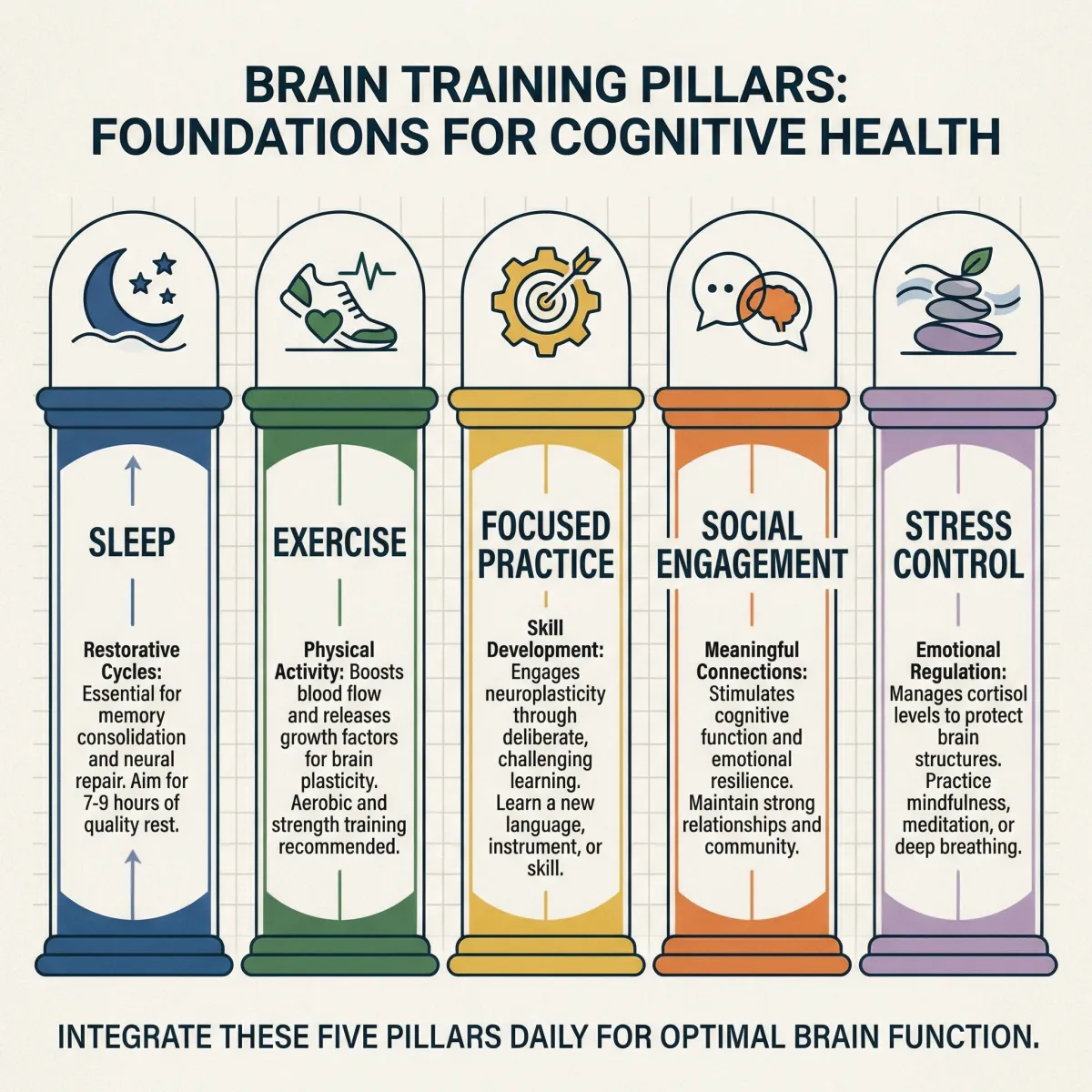
Most people overcomplicate cognitive improvement and underinvest in fundamentals. Before you buy another productivity app, make sure the five high-impact pillars below are in place. The combination is what creates compounding results.
| Pillar | Why It Matters | Minimum Effective Dose | What to Track |
|---|---|---|---|
| Sleep quality | Consolidates learning and protects attention | 7-9 hours most nights | Bedtime consistency, wake consistency, morning alertness |
| Aerobic movement | Supports blood flow, mood, and executive function | 150 minutes moderate activity weekly | Weekly active minutes and perceived energy |
| Focused cognitive practice | Builds attention and working memory through challenge | 30-45 minutes, 5 days weekly | Task completion quality and distraction rate |
| Stress regulation | Chronic stress disrupts memory and planning | 10 minutes daily down-regulation practice | Stress score, irritability, recovery speed |
| Social and language complexity | Challenges cognition through novelty and communication | 3 meaningful interactions weekly | Conversation quality, novelty exposure |
Physical activity is one of the most replicated inputs for cognitive health. The WHO physical activity fact sheet and the CDC evidence summary on activity benefits both connect regular movement to better health outcomes, including outcomes tied to brain function. If you are mostly sedentary, adding daily walking plus two weekly strength sessions is often a high-return place to start.
Sleep is the second pillar that people ignore until symptoms appear. If your attention is unstable, your mood is volatile, and your memory feels "slippery," sleep debt is frequently part of the picture. Before changing ten variables, stabilize bedtime and waking time for two to three weeks.
Nutrition also supports cognitive stability, but consistency matters more than perfection. If you are exploring dietary changes for brain outcomes, our post on foods often discussed as natural brain-support options is a useful starting point. Keep expectations realistic and prioritize patterns you can sustain.
Finally, stress regulation is not optional. Long periods of unmanaged stress can degrade sleep, attention, and decision quality. Short daily breathing practices, low-intensity walks, and deliberate transition routines between work blocks are simple ways to reduce cognitive noise.
Methods With the Best Evidence

When people say they want to "train their brain," they usually mean one of four goals: better memory, stronger focus, faster learning, or clearer thinking under pressure. Different methods target different outcomes, so matching method to goal is essential.
| Method | Main Cognitive Target | Evidence Direction | Practical Tip |
|---|---|---|---|
| Spaced repetition | Long-term memory retention | Strong for factual learning | Review right before forgetting, not by fixed cramming |
| Retrieval practice | Recall strength and exam performance | Strong across many domains | Use self-testing more than re-reading |
| Dual-task and working-memory drills | Working memory and attentional control | Mixed transfer to daily life | Use as supplement, not sole strategy |
| Novel skill learning (language, music) | Cognitive flexibility and neural adaptation | Promising when sustained | Choose a skill with progressive challenge |
| Mindfulness-based attention training | Emotional regulation and sustained focus | Moderate, context-dependent | Short daily sessions beat occasional long sessions |
Two methods consistently help real-world learners: retrieval practice and spaced repetition. They are less glamorous than "brain game" marketing but produce better transfer for study, language learning, and professional knowledge retention. If you are building a cognitive routine for work or school, start there.
Working-memory games can still be useful, but expectations should stay grounded. They often improve performance on similar tasks more than unrelated life outcomes. That is why many experts recommend combining them with broader behavior changes, including exercise and sleep.
If supplements are part of your exploration, read cautiously. Our articles on nootropics for beginners and mental-edge supplement claims can help you frame questions, but lifestyle inputs should remain the core of your strategy.
A practical rule is to allocate your weekly effort like this: around 60% to sleep and movement habits, 30% to structured cognitive practice, and 10% to experiments. This ratio prevents novelty from replacing fundamentals.
Another useful rule is progressive overload for cognition: make tasks slightly harder each week. Increase recall interval length, reduce distractions, add complexity to language practice, or shorten response windows in reasoning tasks. If everything feels easy, adaptation plateaus.
A Practical 4-Week Brain Training Plan

Below is a realistic framework you can run for four weeks without turning your schedule upside down. The goal is not perfection. The goal is consistency with measurable progression.
| Week | Primary Focus | Daily Cognitive Work | Lifestyle Anchor |
|---|---|---|---|
| Week 1 | Stabilize rhythms | 20-25 min retrieval practice or language drills | Fixed wake time and 30 min brisk walk |
| Week 2 | Increase focus depth | 30 min deep work block + 10 min recall | Three moderate-intensity exercise sessions |
| Week 3 | Add complexity | 40 min mixed practice: memory, reasoning, language | Stress reset ritual before bed |
| Week 4 | Transfer to real projects | 45 min on high-value real task + self-test | Maintain sleep consistency and weekly review |
A sample daily flow can look like this:
- Morning: 30-45 minutes of focused practice before reactive work.
- Afternoon: one short movement break plus a 10-minute recall test.
- Evening: reduce stimulation, protect sleep window, and preview tomorrow's single cognitive priority.
For many people, the biggest breakthrough is not a new tool. It is protecting the first focused block of the day. When you place difficult cognitive work before notifications and meetings, you train attentional control and produce higher-quality output at the same time.
If you miss a day, avoid all-or-nothing thinking. Resume at the next scheduled block. Missing one session has little impact; abandoning the system for a week does.
Pairing this plan with sleep hygiene has outsized returns. If your sleep is inconsistent, start with practical steps from our internal sleep guide: 10 simple tips to improve sleep.
It also helps to choose one meaningful \"transfer task\" each week. A transfer task is a real activity where better cognition matters to you personally: writing a clearer report, learning a software workflow faster, remembering names in meetings, or staying calm during difficult conversations. At week end, score yourself on that one task from 1 to 10 and compare with the prior week. This prevents you from chasing abstract metrics while ignoring whether your everyday thinking is actually improving.
Common Brain Training Myths vs Facts
| Myth | What the Evidence Suggests | What to Do Instead |
|---|---|---|
| "A single brain game can make me generally smarter." | Task-specific gains are common; broad transfer is less guaranteed. | Combine cognitive drills with sleep, movement, and real-task practice. |
| "If I sleep less, I gain more productive time." | Sleep loss hurts attention, mood, and learning efficiency. | Protect consistent sleep and treat it as a performance multiplier. |
| "Supplements can replace training." | Evidence for many products is mixed and often context-specific. | Use food quality and habits as base; test supplements cautiously. |
| "Older adults cannot significantly improve cognition." | Neuroplasticity remains possible with structured, repeated challenge. | Use progressive, realistic routines and track practical outcomes. |
| "Multitasking trains my brain to be efficient." | Frequent task-switching usually increases errors and mental fatigue. | Train single-task focus blocks and deliberate recovery windows. |
This myth-versus-fact lens can save you months of wasted effort. Most people do not fail because they are incapable. They fail because they follow a narrow protocol and ignore the biological conditions that allow learning to consolidate.
The combination of protective factors described by major public-health sources and journal literature is clear: movement, sleep, vascular risk management, social engagement, and ongoing cognitive challenge are all relevant. You can see this reflected in both the WHO dementia evidence summary and the Lancet Commission framework.
Another common trap is trying to fix cognition with extreme routines. Going from zero to two hours of daily \"optimization\" usually creates fatigue and poor adherence. A calmer, more durable approach works better: build a repeatable baseline first, then add one variable at a time. This lets you see cause and effect. If a new technique improves your focus, keep it. If it increases stress without measurable gains, remove it quickly. Simplicity is often the most advanced strategy.
How to Track Progress Without Obsessing

Progress tracking works best when it is simple enough to maintain. Over-tracking creates anxiety and can reduce adherence. Under-tracking makes improvement invisible. A middle path is best.
Use three layers of measurement:
- Behavior metrics: number of focused sessions completed, weekly active minutes, and nights with consistent sleep timing.
- Performance metrics: recall test score, reading retention after 24 hours, and quality ratings on high-value work outputs.
- Functional metrics: fewer attention lapses, better emotional control under stress, and faster recovery after mentally demanding days.
Review these once per week, not daily. Weekly reviews prevent emotional overreaction to random day-to-day variation. Look for trends over four-week windows. That is where meaningful change becomes visible.
When progress stalls, diagnose in a specific order. First, check sleep regularity. Second, check whether your cognitive sessions are truly focused or full of interruptions. Third, check whether training difficulty has increased over time. Plateaus are usually caused by one of those three factors, not by a lack of talent. In many cases, tightening bedtime consistency and restoring distraction-free work blocks restores improvement within one to two weeks.
If you want a quick personal dashboard, keep it to five weekly questions:
- Did I complete at least four focused cognitive sessions?
- Did I hit at least 150 minutes of movement?
- Was my sleep schedule stable on most nights?
- Did my recall or work quality improve in at least one measurable way?
- Do I feel more mentally stable and less reactive under pressure?
If three or more answers are "yes," you are likely moving in the right direction. If fewer than three are "yes," do not add complexity. Tighten basics first, especially sleep and focus block protection.
Brain training is a long game. The objective is not a temporary spike. The objective is durable cognitive capacity you can rely on during demanding seasons of life.
Frequently Asked Questions
How long does it take to notice results from brain training?
Many people notice early improvements in focus and mental clarity within 2 to 4 weeks of consistent practice, especially when sleep and exercise improve at the same time. Larger gains in memory reliability and complex problem-solving usually require 8 to 12 weeks of structured effort.
Are brain-training apps worth using?
They can be useful for building consistency and targeting specific cognitive skills, but they should not be your entire program. Use apps as one component inside a broader routine that includes deep work, movement, stress control, and sleep protection.
Can older adults still improve memory and attention?
Yes. Neuroplasticity continues across adulthood. The pace may differ, but adults of all ages can improve cognitive performance through progressive challenge, lifestyle support, and repetition. Consistency and realistic progression matter more than age alone.
What is the single highest-impact habit to start with?
If you must pick one, start with consistent sleep timing. Better sleep improves attention, emotional regulation, and learning efficiency, which makes every other cognitive training method work better.
Do supplements replace lifestyle-based brain training?
No. Supplements may have context-specific roles, but they are not substitutes for sleep, exercise, focused practice, and stress regulation. Build your foundation first, then evaluate any add-ons carefully with a clinician when needed.
Related Articles
- Physical Exercise and Brain Health - Learn how aerobic and resistance training support memory, mood, and executive function.
- Foods Thought to Be Natural Brain Supplements - A practical look at dietary patterns and foods often linked to cognitive performance.
- Beginner's Guide to Nootropics - Understand common nootropic categories, risks, and evidence limits before experimenting.
- 10 Simple Tips to Improve Sleep - Build better sleep habits to strengthen learning, focus, and daily mental resilience.
Medical Disclaimer
This article is for informational and educational purposes only and is not medical advice, diagnosis, or treatment. Always consult a licensed physician or qualified healthcare professional regarding any medical concerns. Never ignore professional medical advice or delay seeking care because of something you read on this site. If you think you have a medical emergency, call 911 immediately.