Your Collagen Powder Probably Clumps Because It Was Never Designed for Coffee
You scoop your collagen powder into hot coffee, stir for thirty seconds, and take a sip. Gritty. Chalky. Little protein rafts floating on the surface. Sound familiar?
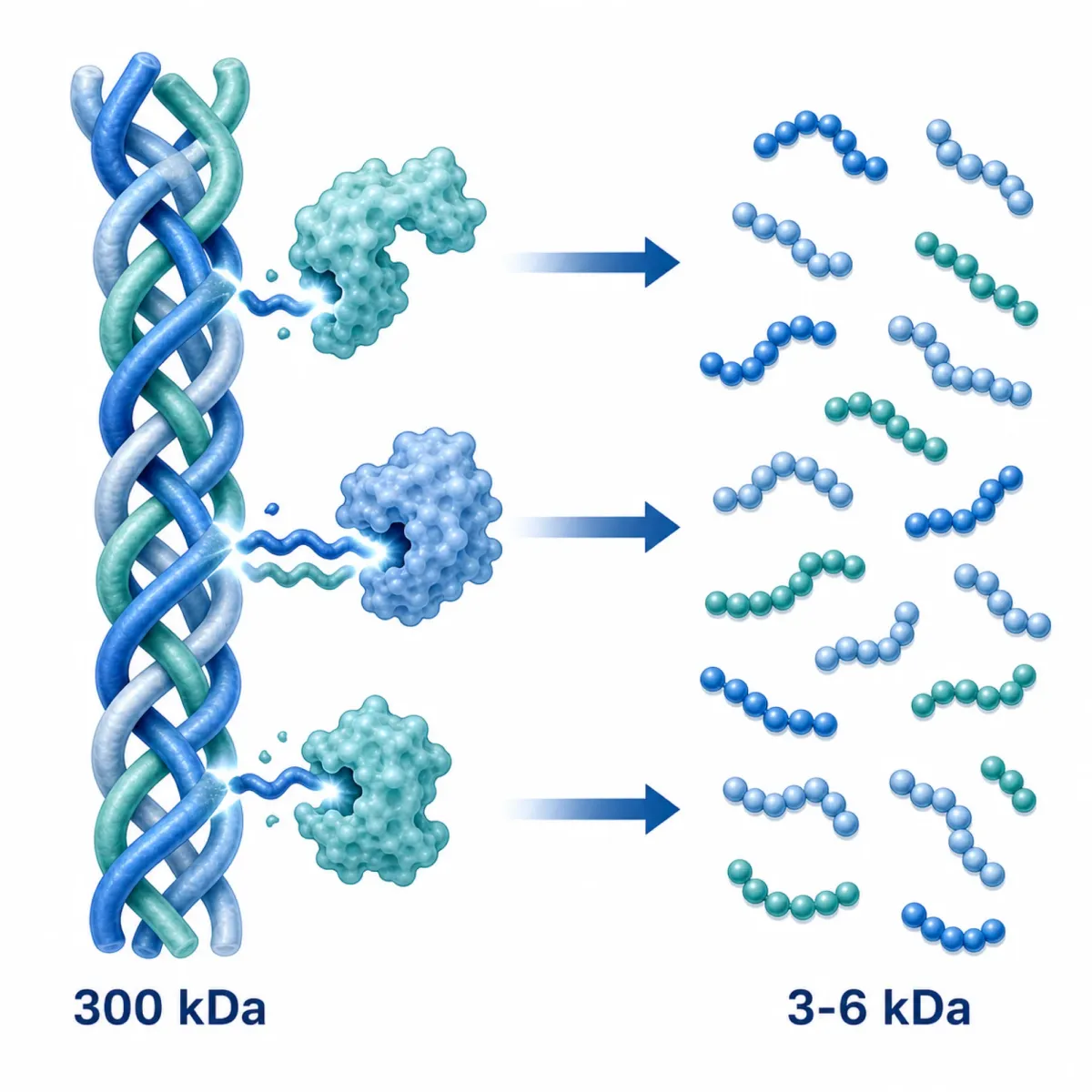
The clumping problem traces back to molecular size. Native collagen proteins weigh roughly 300 kilodaltons (kDa) — massive molecules that refuse to play nice with liquid. To make them supplement-friendly, manufacturers break collagen down through enzymatic hydrolysis, using enzymes like alcalase, papain, and pepsin at temperatures above 40°C to slice those bulky proteins into fragments weighing just 3 to 6 kDa. Think of it like breaking a cinder block into sand. Sand dissolves into water far more readily than a whole block ever could.
But not all collagen powders undergo the same degree of hydrolysis. Cheaper products cut the process short, leaving larger fragments that resist dissolving. When powder hits coffee too fast, the outer layer of each granule hydrates and forms a sticky shell that traps dry powder inside. Bartenders call this "fish-eyeing" when it happens with thickeners. Same physics.
The fix starts at the label: look for "hydrolyzed collagen peptides" rather than just "collagen." That distinction signals the extra processing that makes coffee compatibility possible.
Hydrolyzed Collagen vs. Gelatin: One Dissolves, the Other Turns Your Coffee Into Jell-O
Collagen and gelatin come from the same animal source. They share the same amino acid profile. But put them in your morning cup and they behave like entirely different substances.
Gelatin — the stuff that makes Jell-O set — has a molecular weight between 20 and 100 kDa. It dissolves in hot water just fine, but the moment it cools below about 40°C, those larger molecules reassemble into a gel matrix. Pour gelatin into iced coffee and you get a wobbly, gelatinous mess within minutes. Pour it into hot coffee and it dissolves — temporarily. As the drink cools on your desk, it thickens. Not what anyone wants from their afternoon pick-me-up.
Hydrolyzed collagen peptides, by contrast, weigh in at 2 to 5 kDa. That further breakdown — the "hydrolyzed" part — strips away the protein's ability to form a gel network. As ScienceDirect's biochemistry reference puts it, hydrolyzed gelatins are "soluble in cold water, but possess no gelling power." They stay liquid whether your drink is 200°F or ice cold.
Properly hydrolyzed collagen peptides dissolve in cold brew, hot drip, iced lattes, or room-temperature water without changing texture. Gelatin cannot. If a label says "gelatin" or "collagen protein" without "hydrolyzed" or "peptides," assume it will gel.
| Property | Gelatin | Hydrolyzed Collagen Peptides |
|---|---|---|
| Molecular weight | 20-100 kDa | 2-6 kDa |
| Dissolves in hot liquid | Yes | Yes |
| Dissolves in cold liquid | No (gels) | Yes |
| Changes drink texture | Yes (thickens) | No |
| Coffee-compatible | Hot only, temporary | Hot and cold |
Does Hot Coffee Destroy Collagen Peptides?
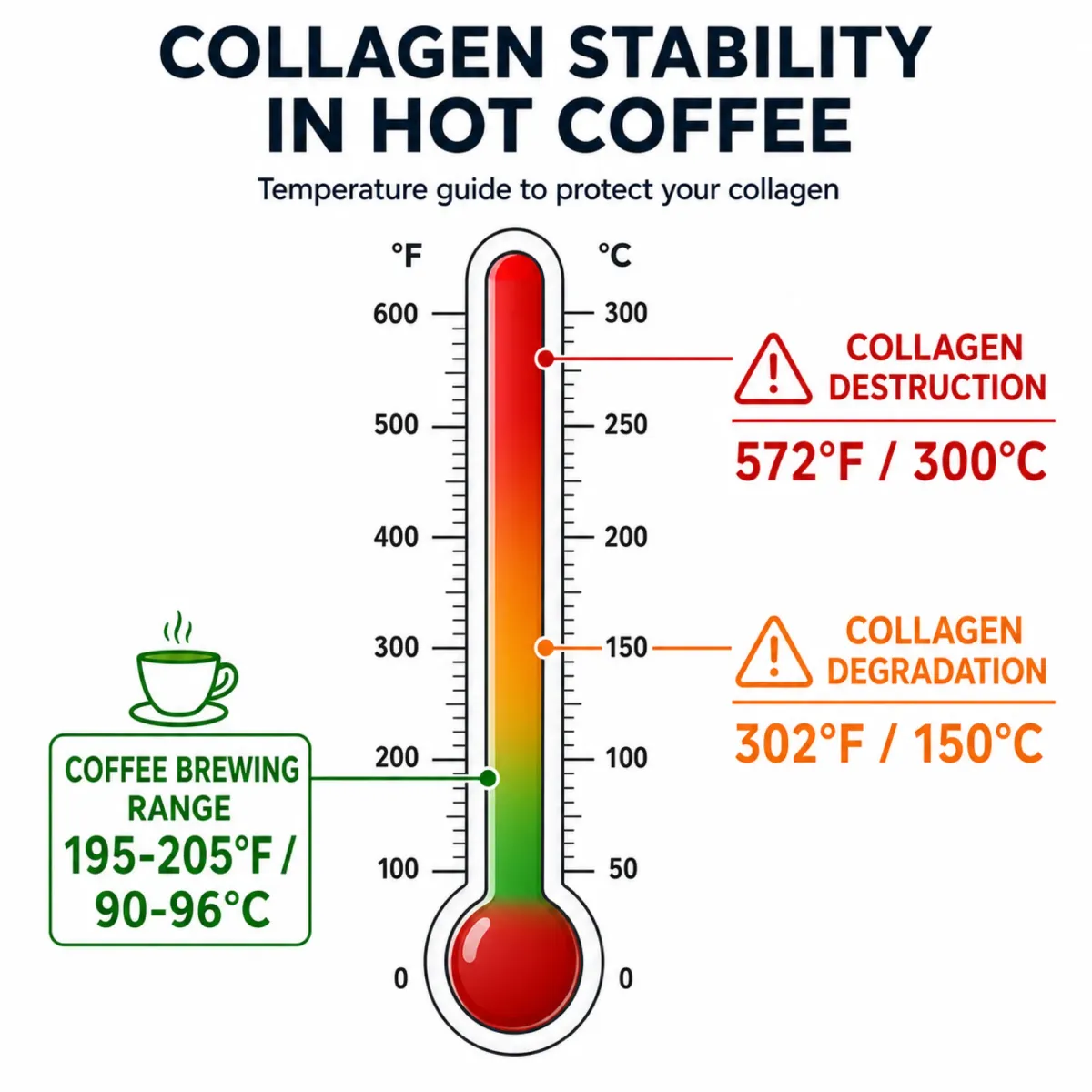
Researchers Laurent Bozec and Marianne Odlyha at University College London studied collagen's thermal behavior using microthermal analysis and atomic force microscopy. They found that hydrated collagen begins denaturing at 58 to 75°C, with the main structural change around 65°C. But that denaturation temperature applies to intact, native collagen — the stuff still attached to animal tissue. Your supplement has already been denatured during manufacturing. As Dr. Jackson explained to Vital Proteins, collagen peptides undergo "a process that usually involves denaturing and digesting the collagen protein, which means it shouldn't matter if the collagen is dissolved in a hot liquid because most collagen supplements are already denatured and hydrolyzed."
For hydrolyzed collagen powder to actually degrade — to break apart at the molecular level into something your body cannot use — you would need temperatures around 302°F (150°C) at minimum. Standard brewed coffee sits between 195 and 205°F (90 to 96°C). Even espresso, which brews under pressure, doesn't approach the danger zone.
A 2016 clinical study provided direct evidence: participants who consumed collagen peptides dissolved in hot beverages for eight weeks showed significant improvements in skin moisture, elasticity, and texture — results that matched studies using cold beverages. If heat were destroying the collagen, those improvements wouldn't appear.
What About Coffee's Polyphenols Binding to Collagen?
Heat is settled, but a subtler question deserves attention. Coffee is loaded with polyphenols — chlorogenic acid, caffeic acid, tannins — and polyphenols bind to proline-rich proteins. Collagen is one of the most proline-rich proteins in the human body. So coffee's polyphenols could, in theory, latch onto collagen peptides in your cup and reduce what your gut actually absorbs.
A 2025 study published in Food Research International tackled this question directly. Researchers measured the bioavailability of amino acids and bioactive peptides from collagen hydrolysate consumed in coffee versus plain water in healthy volunteers. The result: "similar area under the curve of collagen peptides in both water and coffee." Despite the theoretical concern, coffee's polyphenols did not meaningfully reduce collagen peptide absorption.
One cell-culture study from 2014 muddies the picture slightly. Researchers found that caffeine inhibited collagen biosynthesis by 48% at 1 mM concentration in cultured fibroblasts. That sounds alarming until you consider the context: those were cells bathed directly in caffeine in a petri dish, not humans drinking coffee. The caffeine reaching your cells after a cup is vastly lower than what researchers applied in the lab.
Four Certifications Worth Checking (and One That Isn't)
The FDA doesn't verify that what's on a supplement label matches what's in the tub before it ships. Third-party testing certifications fill that gap. Not all carry equal weight:
| Certification | What It Tests | Why It Matters |
|---|---|---|
| NSF Certified for Sport | 280+ banned substances, label accuracy, contaminant screening | Gold standard for athletes; most rigorous testing |
| Informed Sport / Informed Choice | Banned substances, batch-level testing | Every production batch tested (not just random samples) |
| USP Verified | Purity, potency, dissolution, manufacturing practices | Pharmacopeia-grade standards; less common in collagen |
| BSCG | Banned substances, contaminants, heavy metals | Independent verification; popular with Olympic athletes |
The certification that gets overrated: GMP (Good Manufacturing Practices). GMP means the facility follows proper manufacturing protocols — clean equipment, consistent processes, trained staff. That's the floor, not the ceiling. GMP verifies how the product was made but does not confirm the final product's purity or ingredient accuracy. A GMP-certified facility could still produce a tub of collagen that contains less protein than the label claims. Third-party testing catches what GMP misses by testing the actual finished product.
For collagen specifically, the NSF Certified for Sport database lists products from Vital Proteins (7+ variants), Momentous, Thorne, Gnarly Nutrition, Klean Athlete, Bubs Naturals, and CB Supplements. If you're spending $30 to $50 per tub, picking one with a real certification costs the same and eliminates the guesswork about what's actually inside.
Which Collagen Powders Actually Disappear Into Coffee?
Treeline Review ran one of the more rigorous consumer tests available: 22 collagen powders evaluated through blind taste tests, with unmarked bags sent to testers nationwide. They scored each product on mixability, flavor, aftertaste, dissolution quality, and price per gram of actual collagen.
Two products scored a perfect 10 out of 10 on mixability: Vital Proteins Collagen Peptides and Gnarly Nutrition Collagen Pro. Both dissolved completely in hot and cold water without visible clumps. Gnarly also carries NSF Certified for Sport status, and at $0.11 per gram includes added vitamin C and zinc — nutrients that support collagen synthesis.
Sports Research Organic Collagen Peptides scored 9/10 on both taste and mixability while holding Informed Choice certification and USDA Organic status. At $0.11 per gram, it matches the price leaders.
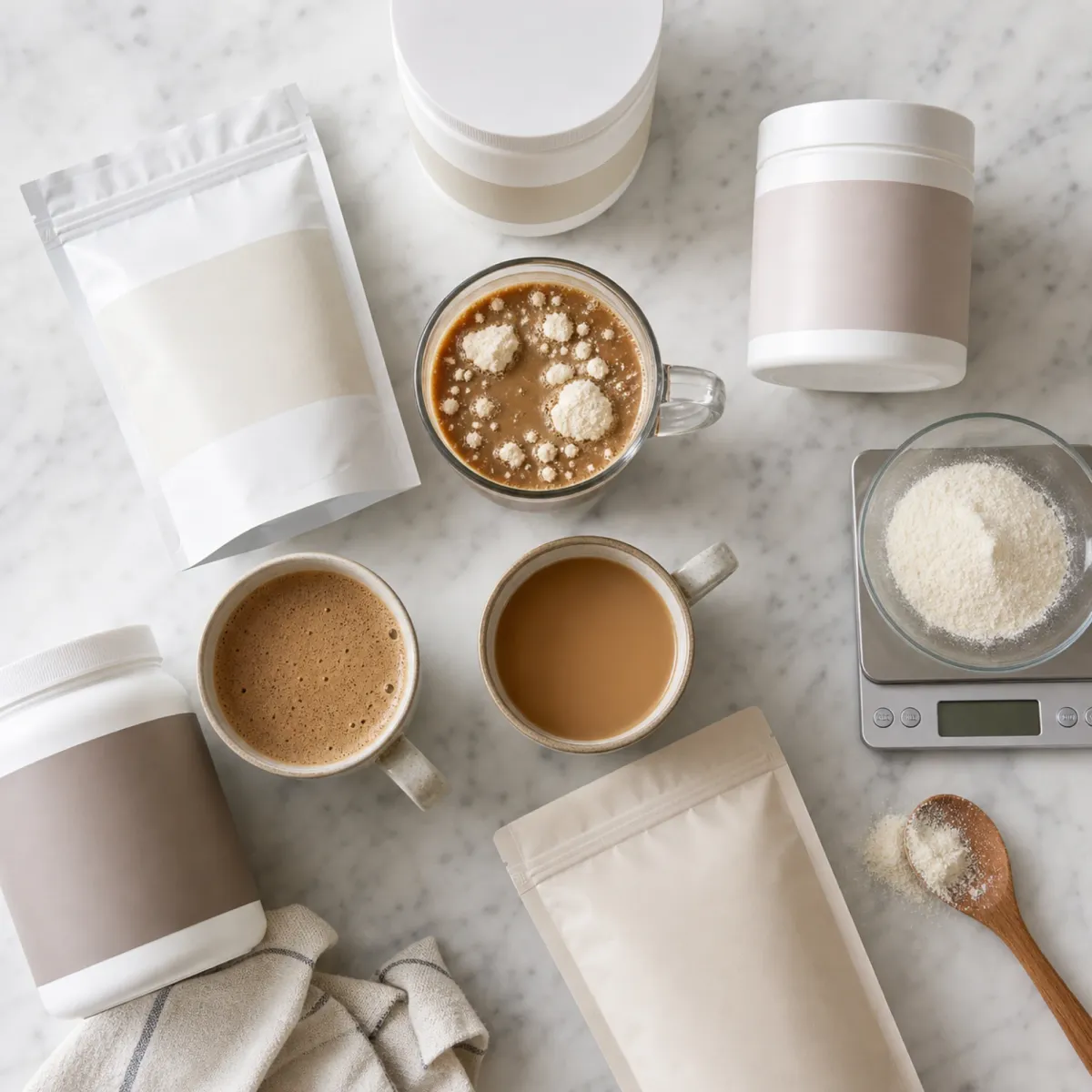
Marine collagen behaves differently than bovine in coffee. Further Food Marine Collagen scored 9/10 on taste but only 5/10 on mixability — it develops a frothy, latte-like texture and leaves small clumps that need a blender to fully incorporate. Wild-caught fish collagen tends to dissolve into a finer consistency with less flavor impact than bovine sources, but some marine products foam in a way bovine ones don't.
For budget-conscious buyers, Orgain Collagen Peptides came in at $0.08 per gram — the cheapest option tested. Trade-off: visible clumps during mixing. You'll need a blender or frother to get it smooth.
| Brand | Taste | Mixability | Price/gram | Source | Certification |
|---|---|---|---|---|---|
| Vital Proteins | 7/10 | 10/10 | $0.11 | Bovine (grass-fed) | NSF Certified for Sport |
| Gnarly Collagen Pro | 8/10 | 10/10 | $0.11 | Bovine | NSF Certified for Sport |
| Sports Research Organic | 9/10 | 9/10 | $0.11 | Bovine (organic) | Informed Choice |
| Further Food Marine | 9/10 | 5/10 | $0.18 | Wild-caught fish | None listed |
| Ancient Nutrition Multi | 8/10 | 9/10 | $0.12 | Multi-source | None listed |
| Orgain | — | — | $0.08 | Bovine (grass-fed) | None listed |
Hot Drip, Cold Brew, Espresso: Collagen Behaves Differently in Each
Hot drip coffee between 195 and 205°F is the easiest vehicle for collagen peptides. The heat accelerates dissolution, and a simple spoon stir incorporates the powder within 15 to 20 seconds for well-hydrolyzed products. No special equipment needed.
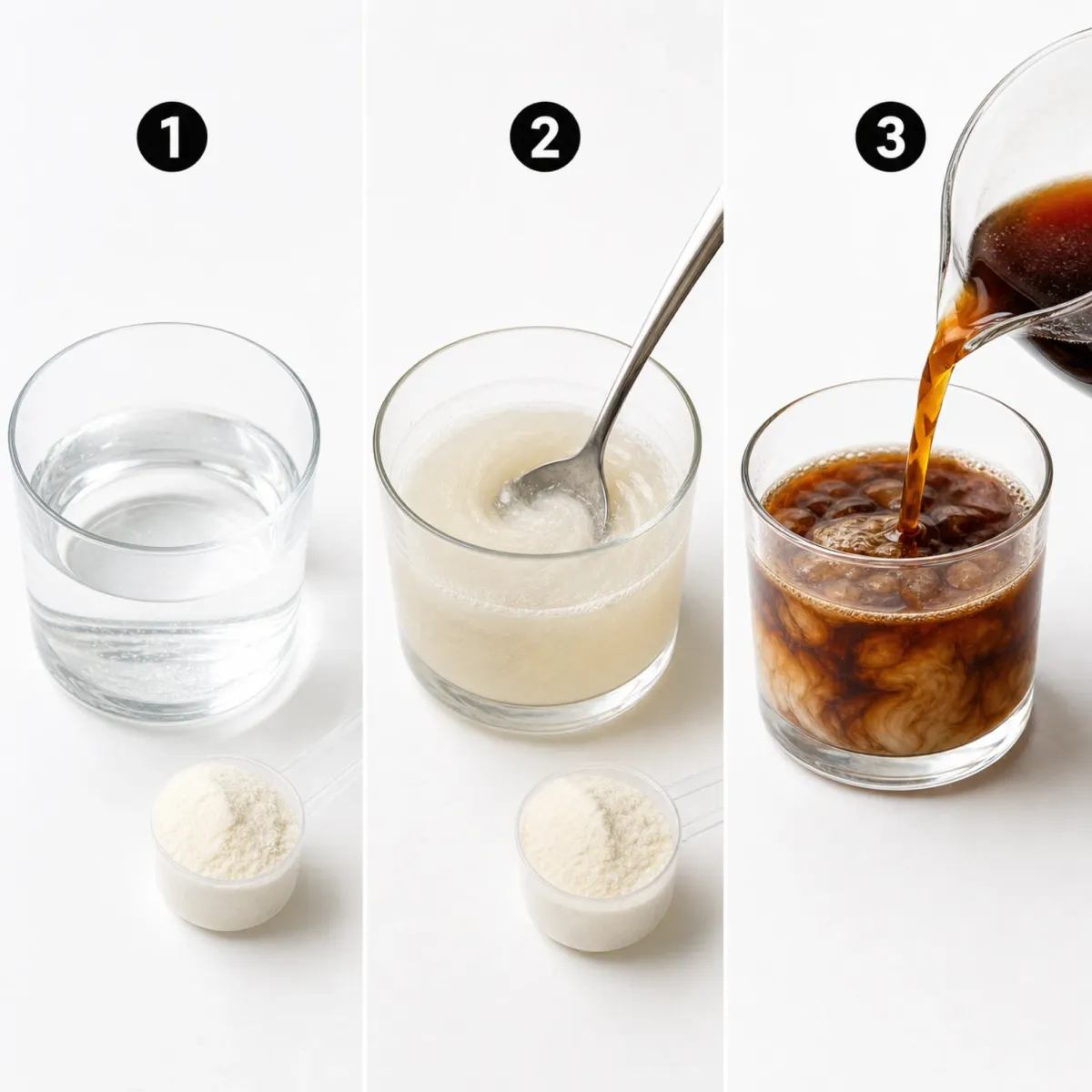
Cold brew presents the real challenge. At refrigerator temperatures, even properly hydrolyzed collagen peptides dissolve more slowly. The powder doesn't break down well at low temperatures, so particles bind together instead of separating into solution. The workaround: pre-dissolve your collagen in two to three tablespoons of warm (not hot) water first, creating a slurry, then pour your cold brew over it. This two-step method eliminates clumping without heating your cold brew.
Espresso adds a wrinkle because of volume. A standard double shot is only about 2 ounces of liquid. Dissolving 10 to 20 grams of collagen powder into 2 ounces of anything — even hot liquid — creates an extremely concentrated slurry. You end up with sludge, not coffee. If espresso is your drink, add the collagen to the milk or water you use to build your americano or latte instead of the espresso shot itself. The larger liquid volume gives the peptides room to disperse.
Quick reference: Hot drip coffee — stir directly. Cold brew — pre-dissolve in warm water first. Espresso — add to the milk or water, not the shot. Iced latte — dissolve in the milk before pouring over ice.
The peptides themselves stay stable in all of these scenarios. A 2024 randomized crossover study in Frontiers in Nutrition measured plasma hydroxyproline levels reaching 6 to 10 times baseline within 100 to 130 minutes after ingestion, with consistent patterns across delivery methods. The same bioactive peptides (primarily Pro-Hyp and Hyp-Gly) appear in your blood whether your coffee was hot, cold, or somewhere between.
Seven Techniques That Eliminate Gritty Collagen Coffee Forever
1. Add powder to liquid, never liquid to powder. Dumping coffee onto a heap of dry collagen creates the same clumping problem as adding flour to water — the outer layer hydrates and seals dry powder inside. Sprinkle the powder into your already-poured coffee while stirring.
2. Use a milk frother. A handheld battery-powered milk frother spinning at several thousand RPM breaks apart micro-clumps that survive hand stirring. Ten seconds with a frother produces noticeably smoother results than sixty seconds with a spoon. They cost $8 to $15 and earn their price within a week of daily use.
3. Match your collagen source to your flavor preference. Marine collagen dissolves into a finer, more neutral consistency and carries less flavor impact than bovine. If you drink single-origin pour-overs where subtle flavor notes matter, marine is the less intrusive choice. Bovine collagen adds a barely perceptible creaminess that some people actually prefer in a dark roast or latte.
4. For cold brew, always pre-dissolve. Fill a glass one-third with warm water, stir in your collagen until smooth, then slowly pour cold brew over the top. Rushing this step — dumping cold coffee directly onto dry powder — guarantees clumps.
5. Skip flavored collagen for black coffee. Vanilla and chocolate collagen peptides contain sweeteners designed for smoothies. They overpower black coffee. "Unflavored" and "tasteless" are separate claims: unflavored means no added flavors, but the base collagen may still carry a faint savory note.
6. Don't microwave collagen-coffee for reheating. Microwaves create uneven hot spots that can push localized temperatures well above the liquid's average. Mix fresh collagen into a newly heated cup instead.
7. Store powder sealed and dry. Collagen powder is hygroscopic — it pulls moisture from the air. An open tub left on a humid kitchen counter develops hard clumps within weeks that won't dissolve in anything. Keep the lid sealed between uses and avoid scooping with a wet spoon.
Frequently Asked Questions
Does collagen powder change the taste of coffee?
Well-hydrolyzed unflavored collagen peptides from reputable brands should not alter coffee's taste in any noticeable way. Some lower-quality products carry a faint savory or bone-broth undertone. Marine collagen tends to be more flavor-neutral than bovine. If you can taste your collagen, switching to a more thoroughly hydrolyzed product (smaller molecular weight, typically under 5 kDa) usually solves the problem.
How much collagen should I add to one cup of coffee?
Most clinical studies showing benefits for skin, joints, and bone health use doses between 10 and 20 grams per day. One standard scoop from most brands provides 10 to 11 grams. Adding a single scoop to your morning coffee is the most common approach. Doubling up to 20 grams in one cup works but may increase the chance of a slightly thicker texture, especially in smaller volume drinks like espresso.
Can I add collagen to coffee with cream or milk?
Yes. The fat in cream or milk does not interfere with collagen dissolution or absorption. Some people find that adding collagen and creamer simultaneously produces smoother results because the fat helps emulsify the peptides. The 2025 Food Research International study tested collagen bioavailability in coffee specifically — a polyphenol-rich matrix — and found comparable absorption to plain water.
Is marine or bovine collagen better for coffee?
Depends on what you drink. Marine collagen dissolves finer and carries minimal flavor — good for light roasts and pour-overs. Bovine adds a subtle creaminess that works in darker roasts. Both provide types I and III collagen. A 2024 Frontiers in Nutrition study found comparable overall absorption between fish, porcine, and bovine sources, so the choice comes down to taste and texture.
Do I need to take collagen on an empty stomach instead of in coffee?
No. The 2025 coffee bioavailability study showed equivalent peptide absorption when collagen was consumed with coffee versus plain water. Taking it with your morning coffee supports consistency, which matters more for long-term results than timing optimization.
Medical Disclaimer
This article is for informational and educational purposes only and is not medical advice, diagnosis, or treatment. Always consult a licensed physician or qualified healthcare professional regarding any medical concerns. Never ignore professional medical advice or delay seeking care because of something you read on this site. If you think you have a medical emergency, call 911 immediately.