How Online Peptide Clinics Actually Work
A customer spent $340 on semaglutide from a vendor with a polished website and "99.8% purity" stamped across every page. The vials arrived looking right. After two weeks of dosing, nothing happened. He sent a sample to Janoshik, an independent analytical lab. The result: 38% purity, with the rest being mannitol and mystery filler.
That story, documented by Pepdex's vendor comparison database, captures the central problem with online peptide access in 2026. The market has split into two distinct channels that look almost identical from the outside but operate under completely different rules.
The first channel runs through licensed prescribers and compounding pharmacies regulated under Sections 503A and 503B of the FD&C Act. A doctor evaluates you, writes a prescription for a specific peptide at a specific dose, and a state-licensed pharmacy compounds it using pharmaceutical-grade API sourced from FDA-registered manufacturers. The pharmacy follows current Good Manufacturing Practice (cGMP) standards. Your vial arrives with a batch-specific certificate of analysis.
The second channel is everything else: research chemical websites, overseas suppliers, and a growing number of slick telehealth platforms that blur the line between medical practice and direct-to-consumer e-commerce. Some of these operate in genuine legal gray areas. Others are straightforward scams dressed in medical language.
The stakes of picking the wrong one go beyond wasted money. In 2012, the New England Compounding Center (NECC) shipped contaminated steroid injections that caused fungal meningitis in nearly 800 people and killed 64. That was a licensed compounding facility. The unregulated market carries every risk the regulated one does, plus the additional risk that nobody is checking.
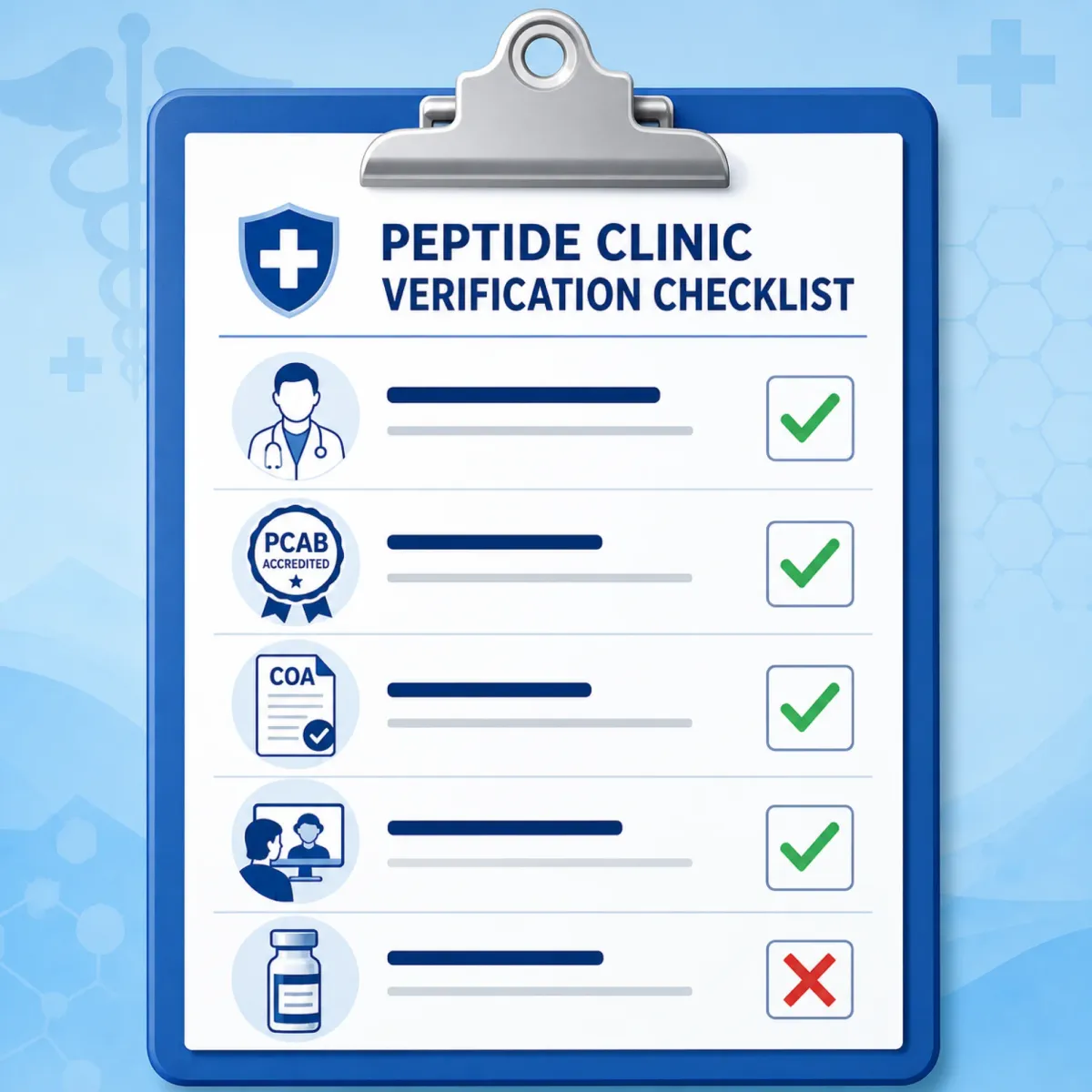
The 5 Markers of a Legitimate Peptide Clinic
Not every online peptide clinic is a scam. Some operate with genuine medical oversight and legitimate compounding partnerships. Here is what separates them from the noise.
1. A named, verifiable prescriber. The clinic should identify the physician, nurse practitioner, or physician assistant writing your prescription. That prescriber should hold an active license you can check on your state medical board's website. Anonymous "medical teams" or AI-driven questionnaires that generate prescriptions without human review are red flags, not features.
2. A named, accredited compounding pharmacy. The clinic should tell you which pharmacy compounds your medication. That pharmacy should be state-licensed and ideally hold PCAB (Pharmacy Compounding Accreditation Board) accreditation, which Dr. Robert Shmerling of Harvard Health Publishing calls "the gold standard for compounding pharmacies." If the clinic will not name the pharmacy, that tells you something.
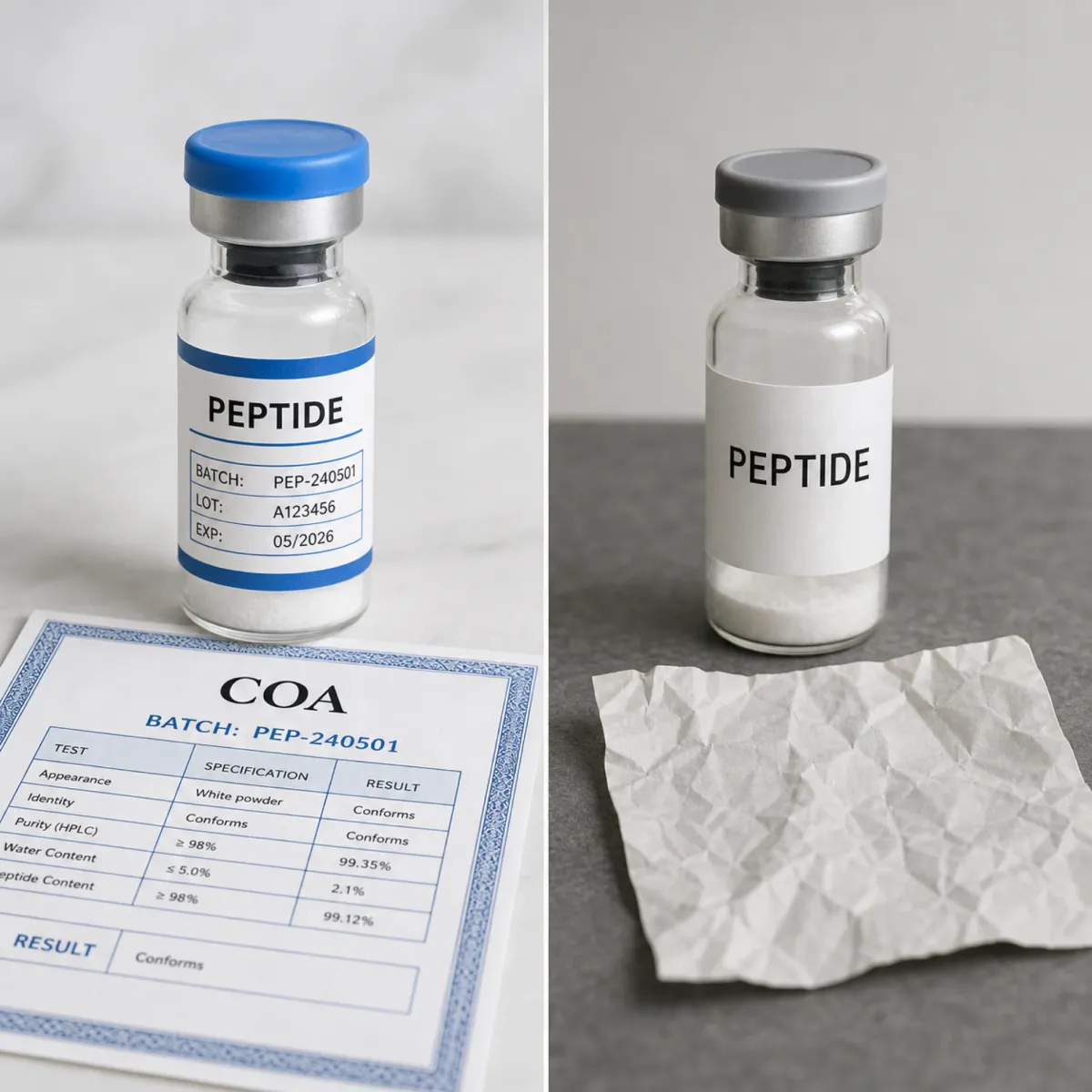
3. Batch-specific certificates of analysis. A legitimate compounding pharmacy provides a COA for each batch, showing purity testing from an accredited third-party lab with matching batch numbers. The COA should be recent and reference a recognized testing methodology (HPLC is standard). Generic COAs with no batch numbers, in-house-only testing, or years-old reports that do not match current inventory are all deal-breakers.
4. An actual medical consultation. This means a real-time conversation, synchronous or asynchronous, where a prescriber reviews your health history, current medications, contraindications, and treatment goals. A 3-question quiz followed by an "Add to Cart" button is not a medical consultation. The Guardian documented Australian online clinics that let customers browse unapproved peptides like MOTs-C after completing a health questionnaire and selecting "areas of interest" like mood and sleep, without any doctor involvement.
5. Clear labeling of what you are getting. The clinic should specify the exact peptide, salt form (e.g., acetate, free base), concentration per vial, and reconstitution instructions. Vague product descriptions like "healing peptide blend" or "anti-aging complex" without identifying the specific compound are marketing, not medicine.
Red Flags That Should Make You Close the Tab
The research chemical market has developed its own set of tells. Pepdex, which maintains a vendor comparison database, identifies nine specific red flags that separate sketchy vendors from legitimate ones.
| Red Flag | What It Looks Like | Why It Matters |
|---|---|---|
| No published COAs | Vendor refuses to provide or has no testing documentation | You have no evidence the vial contains what the label says |
| COAs that do not match | Batch numbers missing, dates old, or lab not verifiable | May be fabricated or recycled from another product |
| Therapeutic claims on packaging | "For fat loss," "treats joint pain" on a research chemical | Makes it an unapproved drug under FDA rules, regardless of disclaimer |
| Crypto-only or wire-only payment | No credit card processing available | Legitimate businesses can get merchant accounts; those selling gray-market products often cannot |
| Pricing far below market | BPC-157 at $15/vial when market average is $40-80 | Pharmaceutical-grade synthesis has a floor cost; below it means underdosed or substituted |
| No batch or lot tracking | Vials have no batch numbers or tracking codes | No way to trace a problem back to a specific production run |
| Telegram-only customer support | No email, phone, or live chat; only encrypted messaging | Designed to avoid accountability and paper trails |
The pricing point deserves particular attention. Pharmaceutical-grade peptide synthesis involves solid-phase peptide synthesis (SPPS), HPLC purification, lyophilization, sterility testing, and packaging under cGMP conditions. Each step has costs that cannot be meaningfully compressed. When a vendor undercuts the market by 60-70%, they are either skipping purification steps, substituting cheaper compounds, or underfilling vials. Sometimes all three.
One additional tell that has become more significant in 2026: the FDA now treats the pairing of peptides with bacteriostatic water as dispositive evidence of intended human use. A "research use only" disclaimer next to a buy-one-get-one offer on bacteriostatic water is no longer a clever legal workaround. It is the specific trigger the FDA uses to classify both items as unapproved drugs.
Telehealth Prescribing Rules That Affect Peptide Access
Telehealth prescribing for peptides operates under two overlapping sets of rules: federal law governing compounding and state law governing medical practice.
At the federal level, Section 503A requires that compounded drugs be prepared "for an identified individual patient based on the receipt of a valid prescription." The prescription must come from a licensed prescriber exercising independent medical judgment. This means the prescriber must evaluate you individually, not rubber-stamp orders generated by a quiz algorithm.
At the state level, prescribing rules vary. Some states require an initial in-person visit before telehealth prescribing. Others allow fully remote prescriber-patient relationships from the start. Several states have specific restrictions on prescribing controlled substances via telehealth, though most peptides (with the exception of growth hormone) are not classified as controlled substances.
The COVID-era telehealth flexibilities that allowed broad remote prescribing have been tightening. The Ryan Haight Act requires an in-person evaluation before prescribing controlled substances online, and the DEA has been narrowing exceptions. While this applies primarily to controlled substances, the enforcement trend signals broader scrutiny of telehealth prescribing practices, including those involving compounded peptides.
The practical implication: if an online clinic prescribes peptides without any meaningful medical evaluation, regardless of your state, the prescriber may be violating their own licensing standards. A legitimate telehealth peptide clinic will conduct a proper intake, review your health history, explain risks and alternatives, and document the medical necessity for the prescribed therapy.
How to Verify the Compounding Pharmacy Behind the Clinic
Every legitimate peptide clinic partners with a compounding pharmacy. That pharmacy is where your medication actually gets made. Verifying the pharmacy matters more than verifying the clinic itself, because the pharmacy determines the quality, sterility, and accuracy of what ends up in your vial.
Here is how to check.
Step 1: Get the pharmacy name. Ask the clinic which compounding pharmacy fills their prescriptions. If they refuse to tell you, stop here.
Step 2: Check state licensure. Every compounding pharmacy must hold a state pharmacy license. Search your state board of pharmacy's website or the FDA's Registered Outsourcing Facilities list for 503B facilities. For 503A pharmacies, use the NABP (National Association of Boards of Pharmacy) license lookup.
Step 3: Check accreditation. PCAB accreditation (now administered through ACHC, the Accreditation Commission for Health Care) is voluntary but represents the highest standard for compounding quality. Ask whether the pharmacy is PCAB-accredited.
Step 4: Check FDA inspection history. For 503B outsourcing facilities, the FDA publishes inspection results, recall notices, and enforcement actions on its compounding oversight page. Any recent recalls, Form 483 observations, or warning letters should give you pause.
Step 5: Request a COA for your specific batch. After receiving your medication, ask for the certificate of analysis corresponding to your batch number. Verify that the testing lab is independent and accredited (ISO 17025 is the standard for testing laboratories).
Dr. Robert Shmerling, Senior Faculty Editor at Harvard Health Publishing: "It's best to use a compounding pharmacy only when truly necessary, that is, when you need a medication that is not commercially available through a regular pharmacy." He recommends asking about PCAB accreditation, sterility testing protocols, and whether the pharmacy has had any FDA actions.
What Legitimate Peptide Therapy Actually Costs (and Why Cheap Is Suspicious)
The price gap between regulated and unregulated peptide sources is one of the clearest signals available to buyers. Here is what the market looks like in mid-2026.
| Peptide | Research Chemical Price | 503A Compounding Pharmacy Price | Why the Difference |
|---|---|---|---|
| BPC-157 (5mg vial) | $15-40 | $60-150 | Pharmaceutical-grade API, sterility testing, cGMP facility, prescriber oversight |
| Semaglutide (4-week supply) | $80-200 | $200-450 | Shortage ended; legal compounding restricted; brand Ozempic $900+ |
| CJC-1295/Ipamorelin stack | $40-80 | $150-350 | Two peptides compounded together, stability testing required |
| TB-500 (5mg vial) | $20-50 | $80-180 | Category 2 removal pending; limited legal supply chain |
The regulated price includes costs the gray market does not bear: a prescriber's time, state pharmacy licensing fees, cGMP-compliant facility overhead, third-party analytical testing per batch, liability insurance, and regulatory compliance staff. When a clinic offers peptide therapy at research-chemical prices, either they are operating outside the regulated framework or they are cutting corners within it.
There is also the hidden cost of the wrong product. Reports of compounding errors resulting in patients receiving 20 times the appropriate dose have been documented even within the regulated system. In the unregulated market, where no one checks concentration or sterility, the risk multiplies.
FDA Enforcement Actions Against Online Peptide Sellers in 2025-2026
The FDA's enforcement posture toward online peptide sellers shifted from reactive to systematic starting in late 2024. Here is the trajectory.
December 2024: The FDA issued a warning letter to Prime Vitality, Inc. (doing business as Prime Peptides) for selling unapproved new drugs including GLP-1 receptor agonists.
February 2025: USApeptide.com received a warning letter for marketing unapproved peptide products.
March 2026: The FDA issued warning letters to both Prime Sciences and Gram Peptides on the same day (March 31), targeting companies selling peptides with "research use only" disclaimers paired with bacteriostatic water.
Early 2026: The FDA sent 30 warning letters to telehealth companies for making false or misleading claims about compounded GLP-1 products. This was the second batch of such letters since the agency launched a crackdown on misleading direct-to-consumer pharmaceutical advertising in September. Over the preceding six months, the FDA had sent thousands of warning letters to pharmaceutical and telehealth firms, more than had been issued over the entire preceding decade.
The primary violations identified in the telehealth letters fell into two categories: making claims that implied their compounded products were the same as FDA-approved drugs (like Ozempic or Mounjaro), and obscuring product sourcing by advertising drug products branded with the telehealth firm's own name without disclosing that they were compounded, not manufacturer-produced.

Frequently Asked Questions
Is it illegal to buy peptides online?
Buying peptides labeled "for research use only" is not illegal for the buyer in most cases. However, selling unapproved peptides intended for human use violates the FD&C Act. The FDA has been systematically targeting sellers, not buyers, but the legal risk to sellers means your favorite vendor could disappear overnight, and there is no quality guarantee on what you receive.
How do I know if a peptide clinic is using a real compounding pharmacy?
Ask for the pharmacy's name, then verify its state license through your state board of pharmacy. Check whether it holds PCAB accreditation (the gold standard per Harvard Health) and search the FDA's outsourcing facility registry or compounding inspection database for any enforcement history.
Why are compounded peptides so much more expensive than research chemicals?
Regulated compounding includes pharmaceutical-grade API sourcing from FDA-registered facilities, cGMP-compliant manufacturing, third-party sterility and purity testing per batch, prescriber evaluation, liability insurance, and regulatory compliance. Research chemical sellers bear none of these costs. The price difference reflects a quality and safety gap, not a markup.
Can a telehealth doctor legally prescribe peptides?
Yes, if the prescriber holds a valid license in the patient's state, conducts a proper medical evaluation, and writes a prescription for a peptide that can be legally compounded. The evaluation must reflect genuine independent medical judgment. An automated quiz that generates a prescription without clinical review does not meet the legal standard for prescribing in any state.
Medical Disclaimer
This article is for informational and educational purposes only and is not medical advice, diagnosis, or treatment. Always consult a licensed physician or qualified healthcare professional regarding any medical concerns. Never ignore professional medical advice or delay seeking care because of something you read on this site. If you think you have a medical emergency, call 911 immediately.