About 77 percent of Americans say stress affects their physical health. Nearly three-quarters report mental health effects too. Prescriptions for anti-anxiety medication keep climbing. And yet one of the oldest practices on the planet keeps showing up in clinical research as a real, measurable intervention for what stress does to the brain.
Not as a cure-all. Not as a replacement for professional care. But as something that changes brain chemistry and brain structure in ways researchers can now see on MRI scans and measure in blood draws. This guide covers what the science actually says, so you can figure out whether unrolling a mat is worth your time.
How stress rewires your brain (and what yoga does about it)
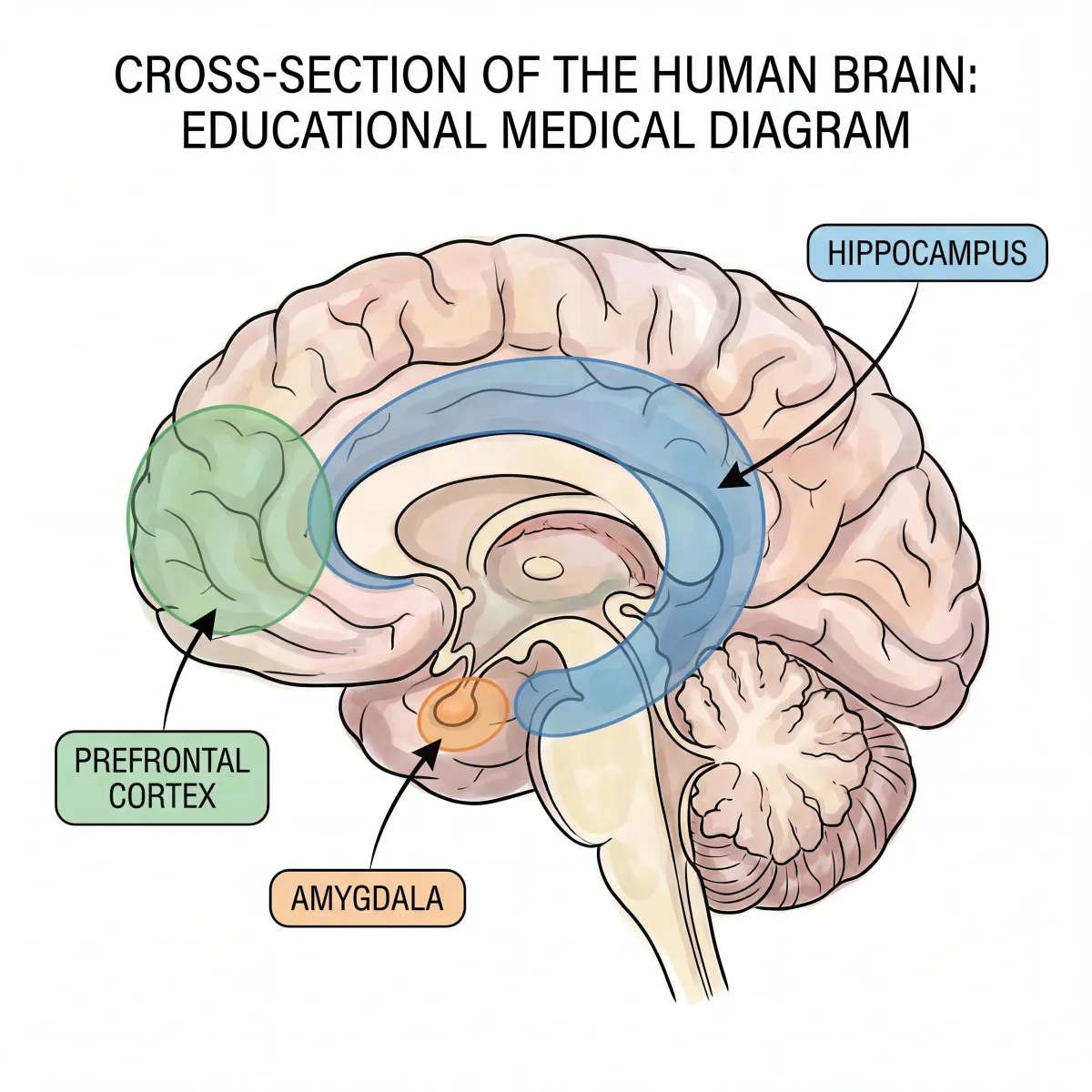
Chronic stress physically changes the brain. The amygdala, your threat-detection center, grows larger and more reactive. The prefrontal cortex, where you make decisions and control impulses, shrinks. The hippocampus, the region handling memory and emotional regulation, loses volume. These are not metaphors. They show up on MRI scans.
Cortisol drives most of this damage. When it stays elevated day after day, it becomes neurotoxic. It erodes the exact brain regions you need for clear thinking and emotional stability.
A 2024 meta-analysis in Frontiers in Psychiatry reviewed 42 studies and found that yoga was associated with reduced evening cortisol, lower waking cortisol, decreased blood pressure, and lower resting heart rate compared to active control groups.
Yoga interrupts the stress cycle at several points. The postures activate your parasympathetic nervous system, the "rest and digest" side of the equation. Breathing practices stimulate the vagus nerve, which sends calming signals from gut to brain. The focus required during practice trains the prefrontal cortex to override the amygdala's alarm system.
A randomized controlled trial in Acta Psychologica (March 2024) found that Sudarshan Kriya Yoga significantly reduced stress scores. A separate 2024 study in Frontiers in Public Health reported that Isha yoga practitioners had lower stress, less mental distress, and higher well-being scores than non-practitioners.
If you want to pair yoga with targeted breathing techniques for stress relief, the research backs that combination. Pranayama, yoga's breathing practices, independently reduce salivary cortisol levels. A study on adolescents who practiced Bhramari Pranayama for six months confirmed the effect.
What brain scans reveal about yoga practitioners
The strongest evidence comes from neuroimaging. When researchers put long-term yoga practitioners into MRI machines and compare their brains to non-practitioners, the differences are consistent.
A 2019 systematic review in Brain Plasticity analyzed 11 neuroimaging studies. Yoga practice was associated with changes in the hippocampus, amygdala, prefrontal cortex, cingulate cortex, and default mode network.
| Brain Region | Change in Yoga Practitioners | Why It Matters |
|---|---|---|
| Hippocampus | Greater gray matter volume | Memory formation, emotional regulation |
| Prefrontal cortex | Increased cortical thickness | Decision-making, impulse control |
| Amygdala | Reduced reactivity | Less overreaction to threats |
| Insula | Increased gray matter density | Body awareness, empathy |
| Default mode network | Altered functional connectivity | Reduced rumination and mind-wandering |
The hippocampus finding matters most. That is the brain region chronic stress damages the hardest, and it is exactly where yoga practitioners show the biggest structural gains. A 2020 review in Frontiers in Integrative Neuroscience confirmed that every structural study from 2009 to 2019 using voxel-based morphometry found measurable gray matter differences between practitioners and controls.
This is also relevant to physical exercise and brain health more broadly. Yoga seems to protect the brain through mechanisms beyond aerobic fitness alone. The combination of movement, breath control, and sustained attention produces a neurological signature that running or lifting weights does not.
Researchers also found a positive correlation between years of practice and gray matter volume. The longer someone had been practicing, the more pronounced the differences. That dose-response relationship makes a stronger case that yoga itself, rather than some confounding variable, is doing the work.
The GABA connection: why yoga mimics anti-anxiety medicine
Gamma-aminobutyric acid (GABA) is the brain's main calming neurotransmitter. It quiets neural activity and promotes relaxation. People with anxiety disorders and depression consistently have low GABA levels. Most anti-anxiety drugs, benzodiazepines like Valium and Xanax, work by boosting GABA activity.
Yoga does something similar through a completely different mechanism.
A pilot study at Boston University School of Medicine found a 27 percent increase in brain GABA levels after a single 60-minute yoga session. A comparison group that spent the same time reading showed no change.
That 2007 pilot study in the Journal of Alternative and Complementary Medicine opened a whole line of inquiry. The same team followed up with a larger randomized controlled trial comparing yoga to walking in 2010. Participants did either 12 weeks of Iyengar yoga or 12 weeks of walking, matched for metabolic demand. The yoga group showed bigger improvements in mood and anxiety, and bigger increases in thalamic GABA levels. It was the first study to link elevated GABA directly to improved mood.
A later 12-week study from Boston University tested Iyengar yoga combined with coherent breathing in people with major depressive disorder. Thalamic GABA went up. Depression scores on the Beck Depression Inventory went down.
| Study | Intervention | GABA Finding |
|---|---|---|
| Streeter et al. (2007) | 60-minute yoga session | 27% increase in brain GABA |
| Streeter et al. (2010) | 12 weeks yoga vs. walking | Greater GABA increase in yoga group; correlated with improved mood |
| Streeter et al. (2020) | 12 weeks yoga + coherent breathing | Elevated thalamic GABA; decreased depression scores |
MRI analysis showed GABA levels stayed elevated for about four days after the last session but dropped back to baseline around eight days later. So practicing once a week probably is not enough. Twice a week seems to be the floor for maintaining the neurochemical shift.
This helps explain why meditation and mindfulness practices pair well with yoga postures. Combining breath, body, and attention activates GABA pathways more effectively than either movement or meditation on its own.
Can yoga treat depression?
Depression is still one of the leading causes of disability worldwide. Medication and psychotherapy help many people, but about 30 percent with major depression do not reach full remission on first-line treatments. That leaves a lot of people looking for what else might help.
A 2023 meta-analysis in Frontiers in Psychology reviewed 34 studies on yoga-based treatments for depressive symptoms. The conclusion: yoga reduces symptoms of both depression and anxiety, and works as an effective add-on to standard depression care.
A Kundalini yoga trial in the Journal of Health Psychology (January 2024) found that six weeks of practice improved emotional expression, self-compassion, and spiritual well-being. The effect sizes were modest, but they were real and measured against a control group.

Here is where yoga has a practical edge over running or gym workouts for people with depression. Many therapeutic sessions are slow, floor-based, and designed for people who are struggling to do much of anything. When getting out of bed feels like a project, a gentle supported practice is far more accessible than a 5K. If you or someone you know is dealing with depression, yoga can be a low-barrier way to start moving while also targeting the brain chemistry side of the problem.
The research supports yoga as a complement to professional treatment, not a standalone replacement for therapy or medication in clinical depression. This distinction matters.
Yoga and sleep: breaking the insomnia cycle
Bad sleep and mental health problems feed each other. Anxiety keeps you awake. Sleep deprivation makes anxiety worse. Depression triggers insomnia, and insomnia deepens depression. If you can break into this loop from the sleep side, a lot of other things improve.
A 2020 meta-analysis in BMC Psychiatry pooled 19 studies with 1,832 participants and found yoga significantly improved sleep quality (SMD = -0.327, P < 0.001). Across 16 randomized controlled trials, yoga improved Pittsburgh Sleep Quality Index scores by an average of 1.2 points.
A separate meta-analysis on older adults found an effect size of -0.54 with zero heterogeneity. That is unusually consistent for a lifestyle intervention. It means the benefits showed up across different studies, different populations, different implementations.
| Population | Effect on Sleep Quality | Quality of Evidence |
|---|---|---|
| Women with sleep problems | Significant improvement (SMD = -0.327) | Moderate |
| Older adults | Consistent improvement (effect size -0.54) | Moderate to high |
| Desk-based workers | Improved sleep quality and reduced stress | Moderate |
| Menopausal women | Mixed results; not statistically significant in all trials | Low to moderate |
The biology is straightforward: lower cortisol, parasympathetic activation, more GABA. Same pathways as the stress and anxiety research, just applied to the sleep side of the equation. Restorative yoga and yoga nidra (guided relaxation) are probably the best fit for sleep since they skip the exertion entirely.
For other sleep strategies that pair well with yoga, see our guide on ways to improve your sleep.
Which yoga style works best for your mental health?
A power vinyasa class that leaves you drenched produces different effects than a restorative session where you hold supported poses for five minutes each. The style matters. Here is what the research supports for specific needs.
Hatha yoga is the most studied style in clinical research. It combines postures with breath control at a moderate pace. Most brain-imaging and cortisol-reduction trials used Hatha. Good all-around choice for stress and anxiety.
Iyengar yoga uses props (blocks, straps, blankets) for precise alignment. The Boston University GABA studies used Iyengar specifically, which makes it the best-supported style for the neurochemical pathways involved in anxiety and depression.
Kundalini yoga leans into breathwork, chanting, and meditation alongside movement. The 2024 trial in the Journal of Health Psychology used Kundalini and found improvements in emotional regulation and self-compassion. Worth trying if you respond well to meditative or spiritual elements.
Restorative yoga and yoga nidra are passive and supported. They are the most accessible options for people with limited mobility, chronic pain, or the kind of fatigue that comes with depression. A 2025 RCT in Stress and Health found online yoga nidra improved well-being and influenced cortisol patterns.
Vinyasa and Ashtanga are more demanding physically. They provide cardiovascular benefits on top of the mental health effects. If you want the mood boost of vigorous exercise with the mindfulness piece that makes yoga different from a treadmill, these are the styles.
Myths vs. facts about yoga and mental health
There is a lot of noise around yoga. Some people dismiss it completely. Others promise it cures everything. Here is where the evidence actually lands.
Myth: Yoga is just stretching with candles.
Neuroimaging studies show structural changes in the hippocampus, prefrontal cortex, and amygdala. A 27 percent increase in brain GABA after one session is not a placebo effect of mood lighting.
Myth: You need years of practice to see mental health benefits.
The GABA studies showed brain chemistry changes after a single session. Stress reductions showed up in a matter of weeks in the 2024 Sudarshan Kriya Yoga trial. Structural brain changes do take months to years, though.
Myth: Yoga can replace psychiatric medication.
No clinical guideline recommends yoga as a standalone treatment for diagnosed anxiety or major depression. The evidence supports it as a complement. Do not stop medication without talking to your doctor.
Myth: Any type of yoga works equally well for mental health.
It does not. Iyengar has the strongest GABA evidence. Hatha has the most brain-imaging data. Restorative yoga and yoga nidra work best for sleep. The style should match the problem.
Myth: You have to be flexible to start.
Therapeutic yoga for mental health involves gentle, supported postures. Iyengar uses props specifically to adapt poses to different bodies. Flexibility is something that might develop. It is not an entry requirement.
How to start yoga for mental wellness
The science is useful, but it does not roll out a mat for you. Here is the practical side.
The GABA research points to at least two sessions per week as the minimum for maintaining elevated neurotransmitter levels. Three sessions per week was the most common frequency in trials that showed results for depression and anxiety. Sessions in the major studies ran 60 to 90 minutes, but even 20 to 30 minutes showed stress reduction benefits. Start with what you can actually do consistently.
For anxiety, Iyengar or Hatha yoga has the strongest backing. For depression, Iyengar combined with coherent breathing is the best-supported option. For sleep, restorative yoga or yoga nidra in the evening. For general stress, any style works as long as you show up regularly.
Start with beginner or "gentle" classes. Many studios and online platforms offer sessions labeled "therapeutic" that are designed for newcomers or people dealing with mental health challenges. Jumping into an advanced class risks injury or frustration, and neither helps.
Yoga works best when it is part of a broader approach. Pair it with professional care when needed, decent sleep habits, and social connection. It is not a magic bullet. It is a useful tool in a larger kit.
Frequently Asked Questions
How long does it take for yoga to improve mental health?
Brain chemistry changes, specifically GABA increases, happen after a single 60-minute session based on the Boston University pilot study. Most people notice improvements in mood and stress within two to four weeks of regular practice. Structural brain changes visible on MRI take months to years.
Is yoga better than regular exercise for anxiety?
A 12-week trial that compared yoga to walking (matched for metabolic demand) found yoga produced bigger improvements in mood and anxiety, plus greater GABA increases. Yoga seems to offer neurochemical benefits that standard aerobic exercise does not, though both help.
Can I do yoga if I take antidepressants or anti-anxiety medication?
Yes. Clinical trials showing yoga benefits for depression and anxiety included participants on medication. Yoga is a complementary practice and does not interfere with psychiatric medications. Check with your prescribing provider before starting, as you would with any new wellness practice.
What type of yoga is best for someone with depression?
Iyengar yoga combined with coherent breathing has the strongest evidence, based on the Boston University studies linking it to increased GABA and lower depression scores. Restorative yoga is a good fallback if active movement feels too hard during a depressive episode. Kundalini yoga has also shown benefits for emotional regulation.
How often should I practice yoga to see mental health results?
At least twice a week to maintain elevated GABA levels. Most successful clinical trials used three sessions per week. Consistency matters more than session length. Regular shorter practices outperform occasional marathon sessions.
Related Articles
- Meditation Techniques, Guides, Tips and Benefits — A complete overview of meditation practices that complement yoga for mental wellness.
- Top 10 Breathing Techniques to Relieve Stress — Pranayama and other breathwork methods backed by research for stress reduction.
- Physical Exercise for Brain Health — How movement protects and strengthens your brain beyond what yoga alone provides.
- Dealing with Depression in 5 Simple Steps — Practical strategies for managing depression, including lifestyle interventions.
- Best Ways to Improve Your Sleep — Evidence-based sleep strategies that work alongside yoga for better rest.
Medical Disclaimer
This article is for informational and educational purposes only and is not medical advice, diagnosis, or treatment. Always consult a licensed physician or qualified healthcare professional regarding any medical concerns. Never ignore professional medical advice or delay seeking care because of something you read on this site. If you think you have a medical emergency, call 911 immediately.