
Your body absorbs almost every drop of fluoride you drink
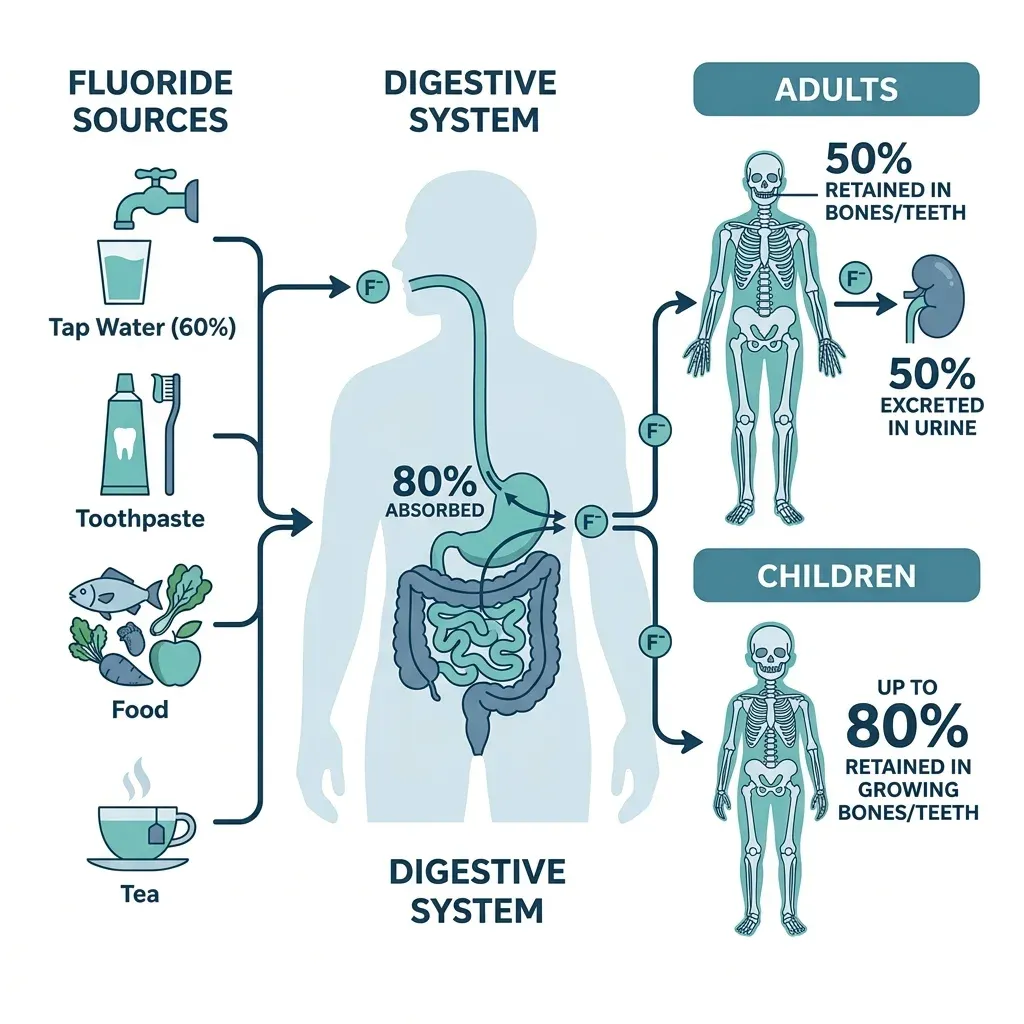
Fluoride is a mineral. It exists naturally in soil, rocks, and water at varying concentrations, and your body handles it much like it handles calcium or phosphorus. When you drink water containing fluoride, roughly 80% of it gets absorbed through your gastrointestinal tract and enters your bloodstream within minutes.
What happens next depends on your age. Adults retain about half of the fluoride they absorb, with nearly all of that 50% depositing into bones and teeth. The other half gets filtered out through urine. Children are different. Because their skeletons and teeth are still growing, young kids retain up to 80% of absorbed fluoride in their developing bones and dental tissue.
Think of fluoride like mortar between bricks. Your tooth enamel is made of hydroxyapatite crystals, and fluoride integrates into this structure, creating fluorapatite, a harder compound that resists the acid attacks from bacteria in your mouth. That process is why fluoride prevents cavities. It physically inhibits and reverses the initiation and progression of dental caries by reinforcing enamel at the molecular level.
Fluoride does not accumulate indefinitely in soft tissue. As Ian Musgrave, a toxicologist at the University of Adelaide, explains, fluoride is highly soluble, and bones slowly turn over, preventing the kind of dangerous buildup you might worry about. The amount in potable water is about 50-200 times lower than the concentration that produces no effect in animals.
Your tap water is not your only source. Fluoridated municipal drinking water and foods prepared with it account for roughly 60% of fluoride intake in the United States. The rest comes from toothpaste (most US toothpaste contains 1,000-1,100 mg/L fluoride), certain foods, and brewed tea, which can contain 0.3 to 6.5 mg/L depending on the type. Breast milk, by contrast, contains fluoride at levels so low they often cannot be detected even in mothers living in fluoridated communities.
Children absorb and retain more fluoride proportionally than adults, and their total exposure comes from multiple sources simultaneously. That asymmetry sits at the center of the current debate.
Seventy-five years of cavity prevention, and a shrinking benefit
When Grand Rapids, Michigan, started adding fluoride to its water supply in 1945, it launched what the CDC would later call one of the 10 great public health achievements of the 20th century. The early results were hard to argue with. Dr. Charlotte Lewis, a pediatrician at Seattle Children's Hospital, notes that initial 1940s studies showed a 60% drop in cavities in children, and at the time, no fluoride toothpaste existed commercially. Fluoride in the water was the only intervention available.
Those numbers built a public health consensus that held for decades. The American Dental Association states that fluoridated water prevents at least 25% of tooth decay in children and adults, even now with widespread fluoride toothpaste use. More than 100 health organizations endorse water fluoridation, including the WHO, the American Medical Association, and the American Academy of Pediatrics.
The economics are hard to ignore. The ADA estimates that every $1 invested in water fluoridation saves $38 in dental treatment costs. The CDC puts the figure at $20 returned for every $1 spent, with communities saving an average of $32 per person per year. Dental disease is not a minor problem: an estimated 51 million school hours and 164 million work hours are lost annually to dental-related illness in the United States.
When Calgary, Canada, discontinued water fluoridation in 2011, the city saw rapid increases in childhood cavities, including more children requiring IV antibiotics and dental surgery under general anesthesia. Calgary is now planning to resume fluoridation.
But the benefit has shrunk. A 2024 Cochrane review of 157 studies found that fluoridation's cavity-prevention effect has declined substantially since fluoride toothpaste became widely available in the 1970s. Studies conducted before 1975 showed an average of 2.1 fewer decayed baby teeth per child in fluoridated areas. Contemporary studies? Just 0.24 fewer decayed baby teeth, with the researchers noting that the true benefit might be zero.
Prof. Anne-Marie Glenny, a co-author of that Cochrane review, put it plainly: "Most of the studies on water fluoridation are over 50 years old, before the availability of fluoride toothpaste. Contemporary studies give us a more relevant picture of what the benefits are now."
The review also looked for evidence that fluoridation reduces oral health inequalities, a common argument in its favor. It did not find enough evidence to support this claim. That finding does not prove there is no equalizing effect, but it does mean the evidence base for that specific argument is weaker than often assumed.
The dental case for fluoridation is real but smaller than it used to be. Whether a smaller benefit still justifies population-wide exposure depends on what shows up on the other side of the ledger.
The IQ studies that changed everything (and why researchers disagree about them)
In August 2024, the National Toxicology Program released a systematic review it had been working on since 2016. The conclusion, stated with what the NTP calls "moderate confidence": higher levels of fluoride exposure, such as drinking water containing more than 1.5 milligrams per liter, are associated with lower IQ in children.
A companion meta-analysis, published in JAMA Pediatrics in January 2025, laid out the numbers. Kyla Taylor and colleagues at the National Institute of Environmental Health Sciences analyzed 74 epidemiological studies covering 20,932 children across 10 countries. The headline finding: for every 1 mg/L increase in urinary fluoride (an estimate of total body exposure), children's IQ scores dropped by 1.63 points. Among only the low risk-of-bias studies, the drop was 1.14 points per 1 mg/L.

The study's critics point to a significant caveat. Of those 74 studies, 52 were rated as having high risk of bias. When the analysis was restricted to the 22 low risk-of-bias studies, the overall effect size dropped from an SMD of -0.45 to -0.19. Steven Levy, a professor at the University of Iowa's College of Dentistry, called the effect "negligible" in a critical editorial published alongside the study.
Both sides acknowledge a related problem: none of the 74 studies were conducted in the United States. Most came from China and India, where fluoride exposures often far exceed US levels, and where confounding factors like heavy metal contamination and coal pollution make clean comparisons difficult. Loc Do, a dentistry researcher at the University of Queensland, questioned why the analysis excluded studies from countries with fluoridation programs comparable to the US, like Australia, Sweden, and Denmark.
Counter-evidence exists too. A study published in Science Advances analyzed academic test data from 26,820 US teenagers across more than 1,000 high schools and found no evidence that living in fluoridated areas worsened performance. There may even have been a small benefit. Prof. Do's own longitudinal research in Australia, tracking nearly 2,700 children over seven to eight years, found no link between fluoride exposure and cognitive development.
The NTP review itself acknowledged this gap. It stated clearly that there were insufficient data to determine if the 0.7 mg/L level recommended for US community water supplies has a negative effect on children's IQ. The research shows a concern at higher exposures but cannot confirm or rule out harm at levels Americans typically encounter.
Beyond IQ, the French food safety agency ANSES submitted a proposal to the European Chemicals Agency to classify sodium fluoride as an endocrine disruptor (Category 1) and a reproductive toxicant (Category 1B). ANSES cited experimental rodent studies and epidemiological evidence showing effects on neurodevelopment during pregnancy and altered thyroid function following oral exposure. If adopted, this classification would not ban fluoride but would require warning labels across the European Union.
Kevin Klatt, a research scientist at UC Berkeley, captures the scientific divide: "You have people aiming to demonstrate that fluoride is a hazard, with the implication that we should probably reduce exposure to it, and then you have other people that think that the literature base for neurocognitive harms is just too weak to act, given benefits of fluoride for dental health."
72% of Americans drink fluoridated water, but levels vary more than you think
As of 2022, roughly 209 million Americans on community water systems receive fluoridated water, representing 72.3% of the US population served by public water. That number has been climbing steadily, up from 66% in 2000.
The target level is straightforward: the US Public Health Service recommends 0.7 mg/L, reduced from a range of 0.7-1.2 mg/L in 2015 to minimize dental fluorosis while maintaining cavity prevention. But actual fluoride concentrations in your tap water depend on where you live, and the variation is wide.
| Standard | Level (mg/L) | Set by | Purpose |
|---|---|---|---|
| Recommended optimal | 0.7 | US Public Health Service (2015) | Cavity prevention |
| Secondary standard | 2.0 | EPA (non-enforceable) | Prevent dental fluorosis |
| Maximum contaminant level | 4.0 | EPA (enforceable, 1986) | Prevent adverse health effects |
| WHO guideline | 1.5 | World Health Organization | Safe drinking water limit |
The gap between the recommended 0.7 mg/L and the enforceable limit of 4.0 mg/L, set by EPA in 1986, is where much of the risk discussion lives. Private wells can have highly variable fluoride concentrations depending on local geology, and the JAMA Pediatrics study notes that roughly 2.9 million people in the US are served by wells and community water systems with fluoride above 1.5 mg/L, the threshold where the NTP found associations with lower IQ.
There are three ways to find out what is in your water. First, the CDC's My Water's Fluoride tool lists fluoride levels by county for public water systems. Second, your water utility is required to publish an annual Consumer Confidence Report with contaminant levels, including fluoride. Third, for well water or a more precise reading, home water testing kits or state-certified labs can measure fluoride concentration directly.
If your water comes from a private well, none of the federal fluoride standards apply to you. The EPA does not regulate private wells, so testing is entirely your responsibility.
Not all water filters remove fluoride (most do not)
Standard pitcher filters and faucet-mounted carbon filters, the kind sold by Brita and PUR, do not remove fluoride. Activated carbon binds organic compounds and chlorine effectively but fluoride ions pass right through. If you want to reduce fluoride in your drinking water, the technology matters.
| Filter type | Removes fluoride? | How it works | Typical cost |
|---|---|---|---|
| Standard carbon filter (Brita, PUR) | No | Adsorbs chlorine and organic compounds; fluoride passes through | $20-40 pitcher |
| Reverse osmosis (under-sink) | Yes (85-95%) | Forces water through a semipermeable membrane that blocks fluoride ions | $150-400 system |
| Activated alumina filter | Yes (80-90%) | Fluoride ions bind to aluminum oxide granules through adsorption | $30-80 cartridge |
| Bone char filter | Yes (70-90%) | Calcium in charred animal bone exchanges with fluoride ions | $40-100 cartridge |
| Distillation | Yes (95%+) | Boils water and collects steam, leaving fluoride behind | $100-400 unit |
| Deionization | Yes (90%+) | Ion exchange resins swap fluoride for harmless ions | $50-200 cartridge |
Activated alumina has been studied extensively for fluoride removal and works through adsorption, where fluoride ions bond to the surface of aluminum oxide granules. Research shows that most fluoride removal occurs within the first 10-60 minutes of contact, which is why flow rate matters. Slower flow means more contact time and better removal.
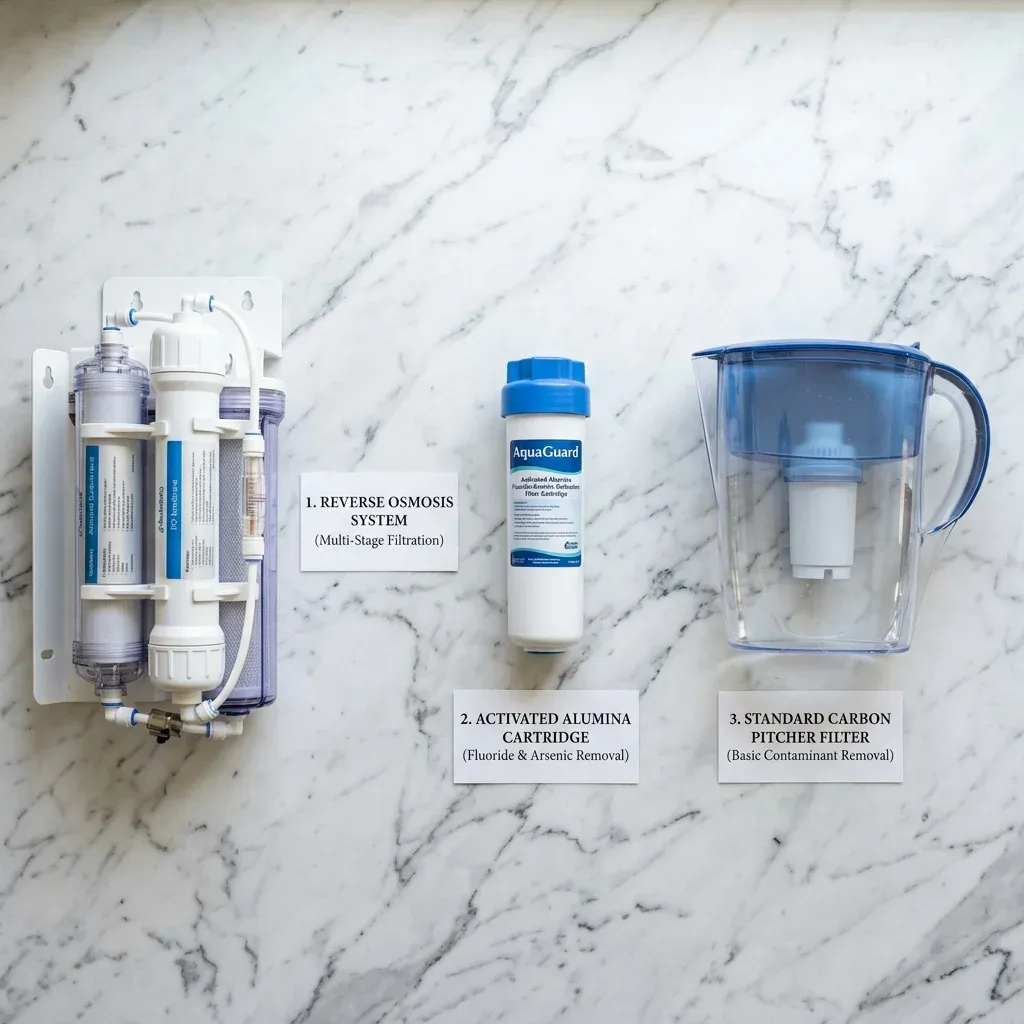
Reverse osmosis is the most common household solution for fluoride removal. These under-sink systems push water through a membrane with pores small enough to block fluoride ions along with most other dissolved minerals. The trade-off is that they also strip beneficial minerals, produce wastewater (typically 2-4 gallons per gallon of filtered water), and require periodic membrane replacement.
The Environmental Working Group specifically recommends reverse osmosis filters for people concerned about fluoride in their drinking water.
For whole-house filtration, the options narrow. Most whole-house systems use carbon or sediment filters that do not address fluoride. Whole-house reverse osmosis exists but is expensive ($1,500-5,000+) and requires significant plumbing modification. A point-of-use approach, filtering only the water you drink and cook with, is more practical for most households.
A federal judge said 0.7 mg/L poses an unreasonable risk. Now what?
On September 24, 2024, US District Judge Edward Chen issued a ruling that reset the terms of this debate. After an eight-year legal battle brought under Section 21 of the Toxic Substances Control Act, he found that fluoridation at 0.7 mg/L poses an unreasonable risk of reduced IQ in children. The court ordered EPA to take regulatory action.
The ruling was careful in its language. It "does not conclude with certainty that fluoridated water is injurious to public health" but rather finds "a risk sufficient to require the EPA to engage with a regulatory response". The case was the first time a TSCA citizen petition led to a lawsuit that won in federal court.
EPA appealed on January 17, 2025. In a March 2026 hearing before the Ninth Circuit, the agency's attorney argued not that the judge was wrong about the health science, but that Judge Chen overstepped procedural bounds by pausing the trial in 2020 to wait for the NTP's systematic review before ruling. EPA never disputed the court's finding that fluoride poses an unreasonable risk to children's health.
Rick North, a board member of the Fluoride Action Network, told The Defender: "The judge wanted to wait for the review so he could make a more informed decision, based on the best science. If the law disallows this, something is wrong with the law."
While the appeal plays out, the political ground has moved fast. HHS Secretary Robert F. Kennedy Jr. stated in an EPA press release that "a growing body of evidence indicates that ingesting fluoride can cause neurological harm" and that "most of Europe has already moved away from water fluoridation in favor of topical products such as toothpaste".
In January 2026, EPA announced an accelerated review of fluoride health effects under the Safe Drinking Water Act, led by the Office of Water. Administrator Lee Zeldin framed it as a "gold standard" science effort that would "not prejudge any outcomes." The normal timeline for such a review would not require completion until 2030; the agency is moving faster.
State legislatures are not waiting. Utah signed a bill prohibiting fluoride addition to public water systems effective May 7, 2025. Florida passed similar legislation in May 2025. Since the 2024 court ruling, more than 60 communities and two states have stopped adding fluoride to drinking water.
| Event | Date | Significance |
|---|---|---|
| NTP monograph released | August 2024 | Moderate confidence: fluoride >1.5 mg/L linked to lower child IQ |
| Federal court ruling (Chen) | September 2024 | Found 0.7 mg/L poses unreasonable risk under TSCA |
| JAMA Pediatrics meta-analysis | January 2025 | 74-study analysis showing dose-response IQ association |
| EPA appeals court ruling | January 2025 | Procedural challenge, not health substance challenge |
| HHS Secretary Kennedy statement | April 2025 | Called for ending fluoridation recommendation |
| Utah and Florida ban fluoridation | May 2025 | First state-level bans on adding fluoride to public water |
| EPA accelerated SDWA review | January 2026 | Fast-track fluoride health assessment under Safe Drinking Water Act |
| Ninth Circuit hearing | March 2026 | EPA argues procedural, not scientific, grounds for reversal |
The ADA filed an amicus brief supporting EPA's appeal and continues to state that community water fluoridation at optimal levels is safe and effective. The professional dental establishment and the federal government are, for the first time, moving in different directions on this issue.

What to do with your own water
The science on fluoride sits in an uncomfortable middle ground. There is strong evidence of dental benefits, declining but still present. There is growing evidence of neurodevelopmental risk at higher exposures, with uncertainty about whether the 0.7 mg/L standard falls within the danger zone. Researchers do not agree, and the regulatory landscape is changing month to month.
A few practical steps can help.
Start by finding out what is actually in your water. The CDC's My Water's Fluoride tool covers public systems. Your utility's annual Consumer Confidence Report lists fluoride alongside other contaminants. Well water requires independent testing. If your level is above 1.5 mg/L, filtering makes sense regardless of where you stand on the broader debate.
Think about who is drinking the water. The higher retention rate in children, and the NTP's focus on prenatal and early childhood exposure, means the risk calculation changes for households with pregnant women or young kids. The EWG recommends using unfluoridated water for infant formula preparation, which costs little if you keep a reverse osmosis pitcher on hand.
Whatever you decide about your water, do not abandon fluoride toothpaste. A review of studies on oral hygiene found that brushing alone had no impact on cavity rates unless accompanied by fluoride toothpaste. If you filter fluoride from your water, toothpaste becomes your primary cavity-prevention tool. The Cochrane review and dental organizations agree that topical fluoride works.
On filters: reverse osmosis under the kitchen sink is the most reliable option for fluoride removal. An activated alumina cartridge works too, at lower cost. A standard Brita pitcher will not touch fluoride. Check for NSF/ANSI certification for fluoride reduction on whatever system you pick.
Neither side of this debate has a clean answer. We are mid-revision on fluoride policy, and the science is still arriving. The old framing, fluoridation as an unambiguous public health win, no longer matches the evidence base. The new framing, fluoride as a neurotoxin that must be eliminated, overreaches what the data support at US exposure levels.
The most defensible position for a household right now: know your levels, protect your most vulnerable family members, keep using fluoride where it works best (on your teeth), and watch the regulatory process as it unfolds over 2026 and 2027.
Frequently Asked Questions
Does boiling water remove fluoride?
No. Boiling water actually concentrates fluoride because water evaporates while the fluoride remains behind. If you boil a pot of water down to half its volume, the fluoride concentration roughly doubles. Distillation, which captures the steam, does remove fluoride, but simple boiling does not.
Is bottled water fluoride-free?
Not necessarily. The FDA allows bottled water to contain fluoride naturally from its source, and some brands add fluoride. When fluoride is added, the total amount cannot exceed 0.7 mg/L according to FDA rules. However, manufacturers are not required to list fluoride content on the label unless they make a specific claim about it. If this matters to you, contact the bottler directly or look for brands that specifically market as fluoride-free.
Can I get a fluoride test for my child's exposure level?
Fluoride can be measured in urine, plasma, hair, nails, and teeth. However, the NIH notes that criteria for adequate, high, or low levels of fluoride in the body have not been established. There is no standard clinical test with defined reference ranges. Urinary fluoride measurement is used in research settings but is not a standard part of pediatric care.
Does fluoride cause cancer?
The American Cancer Society states that major studies have not found a convincing link between water fluoridation and cancer. Dr. Charlotte Lewis at Johns Hopkins notes that potential connections to bone cancer and hip fractures have been disproven through robust research. The current health debate centers on neurodevelopmental effects, not carcinogenicity.
If I filter fluoride out of my water, will my children get more cavities?
The risk increases somewhat, but fluoride toothpaste compensates for much of the loss. The Cochrane review found that fluoridation's benefit has declined in the era of widespread fluoride toothpaste. If you remove fluoride from your water, prioritize twice-daily brushing with fluoride toothpaste, and discuss fluoride varnish or supplements with your dentist, especially for children at higher cavity risk.
Medical Disclaimer
This article is for informational and educational purposes only and is not medical advice, diagnosis, or treatment. Always consult a licensed physician or qualified healthcare professional regarding any medical concerns. Never ignore professional medical advice or delay seeking care because of something you read on this site. If you think you have a medical emergency, call 911 immediately.