
What emotional support animals actually do for mental health
A woman named Karin, struggling through a depressive episode, described what happened when she started crying at home: her dog heard her from another room, came running, lay beside her, and licked away her tears. "It's a good thing we have the dog," she told researchers, "otherwise no one would be able to comfort me." That description comes from a systematic review published in BMC Psychiatry that analyzed 17 studies on companion animals and mental health — and it captures something clinical language usually misses about what emotional support animals provide.
Of those 17 studies, 15 reported positive aspects of pet ownership for people living with diagnosed mental health conditions. The benefits weren't vague feel-good effects. Researchers identified three distinct categories of support: emotional work (alleviating worry, providing comfort, reducing isolation), practical work (disrupting symptoms, encouraging routine and physical activity), and biographical work (restoring a sense of identity and self-worth after diagnosis).
The emotional dimension runs deeper than most people expect. Across multiple studies in that review, people described their pets as the one relationship free from judgment, conditions, or unsolicited advice. A man with PTSD explained that his dog didn't offer input on what he should do or try — just "dying devotion and love." For people whose conditions make human interaction exhausting or frightening, that absence of social complexity is the point. The animal doesn't evaluate, criticize, or grow tired of hearing the same fears. It just stays.

The practical side matters just as much. People reported that their animals pulled them out of flashbacks, interrupted panic attacks through physical contact, and gave them a reason to maintain daily routines when depression made everything feel pointless. One participant in a study of people with serious mental illness said the thing that stopped them from acting on suicidal thoughts was wondering what their rabbits would do — "I can't leave because the rabbits need me." That wasn't metaphorical companionship. It was a concrete reason to stay alive.
A mixed-methods study of college students with ESAs found four recurring positive themes: the animal's physical presence as a stabilizer, a sense of empowerment from caring for another being, direct alleviation of psychiatric symptoms, and social connection (students reported their ESAs helped them start conversations and feel less isolated on campus). The study also found negatives — housing difficulties, campus confusion about ESA rules, and social stigma from peers who viewed ESAs as an excuse to bring pets to school.
For military veterans specifically, the effects have been measured more rigorously. A HABRI-funded study at Purdue University compared 141 post-9/11 veterans with PTSD: those paired with trained service dogs showed reduced overall PTSD symptomology, lower depression, better quality of life, less loneliness, and lower absenteeism from work. The service dog group reported an average 20% improvement from usual care with dosages remaining the same. The dogs were adding something that medication alone was not.
Your dog's presence changes your blood chemistry within minutes
Most people feel calmer around their animals. That's obvious to anyone who's ever come home to a wagging tail after a bad day. The more useful question is whether that feeling shows up in blood draws and heart rate monitors, or whether it stays entirely subjective. Based on available evidence: short-term physiological changes are real and measurable. Long-term mental health outcomes remain genuinely uncertain.
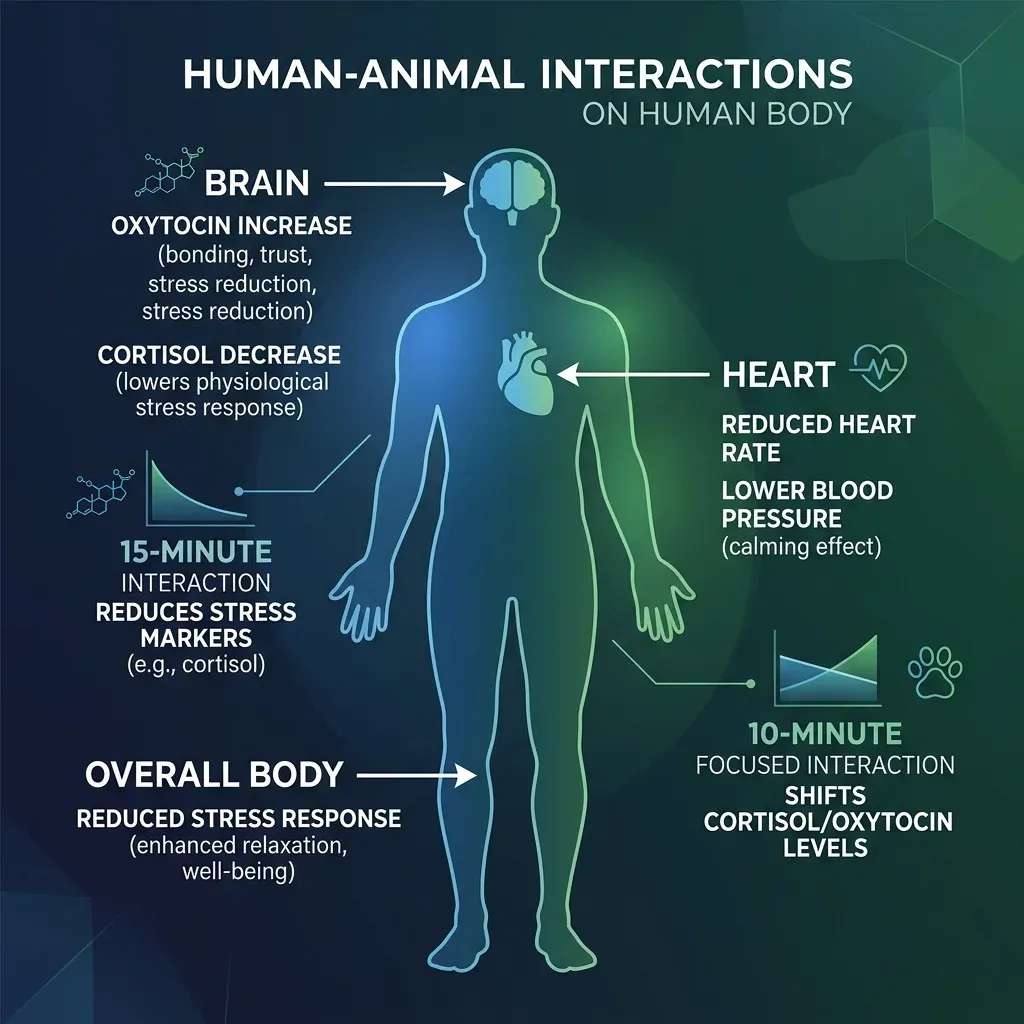
When you pet a dog, your body decreases production of cortisol (the primary stress hormone) and increases oxytocin (associated with bonding and trust). A study comparing dog owners performing stressful arithmetic tasks found that women in the presence of their pet dog showed almost no physiological reactivity to the stress, while women with their closest human friend present actually showed greater reactivity. The researchers concluded that pets provide "nonevaluative social support" — your dog doesn't judge your math skills, and your nervous system knows it.
This isn't limited to dogs you know. An exploratory study of stress responses after therapy dog interactions found reduced blood pressure, heart rate, and salivary cortisol in both owners interacting with their own therapy dogs and people meeting an unfamiliar therapy dog for the first time. The unfamiliar-dog group actually experienced greater reductions in physiological measures like blood pressure. Even 15 minutes with a therapy dog produced statistically significant reductions in perceived stress and blood pressure among university students.
The calming effect of touch extends beyond furry animals, and in a direction most people wouldn't predict. A study of 58 individuals in stressful situations found that petting any live animal — including hard-shelled turtles — reduced state-anxiety. Petting stuffed toys had no effect. The researchers concluded it was "the quality of being alive" rather than texture that produced the calming response. Your nervous system can apparently tell the difference between something breathing and something made of polyester.
For the first study designed specifically around emotional support animals (not pets generally, not therapy animals, not service dogs), Dr. Janet Hoy-Gerlach at the University of Toledo followed adults with serious mental illness who were paired with shelter dogs and cats through a community program. After 12 months, the researchers found statistically significant decreases in depression, anxiety, and loneliness as measured by standardized scales. They also observed a consistent pattern of higher oxytocin and lower cortisol after participants engaged in 10-minute focused interactions with their ESA, with the highest oxytocin increase at the 12-month mark — suggesting the bond strengthened over time.
But honest assessment requires acknowledging the limits. That pilot study had only 11 participants and no control group, which means we can't rule out that the improvements came from ongoing therapy, medication, or spontaneous recovery. A 2025 meta-analysis of 21 studies involving 159,322 participants found that pet ownership overall was not significantly associated with depression risk (OR: 1.03). When broken down by animal type, cat ownership showed a modest association with increased depression risk (OR: 1.06), while dog ownership showed no significant association either way (OR: 0.93). A separate 2025 cross-sectional study of 215 older adults found that pet owners did show lower depression symptoms (GDS score 2.33 vs. 3.00 for non-owners, P=.02), but the effect was small and there was no difference in anxiety, well-being, or cognitive functioning.
So your dog does change your biology. Fifteen minutes of petting measurably reduces cortisol and blood pressure. A year with an ESA correlated with lower depression and anxiety scores in the one study that measured it. But whether animal companionship prevents or treats chronic psychiatric conditions remains an open question, and researchers are honest enough to say so. The physiology is solid. The clinical case needs more work.
Getting an ESA letter: the process most websites get wrong
An ESA letter is not a certificate, a registration, or something you buy online in 20 minutes. It is a clinical recommendation written by a licensed mental health professional — a psychologist, psychiatrist, licensed clinical social worker, licensed professional counselor, or similar provider — who has evaluated you and determined that you have a qualifying mental health condition and that an emotional support animal would provide therapeutic benefit.

The qualifying condition must be a mental health disorder listed in the DSM (Diagnostic and Statistical Manual of Mental Disorders) that "substantially limits one or more major life activities." That's the legal standard. Feeling stressed about work or wanting your pet in a no-pet apartment doesn't qualify. The condition needs to meaningfully impair your ability to function — in activities like sleeping, concentrating, caring for yourself, maintaining relationships, or working.
A valid ESA letter, according to clinical practice guidelines and federal housing guidance, must include:
- The professional's name, title, license number, and contact information on their official letterhead
- Confirmation that you are their patient/client
- A statement that you have a mental health condition recognized in the DSM
- A statement that the ESA is necessary to alleviate symptoms of that condition
- The type of animal being recommended
- The date of the letter (letters are typically valid for one year)
The professional writing the letter faces real ethical stakes. As a 2016 paper in Professional Psychology detailed, psychologists who write ESA letters for their own patients face a conflict between their therapeutic role and their evaluative role. If the patient requests a letter and the psychologist disagrees that an ESA is clinically necessary, that disagreement can damage the therapeutic relationship. The paper recommended that when ESA letters involve permanent accommodations (rather than short-term therapeutic support), the evaluation should ideally come from an independent professional rather than the treating therapist.
What about cost? Legitimate ESA evaluations from a licensed provider typically range from $100 to $300, depending on whether it's conducted through an existing therapeutic relationship or a new assessment. Some therapists include ESA evaluation as part of ongoing treatment. Be deeply skeptical of any service charging less than $50 or offering "instant" letters — that price point usually means no real clinical evaluation is happening.
What a legitimate ESA letter is NOT: It is not an animal registration. It is not a certificate with a badge or vest. It is not something purchased from a website that doesn't connect you with a licensed professional. It is not a guarantee of approval — a clinician may determine, after evaluation, that an ESA is not clinically appropriate for you.
The Fair Housing Act protects your ESA — but the rules just changed
The primary federal protection for ESA owners comes from the Fair Housing Act (FHA), which prohibits discrimination in housing on the basis of disability. The FHA was last significantly amended in 1988 to add protections for people with physical and mental disabilities. Under this law, an ESA is considered a "reasonable accommodation" — meaning a housing provider must allow the animal even in properties with no-pet policies, and cannot charge pet deposits or pet fees for a legitimate ESA.
This coverage is broad. According to the Congressional Research Service, the FHA applies to apartments, condominiums, single-family homes, mobile homes, college dormitories, and both public and private housing. The main exceptions are owner-occupied buildings with four or fewer units, single-family homes sold or rented without a broker by owners with three or fewer properties, and housing operated by religious organizations for their members.

For years, housing providers relied on two HUD guidance documents (FHEO 2013-01 and FHEO 2020-01) that spelled out best practices for evaluating ESA requests — how to verify documentation, when to ask for more information, what constitutes a legitimate letter. In September 2025, HUD formally withdrew both of those guidance documents as part of a deregulatory initiative. The agency stated that the withdrawn guidance "should not be enforced or otherwise relied upon."
The FHA itself remains fully in effect. Housing providers are still legally required to make reasonable accommodations for people with disabilities, including those who use ESAs. But the withdrawal of the detailed federal framework means there's currently no standardized best-practice guide for how landlords should evaluate ESA requests. Enforcement and interpretation may now vary significantly across jurisdictions until new guidance is issued.
What hasn't changed: disability-related complaints constitute 60% of all FHA complaints against housing providers, according to HUD. Landlords who deny legitimate ESA requests face real legal exposure. A landlord may verify a provider's license credentials and evaluate legitimate safety concerns, but cannot demand medical records, require the animal to demonstrate tasks, or impose breed restrictions on ESAs (as opposed to the pet policies that apply to non-ESA animals).
One major change that predates the 2025 guidance withdrawal: the Department of Transportation revised its rules in 2021, and no U.S.-based airlines currently allow emotional support animals on flights. Airlines now treat ESAs as pets, subject to whatever pet policies (and fees) the airline maintains. Only trained psychiatric service dogs retain the right to fly in-cabin at no charge. This was driven partly by a proliferation of questionable ESA letters and incidents involving unusual animals on aircraft.
| Protection | Current status |
|---|---|
| Housing (Fair Housing Act) | Protected. No-pet policies must be waived; no pet deposits for ESAs. |
| Air travel (DOT/ACAA) | Not protected since 2021. ESAs treated as pets on all U.S. airlines. |
| Public places (ADA) | Not protected. ESAs are not service animals under ADA. |
| Employment (Title I ADA) | Possible accommodation. ESAs may be allowed as workplace accommodation on case-by-case basis. |
| College housing | Protected under FHA. Universities must allow ESAs in dorms with documentation. |
Three categories of assistance animals, three different sets of rights
Mixing up emotional support animals, service animals, and therapy animals isn't a harmless vocabulary mistake. The category your animal falls into determines where it can legally go, what paperwork you need, and what happens if someone challenges you. People have lost housing and been removed from businesses over this distinction.
Service animals have the strongest legal protections. The ADA defines a service animal as "a dog that has been individually trained to do work or perform tasks for an individual with a disability." Only dogs qualify (with a narrow exception for miniature horses). The tasks must directly relate to the person's disability — a dog trained to detect seizures, guide a blind person, or perform deep pressure therapy during panic attacks. No registration, certification, or documentation is required under the ADA. Businesses can only ask two questions: is the dog a service animal required because of a disability, and what task has it been trained to perform? They cannot ask for proof of disability or demand a demonstration.
A psychiatric service dog is a specific type of service animal trained to assist with mental health conditions — detecting onset of panic attacks, interrupting self-harm, providing grounding during dissociative episodes. These dogs have full ADA access rights. They also cost between $20,000 and $40,000 for professional training, though people can train their own.
Emotional support animals occupy a middle ground. They require no task training — their presence itself is the therapeutic intervention. They can be any domesticated species. Their legal protections are limited to housing under the FHA. They have no ADA access rights to restaurants, stores, or other public places. A doctor's letter does not turn an ESA into a service animal, no matter what the letter says.
Therapy animals are trained to provide comfort to many people in institutional settings — hospitals, nursing homes, schools, disaster sites. They work with a handler and typically undergo certification through organizations like Pet Partners. They have no individual legal access rights; they go where the institution invites them.
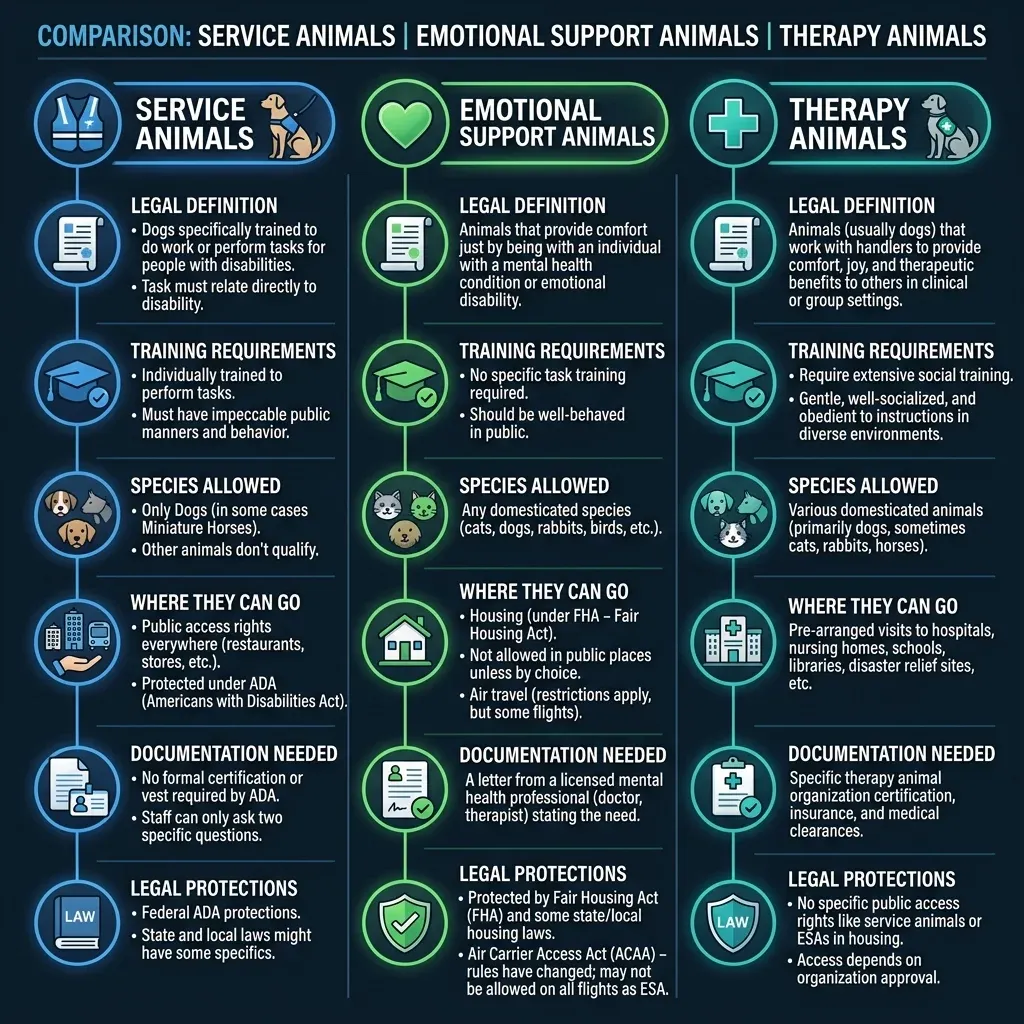
| Feature | Service animal | Emotional support animal | Therapy animal |
|---|---|---|---|
| Species | Dogs only (miniature horses in limited cases) | Any domesticated animal | Typically dogs, sometimes cats or horses |
| Training | Individually trained for specific tasks | No task training required | Trained for comfort in institutional settings |
| Public access (ADA) | Yes — restaurants, stores, transit | No | No (only where invited by institution) |
| Housing (FHA) | Yes | Yes | No special rights |
| Air travel | Psychiatric service dogs only | No (since 2021) | No |
| Documentation | None required under ADA | Letter from licensed mental health professional | Certification through therapy animal organization |
| Who they serve | One individual handler | One individual owner | Multiple people in institutional settings |
That $49 ESA certificate? It's worthless
A profitable industry has grown in the space between what ESA laws actually require and what most people think they require. The National Service Animal Registry, a private commercial enterprise, registered 11,000 animals online in a single year — selling certificates, vests, and ID badges that carry no legal weight whatsoever.
There is no legitimate ESA registry. There is no government-issued ESA certificate. There is no badge or vest that confers legal status. The Department of Justice explicitly states that online certification and registration documents "do not convey any rights under the ADA." For ESAs, the only document that matters is a letter from a licensed mental health professional who has actually evaluated you.
The red flags for fraudulent ESA services are consistent:
- Instant approvals with no clinical evaluation
- No connection to a licensed, identifiable mental health professional
- Selling "certificates," "registrations," or ID cards
- No license number provided for the evaluating clinician
- Guaranteeing an ESA letter before any assessment takes place
- Websites designed to look government-affiliated when they're private businesses
This fraud cuts both directions. People who pay for worthless certificates waste their money and may face housing denial or lease termination when landlords recognize invalid documentation. Meanwhile, the flood of questionable ESA claims has eroded trust in the entire system — making it harder for people with genuine clinical need to be taken seriously.

Mental health professionals themselves are cautious. The American Psychiatric Association concluded in a 2022 resource document that "given the limited evidence supporting ESAs, it is ethically permissible to decline to write ESA certification letters for patients." That's not a blanket rejection — it's an acknowledgment that the evidence base is thin enough that a mental health professional declining to write a letter is not committing an ethical violation. In some states, fraudulently certifying an animal as a service animal or ESA is a criminal offense.
The limited research base is itself part of the problem. As of the most recent review, there was only one peer-reviewed study specifically examining ESA effectiveness — the Hoy-Gerlach pilot study with 11 participants and no control group. Hundreds of studies exist on therapy animals and service dogs, but ESAs occupy an evidence gap. The laws granting ESA housing rights were built on the reasonable assumption that the existing evidence for pet-mental health benefits would extend to ESAs specifically, but that assumption hasn't been rigorously tested.
How to protect yourself: Get your ESA letter through a licensed mental health professional who conducts a genuine clinical evaluation. Verify that their license is active through your state's licensing board. Keep copies of all documentation. If a website promises instant approval or sells certificates, leave immediately.
Frequently Asked Questions
Can my landlord refuse my emotional support animal even if I have a valid ESA letter?
Generally no, if your letter comes from a licensed mental health professional and documents a qualifying disability. Under the Fair Housing Act, landlords must make reasonable accommodations. However, they can deny an ESA if the specific animal poses a direct threat to health or safety that cannot be mitigated, or if the animal would cause substantial physical damage to the property. They can also verify your provider's credentials. They cannot impose breed restrictions, charge pet fees, or demand medical records.
Do I need to register my ESA or get it certified?
No. There is no legitimate ESA registry or certification process recognized by any government agency. The only documentation you need is a letter from a licensed mental health professional. Any website selling ESA certificates, registration numbers, or ID badges is offering products with no legal standing.
Can I take my emotional support animal on a flight?
Not as an ESA. Since 2021, the Department of Transportation no longer requires airlines to accommodate emotional support animals. All major U.S. airlines now treat ESAs as pets, subject to standard pet policies and fees. Only trained psychiatric service dogs retain the right to fly in the cabin without charge. Individual airline policies may vary, so check directly with your carrier.
What is the difference between an ESA and a psychiatric service dog?
A psychiatric service dog is individually trained to perform specific tasks related to a mental health disability — detecting panic attacks, interrupting self-harm, providing grounding during dissociative episodes. This training gives the dog full ADA access rights to public places, workplaces, and aircraft. An ESA has no task training; its presence alone is the therapeutic benefit. ESAs are only protected in housing under the Fair Housing Act and have no public access rights under the ADA.
Can any animal be an emotional support animal?
Under federal housing law, ESAs are not limited to dogs and cats. Any domesticated animal can potentially serve as an ESA — rabbits, birds, miniature pigs, hamsters, and others. However, housing providers may request additional documentation for unusual species, and the animal must be manageable and not pose health or safety risks. Some state laws have additional restrictions on species.
Medical Disclaimer
This article is for informational and educational purposes only and is not medical advice, diagnosis, or treatment. Always consult a licensed physician or qualified healthcare professional regarding any medical concerns. Never ignore professional medical advice or delay seeking care because of something you read on this site. If you think you have a medical emergency, call 911 immediately.