Why the Pineal Gland Makes Epitalon a Body-Clock Story
Epitalon is usually sold to the imagination as a longevity peptide. The more interesting question is smaller and sharper: could a pineal-derived peptide influence the timing signals that tell the body when night has arrived?
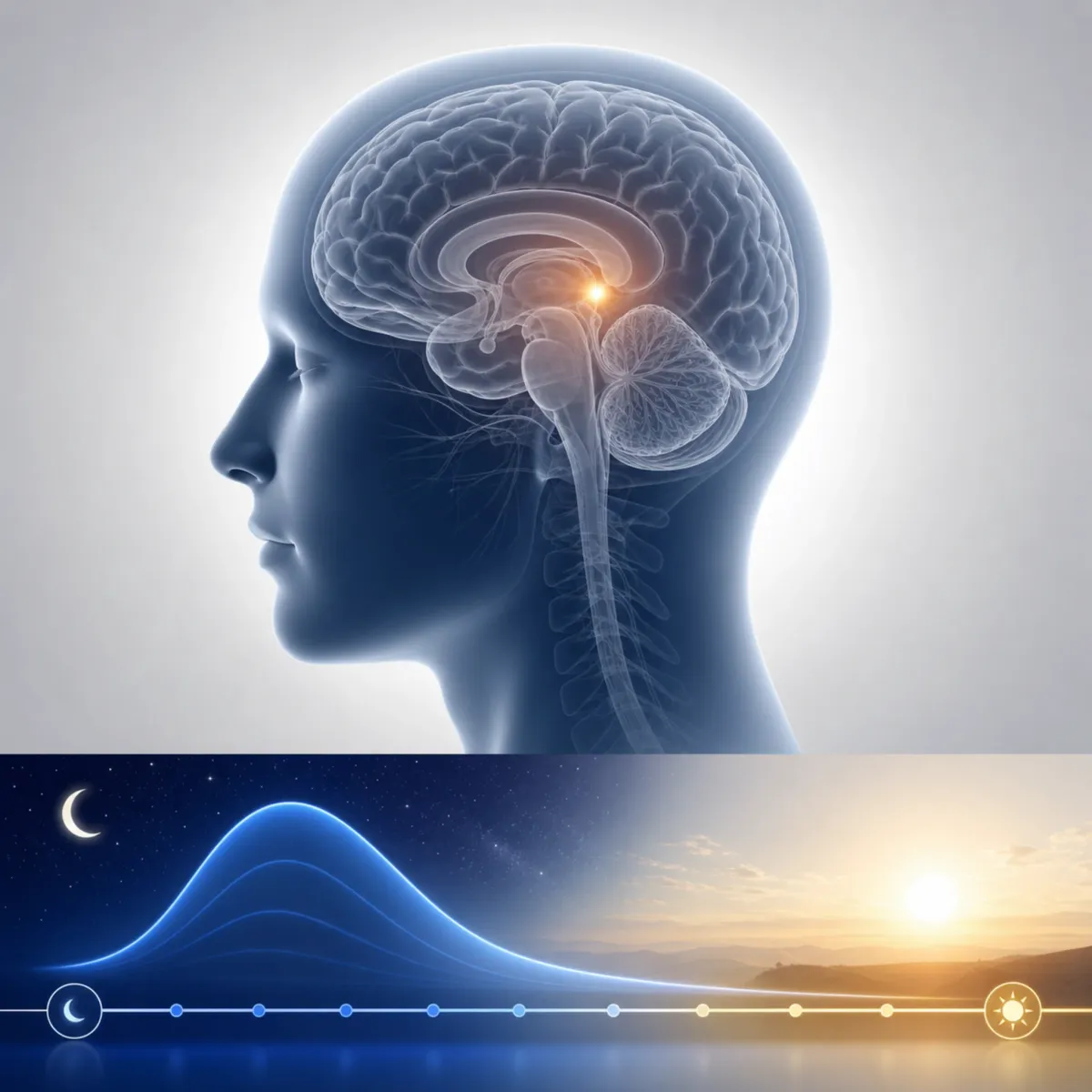
The pineal gland is not a mystical switch. It is a small endocrine structure that helps translate darkness into melatonin, and melatonin is one of the body's timing signals. A Science.gov record summarizing work by O.V. Korkushko, B.A. Lapin, N.D. Goncharova, V.Kh. Khavinson, V.B. Shatilo, A.A. Vengerin, I.A. Antoniuk-Shcheglova, and L.V. Magdich reports that aging in monkeys and people is associated with lower night and average daily plasma melatonin and reduced circadian rhythm amplitude in the pineal peptide literature.
Think of the pineal gland less like an on-off sleep button and more like a dimmer tied to sunrise and sunset. If the dimmer gets weak with age, the room is never fully dark or fully lit. That is the appeal of Epitalon: not that it knocks you out, but that it might help a fading timing signal become clearer.
The same Science.gov summary says pineal peptide preparations, including Epithalamin and synthetic Epitalon, recovered night release of endogenous melatonin and normalized the plasma melatonin circadian rhythm in old monkeys and elderly people in that summarized record. That is a provocative signal. It is not the same as proof that an online peptide vial will reset a person's body clock.
What Epitalon Is, and What It Is Not
Epitalon, also written as Epithalon in some sources, is a short synthetic peptide. The NIH-linked NCATS Inxight Drugs database lists Epitalon as Ala-Glu-Asp-Gly, a four-amino-acid synthetic peptide. The mouse study indexed in PubMed uses the same Ala-Glu-Asp-Gly description for the experimental compound.
That structure matters because tiny peptides are often discussed as if they were precise biological text messages. A four-letter message can be powerful if the receiving system is tuned to it, but it can also be misunderstood, degraded, contaminated, or delivered to the wrong place. A short sequence alone does not make a therapy.
NCATS also states that Epitalon is still under pre-clinical and clinical development and has not been approved for therapeutic or prophylactic use by any government health authority in the USA or Europe in its Epitalon entry. That is the line readers should keep in their heads. Epitalon is not an FDA-approved sleep treatment. It is not melatonin. It is not a proven circadian reset protocol.
Best plain-English framing: Epitalon is an experimental pineal-associated peptide with intriguing timing biology, not a validated treatment for insomnia, jet lag, shift-work disorder, or aging.
This distinction also keeps the conversation from drifting into a common peptide trap: confusing a plausible target with a finished medicine. A molecule can be biologically active and still be clinically immature. Coffee is biologically active. Sunlight is biologically active. The question for Epitalon is whether the right preparation, route, dose, timing, patient group, and safety oversight have been worked out well enough for a medical claim. The fetched sources do not show that level of certainty.
There is another naming problem. Epithalamin, the older pineal extract, and Epitalon, the synthetic tetrapeptide, are related but not identical. Some melatonin findings come from pineal peptide preparations or extract-based work, while marketing often slides those findings onto synthetic Epitalon as if the evidence were interchangeable. That may be tempting, but it is not careful reading.
Practically, this means the question is not "Should I use Epitalon to fix my sleep?" The better question is "What evidence exists that pineal peptides can change melatonin timing, and how far can that evidence responsibly go?"
The Melatonin Timing Theory Behind Epitalon
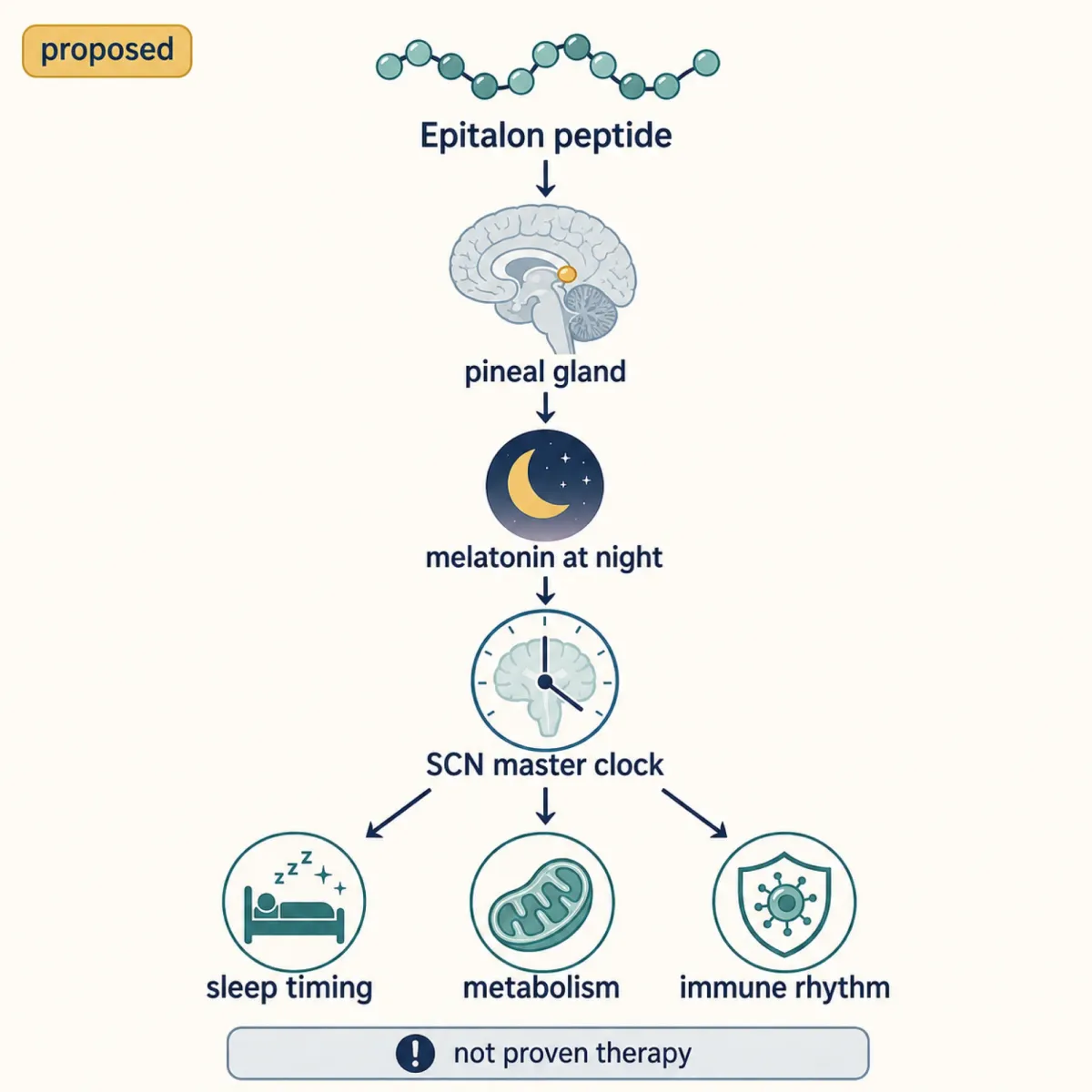
The body clock is not one clock. It is more like an airport control tower coordinating many runways. Frontiers in Endocrinology describes the central clock as the suprachiasmatic nucleus, or SCN, which synchronizes peripheral oscillators through neural and humoral pathways in its circadian system overview. The same paper identifies pineal melatonin, synthesized during dark hours, as a systemic timekeeping signal within that timing network.
That gives the Epitalon theory a plausible route: if a peptide can influence pineal melatonin output or clock-gene expression, it might alter the strength or timing of a signal that the SCN and peripheral tissues already listen to. The word "might" is doing real work here.
One cited human signal is a randomized study summarized by Dr. Herna de Wit, PhD, in Healthspan: 75 women received 0.5 mg/day of sublingual Epitalon for 20 days, and urinary 6-sulfatoxymelatonin was used as a melatonin-output marker. Healthspan reports a 1.6-fold rise in urinary 6-sulfatoxymelatonin versus placebo, plus clock-gene shifts: Clock expression down 1.8-fold, Cry2 doubled, and Csnk1e down 2.1-fold in that study summary.
Urinary 6-sulfatoxymelatonin is useful because it behaves like a receipt for melatonin production rather than a direct look inside the pineal gland. If melatonin is the nightly message, the metabolite is the delivery confirmation. That makes the marker relevant, but still indirect. A higher marker does not automatically tell you whether sleep improved, whether the circadian phase shifted earlier, or whether the person felt better the next morning.
That is the cleanest "body clock" data point in the research package, but it is still a small signal rather than a clinical endpoint. It measured biomarkers and gene expression, not whether people with diagnosed circadian rhythm disorders improved in daily life.
The clock-gene findings are also easy to overread. Genes such as Clock, Cry2, and Csnk1e sit inside the cell's timing machinery, so movement there is meaningful. But a gene-expression change is more like seeing backstage lights flicker before a concert. It tells you something is happening behind the curtain. It does not prove the whole orchestra played better for the audience.
For readers, the practical implication is simple: the melatonin theory is biologically interesting because it points to timing, not sedation. But an interesting mechanism is a starting line, not a prescription.
What Circadian Research Actually Shows
General circadian science gives the Epitalon story its seriousness. A Frontiers in Aging review indexed by OUCI says circadian clocks regulate nearly every aspect of physiology and that mammalian timing is made of multiple tissue-specific oscillators entrained by light, food, and activity in its circadian aging abstract. It also says circadian function deteriorates with age, contributing to metabolic dysfunction, cognitive decline, immunosenescence, and disrupted sleep in the same review.
That is why a pineal peptide attracts attention. If aging weakens timing signals, a molecule tied to pineal function looks like it belongs in the conversation. But belonging in the conversation is not the same as winning the argument.
The Alzheimer’s Drug Discovery Foundation review is more cautious. It says Epithalamin stimulates melatonin production in elderly adults with pineal gland dysfunction, but the synthetic Epithalon evidence is mixed: one rat study failed to stimulate melatonin production, while older primate data reportedly showed increased melatonin in its evidence summary. That is exactly the kind of split result that gets lost in marketing copy.
The review also notes that the evidence base is unusually concentrated. It says every preclinical and clinical study it discussed had been conducted by Dr. Khavinson's group in Russia and that the results had not been independently confirmed in its researcher-focused report. That does not make the work worthless. It does mean readers should want replication before treating the findings as settled biology.
| Evidence Type | What It Supports | What It Does Not Prove |
|---|---|---|
| Pineal peptide melatonin records | Possible restoration of night melatonin patterns in aging contexts | A guaranteed sleep benefit for healthy adults |
| Clock-gene and metabolite summaries | Possible circadian biomarker movement after Epitalon exposure | Clinical reversal of circadian rhythm disorders |
| General circadian aging reviews | Timing systems matter for aging biology | That any one peptide safely fixes those systems |
So the honest read is neither hype nor dismissal. Epitalon has a plausible pineal-clock hypothesis and some supportive biomarker findings. It also has a research base with replication gaps, mixed preclinical melatonin findings, and very little independent human sleep-outcome testing.
This is the point where a cautious reader should feel both curious and unsatisfied. Curious, because the pineal-melatonin link is not random. Unsatisfied, because the studies we most need would measure sleep timing, dim-light melatonin onset, actigraphy, adverse events, and quality-of-life outcomes in clearly defined human groups.
Pineal Peptide Myths vs. Evidence
The easiest way to misunderstand Epitalon is to flatten every result into one shiny claim. The prior article package in this series focused on lifespan headlines; this one should not. Body-clock biology is a different question.
| Myth | Evidence-Based Correction |
|---|---|
| Epitalon is proven to reset the human body clock. | The evidence supports a proposed pineal and melatonin-timing mechanism, not a proven reset indication. |
| If melatonin is involved, Epitalon is just another sleep aid. | The theory is about endogenous timing signals, not direct sedation. |
| Mouse lifespan findings prove human anti-aging effects. | They are preclinical context and should not be treated as human proof. |
The mouse data are still worth mentioning for context. In the PubMed-indexed study by Vladimir Anisimov and colleagues, female Swiss-derived SHR mice were assigned to saline or 1.0 microg/mouse Epitalon, injected on 5 consecutive days every month from age 3 months until natural death, with 54 mice in each group according to the abstract. The same abstract reports no change in food consumption, body weight, or mean lifespan, while maximum lifespan increased 12.3% and the lifespan of the last 10% of survivors increased 13.3% in that mouse model.
Those numbers are real, but they do not answer the body-clock question in humans. They tell us Epitalon has biological activity in animals. They do not tell us that a person with delayed sleep phase, jet lag, night-shift fatigue, or age-related insomnia should self-administer it.
They also show why nuance matters. The same mouse abstract reports a maximum-lifespan signal and no mean-lifespan signal in the PubMed record. If someone only repeats the largest number, the finding sounds cleaner than it was. Good health writing should preserve the awkward parts of the data, especially when readers may be tempted to act on it.
Safety, Regulation, and Why Human Claims Stay Narrow
The regulatory picture is not a footnote. It is part of the story. NCATS says Epitalon has not been approved for therapeutic or prophylactic use by government health authorities in the USA or Europe in its drug record. The Therapeutic Goods Administration warns about responsibilities when importing, compounding, and supplying unapproved peptide products in its peptide safety guidance.
The FDA landscape is also moving. A Federal Register notice published on April 16, 2026 says the FDA established docket FDA-2025-N-6895 and scheduled a Pharmacy Compounding Advisory Committee meeting for July 23-24, 2026 on bulk drug substances nominated for the section 503A list. The FDA's meeting page separately lists the 2026 Pharmacy Compounding Advisory Committee materials for that process.
For a reader, the practical risk is not only "does the peptide work?" It is "what exactly is in the vial, who made it, how was it tested, and what legal or medical oversight applies?" With experimental peptides, those questions matter as much as the mechanism.
Regulatory movement can also be misread. A meeting, docket, or comment period is not the same as an approval. It means regulators are reviewing questions, taking advice, or gathering public input. For a consumer trying to make a health decision today, that uncertainty should lower confidence, not raise it.
| Question | Why It Matters | Conservative Answer |
|---|---|---|
| Is Epitalon approved as a sleep or circadian drug? | Approval requires evidence, manufacturing standards, and safety review. | No approved USA or Europe therapeutic use is listed by NCATS. |
| Can unapproved peptide products carry quality risk? | Purity, sterility, dose accuracy, and sourcing affect safety. | Regulators warn about unapproved peptide supply responsibilities. |
| Should biomarker changes be treated as clinical proof? | Biomarkers can move without producing meaningful patient benefit. | No. They justify research, not self-treatment. |
This is where conservative language protects readers. Epitalon may influence pineal and circadian biology. It may alter melatonin-related markers. It may deserve better trials. It should not be framed as a proven human body-clock reset.

A Safer Way to Think About Body-Clock Support
If you are interested in Epitalon because your sleep timing feels broken, start with the boring interventions first. They are boring because they are repeatable. Light exposure, consistent wake time, meal timing, caffeine timing, alcohol reduction, and treatment for sleep apnea do not sound futuristic, but they speak the same language as the circadian system: timed signals repeated daily.
The OUCI-indexed circadian aging review emphasizes that clocks are entrained by light, food, and activity across multiple tissue oscillators. That makes circadian support less like replacing a broken part and more like conducting an orchestra. The baton has to move at the same time every day.
Epitalon belongs, for now, in the research and clinician-supervised discussion category. Someone with a serious circadian disorder, cancer history, autoimmune disease, pregnancy, breastfeeding, psychiatric instability, or multiple medications should not treat an experimental peptide as a casual sleep supplement.
A useful self-check is to ask what problem you are trying to solve. If the problem is inconsistent bedtime, late caffeine, evening light, or a rotating schedule, a peptide is a strange first tool. If the problem is chronic insomnia, depression, sleep apnea, restless legs, medication effects, pain, or perimenopausal sleep disruption, the right next step is evaluation, not a gray-market experiment.
The best current takeaway: Epitalon is a pineal-clock hypothesis with intriguing signals, but the safest body-clock reset still starts with light, schedule, medical evaluation, and evidence-based sleep care.
That may feel less exciting than a peptide protocol. It is also the difference between respecting biology and trying to force it. The pineal gland listens to timing. Before chasing a molecular shortcut, make sure the daily signal is clear.

Frequently Asked Questions
Does Epitalon reset the human body clock?
No strong source in this research package proves that Epitalon resets the human body clock in the clinical sense. The evidence is better described as suggestive: pineal peptide records report melatonin rhythm effects, and one summarized human study reports melatonin-metabolite and clock-gene changes.
Is Epitalon the same as melatonin?
No. Melatonin is a hormone made mainly by the pineal gland during darkness. Epitalon is a synthetic peptide listed by NCATS as Ala-Glu-Asp-Gly, and the proposed appeal is that it may influence endogenous pineal signaling rather than simply adding melatonin from the outside.
Is Epitalon approved for sleep, jet lag, or circadian rhythm disorders?
No approved therapeutic or prophylactic use in the USA or Europe is listed by NCATS, and the article found no fetched source supporting an approved indication for sleep, jet lag, or circadian rhythm disorders.
Why mention mouse lifespan data in a body-clock article?
The mouse data show that Epitalon has biological activity in aging models, but they do not prove human circadian benefits. They are included as context and deliberately kept secondary to the pineal melatonin question.
What should someone try before considering experimental peptides?
Start with validated circadian basics: consistent wake time, morning light, dimmer evenings, regular meal timing, caffeine limits, and evaluation for medical sleep problems. These interventions target the timing system without the sourcing and safety uncertainty of unapproved peptides.
Medical Disclaimer
This article is for informational and educational purposes only and is not medical advice, diagnosis, or treatment. Always consult a licensed physician or qualified healthcare professional regarding any medical concerns. Never ignore professional medical advice or delay seeking care because of something you read on this site. If you think you have a medical emergency, call 911 immediately.