Both Come From Animals, but the Proteins Are Not Identical
Walk into any supplement aisle and you will find marine collagen and bovine collagen sitting side by side, often at very different price points. The proteins inside differ in ways that matter for how your body uses them.
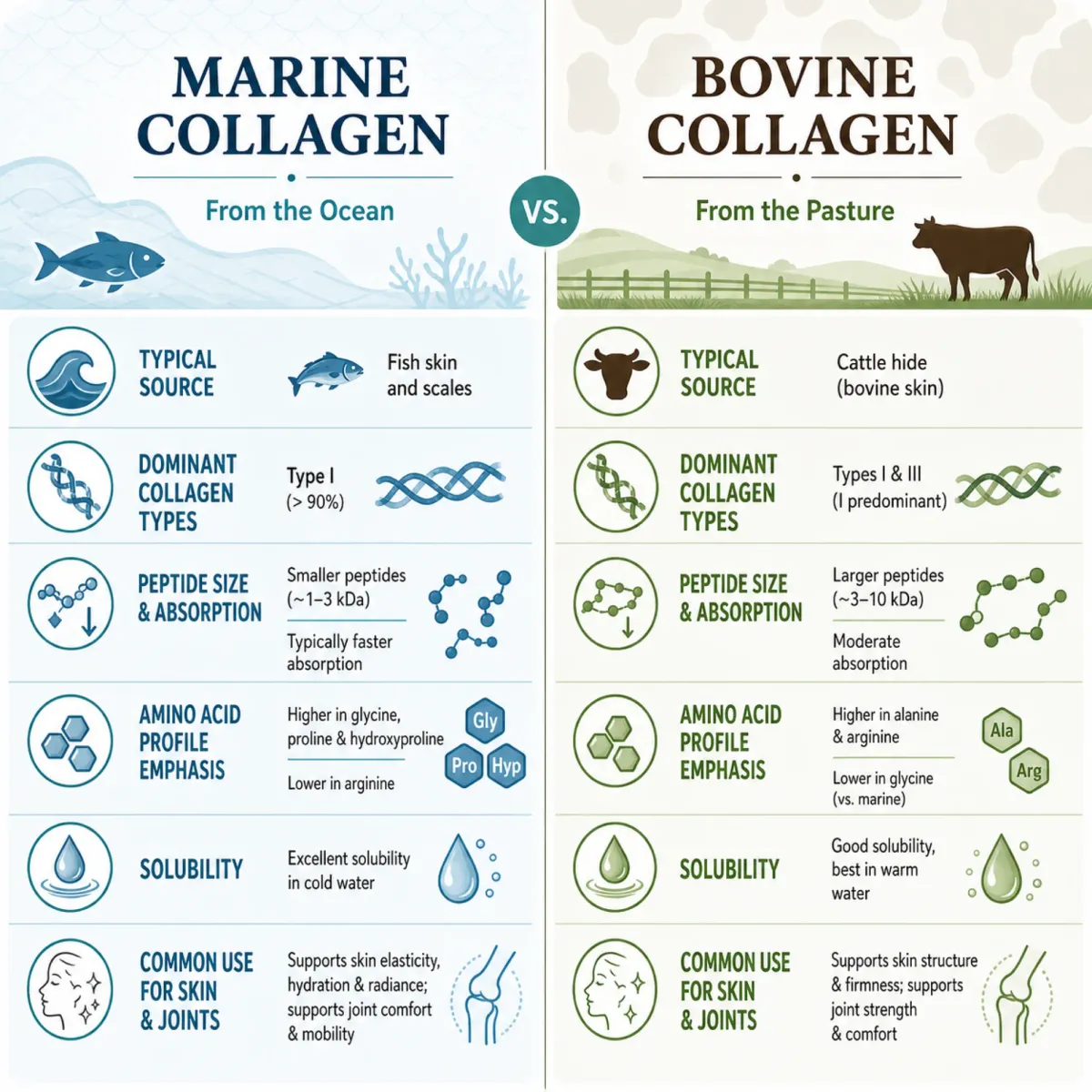
Marine collagen comes from fish skin and scales. It is almost entirely Type I collagen, the same variety that accounts for roughly 80 percent of collagen in human skin. Bovine collagen, extracted from cow hides and bones, delivers a mix of Type I and Type III. Type III shows up in blood vessels, organs, and the structural scaffolding around muscles.
The amino acid profiles diverge too. Marine collagen runs higher in glycine, serine, and threonine, but lower in proline and hydroxyproline compared to mammalian sources. Bovine collagen packs more arginine, an amino acid with its own role in connective tissue repair. These are not trivial differences. Proline and hydroxyproline stabilize collagen's triple-helix structure. The relative shortage of these amino acids in fish collagen is the reason marine collagen is less cross-linked and has lower thermal stability than bovine collagen. That same looseness, though, makes marine collagen easier to break down into small peptides during manufacturing.
Marine collagen peptides typically land in the 2,000 to 5,000 Dalton range, often trending toward the lower end. Bovine peptides can be hydrolyzed to similar sizes, but the starting material is denser and more resistant to enzymatic breakdown.
Does Marine Collagen Actually Absorb Better? The Answer Is Messier Than the Marketing
Nearly every marine collagen brand leads with a bioavailability claim. The number that gets repeated most often is "1.5 times more efficient absorption than bovine." That figure traces back to a 2025 PMC review on hydrolyzed marine collagen, and the researchers themselves were citing earlier comparative work. The full picture is more complicated than a single multiplier suggests.
A 2024 randomized, double-blind crossover study led by Nicolina Virgilio at Rousselot BV tested this directly. Six healthy volunteers took 10-gram doses of collagen hydrolysates from fish skin, porcine skin, and bovine hide at two molecular weights (2,000 and 5,000 Daltons). Their finding: fish-derived collagen showed 2.3-fold higher absorption of the Hyp-Gly dipeptide compared to bovine (p=0.005). A real, statistically significant difference for one specific peptide.
But the same study also found that overall absorption patterns across all three animal sources were "highly comparable". Porcine collagen actually showed 1.2-fold higher total hydroxyproline than fish (p=0.029). And here is what should give every "1.5x bioavailability" claim pause: bovine collagen at 5,000 Daltons versus 2,000 Daltons produced virtually identical blood peptide levels, meaning the molecular weight advantage that marine collagen brands lean on may not matter much once the protein is properly hydrolyzed.
What does matter: free hydroxyproline concentrations jumped 6 to 10 times above baseline within 100 to 130 minutes of ingestion, regardless of source. And between 36 and 47 percent of absorbed hydroxyproline remained in intact peptide form. Your gut does not just shred everything into individual amino acids. Bioactive dipeptides and tripeptides survive digestion and enter circulation through the PepT1 intestinal transporter, and that mechanism works identically for fish and cattle peptides.
Marine collagen may have a slight edge in absorption of certain specific peptides, but the gap between well-hydrolyzed marine and well-hydrolyzed bovine collagen is far smaller than supplement marketing implies. Processing quality matters more than the animal on the label.
For Skin, Marine Collagen Has the Stronger Clinical Resume
When researchers want to study collagen for skin, they keep reaching for fish. That pattern in the literature is worth noting because it creates a lopsided evidence base: marine collagen has more skin-specific clinical trials behind it, while bovine collagen's skin data comes from fewer but well-designed studies.
The most rigorous marine collagen skin trial came from Dr. Mark Evans and colleagues at KGK Science in Ontario. Their randomized, triple-blind, placebo-controlled study gave 50 women aged 45 to 60 either 10 grams of hydrolyzed fish collagen or placebo daily for 12 weeks. Results: a 35 percent reduction in wrinkle scores (P=.035), with participants reporting 23 percent improvement in elasticity, 14 percent in hydration, and 25 percent in firmness over placebo.
A 2018 Korean trial found even more striking hydration numbers at lower doses. Using collagen hydrolysate from catfish skin, researchers measured skin hydration 7.23-fold higher in the treatment group compared to placebo after just six weeks, at only 1,000 milligrams daily. That is a fraction of the Evans trial dose.
A 2023 study measured region-specific wrinkle changes with marine collagen and found reductions of 14 percent on the forehead, 31 percent on nasolabial folds, and 26 percent around the eyes compared to baseline. The nasolabial area showed the largest response.

On the bovine side, the Verisol brand (a specific bovine collagen peptide blend) has produced solid results at remarkably low doses. Randomized controlled trials using just 2.5 grams daily showed improvements in skin elasticity, periorbital wrinkles, hydration, and dermal collagen density over 4 to 12 weeks. Those are credible outcomes at one-quarter the dose of many marine collagen studies.
A broader 2023 meta-analysis of 26 randomized controlled trials involving 1,721 participants found that hydrolyzed collagen supplementation significantly improved skin hydration and elasticity compared to placebo. Fish-sourced collagen showed particularly strong results for hydration. But the same review flagged an uncomfortable pattern: studies funded by supplement manufacturers consistently showed significant benefits, while independent studies produced more modest results. That funding bias does not invalidate the positive findings, but it should temper your expectations.
One genuinely interesting piece of evidence: radioactivity tracking showed marine collagen peptides remained detectable in skin tissue for over two weeks after administration. So these peptides are not just passing through. They accumulate in the tissue they are supposed to help, at least temporarily.
The honest assessment: if your primary goal is skin health, marine collagen has a deeper evidence base. Bovine collagen can work too, particularly the Verisol formulation, but you are betting on fewer trials. And nobody has run a head-to-head comparison. No direct human clinical comparisons between marine and bovine collagen for skin outcomes exist in indexed literature.
For Joints, the Source of Your Collagen Matters Less Than You Think
Joint health is where this debate gets quietly embarrassing for both sides. Most meaningful joint research does not use either marine or bovine collagen. The collagen type that dominates joint clinical trials is Type II, and it overwhelmingly comes from chickens.
A meta-analysis of 41 studies, including 25 clinical trials, found that collagen benefited osteoarthritis and aided cartilage repair regardless of dose, type, or brand. Sounds encouraging until you look at what those trials actually used.
All documented native Type II collagen clinical studies used chicken-derived collagen when origins were specified. A randomized double-blind study by Lugo and colleagues found that 40 mg daily of native Type II collagen outperformed glucosamine (1,500 mg) plus chondroitin sulfate (1,200 mg) for pain and function after six months. But that was chicken collagen.
For hydrolyzed collagen and joints, the doses jump dramatically to 1.2 to 10 grams per day. The most promising single finding came from McAlindon and colleagues in 2011: 10 grams daily for 24 weeks increased proteoglycan content in knee cartilage, which remains the only documented structural cartilage improvement in the reviewed literature. Think of proteoglycans as the shock absorbers within cartilage. More of them means better cushioning.
Here is the uncomfortable reality for bovine collagen joint claims: one study testing 10 grams per day of bovine hydrolyzed collagen found no significant differences versus placebo over three months. That does not mean bovine collagen cannot help joints. Three months may not have been long enough. But it is the kind of result that rarely appears on product labels.
The mechanisms differ by collagen form. Native Type II works through oral tolerance, an immune-mediated mechanism that teaches the immune system to stop attacking cartilage. Hydrolyzed collagen's bioactive peptides (Pro-Hyp and Pro-Hyp-Gly, detectable in blood within one hour) accumulate in cartilage and stimulate chondrocytes to produce new matrix.
For joints, the evidence favors adequate doses taken consistently for months. The animal source matters far less than the processing and dose.
The Safety Risks Are Different for Each Source
Marine and bovine collagen each carry their own safety baggage, and neither is risk-free.
The contamination question hits marine collagen harder in public perception. Fish accumulate heavy metals from ocean water, so it is reasonable to worry about mercury and arsenic in fish-derived supplements. A 2025 study led by Gaetano Cammilleri at the Experimental Zooprophylactic Institute of Sicily tested marine collagen supplements from cod, pangasius, jellyfish, and tilapia for five toxic metals: lead, cadmium, mercury, arsenic, and chromium. The results were reassuring. None of the samples exceeded European Union maximum concentration levels. Arsenic was the most prevalent contaminant at 0.59 mg/kg mean concentration. Mercury showed up in only 12 percent of samples at a maximum of 0.0018 mg/kg. Jellyfish-derived collagen showed no detectable toxic metals at all.
That European data tells a more optimistic story than American testing has. A 2020 analysis of US collagen supplements found arsenic in 64 percent, lead in 37 percent, and mercury traces in 34 percent. The discrepancy likely reflects differences in sourcing, manufacturing standards, and regulatory oversight rather than an inherent problem with marine collagen itself.
Bovine collagen carries a different historical concern: bovine spongiform encephalopathy (mad cow disease). Marine collagen is free from BSE, TSE, and foot-and-mouth disease transmission risk. Modern bovine collagen from countries with strong surveillance (the US, Australia, New Zealand) carries negligible BSE risk, but the perception lingers.
Allergens present the clearest divide. Fish collagen is off-limits for anyone with a fish allergy. Collagen from bony fish has higher allergenicity than collagen from cartilaginous fish, and fish collagen IgE reactivity persists even after high-heat treatment. Bovine collagen is the safer bet for seafood sensitivities. Conversely, people avoiding beef for religious reasons or seeking halal/kosher certification may prefer marine sources.
On the safety profile of the supplements themselves, no clinically significant adverse events appeared in any of the reviewed human studies with hydrolyzed marine collagen, with safety profiles comparable to placebo. The Arthritis Foundation notes that ConsumerLab testing found most collagen products contained exactly what labels claimed, with only one sample showing cadmium contamination. Neither source is dangerous at standard supplemental doses for people without relevant allergies.
The Environmental and Financial Cost of Your Choice
Marine collagen has a sustainability story that bovine cannot match on paper. Most marine collagen is extracted from parts of the fish that would otherwise become waste. Fish processing generates approximately 25 percent waste of total production, consisting of skin, scales, bones, and fins. Turning that waste stream into collagen peptides is a genuine upcycling play. Fish skin yields 28 to 54.3 percent collagen by dry mass depending on species, making the conversion economically viable.
Cattle ranching's environmental footprint is well documented: land use, methane emissions, water consumption. Marine collagen avoids those burdens, though it introduces concerns around overfishing and bycatch. The carbon footprint gap narrows when you compare marine collagen against bovine from regeneratively managed grasslands, where cattle can improve soil carbon sequestration.
The religious and cultural accessibility angle is quantifiable. Marine collagen is acceptable across Muslim, Hindu, and Jewish populations, representing 38.4 percent of the global population. Bovine collagen is excluded by Hindu dietary norms and requires specific halal certification for Muslim consumers. Porcine collagen, the third major source, is excluded by both Muslim and Jewish dietary laws. Marine collagen's broad acceptability is one reason it dominates the Asian supplement market.
On price, marine collagen consistently costs more. Expect to pay 30 to 60 percent more per serving for marine versus bovine collagen of comparable quality. The premium reflects more complex extraction processes, lower thermal stability requiring gentler handling, and the marketing value of "marine" as a premium positioning. Whether that premium delivers proportionally better results is, based on the absorption data we covered, debatable.
| Factor | Marine Collagen | Bovine Collagen |
|---|---|---|
| Collagen types | Primarily Type I | Type I and Type III |
| Molecular weight (typical) | 2,000-5,000 Da | Variable; can match marine when hydrolyzed |
| Source material | Fish skin, scales, bones | Cow hide, bones, cartilage |
| Allergen risk | Fish allergy | Beef sensitivity (rare) |
| Disease transmission risk | None (no BSE/TSE) | Negligible with modern sourcing |
| Religious compatibility | Halal, kosher, Hindu-compatible | Excluded by Hindu dietary norms |
| Environmental footprint | Lower (byproduct upcycling) | Higher (conventional); moderate (regenerative) |
| Price per serving | 30-60% higher | Lower |
| Skin evidence base | Larger (more trials) | Smaller but solid (Verisol) |
| Joint evidence base | Limited | Limited (chicken Type II dominates) |
Matching Your Collagen to What You Actually Want
Neither marine nor bovine collagen is categorically superior. The right choice depends on what you are trying to accomplish, what you can tolerate, and what you are willing to spend.
If skin health is your primary goal, marine collagen has the edge. More clinical trials, stronger hydration data, and evidence that fish-derived peptides accumulate in skin tissue all point toward marine sources. The Evans trial used 10 grams daily, while the Korean hydration study saw results at just 1 gram. Give it at least 8 to 12 weeks.
If joint support is the priority, the source matters less than the type and dose. Look for hydrolyzed collagen at 5 to 10 grams daily, or native Type II collagen at 40 mg daily. Most joint evidence comes from chicken-derived Type II collagen. Neither marine nor bovine has earned a clear advantage for joints.
If you want both skin and joint benefits, bovine collagen's Type I plus Type III combination offers broader coverage in a single product. Marine collagen's Type I focus is excellent for skin but leaves Type III out of the picture.

Three practical filters for your buying decision:
Allergy check. Fish allergy means bovine. Beef sensitivity or Hindu/halal/kosher requirements mean marine. This filter overrides everything else.
Third-party testing. Regardless of source, look for NSF, USP, or ConsumerLab certification. Heavy metal contamination varies more by manufacturer than by animal source.
Hydrolysis quality over origin. A well-hydrolyzed bovine collagen will absorb comparably to marine collagen. The Virgilio crossover study showed that molecular weight differences between 2,000 and 5,000 Daltons barely changed blood peptide levels. Do not pay a premium for "nano-sized" or "ultra-low molecular weight" marine peptides unless you have reason to believe the bovine alternative is poorly processed.
One thing the research is clear on: collagen supplements work through indirect signaling rather than direct structural replacement. The peptides do not deposit directly in your skin or cartilage. They break down into fragments like proline-hydroxyproline that signal your fibroblasts and chondrocytes to ramp up their own collagen production. Whether those signaling peptides came from a fish or a cow matters far less than whether they survived digestion intact and reached the target tissue.
Frequently Asked Questions
Can I switch between marine and bovine collagen, or should I stick with one source?
You can switch without issue. Both sources break down into similar bioactive peptides during digestion. Some people rotate between them to get the broader amino acid coverage that neither source provides alone. There is no evidence that switching disrupts any benefit you have built up.
How long does it take to see results from collagen supplements?
Skin improvements in clinical trials typically appeared between 6 and 12 weeks. Joint benefits required longer, with most positive trials running at least 3 to 6 months. Taking collagen for two weeks and judging it is like joining a gym on Monday and checking for visible muscle on Friday.
Is marine collagen safe during pregnancy?
Limited clinical data exists on collagen supplementation during pregnancy. The primary concern with marine collagen is heavy metal exposure, but tested supplements from reputable manufacturers fell within safe daily intake limits. Discuss any supplement with your healthcare provider before starting it during pregnancy.
Does cooking temperature destroy collagen peptides?
Hydrolyzed collagen peptides are heat-stable and survive cooking and hot beverage temperatures. Marine collagen has lower thermal stability in native form, but once hydrolyzed, it handles heat similarly to bovine collagen. Mixing either into coffee or soup will not destroy the bioactive fragments.
Medical Disclaimer
This article is for informational and educational purposes only and is not medical advice, diagnosis, or treatment. Always consult a licensed physician or qualified healthcare professional regarding any medical concerns. Never ignore professional medical advice or delay seeking care because of something you read on this site. If you think you have a medical emergency, call 911 immediately.