What Reversed Sun Damage Can Actually Mean
The honest version of "reversed sun damage" is less dramatic than a before-and-after ad, and more useful. Sun damage is not one thing sitting on the surface. A review of photoaged skin describes UV-driven changes in collagen, glycosaminoglycans, basement membrane proteins, elastic fibers, and other extracellular-matrix components that shape how skin looks and behaves after years of UV exposure.
Think of the dermis like the mattress under a fitted sheet. When the internal springs and padding lose structure, the sheet wrinkles even if the sheet itself is clean. In skin, one part of that structural loss is matrix metalloproteinase activity: photodamage can overexpress these collagen-degrading enzymes, contributing to abnormal breakdown of collagen in the tissue over time.
That is why a 12-week routine should be judged by visible and functional markers: smoother texture, better hydration, less roughness, improved barrier behavior, more even tone, and softer-looking fine lines. It should not be sold as erasing every UV injury the skin has ever stored.
Practical translation: peptides may help skin look and function more repaired, but sunscreen is what stops the repair project from being vandalized every morning.
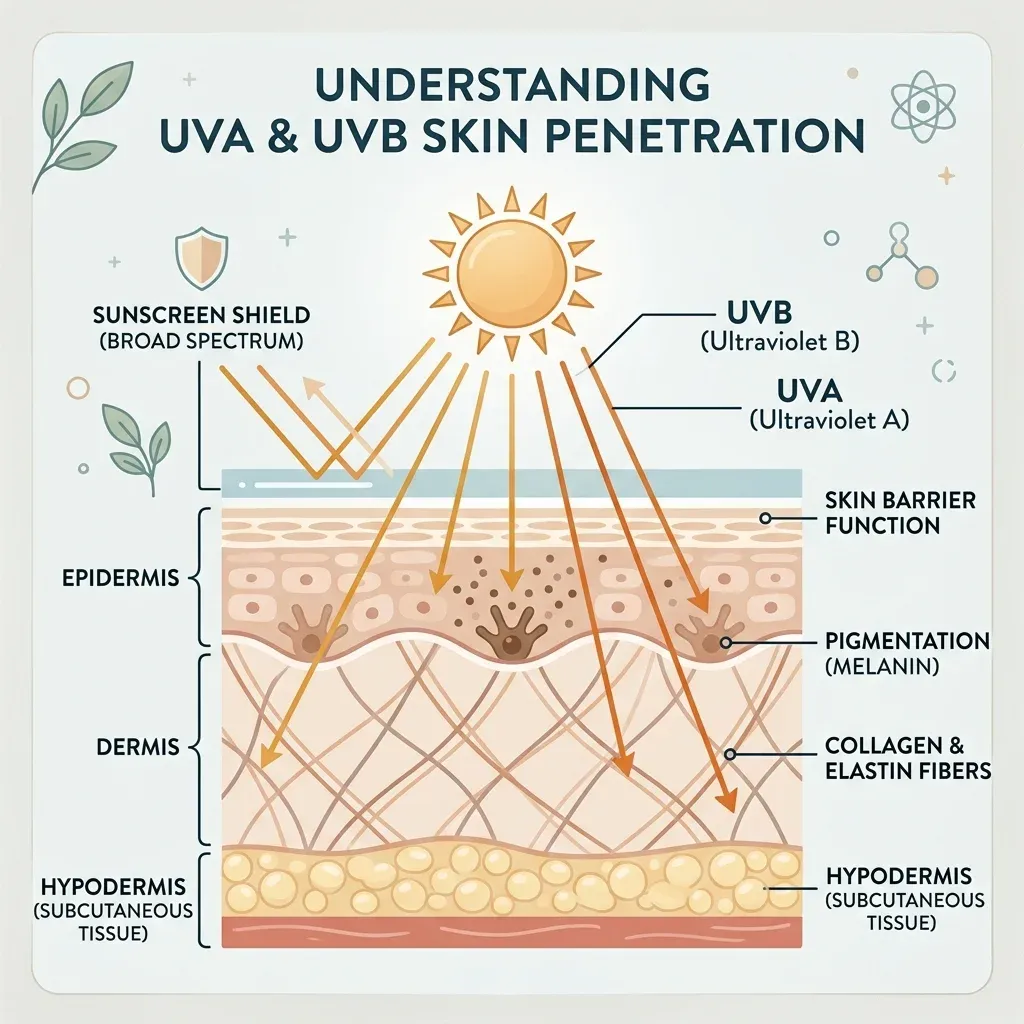
The FDA separates UV exposure into UVA and UVB behavior: UVB has a shorter wavelength and reaches the epidermis, while UVA has a longer wavelength and can penetrate into the dermis where collagen lives. The same FDA guidance says both UVA and UVB can damage skin, with premature aging among the effects of prolonged UV exposure rather than a one-time burn event.
This distinction keeps the promise honest. A peptide serum can support the mattress, but it cannot rewind every sunny commute, beach week, and forgotten reapplication. The useful question is narrower: can a consistent peptide-centered routine improve the parts of photoaging that are still responsive to topical care?
The available answer is yes, with guardrails. The photoaging literature points to structural deterioration, enzyme-driven collagen breakdown, and barrier stress as targets worth supporting in prevention and treatment research. Peptides fit that repair-support role best when they are paired with daily photoprotection, not when they are treated like a rescue product after unprotected UV exposure.
Why Peptides Belong in a Sun-Damage Routine
Peptides belong in the conversation because they do not all try to do the same job. A cosmetic peptide review groups them into signal peptides, neurotransmitter-inhibiting peptides, carrier peptides, and enzyme-inhibitor peptides with different skin targets. The easiest analogy is a repair crew: one worker sends the work order, another brings materials, another slows demolition, and another quiets repeated movement that deepens expression lines.
Signal peptides are described as nudging fibroblast activity and collagen production, while carrier peptides can deliver trace elements involved in repair inside cosmetic formulations. Copper peptide literature makes the same broad repair argument for GHK-Cu, tying the peptide to collagen, elastin, glycosaminoglycan synthesis, and wound-repair pathways through a review of gene and tissue data.
That still does not make peptides the king ingredient. A 2026 review by Anna-Lena Gurtler, Jonathan P. Sirois, and Andrea Heinz states that retinoids remain the most consistently supported intervention for skin aging, while evidence for collagen peptides remains inconclusive because the evidence base is uneven. The same review flags small samples, short durations, subjective outcomes, limited controls, poor absorption, instability, and industry sponsorship as recurring problems in skin-aging studies.
So peptides are not a replacement for retinoids, sunscreen, or procedures. They are a gentler supporting lane: useful when the goal is barrier support, collagen-signaling support, or a routine that a sensitive skin type can actually use for 12 weeks.
That last point is underrated. A harsh routine that causes peeling, stinging, and stop-start use may look impressive on paper but fail in a real bathroom. A peptide routine is often valuable because it gives the skin a quieter path: encourage repair signals, keep the barrier hydrated, and make sunscreen compliance easier because the face is not irritated every morning.
Use peptides as the steady contractor, not the demolition crew. If retinoids are the renovation permit with the strongest evidence, peptides are the team that helps patch drywall, bring materials, and keep the site livable while the larger project continues.
| Peptide type | Main role | Routine implication |
|---|---|---|
| Signal peptides | Support fibroblast and collagen-signaling pathways | Best framed as gradual texture and fine-line support |
| Carrier peptides | Carry trace elements involved in repair | Useful in copper-peptide routines, but formulation quality matters |
| Enzyme-inhibitor peptides | Reduce collagen-breakdown signaling | Most relevant when photoaging has left skin crepey or lax |
The 12-Week Peptide Routine
The most practical routine in the research is not complicated. In a 12-week study of 46 women aged 25 to 55, the morning product combined AP31 with SPF moisturizer, while the evening product paired AP31 with bakuchiol moisturizer as the daily regimen. That structure matters: the peptide was not asked to repair new damage while the skin kept taking fresh UV hits.
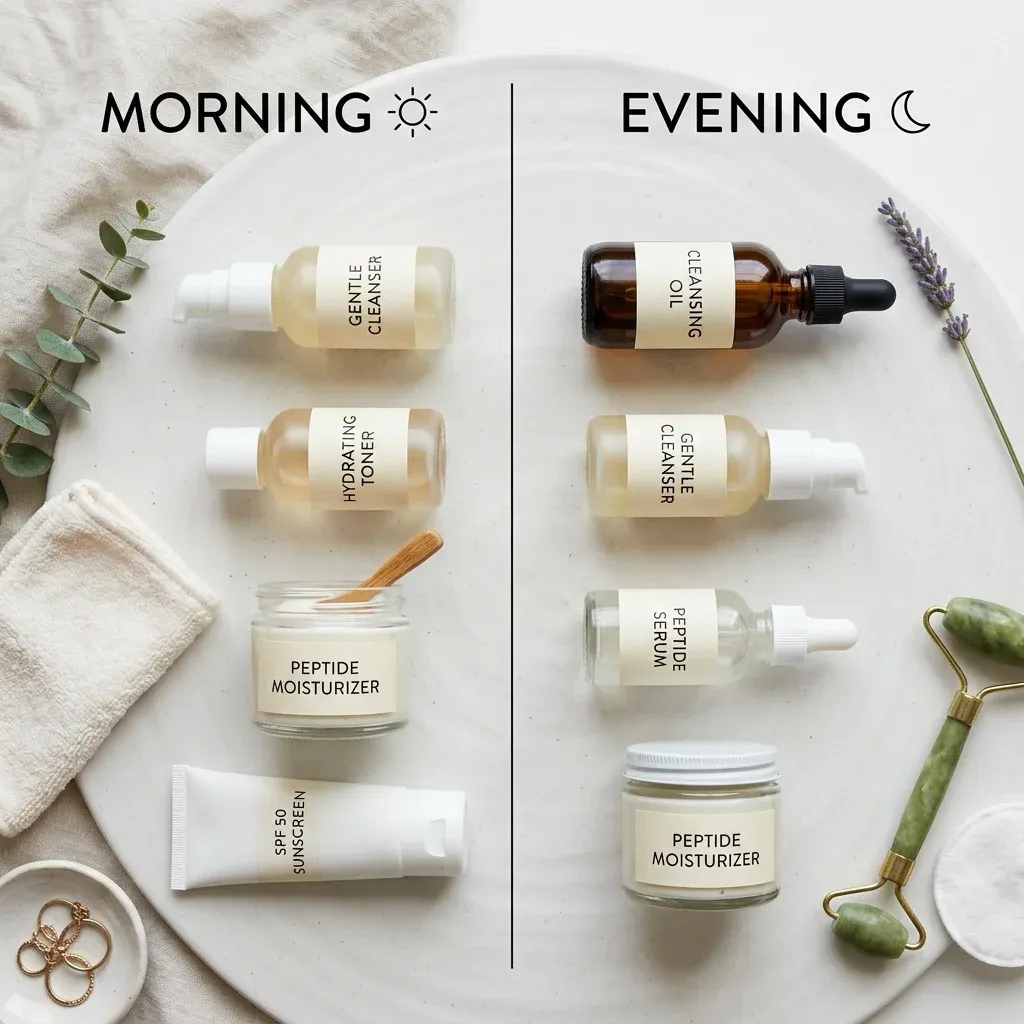
Here is the usable version. Morning: cleanse lightly, apply a peptide serum or peptide moisturizer, then finish with broad-spectrum sunscreen. Evening: cleanse, apply the peptide product, and use a moisturizer that keeps the barrier comfortable. If you use retinoids, strong acids, or vitamin C, separate them from copper-peptide products unless the product label says the formula was built for that combination.
The FDA says broad-spectrum sunscreen with SPF 15 or higher should be used regularly and as directed for sun protection. It also says SPF values primarily indicate UVB protection, so the agency recommends choosing broad-spectrum sunscreen with SPF of at least 15 to get the most protection out of sunscreen rather than judging by SPF alone.
For a reader trying this at home, the boring part is the treatment. The formula that wins is the one you can repeat without irritation, missed mornings, or experimental layering. Twelve weeks is long enough for inconsistency to become the main ingredient.
If your skin is reactive, start with the peptide moisturizer version instead of stacking a peptide serum under several other actives. If your skin is resilient, a serum plus moisturizer can work, but the routine still needs one clear job. The morning job is protection. The evening job is repair support. Everything else has to earn its place.
Photographs help because memory is unreliable. Take one face-forward image and one side image before starting, then repeat them at the same time of day. The goal is not to hunt for perfection; it is to see whether texture, dullness, roughness, fine lines, and tone are moving in the right direction without new irritation.
| Time | Step | Why it is there |
|---|---|---|
| Morning | Peptide serum or peptide moisturizer | Provides the repair-support active before daily protection |
| Morning | Broad-spectrum sunscreen | Prevents new UV injury from overwhelming visible repair |
| Evening | Peptide product plus moisturizer | Keeps the barrier comfortable enough to repeat the routine |
Ingredients That Do the Heavy Lifting
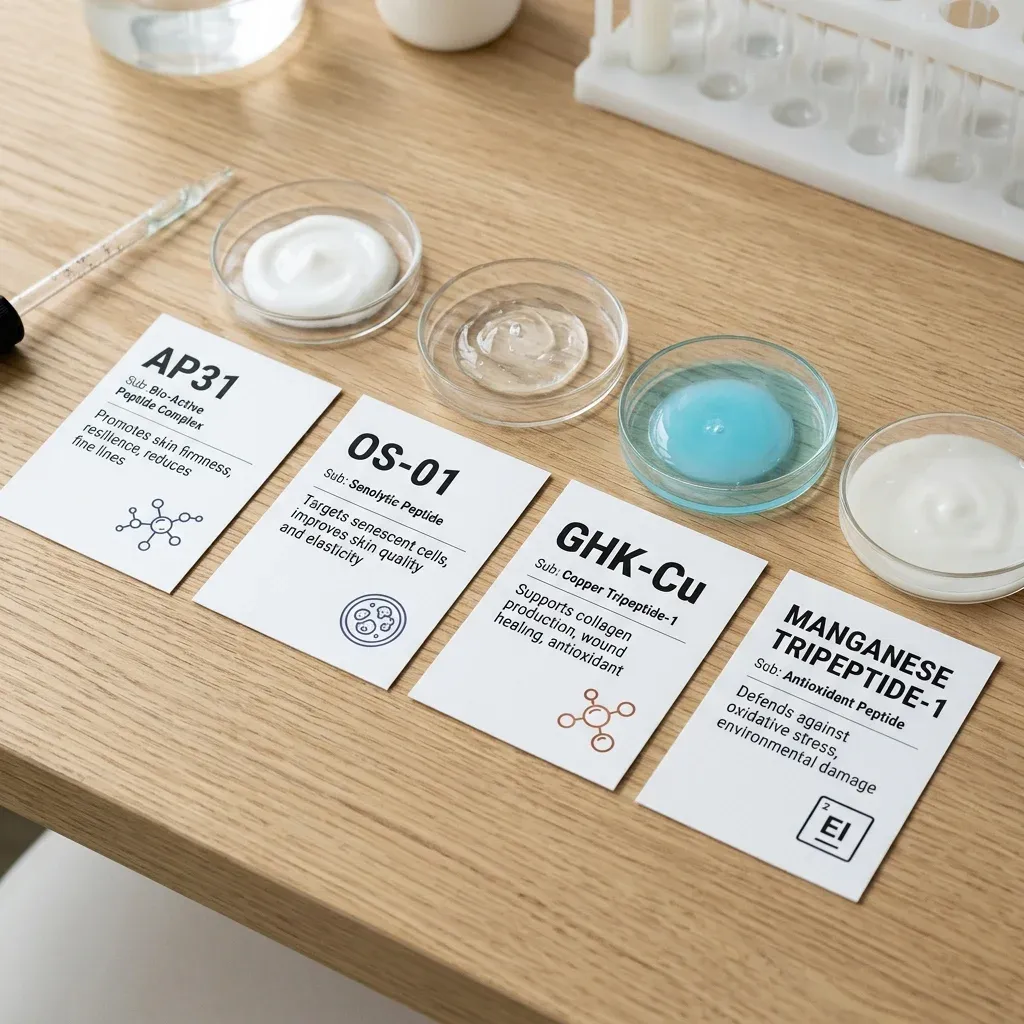
The strongest 12-week routine data in this corpus comes from AP31 and OS-01. The AP31 regimen reported roughly 23% improvement in fine lines, almost 20% in roughness, 15% in radiance and firmness, and roughly 13% in elasticity at week 12 against baseline. Those are believable cosmetic numbers: meaningful enough to notice, not magical enough to erase the need for sunscreen.
OS-01 is interesting because it shifts the focus from wrinkle chasing to barrier behavior. Alessandra Zonari, Lear E. Brace, Luiza Brunelli Buhrer, Nathaniel H.O. Harder, and colleagues ran a randomized, double-blind trial in 60 women aged 60 to 90 for 12 weeks using an OS-01 topical peptide formulation. The study reported significantly improved barrier function and hydration compared with control, and 70% of the OS-01 group noticed improved general skin appearance after 12 weeks compared with 42% of the control group in participant assessments.
Copper peptides deserve a narrower, more cautious role. A GHK-Cu review summarizes a 12-week placebo-controlled study in 71 females in which GHK-Cu-containing face creams reduced wrinkles and fine lines while increasing skin elasticity, density, and thickness in the reported clinical literature. That is promising, but the same copper-peptide universe is full of formulation caveats; a poor copper complex is not automatically a regenerative skin product.
Manganese Tripeptide-1 is the pigmentation-adjacent option in the research. A peptide review describes a study in 15 women aged 40 to 70 with moderate photodamage and hyperpigmentation marks, where Manganese Tripeptide-1 produced the largest visible effect on hyperpigmentation signs and a more moderate effect on fine lines and wrinkles in that small trial.
There is also eye-area evidence, though it should be kept in its lane. A multi-peptide eye serum study reported a 7.59% decrease in Sa roughness values after 28 days around the crow's-feet area. That does not prove a whole-face sun-damage reversal, but it does show why multi-peptide formulas are often aimed at texture, firmness, and fine lines rather than one single dramatic endpoint.
The common thread is not that one peptide is a miracle. It is that the better formulas match a target: AP31 for early collagen-decline signs, OS-01 for barrier behavior, GHK-Cu for repair signaling, and manganese tripeptide for pigment-adjacent photodamage. A routine gets smarter when the peptide is chosen for the visible problem, not for the longest ingredient name.
What Results to Expect by Week 12
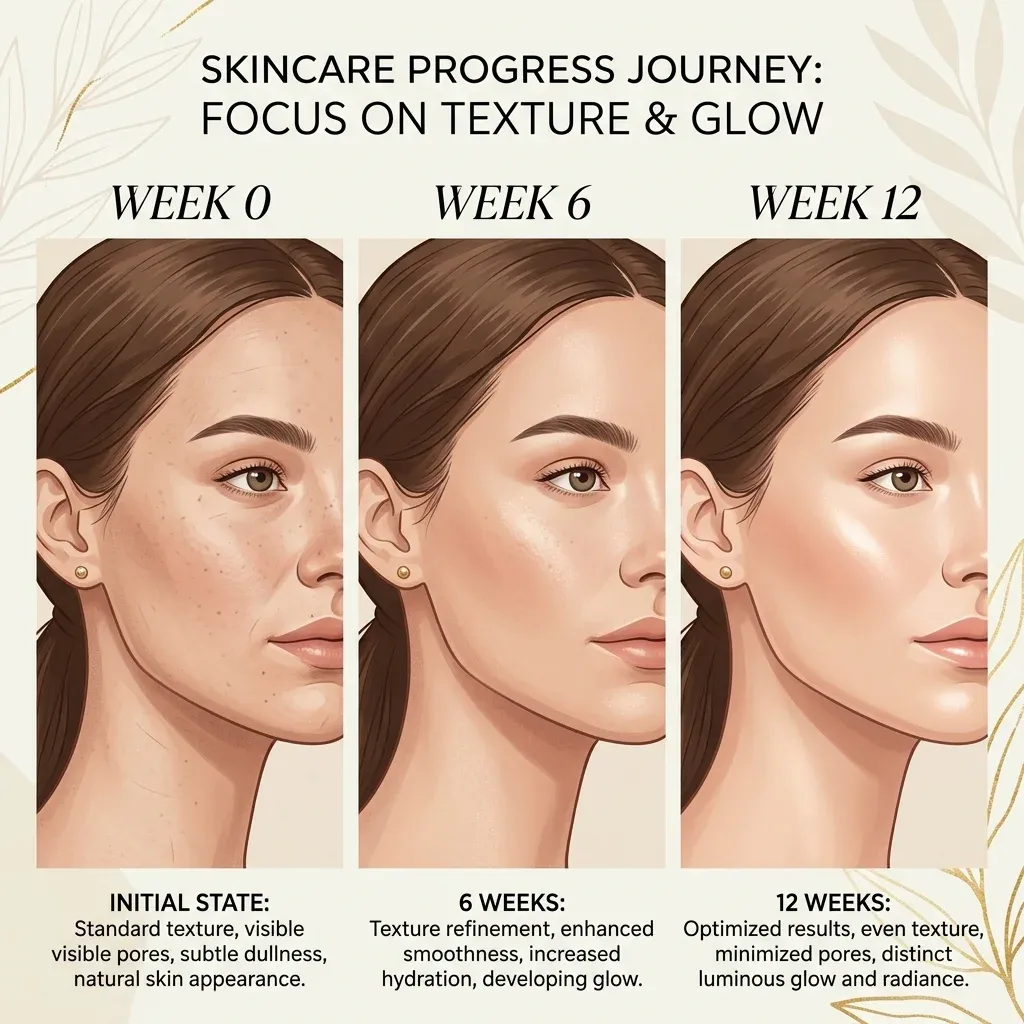
Week 12 is a good checkpoint because several cosmetic studies use it, but it is not a finish line. In the AP31 regimen, the headline changes were fine lines, roughness, radiance, firmness, and elasticity rather than total pigment erasure. In the OS-01 study, the measurable story was barrier function and hydration, with participant perception improving alongside those measurements after 12 weeks.
A separate oral collagen peptide study described in the Journal of Drugs in Dermatology reported up to 28% higher hydration after 8 weeks and noted that the placebo group's number of deep wrinkles increased 30% between baseline and week 12 in the cited trial summary. That does not prove an oral supplement belongs in every routine, but it reinforces the larger point: hydration, elasticity, and wrinkle metrics can move on a two-to-three-month timeline.
Set expectations in layers. By week 4, many people mainly notice comfort, glow, and less tightness. By week 8, texture and fine lines are easier to judge. By week 12, take photos in the same light and look for roughness, uneven tone, fine lines, and whether makeup sits more smoothly. If the only "result" is a new irritation cycle, the routine is too aggressive.
The week-by-week framing also prevents overreacting. Barrier improvement can show up as less tightness before it shows up as a smoother photo. Pigment-related changes can lag behind texture because uneven tone reflects both surface appearance and deeper UV history. Fine lines may soften before deeper folds move at all.
The most credible win is a cluster of small changes that all point the same way. If roughness is down, sunscreen is no longer stinging, fine lines look softer in side light, and the skin has less afternoon tightness, that is a repair signal worth keeping. If only one metric changes and everything else feels worse, simplify.
| Checkpoint | Most realistic signal | What not to expect |
|---|---|---|
| Weeks 1-4 | Better comfort and less roughness if the barrier tolerates the formula | Deep wrinkle reversal |
| Weeks 5-8 | Texture, hydration, and makeup-sit changes | Total pigment clearance |
| Weeks 9-12 | Fine-line, radiance, firmness, and elasticity changes | Undoing years of unprotected UV exposure |
Mistakes That Slow Repair
The first mistake is treating peptides like sunscreen. They are not. FDA sunscreen guidance says no sunscreen is waterproof, and water-resistant labels must state whether the product remains effective for 40 or 80 minutes when swimming or sweating before reapplication is needed. If sunscreen is skipped, the peptide routine becomes a mop under a leaking ceiling.
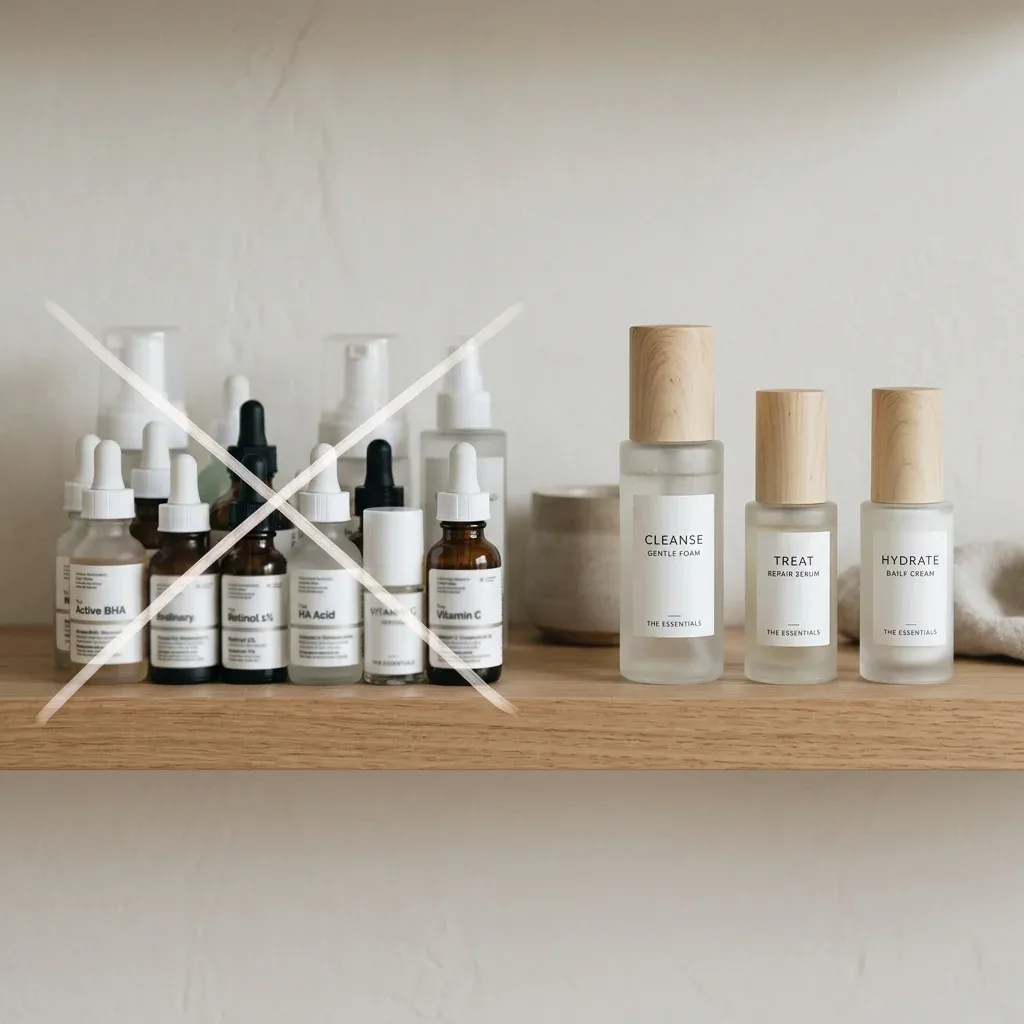
The second mistake is using too many actives at once. Peptides can have penetration and stability problems because many are large, hydrophilic molecules that do not easily cross the stratum corneum without smart formulation. Adding acids, retinoids, exfoliating pads, vitamin C, and copper peptides into one routine may feel serious, but it often just makes the barrier angry.
The third mistake is believing every copper peptide is repair-friendly. Loren Pickart's GHK-Cu review warns that not every copper peptide complex is regenerative and that some complexes may even inhibit skin repair depending on the complex. That is the unglamorous reason to buy boring, well-formulated products instead of mixing raw actives like a home chemistry project.
The fourth mistake is judging too fast. A 12-week routine asks for repetition: same sunscreen habits, same peptide product, same camera angle, same lighting. If you keep changing the formula, you will never know whether the peptide helped or whether your skin was just recovering from the last experiment.
Another common mistake is chasing the strongest possible concentration instead of the most stable formula. The skin-aging intervention review specifically calls out poor absorption and chemical instability as barriers to effectiveness across topical and systemic options. With peptides, packaging, pH, delivery system, and compatibility can matter as much as the marketing percentage.
Finally, do not use irritation as proof that something is working. Photodamaged skin is often already dealing with barrier stress. If a product causes burning, persistent dryness, or new breakouts, pushing through can make the surface look worse and make sunscreen harder to tolerate. The practical move is to reduce the routine to cleanser, peptide moisturizer, sunscreen, and a plain night moisturizer until the skin calms down.

Frequently Asked Questions
Can peptides really reverse sun damage?
They can improve visible markers linked with photoaging, such as fine lines, roughness, hydration, firmness, and barrier behavior, but "reverse" should not mean erasing all UV injury. The AP31 and OS-01 studies support visible and functional improvement over 12 weeks, while broader reviews still warn that the evidence is uneven and often limited.
What is the most important step in a peptide routine?
Sunscreen. The AP31 routine paired the morning peptide moisturizer with SPF, and FDA guidance emphasizes broad-spectrum sunscreen use as part of sun protection rather than as an optional extra.
How long should I try a peptide product before judging it?
Use 12 weeks as the cleanest checkpoint because the AP31 and OS-01 studies both used 12-week windows for clinical assessment. Stop earlier if irritation, rash, persistent dryness, or breakouts develop.
Are copper peptides better than regular peptides?
Not automatically. GHK-Cu has interesting repair data, including reported improvements in wrinkles, elasticity, density, and thickness, but Pickart's review also warns that some copper complexes may inhibit repair if poorly designed.
Can I use peptides with retinol?
Sometimes, but keep the routine conservative. Retinoids remain the best-supported skin-aging intervention in the broader evidence review, while peptide evidence is more mixed and formulation-dependent. If irritation is a problem, separate retinoid and peptide nights or use a peptide-only recovery night.
Medical Disclaimer
This article is for informational and educational purposes only and is not medical advice, diagnosis, or treatment. Always consult a licensed physician or qualified healthcare professional regarding any medical concerns. Never ignore professional medical advice or delay seeking care because of something you read on this site. If you think you have a medical emergency, call 911 immediately.