Why GHK-Cu Is Suddenly Back in Skin Care
GHK-Cu feels new because it is showing up in blue serums, TikTok routines, and skin-longevity conversations. The odd part is that the molecule itself is not new at all. Loren Pickart's work traces the copper-binding peptide back to a 1973 discovery involving human albumin activity and youthful protein synthesis.
That age gap is the whole story. The beauty market loves a rediscovery: an old lab finding gets repackaged as the active ingredient people were missing all along. Board-certified dermatologist Jennifer Gordon describes the current copper-peptide boom as a mix of TikTok, skin cycling, and "skin longevity" language that frames GHK-Cu as cellular repair in a bottle on her dermatology practice's ingredient review.
The better question is whether the hype has outrun the evidence. Gordon says there is real science behind GHK-Cu, but also plenty of exaggeration in consumer claims about collagen, wrinkles, and retinoid replacement. That matters because the headline version of the trend, including claims that copper peptides are outselling vitamin C serums, is mostly market shorthand. The clinical question is narrower and more useful: what can GHK-Cu do that vitamin C, retinol, and ordinary moisturizers do not?
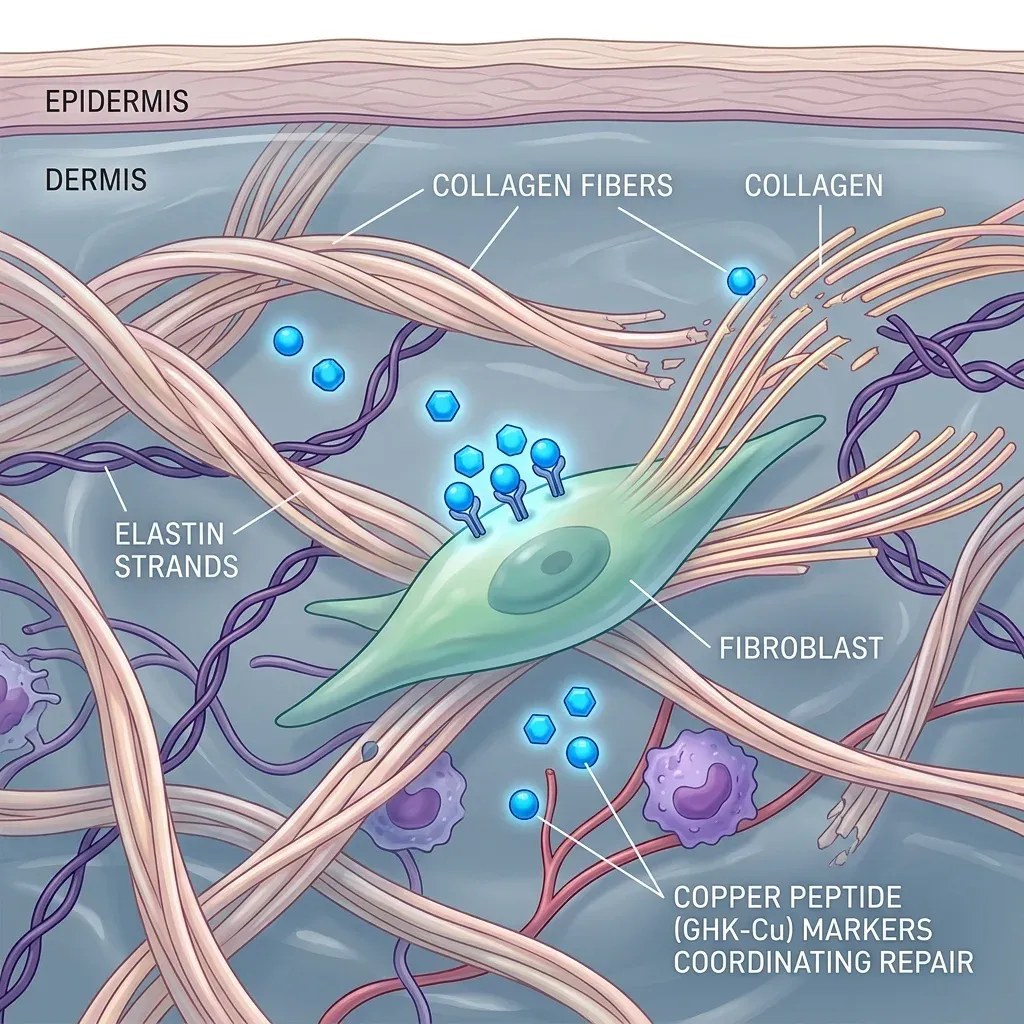
Think of GHK-Cu less like a harsh resurfacing acid and more like a renovation foreman. It does not sand down the top layer overnight; it seems to signal repair crews, collagen builders, and cleanup enzymes to coordinate over time.
There is also a biological reason people are interested in replacing what age removes. One source in the research corpus reports that GHK-Cu levels in human plasma are about 200 ng/mL around age 20 and about 80 ng/mL by age 60. That number should not be read as a prescription for topical dosing, but it explains why formulators keep returning to the molecule: the body already uses it as part of tissue repair signaling.
The practical takeaway is simple: treat GHK-Cu as a promising repair-support ingredient, not a magic replacement for everything already in your cabinet. If a serum promises overnight lifting or a complete retinol substitute, the marketing is doing more work than the molecule.
It also helps to separate popularity from proof. A dermatology practice can reasonably say copper peptides have surged because patients are asking about them after seeing them in skin-cycling and longevity routines. That is different from proving they outsell every vitamin C serum in every channel. The smart reader can hold both thoughts at once: GHK-Cu is legitimately having a moment, and the most useful buying decision still comes from the biology and tolerability data.
What GHK-Cu Actually Does in Skin
GHK-Cu is short for glycyl-L-histidyl-L-lysine copper. Gordon describes it as a naturally occurring copper-binding peptide found in human plasma, saliva, and urine. The peptide part has a strong attraction to copper ions, and the paired complex participates in tissue repair and cellular signaling.
The easiest way to understand the "copper" part is to think of it like a keycard. Copper is useful for enzyme systems involved in repair and antioxidant defense, but loose copper is not something skin wants scattered everywhere. The peptide helps carry and present it in a more organized way, which is why dermatology sources often call GHK-Cu a carrier peptide rather than just another collagen-signaling peptide.
Older biochemical work summarized by Pickart and Margolina reports that Maquart and colleagues found low, non-toxic concentrations of GHK-Cu stimulated collagen and glycosaminoglycan synthesis. Those are not glamorous terms, but they are central to skin that feels springy rather than papery: collagen is the scaffolding, and glycosaminoglycans help hold water in the matrix.
The more interesting part is that GHK-Cu does not appear to tell skin only to build. In the Badenhorst, Svirskis, Merrilees, Bolke, and Wu paper, the team studied MMPs, TIMPs, collagen, elastin, and wrinkle parameters. MMPs help break down damaged matrix; TIMPs help restrain that breakdown. A good remodeling signal is not a construction worker with a hammer. It is a crew that knows what to remove before rebuilding.
| Skin task | What GHK-Cu is linked to | Why it matters |
|---|---|---|
| Repair signaling | Tissue repair and cellular signaling | Useful for barrier-support routines |
| Matrix remodeling | MMP/TIMP balance | Old or damaged matrix can be cleared before rebuilding |
| Firmness support | Collagen and elastin production | Firmness changes are gradual, not instant |
In the Badenhorst study, GHK-Cu increased MMP1 and MMP2 gene expression while also increasing TIMP1-related inhibitory activity. The same report says all tested concentrations increased collagen and elastin production in human adult dermal fibroblasts in the cell-culture portion of the experiment.
For a reader, that means GHK-Cu fits best when the goal is better skin quality over weeks, not a peel-like glow by tomorrow morning. It belongs in the "repair and resilience" lane of a routine.
That lane matters for people who have already learned that stronger is not always better. If your skin gets red after vitamin C, flakes after retinol, and stings when you add acids, another aggressive active may not be the missing piece. A copper peptide serum is not automatically soothing, but its best-supported role is different enough that it can be tested as part of a calmer rebuild.
The Evidence for Wrinkles, Firmness, and Repair
The strongest claims for GHK-Cu come from a mix of older cosmetic studies, cell work, and a small human facial trial. That mix is promising, but not airtight. It is more like a set of matching footprints than a single definitive map.
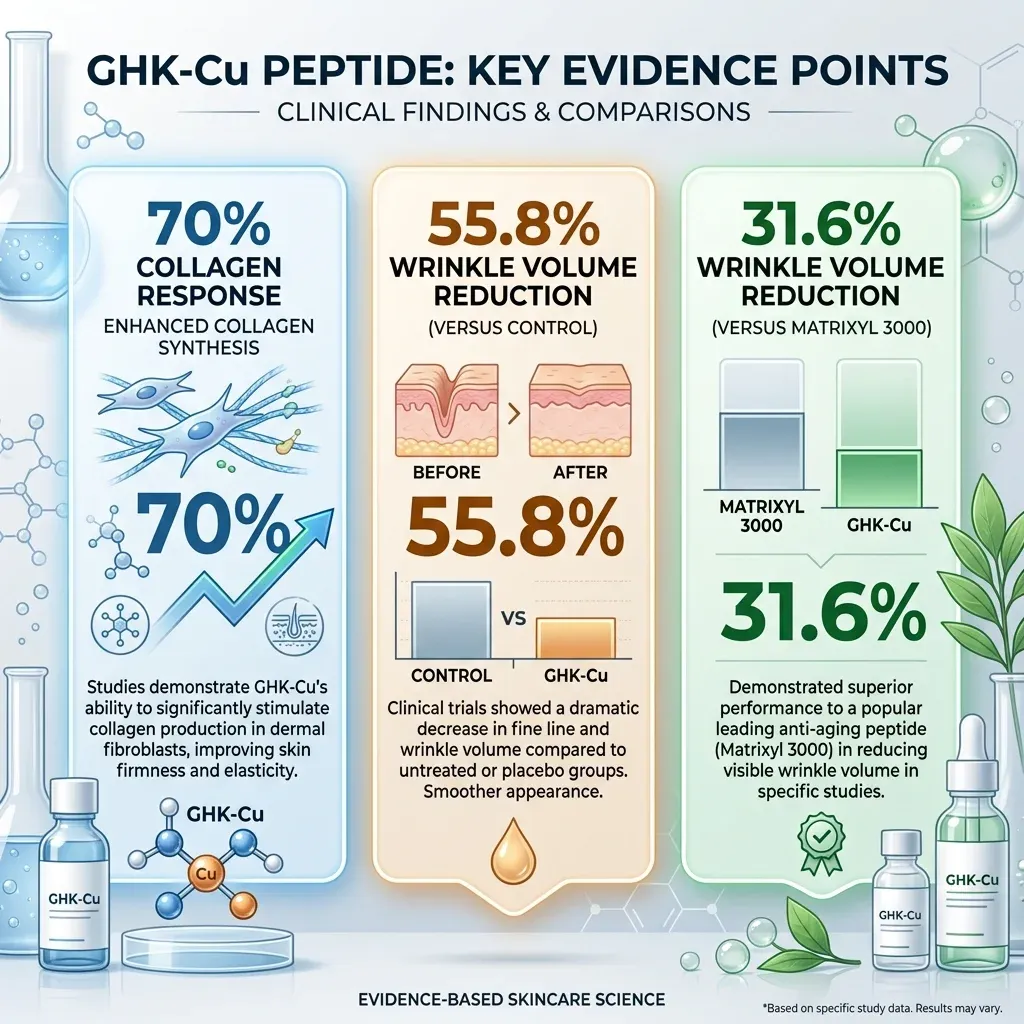
One often-cited comparison summarized by Pickart and Margolina reports that after one month, GHK-Cu increased collagen in 70% of treated participants, compared with 50% for vitamin C and 40% for retinoic acid. That is a striking number, and it explains why copper peptides keep getting compared with classic actives. It should also be handled carefully because the accessible corpus gives the summary, not a modern large trial with transparent consumer endpoints.
There is more direct facial data, though it is still small. The Badenhorst team ran an 8-week randomized double-blind split-face trial in 40 women aged 40 to 65, using a lipid nano-carrier GHK-Cu serum, a vehicle control, and a Matrixyl 3000 comparator. The nano-carrier GHK-Cu arm showed 55.8% lower wrinkle volume and 32.8% lower wrinkle depth versus control serum. It also showed 31.6% lower wrinkle volume versus a Matrixyl 3000 product.
A separate facial-cream study summarized in the Pickart and Margolina review followed 71 women with photoaging for 12 weeks. The reported improvements included fine lines, wrinkle depth, skin laxity, clarity, density, and thickness compared with placebo. That is encouraging, but it still does not make every blue peptide serum equal. Delivery system, concentration, packaging, and formula stability decide whether the ingredient reaches skin in a useful form.
Practically, the evidence supports cautious interest, not blind loyalty. If your skin tolerates retinoids and vitamin C well, GHK-Cu may be an addition. If your barrier is reactive, it may be a gentler way to support repair while you build back tolerance.
The catch is that small studies can make ingredients look cleaner than real life does. The 40-participant nano-carrier trial tested a particular delivery system under controlled conditions. Your bathroom shelf adds heat, light, inconsistent application, other actives, and whatever base the brand chose. That does not invalidate the data; it just means "GHK-Cu worked in a study" is not the same as "any copper peptide serum will work for me."
GHK-Cu vs. Vitamin C: Different Jobs, Different Tradeoffs
Vitamin C has earned its place. A PubMed-indexed dermatology review describes topical vitamin C as a water-soluble antioxidant used for photoaged skin, with benefits that include collagen synthesis support, UVA/UVB photoprotection, hyperpigmentation lightening, and help with inflammatory dermatoses. In plain English, vitamin C is a brightening antioxidant first and a collagen-supporting ingredient second.
GHK-Cu is built for a different job. Vitamin C is like a smoke alarm and cleanup crew for oxidative stress; GHK-Cu is closer to a repair coordinator. It does not replace sunscreen, it does not exfoliate pigment like an acid, and it should not be sold as a universal upgrade over vitamin C.
Retinol is a third category again. In a 24-week trial of 0.4% retinol lotion, investigators reported significant fine-wrinkle improvement versus vehicle, with increased glycosaminoglycan expression and procollagen I staining in small subgroups. That kind of evidence is why dermatologists still treat retinoids as foundational for photoaging, even when patients hate the peeling phase.
| Ingredient | Best at | Main tradeoff |
|---|---|---|
| GHK-Cu | Repair signaling, firmness support, barrier recovery | Delivery and formulation quality matter heavily |
| Vitamin C | Antioxidant support and brightness | Pure L-ascorbic acid can be acidic and unstable |
| Retinol/retinoids | Wrinkle and texture remodeling | Irritation, peeling, and adjustment are common |
The chemistry conflict is where many routines go wrong. Gordon recommends avoiding simultaneous use of strong acids or high-strength vitamin C with copper peptides and alternating retinoids rather than layering everything at once. A routine is not stronger because every active touches your face in the same hour. It is stronger when each ingredient gets conditions where it can work.
That means the "GHK-Cu versus vitamin C" debate is mostly the wrong fight. Use vitamin C when your priority is antioxidant brightness. Use GHK-Cu when your priority is repair, resilience, and gradual firmness support. If you want both, separate them.
Brightness is especially easy to confuse with repair. A PubMed-indexed study on glycolic and lactic acids found these AHAs could suppress melanin formation by directly inhibiting tyrosinase activity in experimental systems while also supporting faster epidermal turnover. That is a pigment-and-surface strategy, not a copper-peptide strategy. If your main concern is dark spots, dullness, or post-inflammatory marks, vitamin C and exfoliating acids may still be the more direct tools.
How to Use GHK-Cu Serums Without Wasting Them
The most expensive mistake is treating a copper peptide serum like a casual extra step. GHK-Cu is highly hydrophilic, and the Badenhorst paper notes that efficient skin delivery is challenging without a delivery system such as a lipid-based nano-carrier. A beautiful blue color does not prove the peptide is getting where it needs to go.
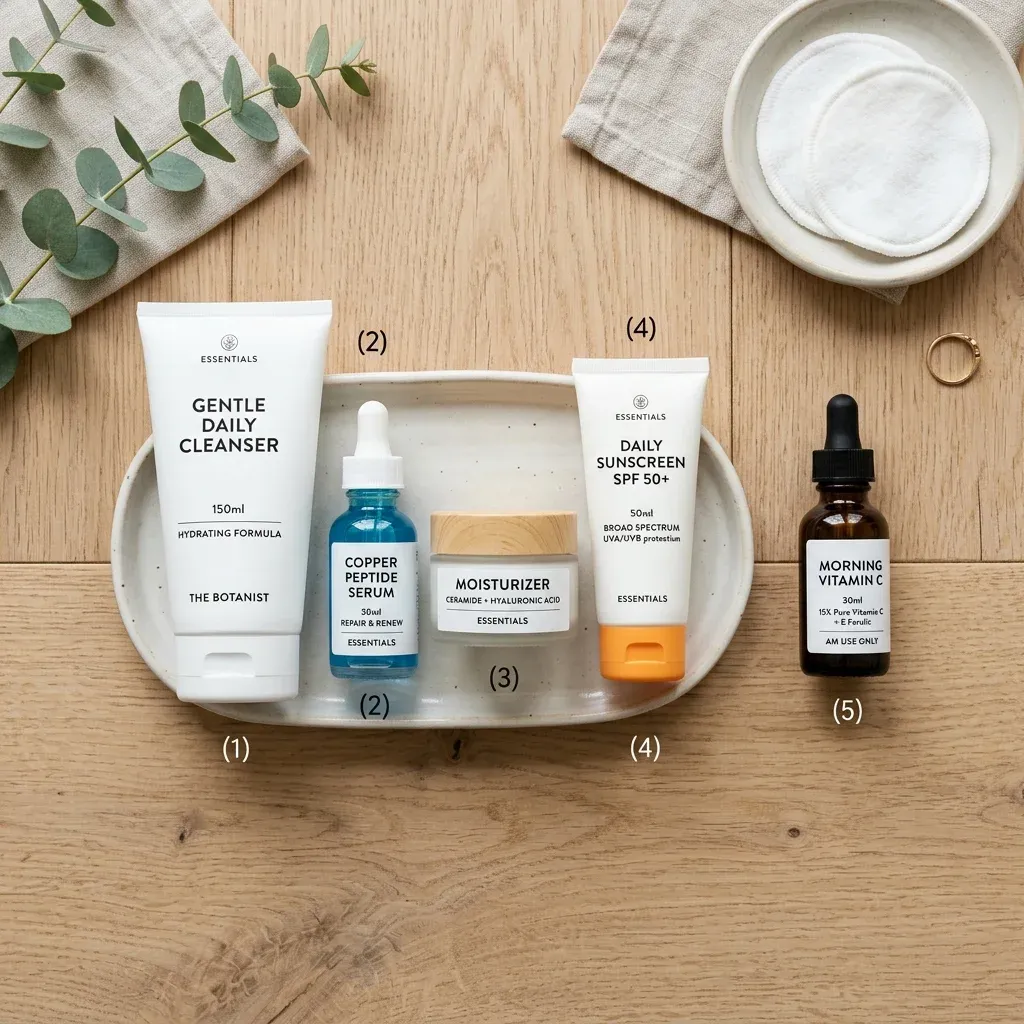
Start with the boring version of the routine: gentle cleanser, GHK-Cu serum, moisturizer, and sunscreen in the morning if used during the day. If you also use pure L-ascorbic acid, exfoliating acids, or retinoids, put them in a different part of the day or on alternating nights. Gordon's practical guidance is once-daily use, avoiding simultaneous strong acids or high-strength vitamin C, and alternating with retinoids instead of stacking irritation.
| Routine question | Conservative answer | Why |
|---|---|---|
| Can I use it daily? | Usually once daily if tolerated | More is not automatically better |
| Can I layer it with vitamin C? | Do not layer directly with strong L-ascorbic acid | Low-pH formulas may interfere with copper-peptide stability |
| Can I use it with retinol? | Alternate nights at first | Barrier irritation can hide whether either active suits you |
Paula's Choice classifies copper tripeptide-1 as a skin-restoring peptide ingredient. That framing is useful because it lowers expectations to something more realistic: healthier-looking, more resilient skin over time. If a formula stings, burns, or leaves your skin inflamed, back off. Repair ingredients should not make your barrier feel hunted.
Give a new copper peptide serum enough time to be fair. A few weeks can tell you whether your skin likes the base. Visible firmness or texture changes, if they happen, are more likely to be a two- to three-month story than a weekend story.
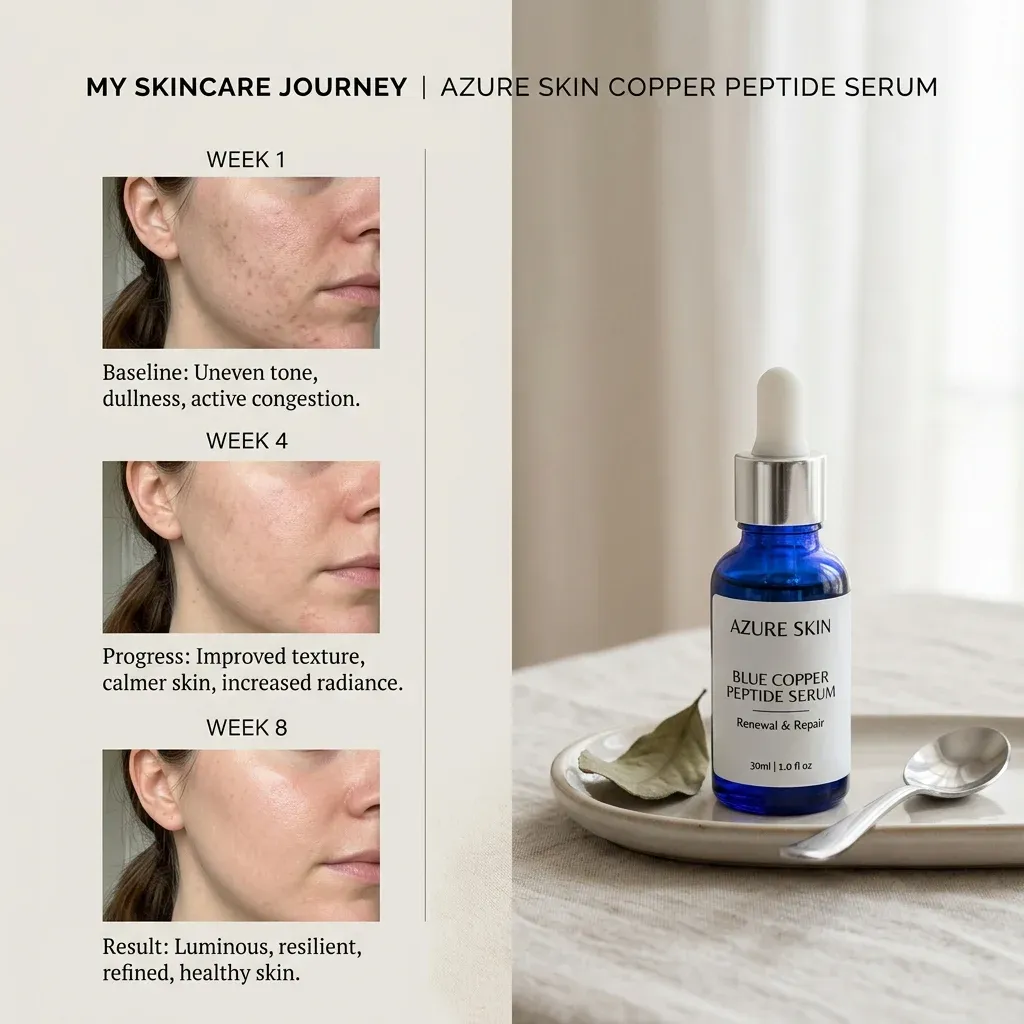
A good test is boring by design. Keep the rest of the routine steady, take photos in the same light every couple of weeks, and track irritation as seriously as glow. If you change cleanser, moisturizer, retinoid strength, exfoliation frequency, and copper peptide serum at the same time, you will not know which change helped or hurt.
Who Should Be Careful With Copper Peptides
GHK-Cu is often pitched as gentle, but gentle does not mean risk-free. Gordon lists possible side effects including irritation, redness, tingling, sensitivity, and breakouts, especially in reactive or acne-prone skin. Anyone already using several strong actives is more likely to blame the newest serum when the real problem is total routine load.
There is also a quality-control issue. The Cosmetic Ingredient Review safety assessment is useful as a broad topical safety reference for tripeptide-1 and related cosmetic peptides in cosmetic formulations. It does not bless every gray-market injectable, high-concentration serum, or social-media protocol. Topical skincare and self-injection are different risk categories.
| Reader type | How cautious to be | Practical move |
|---|---|---|
| Reactive or acne-prone skin | High | Patch test and start every other night |
| Retinoid user | Moderate | Alternate nights before layering |
| Barrier-damaged skin | Moderate | Pair with bland moisturizer, skip acids |
| Expecting dramatic wrinkle reversal | High | Reset expectations before spending |

The smartest buyer looks for restraint: clear ingredient lists, air-protective packaging, realistic concentration claims, and instructions that do not ask you to abandon every other proven active. GHK-Cu may deserve a place in anti-aging routines, but it should earn that place by tolerability and results, not by fear of missing the next skincare wave.
Frequently Asked Questions
Is GHK-Cu better than vitamin C?
Not exactly. Vitamin C is better framed as an antioxidant and brightening ingredient, while GHK-Cu is better framed as a repair and remodeling signal. The collagen comparison showing 70% for GHK-Cu, 50% for vitamin C, and 40% for retinoic acid is interesting, but it does not erase vitamin C's evidence for photoaging and hyperpigmentation.
Can I use GHK-Cu and vitamin C in the same routine?
You can use both in a broader routine, but avoid applying strong L-ascorbic acid and copper peptides at the same time. A conservative plan is vitamin C in the morning and GHK-Cu at night, or alternating days if your skin is easily irritated.
How long does GHK-Cu take to work?
Expect gradual changes. The facial studies in this research corpus used 8-week and 12-week windows, so judging a serum after a few nights is not fair.
Should copper peptides replace retinol?
No. Gordon's dermatology review says copper peptides can support skin repair and collagen production, but they should not replace retinoids or in-office treatments when those are appropriate and tolerated.
Medical Disclaimer
This article is for informational and educational purposes only and is not medical advice, diagnosis, or treatment. Always consult a licensed physician or qualified healthcare professional regarding any medical concerns. Never ignore professional medical advice or delay seeking care because of something you read on this site. If you think you have a medical emergency, call 911 immediately.