
Can Peptides and Retinol Be Used Together?
Yes, peptides and retinol can share a routine. The smarter question is whether they should share the same layer, on the same night, at the same strength, while your skin is already a little irritated.
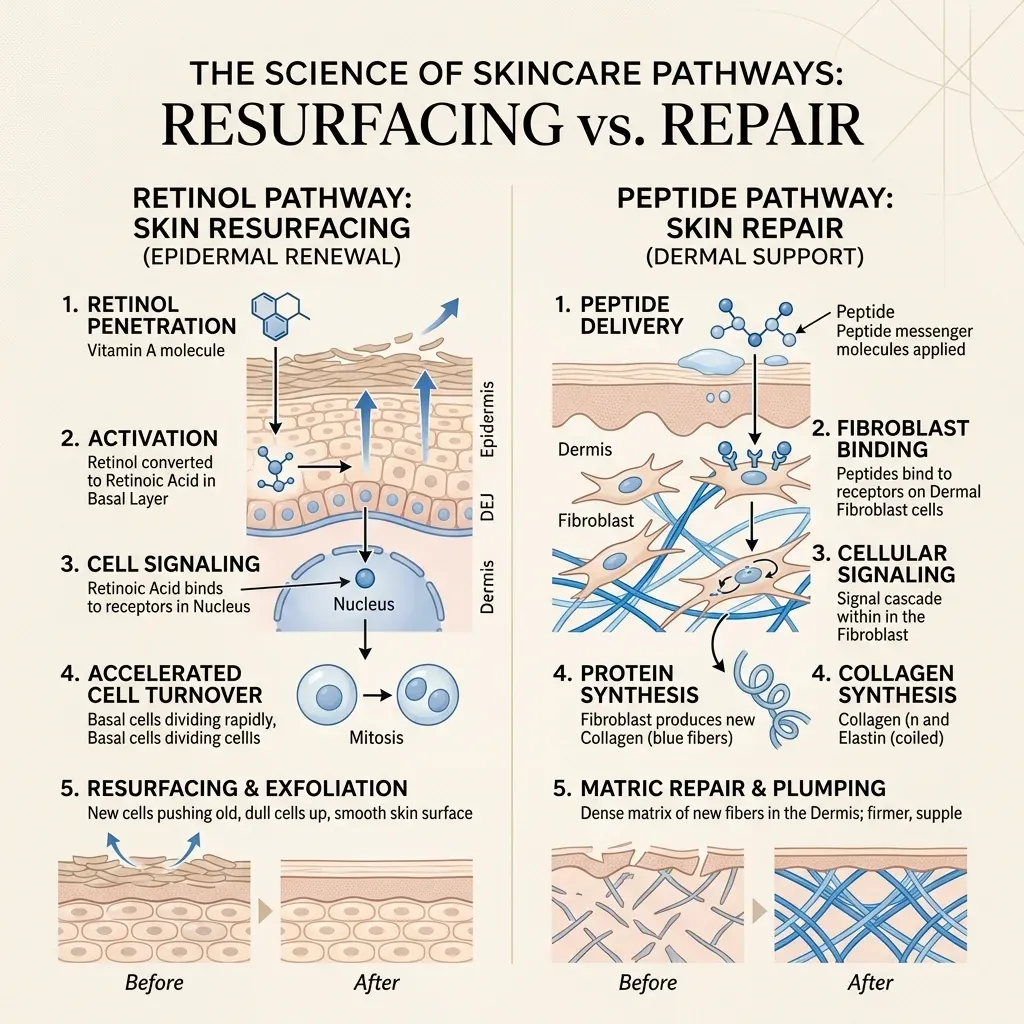
Peptides are short amino-acid chains that act more like messages than resurfacing tools. Some support collagen signaling, some help hydration and barrier function, and copper peptides carry trace minerals involved in repair, according to City Skin Clinic's ingredient overview and Art of Skin Care's copper peptide guide City Skin Clinic Art of Skin Care. Retinoids behave differently. They are vitamin A derivatives that speed cell turnover and stimulate collagen pathways, which is why they are powerful for texture, acne, fine lines, and uneven tone City Skin Clinic.
Think of retinol like a renovation crew working faster than usual. Peptides are closer to the project notes telling the crew what needs repair. In theory, those two jobs complement each other. In practice, too many instructions and too much demolition in one evening can leave the barrier raw.
The practical answer: standard peptides and retinol can often work together, but copper peptides deserve more separation and beginners should not stack everything at once.
The combination is not just wishful thinking. A periorbital-skin review reported wrinkle-improvement rates of 75% for retinoids, 56.25% for peptides, 62.5% for vitamin C, 50% for ceramides, and 87.5% for a retinoid-plus-peptide combination. That finding is useful, but it should be handled with restraint: it is one review, not permission to turn your bathroom shelf into a chemistry set.
The best mental model is "compatible in a routine" rather than "pile them into one step." A product that has retinol and peptides in one finished formula has been built around that pairing. Two separate products bought from two separate brands have not. The difference is similar to a recipe versus dumping all the spices in a pan and hoping the sauce behaves.
| Ingredient | Main job | Common issue |
|---|---|---|
| Retinol or retinal | Turnover, texture, pigment, collagen support | Dryness, redness, peeling, and early irritation source |
| Signal peptides | Support collagen, hydration, firmness, and barrier function | Slower and usually subtler results than retinoids source |
| Copper peptides | Repair signaling and barrier support | Better separated from retinoids in the same application source |
So the right takeaway is not "never combine them." It is "match the peptide type to your tolerance." A bland peptide moisturizer after retinol is one thing. A strong copper peptide serum, a high-strength retinol, and a sensitive face on night one is another.
Why They Can Clash on Skin
The clash is partly chemistry and partly human behavior. Copper peptides are not the same as every peptide serum. Art of Skin Care describes copper peptides as short chains bound to copper, usually GHK-Cu, and recommends using them in the same overall routine as retinoids but not in the same application Art of Skin Care.
The chemistry concern is that copper can reduce retinol stability, making separation the more performance-minded choice Art of Skin Care. That does not prove your skin will be damaged if the products touch once. It means the cleaner plan is to avoid asking delicate formulas to compete in the same layer.
The human-behavior problem is more common. Retinoids can cause dryness, redness, irritation, purging, and peeling during the adjustment phase City Skin Clinic. CeraVe's retinol guidance makes the same point in consumer language: introducing retinol without following directions can raise the chances of redness, discomfort, or flaking CeraVe Australia. If your skin barrier is a brick wall, retinol temporarily asks the masons to work faster. Adding too many actives is like changing the blueprint while the mortar is still wet.
Peptides also depend on formulation. A peptide stability guide notes that peptide performance can be affected by conditions such as pH, temperature, oxidation, and formulation environment Peptides UK. That is why the best advice is boring but effective: simplify the routine before blaming the ingredient.
This is also why "my friend layers them and looks great" is not strong evidence. Her retinol may be mild, her peptide may be non-copper, her moisturizer may be doing half the work, and her barrier may simply tolerate more than yours. Skincare advice travels badly when it leaves out skin type.
| Clash risk | What it means | Better move |
|---|---|---|
| Copper peptide plus retinol | Possible retinol stability loss | Use copper peptides in the morning or on recovery nights source |
| Too much retinol too soon | Dryness, peeling, and barrier stress | Start low and increase slowly source |
| Moisturizer packed with extra actives | Irritation can stack up silently | Choose a bland barrier-support moisturizer source |
Practically, if your skin stings when you apply moisturizer, do not add a peptide serum just because the label says "repair." Pause the retinoid, rebuild comfort, then reintroduce one active at a time.
The Mistake Most People Make
The mistake is not using peptides with retinol. The mistake is treating compatibility like a yes-or-no switch instead of a tolerance plan.
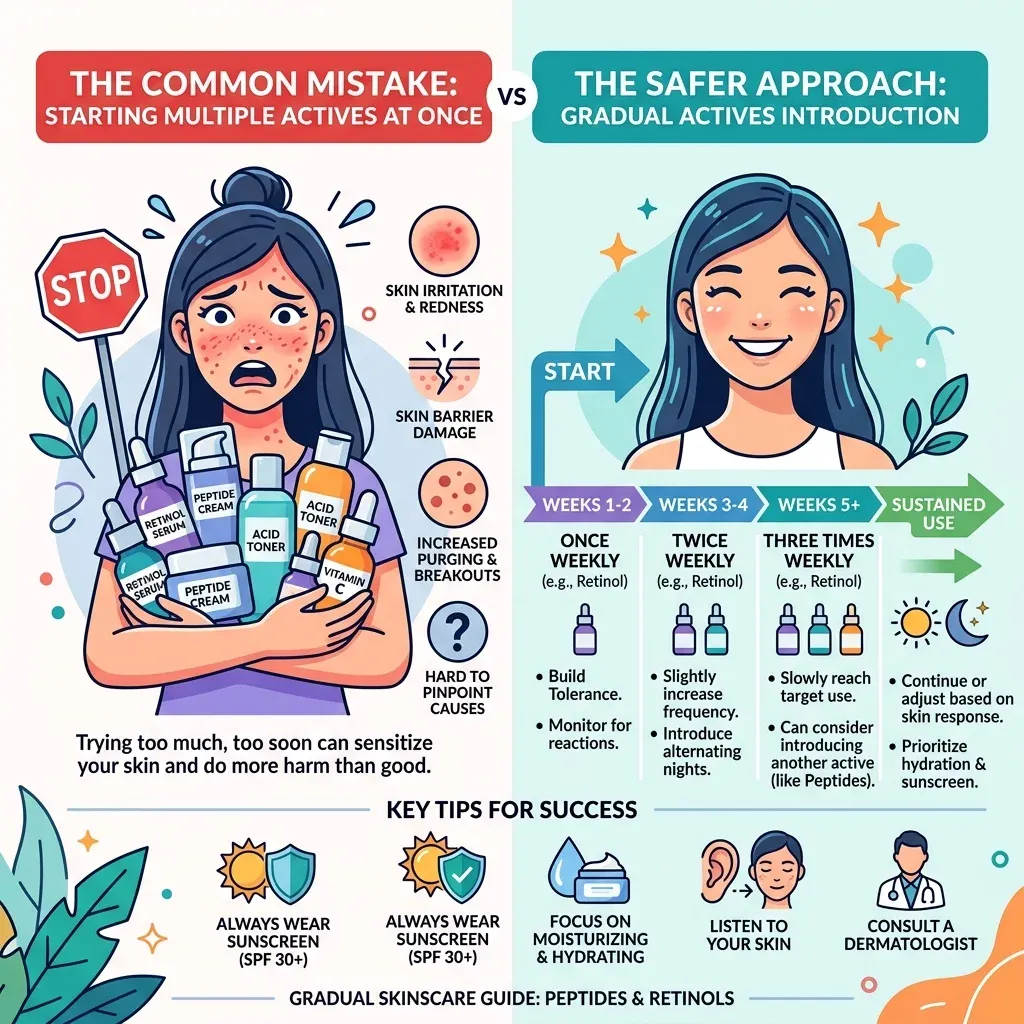
CeraVe recommends a gradual retinol schedule: once weekly for one week, twice weekly for two weeks, three times weekly for three weeks, then every second night only if there are no side effects. City Skin Clinic gives similar advice, suggesting low strength and low frequency, often two to three evenings per week, before increasing.
That schedule is not timid. It is how you keep using the product long enough for it to matter. Retinoids work through repeated exposure over time, not through one heroic night of maximum irritation Westlake Dermatology. The routine that looks weaker on paper often wins because your skin will actually tolerate it.
Most over-layering starts with a reasonable thought: if retinol renews and peptides repair, why not use both every night? The flaw is assuming your skin barrier has unlimited bandwidth. It does not. If you are already using retinol, exfoliating acids, vitamin C, and a fragrance-heavy moisturizer, adding peptides may be less of a missing puzzle piece and more of one more tab open in an overloaded browser.
The chart above comes from the same review that found the retinoid-plus-peptide group had the highest wrinkle-improvement rate CME Journal Geriatric Medicine. It is tempting to read that as "more is better." The better read is "smart combinations can help, but the skin still gets a vote."
How to Layer Them Without Overdoing It
Start with timing, not product order. If you are new to retinol, use peptides in the morning or on evenings when you are not using retinoids City Skin Clinic. If the peptide is a copper peptide, keep that separation as your default because Art of Skin Care specifically recommends copper peptides in the morning or on recovery nights, with retinol at night Art of Skin Care.
If your skin is already comfortable with retinoids, non-copper peptides can usually be layered more closely. City Skin Clinic's practical order is retinoid first, then peptides, once tolerance is established City Skin Clinic. That makes sense if your retinoid is the active you want to land cleanly on dry skin, while the peptide product functions as a hydrating support layer.
Buffering is the other tool. The retinol sandwich method places moisturizer before and after retinol to reduce irritation Westlake Dermatology. An ex vivo human-skin study presented at AAD tested 0.1% retinol and 0.025% tretinoin; open sandwiching preserved bioactivity, while full sandwiching reduced bioactivity about threefold. In plain English: one moisturizer layer may cushion without turning the retinoid off, while a full sandwich can intentionally soften the effect for reactive skin.
| Your situation | Safer routine | Why |
|---|---|---|
| New to retinol | Peptides AM, retinol PM on limited nights | Builds tolerance before stacking actives source |
| Using copper peptides | Copper peptides on recovery nights or mornings | Avoids same-application stability concerns source |
| Retinol-tolerant skin | Retinoid first, non-copper peptide after | Lets the corrective active lead, then supports comfort source |
| Dry or reactive skin | Open sandwich or full sandwich | Buffers irritation; full sandwich may reduce potency about threefold source |
Keep the moisturizer boring. Westlake Dermatology recommends avoiding moisturizers that add exfoliating acids, strong vitamin C, benzoyl peroxide, extra retinoids, fragrance, essential oils, and drying alcohols when you are buffering retinol Westlake Dermatology. This is one of those places where plain is elegant.
A useful test: if the product that comes after your retinol has its own "active complex," save it for a different night. The retinol night job is renewal plus comfort, not renewal plus every marketing promise on the shelf. A simple peptide cream may help; a peptide product with acids, perfume, and a second retinoid is just more pressure.
When to Separate Them
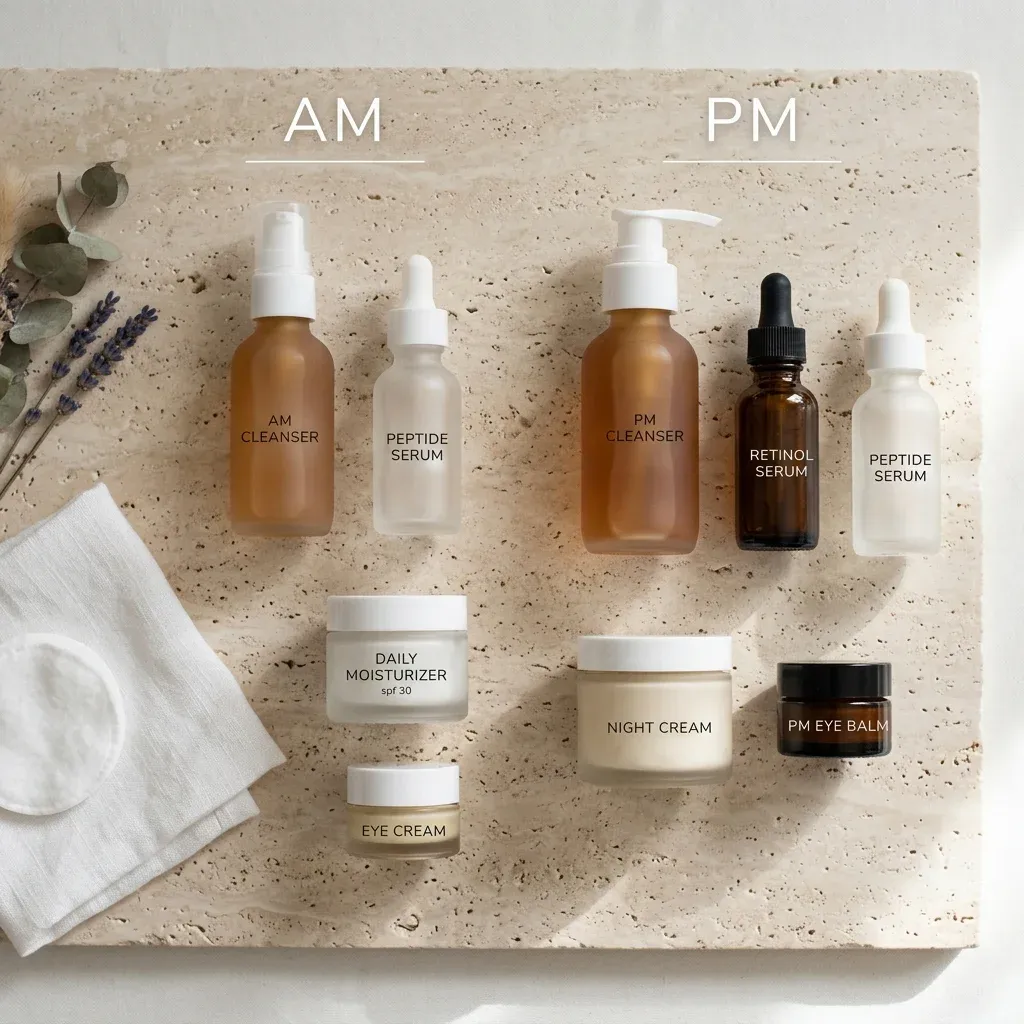
Separate them when the peptide is copper-based, when the retinol is new or strong, when your skin is irritated, or when the rest of the routine already contains strong actives. Separation is not a punishment; it is a way to keep both products useful.
Retinol belongs at night for most people. CeraVe advises against morning retinol use and emphasizes daily sunscreen because retinol can increase sun sensitivity CeraVe Australia. The same guide separates vitamin C and retinol by timing, using vitamin C in the morning and retinol at night CeraVe Australia. Art of Skin Care gives a similar timing logic for copper peptides and vitamin C because copper can increase oxidation of certain vitamin C forms Art of Skin Care.
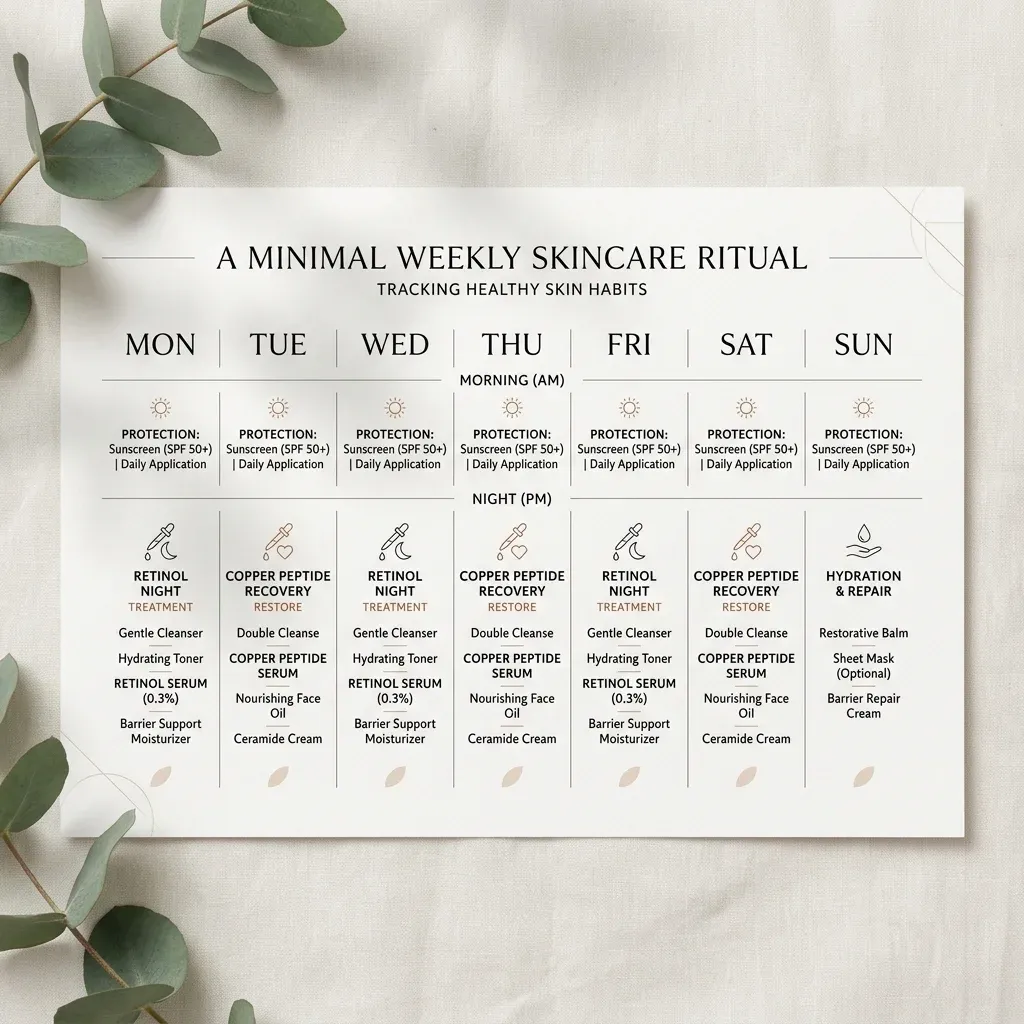
The easiest weekly plan is not fancy. Use retinol on your retinoid nights. Use copper peptides on the off nights or in the morning. Use a non-copper peptide moisturizer whenever it keeps the barrier comfortable and does not add more active stress.
If you want a simple rhythm, think in lanes. The morning lane is protection and light support: cleanser if needed, peptide or vitamin C if tolerated, moisturizer, sunscreen. The evening lane is correction: retinol on planned nights, moisturizer support, and no extra drama. Recovery nights are where copper peptides can make the most sense because the skin is not also being asked to speed turnover.
- Separate copper peptides and retinol by time of day or by alternating nights.
- Separate retinol from exfoliating acids until your skin is stable.
- Separate new products by at least a few uses so you know what caused irritation.
- Separate retinol from morning routines unless your clinician gives different instructions.
If your routine feels like a puzzle, remove pieces. Skin care should not require you to remember a dozen chemical conflicts before bed.
The boring version is usually the more advanced version. Once the routine is calm for several weeks, you can decide whether closer layering adds anything. If the answer is unclear, the separation plan is already doing its job.
Who Should Be Extra Careful
People with dry, sensitive, reactive, or barrier-compromised skin should be slowest to stack actives. Westlake Dermatology notes that moisturizer buffering can help retinoid beginners, dry skin, reactive skin, and people starting or increasing prescription-strength products Westlake Dermatology. City Skin Clinic also describes peptides as generally well tolerated but still advises cautious introduction for sensitive or reactive skin City Skin Clinic.
The best clinical evidence in this NotebookLM run came from combination formulas, not random same-night layering. Shikha Rao and David Goldberg studied a cream containing 0.2% pure retinol, 2.5% tripeptide concentrate, and 5.0% glaucine complex in 20 subjects for three months. All subjects completed the study, and the authors reported clinical and histologic improvement without excess transepidermal-water-loss effects Journal of Cosmetic Dermatology.
A separate Journal of Drugs in Dermatology trial tested a 0.1% retinaldehyde formula with peptides in 32 female subjects, used three nights weekly for eight weeks. The study reported 12% improvement in fine lines, 19% improvement in hyperpigmentation, and 20% improvement in pores, with no patch-test sensitization or irritation.
That distinction matters. A lab-designed formula is not the same as mixing two unrelated bottles on your hand. Formulators can tune pH, delivery, stabilizers, and concentrations. Consumers can mostly tune timing, frequency, and restraint.
People with rosacea-prone, eczema-prone, post-procedure, or recently over-exfoliated skin should be especially skeptical of same-night layering. The Art of Skin Care guide describes copper peptides as useful for sensitive, compromised, menopausal, and post-procedure skin, but that is support logic, not a license to pair them with a strong retinoid during a flare Art of Skin Care.
The practical rule is simple: if your skin is calm, proceed slowly; if your skin is angry, stop negotiating with it. A comfortable routine you repeat for months beats an impressive routine you abandon after a burning week.
Frequently Asked Questions
Can I use peptide serum after retinol?
Usually yes if it is a non-copper peptide and your skin already tolerates retinol. City Skin Clinic suggests that once skin adjusts, most people can layer retinoids first and peptides after City Skin Clinic. If the peptide is copper-based, separate it from retinol.
Should copper peptides and retinol be used on the same night?
It is cleaner to separate them. Art of Skin Care recommends copper peptides in the morning or on recovery nights and retinol at night because copper can reduce retinol stability Art of Skin Care.
What should I do if my skin burns after layering them?
Stop the active stack and go back to a bland cleanser, moisturizer, and sunscreen until the stinging settles. Retinoid irritation often means the frequency, strength, or number of products is too high for the barrier right now CeraVe Australia.
Is a peptide cream better than a peptide serum with retinol?
For sensitive skin, a peptide cream may be easier because it can support moisture while adding fewer layers. For retinol-tolerant skin, a lightweight peptide serum can work, but the product type matters less than whether the formula is non-irritating and not copper-based.
Medical Disclaimer
This article is for informational and educational purposes only and is not medical advice, diagnosis, or treatment. Always consult a licensed physician or qualified healthcare professional regarding any medical concerns. Never ignore professional medical advice or delay seeking care because of something you read on this site. If you think you have a medical emergency, call 911 immediately.