
What Crow's Feet Actually Need From a Formula
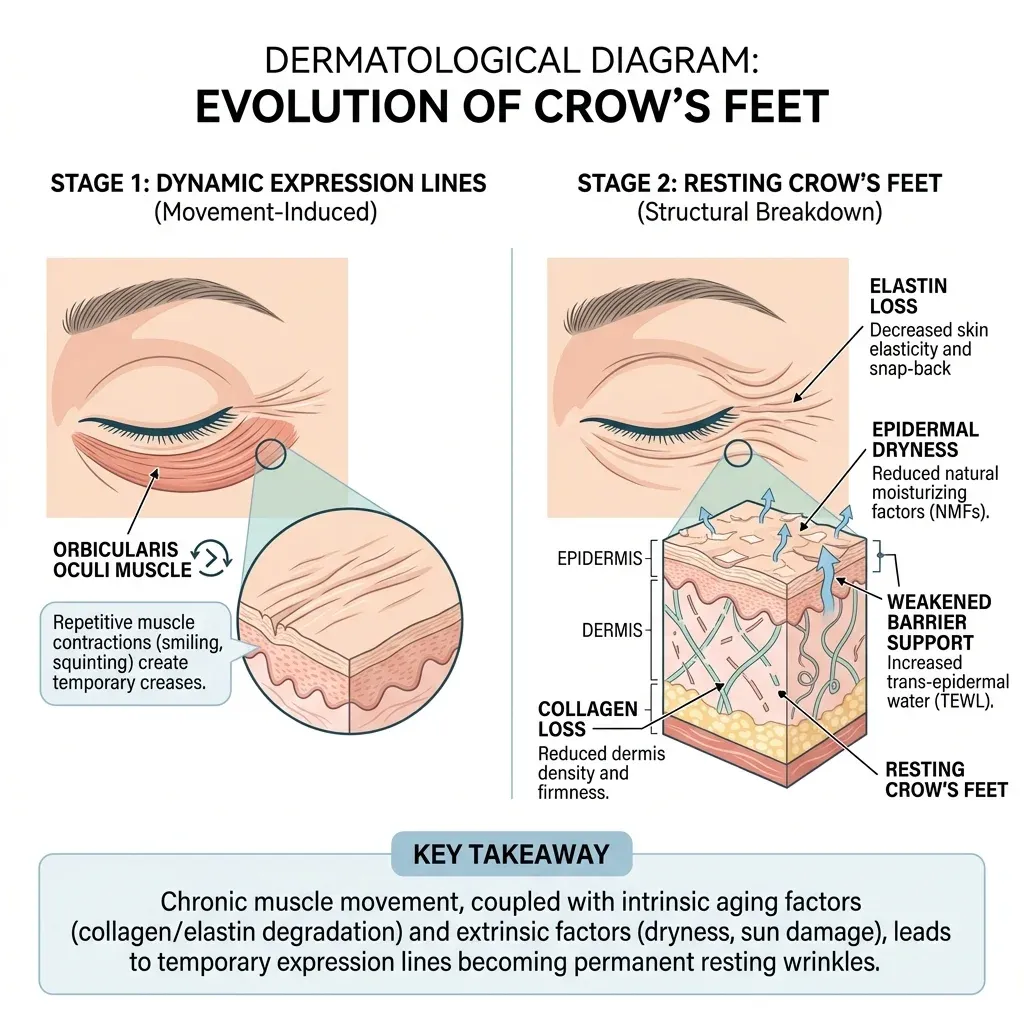
The problem with crow's feet is that they are not one problem. Cleveland Clinic describes them as lateral canthal lines: the small wrinkles at the outer corners of the eyes that usually show up first when you smile and can later become visible even at rest as facial expression lines mature into resting lines.
That makes the eye area a bad place for one-note skincare. Repeated squinting and smiling create dynamic creases, while collagen and elastin decline make the skin less springy over time according to Cleveland Clinic's overview of causes. Zhu and colleagues describe the same split between dynamic wrinkles from muscle contraction and static wrinkles that persist as collagen and elastin decline in their cosmetic-science paper.
Think of crow's feet like a folded piece of silk. At first, the fold only appears when you pinch the fabric. After enough folding, and after the fibers lose some bounce, the crease stays. A useful eye formula has to soften the fold, hydrate the fabric, and avoid irritating the thin area around it.
That is why peptide eye creams can beat prestige serums in real life. A serum may carry a high concentration of actives, but a cream is built to cushion and seal. Dr. Sabrina Shah-Desai's eye cream versus serum guide describes eye creams as richer formulas that create a protective hydrating layer, while serums absorb quickly and leave less residue on the surface in her formulation comparison.
The best crow's-feet product is not always the strongest bottle. It is the formula that treats expression lines, dryness, barrier comfort, and tolerability at the same time.
Practical takeaway: if your crow's feet look sharper when your skin is dry, tight, or irritated, a peptide eye cream has an advantage before the peptide even gets to work. The base matters.
Why Peptides Fit the Eye Area Better Than Prestige Serums
Peptides are often sold as collagen fairy dust. The more useful definition is quieter: they are short amino-acid chains that can act as cell messengers. Dr. Sarah Sheu, a Stanford-trained dermatologist, explains that some skincare peptides tell skin cells to make more collagen and elastin, while others carry minerals or interfere with muscle-contraction signals in a dermatologist review of peptide evidence.
That messenger role is the reason peptides make sense around crow's feet. A systematic review in Frontiers in Medicine describes peptide-based therapies as agents that can support collagen synthesis and extracellular matrix integrity while reviewing randomized trials in skin aging. In plain English, peptides are more like text messages than bricks: the goal is not to paste collagen into the skin, but to nudge repair behavior.
The catch is delivery. Palmitoyl peptides are designed with a fatty-acid tail that can help them move through the skin barrier, a detail Dr. Sheu uses to distinguish Matrixyl-type peptides from larger, less mobile molecules in her discussion of palmitoyl peptide structure. The Cosmetic Ingredient Review draft for pentapeptide ingredients also treats penetration and degradation data as a relevant safety and evaluation issue in its draft report.
This is where the cream-versus-serum fight gets interesting. Serums are often better at quick delivery. Eye creams are often better at making the eye area tolerate the routine long enough for the actives to matter. A thin serum is like sending a courier through town with one package. A cream is more like sending the courier with a coat, a map, and a place to leave the package safely.
The Botox comparison deserves a hard stop. Acetyl hexapeptide-8 is often marketed as Botox-like because it is aimed at nerve-to-muscle signaling, but Dr. Sheu points out that Botox is injected directly near the muscle while a topical has to cross the epidermis, basement membrane, dermis, subcutaneous fat, and then reach muscle around the eye before it could plausibly affect contraction. Zhu and colleagues also describe acetyl hexapeptide-8 as having a mechanism similar to botulinum toxin, but they studied it as part of a topical cosmetic formula, not as an injection substitute in the International Journal of Cosmetic Science.
Practical takeaway: use peptide eye creams for incremental softening, smoother texture, and better comfort. Do not buy one because the label whispers "Botox."
| Formula type | Where it shines | Where it can disappoint |
|---|---|---|
| Peptide eye cream | Hydration, barrier support, fine-line comfort, lower-irritation routines | May deliver actives more slowly than a serum |
| Peptide serum | Lightweight delivery of concentrated actives | May not seal moisture well enough for dry eye-area skin |
| Retinoid eye product | Long-game collagen and texture support | Can be harder to tolerate near the eyes |
The Supporting Ingredients That Make Eye Creams Work Harder
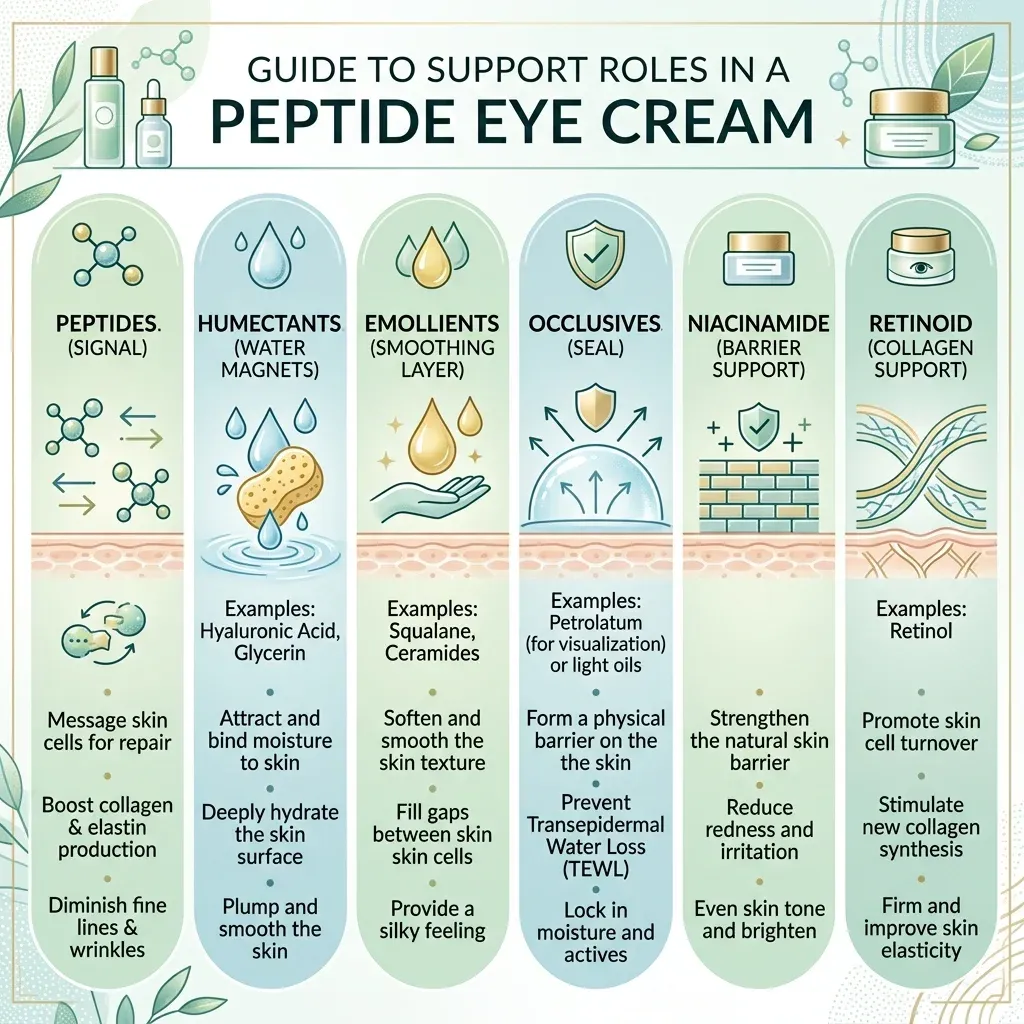
A good peptide eye cream usually wins by committee. Peptides may carry the signal, but emollients, humectants, occlusives, niacinamide, retinoids, antioxidants, and sunscreen habits decide whether the eye area can stay calm enough to benefit.
Dr. Shah-Desai's guide says eye creams commonly use emollients to smooth, humectants to attract moisture, and occlusives to seal hydration in the richer cream base. That sounds basic until you remember what aging skin is losing. A comparative antiwrinkle paper notes that young skin has abundant collagen, elastic fibers, and glycosaminoglycans such as hyaluronic acid, while aging brings reduced collagen, lower glycosaminoglycans, dryness, and rougher texture in its background on intrinsic aging.
The strongest example of "supporting cast" skincare is a randomized trial comparing a cosmetic regimen with prescription tretinoin. J.J. Fu, G.G. Hillebrand, P. Raleigh, and J. Li studied 196 women with moderate to moderately severe periorbital wrinkles in an 8-week randomized parallel-group study. The cosmetic side used SPF 30 moisturizer with 5% niacinamide, peptides, and antioxidants, a moisturizing cream with niacinamide and peptides, and a targeted wrinkle product with 0.3% retinyl propionate against 0.02% tretinoin plus moisturizing sunscreen.
The surprising part: the cosmetic regimen improved wrinkle appearance after 8 weeks relative to tretinoin and was better tolerated through 8 weeks by all measures in the trial results. That does not mean every cosmetic cream beats every prescription. It means a well-designed, multi-step, barrier-conscious regimen can compete better than shoppers expect.
Think of peptides as the instruction note on a repair order. Niacinamide, moisturizers, retinoid derivatives, antioxidants, and sunscreen are the crew, the tools, and the weather protection. Without them, the note can be perfectly written and still not change the wall.
Practical takeaway: choose an eye cream that supports the peptide with hydration and barrier ingredients. A peptide name on the front of the jar is not enough.
What Clinical Studies Actually Show
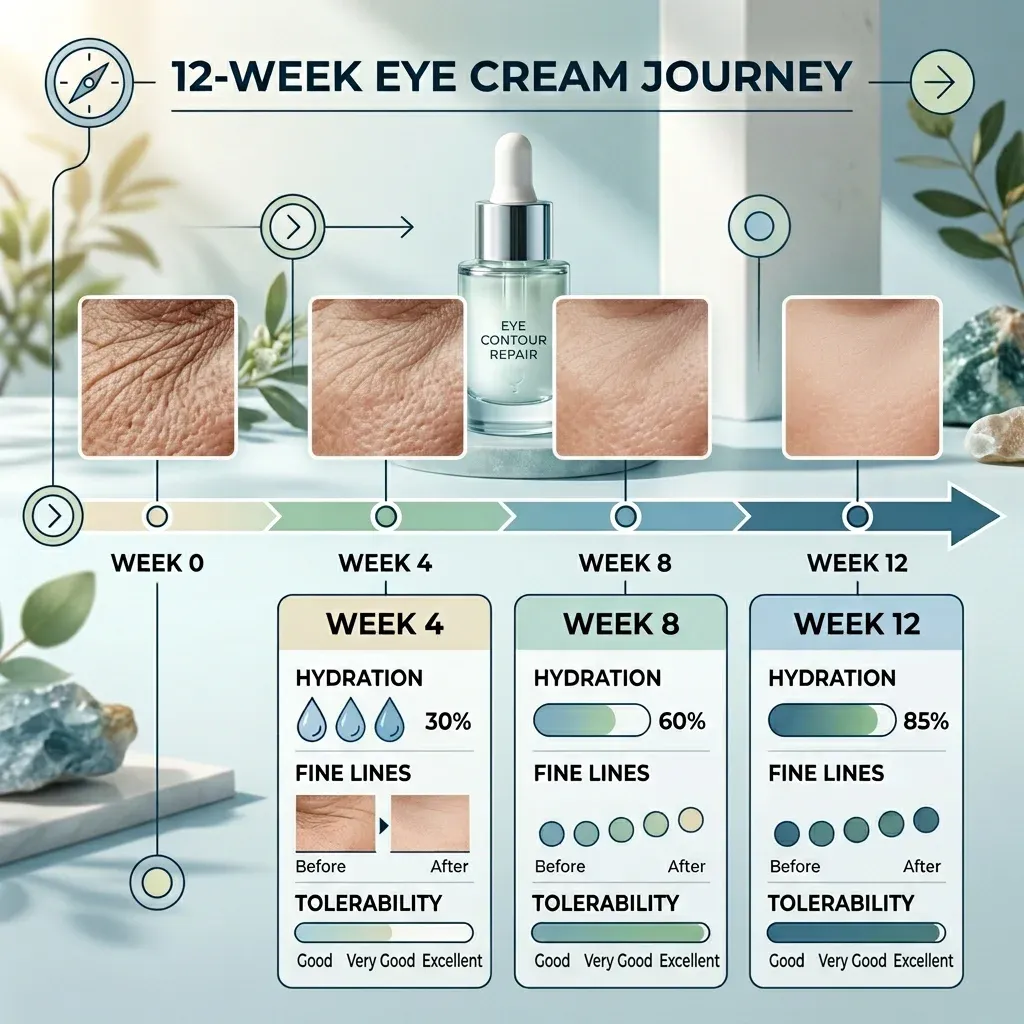
The evidence is real enough to take seriously and limited enough to keep your expectations sane. The best clinical story is not "peptides erase crow's feet." It is "some peptide-containing formulas produce measurable changes, often modest, over weeks to months."
Zhu and colleagues tested a serum containing acetyl hexapeptide-8, dipeptide diaminobutyroyl benzylamide diacetate, gluconolactone, niacinamide, and laminaria extract through one ex-vivo study and two clinical studies in an open-access cosmetic-science article. Clinical study 1 included 50 participants and clinical study 2 included 42 participants according to the methods summary. After 12 weeks, static wrinkle clinical scoring improved by 35% to 69% across wrinkle types, and dynamic wrinkle scores improved by 10% to 13% in the reported clinical results.
A separate Tetrapeptide-68 cream study followed 25 women aged 40 to 60 for 12 weeks in a randomized double-blind placebo-controlled trial. The test group showed larger improvements than control on 3D wrinkle measures: Rz changed -7.40 +/- 9.53 versus -0.98 +/- 5.71, and Ra changed -1.68 +/- 2.06 versus -0.24 +/- 1.40 after 12 weeks in the Primos Lite analysis. The same trial reported no skin adverse reactions during the study in its safety evaluation.
The crow's-feet-specific trial by Indonesian dermatology researchers is smaller, but useful. It randomized 21 women aged 26 to 55 for 8 weeks to acetylhexapeptide-3 cream, palmitoyl pentapeptide-4 cream, or placebo in a double-blind study. Crow's-feet grading fell by 0.86 points static and 0.57 dynamic in the acetylhexapeptide-3 group, while palmitoyl pentapeptide-4 fell by 0.86 points for both static and dynamic scores by week 8. The study also reported no serious adverse events and no complaints in the palmitoyl pentapeptide-4 group in its tolerability results.
| Study | Formula tested | Best practical read |
|---|---|---|
| Zhu et al. | Multi-active peptide serum | Peptide blends can move static and dynamic wrinkle scores, but the tested product was a full formula. |
| Tetrapeptide-68 trial | O/W cream around the eyes | A cream base can carry a peptide into a measurable periorbital wrinkle study. |
| Indonesian crow's-feet trial | AHP-3 and PPP-4 creams | Small, direct crow's-feet data favors peptide creams, especially PPP-4, but the sample was tiny. |
The broader peptide picture is more cautious. A systematic review/meta-analysis looked at 19 randomized trials with 1,341 participants and found peptide benefits for skin aging outcomes, with oral peptide effects driving more of the wrinkle signal than topical peptide effects in the pooled review. That does not cancel the topical studies. It puts them in perspective.
The honest read is useful because it saves you from both extremes. The data is too good to dismiss peptides as label fluff, but too uneven to treat them as a guaranteed wrinkle eraser. The cream format earns its keep when the active blend, the moisturizing base, and the way you use it all point in the same direction.
Practical takeaway: expect visible smoothing and comfort if the formula suits your skin. Do not expect an eye cream to behave like a procedure, and do not judge it after a few nights.
When an Expensive Serum Still Makes Sense
The argument is not that expensive serums are useless. The argument is that price does not automatically buy a better crow's-feet result.
Dr. Sheu's review makes the value question concrete. She notes that familiar peptides such as acetyl hexapeptide-8, Matrixyl-type peptides, SYN-AKE-style peptides, and copper peptide can appear in budget formulas, while many multi-peptide products do not disclose the exact amount of each peptide in her product-evidence discussion. That matters because a label can list the right peptide without telling you whether the formula resembles the one used in a study.
The luxury case is strongest when the final product itself has clinical testing. In Dr. Sheu's example, a high-end peptide serum had data from a 12-week study of more than 100 women, including a split-face group of about 40 women, and reported about 20% fine-line reduction for that specific product. That is more meaningful than simply borrowing data from an ingredient supplier.
Still, about 20% is not magic under bathroom lighting. A small reduction measured with imaging can be worth paying for if you love the texture, tolerate it well, and want that exact tested formula. But if your outer-eye skin is dry, flaky, or retinoid-sensitive, a well-built peptide eye cream may give you the smoother look you wanted from the serum by solving the boring moisture problem first.
| Buy the serum when... | Buy the eye cream when... |
|---|---|
| The exact final product has published or disclosed testing. | Your eye area looks crepey because it is dry or easily irritated. |
| You already use a separate moisturizer and sunscreen consistently. | You want peptides plus barrier support in one step. |
| You prefer featherweight texture under makeup. | You need cushioning at night or during retinoid breaks. |
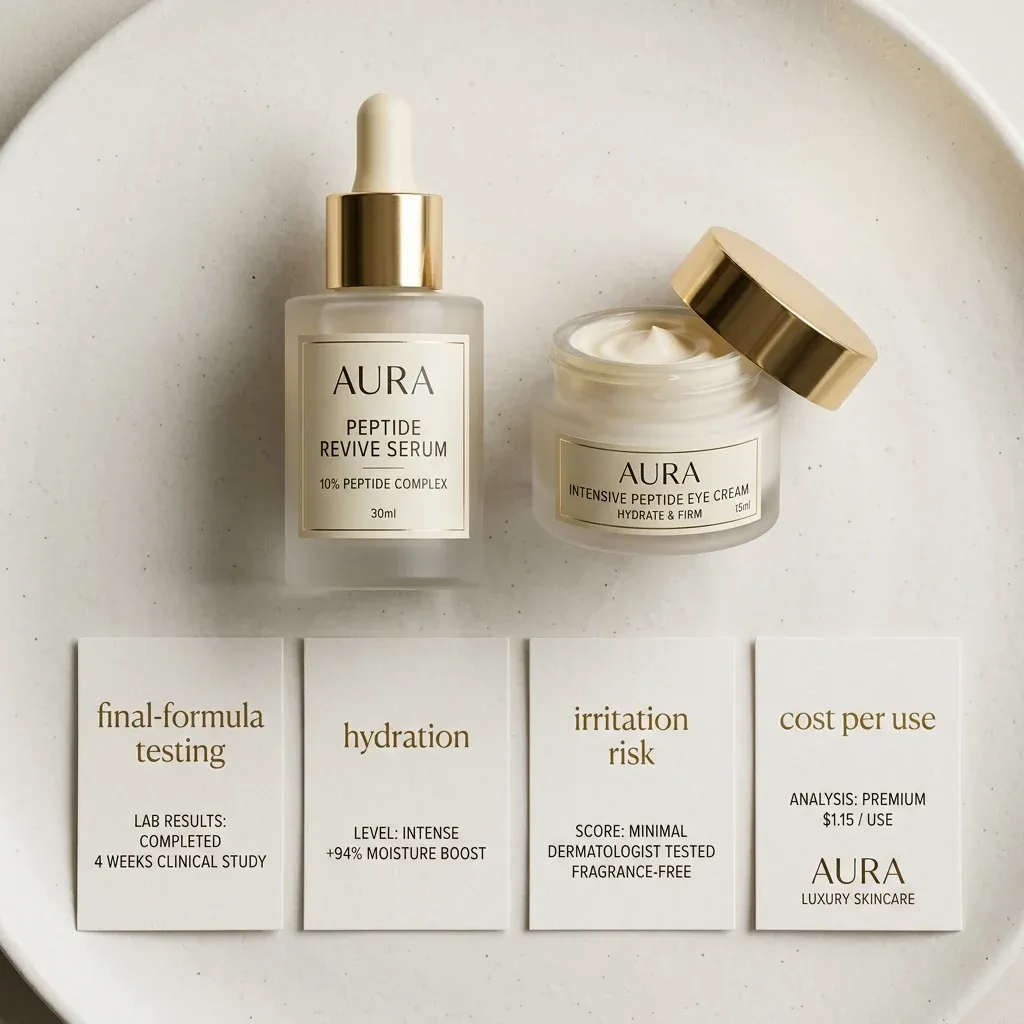
Practical takeaway: if you are paying luxury prices, pay for final-formula testing, not a fancy peptide name. If you are buying for crow's feet specifically, comfort and consistency often beat intensity.
How to Choose and Use a Peptide Eye Cream
Start with the base, then read the peptide list. For dry or aging skin, Dr. Shah-Desai's guide favors richer eye creams because they stay on the surface longer and are better suited to moisturizing fine-line-prone skin in her dry-skin guidance. For oily or combination skin, the same guide says a lightweight eye serum may be more comfortable in its skin-type section.
Then look for a formula that names its support actives. Peptides plus niacinamide, a gentle retinoid or retinoid alternative, hyaluronic acid, ceramides, antioxidants, or sunscreen-friendly morning use is more persuasive than a jar that only says "advanced peptide complex." The Fu trial matters here because the better-tolerated cosmetic regimen was not peptide-only; it combined peptides with 5% niacinamide, antioxidants, moisturizers, SPF 30, and 0.3% retinyl propionate in a structured regimen.
Safety still deserves attention. The Cosmetic Ingredient Review draft for pentapeptide ingredients listed data needs around irritation/sensitization and penetration/degradation, and it reported 0.012% as the highest reported leave-on concentration of use for Palmitoyl Pentapeptide-4 in face and neck preparations in the draft safety assessment. That is not a panic signal. It is a reminder that cosmetic peptides are formula-dependent ingredients, not automatic green lights for every sensitive eyelid.
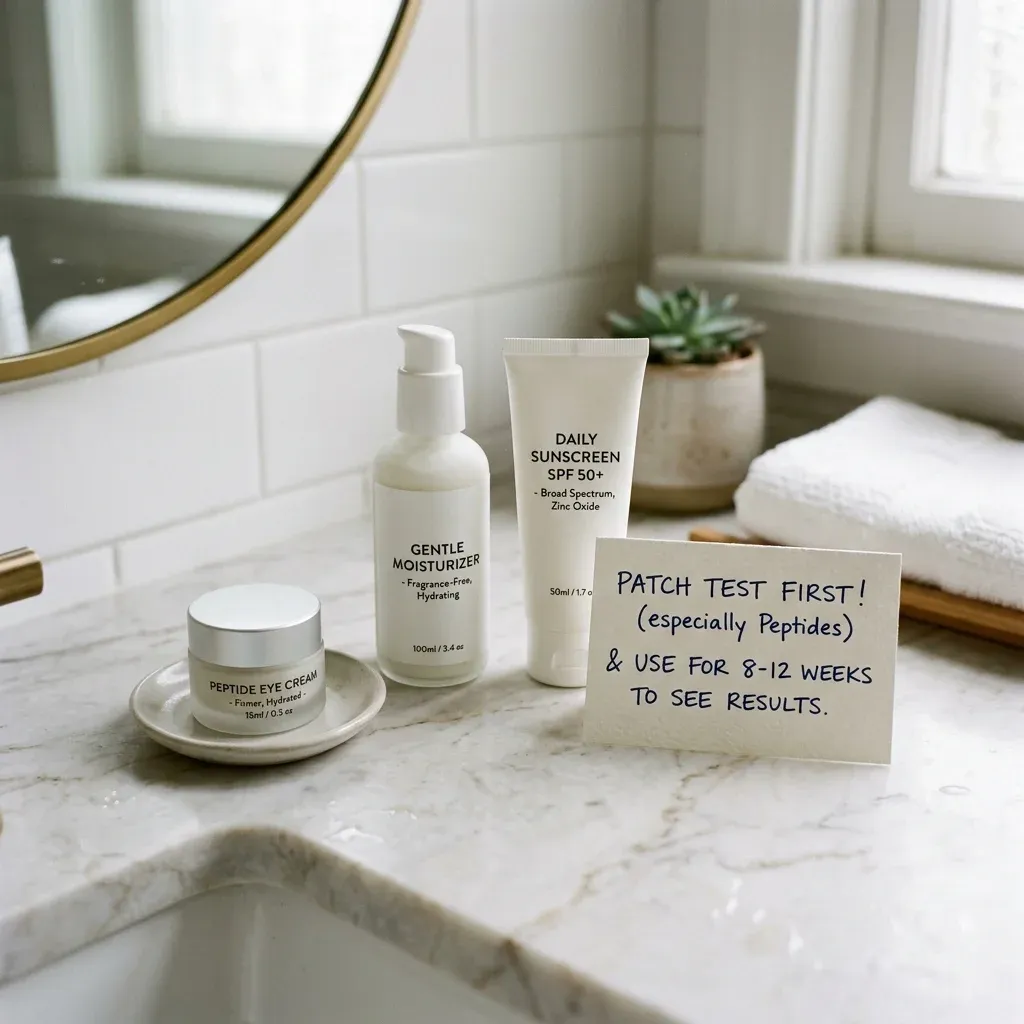
Use it simply: a rice-grain amount for both eyes, tapped around the orbital bone, after watery serums and before heavier face cream. Give it 8 to 12 weeks before judging wrinkle changes, because the crow's-feet trials that showed measurable changes generally measured outcomes over those time frames in the 8-week AHP-3/PPP-4 study and in the 12-week Tetrapeptide-68 study.
Do not skip sunscreen. Cleveland Clinic says sunscreen habits affect crow's-feet development and that sunscreen plus some facial moisturizers may help prevent them, even though aging itself is unavoidable in its prevention guidance.
Practical takeaway: buy the eye cream you will use every night without stinging, pilling, or making your eyes water. The most evidence-backed formula fails if it sits untouched because it feels awful.
Frequently Asked Questions
Are peptide eye creams better than peptide serums for crow's feet?
Often, yes, if dryness and sensitivity are part of the problem. Serums can deliver concentrated actives quickly, but creams are better at sealing hydration and cushioning the thin eye area according to the eye cream versus serum comparison.
How long does a peptide eye cream take to work?
Give it at least 8 to 12 weeks before judging fine-line changes. Direct crow's-feet and periorbital peptide trials measured outcomes at 8 weeks in the AHP-3/PPP-4 study and at 12 weeks in the Tetrapeptide-68 cream study.
Can peptide eye cream replace Botox?
No. Topical acetyl hexapeptide-8 may slightly soften expression lines, but it has to cross skin layers before reaching muscle, while botulinum toxin is injected near the target muscle as Dr. Sarah Sheu explains.
Should I use retinol with peptides around my eyes?
It can make sense if your skin tolerates it. A cosmetic regimen that combined peptides, niacinamide, antioxidants, moisturizers, sunscreen, and 0.3% retinyl propionate performed well against tretinoin in women with periorbital wrinkles in an 8-week trial.
What should I avoid in a peptide eye cream?
Avoid buying on peptide names alone. Exact concentrations are often unclear, and the eye area is sensitive, so prioritize a formula with barrier support, tolerability, and realistic claims rather than "Botox in a jar" marketing.
Medical Disclaimer
This article is for informational and educational purposes only and is not medical advice, diagnosis, or treatment. Always consult a licensed physician or qualified healthcare professional regarding any medical concerns. Never ignore professional medical advice or delay seeking care because of something you read on this site. If you think you have a medical emergency, call 911 immediately.