What Argireline Is and Why It Gets Compared With Botox
Argireline is the skincare ingredient that gets dragged into the most flattering and least fair comparison in wrinkle care. Its technical name is acetyl hexapeptide-8, and a recent review in International Journal of Molecular Sciences describes it as a topical "botox-like" peptide used in anti-aging, scar, and skin-rejuvenation formulas. That label is not random. Argireline was designed to affect the machinery involved in expression lines, which is exactly why marketers love calling it "Botox in a bottle."
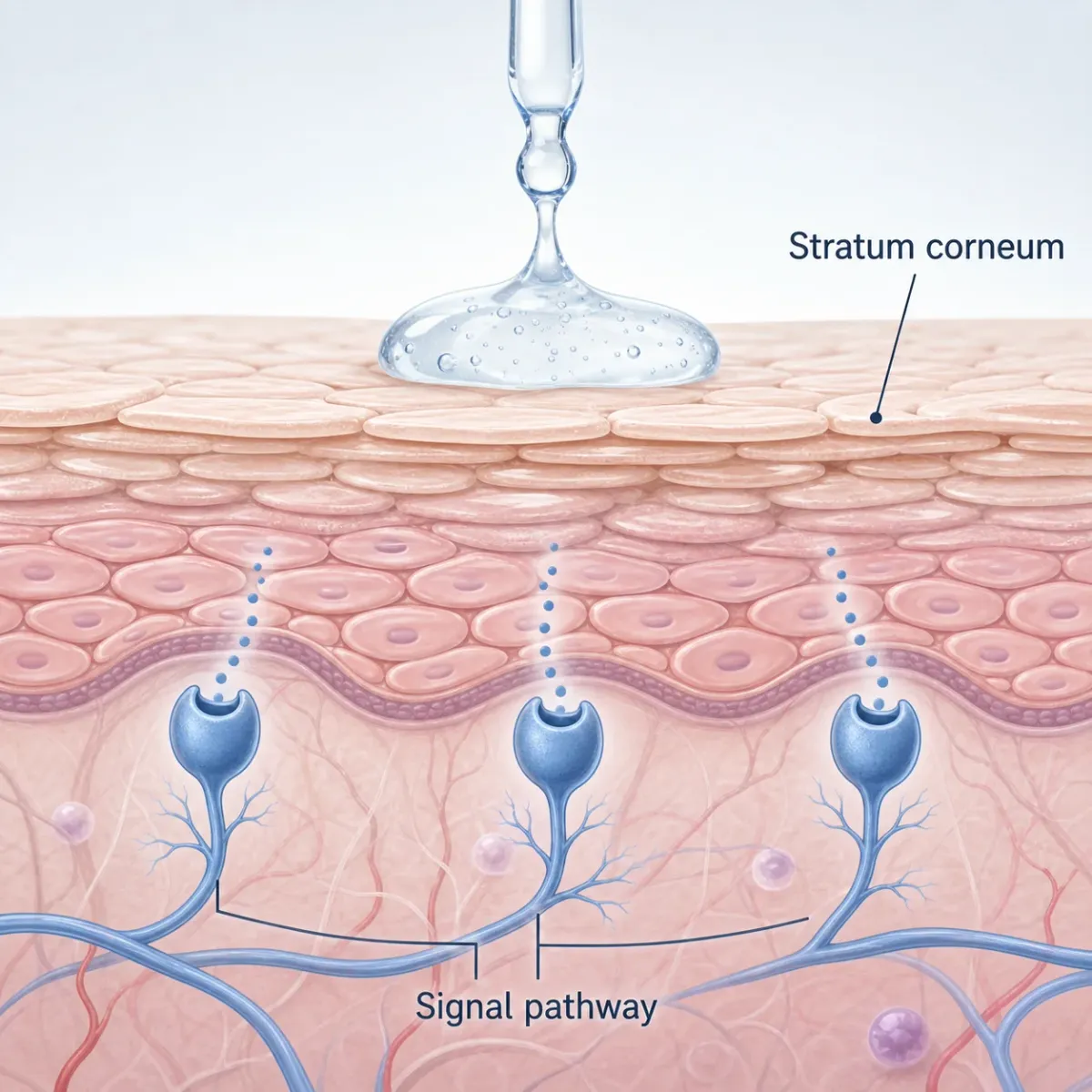
The mechanism is easier to picture if you imagine a delivery truck backing into a loading dock. For a nerve signal to make a facial muscle contract, the cell has to release neurotransmitters through a docking system called the SNARE complex. Blanes-Mira and colleagues reported that Argireline interferes with the formation or stability of that complex, while a Cosmetics Business technical overview says it mimics the N-terminal end of SNAP-25 and competes for a place in the SNARE complex. If that dock becomes unstable, the signal is weaker and the muscle contraction may be softened.
That mechanism explains why the ingredient attracts serious interest instead of being dismissed as another pretty serum name. It also explains why the comparison gets out of hand. Botox works because it is delivered past the outer barrier; Argireline has to negotiate the skin from the outside. The same idea can be clever in a lab and still be limited in a bathroom routine.
That is the theory. The real-world caveat is skin. Injected botulinum toxin is placed where it can act on the muscle pathway; a serum has to cross the outer skin barrier first. Zdrada-Nowak, Surgiel-Gemza, and Szatkowska note that acetyl hexapeptide-8 is hydrophilic and relatively large, which makes dermal delivery difficult when it is applied as a cosmetic product. In plain English: the ingredient may have a sensible target, but the route to that target is crowded, narrow, and not especially welcoming.
Short version: Argireline is a real peptide with a plausible wrinkle-softening mechanism. The bottle is not a syringe, and that difference matters.
What the Clinical Evidence Actually Shows
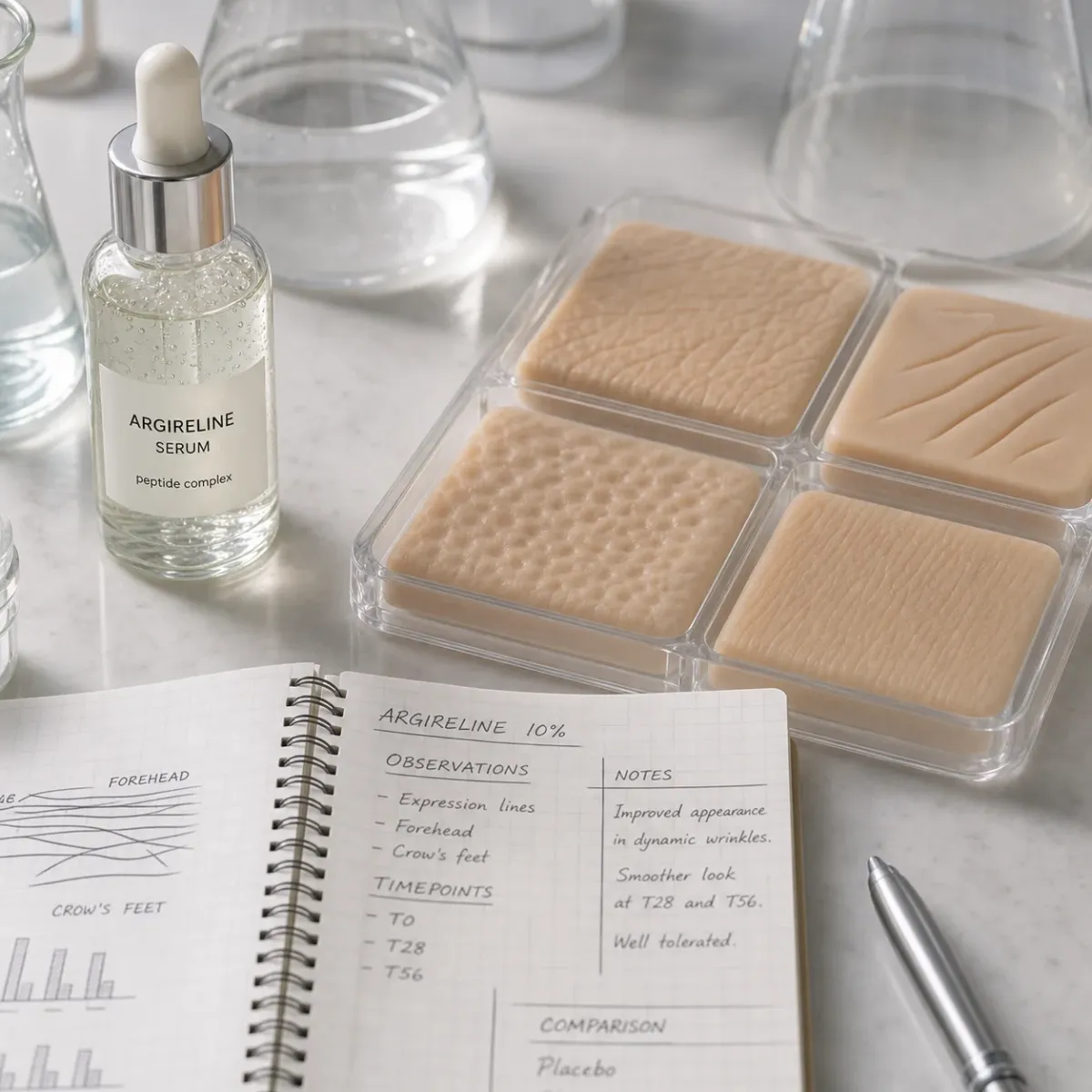
The best evidence does not say Argireline is fake. It says the effect is measurable, modest, and tied mostly to expression lines around the eyes. The foundational paper by C. Blanes-Mira and colleagues reported that an oil-in-water emulsion containing 10% Argireline reduced wrinkle depth by up to 30% after 30 days in healthy women. A ClinicalTrials.gov record for periorbital wrinkles describes the same basic use pattern: 10% topical Argireline applied twice daily to the lateral preorbital area for 30 days.
A separate trial by Yuan Wang, Mei Wang, Shengxiang Xiao, Ping Pan, Ping Li, and Jia Huo gives the evidence a cleaner placebo comparison. In that study, 60 subjects were randomized in a 3:1 ratio to Argireline or placebo and applied treatment twice daily for 4 weeks. The result was not dramatic, but it was not nothing: 48.9% total anti-wrinkle efficacy in the Argireline group compared with 0% in placebo, with objective roughness parameters decreasing in the Argireline group.
The broader literature points in the same direction. A review in the Journal of Drugs in Dermatology evaluated 10 human studies involving 312 subjects and reported decreases in wrinkle or scar prominence across those studies. It also found that all 4 studies looking at isolated acetyl hexapeptide-8 effects reported significant changes in wrinkle appearance. That is enough to take the ingredient seriously, though not enough to treat every serum label as equally proven.
Notice what the studies keep measuring: skin topography, peri-orbital lines, wrinkle replicas, and visible roughness. That is exactly where a topical cosmetic should be judged. The evidence is much less useful for deciding whether Argireline changes deep facial movement in the way an injection does, because the main clinical endpoints are about the surface result. That is not a flaw in the trials so much as a reminder to ask the right question before buying the product.
There is another quiet strength in the evidence: the better studies do not rely only on "my skin looks nicer" impressions. Wang's group used silicone replicas and wrinkle-analysis equipment, while the Blanes-Mira paper used skin topography analysis. Those methods still do not turn Argireline into an injectable treatment, but they make the visible wrinkle claims harder to wave away as pure placebo or wishful lighting.
| Evidence | What was tested | What it found |
|---|---|---|
| Blanes-Mira et al. | 10% emulsion for 30 days | Up to 30% wrinkle-depth reduction |
| Wang et al. | 60 subjects, twice daily for 4 weeks | 48.9% efficacy versus 0% placebo |
| JDD review | 10 human studies with 312 subjects | Wrinkle or scar prominence decreased across all reviewed studies |
The practical takeaway is refreshingly boring: Argireline is most reasonable for people dealing with early expression lines, especially around the eyes and forehead, who are willing to use it consistently. If the goal is to erase deep folds quickly, the studies above do not support that expectation.
Why Results Are Realistic, Not Injectable-Botox-Level
The biggest argument against the "Botox in a bottle" phrase is not that Argireline has no activity. It is that topical delivery is a completely different job. The CIR safety report lists acetyl hexapeptide-8 amide at a molecular weight of 889.1 Da, and the PMC review emphasizes that hydrophilic, high-molecular-weight peptides have trouble crossing the lipophilic stratum corneum. Think of the skin barrier like a bouncer checking both size and temperament at the door. Argireline is showing up with the wrong jacket and a bulky backpack.
The numbers are not kind to the deeper-muscle story. The review describes Kraeling and colleagues' human cadaver skin experiment in which 99.7% of the applied peptide was washed from the skin surface. Only 0.22% reached the human stratum corneum, and no peptide was detected in the dermis or receptor solution. That does not mean the ingredient cannot improve the look of skin. It does mean a serum should not be described as if it reliably reaches the same neuromuscular target as an injection.
Zdrada-Nowak and colleagues put the uncertainty plainly: acetyl hexapeptide-8 may reduce wrinkle depth, improve elasticity, and enhance hydration, but the ability of topical AH-8 to reach neuromuscular junctions remains uncertain. That distinction changes the whole conversation. A surface-level improvement can still be useful; it just should not be sold as facial-muscle paralysis in a dropper bottle.
This is also where hydration can confuse the story. A product that improves the look of fine lines may be doing several things at once: softening the surface, helping the barrier hold water, and giving the skin a smoother optical finish. The PMC review explicitly leaves room for these upper-layer effects. If the mirror shows a small improvement, that improvement is still real to the person using the serum. It just may not come from the glamorous mechanism printed on the marketing page.
That nuance is useful when reading product claims. "Botox-like" can describe the target pathway in a simplified way, but it should not be allowed to imply equivalent delivery, strength, or speed. A topical peptide that makes fine lines look less etched is still doing something. The mistake is expecting it to behave like a medical procedure because the marketing borrowed the same vocabulary.
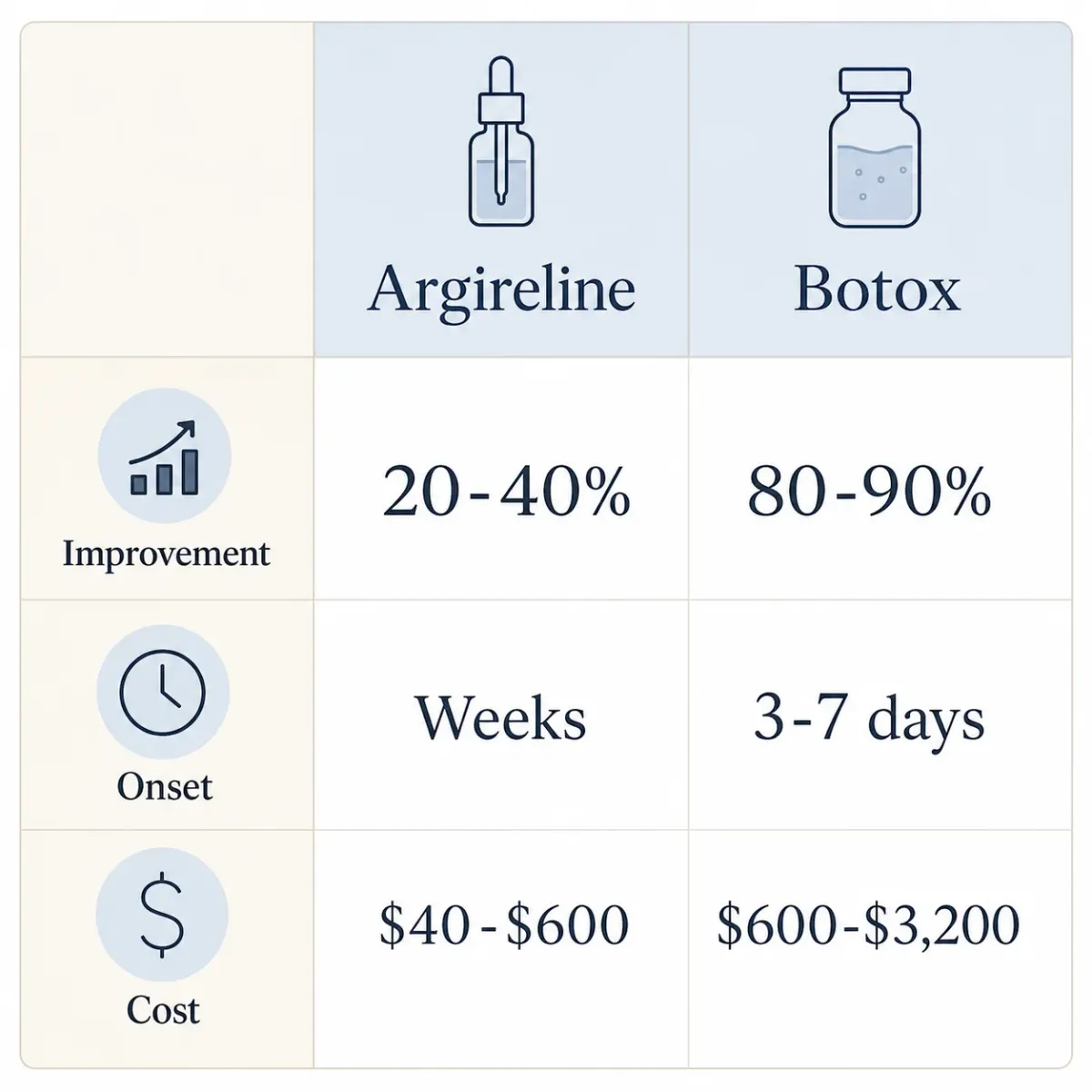
That chart uses a lower-tier consumer-facing comparison, so it should be read as a practical estimate rather than a clinical endpoint. Green Relief Health describes topical alternatives as producing 20-40% improvement, while injectable Botox produces 80-90% wrinkle reduction lasting 3-6 months. The same source estimates yearly topical costs at $40-$600 versus $600-$3,200 for injections. The useful comparison is not "which one wins?" It is "what level of change are you paying for?"
| Question | Topical Argireline | Injectable Botox |
|---|---|---|
| Expected result | 20-40% improvement | 80-90% wrinkle reduction |
| Typical timing | Weeks of steady use, based on trials lasting 4 weeks or 30 days | 3-7 days in the consumer comparison |
| Best fit | Early expression lines and maintenance | More dramatic temporary muscle relaxation |
For readers, the practical point is simple: buy Argireline for subtle softening, not for a non-invasive copy of an injection. That mindset protects you from both disappointment and the temptation to overuse a product because the first week did not look dramatic.
How to Use Argireline Without Wasting the Serum
Because delivery is the weak link, the formula matters as much as the star ingredient. CIR summarizes permeation data showing that a multiple water-in-oil-in-water emulsion delivered 755 +/- 149 ng/cm2 after 8 hours, compared with 456 +/- 120 ng/cm2 from an oil-in-water emulsion, while water-in-oil was undetectable. The PMC review makes the same general point: oil-in-water and multiple water-in-oil-in-water systems have been explored because AH-8 needs help crossing the barrier.
That does not mean a shopper can reverse-engineer every emulsion from a label. It does mean the bland details matter: product base, stability, and where the serum sits in your routine. Guinama's technical sheet recommends formulating Argireline below 40 C and lists oxidizing substances, electrophiles, and tannins as incompatibilities. That is formulator information, not a home chemistry assignment, but it argues against mixing every active in your bathroom at once.
| Use decision | Evidence-based reason | Practical move |
|---|---|---|
| Target expression areas | Trials focused on periorbital or expression-line areas, including periorbital wrinkles | Apply to crow's feet, forehead movement lines, or the "11" area rather than treating it like a whole-face moisturizer |
| Use consistently | Human trials used repeated application for 4 weeks or 30 days | Judge it after a month, not after a weekend |
| Avoid aggressive layering | Guinama lists incompatibilities with oxidizing substances, electrophiles, and tannins | Keep it away from harsh active cocktails unless the product maker specifically designed the combination |
A sensible routine would be restrained: cleanse, apply Argireline to the expression-line areas you actually care about, let it settle, then moisturize. If your product already combines several peptides, resist adding more just because social media made it sound more advanced. With this ingredient, more steps can easily become more irritation and not more results.
One more practical filter: favor products that explain their peptide system instead of just shouting a percentage. A good formula has to keep the peptide stable, compatible, and in a base that makes sense for skin. If the brand gives no context at all, the name "Argireline" is doing too much of the selling. The ingredient has evidence behind it, but it still needs a competent vehicle.
Use it where movement creates the line, then stop fussing with it. Crow's feet, forehead expression lines, and the vertical lines between the brows are better matches than sagging, volume loss, or deep folds that stay visible when your face is relaxed. This is not about being pessimistic; it is about matching the tool to the problem. A screwdriver is not disappointing because it fails as a hammer.
Side Effects, Safety, and Who Should Be Careful
Argireline's safety profile is one of the reasons it became popular. The CIR Expert Panel concluded that acetyl hexapeptide-8 amide is safe in cosmetics under current practices of use at concentrations up to 0.005%. That same document also says the available data are insufficient to determine safety at concentrations greater than 0.005%. The boundary is important: "safe as used in cosmetics" is not a blank check for high-dose experimentation.
The irritation data are mostly reassuring. CIR describes a human repeated insult patch test in 50 subjects in which a tradename mixture containing 0.05% aqueous acetyl hexapeptide-8 amide did not cause skin sensitization. In a blepharospasm study, 24 patients were split between topical test and placebo treatment; the test group used 0.005% acetyl hexapeptide-8 amide twice daily, no severe adverse events were observed, and 4 subjects had minor, self-limiting eyelid irritation, evenly split between test and placebo.
The cautionary signal comes from cell work and trial exclusions. CIR reports significant antiproliferative activity above 10 uM and 67% inhibition in human epidermal fibroblasts at 100 uM. That does not mean a normal serum is damaging your skin. It means pushing concentration and duration far beyond studied cosmetic use is not evidence-based. The ClinicalTrials.gov periorbital wrinkle trial also excluded pregnancy and nursing, plus keloids or scars at the periorbital area and recent topical periorbital pre-treatment.
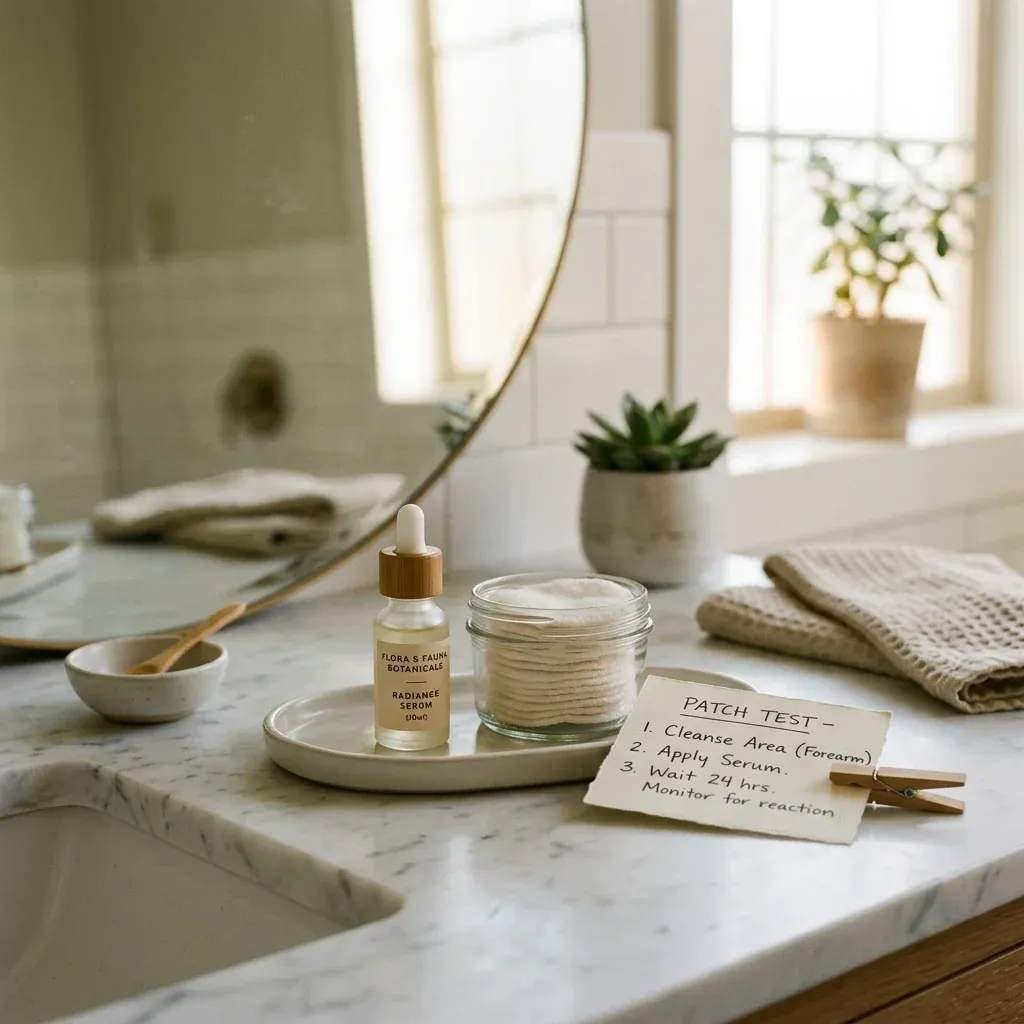
If you are pregnant, nursing, prone to eyelid dermatitis, reacting to several skincare products already, or treating active skin disease around the eyes, Argireline belongs in the "ask first" category. For everyone else, patch testing and conservative use are more rational than chasing stronger and stronger formulas.
It is also worth separating topical use from risky misuse. The evidence base here is about products placed on the skin, usually around expression-line areas. It is not permission to inject a cosmetic serum, compound high-strength versions at home, or keep applying through burning and swelling. If irritation shows up, the responsible move is to stop, simplify the routine, and let the skin calm down.
The Bottom Line: Does Argireline Actually Work?
Yes, Argireline can work, if "work" means softening the appearance of some expression lines with steady topical use. The most defensible case rests on the 30-day Blanes-Mira finding, the 4-week Wang placebo-controlled study, and the newer reviews showing a pattern of visible wrinkle or scar improvement. That is enough evidence to separate Argireline from pure skincare folklore.
No, it is not literally Botox in a bottle. The delivery problem is too large, the direct neuromuscular proof is too thin, and the expected magnitude is smaller. A better way to think of Argireline is as a low-drama maintenance ingredient: useful for people who want gradual improvement, dislike injections, or want something to pair with a broader barrier-supporting routine. It is not the right tool for quick correction of deep static wrinkles.
The marketing phrase survives because it is memorable, not because it is precise. A precise phrase would be less exciting: "a topical peptide with some evidence for softening expression-line appearance and unresolved delivery questions." That does not fit on a box, but it is much closer to what the research supports.
The smartest purchase test is whether the product helps you make calmer decisions. Choose a formula from a credible brand, use it on expression areas for roughly the same time frame studied in trials, and take photos before judging. If the change is subtle but visible, the ingredient did its job. If you wanted injectable-level change, the bottle was never going to meet that brief.
That makes Argireline a decent ingredient for patient people and a poor one for impatient promises. The fairest verdict is not hype or dismissal. It is a smaller, more useful sentence: Argireline can help some fine lines look softer, especially when the formula is good and the expectations are sane.

Frequently Asked Questions
How long does Argireline take to show results?
Use the trial timelines as the fairest guide. The key human studies assessed results after 4 weeks or 30 days, so judging a serum after a few applications is too early.
Can Argireline replace Botox?
No. Argireline can soften the look of expression lines, but topical delivery is limited and evidence that it reaches facial neuromuscular junctions remains uncertain. If you want the stronger muscle-relaxing effect associated with injections, Argireline is not an equivalent substitute.
Is Argireline safe around the eyes?
It has been studied around the eye area, including periorbital wrinkle trials and a blepharospasm study. Still, the eye area is reactive skin. Patch test first, keep product out of the eyes, and avoid it during irritation.
What strength of Argireline is best?
The wrinkle studies often discuss 10% Argireline, but CIR's cosmetic safety conclusion is framed around current use practices up to 0.005% for acetyl hexapeptide-8 amide in cosmetics. Because ingredient naming and solution concentration can differ by supplier, brand transparency matters more than chasing the biggest percentage on a label.
Medical Disclaimer
This article is for informational and educational purposes only and is not medical advice, diagnosis, or treatment. Always consult a licensed physician or qualified healthcare professional regarding any medical concerns. Never ignore professional medical advice or delay seeking care because of something you read on this site. If you think you have a medical emergency, call 911 immediately.