
What Matrixyl 3000 Actually Is
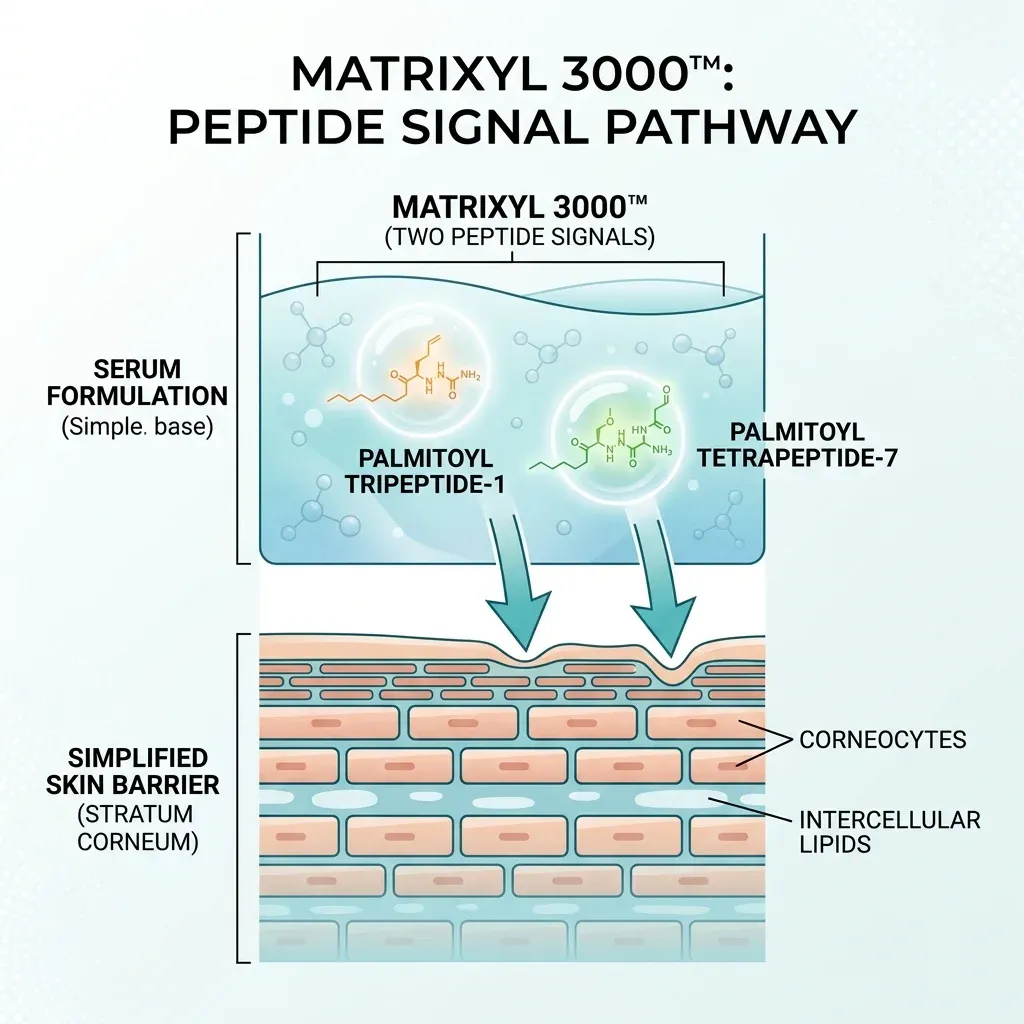
Matrixyl 3000 sounds like something invented for glossy packaging, but the ingredient is fairly specific. Paula's Choice describes Matrixyl 3000 as a trademarked blend of palmitoyl tripeptide-1 and palmitoyl tetrapeptide-7, and Croda lists the same pair inside a carrier base of glycerin, water, butylene glycol, carbomer, and polysorbate 20.
Think of those peptides as short repair notes rather than replacement parts. They do not supply collagen the way a supplement supplies protein. They are used because skin cells respond to small peptide signals, a bit like a maintenance crew responding to a work order taped to the door.
The first peptide, palmitoyl tripeptide-1, is also called pal-GHK. Silke Karin Schagen's topical peptide review describes palmitoyl tripeptide-1 as a messenger peptide for collagen renewal and says it is suggested to act on TGF beta, a pathway involved in fibrillogenesis. The second, palmitoyl tetrapeptide-7, is usually discussed as the inflammation-calming partner in the blend.
That two-part design is the reason Matrixyl 3000 keeps appearing in serums that promise smoother texture and firmer-looking skin. One peptide is framed around matrix renewal. The other is framed around visible calm. In a drugstore formula, that is an easy story to understand: repair signal plus comfort signal.
Matrixyl 3000 is not one peptide. It is a branded peptide blend, and the rest of the formula decides how much that blend can realistically do.
The practical takeaway is to read the ingredient list more literally. If a product says "Matrixyl 3000," look for the actual peptide names or a clear brand explanation. If all you get is "advanced peptide complex," you have less to evaluate.
Why It Ended Up in Drugstore Anti-Aging Products
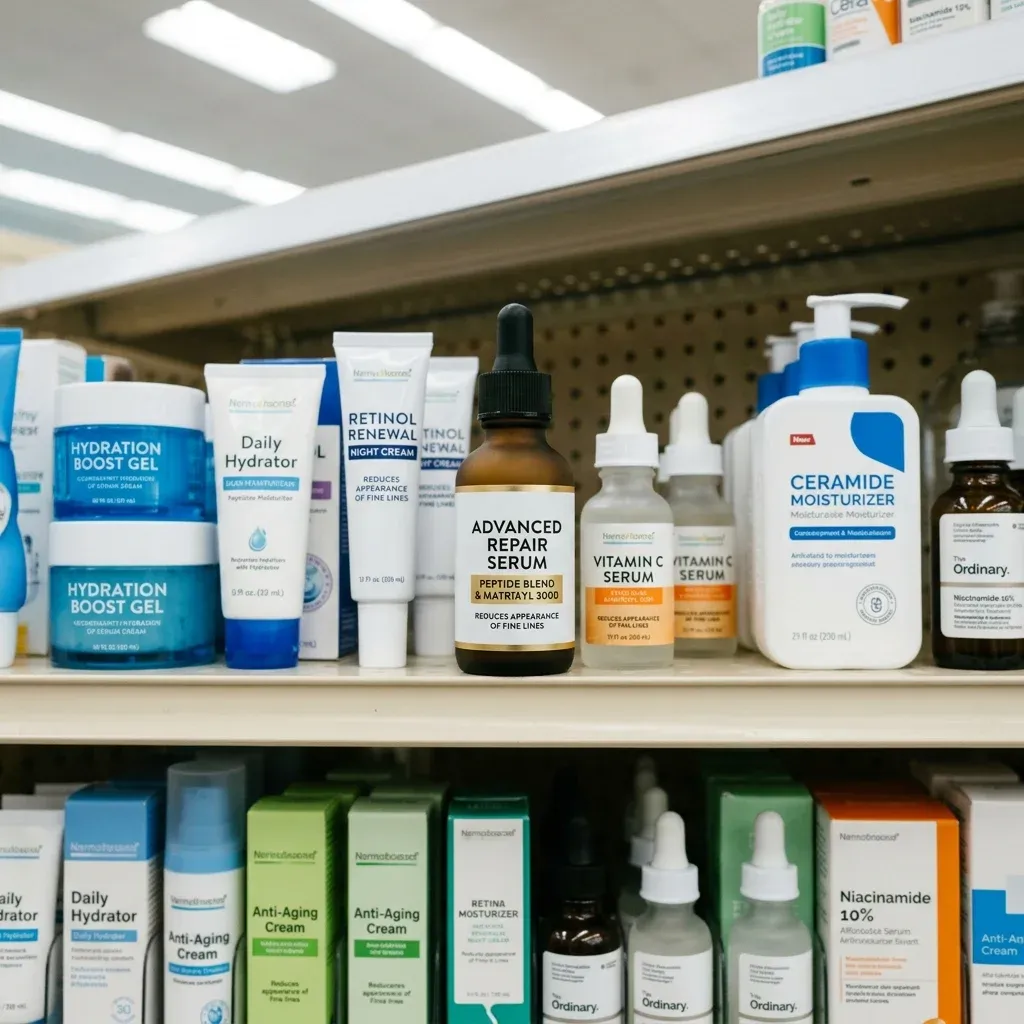
Matrixyl did not become common because shoppers suddenly learned peptide chemistry. It became common because it gave mass-market skincare a better anti-aging pitch: less harsh than a retinoid, more technical than a basic moisturizer, and easy to print on the front of a box.
The ingredient also had industry momentum. COSSMA reported that Matrixyl launched in 2000 and won the in-cosmetics 25 Years of Innovation Award in 2015 for its impact on the personal care ingredients market. Croda's own product page repeats the award claim, which tells you how central that story remains to the ingredient's commercial identity.
The drugstore appeal is not hard to see. Retinoids have better name recognition, but they can be irritating. Schagen's review describes palmitoyl tripeptide-1 as comparable to retinoic acid in activity while not triggering irritation. That does not make Matrixyl a retinoid replacement in a medical sense. It makes it easier to sell to someone who wants a gentler nightly serum.
The Ordinary helped make the peptide aisle feel normal rather than exotic. Its Multi-Peptide + HA Serum page describes a formula using five peptide technologies and positions it around firmness, elasticity, texture, and resilience. Those are everyday skincare words, not clinic words.
There is a less romantic reason too: Matrixyl 3000 is label-friendly. A brand can talk about two named peptides, a patented-sounding complex, visible wrinkle data, and tolerability without selling a prescription-strength active. For shoppers, that can be useful. For marketers, it is almost too convenient.
| Why brands like it | Why shoppers notice it |
|---|---|
| Recognizable trade name | Sounds more specific than "peptide complex" |
| Gentler anti-aging positioning | Feels less intimidating than retinoids |
| Can sit in affordable serums | Shows up in ordinary drugstore routines |
| Has manufacturer study data | Gives wrinkle claims a research hook |
Practically, this means the ingredient's popularity is not proof that every Matrixyl serum is excellent. It means formulators found a peptide story that fits affordable skincare. The real question is whether the formula behind the story is any good.
What the Clinical Studies Show
The evidence for Matrixyl 3000 is interesting, but it is not as independent as the marketing makes it sound. The best way to read it is with two columns in your head: what the studies report, and who benefits when those reports are repeated.
The strongest repeated study summary comes from the topical peptide review. Schagen describes a blind, randomized clinical study with 28 volunteers who applied Matrixyl 3000 twice daily to half the face and one forearm, with placebo used on the opposite side. The review says the active side showed anti-wrinkle efficacy, including reductions in wrinkle depth, volume, density, roughness, and the area occupied by deep wrinkles.
Another data set is more dramatic but less independently anchored. A Matrixyl 3000 summary page reports that 23 volunteers ages 42 to 67 saw a 39.4% reduction in wrinkle density after twice-daily use. The same page reports a 16% reduction in skin roughness, 15.5% improvement in skin tone, and 5.5% improvement in elasticity. Those are useful numbers, but they should be treated as brand-adjacent evidence rather than large independent dermatology trials.
Croda's own page goes further. It says Matrixyl 3000's anti-wrinkle efficacy was measured as an "age gain" of 2 years in 1 month and up to 5.5 years after 2 months. That phrasing is memorable, but it is manufacturer language. I would not treat it the same way I would treat a large, blinded, independently published trial.
The penetration question is where the evidence gets more interesting. The University of Nottingham reported that its researchers and No7 used 3D OrbiSIMS to track the Matrixyl 3000+ peptide blend after topical application. The same report says the technique detected peptide ten surface layers deep into skin, while preserving the structure of the sample.
No7 also says more than 5,000 women have taken part across nearly 80 trials of its serums and that over 90% achieved a visible reduction in wrinkle appearance in scientifically controlled clinical trials. Those figures support the idea that peptide serums can show visible cosmetic changes, but they are tied to No7's serum portfolio, not pure Matrixyl 3000 alone.
This distinction matters because skincare studies often test finished products, not isolated ingredients floating in a lab fantasy. A serum might contain Matrixyl 3000, hyaluronic acid, humectants, preservatives, texture agents, and a base that changes how the whole product behaves. If the finished serum performs well, the peptide may deserve credit, but it is rarely the only actor on stage.
For a shopper, the fairest reading is moderate optimism. Matrixyl 3000 has more evidence than many buzzy skincare ingredients. It also has enough manufacturer involvement that you should resist the fantasy that one serum will erase years from your face.

How It Compares With Retinoids and Copper Peptides
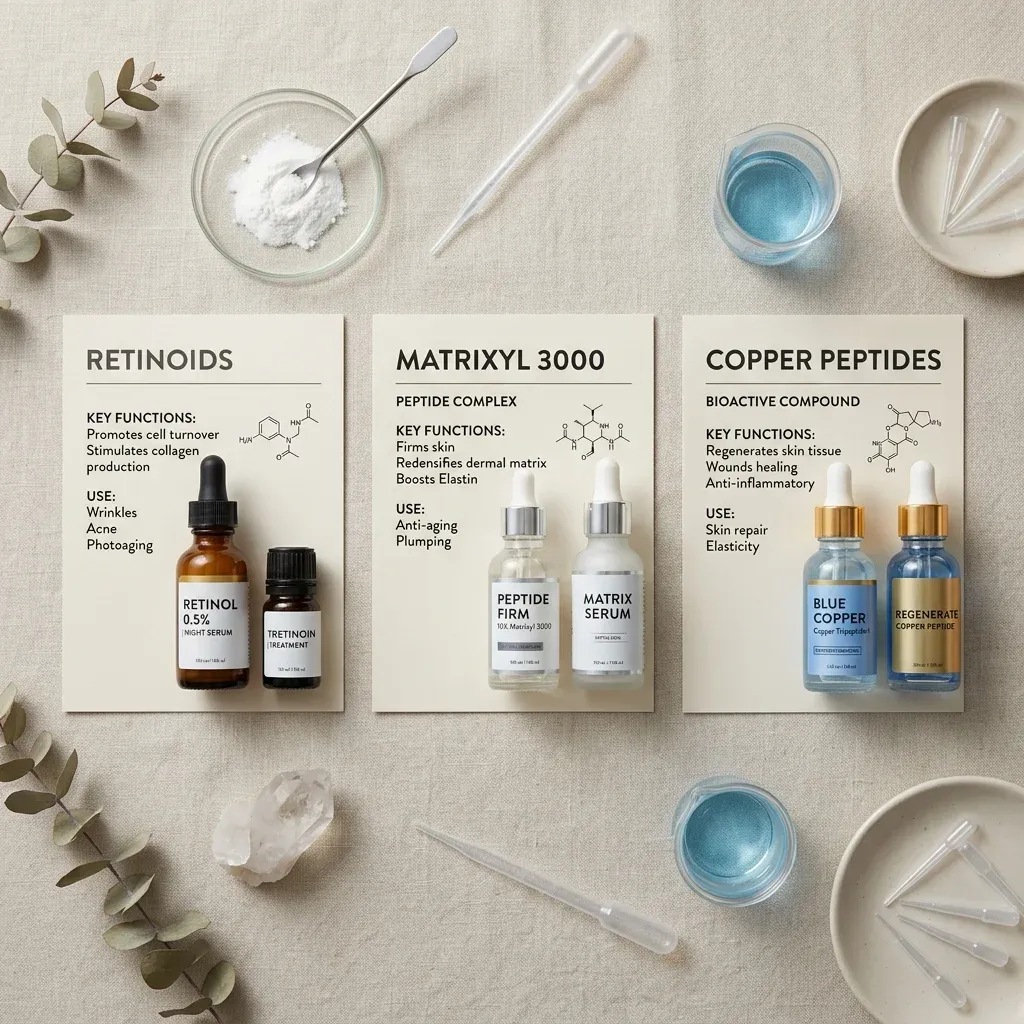
Matrixyl 3000 is often talked about as the easy alternative to retinol. That comparison is useful only up to a point. Retinoids have a much deeper medical and dermatology evidence base. Matrixyl 3000 has a gentler cosmetic profile and a narrower, more formulation-dependent claim.
The mechanism is different too. Retinoids are like a demanding project manager who reorganizes the whole office and annoys half the staff in the process. Matrixyl 3000 is more like a short maintenance memo. The peptide review says palmitoyl tripeptide-1 is comparable to retinoic acid in activity without triggering irritation, but that statement does not make the two ingredients interchangeable.
Copper peptides sit in a different lane again. Schagen's review says copper tripeptide is one of the better-researched cosmeceutical peptides. Matrixyl 3000 is a signal-peptide blend. GHK-Cu is usually discussed as a copper carrier peptide. Both can live in anti-aging routines, but they are not duplicates.
The strongest scientific caution is delivery. A PMC review of cosmetic peptides describes poor membrane permeability as one of the most significant drawbacks of peptides, because the stratum corneum is built to keep large, water-loving molecules out. A ScienceDirect review on anti-aging peptides also frames delivery and stability as major formulation problems.
That delivery problem explains why formulas matter so much. The PMC review discusses nano-systems such as liposomes, niosomes, ethosomes, and nanoemulsions as ways to improve peptide delivery. In plain English, the peptide needs a vehicle. A good ingredient in a bad vehicle is like a letter with no address.
There is also a patience problem. Retinoids often announce themselves through dryness and peeling, which can trick people into thinking "activity" must feel aggressive. Matrixyl 3000 is quieter. If it helps, the change is more likely to look like smoother texture over weeks than a dramatic overnight resurfacing. That can feel less exciting, but for sensitive skin it may be the whole point.
| Ingredient family | Main appeal | Main caution |
|---|---|---|
| Retinoids | Strongest anti-aging evidence base | Can irritate, dry, or peel sensitive skin |
| Matrixyl 3000 | Gentler signal-peptide story | Evidence often comes through formulations and brand data |
| Copper peptides | Well-known carrier peptide category | Not the same mechanism as Matrixyl 3000 |
Use the comparison to set expectations. Matrixyl 3000 is appealing when you want a lower-irritation anti-aging serum, especially around texture and fine lines. It should not be sold to you as prescription retinoid results without the tradeoffs.
Who Should Consider Matrixyl 3000
Matrixyl 3000 makes the most sense for someone who wants a polite anti-aging active. Not weak, exactly. Polite. It fits people who are interested in fine lines, texture, and early firmness changes but do not want the drama that can come with strong retinoids.
It may be especially appealing if your skin gets cranky fast. Paula's Choice describes Matrixyl 3000 as helping smooth the appearance of wrinkles while calming visible signs of sensitization. The same page says both peptides in the blend have undergone Cosmetic Ingredient Review safety and toxicology review and were deemed safe.
Still, "peptides are gentle" does not mean every peptide serum is gentle for every face. Good Housekeeping's peptide serum testing notes that some testers with sensitivities had adverse reactions to certain formulas. The peptide may be well tolerated, while the fragrance, solvent system, exfoliant, preservative, or companion active is not.
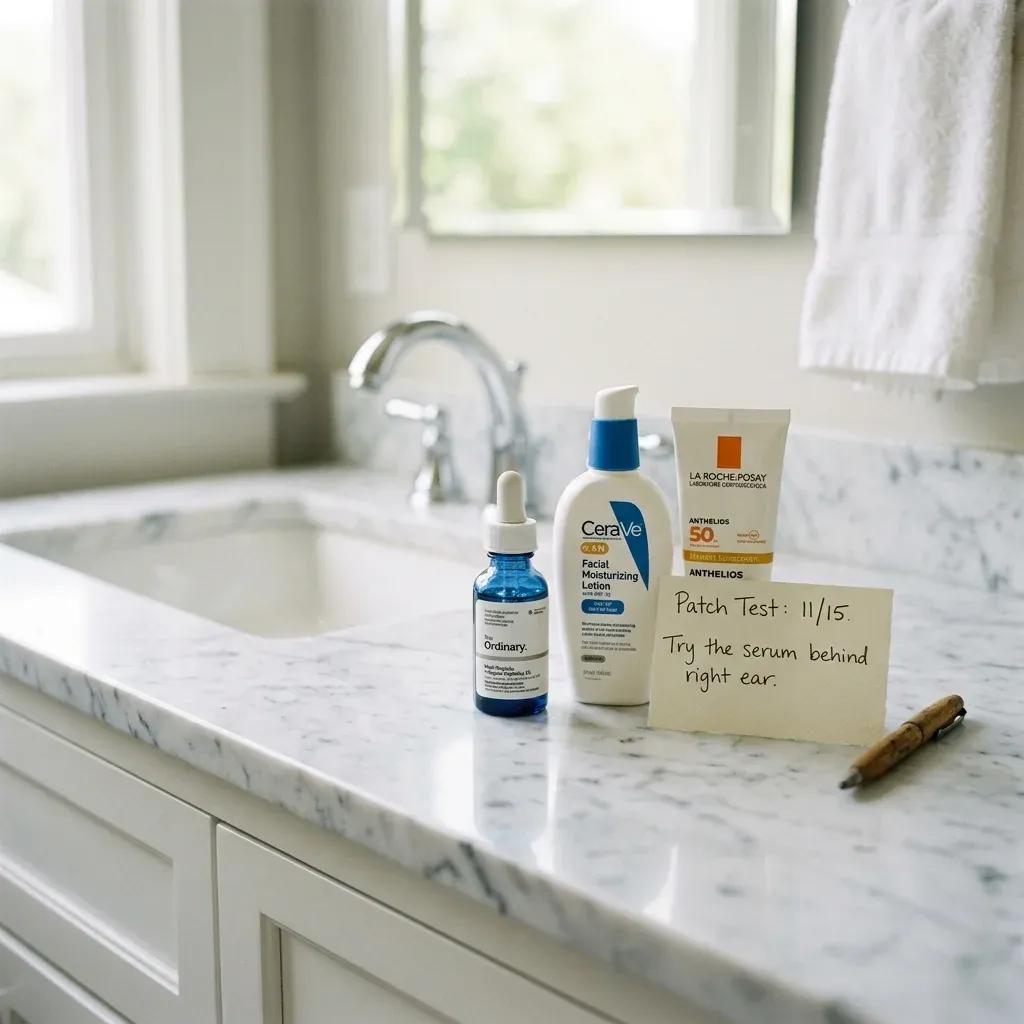
This is where patch testing earns its boring reputation. If your barrier is compromised, use Matrixyl 3000 like you would test a new detergent: small area first, then broader use only if the skin stays calm.
- Consider it if retinoids leave you flaky or irritated.
- Consider it if you want a daytime-friendly peptide serum under moisturizer and sunscreen.
- Be cautious if you react to many serums, not just strong actives.
- Skip the hype if a product hides the peptide names or makes drug-like promises.
The practical decision is less about age and more about tolerance. If your routine already has a retinoid you love, Matrixyl 3000 may be optional. If your skin refuses retinoids, it can be a reasonable gentler route.
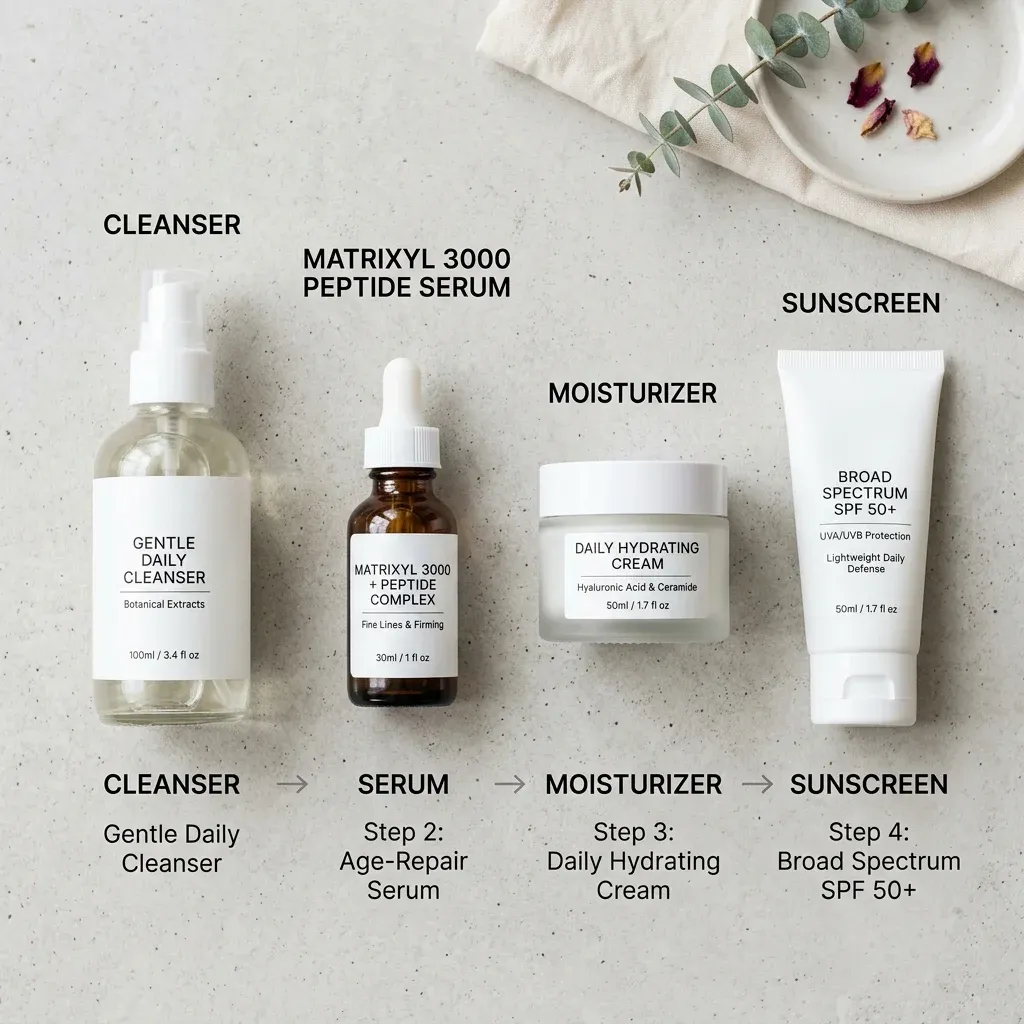
How to Use It Without Overcomplicating Your Routine
Matrixyl 3000 is not an ingredient that needs ceremony. You do not need a ten-step routine, a separate peptide night, or a spreadsheet. You need a formula your skin tolerates, steady use, and sunscreen.
Start by checking the use level story. Paula's Choice lists 3% as the suggested usage concentration for Matrixyl 3000, while noting that the actual concentration of the two peptides is much lower than that because the trade-name blend includes carriers. That is why a "10% peptide serum" label may not mean what a shopper thinks it means.
If you layer products, keep the order simple. Timeless Skin Care advises applying multiple serums from thinnest to thickest and waiting about one minute between layers. That is practical advice, not sacred law. It just helps prevent pilling and gives each layer a fair chance to settle.
If your skin is reactive, start slowly, then increase only if the formula plays nicely. Pair it with moisturizer. In the morning, finish with sunscreen, because no peptide serum can outwork unprotected UV exposure.
A good routine also leaves room for boredom. If you add Matrixyl 3000, keep the rest of the routine steady for a few weeks so you can tell what changed. Adding a peptide serum, a new exfoliant, and a stronger vitamin C product at the same time turns your face into a messy experiment with no control group.
| Routine step | Simple Matrixyl 3000 approach |
|---|---|
| Cleanse | Use a gentle cleanser, especially if your barrier is dry |
| Serum | Apply Matrixyl 3000 to dry or slightly damp skin |
| Moisturize | Seal it with a barrier-friendly moisturizer |
| Morning finish | Use sunscreen every day |
The best Matrixyl routine is almost disappointingly plain. That is a good thing. If the peptide works for you, it will do so through consistency, not through elaborate layering gymnastics.
Frequently Asked Questions
Is Matrixyl 3000 the same as retinol?
No. Matrixyl 3000 is a peptide blend, while retinol is a vitamin A derivative. A peptide review compares palmitoyl tripeptide-1 with retinoic acid in activity and notes it does not trigger irritation, but that does not make it a retinoid.
How long does Matrixyl 3000 take to work?
Most cited Matrixyl 3000 study summaries talk in weeks, not days. One review describes a 28-volunteer twice-daily split-face study, and Croda's product page frames visible anti-wrinkle changes across 1 to 2 months.
Can Matrixyl 3000 replace prescription anti-aging treatments?
No. Matrixyl 3000 is a cosmetic ingredient used for visible skin appearance. It can be useful in a routine, but it should not be treated like a prescription retinoid, procedure, or medical treatment.
Is a higher Matrixyl percentage always better?
Not necessarily. Paula's Choice lists 3% as the suggested Matrixyl 3000 usage concentration and notes the actual peptide content is lower because Matrixyl 3000 is a blend. More label percentage does not automatically mean better delivery or better results.
Can sensitive skin use Matrixyl 3000?
Often, yes, but the whole formula matters. Good Housekeeping notes some testers with sensitive skin reacted poorly to certain peptide serum formulas, so patch test before using a new serum all over your face.
Medical Disclaimer
This article is for informational and educational purposes only and is not medical advice, diagnosis, or treatment. Always consult a licensed physician or qualified healthcare professional regarding any medical concerns. Never ignore professional medical advice or delay seeking care because of something you read on this site. If you think you have a medical emergency, call 911 immediately.