What Bone Broth Actually Delivers
Bone broth has a simple appeal: bones, water, time, and a glossy surface that looks like it ought to be doing something for your skin and joints. The evidence is less romantic. Bone broth can be a useful protein-rich food, but it is not a predictable anti-aging dose.
Independent testing gives the clearest starting point. ConsumerLab reported that tested bone broths contained 3.8 to 11 grams of protein per cup, while collagen ranged from 1.3 to 11.5 grams per cup, with about 4 grams most common. Harvard Health gives a similar everyday range, noting that bone broth provides about 8 to 10 grams of protein per cup, more than many ordinary broths or stocks.
That protein is real. The problem is precision. In an amino-acid analysis of commercial beef, chicken, and turkey broths, M.H. Shaw and Nick E. Flynn measured 19 individual amino acids and found average protein content of 23.2 +/- 0.71 mg per gram of product. Their conclusion was blunt: bone broths did not appear to be a better amino acid source than other animal proteins.
Bone broth is better understood as a variable food than as a measured collagen treatment.
Think of bone broth like coffee brewed at home. The beans matter, the grind matters, the water matters, and two cups can taste completely different. Collagen peptide powder is closer to an espresso shot from a calibrated machine: less interesting as food, but far more predictable as a dose.
| What one cup may provide | Evidence-based range | What it means |
|---|---|---|
| Protein | 3.8 to 11 g | Useful, but not consistent across products. |
| Collagen | 1.3 to 11.5 g | Some servings are close to supplement territory; many are not. |
| Typical collagen | About 4 g | Often below doses used in collagen studies. |
The practical takeaway is narrow but useful: bone broth can help someone add savory protein to the day. It should not be sold to them as a reliable substitute for a standardized collagen intervention.

Why Collagen Content Varies So Much
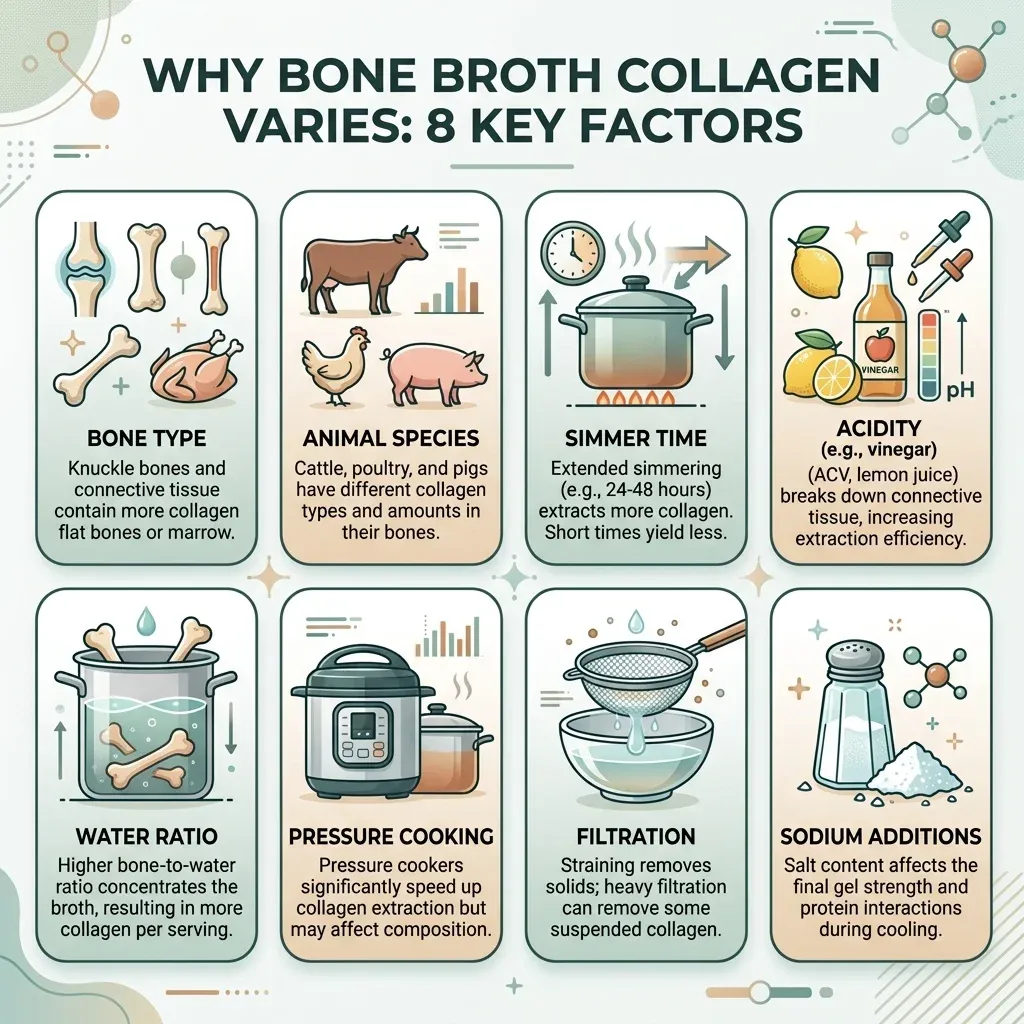
Collagen content varies because bone broth is not one product. It is a cooking method. The bones, species, age of the bones, surface area, acidity, simmer time, pressure, filtration, dilution, and added ingredients all change what ends up in the cup.
A Hanwoo cattle bone study found total collagen content varied by bone type, from 7.09 to 7.54 g per 100 g, and essential amino acids ranged from 501.92 to 853.20 mg per 100 g. That is before anyone turns the bones into broth. The raw material is already uneven.
Cooking changes the result again. A bone-soup study identified raw material characteristics, additive formula, pre-processing, boiling conditions, particle size, bone-to-water ratio, and boiling time as factors that influence nutrient release. A separate metals study found that acidity and cooking longer than 8 hours increased calcium and magnesium extraction, though the final serving still contributed little nutritionally.
Commercial products add another layer. ConsumerLab reported that 4 out of 10 tested bone broths failed approval for issues such as low protein, unusually low collagen, authenticity problems, or excess sodium. In one update, 2 products supplied only 65% to 85% of claimed label protein.
The smart move is to stop asking whether bone broth “has collagen” and ask how much, from what source, and with what sodium load. A gelatin-rich homemade batch can be satisfying. A watery boxed broth with vague labeling is a different food.
Bone Broth vs. Collagen Peptides
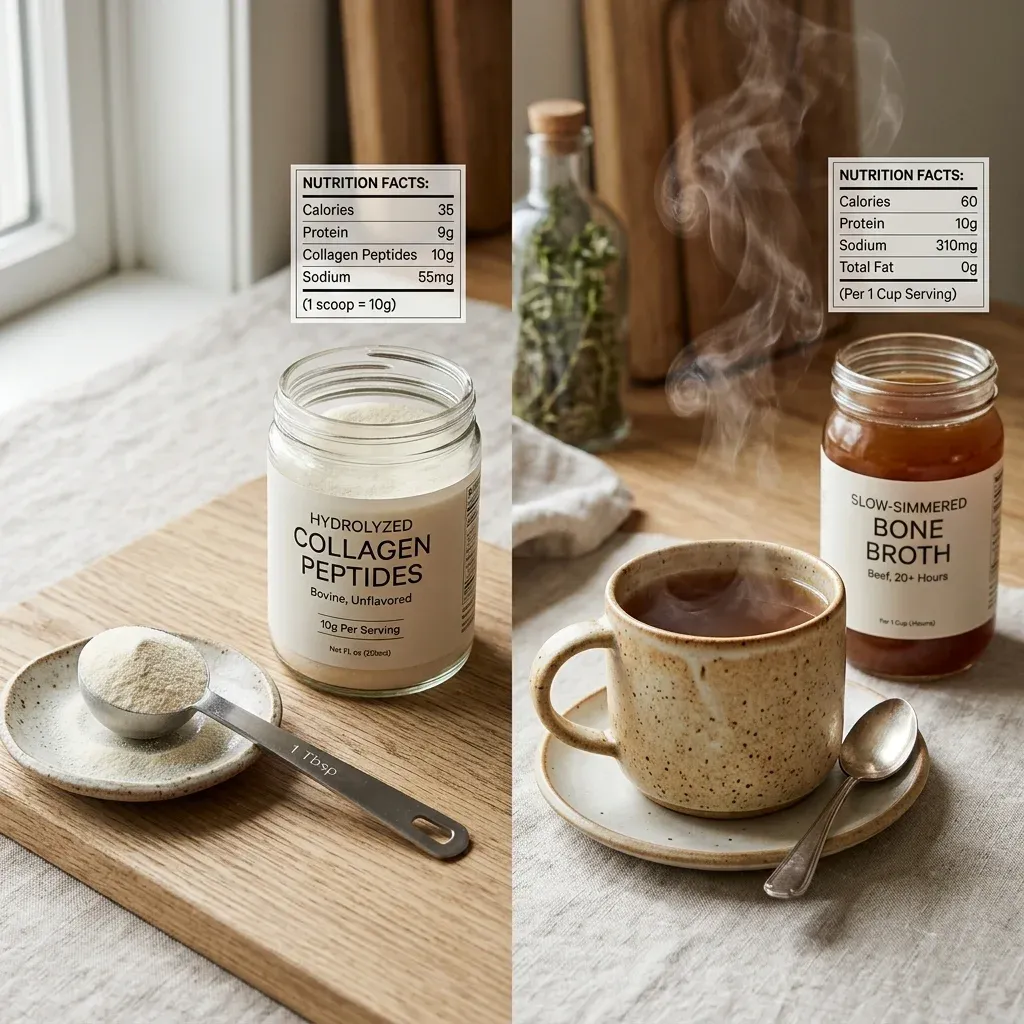
The comparison is not really fair unless the goal is clear. Bone broth is food. Collagen peptides are an ingredient engineered for dose consistency. Confusing the two is where most of the marketing fog starts.
Skin research usually tests purified or hydrolyzed collagen, not mugs of broth. A narrative review reported that hydrolyzed collagen preparations used in clinical trials are typically more than 90% to 97% purified. That matters because researchers are trying to isolate the effect of the peptides. A cup of bone broth brings gelatin, amino acids, sodium, minerals, and whatever else the recipe contributes.
The skin data also deserves a colder reading than supplement ads allow. A 2025 meta-analysis in The American Journal of Medicine analyzed 23 randomized controlled trials with 1,474 participants. Across all trials, collagen looked helpful for hydration, elasticity, and wrinkles, but studies without pharmaceutical-company funding and high-quality studies did not show significant benefit.
Other reviews are more favorable. A skin-aging review reports that oral hydrolyzed collagen at 2.5 to 10 g/day for at least 8 to 12 weeks is associated with improvements in hydration, elasticity, and wrinkle depth, while also noting inconsistent results. The fairest interpretation is not “collagen does nothing.” It is that the signal is product-specific, trial-specific, and less certain than the wellness aisle suggests.
| Question | Bone broth | Collagen peptides |
|---|---|---|
| Dose predictability | Variable; 1.3 to 11.5 g collagen per cup. | Usually measured by scoop or serving. |
| Clinical match | Often below study dosing. | Closer to 10 to 15 g/day collagen trial ranges. |
| Food value | Warm, savory, hydrating, and protein-containing. | Efficient, but not a meal. |
| Main caution | Sodium and label variability. | Overstated skin claims and industry-funded evidence. |
If the target is a consistent collagen dose, peptides win on measurement. If the target is a comforting high-protein cup that may replace a salty snack or low-protein soup, broth can earn its place.
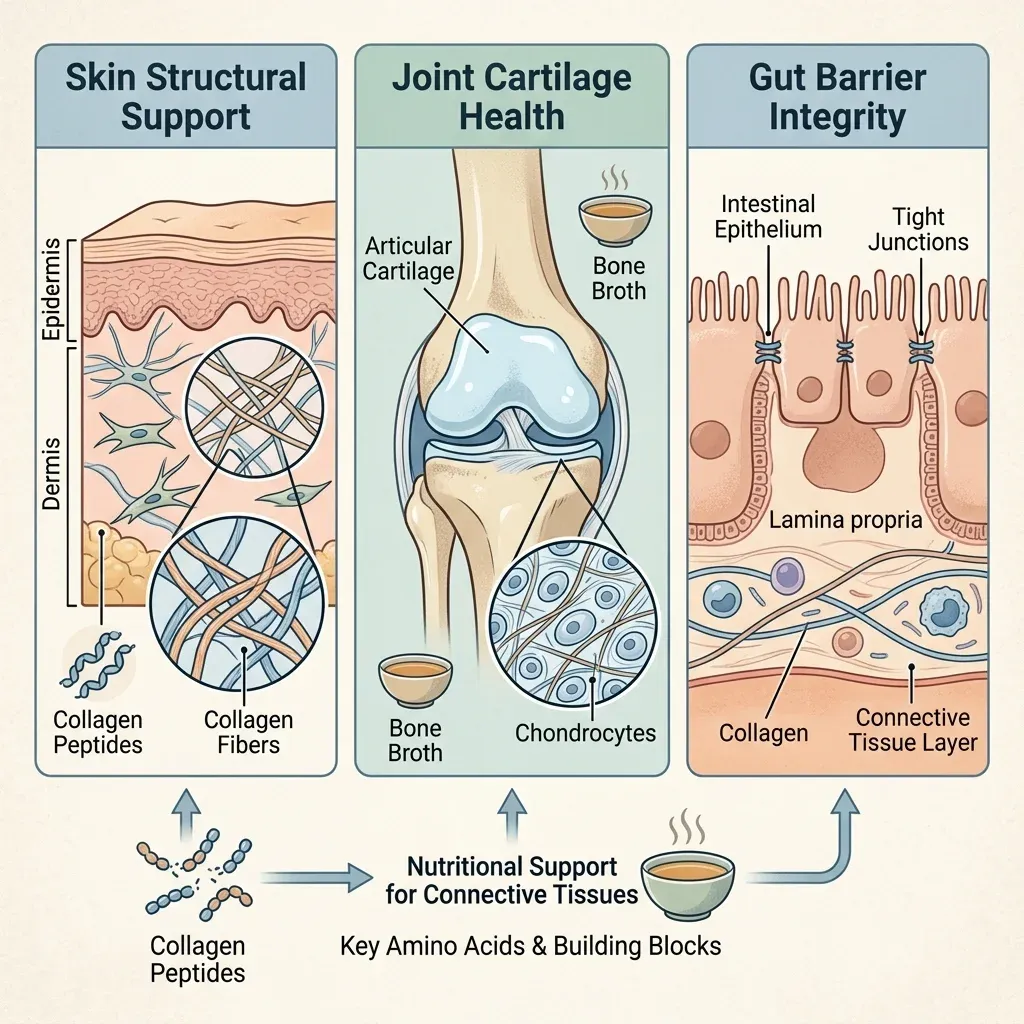
Skin, Joints, and Gut Claims
Skin and joint claims need the biggest caveat: the better evidence is for collagen supplements, not for liquid bone broth. That distinction is not nitpicking. It is the difference between studying a measured dose and studying soup.
For joints, the evidence is stronger than for broad anti-aging. A knee osteoarthritis meta-analysis included 11 randomized trials and 870 participants and found significant improvements in function and pain scores favoring collagen supplementation. A separate randomized, double-blind, placebo-controlled trial used 10 g of collagen peptides for 6 months and reported reductions in VAS pain, Lequesne index scores, CRP, and ESR versus placebo, with no adverse effects reported.
Those findings do not magically transfer to bone broth. A typical cup may deliver far less collagen than a trial dose, and Shaw and Flynn’s amino-acid paper found bone broth was not a superior amino-acid source compared with ordinary animal proteins. If clinical collagen peptides are like a precisely addressed package, bone broth is more like a mixed grocery bag. Useful, but not guaranteed to deliver the same item in the same amount.
Gut claims are plausible but thinner. The Canadian Digestive Health Foundation notes that glutamine helps maintain gut barrier function, and bone broth can contain glutamine, glycine, gelatin, and related compounds. But plausible mechanism is not the same thing as proof that drinking broth heals a specific gut condition in humans.
For readers, the useful split is this: consider collagen peptides if the goal is a testable skin or joint dose, and consider bone broth if the goal is a warm, protein-containing food that may be easier to tolerate than a full meal. Do not let the second claim borrow the evidence strength of the first.
Lead, Sodium, and Safety Tradeoffs
The safety story is not “bone broth is dangerous.” It is more ordinary: some products are salty, some labels disappoint, and bones can leach small amounts of metals. The dose and the product matter.
The best direct metals study in the fetched research is reassuring but not a free pass. In Food & Nutrition Research, researchers found calcium and magnesium in homemade or commercial broth/soup were less than 5% of daily recommended levels. The same study found lead and cadmium risks were minimal because levels were in the range of a few micrograms per serving.
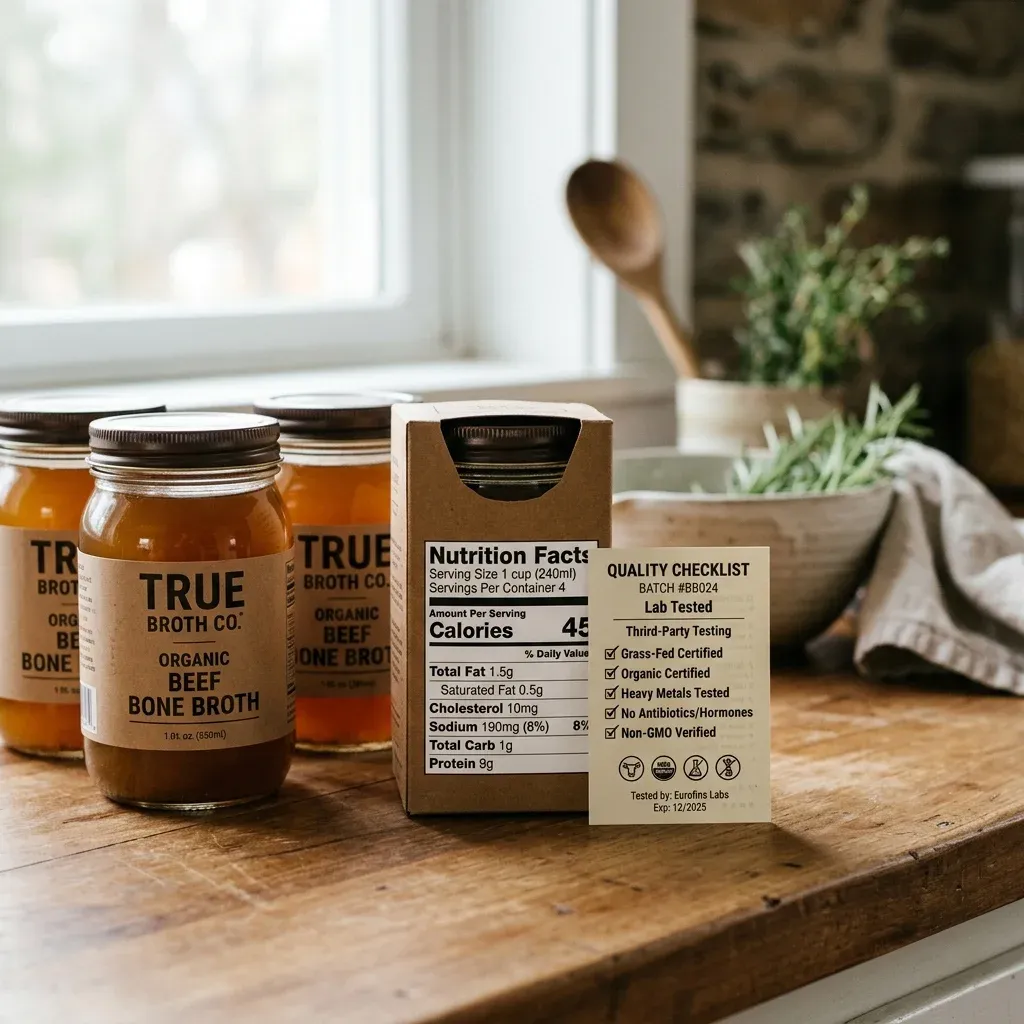
ConsumerLab’s product testing also found no tested product exceeded its heavy-metal limits, but sodium varied widely. Its review reported sodium from 104.2 mg in an unsalted product to over 800 mg per cup. Harvard Health warns that some broths contain more than 450 mg sodium per cup, which is about 20% of the recommended daily limit.
| Concern | What the research found | Practical response |
|---|---|---|
| Lead and cadmium | A few micrograms per serving in the metals study. | Prefer brands with contaminant testing if drinking it often. |
| Mineral claims | Less than 5% of daily calcium and magnesium needs. | Do not count broth as a mineral supplement. |
| Sodium | 104.2 mg to over 800 mg per cup. | Choose low-sodium if blood pressure or kidney health is a concern. |
| Freshness | Refrigerated Hanwoo bones showed increasing microbial and lipid oxidation markers over 21 days. | Use fresh bones, chill broth quickly, and freeze extra portions. |
For occasional use, the heavy-metal evidence does not justify panic. For daily use, especially in pregnancy, kidney disease, hypertension, histamine intolerance, or medically restricted diets, “natural” is not enough information. The label and the lab testing matter.
The Practical Verdict
Bone broth is neither nonsense nor a miracle. It is a decent food with a marketing problem. The more specific the claim gets, the less comfortable the evidence becomes.
Use bone broth for what it can do well: add savory protein, make meals easier when appetite is low, replace a less nourishing snack, and provide a gelatin-rich base for soups. Be more skeptical when someone claims it can rebuild skin, reverse aging, heal joints, or repair the gut by itself.
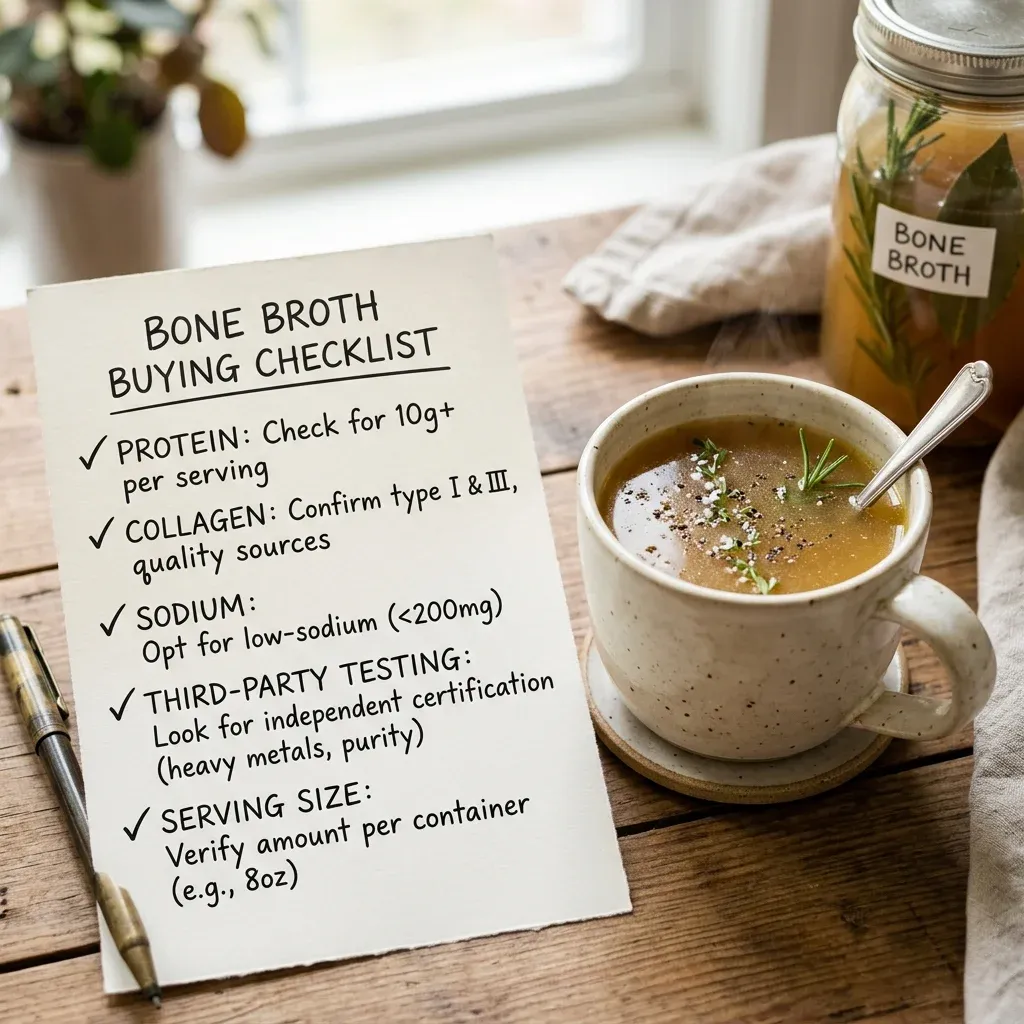
If you want collagen-like dosing, read the label like a dosage panel. Look for protein per serving, collagen per serving if the brand tests it, sodium per cup, serving size, ingredient simplicity, and heavy-metal testing. A product with vague claims and no numbers is asking for trust it has not earned.
A practical serving pattern is boring, which is probably why it does not sell as well: use broth as a base for soup, sip it when you want something warm, or add it to meals that need more protein and salt-aware flavor. If you are drinking it every day, rotate the question away from “is this anti-aging?” and toward “does this fit my sodium budget, protein target, and overall diet?” That framing is less flashy, but it is much closer to the evidence.
The buying decision gets easier if you separate people into a few camps. Someone who wants a warm, savory drink can choose broth on taste, sodium, and ingredient quality. Someone trying to hit a collagen dose for a joint or skin experiment should choose a product where the collagen amount is measured, then track whether anything changes after a consistent trial period. Someone with high blood pressure, kidney disease, or a low-sodium diet should treat broth like any other salty packaged food, because tested products ranged from 104.2 mg to over 800 mg sodium per cup.
Homemade broth is not automatically better or worse. It gives you control over salt, bones, vegetables, and cooking time, but it also removes the testing that better commercial products can provide. The metals study found lead and cadmium exposure from broth was minimal, yet it also showed that acidity, bone type, species, and simmering time change what leaves the bone and enters the liquid. That is exactly why homemade broth should be treated as a food tradition, not as a lab-standardized supplement.
Bone broth also has a psychological advantage that powders do not. It is warm. It smells like dinner. It can make a simple meal feel more complete. Those things are not clinical anti-aging outcomes, but they matter for consistency. A habit you enjoy is easier to keep than a supplement you resent. Just keep the claim proportional to the evidence: comfort and protein are fair; wrinkle reversal is not.
The most honest label for bone broth is “supportive food.” That is not a downgrade. Foods do not need to behave like drugs to be worth eating. The trouble starts when a supportive food gets marketed as a precision tool. Once the promise becomes younger skin, repaired cartilage, or healed intestines, the burden of proof changes, and bone broth has not met that burden yet.
For skin, purified collagen peptide evidence is mixed: some studies and reviews are favorable, while the American Journal of Medicine meta-analysis found no significant benefit in high-quality or non-pharmaceutical-funded subgroups. For joints, collagen supplementation has more encouraging data, but again, that is supplement data. Bone broth should not borrow those results unless it matches the dose, composition, and consistency.
The anti-aging verdict is modest. Bone broth may fit into a healthy routine, especially if you enjoy it and choose a low-sodium, tested product. It is not a genuine anti-aging tool in the way the phrase is usually marketed. It is soup with some useful amino acids, and soup can be enough.
Frequently Asked Questions
Is bone broth the same as collagen peptides?
No. Bone broth is a variable food made by simmering bones and connective tissue, while collagen peptides are a standardized supplement ingredient. ConsumerLab found bone broth collagen ranged from 1.3 to 11.5 grams per cup, so one cup cannot be assumed to match a measured scoop of collagen peptides.
Can bone broth improve skin aging?
There is not strong direct clinical evidence that liquid bone broth improves skin aging. Collagen supplement research is adjacent but not identical, and a 2025 meta-analysis of 23 randomized trials found no significant skin-aging benefit in high-quality or non-pharmaceutical-funded subgroups.
Is bone broth good for joints?
Collagen supplements have some supportive joint data, including a knee osteoarthritis meta-analysis of 11 trials and 870 participants. Bone broth itself has not been tested as rigorously for joint outcomes, and its collagen dose is less predictable.
Should I worry about lead in bone broth?
Occasional broth use does not look alarming based on the fetched evidence. A metals study found lead and cadmium levels in broth were generally a few micrograms per serving, and ConsumerLab reported no tested product exceeded its heavy-metal limits. Daily users should still prefer tested brands.
What should I check before buying bone broth?
Check protein per serving, sodium per cup, serving size, whether collagen is actually measured, and whether the company publishes third-party contaminant testing. Harvard Health notes that some broths exceed 450 mg sodium per cup, so low-sodium options matter for frequent use.
Medical Disclaimer
This article is for informational and educational purposes only and is not medical advice, diagnosis, or treatment. Always consult a licensed physician or qualified healthcare professional regarding any medical concerns. Never ignore professional medical advice or delay seeking care because of something you read on this site. If you think you have a medical emergency, call 911 immediately.