
Your Heart Rate Doesn't Need to Spike for Exercise to Count
A slow walk to the coffee shop. Ten minutes of stretching while a podcast plays. Standing at your desk instead of sitting. None of these count as "exercise" by any normal standard. But the research on what they actually do inside your body keeps stacking up, and the picture is hard to wave away.
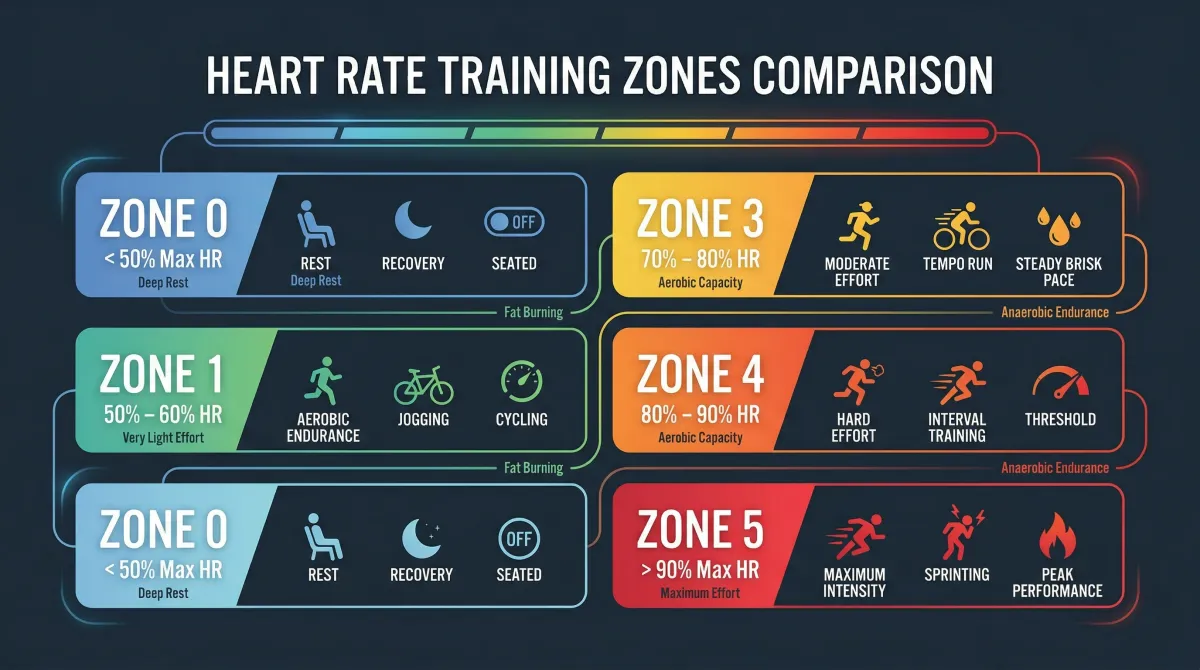
Zone 0 training is any movement that keeps your heart rate below 50% of its maximum. That's a threshold so low most people hit it walking around the house. The idea borrows from heart rate zone training, which splits exercise intensity into five zones based on percentage of max heart rate. Zone 0 sits beneath all of them. It shouldn't feel like work. If you're breathing hard, you've already gone past it.
Dr. Julia Iafrate, a sports medicine physician at NYU Langone Medical Center, called the concept "a new term for an old concept" — the idea that any physical activity benefits health. What's different about giving it the "zone 0" label is that it treats laziness-adjacent movement as an intentional strategy, not a failure to train hard enough.
And the data backs this up. A 2022 review of studies found that even light-intensity walking was enough to cut post-meal glucose levels compared with continued sitting. That matters for insulin resistance and type 2 diabetes risk. Because low-intensity exercise draws a higher percentage of energy from fat stores than high-intensity training (which runs on glucose), zone 0 movement delivers metabolic benefits that gym workouts don't always match.
Zone 0 training: heart rate below 50% of maximum. Activities include slow walking, gentle cleaning, standing desk work, light yoga. It should not feel like exercise.
Brian Passenti, founder of Altitude Endurance Coaching, puts it bluntly: "Zone zero is an accessible way to increase daily movement without the need for formal workouts or special equipment." His advice: park farther from the shops, take walk breaks during calls, stand and stretch at your desk. Then expand until you're spending hours in zone 0 rather than on the couch. If the gym has never felt like your thing, this is a different door.
What Happens Inside Your Body When You Move Gently
Your autonomic nervous system runs like a car with two pedals. The sympathetic branch is the gas — fight-or-flight, cortisol release, elevated heart rate. The parasympathetic branch is the brake — rest-and-digest, recovery, heart rate deceleration. Hard exercise floors the accelerator. Zone 0 takes the foot off entirely and lets the brake do its job.
Researchers measure parasympathetic activity through heart rate variability (HRV), which tracks the fluctuation in time between consecutive heartbeats. Higher HRV generally means your parasympathetic system is working and your body is recovering well. Lower HRV signals sympathetic dominance: inflammation, stress, less adaptability. A systematic review of 19 studies (screened from 2,041 articles) found that 13 showed a clear link between HRV parameters and overtraining symptoms — connecting autonomic markers to performance decline, fatigue, and hormonal disruption.
One HRV marker called RMSSD (root mean square of successive differences between heartbeats) gives you a direct read on vagal — parasympathetic — tone. When RMSSD drops after exercise and stays low, it means your body's braking system isn't bouncing back. Research on track and field athletes showed that reduced RMSSD tracks with parasympathetic suppression. The same marker has been validated across multiple athletic populations for catching overreaching before it becomes a bigger problem.
Cortisol tells a parallel story from the hormonal side. Dr. Anne Friedlander, an exercise physiologist at Stanford Lifestyle Medicine, describes exercise as "technically a stressor" that spikes cortisol. In measured doses, that's useful — like a vaccine training the immune system. Regular moderate movement teaches the body to fire up a cortisol response, then stand down. But chronic high-intensity training without enough recovery keeps cortisol elevated, which chips away at sleep quality, mood stability, and immune function.
Zone 0 movement is cortisol-neutral. A slow walk doesn't trip the stress response. It does the opposite — switching on the parasympathetic branch and allowing the recovery that hard training shuts down. Stanford's research confirms that practices like yoga and tai chi engage the parasympathetic nervous system directly, with yoga showing a particularly strong cortisol-lowering effect. Zone 0 lives in this same territory — movement gentle enough that it helps rather than blocks your body's natural deceleration systems.
Every minute in zone 0 gives your parasympathetic system room to work without the stress response fighting it. For athletes stacking hard sessions, that gap between workouts is where adaptation actually happens. Without it, you're training without recovering from training.
The Difference Between Going Slow and Going Easy
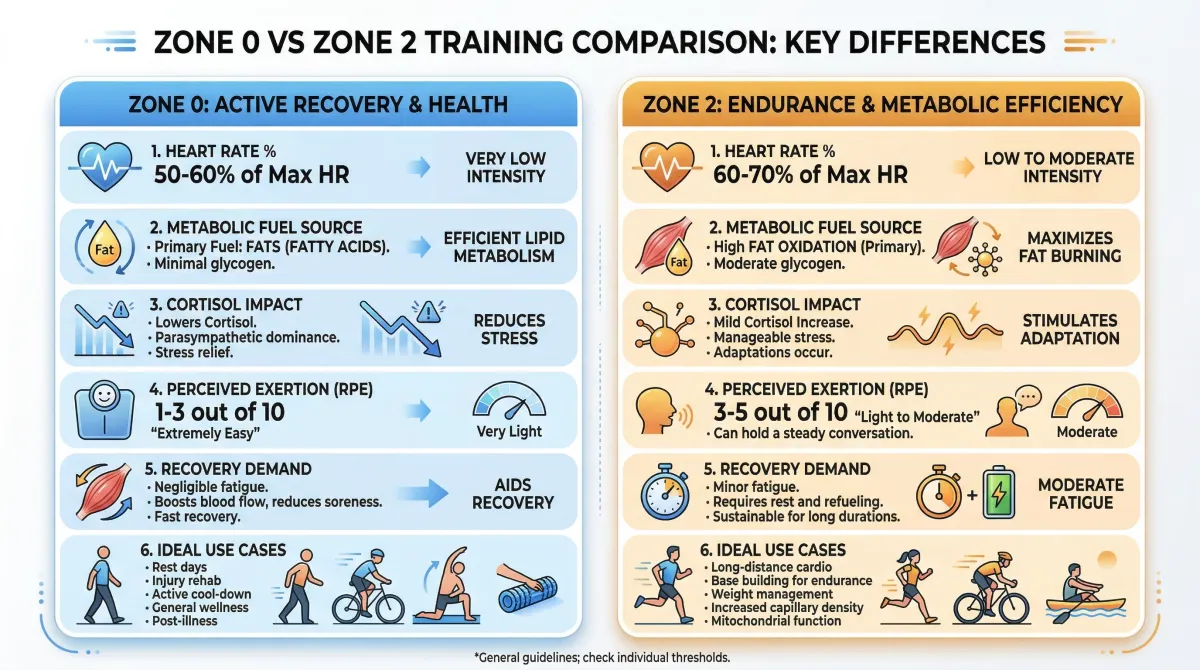
Zone 2 training has dominated endurance talk for the past few years, and the attention is deserved. Training at 60-70% of max heart rate builds aerobic base, improves mitochondrial density, and teaches the body to burn fat during sustained effort. Zone 0 is somewhere else entirely — below 50% of max heart rate, where the metabolic and neurological dynamics shift.
Zone 2 is still training. Your muscles contract against real resistance, your cardiovascular system works above baseline, and your body registers the session as a stress event (even if manageable). Zone 0 doesn't register as stress at all. That's the whole point.
A piece in the European Journal of Applied Physiology noted that full cardiac recovery from high-intensity exercise might take over two days, limiting athletes to two or three well-rested hard sessions per week. That leaves four or five days to fill. Zone 2 is one option. Zone 0 is another, and it serves a different purpose.
Exercise scientist Brady Holmer pointed to research showing that people doing the same structured training but accumulating 5,000 to 7,000 daily steps got better training adaptations than those limited to 2,000 steps. A separate 2021 study found the reverse: cutting daily background steps actually blunted the effects of a high-intensity training program. Zone 0 movement doesn't just avoid interfering with serious training. Without it, structured training produces weaker results.
| Feature | Zone 0 | Zone 2 | Active Recovery |
|---|---|---|---|
| Heart rate | Below 50% max | 60-70% max | 50-60% max |
| Perceived effort | None to minimal | Light to moderate | Light |
| Primary fuel | Fat (predominantly) | Fat + some glycogen | Fat |
| Cortisol impact | Neutral/lowering | Mild temporary spike | Neutral |
| Training stress | None | Low-moderate | Minimal |
| Recovery demand | None | Low | None |
| Best for | Daily movement, recovery | Aerobic base building | Post-workout cooldown |
Dr. Friedlander at Stanford recommends limiting HIIT to one or two sessions per week and following them with restful recovery. Zone 0 fills the remaining days without adding recovery burden. Zone 2 training, while excellent for aerobic development, still needs its own recovery window. The two aren't interchangeable — they serve different physiological purposes, and most people benefit from both.
When Your Body Stops Responding to "More"
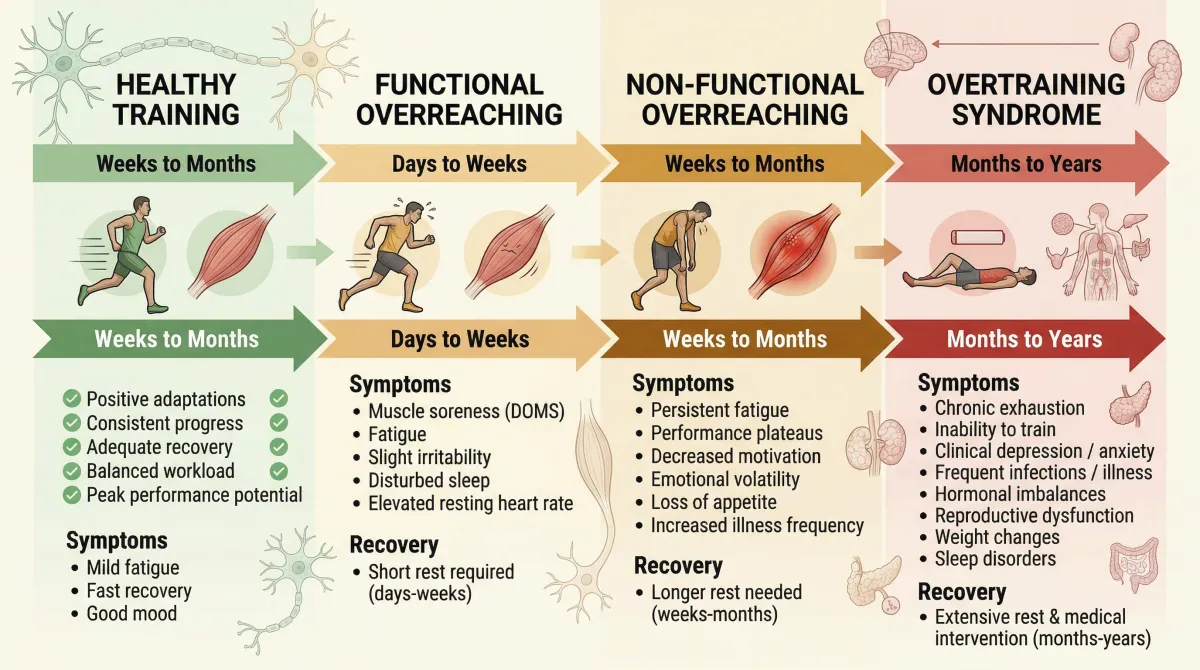
Overtraining syndrome (OTS) isn't just feeling sore after a hard week. It's a medical condition with physical, psychological, and neurological dimensions, and it hits more athletes than people assume. According to the Cleveland Clinic, roughly two-thirds of elite runners experience OTS at some point, and about a third of all competitive athletes run into it regardless of sport.
The Cleveland Clinic breaks OTS into three stages. Stage 1 (functional overtraining) brings mild, easy-to-dismiss symptoms — muscle stiffness, poor sleep, more frequent illness. Stage 2 (sympathetic overtraining) escalates the stress response: insomnia, irritability, elevated resting heart rate, high blood pressure. Stage 3 (parasympathetic overtraining) is the worst and the slowest to recover from — chronic fatigue, depression, total loss of training motivation, and an unusually slow resting heart rate. Coming back from Stage 3 can take months.
The path from overreaching to full OTS follows a timeline that researchers have mapped: functional overreaching clears up within two weeks with supercompensation, nonfunctional overreaching persists for up to four weeks, and overtraining syndrome extends beyond four weeks — sometimes far beyond.
HRV monitoring is one of the clearest early-warning systems available. A study of track and field athletes using HRV markers found that 72.4% showed mild to moderate fatigue indicators (the expected range for trained athletes), 22% showed signs of overreaching, and 5.6% displayed patterns suggesting potential cardiac risk that needed medical attention. That last group — more than 1 in 20 — had pushed past the point where training was building them up.
The HRV narrative review supports this: low HRV relative to someone's baseline points to an autonomic system locked in sympathetic dominance — the same state that defines Stage 2 and Stage 3 overtraining. If your resting HRV has been dropping for weeks and your performance is flat or sliding, those are signals that your body needs less intensity, not more. Zone 0 stops being optional and becomes corrective.
Warning signs you've crossed from training into overtraining: resting heart rate changes (higher or lower than normal), persistent fatigue unrelieved by sleep, mood shifts (irritability, depression, loss of motivation), declining performance despite consistent effort, frequent minor illnesses.
Practical Zone 0: What to Do and How Much
Zone 0 needs no gear, no gym, no plan. But "just move more" rarely changes behavior. Specific routines do.
Terry Tateossian, a personal trainer and nutritionist quoted in the Guardian, recommends starting with "10 to 15 intentional minutes of zone zero a day." Intentional is what matters. Not minutes that happen by accident, but minutes you choose: mobility work while the coffee brews, parking farther from the entrance, a five-minute walk between meetings. These add up. Tacking on a post-meal walk after dinner alone can stack 30 to 45 minutes of zone 0 movement into your day while also helping with glucose management and digestion.
For mind-body work, the tai chi evidence is worth looking at. A randomized controlled trial with 88 college students who reported high perceived stress found that a 16-week tai chi program (three sessions per week, 90 minutes each) produced measurable improvements in perceived stress, sleep quality, somatic anxiety, physical functioning, fatigue, and general mental health compared to controls — all statistically significant (p < 0.05). All from a practice most people would describe as "moving slowly."
A systematic review and network meta-analysis on cortisol reduction found that mind-body practices were the most effective exercise type for lowering cortisol in people with psychological distress. The optimal dose landed around 530 MET-minutes per week — roughly 90 minutes of yoga, tai chi, or gentle walking spread across seven days.
| Zone 0 Activity | Time Required | When to Do It | Primary Benefit |
|---|---|---|---|
| Post-meal walk | 10-15 min | After any meal | Glucose regulation, digestion |
| Morning mobility | 5-10 min | Before breakfast | Parasympathetic activation, joint health |
| Standing desk periods | 30-60 min blocks | During work | Metabolic activity, posture |
| Gentle yoga or tai chi | 20-30 min | Evening or rest days | Cortisol reduction, sleep quality |
| Casual cycling | 15-20 min | Commute or errands | Blood flow, fat oxidation |
| Floor sitting (instead of couch) | Any duration | Evening | Natural mobility, movement variety |
For athletes using zone 0 on rest days, the research points toward replacing total inactivity with gentle movement. Ultra-low intensity movement increases blood flow to muscles without creating extra stress, speeding recovery and reducing inflammation while keeping your metabolism active. An easy walk around the block after a hard training day does more for sore muscles than sitting on the couch — the added blood flow carries oxygen and nutrients to damaged tissue without taxing the systems that need to recover.

The "Lazy" Objection and Why It Misses the Point
The most predictable criticism of zone 0 training is that it's permission to be lazy — a trendy rebrand of doing nothing. This gets the causality backwards. Zone 0 isn't a replacement for hard training. It's the base that makes hard training sustainable.
Stephanie Holbrook, an endurance coach with 16 years of experience, identifies the problem she sees at every level: "the inability to slow down." Athletes default to intensity because it feels productive. Gentle movement feels like cheating. But Holbrook has found that zone 0 is often "the missing piece that unlocks breakthrough performances because it facilitates genuine recovery without contributing to the body's stress response."
The sports psychology research goes beyond anecdote. Work cited in Weinberg and Gould's Foundations of Sport and Exercise Psychology documents how self-regulation and mindfulness interventions reduced burnout in university and junior athletes. A 12-week attentional training program aimed at building mindfulness in Norwegian junior athletes dropped burnout scores compared to a control group. Athletes who learn to dial back effort and build recovery into their routines — even through gentle movement — burn out less. The pattern holds across sports and experience levels.
Autonomic balance data adds the physiological layer. Research shows that high HRV relative to an individual's baseline reflects a healthy, flexible autonomic system with better adaptability and recovery capacity. Low HRV signals a sympathetic-dominant state tied to increased inflammation and reduced performance. Zone 0 training promotes the former. Chronic intensity without recovery produces the latter.
A study comparing CrossFit-style athletes to endurance athletes showed what happens when training skews too hard for too long. The high-intensity functional training group had slower heart rate recovery at every post-exercise time point compared to endurance athletes, along with higher sympathetic activity and lower overall cardiac autonomic modulation during recovery. Their nervous systems weren't bouncing back. They were stuck on the gas pedal.
Zone 0 doesn't make you weaker. Chronic sympathetic dominance does. The fix is deliberate periods where intensity drops to near zero and the parasympathetic system gets space to work. Calling that laziness ignores the autonomic data entirely.

Frequently Asked Questions
Do I need a heart rate monitor for zone 0 training?
No. Zone 0 sits below 50% of maximum heart rate, but the practical test is simpler: if it feels like effort, you're past zone 0. Slow walking, gentle stretching, light housework, and standing desk work all count. A heart rate monitor can confirm you're in range, but it's not necessary. The whole appeal of zone 0 is the lack of barriers.
Can zone 0 training replace regular exercise?
No, and it shouldn't try to. Zone 0 lacks the intensity to build cardiovascular fitness, muscular strength, or meaningful aerobic adaptations. It's a supplement — filling gaps between harder sessions, supporting recovery, and adding daily movement volume. Research on training adaptations consistently shows that structured intensity is required for fitness gains. Zone 0 makes those gains stick by giving your body the space to recover from them.
How much zone 0 movement should I aim for daily?
Start with 10-15 intentional minutes and grow from there. Research on daily step counts suggests that 5,000 to 7,000 steps per day (much of which falls into zone 0) correlates with better training adaptations compared to lower counts. For general health, more daily movement at any intensity tracks with lower all-cause mortality. There's no ceiling where zone 0 becomes harmful — you can't overtrain at this intensity.
Is zone 0 the same as rest days?
Not quite. A rest day usually means no structured exercise, which often defaults to sitting around. Zone 0 fills rest days with gentle movement that aids recovery without creating training stress. Research on active recovery shows that even minimal movement boosts blood flow to muscles, delivering oxygen and nutrients that speed repair. Zone 0 on a rest day means you're still recovering, just doing it better than you would from the couch.
Who benefits most from zone 0 training?
Athletes showing signs of overreaching — declining performance, persistent fatigue, suppressed HRV — who need to dial back training stress without going sedentary. Beginners who find regular exercise intimidating and want a non-threatening entry point. And anyone dealing with chronic stress, burnout, or elevated cortisol, since zone 0 movement activates the parasympathetic nervous system without loading more stress onto the body.
Medical Disclaimer
This article is for informational and educational purposes only and is not medical advice, diagnosis, or treatment. Always consult a licensed physician or qualified healthcare professional regarding any medical concerns. Never ignore professional medical advice or delay seeking care because of something you read on this site. If you think you have a medical emergency, call 911 immediately.