What Makes Padel Different from Tennis and Squash
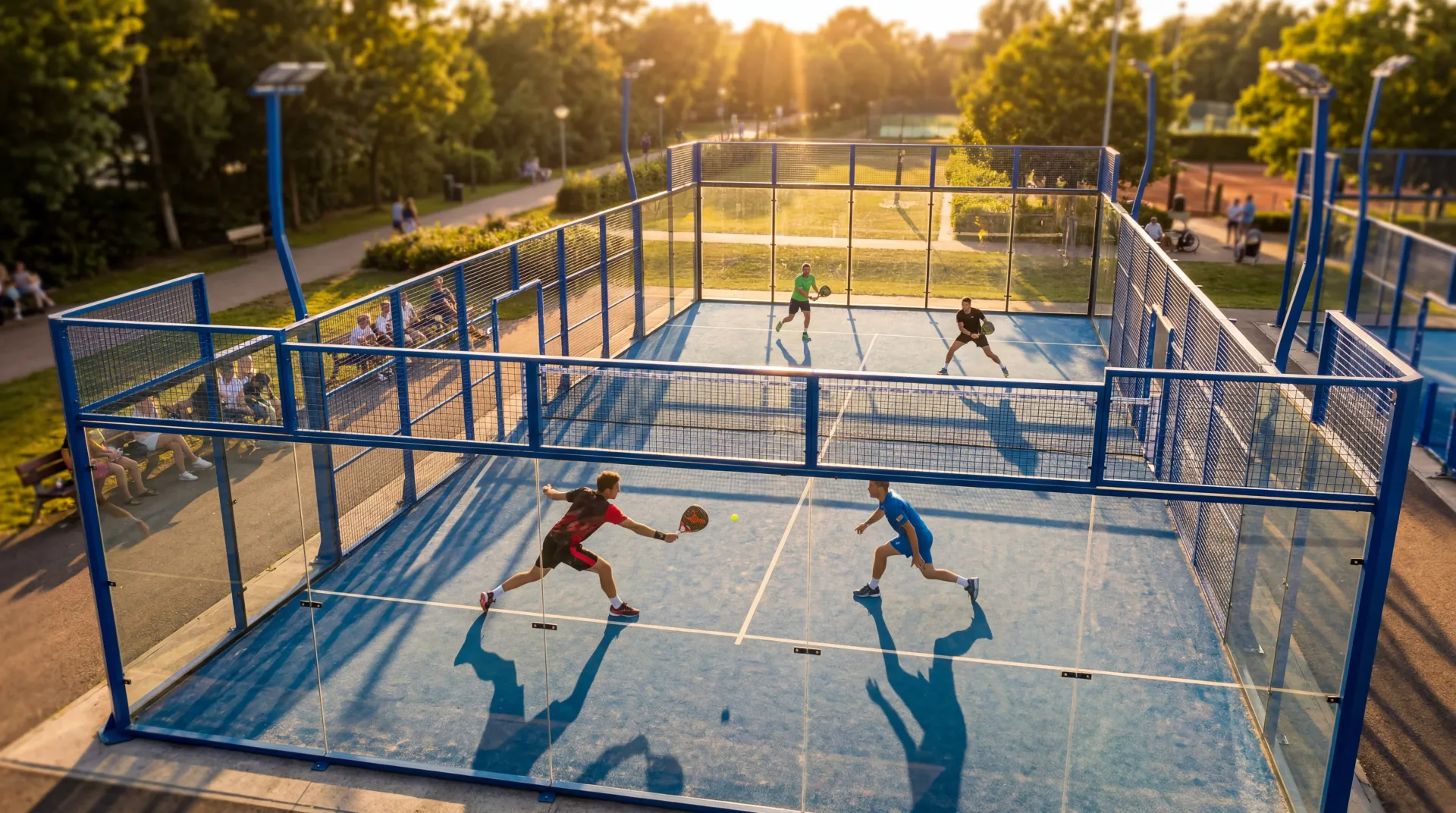
Enrique Corcuera built the first padel court in his backyard in Acapulco, Mexico in 1962. He wanted a racquet sport his family could enjoy without chasing balls into the neighbor's garden, so he walled in the court. That improvised solution became padel's defining feature: a 20-by-10-meter enclosed playing area with synthetic glass and metal walls that keep the ball in play.
The walls change everything. When a ball strikes glass or mesh, it bounces back into play, creating rallies that average 4 to 6 strokes per point at recreational level. Tennis rallies, by comparison, tend to end faster because the ball sails past the baseline. Think of padel walls like bumpers on a bowling lane: they keep beginners in the game while adding a tactical layer for experienced players who learn to use angles off the glass.
The court itself is roughly three-quarters the size of a standard tennis court, and every match is doubles. Two features that matter: less ground to cover per player and a built-in social component. All serves are underarm, which removes the overhead serve's shoulder stress and makes the sport accessible from day one. Tom Murray, the LTA's head of padel, told the Guardian that "many players can rally and play points from their very first session."
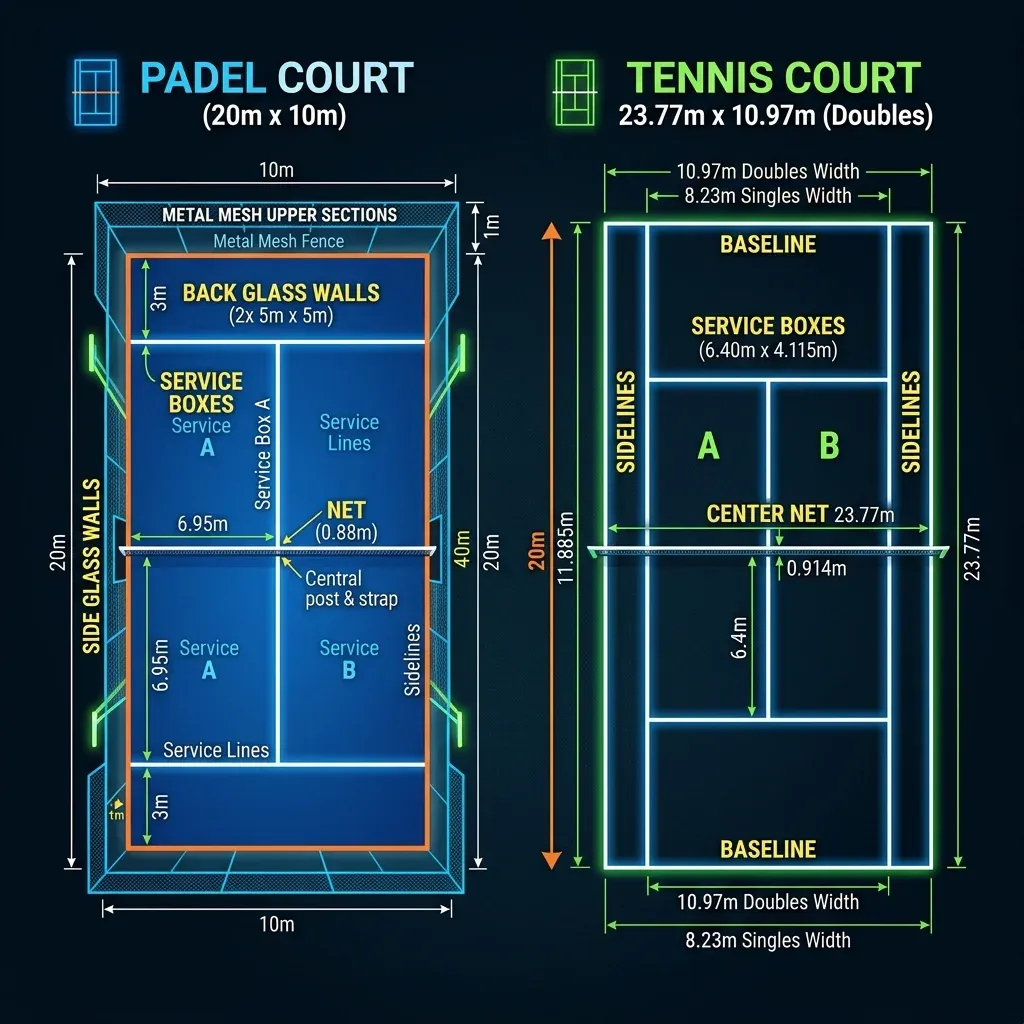
Movement patterns reflect that smaller playing surface. Research published in the journal Sports found players cover 8 to 12 meters per point and 2,500 to 3,500 meters per match, with short-distance sprints predominantly forward and sideward at average velocities between 0.60 and 1.70 m/s. The result is a sport that sits between squash's anaerobic intensity and pickleball's gentler pace.
What does this mean for someone choosing between racquet sports? Padel delivers continuous physical engagement without the punishing baseline sprints of tennis or the explosive lunging of squash. If you've avoided racquet sports because you couldn't consistently serve or spent more time retrieving balls than hitting them, padel's walled court and underarm serves remove those barriers.
The Numbers Behind Padel's Global Explosion
The International Padel Federation's 2025 World Padel Report counted over 35 million active players worldwide, spread across 150 nations and 20 dependent territories. The same report documented 77,300 courts globally, with 14,355 built in 2025 alone. Clubs surpassed 24,600, up 4,775 from the previous year. Federation membership grew 42% year-over-year.
Those raw numbers gain context when you look at individual markets. In the UK, 860,000 people played padel at least once in 2025, according to LTA figures reported by the Guardian. That's up from 400,000 in 2024 and 129,000 in 2023. The number of UK courts grew from 69 when the LTA assumed governance in 2020 to 1,553 across 559 venues by the end of 2025.
Across the Atlantic, the United States passed a symbolic milestone: its 1,000th padel court, located at Thesis Hotel in Coral Gables, Miami. Padel now has a presence in 37 US states, having been virtually unknown five years ago. The United States Padel Association expects 20,000 courts and 15 million players by 2030.
The professional side is attracting serious investment. The Pro Padel League, the only professional padel league in the world, saw teams valued in the tens of millions: the Los Angeles Beat sold for a reported $10 million, while the Toronto Polar Bears, partly owned by Edward Rogers, reached a $25 million valuation. The league raised $15 million in a Series A funding round led by Charlotte Hornets co-chairman Rick Schnall.
FIP tournaments grew from 182 in 2024 to 290 in 2025, involving over 11,000 athletes. The sport will be a medal event at the 2027 European Games in Istanbul, which the International Padel Federation called "a fundamental step on the pathway towards Olympic participation." Nine new padel clubs now open somewhere in the world each day.
Cardiovascular and Metabolic Benefits of Playing Padel
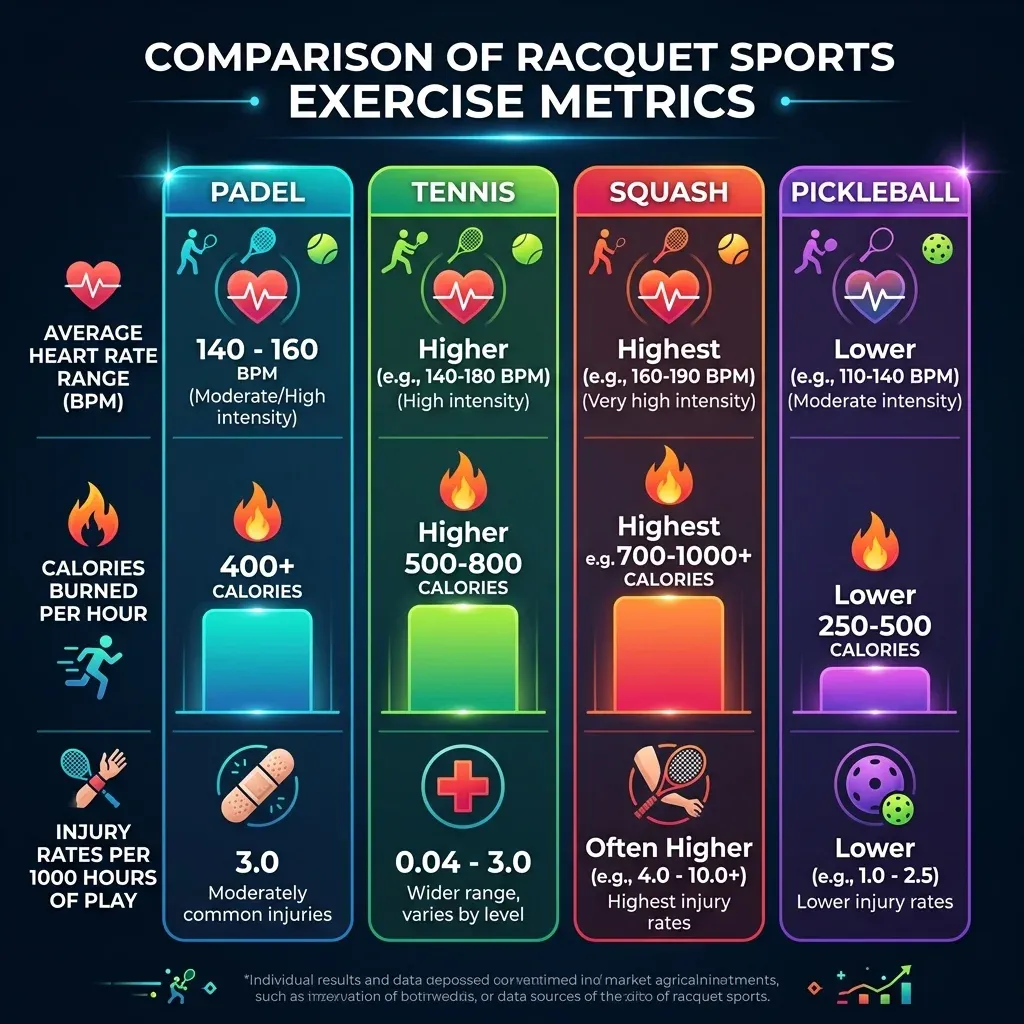
A narrative review published in International Journal of Environmental Research and Public Health analyzed padel's physiological demands and found that players maintain a mean heart rate of 140 to 160 beats per minute during matches, which corresponds to 70-80% of maximal heart rate. Their mean oxygen consumption ran at 40-50% of VO2max. Both figures are lower than those recorded in tennis, squash, and badminton, making padel what researchers describe as a moderate-intensity intermittent sport.
That moderate intensity is the point, not the limitation. The World Health Organization recommends 150-300 minutes of moderate-intensity activity per week for adults. A typical recreational padel habit of 2-3 sessions per week, 60-120 minutes each, puts players comfortably within that window. Francisco Pradas, a sports science researcher at the University of Zaragoza, told National Geographic that padel's "intermittent and aerobic nature" makes it attractive from a health perspective because "it involves the metabolism of glucose and fats."
The fitness benefits extend beyond cardiovascular conditioning. Research cited by National Geographic found that padel practice improves sprint speed, hand grip strength, and spinal stability through increased lumbar isometric strength. A study by Courel-Ibáñez and colleagues, reviewed in the PMC narrative review, showed that women who practiced padel regularly had greater body balance, explosive power, abdominal endurance, and cardiovascular capacity compared to sedentary controls. They also measured lower waist-to-hip circumference ratios.
Padel is interval training where someone else controls the intervals. The ball dictates when you sprint, pivot, and recover. Points last 10 to 15 seconds on average with roughly equal rest between them (work:rest ratio of 1:1.13 to 1:1.41). Your body alternates between aerobic baseline effort and short anaerobic bursts, building both endurance systems simultaneously. The LTA estimates a typical game burns over 400 calories.
For anyone who finds treadmill running monotonous or gym routines hard to sustain, padel's structure matters. You're getting interval training without watching a timer. The game creates the exercise stimulus, and the social element (your partner and opponents) provides the accountability that keeps you coming back.
Why Padel Causes Fewer Injuries Than Other Racquet Sports
A 2023 systematic review in BMJ Open Sport & Exercise Medicine examined eight studies covering 2,022 padel participants and found an incidence rate of 3 injuries per 1,000 hours of padel training. For comparison, a systematic review by Pluim and colleagues found tennis injury incidence ranging from 0.04 to 3.0 injuries per 1,000 hours. The overlap in those ranges is important: padel's injury rate is comparable to tennis at the training level, not dramatically higher or lower.
| Sport | Injury Rate (per 1,000 hours) | Most Common Injury Site | Typical Intensity |
|---|---|---|---|
| Padel (training) | 3.0 | Elbow | Moderate (70-80% max HR) |
| Padel (matches) | 8.0 per 1,000 matches | Elbow | Moderate-vigorous |
| Tennis | 0.04–3.0 | Shoulder/elbow | Vigorous |
| Squash | Higher (limited data) | Lower limb | Very vigorous |
Where padel does differ is in injury type and mechanism. The BMJ review identified the elbow as the most common anatomical site of injury, with tendinous and muscular injuries being the most reported types. Epicondylitis (tennis elbow) topped the specific diagnoses. The narrative review by Sánchez-Alcaraz and Courel-Ibáñez, published in PMC, found similar patterns: across studies examining 478 injuries, the injury rate was 2.75 per 1,000 hours, with muscle-tendinous injuries predominating.
The reason padel tends to be kinder on the body than tennis or squash comes back to court design. George Thomas, a former tennis coach now working at UK retailer Padel HQ, explained to National Geographic: "It's usually doubles based so there's less distance to cover, and often less heavy lateral movement, so it can feel a bit kinder on the joints." No overhead serves mean less rotator cuff strain. The smaller court means fewer full-sprint recoveries.
That said, padel is not injury-proof. The BMJ review found overall injury prevalence ranging from 40% to 95%, depending on the study. A concerning finding from the PMC review: fewer than 30% of amateur padel players perform joint mobility exercises, stretching, or specific strength work. Francisco Pradas told National Geographic that injuries are typically non-serious and can be mitigated by proper warm-ups, cool-downs, and choosing adequate equipment. The repetitive forehand motion is the main culprit for elbow problems, particularly among beginners using poor technique.
Padel's lower physical demands reduce injury risk, but they don't eliminate it. Warm up before playing, learn proper forehand mechanics early, and add basic forearm strengthening to your routine. Those three habits address the sport's main vulnerability.
The Social Side: How Padel Doubles as Mental Health Support
The Copenhagen City Heart Study followed 8,577 people for up to 25 years and found that sports involving social interaction were associated with the longest life expectancy gains. Tennis topped the list at 9.7 additional years compared to sedentary individuals, followed by badminton at 6.2 years. Solitary activities like jogging (3.2 years) and health club workouts (1.5 years) ranked lower. The researchers noted that "leisure-time sports that inherently involve more social interaction were associated with the best longevity."
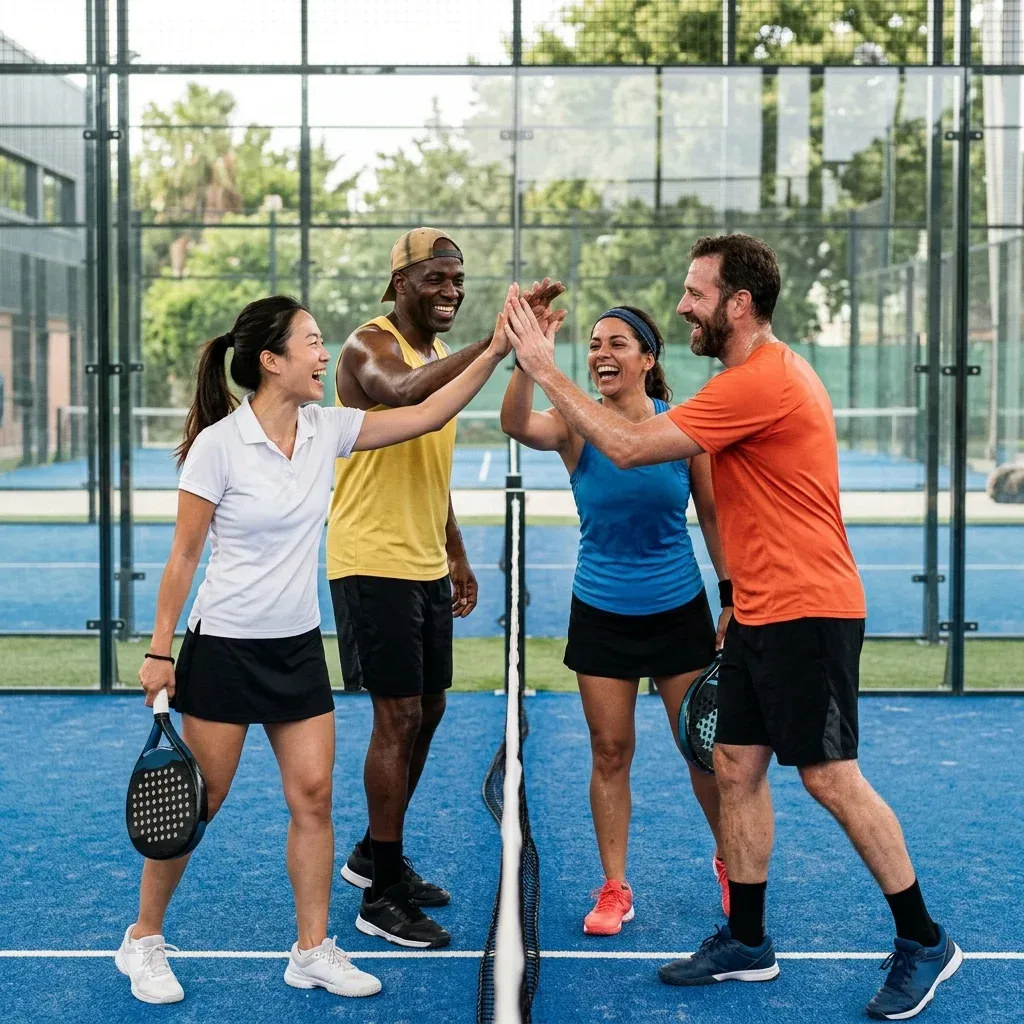
Padel is social by design. Every match requires four people. You share a court half the size of a tennis court with a partner, making verbal communication and tactical coordination constant. There's no singles format to retreat into. This built-in social structure may partly explain why a 2025 systematic review in Frontiers in Psychology, which analyzed 14 studies involving 1,403 participants, found that racquet sport participation was positively associated with happiness (r = 0.263, p < 0.001) and negatively associated with depression (r = −0.23, p < 0.01).
The mental health dimension goes beyond mood. Pradas and colleagues at the University of Zaragoza measured brain-derived neurotrophic factor (BDNF) in 24 trained padel players before and after simulated competition. BDNF is a protein that supports the growth and survival of brain cells, and exercise-induced increases are linked to improved memory and cognitive function. In female players, BDNF levels rose from 1,531 to 1,769 ng/mL after padel competition, a statistically significant increase. The researchers described padel as a "cognitively demanding activity where players must make decisions in a complex environment under time pressure."
The systematic review also found that padel players reported higher self-confidence than tennis players in a comparison of 291 padel players and 132 tennis players. Female padel players showed lower state anxiety than their tennis counterparts. Fun rated as the strongest motivational factor, with motivation correlating strongly with perceived psychological health benefits (r = 0.74) and enjoyment (r = 0.71).
The LTA notes that padel triggers the release of dopamine, endorphins, and serotonin, the same neurochemical response you'd get from any vigorous exercise. What padel adds is context: you're producing those chemicals while communicating with a partner, reading opponents, and making rapid tactical decisions. The cognitive load keeps your brain engaged in ways that a solo jog doesn't replicate.
Researchers don't fully agree on how much of these benefits come from padel specifically versus racquet sports generally, or even exercise in general. The systematic review noted that mental health research on padel is still emerging, with most wellbeing studies focused on pickleball among older adults. That gap is worth acknowledging. But the consistent signal across the available evidence is that padel combines physical exertion, cognitive demand, and social interaction in proportions that mental health researchers find promising.
How to Find a Court and Start Playing
Finding a court remains padel's biggest practical barrier. Brittany Dubins, the first US padel player to win a CUPRA FIP Tour tournament, told National Geographic: "While it's extremely popular all over Spain, in the US it depends on which city you are in. Miami, NYC, San Diego, Austin have courts. But other places still confuse it with padel tennis, pickle, or simply haven't heard of it yet."
Court access is expanding rapidly, though. The United States Padel Association (USPA) maintains an interactive club map on padelusa.org showing locations across the country. Playtomic, a global racquet sports booking platform, lists padel courts alongside tennis and pickleball facilities. In the US, roughly 30% of padel courts share facilities with pickleball, so checking your local pickleball venue is a reasonable starting point.
| Resource | What It Offers | Best For |
|---|---|---|
| USPA Club Map (padelusa.org) | Interactive map of US padel venues | Finding courts by location |
| Playtomic App | Global court booking platform | Reserving court time, finding players |
| LTA Padel (UK) | Court finder + beginner resources | UK-based players |
| Local pickleball/tennis clubs | May have or be adding padel courts | Areas without dedicated padel venues |
Cost varies significantly by location. In the US, court bookings can run upward of $35 per session, which splits to roughly $9 per person for doubles. In the UK, the average off-peak booking costs about £7 per person per hour based on four players sharing. Equipment costs are modest: a beginner padel racket runs $40-80, and standard tennis balls work for casual play.
For true beginners, group coaching sessions offer the fastest on-ramp. Most padel clubs offer introductory sessions where staff can pair you with other beginners. The LTA recommends speaking to your local club about group sessions or partner-matching services. The US National Padel league ran its debut amateur tournament across 37 cities with 160+ teams, suggesting a growing organized recreational scene.
One practical consideration: padel generates more noise than tennis due to the ball striking glass and metal walls. Some UK communities have pushed back against new court construction over noise concerns. If you're evaluating a venue, outdoor courts near residential areas may have restricted evening hours. Indoor courts avoid the issue entirely.
Frequently Asked Questions
Is padel easier than tennis for beginners?
Padel has a lower skill floor than tennis. The underarm serve removes the most technically difficult shot in tennis, and the enclosed court keeps balls in play longer, so beginners spend more time hitting and less time retrieving. The LTA reports that most new players can sustain rallies from their first session. The tradeoff: padel's ceiling is high, with advanced wall play and tactical positioning taking years to master.
How many calories does padel burn per hour?
The LTA estimates a typical padel game burns over 400 calories. Research shows players maintain heart rates at 70-80% of their maximum during matches, placing padel firmly in the moderate-intensity exercise category. Actual burn varies with playing intensity, body weight, and match duration. Most recreational sessions last 60-90 minutes.
What equipment do I need to start playing padel?
A padel racket (shorter than a tennis racket, with no strings and a perforated solid face), padel balls (similar to tennis balls but slightly less pressurized), and athletic shoes with non-marking soles. Beginner rackets cost $40-80. Many clubs offer rental rackets for first-time players, so you don't need to buy anything to try the sport.
Can older adults play padel safely?
Padel's moderate intensity and adjustable pace make it suitable for a wide age range. The systematic review in Frontiers in Psychology included players from age 15 to over 80. Padel peaks in popularity among adults aged 35 to 43, but the doubles format and enclosed court mean experienced older players can remain competitive by relying on positioning and wall play rather than raw athleticism.
Is padel bad for your elbows?
The elbow is padel's most commonly injured body part, with epicondylitis (tennis elbow) the most frequent specific diagnosis. However, researchers note these injuries are typically non-serious and preventable with proper technique, warm-ups, and appropriate equipment. Beginners should focus on learning correct forehand mechanics and consider forearm strengthening exercises as prevention.
Medical Disclaimer
This article is for informational and educational purposes only and is not medical advice, diagnosis, or treatment. Always consult a licensed physician or qualified healthcare professional regarding any medical concerns. Never ignore professional medical advice or delay seeking care because of something you read on this site. If you think you have a medical emergency, call 911 immediately.