The Pre-Workout Industry's Blind Spot
Walk into any nutrition store and the pre-workout formula has barely changed in fifteen years. Caffeine. Beta-alanine. Citrulline. Creatine. A flavored powder that floods the bloodstream with stimulants and amino acids before training. Grand View Research pegged the global pre-workout supplements market at $19.58 billion in 2024, with a 5.9% CAGR forecast through 2030, and North America takes 35.1% of that revenue.
A 2025 integrative review in the Journal of Cardiovascular Development and Disease tracked the ingredient profile across 24 multi-ingredient pre-workout studies. Caffeine appeared in 22 of 24 formulas. Jagim and colleagues' 2019 user survey found beta-alanine in 87% of products, citrulline in 71%, and creatine in 49%. That is the template the industry has built around — minor flavor differences, proprietary-blend gimmicks, the same chemistry underneath.
The chemistry also runs hot. Pilegaard's 2022 observational study of 63 gym-goers traced 53% of all reported adverse effects to pre-workout supplements. A separate 872-user survey reported palpitations in 23.4%, nausea in 26.6%, and dizziness in 14.7%, and Knapik's 2022 survey of 2,005 US military service members on standard formulas found palpitations in 11% and tremors or seizures in 1.5%. The case-report literature includes elevated troponin, tachycardia, and a rhabdomyolysis tied to a multi-ingredient pre-workout.
None of this is new. The industry has known about it. What it didn't see coming was a different exit ramp. Around 2022, a small Dublin company called Nuritas started publishing peer-reviewed trials on a fava bean peptide hydrolysate that did things to muscle caffeine cannot. By the end of 2024 the company had closed a $42 million Series C, and major MIPW brands — FINAFLEX, EFX Sports, BPI Sports, the names Grand View Research lists as category leaders — had no equivalent ingredient in their pipelines. The disruption arrived through a regulatory door the industry doesn't usually watch.
PeptiStrong: The Fava-Bean Disruptor
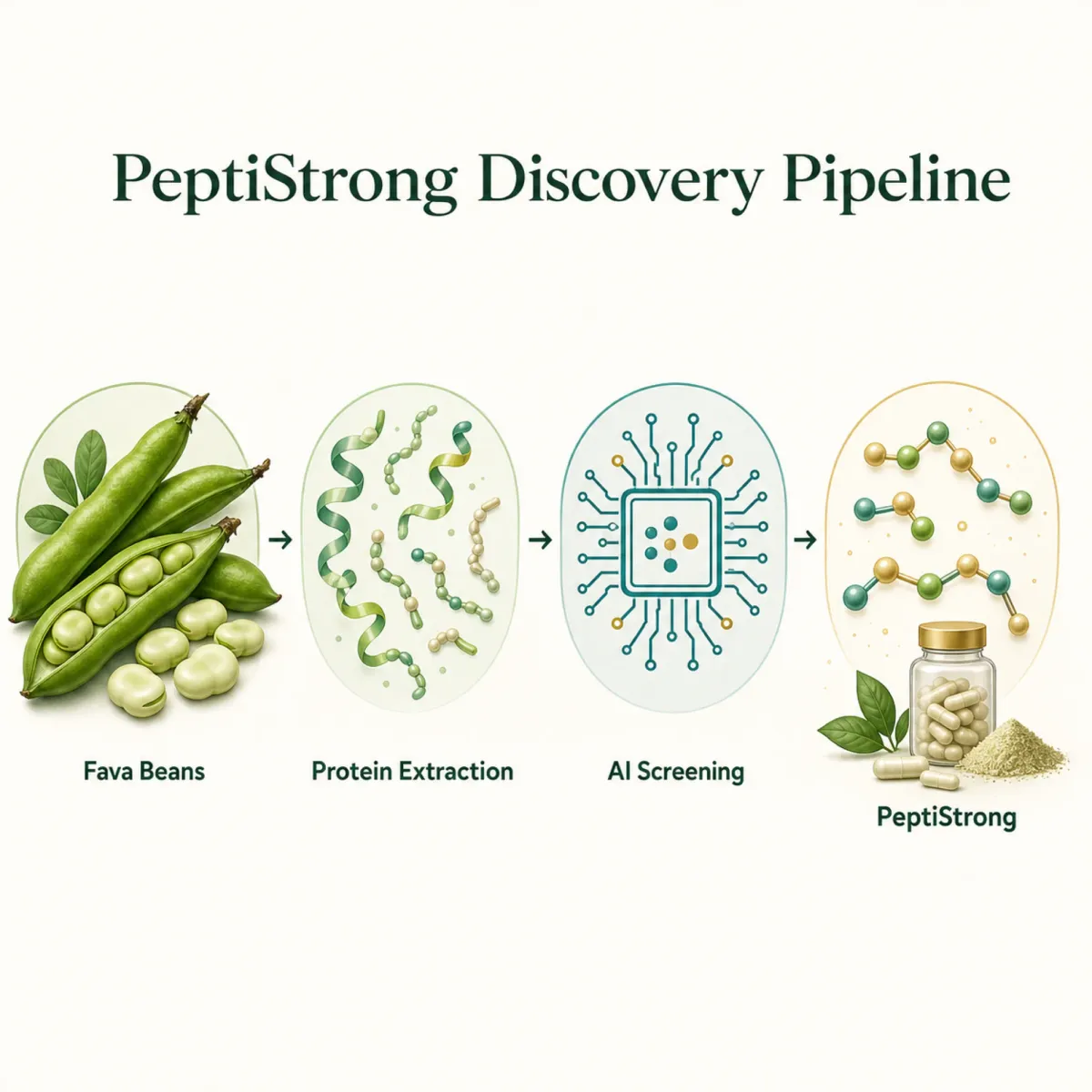
PeptiStrong is what happens when a machine-learning platform reads through the entire peptide content of a fava bean and asks which short sequences hit a specific molecular target. Nuritas calls the platform Magnifier. Two peptides survived its in vitro filters: a ten-amino-acid sequence called HLPSYSPSPQ that increases muscle protein synthesis in cultured cells, and an eight-amino-acid sequence called TIKIPAGT that suppresses TNF-alpha release. Both peptides survived simulated stomach digestion and stayed stable in human plasma. That last detail matters because oral peptides usually don't.
The first human trial landed in Nutrients in 2023. Researchers at the Sports Surgery Clinic in Dublin (NCT05159375) randomized 30 healthy men aged 30 to 45 to 2.4 grams per day of NPN_1 — Nuritas's R&D code for PeptiStrong — or a microcrystalline-cellulose placebo. After 14 days of pre-loading, participants performed a maximal-effort isokinetic protocol designed to provoke muscle damage. The peptide group recovered significantly faster (p = 0.027 on torque per body weight). Fatigue dropped (p = 0.041). The biggest biomarker shift: myostatin, the protein that brakes muscle growth, fell with strong significance (p = 0.006).
The second trial scaled up. A 72-person double-blind RCT conducted by KGK Science and published in BMJ Nutrition, Prevention & Health in 2025 ran men and women aged 19 to 40 on the same 2.4-gram daily dose for eight weeks of resistance training. The PeptiStrong group gained 22% more muscular endurance than placebo, plus significant leg strength and a 0.7% increase in bone mineral content. The myokine analysis found PeptiStrong modulated biomarkers tied to blood-sugar control, bone formation, and mitochondrial function — a wider effect surface than caffeine touches.
The regulatory move is what really shifts the industry. Nuritas filed FDA GRAS Notification No. 1166 covering 2.4 grams per serving across food applications: dry-blend powders, meal-replacement bars, milk analogs, ready-to-drink beverages, gummies, and baked goods. The supplement industry isn't built to ship into baked goods. Big food is. The published data, importantly, does not show acute single-dose pre-workout effects — both RCTs used chronic daily supplementation, and the "pre-workout peptide" framing is partly industry-generated.
Creatine and Collagen Peptides: A Quiet Repositioning
PeptiStrong is the new entrant. The category-defining moves around it are quieter — older peptide ingredients getting repositioned into the pre-workout window.
Hydrolyzed collagen peptides have been circling sports nutrition for a decade, mostly in the joint-and-tendon category. The 2024 integrative review in Nutrients looked at eight RCTs covering 286 participants and concluded that low-molecular-weight collagen peptides between 2,000 and 3,500 daltons attenuate muscle stress from acute strenuous resistance training. Two larger RCTs nail down the specifics. University of Vienna researchers ran 55 sedentary men on 15 grams per day of specific collagen peptides plus 12 weeks of concurrent training, then induced muscle damage with 150 drop-jumps. Recovery of maximum voluntary contraction was significantly faster (p = 0.02), as was rate of force development (p < 0.01) and countermovement jump height (p = 0.046). A separate RCT at Freiburg ran 32 trained men and tracked endurance. The 1-hour running time-trial climbed 1,727 meters in the collagen group versus 1,018 meters in placebo, with significant gains in lactate-threshold velocity (p ≤ 0.05) and anaerobic threshold (p ≤ 0.01).
What's interesting is what didn't move. Body composition didn't shift in the Vienna trial. Muscle soreness didn't improve. The benefit landed on biomechanical performance rather than muscle mass or subjective pain. The proposed mechanism: glycine-and-proline-rich collagen fragments may bind alpha7-beta1 integrins on muscle fibers, triggering reorganization of the intramuscular connective tissue that transmits force to bone. Caffeine, beta-alanine, and creatine don't touch that pathway.
Creatine peptides are a noisier story. Manufacturers market creatine HCl and creatine peptides as superior pre-workout forms; the published comparisons don't bear that out. A 2024 head-to-head study found creatine HCl no more effective than monohydrate. Creatine ethyl ester research shows it performs no better than placebo. The original timing study points the other direction. Antonio and colleagues randomized 19 male recreational bodybuilders to 5 grams of creatine immediately before vs. immediately after training over four weeks, and found post-workout creatine "likely beneficial" for 1-RM bench press and "possibly beneficial" for fat-free mass compared with pre-workout dosing. Creatine peptides as a pre-workout differentiator are largely a packaging story.
The practical takeaway: collagen peptides earn their pre-workout slot only across weeks of consistent dosing, and creatine in any form probably belongs after the workout, not before.
Why Synthetic GHRPs Were Never the Answer
Spend any time in bodybuilding forums and you've seen the other peptide pre-workout culture: GHRP-2 stacked with GHRP-6 thirty minutes before training, hexarelin shots, ipamorelin and CJC-1295 daily. These are synthetic growth-hormone-releasing peptides that bind ghrelin receptors in the pituitary and trigger a pulse of growth hormone. The mechanism works. The legal situation does not.
The U.S. Anti-Doping Agency confirms growth hormone sits on the WADA Prohibited List as an Anabolic Agent, prohibited at all times for elite, junior, and masters-level athletes. Growth-hormone-releasing factors are also banned. Off-label sale of growth hormone is a felony under the Food, Drug, and Cosmetic Act per a Drug Enforcement Agency statement. Healthline's catalog of growth-hormone-secretagogue peptides — sermorelin, tesamorelin, CJC-1293, CJC-1295, ipamorelin, anamorelin, lenomorelin, macimorelin, tabimorelin, GHRP-1 through GHRP-6, hexarelin, alexamorelin — confirms all of them are WADA-banned. None have FDA approval for the uses they're sold under.
BPC-157 is a separate case. USADA confirms it sits on the WADA list under S0 Unapproved Substances. The FDA confirmed no legal basis for compounding pharmacies to use BPC-157. Its clinical trials appear cancelled or stopped without published conclusions; no one knows if there is a safe dose. The gray market continues selling it as a "research chemical not for human use" while suggesting human dosing on the same page.
Reported side effects from synthetic GHS peptides include increased appetite, elevated blood sugar, fluid retention, and decreased insulin sensitivity. USADA adds increased intracranial pressure, retinal damage in people with diabetes, hypothyroidism, pancreatitis, and downregulation of endogenous growth hormone. The plain rule: if a product claims to release growth hormone, raise IGF-1, or uses any name from the GHRP roster, it is WADA-banned and probably illegal as a U.S. dietary supplement. PeptiStrong and hydrolyzed collagen are not on that list because they don't touch the growth-hormone axis at all.
Different Molecules, Different Targets
Conventional pre-workout ingredients hit acute energy systems within minutes. Caffeine antagonizes adenosine receptors and allows for the release of catecholamines. Beta-alanine bumps muscle carnosine over weeks of dosing, then buffers hydrogen ions when intensity spikes. Citrulline converts to arginine and feeds the nitric oxide pathway. Creatine increases phosphocreatine for fast ATP regeneration. Each targets the energetic side of muscle work — fuel, pH, blood flow.
The peptide ingredients work different layers. PeptiStrong's signature outcome was suppression of myostatin (p = 0.006) plus increases in markers regulating muscle protein synthesis, regeneration, and myoblast differentiation. Myostatin is the brake on muscle growth — lifting it doesn't change today's bench press, it changes how much muscle gets built across weeks. Collagen peptides feed connective-tissue scaffolding via a glycine-and-proline profile that matches extracellular matrix synthesis, unlike the leucine-rich profile of whey. The proposed signaling pathway runs through alpha7-beta1 integrin engagement; collagen accounts for roughly 30% of total body protein, so the connective-tissue fraction is not a rounding error.
Two implications. Peptide ingredients don't replace caffeine for the same-day kick — caffeine still does that best. They fill a different gap: building the connective tissue and signaling that lets the body train harder over months. The major MIPW brands haven't been designing for that target.
Where the Money Started Moving
The clearest sign that the supplement establishment underestimated this trend is who actually wrote the checks. Nuritas closed a $42 million Series C in December 2024, led by M&G Investments and joined by McWin Capital Partners — a private equity firm focused on the food ecosystem, not supplements. Grosvenor and ECBF returned. The earlier Series B raised $45 million. The capital is coming from food and impact investors, pools the traditional sports nutrition industry doesn't track.
The partnership roster is sharper. Nuritas's commercial relationships include Givaudan, Nestle, Mars, and Sumitomo Corporation. None are sports-supplement brands. They are in cereal, baked goods, and functional beverages — exactly where the FDA GRAS Notification No. 1166 lets PeptiStrong land. Dr. Andy Franklyn-Miller, Nuritas's chief medical and innovation officer, said it plainly: "Peptistrong was designed not only for supplements, but the food market, to add health benefits to everyday staples such as cereals, pasta, bread and baked goods".
Major MIPW brands aren't set up to formulate a peptide-fortified cereal for a Walmart endcap or to negotiate with Mars's procurement team. The Nuritas 2025 pipeline includes PeptiControl, PeptiSleep, and three additional clinically validated peptide ingredients designed to slot into food applications. The supplement market is a cluttered $19.58 billion wedge; food and functional beverages are multiples larger, with room for evidence-backed peptides.
What Buyers Actually Need to Look For
The peptide pre-workout category will fragment quickly. Some products will be properly dosed PeptiStrong. Some will be cheap collagen riding PeptiStrong-style claims. Some will be synthetic-peptide gray-market products bent around FDA scrutiny. A few practical filters help.
First, the regulatory marker. The FDA does not regulate the quality, type, or quantity of ingredients in dietary supplements, and products often make false claims about ingredient content or effectiveness. A genuine GRAS notification — Nuritas's Notification No. 1166 is publicly searchable — beats vague "natural" labeling. The number tells you a safety dossier was filed and the FDA registered no objection.
Second, the trial trail. Real peer-reviewed RCTs land in Nutrients, Frontiers in Nutrition, Sports Medicine - Open, BMJ journals, or the Journal of the International Society of Sports Nutrition. They register at ClinicalTrials.gov with an NCT number you can verify — PeptiStrong's first trial is NCT05159375. Independent CROs like KGK Science add separation between manufacturer and data.
Third, the WADA list. USADA recommends athletes avoid any supplement claiming to contain or release growth hormone. If you compete tested, skip any product whose ingredient list includes a "GHRP" prefix, "morelin" suffix, "BPC" prefix, MK-677, or sermorelin/tesamorelin/CJC-1295 by name. USADA confirms BPC-157 is not approved for any human therapeutic use and not legally salable as a supplement.
Fourth, the dose match. PeptiStrong's published trials all use 2.4 grams per day. Specific collagen peptide trials cluster at 15 grams per day. The integrative review found low-molecular-weight collagen at 2,000 to 3,500 daltons performed best. A product claiming peptide benefits at a fraction of the studied dose is decorating the label.
The peptide pre-workout shift is real, and the data is hard to dismiss. The strange part of how it arrived — a Dublin AI startup partnering with Nestle and Mars rather than FINAFLEX or Bang Energy — is exactly why most incumbents missed the lane. The chemistry sits outside their R&D playbook, and the distribution sits outside their retail relationships. The next few years will look like food companies quietly absorbing the peptide trend while supplement aisles slowly catch up.
Frequently Asked Questions
Can you take PeptiStrong as an actual pre-workout, 30 to 60 minutes before training?
The published trials don't test that. Both PeptiStrong RCTs used chronic daily dosing of 2.4 grams for 14 days to 8 weeks. The "pre-workout peptide" framing is partly industry-generated; the evidence supports sustained daily intake for recovery and strength accumulation, not a same-session performance pop.
Are creatine peptides better than creatine monohydrate?
No published head-to-head trial supports that claim. A 2024 study found creatine HCl no more effective than monohydrate. Creatine ethyl ester performs no better than placebo. The 2013 Antonio timing study actually favored post-workout creatine for fat-free mass and bench press 1-RM. Creatine peptides are mostly a marketing differentiator.
Why aren't growth-hormone-releasing peptides used in mainstream pre-workout products?
GHRP-2, GHRP-6, hexarelin, ipamorelin, sermorelin, tesamorelin, CJC-1295 and related growth-hormone-secretagogue peptides are on the WADA Prohibited List as Anabolic Agents at all times. Off-label growth hormone use is a felony under the Food, Drug, and Cosmetic Act per the DEA. BPC-157 sits in the WADA S0 Unapproved Substances category, with the FDA confirming no legal basis for its sale. Mainstream brands cannot include these compounds without federal action and product seizure risk.
What does FDA GRAS status actually mean for a peptide ingredient?
Generally Recognized As Safe is a regulatory determination that a substance is safe for a specific use, either notified to or affirmed by the FDA. Nuritas's GRAS Notification No. 1166 covers PeptiStrong at 2.4 grams per serving across food applications. This is a higher regulatory floor than typical supplements; the notification number is publicly searchable.
How does the peptide category compare to caffeine-based pre-workouts on side effects?
The 2025 integrative review documented palpitations in 11 to 23% of users across multiple MIPW studies, plus case reports of tachycardia, elevated troponin, and rhabdomyolysis. Pre-workout supplements were responsible for 53% of adverse effects reported in one 63-person observational study. Plant-derived peptides like PeptiStrong have not produced equivalent adverse-event signals because they don't antagonize adenosine receptors or release catecholamines. The trade-off: peptide effects accumulate over weeks rather than within an hour.
Medical Disclaimer
This article is for informational and educational purposes only and is not medical advice, diagnosis, or treatment. Always consult a licensed physician or qualified healthcare professional regarding any medical concerns. Never ignore professional medical advice or delay seeking care because of something you read on this site. If you think you have a medical emergency, call 911 immediately.