The claim usually arrives as a screenshot. A personal trainer on a paid newsletter posts his elbow ligament tear, his dosing schedule, and one sentence that travels: "It effectively cut healing time in half for all my injuries." The peptide is TB-500. The injury is one most readers recognize on contact, tennis elbow that will not quit. The screenshot has been forwarded into a thousand group chats and has done what one person's account on the internet does best, which is bypass the part where you ask what the evidence looks like.
The evidence is not what the screenshot suggests. There are zero completed human RCTs of injectable TB-500 for tennis elbow, tendons, ligaments, or muscles. Animal data shows real tendon-strength gains in rats. Equine work shows real ultrasound improvements in racehorses. There is also a chemical-identity problem most readers do not know exists, a 2023 FDA action that ended legal compounding, and a WADA ban that took down 32 athletes in a single Australian football scandal. This article walks all of it.
Why Tennis Elbow Resists Standard Care
Tennis elbow, formally lateral epicondylitis, affects roughly 1 to 3 percent of the population, most heavily between ages 35 and 50. The name is a misnomer twice over. Most cases happen to people who have never picked up a racket, and the suffix "itis" implies inflammation that is mostly absent in chronic presentations. What is happening at the common extensor tendon is closer to a stalled repair than an inflammatory fire. Microtears at the origin of the extensor carpi radialis brevis fail to heal because repetitive wrist extension keeps reinjuring the tissue faster than collagen can lay down.
That biology explains why standard care so often disappoints. NSAIDs block COX-2 enzymes, fine for an acute sprain but counterproductive for a tendon stuck in a degenerative loop. Those same enzymes are required for the inflammation-resolution phase that initiates real repair. Cortisone shots work short-term and fail long-term. A 2019 systematic review summarized by the Banned Substances Control Group found that corticosteroid injections raised re-injury risk roughly 63 percent at 12-month follow-up versus physical therapy or wait-and-see. They suppress inflammation and degrade collagen cross-linking at the same time.
A 2025 RCT in MDPI's Journal of Clinical Medicine compared PRP, corticosteroid, hyaluronic acid, and saline in lateral elbow tendinopathy, with PRP outperforming the other groups on pain and grip strength at one year while the corticosteroid group regressed. That is the gap peptide vendors stepped into. Standard care suppresses pain without rebuilding tissue. Peptides, the marketing argues, do the opposite. Whether that pitch survives contact with the evidence is the question this article keeps returning to.
TB-500: What It Actually Is
The name is misleading. Thymosin Beta-4, abbreviated Tβ4, is a naturally occurring 43-amino-acid peptide first isolated from bovine thymus in the 1980s and encoded by the human TMSB4X gene. Tβ4 is one of the most abundant intracellular proteins in mammalian cells. Its day job is binding monomeric G-actin and regulating the actin cytoskeleton, which puts it at the center of cell motility, wound closure, and angiogenesis. RegeneRx Biopharmaceuticals has run trials on Tβ4 for dry eye disease, neurotrophic keratopathy, and post-infarct cardiac repair, with mixed results.
What is sold online as TB-500 is a different molecule. The spec sheet usually advertises the full 43-amino-acid sequence, but the vial typically contains a much shorter synthetic fragment, most commonly the heptapeptide Ac-LKKTETQ or the tetrapeptide Ac-SDKP. The FDA's bulk-drug-substances notice describes TB-500 as "Thymosin beta-4, fragment (LKKTETQ)," codifying that the marketed compound is the seven-amino-acid fragment, not the parent protein. Vendors and customers cite Tβ4 literature, including dry-eye trials and cardiac studies, as evidence for the injectable TB-500 product. The two are chemically and pharmacologically distinct.
That gap matters more than vendors acknowledge. A 2024 study reported that the parent fragment Ac-LKKTETQ did not, on its own, drive measurable wound-healing activity. The healing effect was attributable to its metabolite Ac-LKKTE. As BSCG summarizes, "the reported wound-healing activity attributed to TB-500 might result from its active metabolite Ac-LKKTE rather than the parent fragment itself." Even if the vial contains exactly what the label claims, the mechanism most users assume is happening may be one or two metabolic steps removed from the molecule they are injecting.
The Half Healing Time Claim
The "half healing time" claim has a single identifiable source. Not a journal article. Not a clinical trial. It is one guest essay published on the BowTied Bull Substack by an anonymous personal trainer who writes under the handle AJAC. AJAC documents using BPC-157 at roughly 300 mcg twice daily and TB-500 at 3 mg twice weekly across four-week cycles, three separate times, for an MCL tear, an elbow ligament tear, and patellar tendinitis. The exact wording: "I had zero side effects from either, and my recovery was rapid. Pain went away and I was able to resume normal training. It effectively cut healing time in half for all my injuries."
That is the entire empirical basis for the most viral statistic in peptide marketing. One person, anonymous, self-reported, no controls, no imaging. Self-report data of this kind cannot distinguish a drug effect from natural healing, placebo response, or concurrent rest, ice, and eccentric loading. The reader is asked to take a single trainer's experience and translate it into an expectation about their own injury.
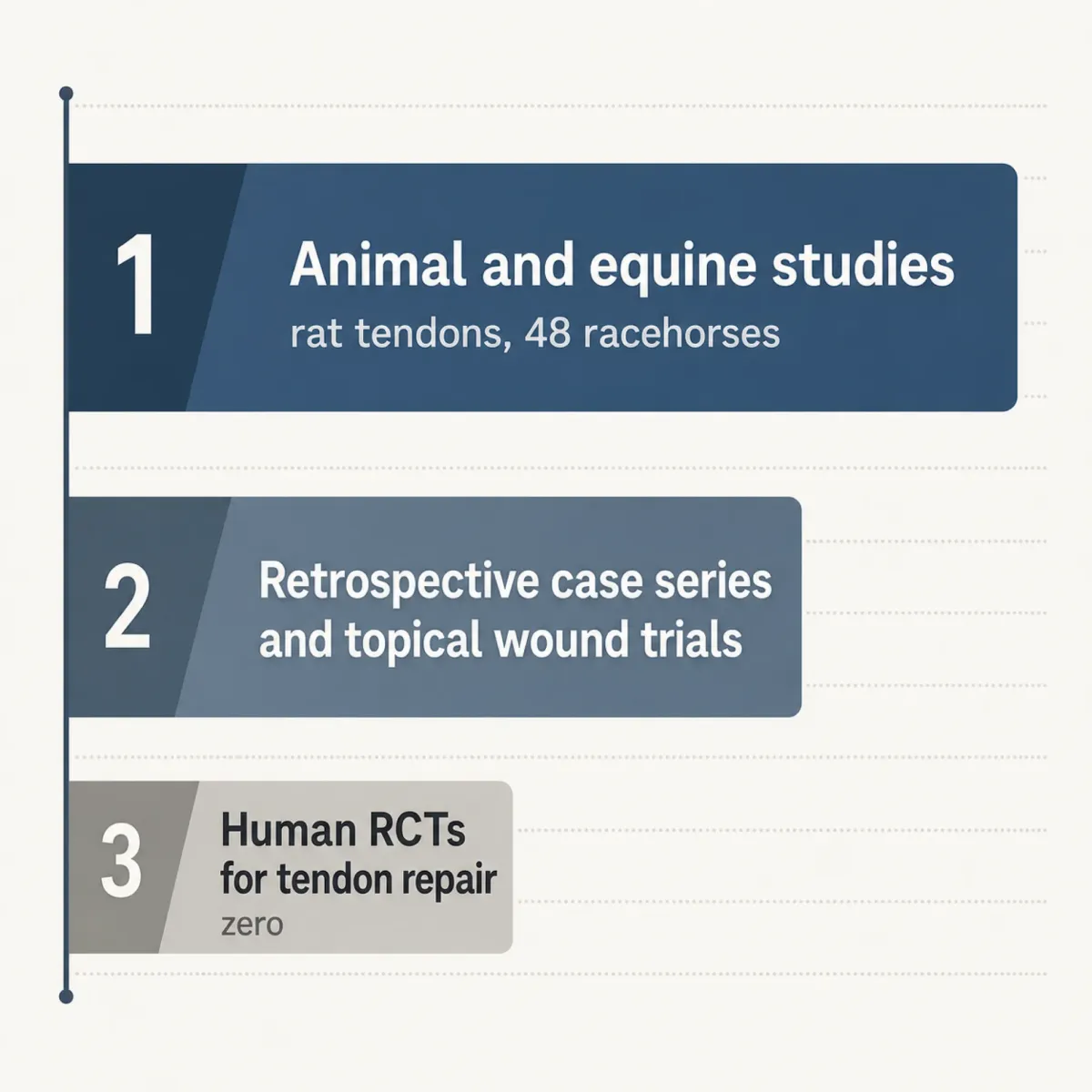
The animal data sits in a different evidential category, real but specific. A 2003 study showed Tβ4 in mice accelerated re-epithelialization versus saline controls. An equine veterinary study tracked 48 racehorses with superficial digital flexor tendon injuries treated with 7.5 mg of TB-500 twice weekly for four weeks. Ultrasound at eight weeks reported 67 percent of treated horses achieved normal tendon echogenicity versus 29 percent in controls, with return-to-racing rates of 58 percent versus 31. Studies in the Journal of Orthopaedic Research reported a 53 percent increase in tendon healing strength at 14 days post-injury. None is a human RCT. None is a tennis elbow RCT. The equine study used a 7.5 mg twice-weekly dose in a 1,100-pound animal, which scales differently than 3 mg twice-weekly in a 180-pound human.
Monotherapy vs the Wolverine Stack
Most users do not take TB-500 alone. The protocol that travels is the Wolverine stack, BPC-157 plus TB-500, named for the Marvel character with rapid tissue regeneration. The pitch is mechanistic complementarity: BPC-157 upregulates VEGF and stimulates local collagen synthesis, while TB-500 acts systemically to free cells to migrate to the wound. Most clinical writers note this is biohacker convention rather than evidence-based protocol. Head-to-head human trials do not exist.
The closest human data comes from a 2021 retrospective case series by Lee and Padgett. Sixteen patients received intra-articular knee injections of BPC-157 alone or BPC-157 plus TB4. Fourteen of sixteen, 87.5 percent, reported significant pain relief at six-to-twelve-month follow-up. Small sample, no control group, no common diagnosis, no imaging. The route was intra-articular, not subcutaneous, and the design cannot isolate what TB-500 added since both arms reported relief.
For the stack itself, we have a separate breakdown of the Wolverine evidence in athletes. A retrospective analysis of 34 patients with chronic lateral epicondylitis treated with subcutaneous BPC-157 reported a 68 percent reduction in pain scores and 54 percent improvement in grip strength at 12 weeks. That is a BPC-157 monotherapy result; no published study isolates what TB-500 adds. The BPC-157 base appears in our piece on the FDA's January 2025 reversal and our dosage guide. Honest framing: BPC-157 has the deeper retrospective record, and the two compounds should not share a syringe. Dr. William Seeds of the International Peptide Society notes the pH-stability profiles differ enough that combining them in one vial can compromise both. For training-volume parallels see our marathoner stack guide and the BPC-157 tendinitis breakdown.
Dosing Protocols Users Actually Follow
Because TB-500 has no FDA-approved human dosing, the protocols circulating online derive from biohacker convention plus extrapolated equine veterinary doses. The standard two-phase protocol on bodybuilding sites is a four-to-six-week loading phase at 4 to 6 mg per week split into two or three subcutaneous injections, followed by a 4-to-8-week maintenance phase at 2 to 3 mg per week. Loading often runs as 2 mg on Monday and 2 mg on Thursday, with an optional third 1-to-2 mg dose for severe cases. Some protocols front-load with 5 mg twice weekly for two weeks and then taper.
For the BPC-157-plus-TB-500 stack, a typical protocol is BPC-157 at 250 mcg daily plus TB-500 at 2 mg twice weekly for four weeks, then BPC-157 alone for ongoing maintenance. AJAC's protocol ran higher. The detail most users underestimate is reconstitution and storage. Lyophilized peptides ship as a powder that must be reconstituted with bacteriostatic water. Once reconstituted, the solution must be refrigerated at 2 to 8 degrees Celsius. Excursions above 8 degrees cause irreversible protein denaturation, meaning a user can inject biologically inactive compound and never know.
None of these protocols are validated by human safety data. As Dr. Hillary Lin, a Stanford-trained internist who has written on the FDA peptide reclassification, has stated, the field's enthusiasm has outpaced its data, and TB-500 has zero completed human RCTs. The doses are best understood as community convention, not pharmacology.
WADA, the FDA, and the Compounding Crackdown
The regulatory picture has hardened. In 2023, the FDA listed Thymosin beta-4 fragment (LKKTETQ), also known as TB-500, as a Category 2 bulk drug substance, citing immunogenicity risk from peptide aggregation and impurities and an absence of human exposure data sufficient to evaluate safety. That listing effectively ended legal compounding-pharmacy production of TB-500 for human use in the United States. Dr. Hillary Lin's commentary captures the practical fallout: when the FDA reclassified 19 peptides to Category 2 in September 2023, patients did not stop using them. They stopped using doctors. The supply chain shifted to gray-market vendors selling under "research chemical" labels, with no quality controls and no recourse when something goes wrong.
The sport-side picture is older and more aggressive. WADA lists TB-500 under category S2, "Peptide Hormones, Growth Factors, Related Substances and Mimetics," prohibited at all times. S2 substances are non-specified, meaning a positive test triggers the strictest default penalty, four years for a first violation. There is no therapeutic-use exemption for TB-500. The single highest-profile sanction is the 2016 Court of Arbitration for Sport ruling that 32 players from the Australian Football League's Essendon Football Club were banned for two years over a thymosin beta-4 program run by team staff. The Canadian Centre for Ethics in Sport has subsequently issued four-year bans for athletes caught using the BPC-157-plus-TB-500 combination.
Strict liability matters. A contaminated supplement or mislabeled vial produces the same default ban as deliberate use. FDA Category 2 plus WADA S2 plus military and law-enforcement testing programs that mirror the WADA list mean TB-500 is not a low-stakes experiment for anyone in a tested profession.
Eric Topol and the Skeptic Counterpoint
The most prominent academic critic is Eric Topol, founder of the Scripps Research Translational Institute. In his Ground Truths essay "The Peptide Craze," Topol calls the trend "unfounded" and the evidence base "wanting." On influencer stacking culture: "These influencers are often advocating taking a stack of peptides each month, so it could be two, three, four different peptides. This is really what I consider dangerous." His structural argument is that BPC-157, TB-500, MOTS-c, and CJC-1295 share a common biology, all pushing cell growth, angiogenesis, or hormone-axis stimulation. Each carries a theoretical cancer risk because each can, in principle, supply a dormant tumor with the same growth signals it gives healthy tissue. None has the long-term human safety dataset adequate to characterize that risk.
The cancer concern is not academic hand-waving. Innerbody's clinical review notes that because Tβ4 and TB-500 stimulate angiogenesis, they may support the growth or spread of cancer, and should not be used by anyone with active or suspected malignancy. Thymosin beta-4 is upregulated in many metastatic cancers and facilitates tumor-cell migration. Animal experiments suggest TB-500 can accelerate dormant tumor growth in some models. For an otherwise healthy 38-year-old with tennis elbow, that risk is theoretical. For a 55-year-old with a remote breast cancer history or a current screening abnormality, it crosses into clinically meaningful.
Maryke Louw, a chartered physiotherapist with a master's in sports injury management, makes the same point more directly. When patients ask whether TB-500 will heal their injuries faster, her answer: "We're not horses. We don't know whether it is safe to use in humans nor do we know the long-term effect it might have on your health. Like other banned substances, it might turn out to have detrimental effects on your kidneys, liver, or other organs. I would stick to proven treatments." TB-500's origin as a horse-doping agent is the foundation of the available evidence base, and translating from racehorse pharmacology to human pharmacology has not been done in any controlled human trial.
When to Skip TB-500 Entirely
Several populations and situations tip the calculus firmly against use. Anyone with a personal history of cancer or a current screening abnormality should skip TB-500. The angiogenic signal is real, and the risk-benefit math for a stalled tendon does not justify the theoretical malignancy risk. Anyone competing in a tested sport should skip it. The default ban is four years, no TUE pathway exists, and a contaminated vial produces the same penalty as deliberate use.
Pregnant or breastfeeding individuals should skip it. Safety has never been evaluated in those populations. Anyone whose tennis elbow is driven by unresolved biomechanics should fix the biomechanics first. TB-500 is a biological repair accelerant in the animal data, not a mechanical fix. If wrist extension under load created the lesion, it will recur regardless of what is in the syringe. Six weeks of eccentric loading, grip-strength rehab, and a hard look at racket-grip size or keyboard ergonomics will do more than any peptide protocol.
Anyone unwilling to accept gray-market supply-chain risk should skip it. Independent assays of research-chemical product have repeatedly shown bacterial endotoxins, heavy metals, residual solvents, missequenced peptides, and in some cases entirely wrong compounds. These vials sit outside the quality controls a regulated pharmacy provides. The FDA's 2023 listing was driven by this concern.
For readers who fit none of those buckets and are still weighing the compound, the honest framing: TB-500 is a real molecule with real preclinical evidence, real legal restrictions, and real safety unknowns. The "half healing time" claim that drives the demand traces to one anonymous trainer's self-report. The strongest peer-reviewed human data in the same family belongs to BPC-157, not TB-500. For chronic lateral epicondylitis, the evidence-based path runs through eccentric loading, possibly PRP, and only then a physician conversation. We covered combat-sports populations in our peptide-protocols guide for MMA fighters, where stakes are higher because of more frequent testing.
Frequently Asked Questions
Does TB-500 actually cut tennis elbow healing time in half?
No human RCT has measured that. The single most-cited source for the claim is an anonymous trainer's self-report on a paid Substack newsletter, with no controls and no outcome measures other than his own perception. Animal studies show real tendon-strength gains, an equine study showed real ultrasound improvement in 48 racehorses, and a retrospective BPC-157 case series in 34 tennis elbow patients reported 68 percent pain reduction at 12 weeks. None of those translates directly to "cuts healing time in half" for a human elbow. Treat the claim as anecdote, not data.
Is the TB-500 in the vial actually thymosin beta-4?
Usually not. Full-length thymosin beta-4 is a 43-amino-acid natural peptide. The compound the FDA designates as TB-500 in its bulk-drug-substances notice is the seven-amino-acid fragment Ac-LKKTETQ. Some vendors ship Ac-SDKP, a four-amino-acid fragment, instead. A 2024 study suggests the actual healing activity in animal models may come from a metabolite of Ac-LKKTETQ, called Ac-LKKTE, rather than the parent fragment most users are injecting.
Is TB-500 legal in the United States?
It is not FDA-approved for any human medical indication. Since 2023, it has been listed as a Category 2 bulk drug substance, meaning regulated compounding pharmacies cannot legally prepare it for human use. WADA prohibits TB-500 at all times under category S2, with a default four-year ban for tested athletes who test positive.
What about the Wolverine stack of BPC-157 plus TB-500?
The mechanistic rationale, BPC-157 driving local collagen synthesis and TB-500 driving systemic cell migration, is plausible but not validated in head-to-head human trials. The closest data is the Lee and Padgett retrospective series of 16 knee-injection patients, where 14 of 16 reported significant pain relief from BPC-157 alone or the combination. That study cannot isolate what TB-500 added. BPC-157 has the deeper retrospective record. Both compounds are WADA-prohibited and FDA Category 2.
Should I worry about cancer risk?
For a healthy adult with no cancer history, the risk is theoretical. The mechanism is biologically defensible: peptides driving angiogenesis can, in principle, supply blood to dormant tumors. For anyone with a personal cancer history, a strong family history, or a current screening abnormality, the theoretical risk becomes clinically meaningful. Most clinicians who prescribe TB-500 in jurisdictions where it remains legal screen these patients out. Innerbody's clinical review and Eric Topol's 2025 Ground Truths essay both cite this as a primary safety concern.
Medical Disclaimer
This article is for informational and educational purposes only and is not medical advice, diagnosis, or treatment. Always consult a licensed physician or qualified healthcare professional regarding any medical concerns. Never ignore professional medical advice or delay seeking care because of something you read on this site. If you think you have a medical emergency, call 911 immediately.