What rucking actually is, and why it caught on
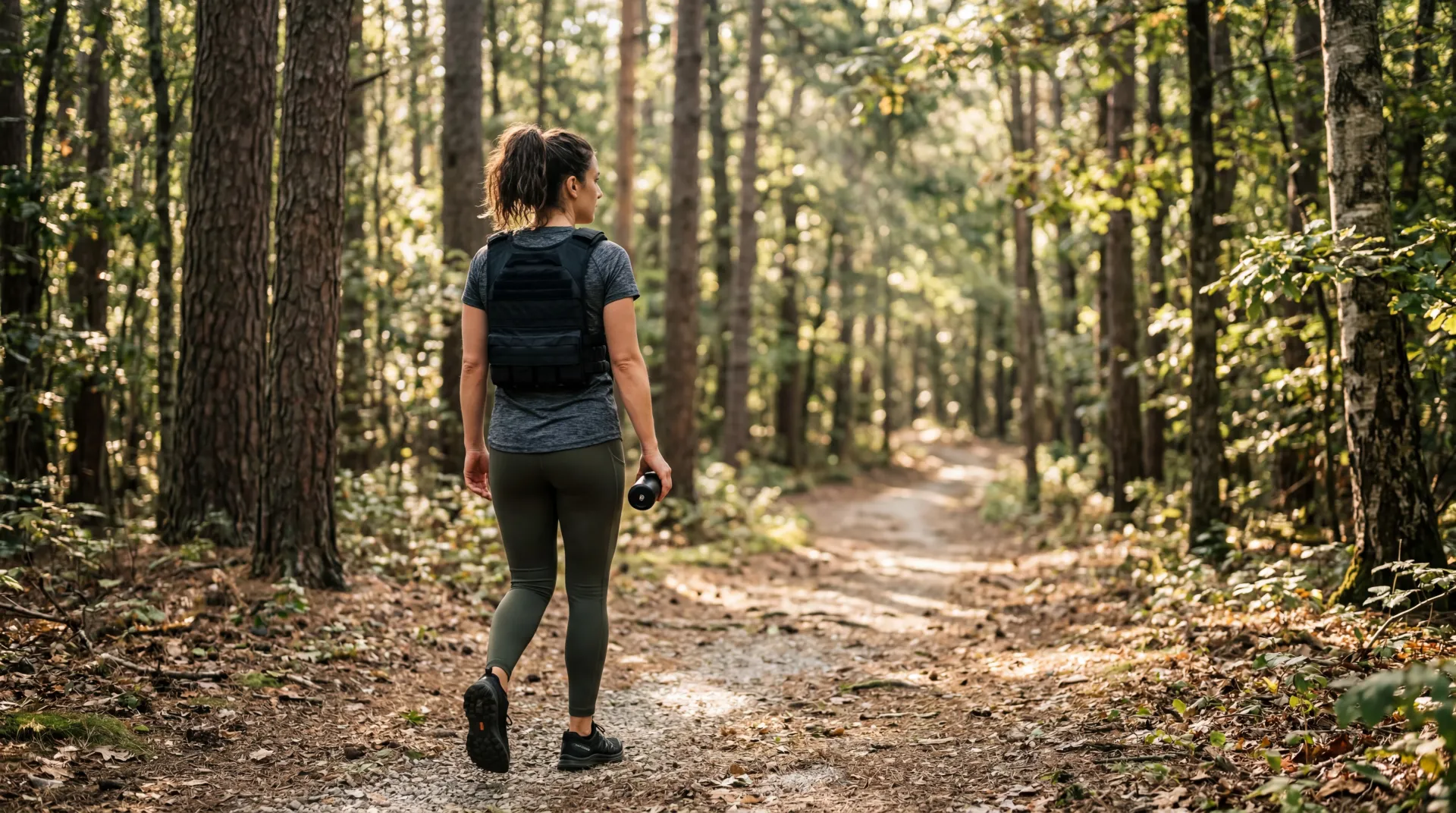
Strip away the branding and rucking is one sentence: you walk for distance or time with weight on your back, usually a loaded pack or a weighted vest (BodySpec). No gym, no machine, no choreography. You put a few plates or a couple of water jugs in a backpack and go for a walk that suddenly asks more of you.
The word comes from "ruck marching," which militaries have used as a core skill since roughly the 7th century B.C. (National Geographic). The British call their versions yomping (Royal Marines) and tabbing (Army). The civilian version took off in the early 2000s, largely through GORUCK, a company started by former U.S. Army Special Forces soldier Jason McCarthy, whose GORUCK Challenge events began in 2010 (National Geographic). The momentum is real: GORUCK reported a 65% year-on-year jump in sales of its flagship pack and a 44% rise in website sessions between 2023 and 2024 (National Geographic).
The idea holds up better than the average fitness fad because of what it builds on. Walking already accounts for around 30% of an adult's daily energy expenditure and is the single most common form of human physical activity (Das Gupta et al., Scientific Reports, 2019). Rucking does not replace that habit. It loads it. As Harvard's Dr. Toni Golen put it in a July 2025 column, adding weight "amps up your walking intensity," which can extend the well-documented payoffs of regular walking, including lower risk of high blood pressure, heart disease, and diabetes (Harvard Health).
One caution before the numbers. Most of the hard science on loaded walking was done on soldiers carrying brutal loads, anywhere from 20 kg to over 60 kg depending on role (Graham et al., BMJ Mil Health, 2025). A civilian putting 15 pounds in a daypack is doing something far gentler, so read the military studies as the upper end of a dial you control, not a description of what you are signing up for.

The calorie question: how much more than plain walking?
This is the claim that pulls people in, so it deserves real numbers. In a controlled study, twenty men walked a forest trail at their own pace, first unloaded and then carrying a pack equal to 25% of body mass. Oxygen uptake climbed from 15.34 to 19.39 ml/kg/min, about a 26% increase, and heart rate rose from 96 to roughly 112 beats per minute, about 16%, at the same walking speed (field-walking study, PMC6259461). The cost of transport, which is the energy your body spends to move each kilogram one meter, went from 3.22 to 3.99 J/kg/m, a 24% bump (field-walking study, PMC6259461). For reference, baseline unloaded walking costs young adults about 3.4 J/kg/m (Das Gupta et al., 2019).
Notice what did not change: walking speed stayed at 1.60 m/s loaded or not (field-walking study, PMC6259461). Same pace, same route, harder work. That is the whole appeal in one data point. The effort cost showed up in how it felt, too: perceived exertion on the Borg scale more than doubled, from 2.65 unloaded to 5.45 with the pack (field-walking study, PMC6259461).
Here the internet gets sloppy. The friendly calorie tables you see everywhere mostly trace back to the GORUCK calorie calculator, which is a commercial tool, not a peer-reviewed study, so treat its exact figures as estimates. By that calculator, a 180-pound person on flat ground burns roughly 300 calories an hour walking with no pack, about 450 with 20 pounds, about 540 with 30 pounds, and over 620 at a faster pace with 30 pounds; uphill or at around 30% of body weight, the figure can top 700 per hour (BodySpec / GORUCK calculator). The same source claims rucking can burn two to three times the calories of unweighted walking at the same pace (BodySpec). The peer-reviewed data supports the direction of all of this, but not the decimal points.
One more wrinkle about heavy loads: the energy cost of carrying weight is non-linear. Researchers built and validated the LCDA backpacking equation by having 30 adults walk under loads up to 66% of body mass, then checked it against seven independent datasets (LCDA modeling study, PMC8919998). For a regular person that means piling on more weight does not add calories tidily, it adds them at an accelerating rate, which is also where the strain accelerates.

So is it worth it? If your goal is to make the walk you already take harder without walking faster or longer, the evidence is solid that 15 to 30 pounds does exactly that. If your goal is a precise calorie figure for a spreadsheet, you will not get one from rucking, and you should distrust any website that promises you will.
What a loaded walk does to your bones
Bone responds to being asked to carry things. That is the logic, and it is where rucking earns some of its best press, especially for women heading toward menopause. The catch is that the research is more conditional than the headlines suggest.
Start with the encouraging end. In a study of 36 postmenopausal women with osteoporosis, 18 sessions of 30-minute treadmill walking three times a week, some with a vest at 4 to 8% of body weight, significantly raised a marker of bone formation (BALP) and lowered a marker of bone breakdown (NTX) in both exercise groups (Roghani et al., Rheumatol Int, 2013). The vest group also lost fat, gained fat-free mass, and improved balance far more than walkers without a vest (Roghani et al., 2013).
The most-cited evidence for bones is older. A five-year study found that postmenopausal women who walked with weighted vests maintained hip bone mineral density, while a comparison group that did not lost bone mass over the same window (Snow et al., 2000, via BodySpec; also referenced in OsteoACTIVE RCT, PMC4650105). Five years. That number matters more than any single calorie figure in this article, because bone is slow.
How slow? Postmenopausal women generally need at least 12 to 18 months of consistent weight training before bone density shows measurable gains, and a meta-analysis of weight-bearing exercise found an average change of only about 1%, not always statistically significant (OsteoACTIVE RCT, citing Howe et al.). That explains the mixed short-term picture. A 12-week trial of 48 working women found bone resorption dropped about 19% with a vest and about 22% without one, with no significant difference between the groups (Tantiwiboonchai et al., 2011). The OsteoACTIVE trial of 80 postmenopausal women saw no significant between-group difference in bone density over one year, though the vest group did hold quadriceps strength 9.8 to 13% above baseline (OsteoACTIVE RCT, PMC4650105).
The honest summary on bone: over weeks, you will not see a density change, and short studies often find no advantage for the vest specifically. Over years, the long-term evidence favors loaded walking for preserving hip bone in postmenopausal women. Bone is a long game, and most rucking content quietly skips that part.
What this means in practice: do not start rucking this month and expect a better DEXA scan next quarter. Start it because you can keep doing it for years, and because the same sessions are doing other things for your muscles and balance on a much faster timeline.

Strength, balance, and the posture caveat nobody mentions
Strength and balance respond faster than bone, and here the numbers are strong. In that osteoporosis study, near-tandem-stand balance improved by 104.66% in the weighted-vest group, compared with 49.68% for walkers without a vest and a 28.96% decline in the do-nothing control group (Roghani et al., 2013). Roughly double the balance benefit, from adding weight to a walk people were already taking. The OsteoACTIVE vest group similarly kept quadriceps strength 9.8 to 13% above baseline a full year out (OsteoACTIVE RCT, PMC4650105).
Posture is where I want to slow down, because this is the claim most likely to be oversold. The popular pitch is that rucking fixes your posture. The mechanism people cite is real enough: the pack's downward pull forces your core, glutes, and postural muscles to brace with every step, which over time can train you to stand and walk more upright (BodySpec; South Denver Cardiology). Think of it like the difference between standing still and standing on a slightly rocking boat: the unstable version recruits muscles the stable one lets sleep.
The marketing leaves out the awkward middle of the story. In the moment, a loaded pack stresses your posture before it can ever train it. When 18 adults wore a normal backpack at just 10% of body weight, their forward lean nearly doubled, from 25.2 mm to 49.3 mm, and the natural curve of their lower back flattened, with lumbar lordosis dropping from 49.0 to 44.0 degrees (Kim et al., IJERPH, 2019). The neck took a hit too: cervical spine angle fell from 11.4 to 6.6 degrees, meaning more forward head posture, even at that light load (Kim et al., 2019). Other work confirms the pattern, with forward head posture appearing once loads reach about 15% of body weight (Orthopedics review, 2020).
Balance gets the same dual story. Carrying 16 kg (20% of body weight) and 20.5 kg (26%) increased postural sway velocity by 16 to 52% in 20 Army cadets, with double-leg sway rising from 0.27 to 0.41 degrees per second under the heavier load (Strube et al., Int J Exerc Sci, 2017). The load makes you wobblier in the moment, which is precisely the stimulus that, repeated over months, makes your stabilizers stronger.
So the practical read is this: rucking is a posture and balance trainer, not a posture fix, and the line between the two is your form and your load. Keep the weight light enough that you are not folding forward to carry it, and the stress becomes a stimulus. Pile it on, and you are just rehearsing bad posture under load.
The injury math: where a pack helps and where it bites
The same forces that make rucking effective make it risky if you are careless. The most quoted ceiling comes from biomechanics research: load should stay at or below 30% of body weight, and right around 30% is where your normal walking mechanics are forced to change to cope (Orthopedics review, 2020). Military field manuals allow conditioned soldiers up to roughly one-third to 45% of body weight on a march, but those are people who trained for years, and beginners are told to stay well below that (Strube et al., 2017; BodySpec).
How common are load-carriage injuries? In a study of 67,525 Air Force recruits, 12.5% sustained at least one musculoskeletal injury during Basic Training, and 78.4% of those injuries landed in the lower extremities (Orthopedics review, 2020). In a Special Forces cohort, road marching was the second most common activity tied to new injuries, about 15% of them (Orthopedics review, 2020). Again, those are heavy military loads, but they point at where civilians will feel it too: knees, shins, feet, and the lower back.
The spine is the part to respect most. Adding a backpack raises joint contact forces in the lumbar spine by more than the weight of the load alone would predict, and those forces peak when you walk uphill (Graham et al., 2025). The strongest protective factor is unglamorous: aerobic fitness is the single best predictor of how well someone handles a load and how likely they are to get hurt, with low aerobic and low muscular endurance flagged as key risk factors (Graham et al., 2025; Orthopedics review, 2020). Translation: a base of regular cardio before you load up is the cheapest injury insurance there is.
| Group | What the evidence says |
|---|---|
| People with neck or back pain | Harvard advises against rucking; loaded packs increase forward head posture and lumbar joint forces (Harvard Health; Kim et al., 2019) |
| Pregnant individuals | Should not wear a weighted vest (Harvard Health) |
| History of knee, hip, or mechanical back injury | Seek professional advice first; a former Royal Marine warns rucking "can cause serious injury to the spine, neck, knees, hips" if done wrong (National Geographic) |
| Older adults | Already pay 12 to 17% more energy to walk unloaded than younger adults, so added weight is relatively more taxing; start lighter (Das Gupta et al., 2019) |
| Low-fitness beginners | Highest injury risk; build aerobic base first (Graham et al., 2025) |
There is also good news on the prevention side. Graduated, progressive conditioning, rather than jumping straight to heavy marches, cut injury rates by 19% versus traditional training in male U.S. Marine recruits, with no loss in performance (Graham et al., 2025). The lesson scales straight down to civilians: the injuries come from doing too much too soon, and the fix is patience, not a fancier pack.

How to start without wrecking yourself
Almost every credible source lands on the same opening move: go light. Harvard suggests a vest around 10% of body weight to begin (Harvard Health). Jen Wilson, an exercise practitioner at Nottingham Trent University, goes lower for true beginners: "Start light, start short," she says, beginning "as light as 5 to 10% of body weight," on even terrain, once or twice a week (National Geographic). For most people that is 10 to 15 pounds, not the 45-pound rucks you see in race photos.
Load placement is the detail that separates a comfortable ruck from a sore lower back. Keep the heavy stuff high on your back and tight against your body, not sagging toward your waist. Placing the load high and close lowers your energy cost, helps you stay upright, and reduces low-back strain, a point that shows up across the biomechanics literature and the practical guides alike (Graham et al., 2025; Kim et al., 2019; BodySpec). A folded towel between the plates and your spine stops the weight from digging in.

For progression, the research-backed protocols are gentler than you might expect. The treadmill studies that improved bone markers and fitness used 30-minute walks at 65 to 75% of maximum heart rate, three times a week, with vest weight added gradually, around 2% of body weight per week up to about 8% by week six (Tantiwiboonchai et al., 2011; Roghani et al., 2013). The military principle is the same in spirit: increase distance first, then load, and space hard sessions out, roughly every 10 days for heavy work (Graham et al., 2025).
If you want a concrete on-ramp, one widely used beginner template ramps over four weeks: about 2 miles at 5 to 10 pounds in week one, 2.5 miles at 12 to 15 pounds in week two, 3 miles at 15 pounds in week three, and 3.5 miles at 20 pounds in week four (BodySpec). It is one reasonable plan, not gospel, but the shape is right: distance climbs, then weight, never both at once.
| Week | Distance | Pack weight |
|---|---|---|
| 1 | ~2 miles | 5–10 lb |
| 2 | ~2.5 miles | 12–15 lb |
| 3 | ~3 miles | 15 lb |
| 4 | ~3.5 miles | 20 lb |
Beginner ramp adapted from the BodySpec four-week plan. Increase distance before weight; drop back a step if form breaks down.
Two gear notes worth knowing. Pairing resistance work with your walking is recommended over rucking in isolation, since strength and cardio together improve how you handle load (Graham et al., 2025). And the carrier matters: the same weight strapped to body armour raises oxygen consumption 12 to 17%, versus only 5 to 6% in a backpack, because the compression itself taxes breathing (Graham et al., 2025). The lesson for civilians is that a well-fitted pack that lets your ribs expand beats a tight vest cinched over your chest.
The whole thing only works if you keep showing up, which is the quiet argument for starting easy. A walk you can repeat for years does more for your bones and your heart than a punishing march you do twice and abandon. Pick a weight you barely notice for the first week, add slowly, and let boredom, not soreness, be the thing you push through.
Frequently Asked Questions
How much weight should a beginner ruck with?
Start at roughly 5 to 10% of your body weight, which is about 10 to 15 pounds for most people, and keep early walks short and on flat ground (National Geographic). Harvard suggests around 10% of body weight as a starting point for a weighted vest (Harvard Health). Add distance before you add weight.
Does rucking really burn more calories than walking?
Yes. Carrying 25% of body weight raised oxygen uptake about 26% and heart rate about 16% at the same walking pace in a controlled study (field-walking study, PMC6259461). Commercial calculators estimate two to three times the calories of unweighted walking, though those exact numbers are not peer-reviewed (BodySpec).
Will rucking improve my bone density?
Possibly, but slowly. Short studies of 12 weeks often show no measurable density change, while a five-year study found weighted-vest walking preserved hip bone density in postmenopausal women who would otherwise have lost it (Snow et al., 2000, via BodySpec). Most women need 12 to 18 months of consistent loading before density shifts (the OsteoACTIVE RCT).
Who should not ruck?
People with neck or back pain should avoid it, and you should not wear a weighted vest while pregnant (Harvard Health). Anyone with a history of knee, hip, or mechanical back injury should check with a professional first (National Geographic).
Is rucking better than running for my joints?
It is lower-impact, since one foot stays on the ground throughout, and a cardiology practice describes it as offering jogging-like cardiovascular effects with less bodily impact (South Denver Cardiology). That said, a heavy load raises spinal joint forces, so "lower-impact" only holds if you keep the weight sensible (Graham et al., 2025).
Medical Disclaimer
This article is for informational and educational purposes only and is not medical advice, diagnosis, or treatment. Always consult a licensed physician or qualified healthcare professional regarding any medical concerns. Never ignore professional medical advice or delay seeking care because of something you read on this site. If you think you have a medical emergency, call 911 immediately.