What is rucking (and why the military swears by it)
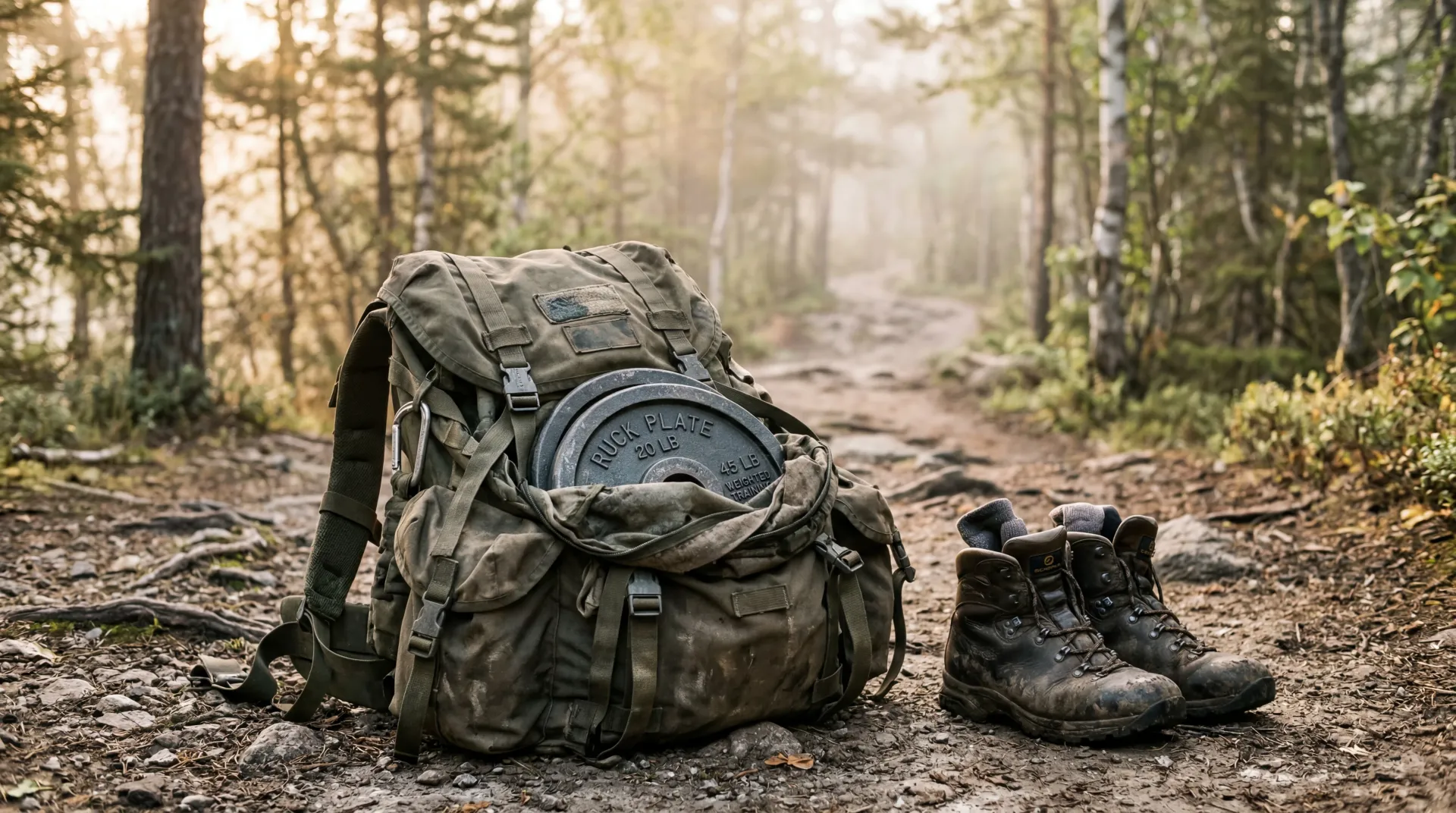
Mid-20th century military planners had a logistics problem. Infantry soldiers needed to cover ground on foot while carrying everything required to fight, eat, sleep, and survive. Their solution was the rucksack march: long walks under heavy load, often for hours. Researchers at the US Army Research Institute of Environmental Medicine (USARIEM) have studied soldiers carrying backpacks loaded up to 66% of their body mass -- a 180-pound soldier hauling close to 120 pounds of gear.
"The term 'rucking' comes from military members carrying weighted rucksacks during boot camp trainings," says Dr. Matthew Kampert, a sports medicine physician at Cleveland Clinic. "Rucking or ruck marching prepares soldiers for real-world scenarios where they must carry heavy loads for long distances and prolonged time."
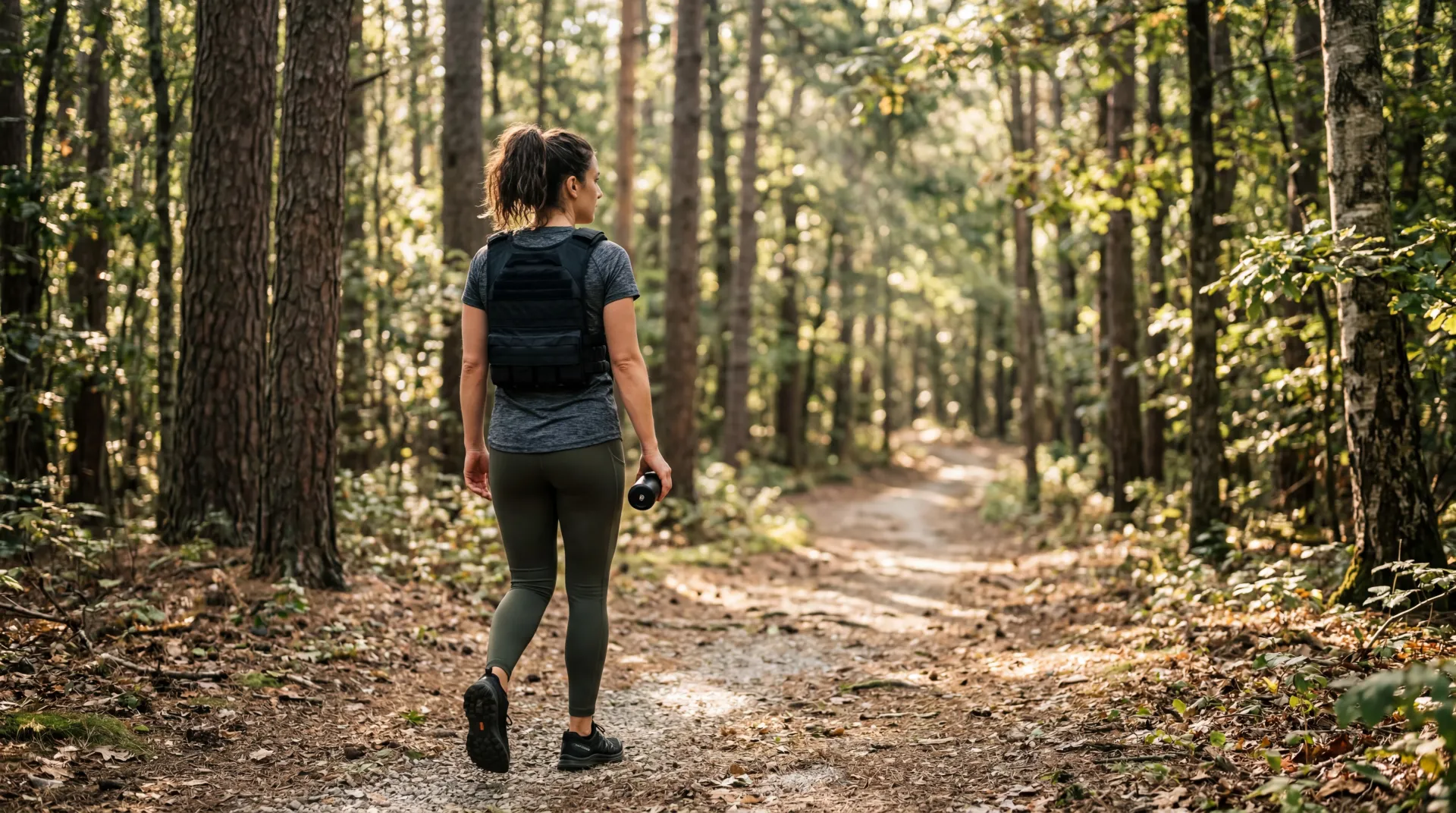
The civilian version strips away the 7-mile forced marches and 100-pound loads. What remains is simple: walk with weight on your back. No barbells, no gym membership, no coordination-intensive movements. A backpack, some weight, and a sidewalk. The military spent decades proving that loaded walking builds durable fitness. Everyone else is just now catching on.
The calorie math: why a loaded pack changes everything
Walking burns calories. Walking with a loaded pack burns more. But the relationship between added weight and energy cost is not proportional -- it is steeper than that, and the specifics matter.
Dr. Tzu-wei Huang and Dr. Arthur Kuo at the University of Michigan measured metabolic expenditure in adults walking at fixed speed with backpack loads ranging from zero to 40% of body weight. They found that metabolic energy expenditure increased approximately 7.6 watts for each additional kilogram of load. Net metabolic power nearly doubled across the range of loads tested. Your body works like a car engine with weight in the trunk: every step requires your legs to redirect your entire mass (body plus pack) from one pendulum-like arc to the next. That redirection work scales with total mass.
Huang and Kuo's inverse dynamics analysis showed the greatest increase in work occurred at the ankle during push-off and the knee during the rebound phase after foot contact. Your calves and quads absorb the extra load.
A 1987 study in the Journal of Sports Medicine found that gross energy cost per mile during weighted walking ranged from 120-158 kcal/mile, comparable to and sometimes exceeding the 120-130 kcal/mile cost of running. Weighted walking at 4 mph matched the intensity of running at 5 mph.
There is also a nonlinear wrinkle. Research from USARIEM showed that walking energy expenditure rises nonlinearly with increased load relative to body mass. David Looney and colleagues found that the metabolic cost of carrying heavier loads accelerates -- going from 25% to 50% of body mass costs proportionally more than going from zero to 25%. For beginners, this means a moderate load (10-20% of your weight) hits a metabolic sweet spot: enough extra burn to matter, without the disproportionate strain that heavier packs bring.
Dr. Mark Faghy and colleagues at the University of Derby confirmed that a 20-40 kg load change (roughly 25-50% body mass) provoked greater increases in heart rate and oxygen consumption compared to a 0-20 kg change. The calorie advantage of rucking is measurable, but the relationship between pack weight and metabolic cost is steeper than linear. Heavier is harder, and disproportionately so.
Strength without the gym: what rucking does to your body
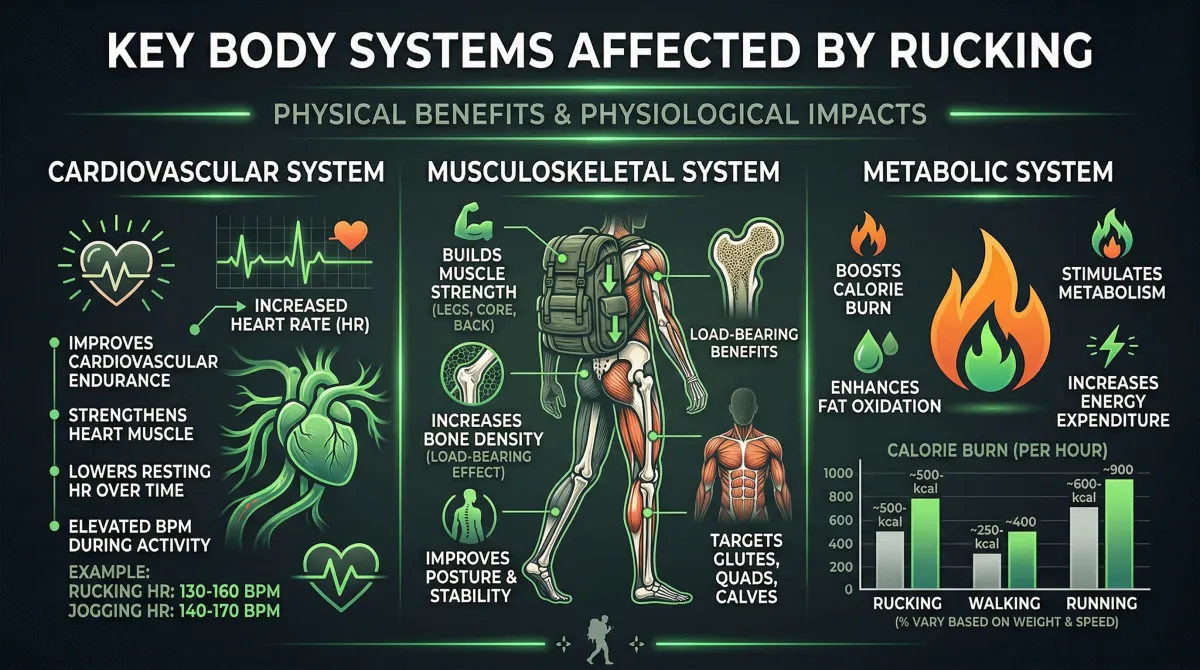
Most exercises pick a lane. Running is cardio. Lifting is strength. Yoga is mobility. Rucking combines cardiovascular conditioning, load-bearing strength work, and balance training in a single walk.
Add weight and your heart pumps harder to supply oxygen to muscles working against the extra load. Research in Physiological Reports documented that load carriage increases both heart rate and oxygen uptake compared to unloaded walking, with magnitude depending on load mass, walking speed, and terrain. Elite soldiers carrying a 20 kg backpack saw their mean heart rate jump by 20 beats per minute when they increased walking speed from 6.4 to 7.4 km/h.
The bone-density evidence deserves attention from anyone over 50. Dr. Christine Snow at Oregon State University led a 5-year study of postmenopausal women doing weighted vest plus jumping exercises three times per week. Women in the exercise group gained 1.54% bone mineral density at the femoral neck. The control group lost 4.43% at the same site. That nearly 6-percentage-point gap over five years represents a real difference in fracture risk. Bone tissue adapts to mechanical loading the way muscle adapts to resistance -- impose stress within recoverable limits and the tissue grows stronger.
The strength component needs honest framing. Jeff Palmer, fitness and wellness manager at University of Washington Recreation, says rucking provides both cardio and a strength component with balance work. But Dr. Joseph Ihm at UW Medicine adds a qualifier: "The strength gains are probably going to be subtle and not comparable to resistance training with weights." He would not position rucking as a replacement for the twice-per-week strength training sessions recommended by the American College of Sports Medicine.
What rucking does well is load the postural muscles -- the deep spinal stabilizers, the upper back muscles that keep your shoulders from collapsing forward, the hip stabilizers that maintain balance over uneven ground. These are the muscles that atrophy fastest with sedentary lifestyles and matter most for injury prevention as people age. A loaded walk will not build the maximal strength you would get from squats and deadlifts, but it conditions the muscular endurance systems that keep you functional and upright under fatigue.
Your first ruck: gear, weight, and getting started
The equipment barrier for rucking barely qualifies as a barrier. "You can use your crappy school backpack and grab a couple books and you're rucking," says Jeff Palmer at UW Recreation. "That's one of the benefits of it, is that anybody anywhere can do it."
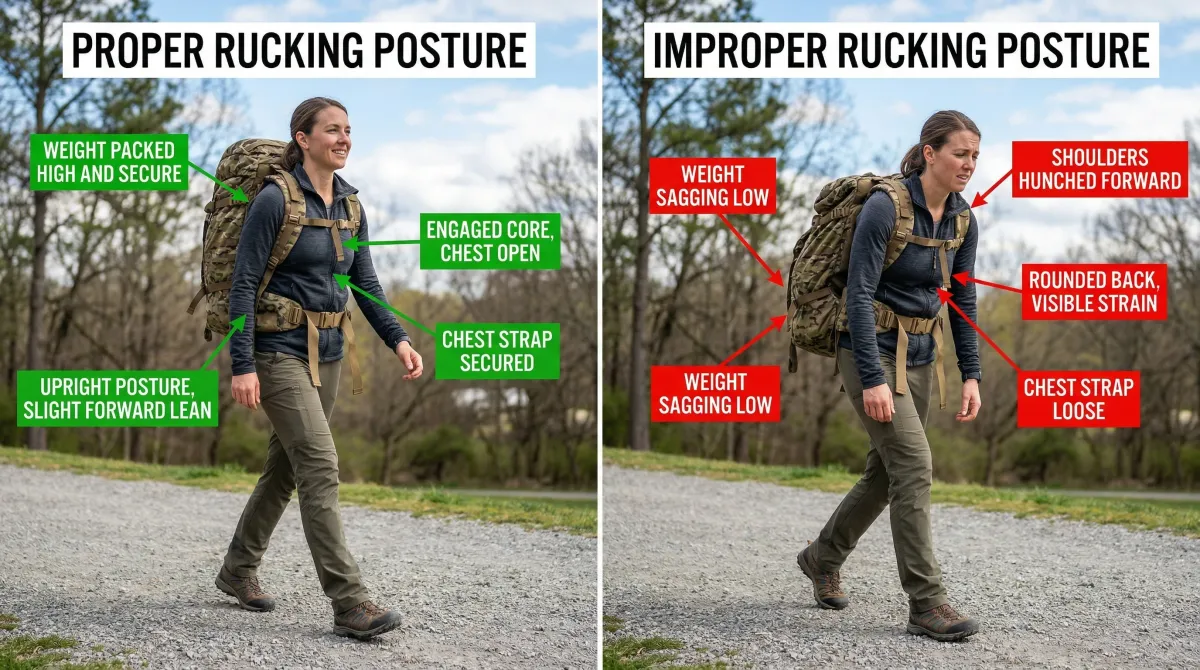
That said, where you put the weight matters more than most beginners realize.
Pack selection
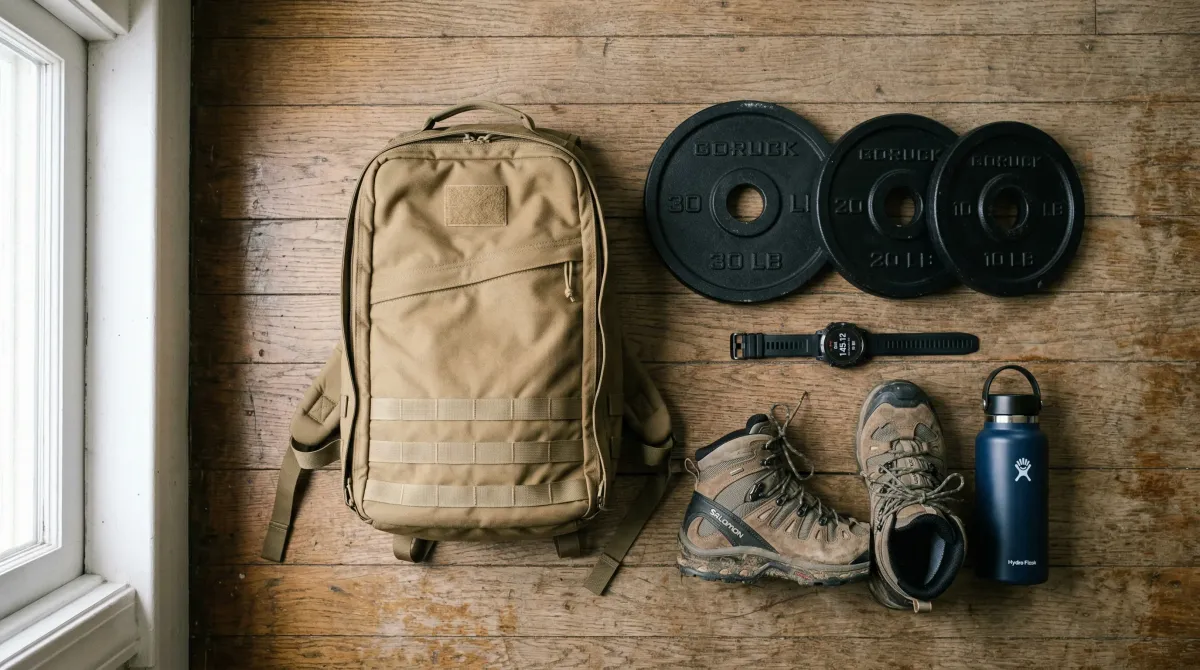
A purpose-built rucksack holds weight in internal pockets positioned high and tight against your upper back, with padded shoulder straps and a chest strap to prevent bouncing. Dr. Kampert explains that "the sack evenly distributes weight on your spine with minimal bouncing or shifting of weights." If you use a regular backpack, wrap weights in towels and pack them so they sit between your shoulder blades rather than sagging toward your lower back.
The reason for upper placement is physiological. Research cited in a 2022 review in Physiological Reports found that load carried on the lower back (lumbar region) caused greater oxygen consumption increases compared to the upper back (thoracic region). Keeping weight high reduces postural compensation and cuts the metabolic penalty of poor load positioning.
How much weight to start
| Fitness level | Starting weight | Target pace | Duration |
|---|---|---|---|
| New to exercise | Empty pack first, then 5 lbs | Comfortable walk | 15-20 minutes |
| Regularly active | 10% of body weight | 15-20 min/mile | 30 minutes |
| Already fit | 15-20% of body weight | 15 min/mile | 45-60 minutes |
Dr. Kampert at Cleveland Clinic recommends that even experienced gym-goers start light: "Lifting weights at the gym isn't the same as carrying 20 pounds on your back for several miles. You might start your initial ruck with 5 pounds and work your way up." WebMD's guidelines suggest starting with 5-10 pounds for true beginners, aiming to maintain a 20-minute mile or better.
Palmer at UW Medicine puts it plainly: "I'd throw 10 pounds out there as a good starting point -- you will notice 10 pounds, you're aware of it, but there's a big difference between that 10 pounds and starting with 30 pounds."
Budget-friendly weight options
You do not need ruck plates. Filled water bottles, canned goods, bags of sand or cat litter, dumbbells wrapped in towels -- all of these work. Weigh whatever you use so you can track load progression. The important thing is that the weight does not shift or poke you during the walk.
The injury line: how to ruck without wrecking yourself
Rucking is lower-impact than running, but "lower impact" does not mean "no impact." The injury research from military populations provides useful warnings for civilian ruckers, even though the loads are much heavier.
A study of Army ROTC cadets found that a 4-mile ruck march increased peak impact force and loading rate in the lower extremities. The researchers noted these changes are consistent with risk factors for bone stress injuries. The cadets also showed decreased ankle strength after the march, even though they did not report feeling fatigued -- a mismatch between perception and physiology that should give beginners pause about relying on "how they feel" to gauge readiness.
Fatigue changes how you move, and not in helpful ways. A 2023 study in Military Medicine tracked three platoons of soldiers during a 7-mile loaded ruck march using body-mounted sensors. By the final quarter, stride length had decreased, stride width had increased, and variability in torso lean and stride width had gone up. These are the biomechanical signatures of a body losing its ability to maintain efficient movement. For civilians carrying lighter loads, the same pattern applies on a longer timeline.
The respiratory system is another consideration that surprises most beginners. Dr. Faghy's research showed that carrying 25 kg (about 55 pounds) for 60 minutes caused respiratory muscle fatigue. Loads of 10-20 kg did not produce the same effect. This suggests a practical ceiling for recreational ruckers: staying under roughly 20-25% of body weight keeps the respiratory system from becoming a limiting factor.
Research by Blacker and colleagues found that neuromuscular impairment from a 25 kg backpack persisted for up to 72 hours after the exercise bout. Knee extensor force production was reduced during both isokinetic and isometric contractions for three days post-march. That three-day recovery window has real implications for how often you should ruck with heavy weight.
Injury prevention checklist
| Risk factor | Mitigation |
|---|---|
| Too much weight too soon | Start with 5-10 lbs; increase by 10% per week maximum |
| Excessive frequency | 2-3 sessions per week with rest days between |
| Poor pack positioning | Weight high between shoulder blades; use chest/hip straps |
| Ignoring pain signals | Muscle fatigue is normal; joint or sharp back pain is not |
| Skipping warm-up | Walk unloaded for 5-10 minutes before adding the pack |
| Increasing weight AND distance simultaneously | Change one variable at a time |
Rucking vs. running vs. walking: how they stack up
The question most people want answered: is rucking actually better than walking faster, or running? It depends on what you are optimizing for.
| Factor | Walking | Rucking (20% BW) | Running |
|---|---|---|---|
| Calories per mile | 70-100 kcal | 120-158 kcal | 120-130 kcal |
| Joint impact | Low (~2.7x BW) | Moderate | High (~8x BW at knee) |
| Upper body engagement | Minimal | Core, back, shoulders | Moderate (arms) |
| Bone-building stimulus | Low | Moderate-High | Moderate |
| Equipment needed | Shoes | Pack + weight | Shoes |
| Injury risk | Very low | Low-Moderate | Moderate-High |
| Social compatibility | High | High | Low (pace-dependent) |
The calorie data comes from a peer-reviewed study measuring energy cost across walking, weighted walking, and running in moderately trained adults. Weighted walking at 4 mph with added limb weight matched the oxygen consumption of running at 5 mph. The calorie-per-mile figures for weighted walking sometimes exceeded running because slower speeds mean more time on your feet per mile, and each step costs more with the extra load.
The joint impact comparison matters most for people who cannot run or should not. Rucking keeps you at walking speeds, which keeps ground reaction forces much lower than running. You add load to a low-impact gait pattern rather than adding impact to a high-speed one. For people with knee concerns, recovering from injuries, or returning to exercise after years off, that is the whole selling point.
Running wins on time efficiency and peak cardiovascular stimulus. A 30-minute run at moderate pace will generally produce a higher VO2 output than a 30-minute ruck. Rucking wins on accessibility, upper body engagement, bone loading, and the ability to carry on a conversation while exercising.

Building a rucking routine that actually sticks
The most common mistake with rucking is treating it like a novelty workout. People go too heavy or too far on their first outing, feel terrible for three days, and quit.
Dr. Kampert at Cleveland Clinic recommends increasing one component at a time by about 10% each week: "Increasing frequency and intensity simultaneously can lead to injuries and setbacks." If you ruck 2 miles with 15 pounds this week, next week you either increase to 2.2 miles or 16.5 pounds. Not both.
A reasonable 8-week beginner progression:
| Week | Weight | Duration | Frequency |
|---|---|---|---|
| 1-2 | 10 lbs / ~5 kg | 20 minutes | 2x per week |
| 3-4 | 15 lbs / ~7 kg | 25-30 minutes | 2x per week |
| 5-6 | 20 lbs / ~9 kg | 30-35 minutes | 2-3x per week |
| 7-8 | 25 lbs / ~11 kg | 35-45 minutes | 3x per week |
This progression keeps you under 20% of body weight for most adults during the first several weeks, which aligns with the research showing that lighter loads produce meaningful metabolic benefits without triggering the nonlinear strain increases of heavier packs.
WebMD recommends building up from once or twice per week to every other day, keeping initial rucks to 15-20 minutes. Mix in other activities on non-ruck days. Yoga, swimming, or bodyweight exercises complement rucking by working mobility and flexibility that loaded walking does not address.
Research on optimal intensity for sustained load carriage found that keeping effort at approximately 45% of VO2 max delayed fatigue most effectively during prolonged marching. For most recreational ruckers, that translates to a pace where you can hold a conversation but feel noticeably warmer and breathe harder than an unloaded walk. If you are gasping, your pack is too heavy or your pace is too fast.
The social element affects adherence. Rucking is one of the few loaded exercises where you can walk alongside someone and talk normally. Running groups require similar paces; gym sessions happen behind headphones. A ruck with a friend or a dog combines exercise with companionship, and that combination predicts long-term consistency better than any training plan.
Frequently Asked Questions
How many calories does rucking actually burn compared to walking?
Research shows that metabolic rate increases approximately 7.6 watts per kilogram of added load at walking speed. Carrying 20% of your body weight roughly doubles the metabolic cost of walking at the same speed. A 170-pound person walking at 3.5 mph burns approximately 80-100 calories per mile unloaded; adding 35 pounds of pack weight pushes that toward 130-160 calories per mile, on par with running.
Is rucking safe for people with back problems?
It depends on the specific condition. WebMD advises checking with your doctor before starting, particularly if you have neck, back, or joint injuries. If cleared, start with minimal weight (5 pounds or less), use a pack with a hip belt to transfer load from shoulders to hips, and keep sessions short. Sharp pain at any point is a stop signal.
Can rucking replace running for cardiovascular fitness?
Partially. Rucking at moderate load and pace can produce heart rates in the 65-75% of max range, sufficient for cardiovascular adaptation. But Dr. Ihm at UW Medicine notes that if you already run regularly, rucking will not fully replace that aerobic stimulus. It works best as a complement or as a primary cardio option for people who cannot or do not want to run.
How heavy should my ruck be once I'm experienced?
Most fitness-oriented guidelines suggest a maximum of one-third of your body weight for experienced ruckers. Military research has tested loads up to 66% of body mass, but those loads caused significant physiological strain. For recreational fitness, 20-30% of body weight provides a strong training stimulus. Loads above 25% begin to produce respiratory muscle fatigue and disproportionate metabolic cost increases, so staying under that threshold for regular training makes sense.
Does rucking build bone density?
Yes. A 5-year study by Dr. Christine Snow found that postmenopausal women doing weighted vest exercise three times per week maintained femoral neck bone density (+1.54%) while controls lost density (-4.43%). Weight-bearing exercise with added load provides the mechanical stimulus that triggers bone remodeling, making rucking particularly relevant for populations at risk of osteoporosis.
Medical Disclaimer
This article is for informational and educational purposes only and is not medical advice, diagnosis, or treatment. Always consult a licensed physician or qualified healthcare professional regarding any medical concerns. Never ignore professional medical advice or delay seeking care because of something you read on this site. If you think you have a medical emergency, call 911 immediately.