Out of 80 billion neurons, fewer than 600,000 make dopamine
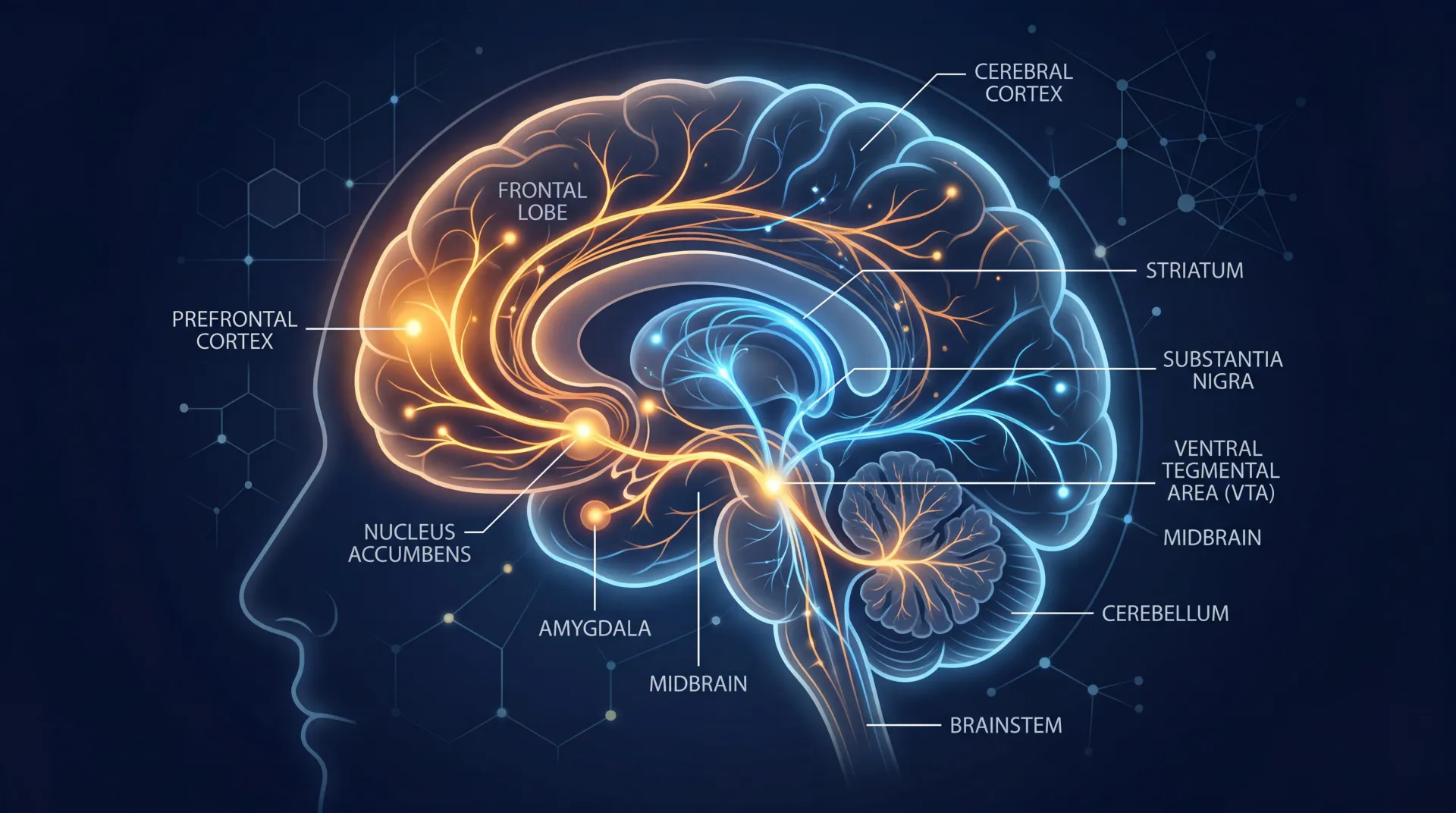
That number surprises most people. Your brain runs on roughly 80 billion neurons, and the ones producing dopamine represent less than 0.001% of the total. They cluster mainly in two small regions deep in the midbrain — the ventral tegmental area (VTA) and the substantia nigra, and from there they send projections outward to regions that handle movement, decision-making, memory, and motivation. Think of those 400,000 to 600,000 dopamine neurons as a tiny switchboard that punches far above its weight.
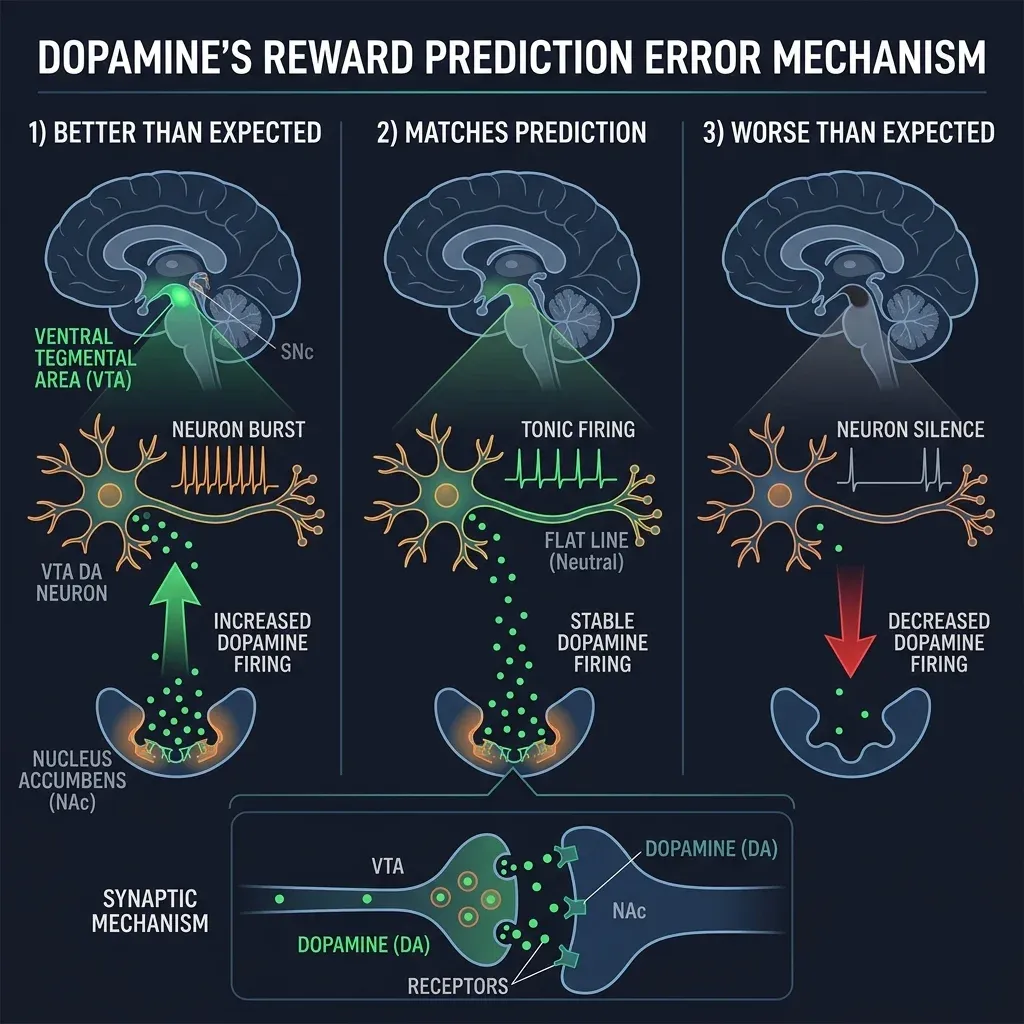
Dopamine operates in two distinct modes. In its tonic mode, neurons maintain a steady baseline level that keeps downstream circuits functioning normally — it's the electrical hum keeping the lights on. Then there's phasic mode: sharp bursts lasting just 100 to 500 milliseconds that cause a temporary flood of dopamine in target structures. These bursts are what most people vaguely associate with "getting a hit of dopamine," but the reality is far more interesting than that.
Wolfram Schultz, a neurophysiologist now at Cambridge, demonstrated in the 1980s that dopamine neurons don't just fire when you get something good. They fire when you get something better than expected. If a reward matches your prediction exactly, those neurons barely respond at all. If the reward is worse than expected, they go temporarily silent. Neuroscientists call this reward prediction error, and it reframes dopamine entirely: it's less about pleasure and more about learning. Your brain is constantly running predictions about what's coming next, and dopamine is the signal that flags when reality departs from those predictions.
That distinction matters because it undercuts a central premise of the dopamine detox trend. Dopamine isn't a pleasure juice that builds up and needs draining. It's a teaching signal. Talia Lerner, a neuroscientist at Northwestern University who studies dopaminergic circuits, has pointed out that some dopamine neurons respond to aversive experiences, not just rewards. Other research from her colleague Gabriela López, published in Current Biology, showed dopamine signals rising and falling in intricate patterns as animals learned to avoid danger. "You definitely don't want to get rid of that signal," López said.
And dopamine doesn't work alone. Endorphins, serotonin, oxytocin, and norepinephrine all participate in producing what we experience as pleasure and motivation. As psychologist Susan Albers at the Cleveland Clinic put it: "Dopamine is one part of the equation, but there are many different aspects involved in developing an addictive or compulsive behavior, so isolating your focus to one particular substance in the body doesn't make sense." Anyone who tells you that dopamine is the single molecule behind your scrolling habit is selling you a cartoon of neuroscience.
A catchy name that outgrew its creator
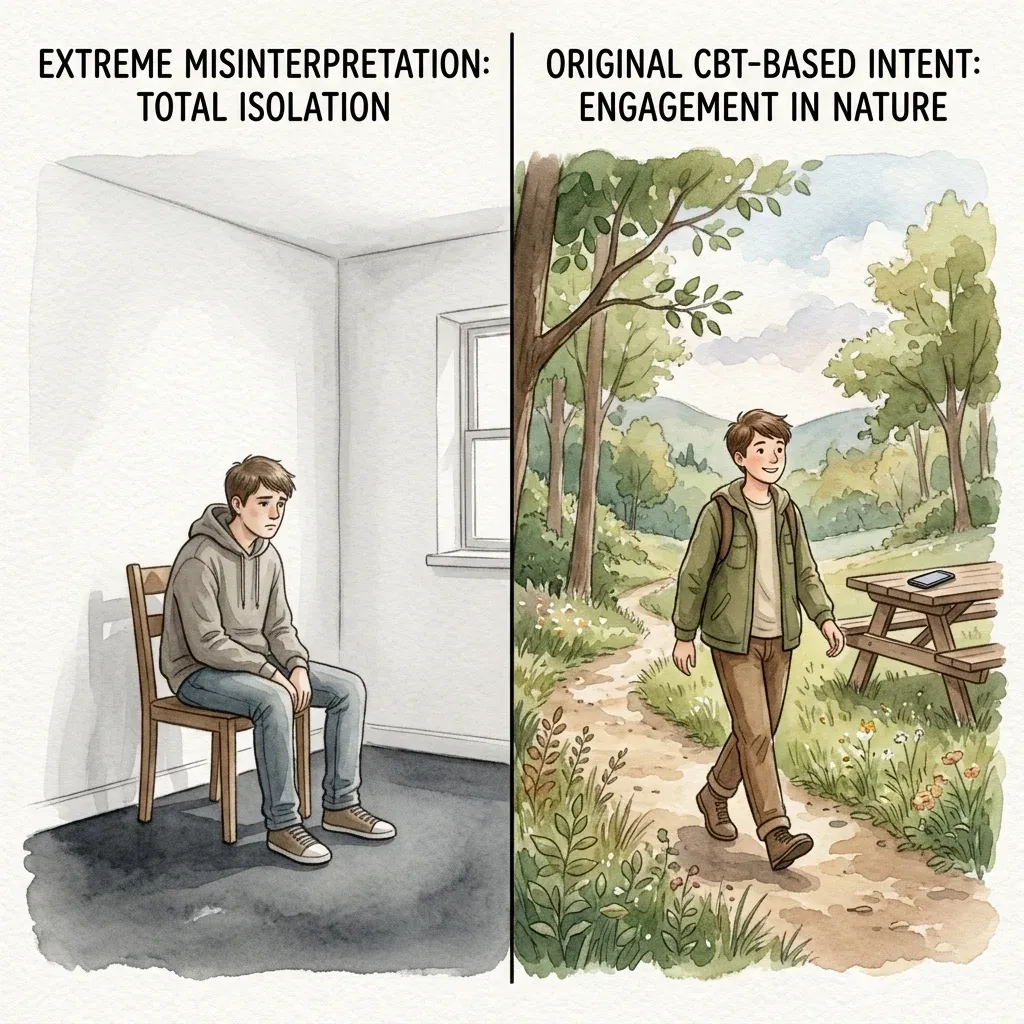
In 2019, a California psychologist named Cameron Sepah published a post on LinkedIn describing something he called "Dopamine Fasting 2.0." He framed it as "the antidote to our overstimulated age" and pitched it to the Silicon Valley crowd he worked with — tech workers and venture capitalists who felt consumed by their devices. The six behaviors he targeted were specific: emotional eating, excessive internet use, gambling and shopping, pornography, thrill-seeking, and recreational drugs. His actual method was grounded in cognitive behavioral therapy, not neurochemistry.
Sepah knew the name was misleading. He told the New York Times: "Dopamine is just a mechanism that explains how addictions can become reinforced, and makes for a catchy title. The title's not to be taken literally." But social media doesn't do nuance well. The concept spread through influencer channels, where it mutated into something unrecognizable. People started avoiding all pleasurable activities — socializing, exercise, music, food, believing they were "depleting their dopamine stores" and needed to let them "refill."
The basic biology makes that impossible. Your brain produces dopamine continuously. It doesn't deplete like a battery. Peter Grinspoon, a physician at Harvard Health, wrote that people "are viewing dopamine as if it was heroin or cocaine, and are fasting in the sense of giving themselves a 'tolerance break'... Sadly, it doesn't work that way at all." The irony is that Sepah's original suggestion — take breaks from compulsive behaviors and substitute simpler activities — resembles practices that have existed for thousands of years across religious traditions like Judaism, Islam, Christianity, and Buddhism. Lerner at Northwestern made exactly this point: "This is something that has existed, and that people have recognized value in, for a long time. But... it's certainly not as simple as just 'lowering your dopamine.'"
What actually happens when your brain gets too much stimulation
If dopamine detox gets the mechanism wrong, the underlying concern isn't entirely unfounded. Something does happen to your brain when it's bathed in constant stimulation, and the evidence for that is growing.
A 2025 review published in MDPI examined what researchers are calling "brain rot" — a term Oxford chose as its Word of the Year for 2024. The review noted that over 4 billion internet-connected young adults now spend an average of 6.5 hours per day online, much of it passively consuming low-quality content. The findings linked excessive digital consumption to emotional desensitization, cognitive overload, impaired executive function, and worsened memory and attention.
The mechanism isn't "too much dopamine" in any simple sense. It's closer to a rewiring of what your brain expects and responds to. In addiction research, Nora Volkow at the National Institute on Drug Abuse showed via PET imaging that the rate of dopamine increase matters — fast surges produce a high, while slow increases don't. Drugs of abuse and rapid-fire digital stimuli both produce fast dopamine spikes. Over time, the brain shifts. Where drugs initially trigger dopamine release directly, eventually it's the cues associated with the drugs — the environment, the ritual, the anticipation — that trigger the response. Your brain has learned a new prediction pattern, and the dopamine system has encoded it.
Social media platforms exploit this machinery. Algorithms like TikTok's "For You Page" create an endless consumption loop designed to deliver novel, unpredictable rewards — exactly the pattern that maximizes phasic dopamine bursts. Each swipe is a tiny slot machine pull. The problem isn't that you have "too much dopamine." The problem is that your prediction-error system has been trained to expect constant novelty, which makes ordinary life feel flat by comparison.
D2 receptors, downregulation, and what recovery actually looks like
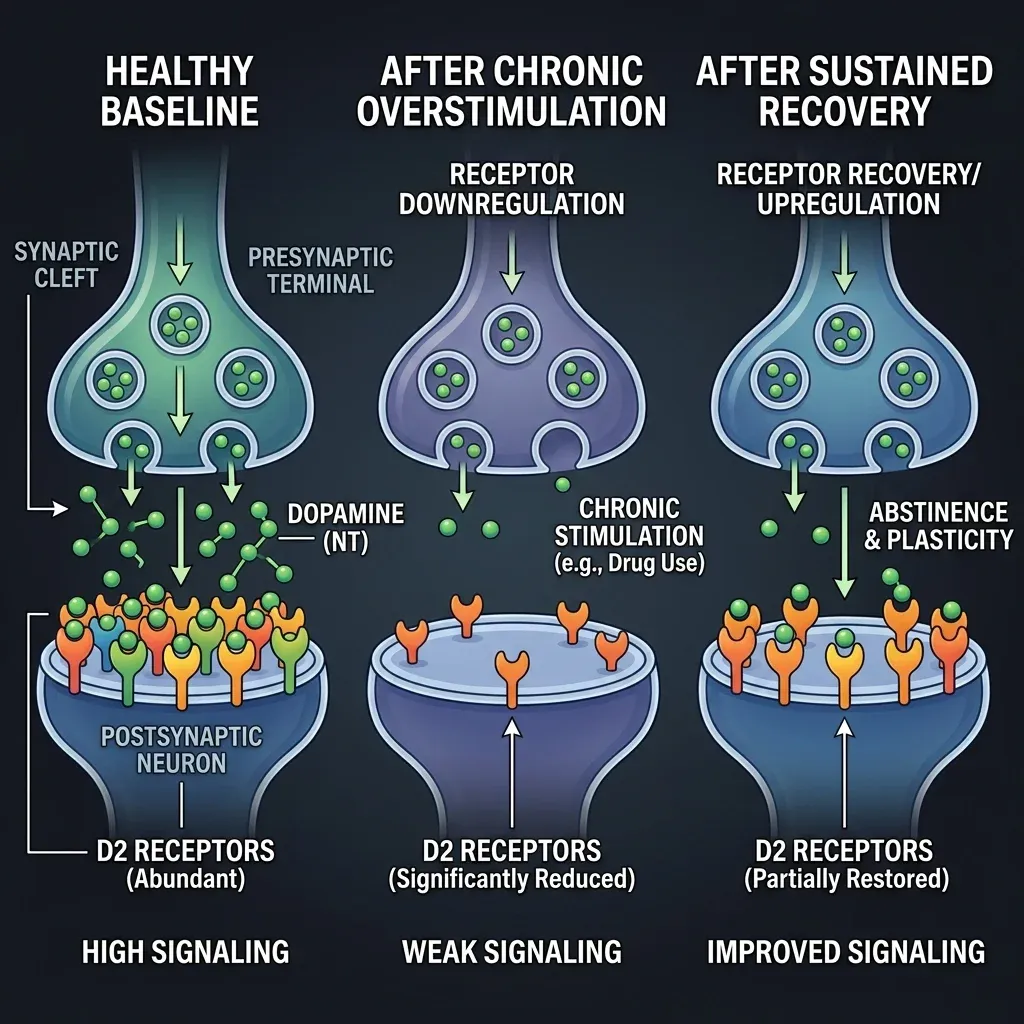
The part of the dopamine detox narrative that isn't entirely wrong involves receptor changes. When a system gets hammered with repeated stimulation, the receiving end adapts. In neuroscience, this is called downregulation.
Your brain has five types of dopamine receptors, labeled D1 through D5. The D2 receptor is especially important for reward processing, and it's also the one most affected by chronic overstimulation. D2 receptors have roughly 10 to 100 times greater affinity for dopamine than D1 receptors, meaning they respond to lower concentrations. Think of them as the sensitive microphones in your brain's reward circuit — they pick up the quiet signals.
Multiple imaging studies have confirmed that people with substance use disorders show lower D2 receptor expression in the striatum. This isn't just a drug-specific finding. The reduced D2 density correlates with decreased activity in the orbitofrontal cortex and anterior cingulate — brain regions responsible for emotion regulation and decision-making. When those regions go quiet, compulsive behavior and impulsivity get worse. It's a vicious loop: overstimulation reduces D2 receptors, which impairs the self-regulation you'd need to stop the overstimulation.
Your brain also has a built-in feedback system. D2-autoreceptors sit on dopamine neurons themselves and act as volume knobs — when dopamine levels run high, they reduce firing rate, slow down synthesis, and increase reuptake. The mechanism works well under normal conditions, but chronic bombardment can overwhelm it.
The question most people actually want answered: can the brain recover? The evidence says yes, but the timeline isn't what social media suggests. NIDA brain imaging data shows that dopamine transporter density can recover after prolonged abstinence from methamphetamine, but "prolonged" means months, not a weekend digital detox. Stephanie Borgland, who studies addiction neurobiology at the University of Calgary, has noted that in rat studies, dopaminergic systems remained altered for a month or more of abstinence — a long stretch relative to a rat's two-to-three-year lifespan.
"The challenge with dopamine fasting is that they're making the assumption that you're going to rewire your brain over this period of time," Borgland told The Scientist. "When, in fact, you're just not being reinforced for that period of time. But you still have all the habits present." Recovery requires new learning, not just abstinence. Your brain needs to build new prediction patterns, and that takes active engagement with alternative behaviors over weeks and months.
The evidence on behavioral fasting is thin but not empty
There are no randomized controlled trials testing "dopamine detox" as a specific intervention. That's worth stating directly because the social media ecosystem treats anecdotal improvement as proof. But there is adjacent evidence worth examining.
A 2024 literature review published in Cureus examined what the authors called "dopamine-fasting-like ideologies." They found that people who engaged in structured periods of reduced stimulation reported increased focus on tasks, reduced feelings of overwhelm, and decreased impulsive behaviors. The same review flagged the risks: extreme versions of the practice — strict isolation, severe dietary restriction — led to loneliness, anxiety, and malnutrition.
More targeted research has looked at specific behavioral changes. A 2025 study published in JAMA Network Open (Calvert et al.) found that reducing social media use for just one week improved mental health outcomes in young adults. That's a meaningful finding, but it's evidence for reducing a specific compulsive behavior — not for the broader "dopamine detox" framework.
| Dopamine detox claim | What the evidence actually shows |
|---|---|
| Abstaining from pleasure "resets" dopamine levels | Dopamine is produced continuously; you can't deplete or reset it through behavior alone |
| A weekend fast will rewire your brain | Receptor recovery takes weeks to months; a weekend changes nothing measurable |
| Avoiding all stimulation is beneficial | Extreme isolation increases risk for anxiety, loneliness, and cognitive decline |
| Reduced screen time improves wellbeing | Supported by evidence — targeted behavioral reduction does show benefits |
| The brain's reward system can recover | Yes, but through sustained behavioral change and new learning, not passive abstinence |
The honest summary: reducing compulsive screen time and high-stimulation behaviors probably helps, but not because you're "detoxing dopamine." You're breaking a behavioral pattern and giving your prediction-error system a chance to recalibrate to lower-intensity inputs. CBT has decades of evidence behind it for exactly this kind of behavioral modification. Marc Potenza, a leading behavioral addiction researcher, has stated that "psychotherapies have the most empirical support for helping people with gambling and gaming disorders and other conditions involving excessive use of digital technologies."
What actually works, according to the research
If the pure "dopamine detox" is neuroscience fiction, what should you do instead? The research points in a clear direction, and it's less dramatic than a 72-hour sensory deprivation experiment.
Target one or two specific behaviors. Susan Albers at the Cleveland Clinic recommends a five-step CBT-based approach: pick the behavior that's actually causing problems, set a time-limited experiment (an hour, a day, a week), find a replacement activity that still provides engagement, keep a journal tracking triggers and urges, and evaluate what changed. This is Sepah's original idea stripped of the misleading packaging.
Give it enough time. Anna Lembke, professor of psychiatry at Stanford and author of Dopamine Nation, recommends a minimum of five to ten days of abstinence from the problematic behavior, with 30 days being ideal for more entrenched patterns. This timeline aligns better with what we know about neural adaptation than a 24-hour "detox."
Exercise matters for receptor recovery. One of the more concrete findings in the dopamine literature: regular aerobic exercise upregulates striatal D2 and D3 receptors in methamphetamine users. While that study involved substance addiction rather than behavioral patterns, the underlying receptor mechanism is the same. Exercise isn't a metaphorical suggestion — it may be the closest thing to a real "dopamine reset" that exists, because it promotes the receptor upregulation that people incorrectly believe fasting provides.
Replace, don't just remove. Borgland's point that "you still have all the habits present" after abstinence is practical advice disguised as a research finding. Your brain needs to encode new behavioral patterns, and that requires doing new things, not just avoiding old ones. Walk outside instead of scrolling. Cook a meal instead of ordering delivery. The replacement needs to engage your prediction system with manageable novelty.

When should you actually be concerned about dopamine?
Most people scrolling through dopamine detox content on social media don't have a dopamine problem. They have a habit problem. But genuine dopamine dysfunction does exist, and mistaking one for the other can delay treatment that actually matters.
Parkinson's disease is the most well-known dopamine disorder. The neurons in the substantia nigra that produce dopamine progressively die, leading to tremors, stiffness, and slowed movement. As neurologist Pablo Villoslada of Hospital del Mar in Barcelona has warned: "A lack of dopamine is seen in Parkinson's disease. The neurons that produce this neurotransmitter die and all of the systems related to it stop functioning properly." Low dopamine also contributes to depression, restless leg syndrome, and ADHD.
Nandakumar Narayanan, a neurologist at the University of Iowa who treats Parkinson's patients, has expressed a specific concern about the dopamine detox trend. "Where I worry is if people start to deplete their dopamine in non-behavioral ways," he said. Supplements marketed as dopamine optimizers or detox aids aren't regulated, aren't evidence-based, and carry real risks when they interact with a neurotransmitter system this complex. "There are dangers in messing with this system," Narayanan added.
Villoslada also pointed out an ironic risk of extreme dopamine fasting: the social isolation it sometimes involves is itself a health hazard. "One of the main risk factors for Alzheimer's is social isolation," he noted. Cutting yourself off from human contact in pursuit of "resetting" your dopamine is trading one problem for a potentially worse one.
If you're experiencing persistent inability to feel pleasure (anhedonia), unexplained movement difficulties, chronic fatigue that doesn't respond to rest, or compulsive behaviors that interfere with daily functioning, those warrant a conversation with a physician or psychiatrist — not a YouTube-guided sensory deprivation weekend.
Frequently Asked Questions
Can you actually deplete your dopamine through behavior?
No. Your brain produces dopamine continuously through enzymatic synthesis — tyrosine hydroxylase converts the amino acid tyrosine into L-DOPA, which then becomes dopamine. Avoiding pleasurable activities doesn't stop this process. What changes with chronic overstimulation is your receptor sensitivity, not your dopamine supply. The distinction matters because it means the fix isn't fasting — it's sustained behavioral change that allows receptor systems to recalibrate.
Is there any benefit to taking a break from screens and social media?
Yes, but the benefit comes from breaking a compulsive behavioral loop, not from dopamine biochemistry. A 2025 JAMA Network Open study found measurable mental health improvements in young adults who reduced social media use for one week. The mechanism is closer to what cognitive behavioral therapy has shown for decades: reducing exposure to triggers weakens the habit cycle. Calling it a "dopamine detox" just adds pseudoscientific framing to something psychologists already understood.
How long does it take for the brain's reward system to recover from overstimulation?
There's no single number because it depends on the severity and duration of the overstimulation. NIDA brain imaging shows dopamine transporter recovery after prolonged abstinence from methamphetamine taking months. For behavioral patterns like excessive social media use, the research is less specific, but the neuroscience of receptor adaptation suggests meaningful changes begin after sustained behavioral change lasting weeks, not days. Stanford psychiatrist Anna Lembke recommends a minimum of five to ten days of abstinence from a specific problematic behavior, with 30 days being more effective for entrenched patterns.
Are dopamine supplements safe?
There is no evidence that over-the-counter "dopamine supplements" safely or effectively modify dopamine function in healthy people. As neurologist Nandakumar Narayanan has warned, these products aren't evidence-based and carry real risks when they interfere with a neurotransmitter system involved in movement, motivation, mood, and cognition. Dopamine-modifying medications exist for specific medical conditions (like Parkinson's disease) and require medical supervision precisely because the system is so sensitive to disruption.
What's the difference between dopamine fasting and cognitive behavioral therapy?
Very little, once you strip away the misleading name. Sepah's original dopamine fasting protocol was explicitly based on CBT principles: identify a problematic behavior, abstain from it for a structured period, replace it with healthier alternatives, and track the results. CBT has decades of clinical evidence supporting its effectiveness for behavioral addictions. The "dopamine detox" label added nothing except confusion about the underlying mechanism.
Medical Disclaimer
This article is for informational and educational purposes only and is not medical advice, diagnosis, or treatment. Always consult a licensed physician or qualified healthcare professional regarding any medical concerns. Never ignore professional medical advice or delay seeking care because of something you read on this site. If you think you have a medical emergency, call 911 immediately.