What Sermorelin and HGH Actually Do Inside Your Body
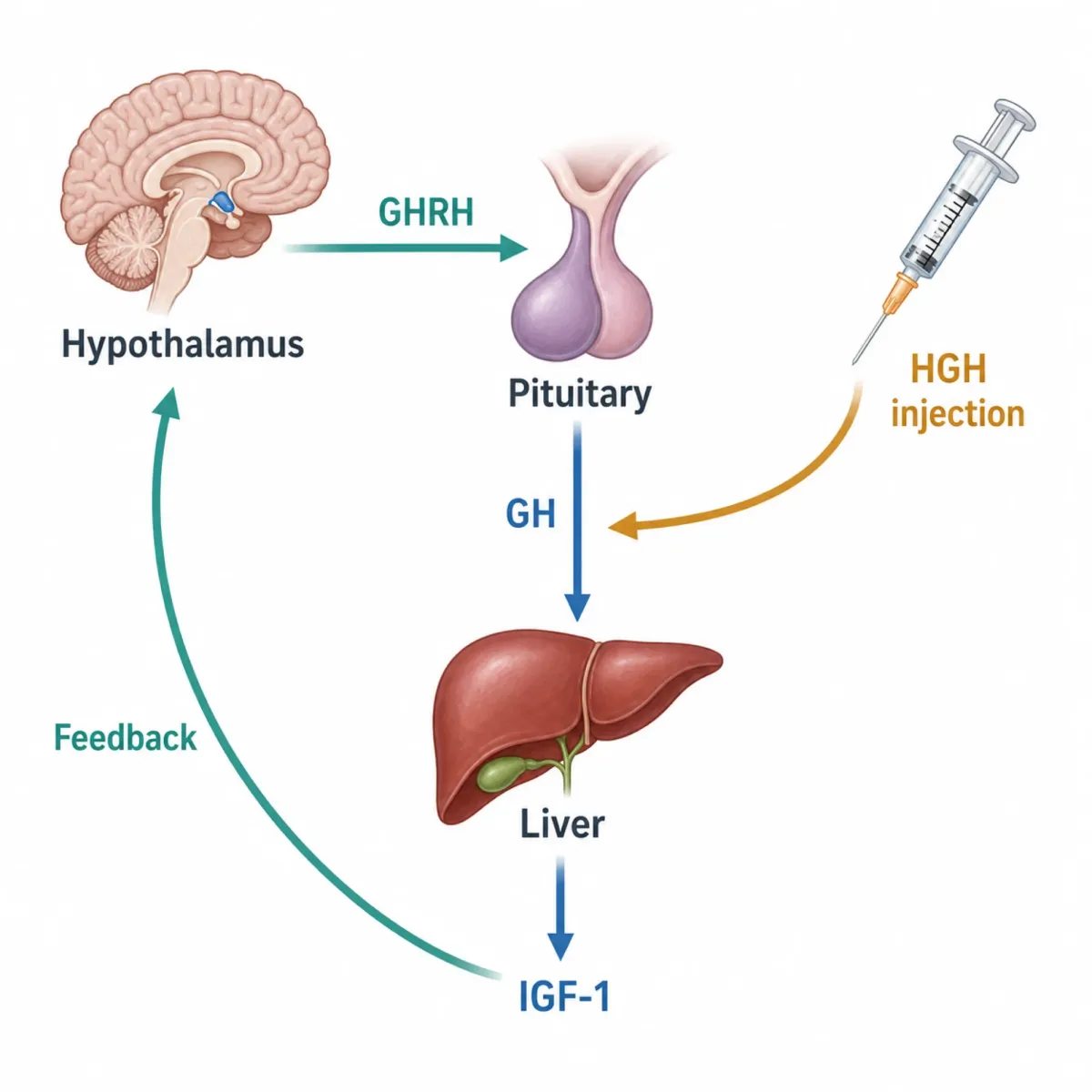
The cleanest way to compare sermorelin and HGH is to stop treating them like rival brand names. HGH injections add growth hormone directly. Sermorelin tries to press the body's own release button.
Somatropin, the prescription form of human growth hormone, is described by MedlinePlus as an hGH analog that replaces growth hormone normally produced by the body, and it is used for specific medical indications such as growth failure from growth hormone deficiency, HIV-related weight and endurance support, and adult short bowel syndrome under medical supervision MedlinePlus notes. Think of HGH like pouring water straight into a reservoir. If the reservoir is genuinely low because the system cannot refill itself, replacement may make sense. If the reservoir is normal, extra water can spill into places it does not belong.
Sermorelin is different. Richard F. Walker described sermorelin as growth hormone releasing factor 1-29 NH2-acetate, a growth hormone-releasing hormone analog that binds pituitary receptors and stimulates endogenous hGH secretion Walker wrote in Clinical Interventions in Aging. The analogy is a thermostat rather than a hose: sermorelin nudges the control panel, while the pituitary and feedback hormones still decide how much heat to release.
That thermostat story is appealing, but it can be oversold. The Endocrine Society explains that growth hormone stimulates the liver to produce IGF-1, and IGF-1 then acts across tissues involved in growth and metabolism the society explains. Once IGF-1 rises, the body is no longer dealing with a harmless wellness signal. It is dealing with a hormone axis that touches glucose handling, fluid retention, tissue growth, sleep, and cancer-related cautions.
| Question | HGH injections | Sermorelin |
|---|---|---|
| Primary action | Adds recombinant growth hormone directly, replacing hormone that may be deficient MedlinePlus describes | Stimulates pituitary release through a GHRH-like signal Walker describes |
| Best-established medical use | Documented growth hormone deficiency and other defined indications Molitch et al. state | Much smaller aging-adult evidence base, mostly GHRH analog studies and editorial discussion Khorram et al. report |
| Anti-aging proof | Not recommended for healthy aging adults in the major systematic review Liu et al. conclude | Hypothesis-generating, not proven longevity treatment Walker frames |
Practically, this means the first question is not "Which shot is stronger?" It is "Do I have a diagnosed hormone deficiency, or am I buying a story about normal aging?" Those are different medical conversations.
The Line Between Approved Treatment and Anti-Aging Marketing
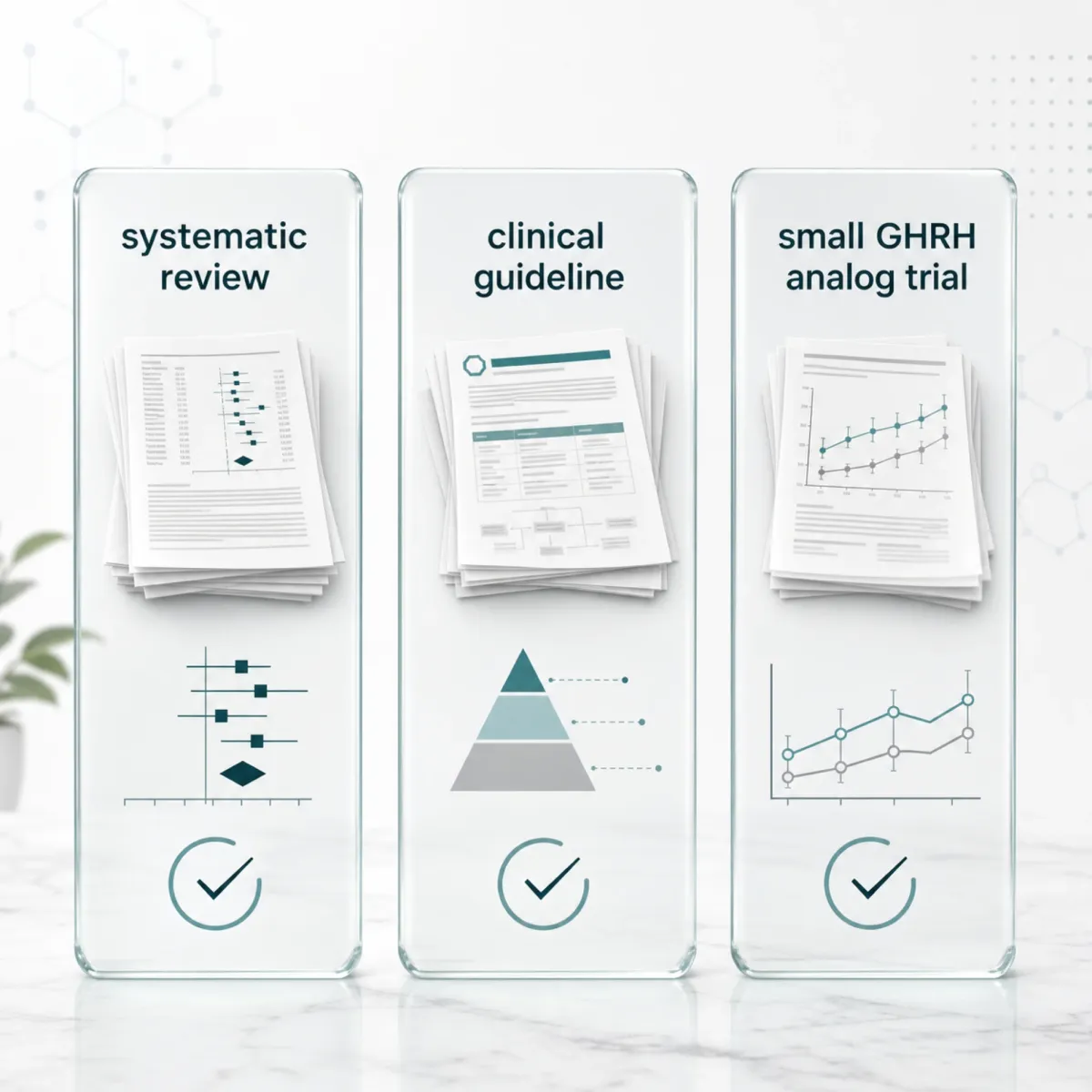
HGH is not fringe medicine when it is used for the right diagnosis. The Endocrine Society guideline says adult growth hormone deficiency can persist from childhood or be newly acquired, and confirmation through stimulation testing is usually required unless a proven genetic or structural lesion persists from childhood Molitch and colleagues write. That is a high bar on purpose. Symptoms like fatigue, belly fat, low mood, and poor recovery are real, but they are also common in sleep apnea, thyroid disease, undertraining, overtraining, depression, medication effects, and ordinary life stress.
The legal line around HGH is also unusually sharp. In its review of growth hormone in healthy older adults, Hau Liu and colleagues stated that GH was widely used as an anti-aging therapy, but that this use was not approved by the U.S. Food and Drug Administration and distribution as an anti-aging agent was illegal in the United States the Annals review states. Cornell's publication of 21 U.S.C. 333 says knowingly distributing human growth hormone for human use outside an authorized disease or recognized medical condition, pursuant to a physician order, is punishable by up to 5 years in prison; if the offense involves someone under 18, the statute lists up to 10 years.
The plain-English version: FDA-approved HGH replacement for documented deficiency is medicine. Selling HGH as a general anti-aging upgrade is not the same thing.
Sermorelin sits in a messier zone. Walker argued that off-label prescribing of sermorelin was not prohibited by the same federal restriction that applies to rhGH his editorial notes. But "not the same legal category as HGH" does not mean "proven anti-aging therapy." It means a doctor still has to justify the prescription, the compounding source, the monitoring plan, and the reason for using a growth-hormone secretagogue in the first place.
| Scenario | Evidence/authority | Practical implication |
|---|---|---|
| Confirmed adult GHD | Guideline-supported diagnosis and individualized GH dosing Molitch et al. advise | Endocrinology care makes sense |
| Healthy aging with normal testing | GH cannot be recommended as anti-aging therapy Liu et al. conclude | Be skeptical of HGH sales pitches |
| Peptide clinic sermorelin offer | Small GHRH analog trials and theoretical physiology Khorram et al. show | Ask for diagnosis, goals, labs, and stop rules |
The useful takeaway is not that sermorelin is automatically safer because clinics call it a peptide. The useful takeaway is that HGH has a narrow legitimate lane, while sermorelin has a larger evidence gap. A careful doctor should make that distinction before discussing price, dose, or "optimization."

What Human Studies Show About Benefits
The strongest argument for HGH in aging clinics usually comes from body composition. That argument is not imaginary, but it is smaller than the marketing makes it sound.
In a systematic review of GH therapy in healthy older adults, Liu and colleagues included 31 articles describing 18 unique study populations, with 220 GH-treated participants who completed their studies and a mean participant age of 69 years the review reports. Compared with no GH, fat mass decreased by 2.1 kg and lean body mass increased by 2.1 kg, but total body weight did not significantly change, and bone density did not improve meaningfully the same analysis found. That is the classic anti-aging trade: the scale may not move, a body scan may look leaner, and the clinical meaning remains uncertain.
Another Liu review looked at physical performance in younger, fit people. It included 44 articles, 27 study samples, and 303 GH-treated participants the Annals review reports. Lean body mass again rose by 2.1 kg, but strength and exercise capacity did not seem to improve, and GH-treated participants more often had soft tissue edema and fatigue Liu and colleagues found. In other words, more lean mass on paper did not translate into the kind of performance upgrade people imagine.
The sermorelin evidence is thinner. Omar Khorram and colleagues studied a GHRH analog in 10 women and 9 men aged 55 to 71 after a 4-week placebo period followed by 16 weeks of nightly 10 mcg/kg subcutaneous treatment the JCEM abstract reports. The treatment increased IGF-I, increased skin thickness in both genders, and increased lean body mass only in men; sleep quality was unaffected, and the only adverse side effect reported in that small metabolic study was transient hyperlipidemia Khorram et al. report.
This is why the showdown is less dramatic than the sales copy. HGH has better-studied effects, but the healthy-aging payoff is modest and burdened by adverse events. Sermorelin has an elegant mechanism and a small positive trial signal, but not the large, durable outcomes people expect when they hear "anti-aging."
The Side Effects Clinics Tend to Downplay
Growth hormone is not a cosmetic tweak. It is closer to adjusting water pressure in a whole building: turn it up in one room and other pipes feel it.
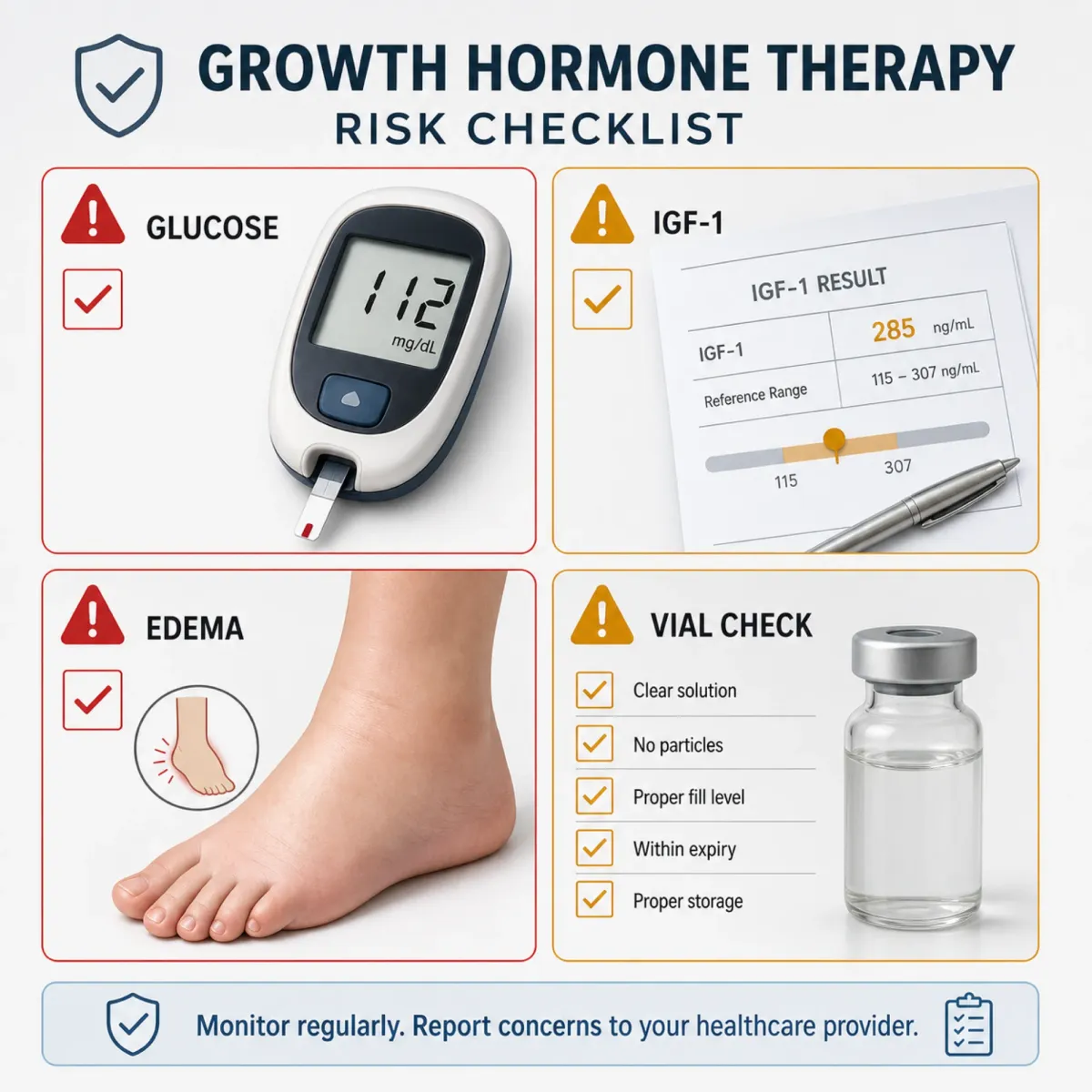
In the healthy-elderly GH review, people receiving GH were significantly more likely to experience soft tissue edema, arthralgias, carpal tunnel syndrome, and gynecomastia, and they were somewhat more likely to develop diabetes mellitus or impaired fasting glucose Liu et al. reported. The athletic-performance review similarly found more soft tissue edema and fatigue among GH-treated participants the later review found. MedlinePlus also lists warnings and side effects for somatropin, including injection-site pain or swelling, headache, muscle or joint pain, swelling of the hands or feet, numbness or tingling, breathing problems or sleep apnea, pancreatitis symptoms, and cancer-related cautions MedlinePlus lists.
Sermorelin is often marketed as the gentler option. The small Khorram metabolic study did report only transient hyperlipidemia as an adverse side effect the abstract states. But a small, short study cannot prove long-term safety across the kinds of patients anti-aging clinics treat. That is especially true when compounded products, multi-peptide stacks, and mail-order protocols enter the picture.
FDA's Pharmacy Compounding Advisory Committee briefing on ipamorelin-related bulk substances is not a sermorelin approval document, but it is useful because it explains why compounded peptides deserve caution. FDA reviewers noted peptide-specific concerns such as immunogenic potential, self-association and aggregation, peptide-related impurities, and characterization challenges the FDA briefing states. The same document said FDA did not identify sufficient data to conclude that ipamorelin-related substances would avoid safety concerns similar to approved GH-stimulating products, including glucose intolerance and diabetes mellitus the briefing notes.
| Risk area | What the evidence says | What to ask before treatment |
|---|---|---|
| Fluid and nerve symptoms | Edema, arthralgias, and carpal tunnel were more common with GH in older adults Liu et al. found | What symptoms trigger dose reduction or stopping? |
| Glucose metabolism | GH users were somewhat more likely to have diabetes or impaired fasting glucose the review reports | Will fasting glucose, A1c, and IGF-1 be monitored? |
| Compounded peptides | FDA flagged peptide impurities, aggregation, and immunogenicity concerns in a compounding review FDA reviewers wrote | Which pharmacy, certificate, sterility process, and adverse-event plan? |
If a clinic talks only about recovery, sleep, fat loss, and "optimization," it is skipping half the discussion. The safer conversation starts with contraindications, baseline labs, expected stop points, and what the clinician will do if IGF-1, glucose, swelling, nerve symptoms, or headaches move in the wrong direction.
Who Might Fit Sermorelin, HGH, or Neither
For a person with documented adult GHD, the comparison is not really sermorelin versus HGH. It is guideline-based diagnosis and individualized treatment versus under-treatment of a real endocrine disorder. The Endocrine Society guideline says GH therapy can benefit body composition, exercise capacity, skeletal integrity, and quality-of-life measures in adult GHD, and that final treatment decisions require careful individualized judgment Molitch et al. write.
For a healthy adult chasing anti-aging, the answer changes. The best HGH review in healthy older adults found small body-composition shifts, more adverse events, and concluded GH cannot be recommended as anti-aging therapy Liu et al. conclude. Sermorelin may seem like the clever middle path, but the supporting human data are closer to a pilot light than a floodlight: promising physiology, small studies, and a need for better trials.
Walker's editorial makes the pro-sermorelin case clearly: because sermorelin stimulates the pituitary rather than delivering a bolus of rhGH, it may preserve more normal pulsatile physiology and feedback regulation Walker argues. That is a reasonable hypothesis. It is not the same as showing fewer fractures, fewer cardiovascular events, longer life, better cognition, or durable fat loss in large randomized trials.
- HGH may fit: adults with confirmed GHD or another defined indication, managed by a clinician who follows accepted diagnostic and monitoring standards the Endocrine Society guideline supports.
- Sermorelin may fit: selected patients in a medically supervised, transparent, off-label context where the doctor admits the evidence limits and monitors IGF-1, glucose, symptoms, and treatment goals.
- Neither may fit: healthy adults with normal endocrine testing who are being sold hormone manipulation for vague "anti-aging" outcomes that have not been proven in hard endpoints the healthy-elderly review cautions.
The practical move is to resist the forced choice. If the clinic starts by asking which vial you want, you are already in the wrong conversation. A serious clinician starts by asking what condition is being treated.

The Doctor Conversation That Matters More Than the Brand Name
A good consultation should feel a little boring. That is not a flaw. The boring parts are where the safety lives.
Start with diagnosis. Ask whether your symptoms point to adult GHD or to something more common, and ask what testing is needed. The Endocrine Society guideline says stimulation testing is usually required for adult GHD confirmation unless a clear genetic or structural childhood lesion persists Molitch et al. state. The Endocrine Society's patient resource also notes that IGF-1 testing can help, but low IGF-1 can reflect other causes such as liver disease or low body weight the society notes.
Then ask about monitoring. MedlinePlus advises patients using somatropin to tell clinicians about medications and medical history because doses may need adjustment and careful side-effect monitoring MedlinePlus advises. For any GH-axis intervention, that same spirit should apply: baseline IGF-1, glucose status, sleep apnea risk, cancer history, thyroid status, medication interactions, and a written stop plan.
Finally, ask what outcome would count as failure. If the promise is "you will feel younger," the target can move forever. If the target is a diagnosed deficiency, a symptom score, an IGF-1 range, glucose safety, and a timeline for reassessment, you at least have a way to judge whether the therapy is helping or just draining money.
The honest answer is not "sermorelin wins" or "HGH wins." HGH wins for documented deficiency when used properly. Neither wins as a proven anti-aging shortcut. Sermorelin remains a plausible but under-tested middle option, not a loophole around biology.

Frequently Asked Questions
Is sermorelin safer than HGH?
It may be gentler in theory because it stimulates pituitary release rather than adding growth hormone directly, but long-term safety for anti-aging use is not proven. The small Khorram GHRH analog study reported transient hyperlipidemia as the only adverse side effect, while the HGH healthy-elderly review found more edema, joint pain, carpal tunnel syndrome, gynecomastia, and possible glucose problems Khorram et al. reported Liu et al. found.
Does HGH reverse aging?
No strong clinical evidence shows that HGH reverses aging in healthy adults. In a systematic review of healthy older adults, GH reduced fat mass by 2.1 kg and increased lean body mass by 2.1 kg, but it also increased adverse events and could not be recommended as anti-aging therapy the review concluded.
Is HGH legal if a doctor prescribes it?
HGH can be prescribed for authorized medical uses, but federal law treats distribution for human use outside authorized disease or recognized medical-condition treatment differently. Cornell's text of 21 U.S.C. 333 lists prohibited hGH distribution penalties of up to 5 years, or up to 10 years when the offense involves someone under 18 the statute states.
Should I choose sermorelin if my IGF-1 is low?
Not from IGF-1 alone. The Endocrine Society says IGF-1 testing can help evaluate GHD, but low IGF-1 can have other causes, and adult GHD usually requires proper diagnostic confirmation before treatment decisions the patient resource explains the guideline states.
Medical Disclaimer
This article is for informational and educational purposes only and is not medical advice, diagnosis, or treatment. Always consult a licensed physician or qualified healthcare professional regarding any medical concerns. Never ignore professional medical advice or delay seeking care because of something you read on this site. If you think you have a medical emergency, call 911 immediately.