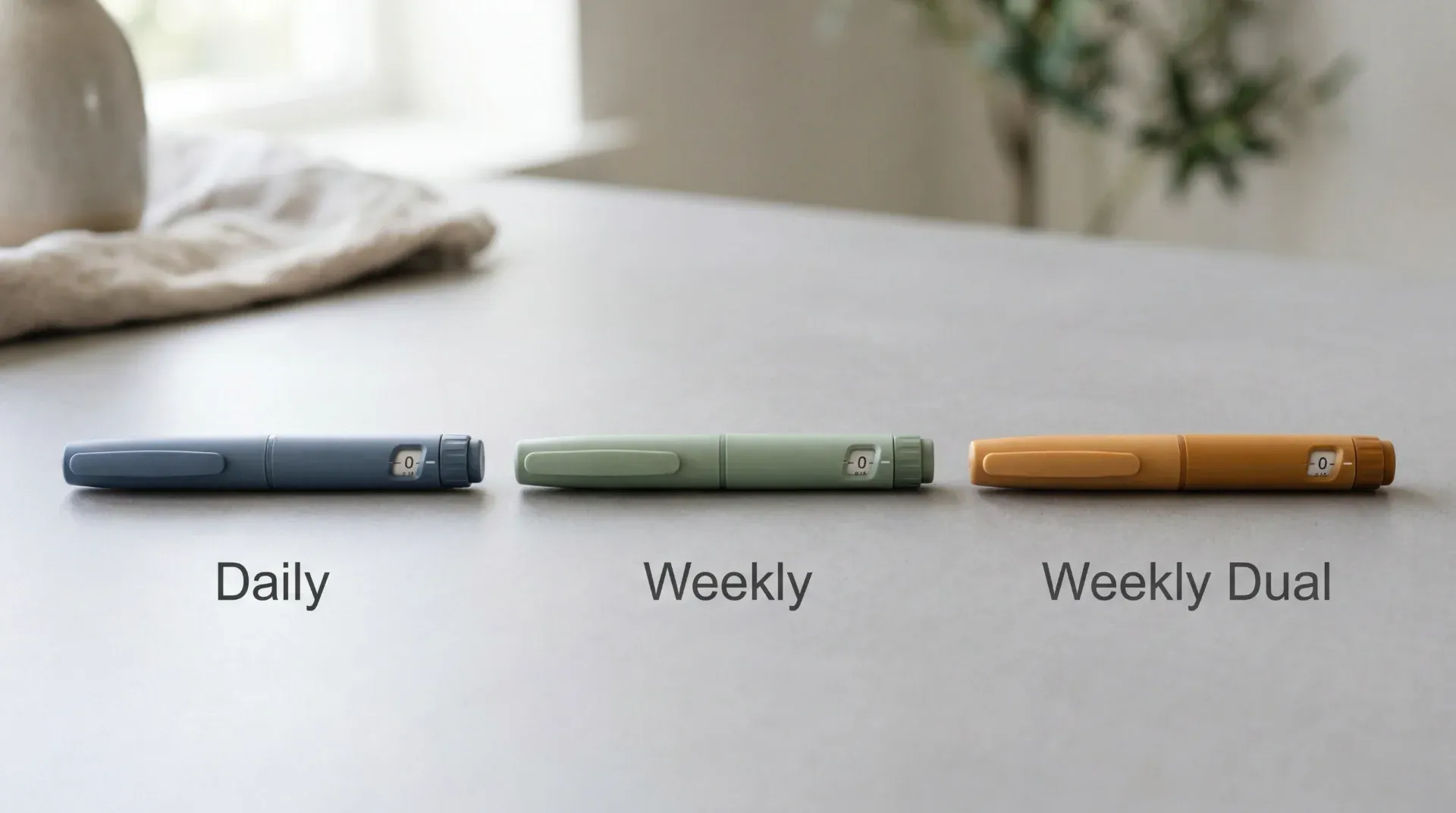
Comparing liraglutide, semaglutide, and tirzepatide is harder than it should be. The information is scattered across drug company sites, trial papers, and pharmacy blogs that each cover a slightly different angle. This guide is the chart we wanted to read: what are the actual differences between the three big GLP-1 medications, and which factors should you weigh before agreeing to one over another?
The Three Drugs at a Glance
Three molecules dominate the GLP-1 landscape. They share enough biology to belong on the same chart, but they differ enough in dosing, potency, and approved uses that the wrong choice can mean a worse fit for your life or your insurance plan. Here is the master comparison; we break down each row below.
| Feature | Liraglutide | Semaglutide | Tirzepatide |
|---|---|---|---|
| Brand names | Saxenda (obesity), Victoza (T2D) | Wegovy (obesity), Ozempic (T2D), Rybelsus (oral T2D) | Zepbound (obesity), Mounjaro (T2D) |
| Drug class | GLP-1 receptor agonist | GLP-1 receptor agonist | Dual GIP and GLP-1 receptor agonist |
| Dosing schedule | Daily injection | Weekly injection (or daily oral) | Weekly injection |
| Average weight loss in pivotal trial | About 8 percent at 56 weeks (SCALE) | 14.9 percent at 68 weeks (STEP-1) | 20.9 percent at 72 weeks (SURMOUNT-1, 15 mg) |
| FDA approval years | 2010 (T2D), 2014 (obesity) | 2017 (T2D), 2021 (obesity) | 2022 (T2D), 2023 (obesity) |
| Cardiovascular trial result | Reduced MACE in T2D (LEADER) | Reduced MACE 20 percent in obesity (SELECT) | Pending (SURPASS-CVOT) |
| U.S. retail price (cash) | About $1,300 per month | Wegovy about $1,821 per month | Zepbound about $1,520 per month |
Quick footnote: the weight-loss numbers come from pivotal obesity trials. Your real-world result depends on dose, adherence, lifestyle changes, and how your body responds.
How They Work, in Plain English
Your gut releases a hormone called GLP-1 (glucagon-like peptide-1) every time you eat. GLP-1 does three things at once: it tells your pancreas to release insulin so blood sugar stays steady, it tells your stomach to empty more slowly so you feel fuller longer, and it nudges the satiety centers in your brain to dial down hunger. Natural GLP-1 vanishes within minutes. The drugs in this guide are engineered versions that stick around long enough to do real work.
Liraglutide and semaglutide are both pure GLP-1 mimics. According to MedlinePlus, the National Library of Medicine's consumer drug reference, liraglutide belongs to a class called incretin mimetics that "works by helping the pancreas to release the right amount of insulin when blood sugar levels are high." Semaglutide is a more durable cousin with a longer half-life, which is why it can be injected weekly instead of daily.
Tirzepatide does something different. Cleveland Clinic's drug monograph describes it as targeting "two hormones (GLP-1 and GIP) that affect appetite and blood sugar control." GIP, glucose-dependent insulinotropic polypeptide, is a second incretin hormone. Hitting both receptors at once produces stronger effects on appetite, glucose handling, and fat metabolism than either alone.
Think of GLP-1 alone as one dimmer switch on your appetite. The dual GIP and GLP-1 mechanism in tirzepatide is two switches working in tandem. That partly explains why the head-to-head data lean tirzepatide's way.
Dr. Louis Aronne of Weill Cornell Medicine, who led the largest direct comparison trial, told his institution's news team that "the pathways that regulate weight are incredibly complicated." The deeper the drugs reach into those pathways, the more weight tends to come off, and the more there is to monitor.
Dosing: Daily, Weekly, or Pill
This is one of the biggest day-to-day differences, and it often gets buried in clinical writeups.
Liraglutide is a daily injection. MedlinePlus describes Saxenda and Victoza as prefilled pens used "once daily, preferably at consistent times" into the stomach, thigh, or upper arm. The pen is discarded 30 days after first use, even if medication remains.
Semaglutide is a weekly injection. MedlinePlus's semaglutide reference says you "inject on the same day weekly, though patients may change injection days if at least 2 days pass since the last dose." Dosing escalates every four weeks. Semaglutide also comes as a daily oral pill called Rybelsus, but only for type 2 diabetes, not obesity.
Tirzepatide is also a weekly injection. Cleveland Clinic's monograph says it's given "once every week (every 7 days)" with rotation between sites. If you're more than four days late, you skip that week's shot. Two doses within three days is forbidden.
The schedule isn't just logistics. People who travel, work shifts, or simply hate the daily reminder of a chronic condition often find weekly dosing more livable.
| Dosing detail | Liraglutide | Semaglutide | Tirzepatide |
|---|---|---|---|
| Frequency | Once daily | Once weekly (or daily oral) | Once weekly |
| Route | Subcutaneous injection | Injection or oral tablet | Subcutaneous injection |
| Injection sites | Stomach, thigh, upper arm | Stomach, thigh, upper arm | Stomach, thigh, upper arm |
| Missed-dose window | Take when remembered | 5 days for diabetes; 2 days for weight loss | Within 4 days, otherwise skip |
| Pen disposal | Discard 30 days after first use | Refrigerate; follow labeling | Refrigerate; follow labeling |
If you're prone to forgetting things, a weekly schedule has 1/7 the chances of a missed dose compared with daily. If your insurance covers liraglutide but not the newer drugs, daily injection is the price of access, and most people adapt within a few weeks.
Weight-Loss Efficacy and the Head-to-Head Trial
This is the section everyone scrolls to first. We start with the original placebo-controlled trials for each drug, then turn to the only direct head-to-head comparison.
Liraglutide: SCALE Obesity
The SCALE Obesity and Prediabetes trial enrolled 3,731 adults with obesity or excess weight plus a related condition, randomized them to liraglutide 3 mg or placebo, and followed them for 56 weeks. According to the published PubMed Central analysis, about 77 percent of liraglutide users qualified as "early responders" who lost at least 4 percent by week 16. Those early responders averaged 10.8 percent loss (about 11.2 kg) by week 56. Across the whole liraglutide group, the headline number is closer to 8 percent.
Semaglutide: STEP-1
STEP-1 randomized 1,961 adults with obesity to semaglutide 2.4 mg weekly or placebo for 68 weeks. The American College of Cardiology's trial summary reports a mean body weight change of -14.9 percent in the semaglutide group versus -2.4 percent in placebo, with 86.4 percent of semaglutide users losing at least 5 percent of starting weight.
Tirzepatide: SURMOUNT-1
SURMOUNT-1 enrolled 2,539 adults with obesity but no diabetes, randomizing them four ways: tirzepatide 5 mg, 10 mg, 15 mg, or placebo, weekly for 72 weeks. According to the ACC trial review, mean weight loss was -15 percent on 5 mg, -19.5 percent on 10 mg, and -20.9 percent on 15 mg, against -3.1 percent for placebo. More striking: 56.7 percent of the 15 mg group lost at least 20 percent of body weight, compared to 3.1 percent of placebo.
The direct comparison: SURMOUNT-5
Until 2025, no trial pitted tirzepatide and semaglutide against each other in a non-diabetic obesity population. SURMOUNT-5 changed that. As Weill Cornell reported, 751 participants were randomized to one of the two drugs and followed for 72 weeks. Tirzepatide users lost about 20.2 percent of body weight; semaglutide users lost 13.7 percent. About 32 percent of tirzepatide users hit the 25-percent-loss mark, versus 16 percent of semaglutide users. The trial wasn't blinded because the auto-injector pens differ, which the researchers acknowledged. Still, the gap is large enough to take seriously.
A Cochrane review commissioned by the World Health Organization pooled the data more broadly. According to that analysis, tirzepatide produces around 16 percent weight reduction across 8 trials with 6,361 participants, semaglutide about 11 percent across 18 trials with 27,949 participants, and liraglutide a more modest 4 to 5 percent across 24 trials with 9,937 participants. The pooled figures are lower than headline pivotal-trial numbers because they include shorter studies and lower-dose arms.
If you're a "responder," you can plausibly expect single-digit percent loss on liraglutide, low-to-mid teens on semaglutide, and high teens to low twenties on tirzepatide. Non-responders are a meaningful share on every drug, which is why prescribers check progress at 3 to 4 months.
Diabetes Control and Heart Protection
Weight loss gets the headlines, but two of these drugs got their original FDA approvals for type 2 diabetes. The blood-sugar story matters, and so does the cardiovascular evidence.
HbA1c reduction
The clearest comparison comes from SURPASS-2, a 40-week head-to-head trial of tirzepatide against semaglutide 1 mg in 1,879 patients with type 2 diabetes. According to the published trial report on PubMed, baseline mean HbA1c was 8.28 percent. After 40 weeks:
- Tirzepatide 5 mg: -2.01 percentage points
- Tirzepatide 10 mg: -2.24 percentage points
- Tirzepatide 15 mg: -2.30 percentage points
- Semaglutide 1 mg: -1.86 percentage points
All three tirzepatide doses were both non-inferior and statistically superior to semaglutide on glycemic control. The 15 mg arm also dropped 5.5 kg more weight than semaglutide 1 mg.
Cardiovascular outcomes
This is where the three drugs diverge most. Liraglutide's evidence comes from LEADER, a 9,340-patient trial of T2D patients with high cardiovascular risk followed for 3.8 years. According to a post-hoc analysis on PubMed Central, liraglutide reduced major adverse cardiovascular events (MACE) with a hazard ratio of 0.89 in non-PAD patients and 0.77 in those with peripheral artery disease.
Semaglutide has the strongest case, thanks to SELECT. As the ACC summary describes, SELECT enrolled 17,604 adults with obesity and established cardiovascular disease but no diabetes. Over 40 months, the primary MACE outcome was 6.5 percent in the semaglutide arm versus 8.0 percent in placebo, a 20 percent relative risk reduction (HR 0.80, p<0.001). All-cause mortality dropped from 5.2 to 4.3 percent. SELECT is why Wegovy carries an FDA indication for cardiovascular risk reduction.
Tirzepatide's cardiovascular trial isn't done yet. SURPASS-CVOT is ongoing. Until those results land, tirzepatide users lean on weight-loss benefits and biological plausibility, not on hard event-reduction proof.
The 3-year SURMOUNT-1 follow-up showed tirzepatide cut new-onset type 2 diabetes from 13.3 percent in placebo to between 0.4 and 2.0 percent across the three dose arms. That's a striking diabetes prevention signal even before the formal CV trial reports out.
Side Effects and Safety Warnings
The drugs share more side effects than they don't, because they share most of their mechanism. Intensity tends to scale with potency.
Common GI side effects
Nausea, vomiting, diarrhea, constipation, and abdominal pain are reported across all three. In SURMOUNT-5, about 44 percent in each treatment arm experienced nausea and 25 percent had abdominal pain, with no meaningful difference between tirzepatide and semaglutide. In STEP-1, 4.5 percent of semaglutide users discontinued because of GI events, compared with 0.8 percent of placebo.
Most GI symptoms cluster in the first weeks of dose escalation and improve as your body adapts. That's why all three drugs use stepwise titration schedules.
The shared boxed warning
All three carry the same FDA boxed warning for medullary thyroid C-cell tumors, based on rat studies that showed dose-related thyroid C-cell tumors. As MedlinePlus warns, anyone with personal or family history of medullary thyroid carcinoma or Multiple Endocrine Neoplasia syndrome type 2 should not use them. Whether the rodent finding translates to humans is debated, but the contraindication is firm.
Pancreatitis
This is the safety story that has evolved most recently. According to a UK Medicines and Healthcare products Regulatory Agency safety update issued January 29, 2026, regulators received 1,296 pancreatitis reports between 2007 and October 2025. Of those, 19 were fatal and 24 involved necrotising pancreatitis. About 25.4 million packs were dispensed over the preceding five years, so absolute risk per patient is small. The MHRA still strengthened warnings: stop the drug if pancreatitis is suspected, and don't restart it if confirmed.
| Adverse event | Liraglutide | Semaglutide | Tirzepatide |
|---|---|---|---|
| Boxed thyroid tumor warning | Yes | Yes | Yes |
| Pancreatitis warning | Yes | Yes | Yes |
| Gallbladder disease | Reported | Reported | Reported |
| Acute kidney injury | Possible | Possible | Possible |
| Oral contraceptive interaction | Standard caution | Standard caution | Backup advised for 4 weeks at start and dose increases |
The contraceptive caveat for tirzepatide is worth flagging for anyone of reproductive age. Cleveland Clinic's monograph specifically advises non-oral or barrier contraception for four weeks after starting tirzepatide and after every dose increase.
Cost, Coverage, and the Insurance Maze
This may be the most consequential row of the comparison chart for many readers. Without insurance, these drugs are expensive in a way that genuinely changes accessibility.
According to a Peterson-KFF Health System Tracker analysis, U.S. list prices break down as: Wegovy at $1,349 per month, Mounjaro at $1,023, and Ozempic at $936. The same brief reports Wegovy at about $328 per month in Germany and $296 in the Netherlands; Mounjaro at $444 in the Netherlands and $319 in Japan.
Pharmacy data from SingleCare shows retail cash prices closer to $1,520 per month for Zepbound and $1,821 for Wegovy without coupons. Saxenda lands between those two, around $1,300 per month, though generic competition is on the horizon now that liraglutide's patent has expired.
KFF notes that Wegovy savings coupons range from $225 to $500 per 28-day supply depending on insurance status. Both manufacturers offer self-pay programs that bring monthly costs down for people without coverage.
| Cost dimension | Liraglutide | Semaglutide | Tirzepatide |
|---|---|---|---|
| U.S. retail (cash, monthly) | About $1,300 (Saxenda) | $1,349 to $1,821 | $1,023 to $1,520 |
| Manufacturer coupon | Yes (Saxenda program) | $225-$500 via NovoCare | Zepbound savings card |
| Medicare Part D for weight loss | No | No | No |
| Patent / generic outlook | Patent expired; generics emerging | Brand patent expires 2026 | Brand-only through late 2030s |
Per SingleCare, Medicare Part D doesn't cover any of these for weight loss specifically. As of August 2024, only 13 state Medicaid programs offered coverage. Private insurance varies wildly: some plans cap out-of-pocket costs at $200 monthly; others exclude weight-loss drugs entirely.
If money is tight: liraglutide is the cheapest path now that it's off patent. Semaglutide will follow in 2026 when its brand patent expires. Tirzepatide will stay brand-only longest. The drug that loses the most weight is also the one most likely to remain expensive.
Which One Should I Choose?
This is a doctor's decision, not an internet article's. But here's the framework medicine tends to use, and the honest tradeoffs.
For maximum weight loss: the data favor tirzepatide. SURMOUNT-5 directly showed 20.2 versus 13.7 percent at 72 weeks, and Cochrane points the same direction. If access isn't a barrier, this is the molecule with the strongest efficacy signal.
For established cardiovascular disease: semaglutide currently has the only approved obesity indication for cardiovascular risk reduction, based on SELECT's 20 percent MACE reduction. Tirzepatide may join when SURPASS-CVOT reports out.
For diabetes with mild excess weight: all three have type 2 diabetes indications. The choice often comes down to insurance, dosing preference, and how aggressively you need to drop A1C. SURPASS-2 showed tirzepatide modestly outperforms semaglutide on glycemic control.
For cost-conscious patients: liraglutide is the most affordable, and the gap will widen as more generics arrive. Daily injection is the tradeoff.
For obstructive sleep apnea plus obesity: tirzepatide (Zepbound) has the only obesity-drug FDA approval for moderate-to-severe OSA, which can sway insurance authorization.
One conversation worth having with your prescriber: what happens if you stop. A University of Cambridge meta-analysis of 48 studies found that, on average, people regain about 60 percent of lost weight within a year of stopping a GLP-1, with regain plateauing around 75 percent long-term. Someone who lost 20 percent on tirzepatide might keep about 5 percent off long-term. The same analysis flagged that 40 to 60 percent of weight lost during treatment is muscle mass.
Real-world data tell a more nuanced story. A Cleveland Clinic analysis of 7,938 patients found obesity patients who stopped GLP-1 drugs regained an average of just 0.5 percent over the following year, with 45 percent maintaining or continuing to lose. The trick: 27 percent switched medications, 20 percent restarted the original, and 14 percent intensified lifestyle work with a clinician. Stopping doesn't have to mean ending obesity treatment.
One last note on the evidence base. Cochrane pointed out that "most studies were manufacturer-funded with substantial industry involvement." Independent research is catching up but isn't there yet. None of this invalidates the trial data, but it's a reason for clinical humility, especially when claims about long-term safety reach further than the data actually do.
Frequently Asked Questions
Is tirzepatide actually better than semaglutide for weight loss?
SURMOUNT-5 showed tirzepatide achieved about 20.2 percent weight loss versus 13.7 percent for semaglutide over 72 weeks, with 32 percent of tirzepatide users hitting at least 25 percent loss compared to 16 percent of semaglutide users. So yes, on average, tirzepatide produces more weight loss. But "average" hides individual variation, and semaglutide's cardiovascular evidence base is currently more developed.
Why is liraglutide a daily injection when the others are weekly?
Liraglutide was developed first and has a much shorter half-life than the newer drugs. Semaglutide and tirzepatide were engineered with structural modifications that extend their half-lives long enough to support weekly dosing. There's no liraglutide weekly version because the molecule wasn't built that way; the newer drugs effectively replaced it for patients who tolerate weekly injection.
Will my insurance cover any of these drugs?
It depends on your plan and indication. For type 2 diabetes, coverage is generally broader. For obesity alone, coverage is much more variable. Medicare Part D doesn't cover any GLP-1 specifically for weight loss, though it may cover Ozempic or Mounjaro with a diabetes diagnosis. Only 13 state Medicaid programs covered weight-loss GLP-1s as of mid-2024.
What happens if I stop taking the drug?
Most people regain a meaningful share of lost weight without other interventions. The Cambridge meta-analysis projects roughly 60 percent regain within a year and around 75 percent long-term, leaving about 25 percent of original loss preserved. Real-world Cleveland Clinic data, however, suggest patients who switch medications, restart the original, or intensify lifestyle work do considerably better. Most clinicians treat obesity as a chronic condition needing ongoing management.
Are these drugs safe for long-term use?
The longest randomized data for tirzepatide stretch about three years from SURMOUNT-1's extension. Semaglutide has roughly two years of pooled trial follow-up plus 40 months in SELECT. Liraglutide has the longest track record, with LEADER's 3.8-year follow-up. Cochrane explicitly flagged that long-term independent safety data are still limited, even though no major safety signals have emerged. Boxed thyroid warnings and the recent UK pancreatitis update reflect real, if rare, risks worth ongoing surveillance.
Medical Disclaimer
This article is for informational and educational purposes only and is not medical advice, diagnosis, or treatment. Always consult a licensed physician or qualified healthcare professional regarding any medical concerns. Never ignore professional medical advice or delay seeking care because of something you read on this site. If you think you have a medical emergency, call 911 immediately.