Somewhere in your produce drawer right now, there are foods that can widen your blood vessels, drop your blood pressure, and push more oxygen to every organ in your body. The molecule responsible is nitric oxide, and your diet is the single biggest lever you have for producing more of it. A 2024 review in the journal Foods found that vegetables supply 70 to 80 percent of the dietary nitrate your body turns into nitric oxide. The rest trickles in from water and, to a lesser extent, animal protein.
This guide covers which foods actually raise nitric oxide, how the conversion works inside your body, what clinical trials say about blood pressure, and how to put it all together into meals you'll actually eat.
What Nitric Oxide Does Inside Your Body
Nitric oxide is a signaling molecule made in the lining of your blood vessels. It lasts only a few seconds before breaking down, but in those seconds it tells the smooth muscle around your arteries to relax. Wider arteries, less resistance, lower pressure. That one action ripples out across your entire cardiovascular system.
Think of nitric oxide as your body's traffic controller for blood flow. It opens vessels, slows clot formation, loosens stiff arteries, and pushes more oxygen to muscles when they need it.
Beyond lowering blood pressure, nitric oxide slows platelet aggregation — the clumping of blood cells that can lead to dangerous clots. It also protects your endothelium, the thin cell layer lining every blood vessel you've got. When that lining starts to break down, cardiovascular risk goes up. Nitric oxide helps keep it intact.
Research in the journal Nitric Oxide found protective effects reaching into pulmonary hypertension, heart attack recovery, and metabolic syndrome. Athletes have their own reason to care: nitric oxide cuts the oxygen cost of exercise, so the same effort produces more output.
| Function | What It Means | Who Benefits |
|---|---|---|
| Vasodilation | Wider blood vessels, less resistance | Anyone with elevated blood pressure |
| Platelet inhibition | Fewer dangerous blood clots | People at cardiovascular risk |
| Endothelial protection | Healthier blood vessel lining | Aging adults, diabetics |
| Oxygen delivery | Better fuel to working muscles | Athletes, active people |
| Arterial flexibility | Less stiff, more elastic arteries | Older adults |
Your body makes nitric oxide two ways. One uses an enzyme called nitric oxide synthase to convert the amino acid L-arginine. The other depends entirely on the food you eat — and it's the one you can control most directly.
How Food Turns Into Nitric Oxide Inside Your Body
When you eat a bowl of spinach or knock back a glass of beet juice, you're taking in inorganic nitrate. Here's what happens next.
Your gut absorbs the nitrate with close to 100 percent bioavailability — nearly all of it gets through. About a quarter of the circulating nitrate then gets concentrated in your salivary glands and shuttled back to your mouth. Bacteria on the surface of your tongue convert that nitrate into nitrite. This step isn't optional. Humans are more dependent on their oral bacteria for this conversion than most other mammals.
Once you swallow the nitrite, it hits the acidic environment of your stomach and bloodstream, where it's reduced into nitric oxide. The whole process peaks between one and three hours after eating. Plasma nitrate can spike by up to 550 percent and nitrite by up to 400 percent after concentrated beetroot juice, according to the Foods review.
| Stage | Where | What Happens | Timing |
|---|---|---|---|
| 1. Absorption | Gut | Nitrate absorbed (~100% bioavailability) | Minutes |
| 2. Salivary uptake | Salivary glands | 25% of circulating nitrate concentrated in saliva | 30-60 min |
| 3. Bacterial conversion | Tongue | Oral bacteria turn nitrate into nitrite | 1-2 hours |
| 4. NO production | Stomach, blood | Nitrite becomes nitric oxide | 2-3 hours |
This pathway works independently of the enzyme-based one, which matters a lot during low-oxygen conditions when enzyme activity drops. An editorial in Circulation noted that the nitrate-nitrite-NO pathway ramps up during ischemia, making dietary nitrate a potential tool for people with heart failure.
10 Foods That Boost Nitric Oxide Naturally
Not all of these foods work the same way. Some dump raw nitrate into the pipeline. Others supply amino acid building blocks. A few protect nitric oxide molecules from breaking down before they can do anything useful. Here are the ten strongest options, grouped by mechanism.
Nitrate powerhouses
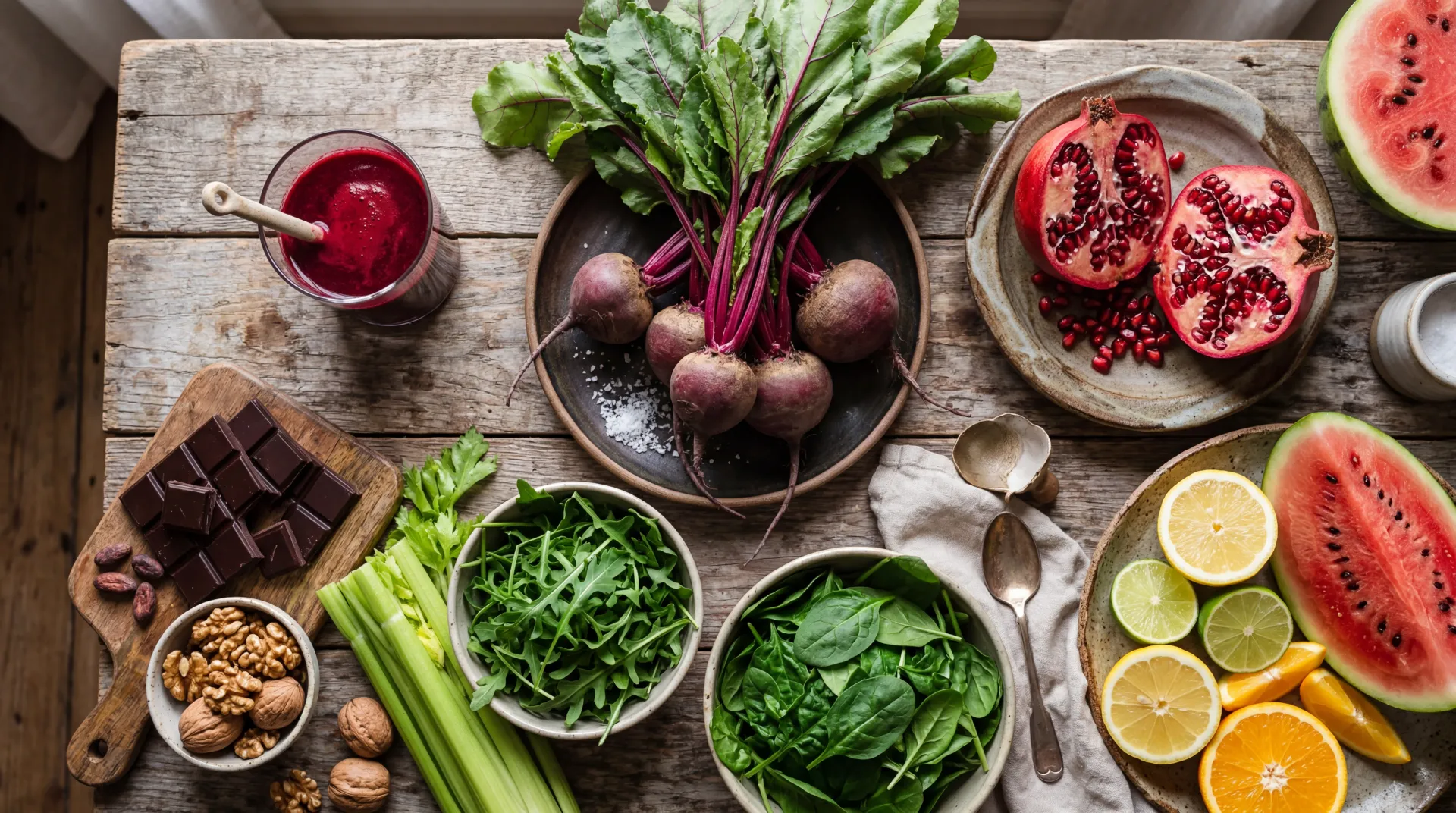
1. Beets and beetroot juice. The most studied nitric oxide food by a wide margin. Beetroot juice packs up to 11.4 grams of nitrate per liter — compare that to less than 45 milligrams per liter in tap water. One small study found beet juice bumped nitric oxide levels by 21 percent in just 45 minutes. Fresh juice consistently outperforms supplement powders in head-to-head nitrate delivery.
2. Arugula (rocket). Clocks in above 2,500 milligrams of nitrate per kilogram of fresh weight according to EFSA data. That peppery bite makes it easy to toss into salads raw, which is exactly how you want it — cooking drains nitrate content.
3. Spinach. In a seven-day trial, 500 milliliters of spinach soup (delivering 845 mg of nitrate daily) lowered both arterial stiffness and blood pressure in 27 healthy people. Eat it often enough and your plasma nitrate levels start looking comparable to someone drinking beetroot juice regularly.
4. Celery. Also in the very high nitrate tier. Contains phenolic compounds like apigenin and luteolin that carry their own antioxidant punch. Easy to eat raw — just grab a stalk and go.
Amino acid sources
5. Nuts and seeds. Walnuts, flaxseeds, chia seeds, and pumpkin seeds are loaded with L-arginine, the amino acid your body's nitric oxide synthase enzyme uses as raw material. A study of 2,771 people found that higher arginine intake from food correlated with higher blood nitric oxide. If you're already eating whole foods for overall health, nuts fit right in.
6. Watermelon. One of the richest natural sources of citrulline, an amino acid your body converts to arginine and then to nitric oxide. What makes citrulline interesting is that it dodges the arginase enzyme that normally chews up arginine before it can be used. Two weeks of 300 mL of watermelon juice meaningfully improved nitric oxide bioavailability in a small trial of eight men.
NO activators and protectors
7. Garlic. Completely different mechanism from the nitrate vegetables. Garlic fires up the nitric oxide synthase enzyme directly, boosting production rather than just supplying ingredients. Aged garlic extract may enhance absorption even further.
8. Dark chocolate. The flavanols in cocoa help your body maintain its nitric oxide levels. In one 15-day trial, 30 grams of dark chocolate daily produced measurable increases in blood nitric oxide and drops in both systolic and diastolic pressure. Stick to 70 percent cocoa or higher.
9. Citrus fruits. Oranges, lemons, and grapefruit deliver vitamin C, which shields nitric oxide from oxidative breakdown and preserves tetrahydrobiopterin, a cofactor your endothelial cells need to keep making NO. Citrus may also independently crank up nitric oxide synthase activity.
10. Pomegranate. Packed with antioxidants that guard nitric oxide from oxidative damage while boosting its activity. A 2019 study of 60 people with type 2 diabetes found pomegranate juice lowered blood pressure and improved blood flow.
| Food | How it works | Best form |
|---|---|---|
| Beets | Direct nitrate supply | Fresh juice or raw |
| Arugula | Direct nitrate supply | Raw in salads |
| Spinach | Direct nitrate supply | Raw or lightly cooked |
| Celery | Direct nitrate supply | Raw |
| Nuts and seeds | L-arginine precursor | Raw or lightly roasted |
| Watermelon | Citrulline precursor | Fresh or juiced |
| Garlic | NOS enzyme activation | Crushed, aged extract |
| Dark chocolate | Flavanol NO protection | 70%+ cocoa |
| Citrus fruits | Vitamin C NO preservation | Whole fruit or fresh juice |
| Pomegranate | Antioxidant NO protection | Juice or whole seeds |
What the Blood Pressure Research Actually Shows
Blood pressure is the most studied outcome of dietary nitrate, and the data is hard to argue with. Multiple systematic reviews and meta-analyses confirm the effect. The size of the drop depends on dose and how long you keep at it.
Siervo and colleagues ran a meta-regression and found a clear dose-response curve: more nitrate in, bigger systolic blood pressure drop out. An 11-study systematic review by Ocampo and colleagues concluded that beetroot juice is an effective blood pressure intervention in both healthy people and those already dealing with hypertension.
The effective doses in trials ranged widely, from 68 to 1,395 mg of nitrate per day. Some people saw benefits within two hours. Others maintained them through 42-day studies. The bar for entry is lower than you'd expect.
Some specific numbers from the research:
- 250 mL of beetroot juice daily for four weeks lowered blood pressure in hypertensive patients.
- 500 mL per day for two weeks showed particularly strong effects.
- Two portions of high-nitrate vegetables daily reduced blood pressure in healthy women.
- 30 grams of dark chocolate daily for 15 days dropped both systolic and diastolic readings.
- 845 mg of nitrate from spinach soup daily for one week reduced arterial stiffness and blood pressure.
The heart failure data is especially striking. A trial in Circulation gave 17 patients with heart failure a single dose of 12.9 mmol of nitrate in 140 mL of beetroot juice. They saw increased exercise oxygen consumption, lower vascular resistance, and better cardiac output — from one dose.
What stands out is that these results showed up in healthy people, overweight people, and people who already had high blood pressure. When a result holds across that many different groups, it's hard to write off.
Whole Foods vs. Supplements: Which Actually Delivers?
L-arginine capsules, citrulline powder, beetroot extract — the supplement aisle is full of options. But the research doesn't favor them over actual food.
A review in the journal Foods found that getting nitric oxide from food is a better option than supplements for avoiding side effects. Fresh beets deliver more nitrate per serving than most beetroot capsules. Beet powder isn't the same thing as beet juice, and nitrate can degrade during manufacturing.
The real advantage of whole foods is what comes packaged alongside the nitrate. Vegetables contain vitamin C, polyphenols, and betalains — antioxidants that stop dietary nitrate from turning into nitrosamines (the compounds that give processed meat its cancer reputation). Supplements don't come with those built-in safety guards, which is why vegetable nitrate is safe while processed meat nitrate raises red flags.
| Factor | Whole foods | Supplements |
|---|---|---|
| Nitrate per serving | Higher (fresh beets, juice) | Variable, often lower per capsule |
| Bioavailability | ~100% absorption | Depends on formulation |
| Antioxidant co-factors | Built in (vitamin C, polyphenols) | Absent unless added separately |
| Nitrosamine risk | Minimal (antioxidants block it) | Higher without protective compounds |
| Side effects | Rare at normal intake | Diarrhea, headache, palpitations |
| Cost | Low (seasonal produce) | Higher per effective dose |
| Stability | Best fresh/refrigerated | May degrade during manufacturing |
L-arginine supplements face another problem: the arginase enzyme in your gut chews up a big chunk before it reaches your bloodstream. Citrulline supplements work better because citrulline slips past arginase — pharmacologist Kenneth Heim calls it a "Trojan horse" that sneaks functional arginine through. But watermelon gives you citrulline naturally, along with everything else the fruit carries.
6 Mistakes That Tank Your Nitric Oxide Levels
You can nail the food side and still sabotage the results. These are the habits that quietly work against you.
Using antibacterial mouthwash. This one catches people off guard. The bacteria that convert nitrate to nitrite live on your tongue. Blast them with antiseptic mouthwash and you significantly blunt the nitric oxide boost from every nitrate-rich food you eat. Govoni and colleagues confirmed that mouthwash measurably reduces the plasma nitrite spike you'd normally get after eating nitrate-rich vegetables.
Boiling your vegetables. Heat and water leach nitrate out. Boiling is the worst because the nitrate drains into cooking water you'll probably pour down the sink. Eating vegetables raw preserves the most nitrate. If you prefer your broccoli or greens cooked, steam them briefly.
Leaving juice on the counter. Nitrate in beetroot and arugula juice starts breaking down within 24 hours at room temperature. Get it into the fridge at 4 degrees Celsius as soon as you make it.
Going supplement-only. Whole foods deliver more nitrate per serving, carry protective antioxidants, and skip the manufacturing stability problems that plague powders and capsules.
Smoking. Cigarette smoke damages the endothelial cells that produce nitric oxide enzymatically and impairs nitrate metabolism. Both production pathways take a hit, leaving smokers with substantially lower baseline levels.
Sitting too much. Physical activity stimulates your endothelial nitric oxide synthase enzyme. Skip the movement and you're running on lower baseline production, no matter how good your diet is. Pairing vegetable-rich eating with regular exercise creates a compounding effect.
How to Build a Nitric Oxide-Boosting Meal Plan
You don't need to overhaul everything. Just work nitric oxide-friendly foods into what you're already eating, hitting different production pathways throughout the day.
Morning. A glass of beetroot juice (250 mL) or a smoothie with beets, watermelon chunks, and a squeeze of orange. The beets supply direct nitrate, watermelon adds citrulline, and citrus kicks in vitamin C to protect the nitric oxide your body's about to make. Peak levels hit mid-morning.
Midday. Build a salad on a base of arugula and spinach. Throw in walnuts or pumpkin seeds for L-arginine. Add bell peppers or cherry tomatoes for vitamin C. The greens and nuts activate both production pathways at the same time.
Afternoon snack. Celery sticks with a handful of almonds. Or a square of dark chocolate (70 percent cocoa minimum). Each one works through a different mechanism.
Evening. Cook with garlic to fire up the NOS enzyme pathway. Add a side of pomegranate seeds or a glass of pomegranate juice for antioxidant protection of whatever nitric oxide is still circulating.
Here's a population-level data point worth chewing on: Japan's traditional diet is heavy on vegetable nitrate, and the country has one of the lowest coronary heart disease rates on earth. Correlation isn't causation, but it does rhyme with the clinical trial data.
For reference, the WHO and EFSA set an acceptable daily nitrate intake of 3.7 mg per kilogram of body weight — about 222 mg for a 60-kilogram person. Clinical trials showing blood pressure benefits typically used higher amounts, equivalent to 250 to 500 mL of beetroot juice daily. If you're eating 400 grams of mixed vegetables at average nitrate concentrations, you're getting roughly 157 mg per day. Beetroot juice or a few extra servings of leafy greens can close the gap.
Frequently Asked Questions
Which foods have the most nitrate for nitric oxide production?
Beetroot, arugula, celery, cress, spinach, and lettuce all top 2,500 milligrams of nitrate per kilogram of fresh weight, putting them in the highest tier according to EFSA. Beetroot juice is the most studied source in clinical trials, but eating leafy greens daily gets your plasma nitrate to comparable levels over time.
How fast do nitric oxide levels rise after eating these foods?
Plasma nitrate peaks one to two hours after you eat, and nitrite peaks two to three hours later. One study found beet juice raised measurable nitric oxide by 21 percent after only 45 minutes. For sustained blood pressure effects, most trials used daily consumption over two to six weeks.
Can mouthwash reduce the benefits of nitric oxide foods?
Yes. Antibacterial mouthwash kills the tongue bacteria that convert dietary nitrate into nitrite — a required step before your body can make nitric oxide. Using antiseptic mouthwash measurably blunts the plasma nitrite increase you'd otherwise get from eating nitrate-rich foods.
Are vegetable nitrates safe, or do they cause cancer?
Vegetable nitrates are safe. The cancer link involves nitrosamines, which form when nitrates combine with amino acids during high-heat cooking of processed meats like bacon and hot dogs. Vegetables carry natural antioxidants — vitamin C, polyphenols — that block nitrosamine formation. Health agencies treat vegetable nitrate and processed meat nitrate as separate issues.
Who should be careful about increasing nitric oxide?
Talk to your doctor if you have very low blood pressure, liver cirrhosis, or kidney disease. A 2006 JAMA study found that L-arginine supplementation after a heart attack was tied to higher mortality. Nitric oxide-boosting foods can also interact with medications for diabetes and blood pressure, so check with your healthcare provider if you're on either.
Related Articles
- Spinach Health Benefits and Nutritional Facts — One of the highest-nitrate vegetables and what else it brings to the table.
- 8 Impressive Health Benefits of Garlic — How garlic fires up nitric oxide synthase and protects your heart.
- Broccoli: Nutrition Facts and Health Benefits — Another nitrate-containing cruciferous vegetable worth working into your rotation.
- How Whole Foods Improve Your Overall Health — Why whole food sources beat supplements across the board.
- Main Benefits of Eating Vegetables — The full range of what a vegetable-heavy diet does for your body.
Medical Disclaimer
This article is for informational and educational purposes only and is not medical advice, diagnosis, or treatment. Always consult a licensed physician or qualified healthcare professional regarding any medical concerns. Never ignore professional medical advice or delay seeking care because of something you read on this site. If you think you have a medical emergency, call 911 immediately.