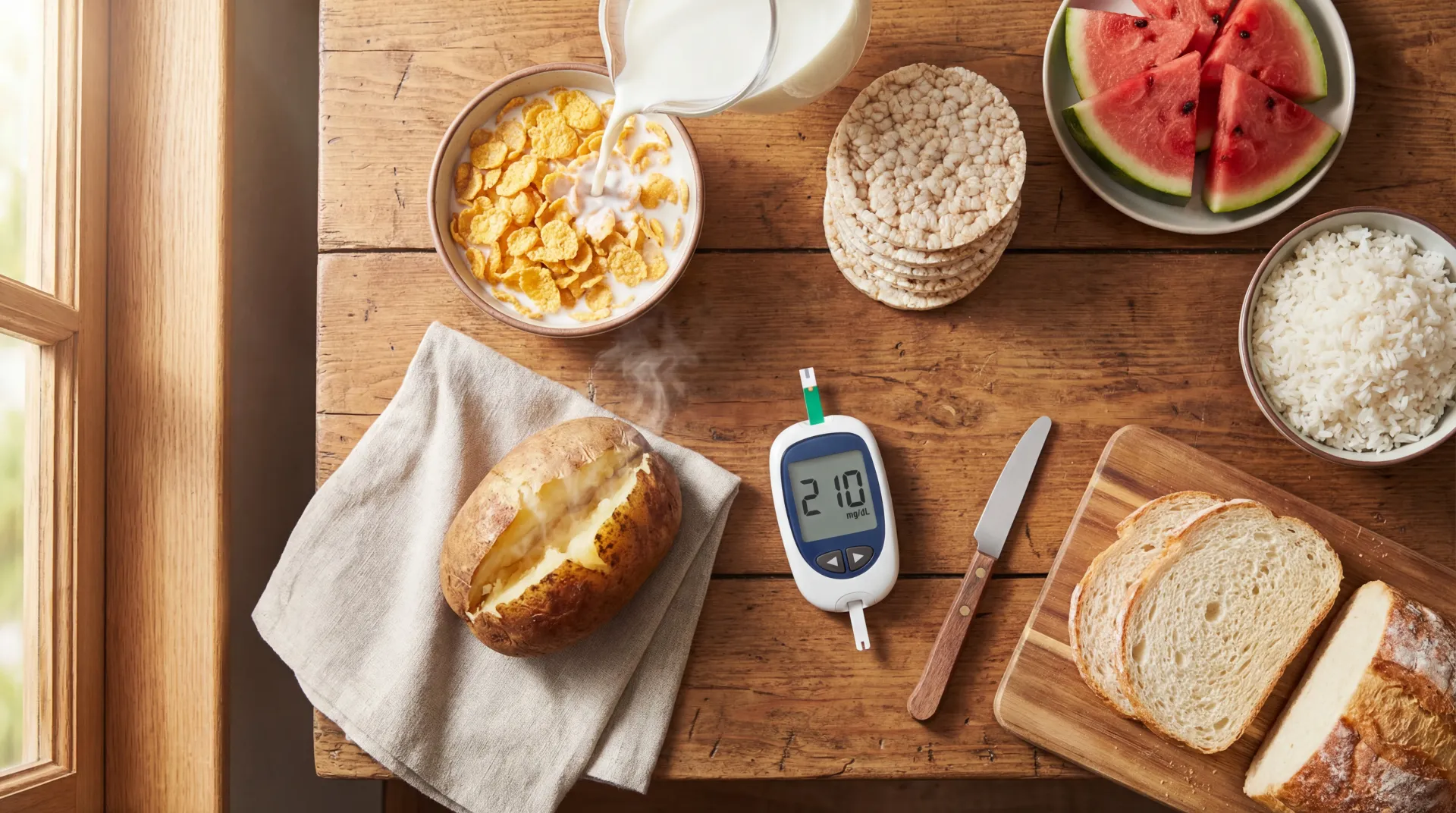
You probably already know that candy bars and soda send your blood sugar through the roof. But what about baked potatoes? Rice cakes? That bowl of cornflakes you had this morning? Some of the foods sitting in your kitchen right now cause a sharper glucose spike than a tablespoon of pure table sugar, and most people have no idea.
According to the CDC's National Diabetes Statistics Report, more than 115 million American adults have prediabetes or diabetes. The World Health Organization reported in 2024 that global diabetes cases have quadrupled over recent decades, now affecting 589 million adults worldwide. What we eat and how we prepare it matters more than ever.
This guide breaks down which common foods have a surprisingly high glycemic impact, why that happens, and what you can do about it without overhauling your entire diet.
What does the glycemic index actually measure?
The glycemic index is a scale from 0 to 100 that ranks carbohydrate-containing foods by how fast they raise blood glucose after eating. Pure glucose sits at 100 as the reference point. Foods scoring 55 or below are considered low-GI, 56 to 69 is medium, and 70 or above is high.
The testing method is standardized: a group of volunteers eats a portion of a food containing 50 grams of digestible carbohydrate, and their blood glucose response over the next two hours is measured and compared against the response from 50 grams of pure glucose. The International Tables of Glycemic Index and Glycemic Load Values, published in the American Journal of Clinical Nutrition, catalog GI values for over 2,400 foods tested this way.
Quick reference: Low GI = 55 or less. Medium GI = 56-69. High GI = 70 or above. Pure glucose = 100.
The GI tells you something a nutrition label cannot: how your body actually responds to a food, not just what that food contains on paper. Two foods with identical carb counts can produce wildly different blood sugar curves depending on their fiber, starch structure, and how they were processed.
That said, the GI has real limitations. It measures the response to a fixed amount of carbohydrate (50 grams), not a realistic serving. Nobody eats enough watermelon in one sitting to hit 50 grams of carbs. That is where glycemic load comes in, which we will cover below.
8 everyday foods that spike blood sugar more than you think
Using data from the Linus Pauling Institute at Oregon State University and the International Tables of Glycemic Index, these are common pantry and fridge staples with GI values that catch most people off guard.
| Food | GI | Serving | GL | Surprise factor |
|---|---|---|---|---|
| Baked russet potato | 111 | 1 medium | 33 | Higher GI than glucose itself |
| Puffed rice cakes | 82 | 3 cakes | 17 | Marketed as a "diet" snack |
| Cornflakes | 79 | 1 cup | 20 | Standard breakfast cereal |
| Watermelon | 76 | 1 cup | 8 | It's a fruit |
| White bread | 71 | 1 slice | 10 | Sandwich staple |
| Pancakes | 67 | 6-inch | 39 | Highest GL on this list |
| White rice | 66 | 1 cup cooked | 35 | Base of many "healthy" meals |
| Pineapple | 58 | 1/2 cup | 11 | Considered a health food |
A few things jump out from this table. A baked russet potato scores 111 on the glycemic index, which is higher than pure glucose. That number sounds impossible until you understand that the starch structure in a baked potato is almost entirely gelatinized, so digestive enzymes tear through it almost instantly. According to a review published in Nutrients, the GI of potatoes ranges from 56 to 111 depending on variety and preparation method.
Rice cakes are another one that catches people off guard. They are puffed, processed, and stripped of nearly all fiber and fat. The puffing process exposes starch granules in a way that makes them easy pickings for digestive enzymes. A GI of 82 puts rice cakes well above most candy bars.
Cornflakes score 79 despite being fortified with vitamins and marketed alongside pictures of athletes. The flaking and toasting process breaks down the corn's cell walls and gelatinizes its starch, making it rapidly digestible. For comparison, table sugar (sucrose) has a GI of 63, and a Snickers bar comes in around 55.
Why "healthy" foods can still send your blood sugar soaring
A food can be packed with vitamins and still wreck your blood sugar. The reason usually comes down to processing, fiber removal, or starch structure.
Processing breaks down natural barriers. Whole oat groats have a GI around 55. Roll them flat and you get rolled oats at about 57. But instant oatmeal, where the oats are steamed, rolled thinner, and pre-cooked, jumps to 79. A systematic review in the journal Foods confirmed that increased oat processing consistently raised glycemic response, with the effect driven by greater starch accessibility from structural breakdown of the oat cell walls.
Fiber slows digestion. When you juice an orange, you remove most of the fiber that would otherwise slow the release of its natural sugars. A whole orange has a GI of 42. Orange juice climbs to 50. The fiber in whole fruit creates a physical matrix that digestive enzymes have to work through, buying your body time to process the sugar gradually.
Starch type matters. Foods high in amylopectin (a branched starch) digest faster than those high in amylose (a linear starch). White rice is mostly amylopectin, which is why it has a GI of 66. Basmati rice, which contains more amylose, sits closer to 50-58. Same grain, very different blood sugar response.
Ripeness plays a role too. A green banana has a GI around 30, mostly from resistant starch that your body can barely digest. Let that banana ripen until it is spotted and yellow, and the resistant starch converts to sugar, pushing the GI up to 55 or higher. The banana did not gain calories; its starch just became easier to break down.
| Myth | Reality |
|---|---|
| "Brown rice is low-GI" | Brown rice has a GI of 50, which is medium, not low. It is lower than white rice (66) but still causes a meaningful glucose spike. |
| "Fruit juice is as healthy as whole fruit" | Juicing removes fiber, increasing the speed of sugar absorption. Whole fruit almost always has a lower GI than its juice. |
| "Whole wheat bread is low-GI" | Most commercial whole wheat bread scores 69-74 on the GI scale because the flour is finely ground, negating much of the fiber benefit. |
| "Rice cakes are a good diet food" | At a GI of 82, rice cakes spike blood sugar faster than most candy. They are low-calorie but high-glycemic. |
| "All potatoes are equal" | Boiled white potatoes score 82, while boiled sweet potatoes come in around 44-61 depending on variety. |
GI vs. glycemic load: which number should you actually watch?
GI tells you how fast a carbohydrate turns into blood sugar. What it does not tell you is how much carbohydrate is in a normal serving. That is where glycemic load (GL) comes in.
Glycemic load is calculated as: (GI x grams of carbohydrate per serving) / 100. A GL of 10 or less is low, 11-19 is medium, and 20 or above is high. The Mayo Clinic recommends considering both numbers together rather than relying on GI alone.
Watermelon is the textbook example of why this distinction matters. Its GI is 76, which looks alarming. But a cup of watermelon contains only about 11 grams of carbohydrate because the fruit is 92% water. That gives it a glycemic load of just 8, which is low. You would need to eat roughly 4.5 cups of watermelon to consume the 50 grams of carbohydrate used in the GI test. Most people do not eat watermelon like that.
Contrast that with pancakes. A single 6-inch pancake has a GI of 67 (medium) but packs 58 grams of carbohydrate, giving it a glycemic load of 39. That is nearly five times the glycemic load of watermelon despite a lower GI score. If you are eating a stack of three pancakes with syrup, the glycemic load becomes enormous.
| Food | GI | GL | Verdict |
|---|---|---|---|
| Watermelon | 76 (high) | 8 (low) | GI overstates the real impact |
| Pancakes | 67 (medium) | 39 (high) | GL reveals the true problem |
| White rice (1 cup) | 66 (medium) | 35 (high) | Large servings amplify the impact |
| Lentils (1 cup) | 29 (low) | 7 (low) | Low on both counts |
| Baked potato | 111 (very high) | 33 (high) | High on both: the real offender |
The bottom line: GI tells you the speed of the spike. GL tells you the size. A food with high GI but low GL (like watermelon) is less concerning than a food with high GI and high GL (like baked potatoes or a stack of pancakes).
How cooking and processing change a food's glycemic score
The same potato can score 82 or 111 depending on whether you boil it or bake it. Preparation method regularly shifts a food's GI by 20-30 points, sometimes more.
Potatoes. A boiled white potato has a GI of about 82. Bake that same potato and the GI jumps to 111. According to research in the journal Nutrients, baking causes more complete starch gelatinization than boiling because the dry heat reaches higher temperatures. But if you boil a potato and then refrigerate it overnight, the GI drops significantly. A study from the SPUD Project published in Nutrients found that cold stored potato cubes had intermediate GI values around 76, compared to freshly boiled potatoes at 82. The University of Minnesota researchers found that chilled potatoes decreased postprandial glucose and insulin compared to boiled potatoes served hot.
Why does cooling help? When cooked starch cools, some of it retrogrades into a crystalline structure that digestive enzymes struggle to break down. This retrograded starch behaves more like fiber, passing through the small intestine without spiking blood sugar. Reheating destroys some but not all of it, so even warmed-up leftovers have a lower GI than food straight from the stove.
Pasta. Cooking time matters a lot here. Al dente pasta (cooked 8-10 minutes) has a lower GI than soft-cooked pasta (15-20 minutes). White spaghetti cooked to the standard average sits at a GI of 46, but overcooking it for 20 minutes pushes the GI to 58. The protein network in pasta, formed from gluten, physically traps starch granules and slows their digestion. Overcooking breaks that network apart. Turns out Italian grandmothers had it right all along: firm pasta, never mushy.
Oats. The more you process oats, the higher the GI climbs. Steel-cut oats maintain more of their intact cell wall structure and have a GI around 55. Rolled oats sit at 57. Instant oatmeal, which has been steamed and pressed thin, reaches 79. Same grain, same calories. The difference is physical: intact cell walls slow enzyme access to the starch inside.
Practical low-GI swaps for your everyday meals
Nobody is asking you to abandon your favorite foods. A few swaps and preparation tweaks can bring the glycemic impact down substantially. A study in the American Journal of Clinical Nutrition found that adding fat, protein, or fiber to a high-GI food blunts the overall meal's glucose response.
| Instead of this | GI | Try this | GI | What changes |
|---|---|---|---|---|
| Cornflakes | 79 | Steel-cut oats | 55 | -24 points, more fiber |
| Baked russet potato | 111 | Boiled sweet potato | 44-61 | -50+ points, more nutrients |
| White rice | 66 | Pearl barley | 28 | -38 points, rich in beta-glucan |
| White bread | 71 | Pumpernickel | 46 | -25 points, dense rye grain |
| Rice cakes | 82 | Apple with peanut butter | ~30 | -52 points, fat + fiber slow absorption |
| Pineapple chunks | 58 | Pear slices | 38 | -20 points, more soluble fiber |
Beyond direct substitutions, a few meal-level strategies help too:
Pair carbs with protein or fat. Eating bread with cheese or hummus slows gastric emptying and reduces the glucose spike. A resource from the American Diabetes Association recommends this approach for managing blood sugar throughout the day. The protein and fat do not change the GI of the carbohydrate food itself, but they change how your body processes the entire meal.
Eat your vegetables first. Starting a meal with non-starchy vegetables and protein before eating carbohydrates has been shown to flatten the post-meal glucose curve. The fiber and bulk from the vegetables slow gastric emptying, so the carbohydrates that follow reach the small intestine more gradually. If you are having rice with a stir-fry, eat the vegetables and meat first.
Use the cooling trick. Cook rice, pasta, or potatoes ahead of time, refrigerate them, and reheat later. The resistant starch that forms during cooling survives reheating. Meal prep becomes a blood sugar strategy, not just a time saver. Potato salad served cold has a lower glycemic impact than a hot baked potato.
For more ideas on choosing the right foods for better health, or if you want to explore diets that help with diabetes prevention, those guides go deeper into building a complete eating plan around these principles.
If sugar cravings are part of the problem, our guide to saying goodbye to a sugary diet in 10 steps offers a practical framework for cutting back. And for a broader look at which foods rank where on the GI scale, check out our guide to low and high glycemic index foods.
Frequently Asked Questions
Can you lower the glycemic index of a food by how you prepare it?
Yes. Cooking method has a major effect. Boiling potatoes produces a lower GI than baking them. Cooking pasta al dente keeps the GI lower than overcooking it. Cooling cooked starches (rice, potatoes, pasta) in the refrigerator creates resistant starch that reduces the glycemic response, even after reheating. Adding fat, protein, or acidic ingredients like vinegar to a meal also blunts the blood sugar spike.
Is the glycemic index reliable for people with diabetes?
The GI is a useful tool but not a complete one. It measures the average response across a group of healthy volunteers, and individual responses vary. The Cleveland Clinic recommends using GI as one factor alongside total carbohydrate counting, portion size, and personal glucose monitoring. People with diabetes should also consider glycemic load, which accounts for serving size and gives a more realistic picture of a food's impact.
Does fruit raise blood sugar as much as candy?
It depends on the fruit and the candy. A ripe banana (GI 55) and a Snickers bar (GI 55) have similar glycemic index values. But the banana provides potassium, vitamin B6, and fiber, while the candy bar provides mostly saturated fat and added sugar. Glycemic index does not capture nutritional value. Whole fruits also tend to have low glycemic loads because they contain a lot of water and fiber relative to their sugar content.
Why is a baked potato's glycemic index higher than pure glucose?
The starch in a baked potato is almost entirely gelatinized by the high dry heat, so digestive enzymes break it down almost instantly. The GI scale uses glucose as the reference at 100, but that number represents the average response. Individual foods can score above 100 because some starches are digested even faster than free glucose in certain test subjects. The baked russet potato's GI of 111 is real and reproducible across multiple studies.
Should I avoid all high-GI foods completely?
Not necessarily. Glycemic index is one piece of the puzzle, not the whole picture. Watermelon has a GI of 76 but a glycemic load of only 8, making it a perfectly reasonable food to eat in normal portions. What matters more is the overall pattern of your diet, not individual foods in isolation. Consistently choosing lower-GI options where it is easy to do so, like swapping white rice for barley or cornflakes for steel-cut oats, adds up over time without requiring you to eliminate foods you enjoy.
Related Articles
- Top 8 Low and High Glycemic Index Foods - A quick reference for where common foods fall on the glycemic scale.
- Diabetes: Causes, Symptoms and Treatments - Understanding the condition that makes glycemic management so important.
- Approved Diets That Prevent or Help With Diabetes - Evidence-based eating plans for blood sugar control.
- Whole Foods: How to Improve Your Overall Health by Choosing the Right Foods - Building meals around unprocessed, nutrient-dense ingredients.
- Say Your Sugary Diet Goodbye in 10 Simple Steps - Practical steps to reduce sugar intake and lower your glycemic load.
Medical Disclaimer
This article is for informational and educational purposes only and is not medical advice, diagnosis, or treatment. Always consult a licensed physician or qualified healthcare professional regarding any medical concerns. Never ignore professional medical advice or delay seeking care because of something you read on this site. If you think you have a medical emergency, call 911 immediately.