This article is informational. Compounded medications carry safety risks; consult a licensed prescriber before purchasing or using compounded GLP-1 products. We do not endorse any specific compounding pharmacy or telehealth platform.
The semaglutide market has changed faster than most patients can keep up with. Wegovy and Ozempic spent more than three years on the FDA's drug shortage list before the agency declared the shortage resolved on February 21, 2025. That single declaration started a clock that ended one entire industry's business model, mass compounding of semaglutide as a low-cost copy, and rerouted patients into a confusing market of "personalized" telehealth compounds, brand-name price cuts, and a black market that has only grown bolder.
If you are weighing a compounded semaglutide product right now, the cheapest version on the screen is also, statistically, the most likely to harm you. The challenge isn't deciding whether to use compounded semaglutide. The challenge is telling the difference between a state-licensed pharmacy operating inside the law and a fake pharmacy, a research-peptide vendor, or a counterfeit pen routed through a legitimate-looking distributor. This guide walks through the legal framework, the credentialing markers, the red flags that should stop you, and the questions a prescriber or pharmacy should be willing to answer before you inject anything.
Why compounded semaglutide became a thing
The shortage created the market. From 2022 onward, semaglutide was on the FDA shortage list, meaning that under sections 503A and 503B of the Federal Food, Drug, and Cosmetic Act, compounding pharmacies and outsourcing facilities were temporarily allowed to produce their own versions of a brand-name drug that patients couldn't get. Wegovy and Ozempic were both in that category for what regulators called "increased demand," according to FDA's own timeline.
The price gap drove the demand. Wegovy carries a list price near $1,349 per month. Even self-pay through Novo Nordisk's direct channel sat at $499 per month before a November 2025 price cut brought it down to $349. By contrast, peer-reviewed analysis published in 2025 documented compounded versions ranging roughly $250 to $400 per month, somewhere between a quarter and a third of brand-name pricing, per a published review of compounded GLP-1 access.
The volume was enormous. The Alliance for Pharmacy Compounding wrote to FDA noting that more than 200,000 prescriptions for semaglutide products not manufactured by Novo Nordisk were being filled each month in the U.S. before the shortage was lifted, as Reuters documented. Roughly one in eight U.S. adults now takes a GLP-1 of some kind, per KFF tracking polls cited by USA Today, and more than half of those users describe the drugs as difficult to afford.
That economic pressure built the parallel supply chain. The shortage exception that kept it legal expired in 2025.
The FDA shortage-end timeline that changed everything
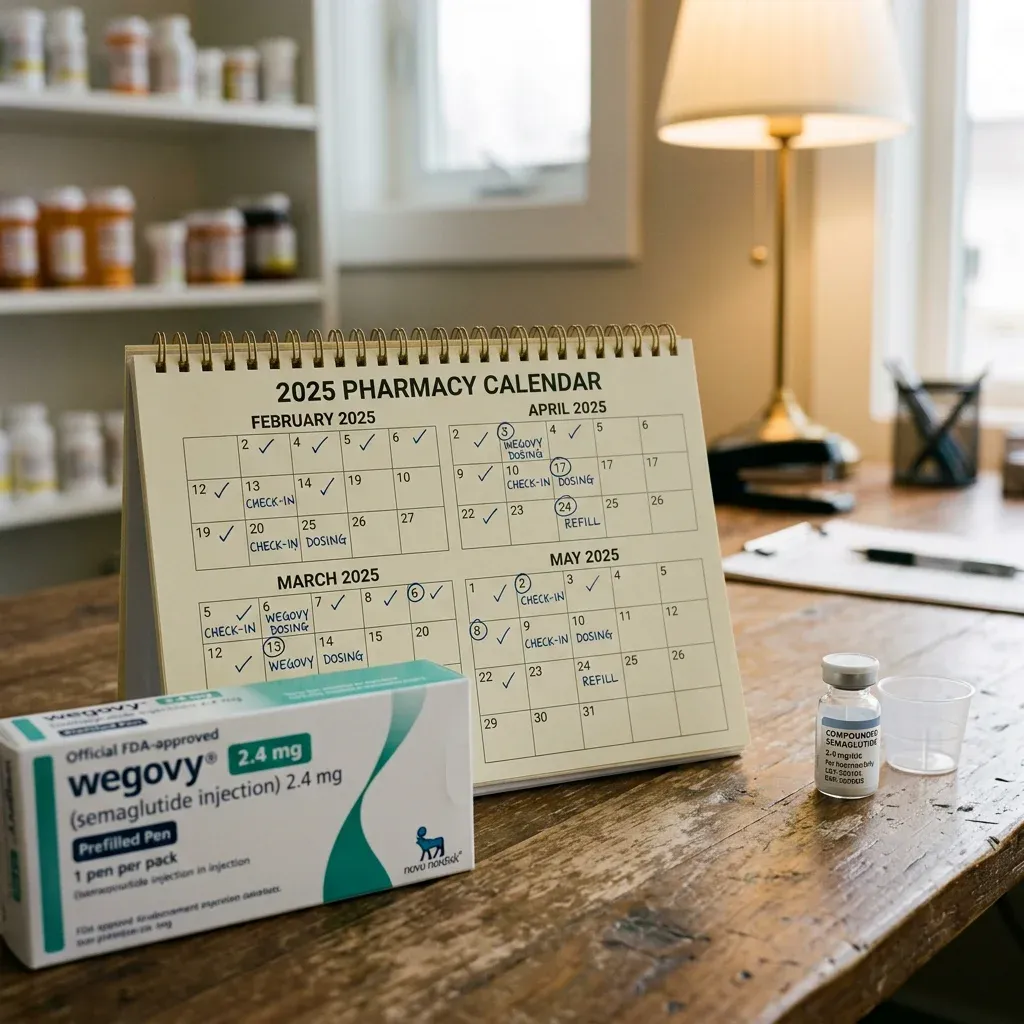
February 21, 2025 was the inflection point. FDA confirmed with Novo Nordisk that supply met or exceeded projected demand and removed semaglutide from the shortage list. The agency offered grace periods so compounders and patients weren't cut off overnight: 503A pharmacies had 60 days, while 503B outsourcing facilities had 90 days, a legal analysis from Frier Levitt explains.
The dates that landed: April 22, 2025, for state-licensed pharmacies; May 22, 2025, for outsourcing facilities. The Outsourcing Facilities Association sued FDA in Texas to block the decision, and on April 24, 2025, a federal district court denied their request for a preliminary injunction in Outsourcing Facilities Association v. FDA, 4:25-cv-00174 (N.D. Tex.), according to FDA's own update log.
FDA's most recent statement, current as of April 2026, is unambiguous: tirzepatide and semaglutide do not appear on the 503B bulks list and are not on the drug shortage list. That means the legal default for compounding is no longer the shortage exception. It is the much narrower individualized-prescription exception under 503A and the bulks-list pathway under 503B, neither of which currently apply to semaglutide as a like-for-like brand replacement.
503A, 503B, and "research peptides": three sources, two of them legal
Most patients shopping for compounded semaglutide don't know there are functionally three different supply chains, with very different legal status. Understanding which one a seller falls into is the single most important question a buyer can ask.
503A pharmacies are state-licensed and compound for individual patients based on a prescription. They operate under USP <795> for nonsterile work, USP <797> for sterile preparations, and USP <800> for hazardous drugs, as the industry trade press summarizes. State boards of pharmacy are the primary regulator. With semaglutide off the shortage list, a 503A pharmacy can no longer produce a copy of Wegovy or Ozempic in volume; it can only compound when a prescriber has documented an individualized clinical need that the FDA-approved drug cannot meet.
503B outsourcing facilities are federally regulated. They produce in bulk for clinics and hospitals, must register with FDA, follow current Good Manufacturing Practice (cGMP) requirements, and undergo surprise FDA inspections. Their products are not for at-home dispensing the way 503A products are. Tirzepatide and semaglutide do not appear on the 503B bulks list, so 503B facilities can no longer mass-produce these molecules either, FDA confirmed in April 2026.
"Research peptide" vendors, sites with disclaimers like "for research use only" or "not for human consumption," are the third channel. They are not legal. FDA has issued warning letters to companies that sold unapproved drugs containing semaglutide, tirzepatide, or retatrutide while labeling them this way. In FDA's own words, "These products have been sold directly to consumers for human use with dosing instructions. The agency urges consumers not to purchase these products which are of unknown quality and may be harmful to their health." The disclaimer is a legal fig leaf, not a real one.
One additional gray zone matters. After the shortage ended, several telehealth platforms shifted to "personalized" compounded versions: the same molecule combined with vitamin B12, B6, L-carnitine, or NAD, or sold at a non-standard dose. The 503A individualization exception is the legal foothold for this model. FDA has clarified, however, that adding cyanocobalamin (B12) to semaglutide may still count as an "essentially a copy" if the route of administration matches an approved combination and the strengths are within 10 percent. The legal cover for this model is narrower than the marketing usually suggests.
Why semaglutide sodium and acetate are red flags, not bargains
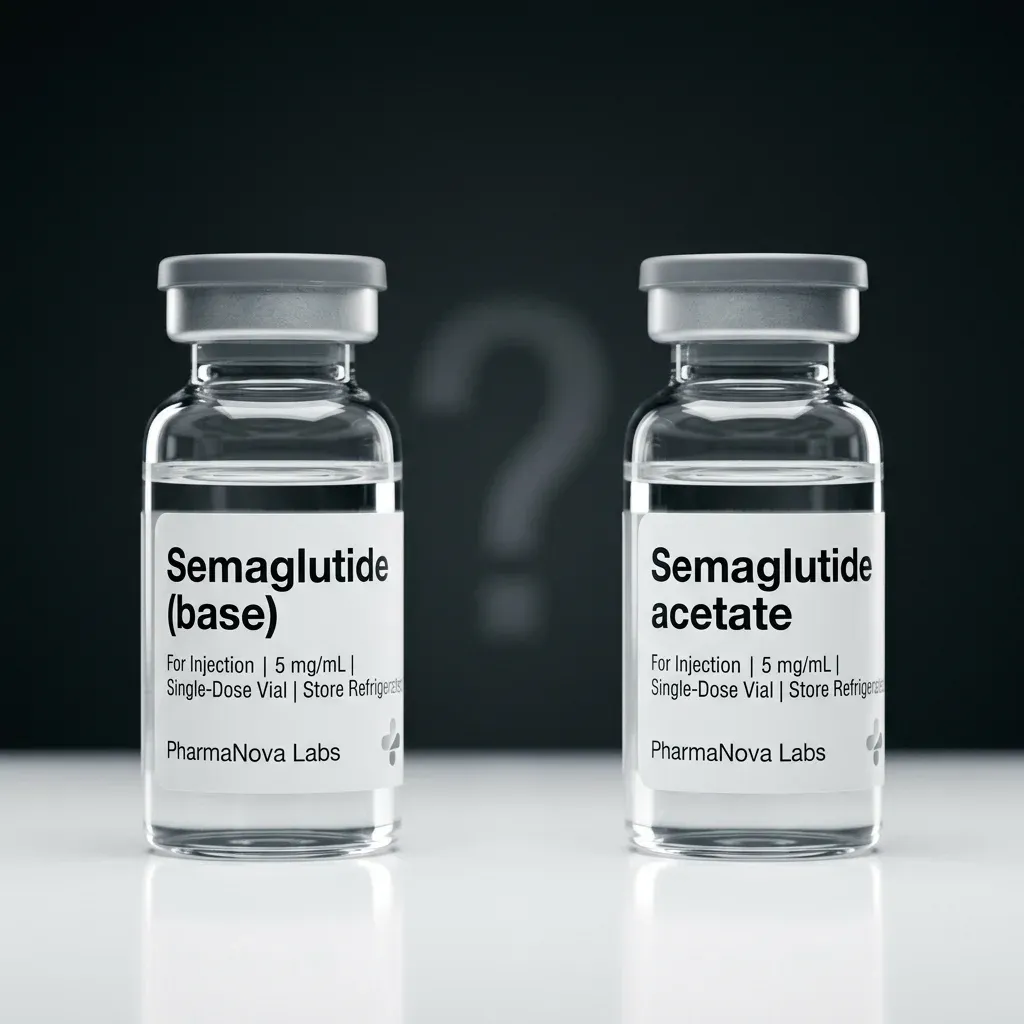
One of the easiest ways to spot a non-legitimate source is to look at the active ingredient. FDA-approved Wegovy, Ozempic, and Rybelsus contain the base form of semaglutide. Many compounded products instead contain semaglutide sodium or semaglutide acetate, the salt forms.
FDA's position on this is direct: "These salt forms, including semaglutide sodium and semaglutide acetate, are different active ingredients than are used in the approved drugs. The agency does not have information on whether these salts have the same chemical and pharmacologic properties as the active ingredient in the approved drug, and we are not aware of any lawful basis for their use in compounding," according to its safety page on unapproved GLP-1s.
The University of Illinois Chicago Drug Information Group put it more bluntly: "There is no evidence that these salt forms are chemically or pharmacologically equivalent," in its August 2025 FAQ on compounded GLP-1 safety.
What might be in a salt-form vial is harder to know than what should be in it. Novo Nordisk has published its own laboratory testing of compounded products purporting to contain semaglutide. Some samples showed impurities as high as 33 percent. Some contained zero percent semaglutide. Some contained banned research peptides such as BPC-157, formaldehyde adducts, residual solvents, and trace metals, per the manufacturer's safety page. Novo is obviously not a neutral party and has business reasons to publicize this. The lab data still align with FDA's parallel observations about counterfeit and substandard products entering the supply chain.
If a label or a Certificate of Analysis lists the active ingredient as semaglutide sodium or semaglutide acetate, treat that as a hard stop. There is no FDA-recognized clinical use for these salt forms in compounding.
Counterfeit incidents and adverse events on record
The counterfeit problem is not theoretical. FDA has documented three separate seizures of counterfeit Ozempic in the U.S. drug supply chain across 26 months, each escalating in sophistication.
In December 2023, the agency seized thousands of units of counterfeit Ozempic, lot NAR0074, serial 430834149057. Lab analysis confirmed that the needles were counterfeit, which meant that sterility could not be guaranteed and patients faced an elevated risk of infection. The pen labels, prescribing information, and cartons were all confirmed counterfeit. In April 2025, FDA seized several hundred units of counterfeit lot PAR0362, serial number starting 51746517. In December 2025, the agency seized dozens more units of counterfeit lot PAR1229. This one used an authentic lot number, distinguishable only by where the EXP/LOT text was printed on the pen, as FDA's counterfeit alert page details.
Counterfeits don't always contain the wrong dose of the right drug. They sometimes contain a different drug entirely. A regional U.S. poison control center reported three patients who sought treatment for hypoglycemia, dangerously low blood sugar that can progress to loss of consciousness or seizures, after taking suspected counterfeit Ozempic, The Globe and Mail reported. International investigations into similar fakes seized in Belgium found that the counterfeit pens contained insulin instead of semaglutide, an explanation that fits the hypoglycemia pattern.
Adverse events from compounded versions are a separate dataset. As of July 31, 2025, FDA had received 605 adverse event reports for compounded semaglutide and 545 for compounded tirzepatide, according to FDA. The agency is careful to caveat: "Federal law does not require state-licensed pharmacies that are not outsourcing facilities to submit adverse events to FDA so it is likely that adverse events from compounded versions of these drugs are underreported."
The dosing-error pattern is grim. FDA's analysis of medication-error reports describes patients who administered five to 20 times the intended dose of compounded semaglutide because they were unfamiliar with drawing a small volume from a multi-dose vial using an insulin syringe. In one case a provider intended a 0.25 mg (5-unit) dose and prescribed 25 units instead. In another, three patients each received 10 times the intended dose because a provider wrote 20 units instead of 2. Reported overdose effects included severe nausea and vomiting, dehydration, fainting, acute pancreatitis, and gallstones. Some patients required hospitalization. Because semaglutide has a half-life of about one week, overdose symptoms can last days, FDA's dosing-error alert details.
None of this is what an FDA-approved Wegovy or Ozempic pen does. The branded prefilled pens use a fixed-dose mechanism that prevents this category of error in the first place, a point Healthline emphasized in its safety review.
Credentialing checklist for a legitimate compounding source
If you decide a compounded GLP-1 is appropriate for your situation, the burden is on the source to prove legitimacy. Six markers, in roughly the order you should check them:
1. State board of pharmacy license. Every legitimate U.S. compounding pharmacy is licensed by a state board. Most boards publish license-lookup tools online. A pharmacy that won't disclose its state license number publicly is not one to use.
2. NABP accreditation or .pharmacy domain. The National Association of Boards of Pharmacy operates a voluntary three-year Compounding Pharmacy Accreditation requiring USP <795>, <797>, and <800> compliance, plus a Verified Pharmacy Program inspection within six months of application, according to NABP's program description. Websites ending in the .pharmacy top-level domain have been accredited by NABP, and unlike .com or .health, the suffix cannot be faked or forged, per Safe.Pharmacy.
3. PCAB accreditation. The Pharmacy Compounding Accreditation Board, run by the Accreditation Commission for Health Care, is the second major credential. PCAB-accredited pharmacies are independently surveyed against USP <795>, <797>, and <800>, with revised standards in effect since June 1, 2024, according to ACHC. Neither NABP nor PCAB accreditation is mandatory, but their absence on a sterile-injectable compounder should prompt much harder questions.
4. Valid prescription requirement. A legitimate U.S. pharmacy will require a prescription from a licensed prescriber. NABP's review found that 96 percent of illegal online pharmacies did not require a valid prescription. If a site lets you check out without one, that single fact disqualifies it.
5. U.S.-based and licensed pharmacist available. A real licensed pharmacist should be reachable for questions. The pharmacy should be physically located in a U.S. state and identifiable by name, not just a brand wrapper.
6. Certificate of Analysis with batch traceability. Sterile injectables should have lot-specific release testing. Reputable 503B outsourcing facilities publish or provide a Certificate of Analysis that documents identity, potency, and sterility for the specific lot you receive. The active ingredient line should read "semaglutide," not "semaglutide sodium" or "semaglutide acetate."
Seven red flags of an unsafe source
Any one of these alone justifies walking away. Several together is closer to a refund-and-flag-the-FDA situation:
- "Research peptide" or "not for human consumption" labeling. FDA has explicitly warned that products sold this way and shipped with dosing instructions are unapproved drugs sold for human use, of unknown quality.
- Salt-form active ingredient. Semaglutide sodium or semaglutide acetate appearing on a label or Certificate of Analysis means the product is not chemically equivalent to FDA-approved semaglutide and has no recognized lawful basis for compounding.
- No prescription required. Especially common on overseas sites and gray-market platforms; combined with NABP's data that this pattern characterizes 96 percent of illegal pharmacies, it is the single highest-yield filter you can apply.
- Unidentifiable pharmacy on the label. FDA has documented cases where compounded GLP-1 products were sold under the name of a pharmacy that did not exist, or under the name of a real licensed pharmacy that did not actually compound the product.
- Cryptocurrency-only or peer-to-peer payment. Safe.Pharmacy lists this as a marker of illegal online pharmacy operations. Legitimate U.S. pharmacies bill insurance or accept credit cards.
- Drug that arrived warm or with melted ice packs. FDA recommends not using any injectable GLP-1 drug that arrives warm or with insufficient refrigeration, since temperature excursions can degrade peptide quality.
- Pricing that is much cheaper than other compounders. Legitimate compounded semaglutide ran roughly $250 to $400 per month before the shortage ended. Anything dramatically below that range, particularly $50 or $99-per-month "deals" sold without insurance, should be assumed to be either a 503A "personalization" workaround under enforcement scrutiny or something worse.
Questions to ask a prescriber or compounding pharmacy

The volume of marketing language around "personalized" GLP-1 compounds makes it hard to tell what you are actually buying. The right questions, asked of a prescriber or directly to the dispensing pharmacy, will surface the answer fast. If the answer is evasive or the question goes unanswered, treat that itself as the answer.
- Is this product 503A (state-licensed individual prescription) or 503B (FDA-registered outsourcing facility)? Can you give me the registration or license number?
- What is the active ingredient, exactly? Is it semaglutide base, semaglutide sodium, or semaglutide acetate?
- Is the pharmacy NABP-accredited or PCAB-accredited? Can you point me to the listing?
- What is the documented clinical reason this compounded version is being prescribed instead of FDA-approved Wegovy, Ozempic, or Rybelsus? (Per FDA, the answer should describe an individualized medical need that the FDA-approved drug cannot meet, not a price difference.)
- Will I receive a Certificate of Analysis for the specific lot I'm being sent, including identity, potency, sterility, and endotoxin testing?
- What concentration is the product, and at what volume per dose? Will I be using a prefilled syringe, a pen, or drawing from a vial with my own syringe?
- Is the product shipped under temperature control with validated cold-chain packaging?
- If I have an adverse reaction, is the pharmacy required to report it to FDA's MedWatch program? (Note: 503A pharmacies are not federally required to report; 503B facilities are.)
A legitimate prescriber should welcome these questions. A telehealth platform whose entire business model relies on the patient not asking them is exactly the kind of source FDA targeted with 30 warning letters in March 2026 for misleading claims about sameness with FDA-approved products.
When compounded semaglutide may legitimately apply in 2026
This is the narrow case. FDA has been consistent on the principle: "Compounded drugs should only be used in patients whose medical needs cannot be met by an FDA-approved drug," per its safety guidance. Genuine cases include documented allergies to a specific inactive ingredient in the FDA-approved formulation, a clinical need for a preservative-free formulation, or a prescriber-documented dose strength that the manufactured products don't offer for a specific patient. The peer-reviewed literature also recognizes potential additives such as glycine, levocarnitine, pyridoxine, or cyanocobalamin where there is a clinical rationale, according to a 2025 review of compounded GLP-1 access.
Affordability, the main reason most patients went to compounded versions, is not by itself a clinical justification under federal law. That is the gap the post-shortage telehealth model has tried to occupy by pairing every prescription with a "personalization," and it is precisely the gap FDA's recent enforcement is closing. The Hims $49 compounded GLP-1 pill, which the company pulled in February 2026 after FDA threatened action and HHS referred the matter to the Department of Justice, was the highest-profile example, Reuters reported. Novo Nordisk separately filed 14 new lawsuits in August 2025 against compounders including Mochi Health, Fella Health, and Prism Aesthetics, framing the "personalization" model as legal cover for knockoffs, according to Reuters.
The brand-name price has also moved. Novo Nordisk dropped Wegovy and Ozempic self-pay from $499 to $349 per month on November 17, 2025, with a $199 introductory two-month offer for new patients, USA Today reported. That price still isn't $50, but the gap that drove the compounded market has narrowed enough that the cost-only argument is harder to make than it was in 2023.
Frequently Asked Questions
Is compounded semaglutide illegal in 2026?
It depends on the source. A 503A state-licensed pharmacy can compound semaglutide for an individual patient if a prescriber has documented an individualized clinical need that an FDA-approved drug cannot meet. A 503B outsourcing facility cannot mass-produce semaglutide because the molecule is not on the 503B bulks list and is no longer on the shortage list. "Research peptide" vendors selling semaglutide for human use are not legal, regardless of disclaimer language.
How do I tell if a compounding pharmacy is legitimate?
Check the state board of pharmacy license, look up NABP or PCAB accreditation, confirm the pharmacy requires a valid prescription, ensure it is U.S.-based with a reachable licensed pharmacist, and verify the active ingredient on the Certificate of Analysis is "semaglutide" rather than "semaglutide sodium" or "semaglutide acetate." NABP's Safe Site Search Tool flags accredited and not-recommended sites.
What's the difference between semaglutide and semaglutide sodium?
Semaglutide is the base form, the active ingredient in FDA-approved Wegovy, Ozempic, and Rybelsus. Semaglutide sodium and semaglutide acetate are salt forms, chemically different molecules that FDA describes as "different active ingredients." The agency states it is "not aware of any lawful basis for their use in compounding," and there is no clinical evidence that the salt forms are pharmacologically equivalent.
Are telehealth platforms like Hims, Ro, or Mochi safe sources?
This is where the legal gray zone lives. Several major telehealth platforms shifted to "personalized" compounded products after the shortage ended, citing the 503A individualization exception. FDA issued warning letters to 30 telehealth companies in March 2026 for misleading marketing, including claims of sameness with FDA-approved products. Novo Nordisk has filed lawsuits against multiple platforms framing the personalization model as a workaround for selling unapproved knockoffs. We do not endorse any specific platform; the same source-vetting checklist applies regardless of brand.
Why is a compounded version $250 a month and a counterfeit $50?
Real compounding has costs: licensed pharmacy facility, sterile-injectable USP <797> compliance, raw active pharmaceutical ingredient sourced from FDA-inspected manufacturers, lot-specific release testing, cold-chain shipping, and pharmacist labor. A $50 product at sterile-injectable scale is not paying those costs. It is more likely an illicit-API product, a salt-form product, or a counterfeit using an authentic-looking lot number, all categories FDA has documented in U.S. supply chains.
Medical Disclaimer
This article is for informational and educational purposes only and is not medical advice, diagnosis, or treatment. Always consult a licensed physician or qualified healthcare professional regarding any medical concerns. Never ignore professional medical advice or delay seeking care because of something you read on this site. If you think you have a medical emergency, call 911 immediately.