Six Peptide Complexes You Will Find in Nearly Every Hair Serum Bottle
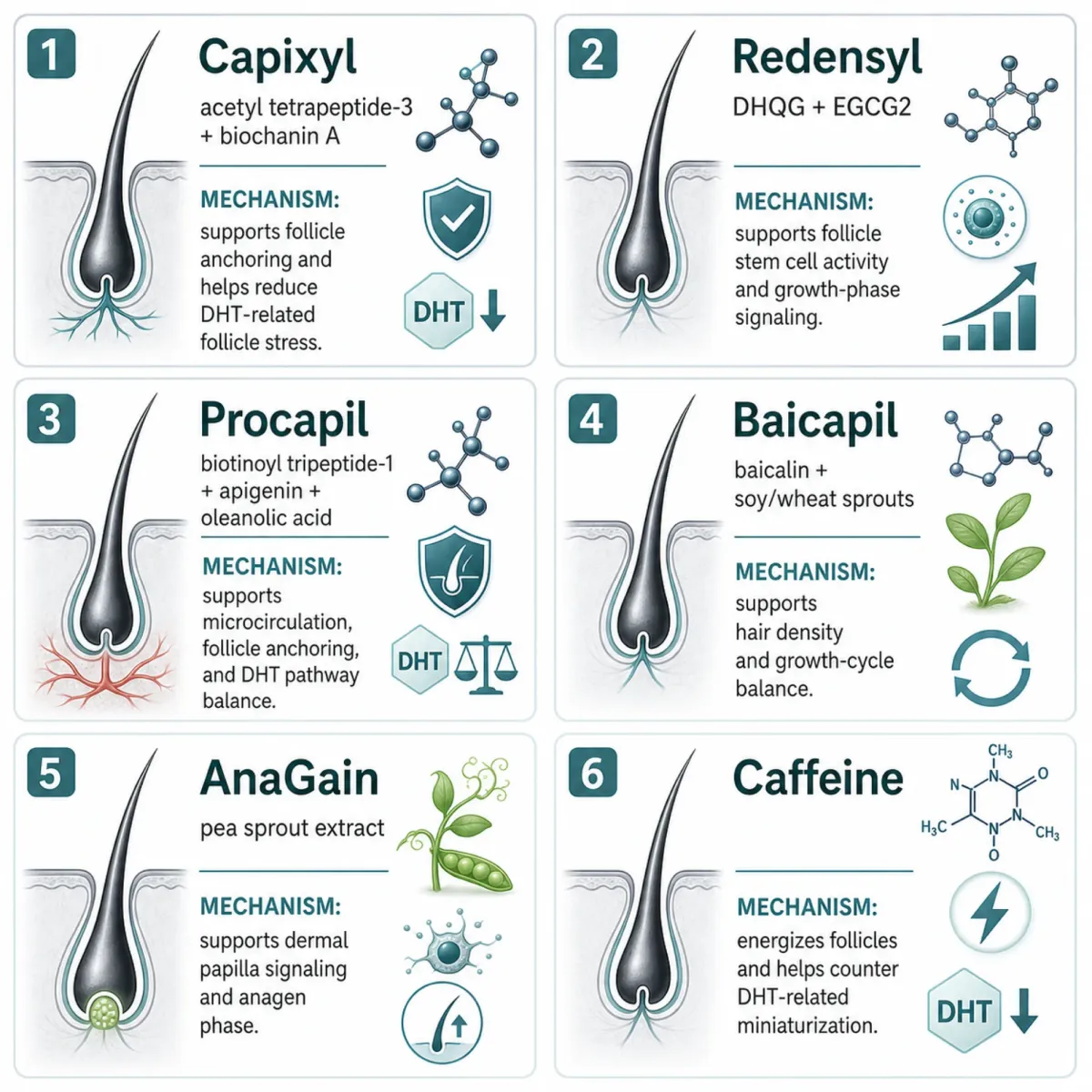
Flip over any peptide hair serum and the ingredients list reads like a patent filing: Redensyl, Capixyl, Procapil, Baicapil, AnaGain. These are trademarked complexes, each built around one or two short-chain peptides mixed with botanical extracts. They are not drugs. They do not require FDA approval. And the companies that manufacture them fund most of the existing studies.
Understanding what each ingredient actually does matters more than recognizing the brand name on the bottle.
Capixyl pairs acetyl tetrapeptide-3 with biochanin A, an isoflavone from red clover. The peptide signals follicle cells to produce more extracellular matrix proteins, the scaffolding that holds hair roots in place. Biochanin A acts as a mild 5-alpha-reductase inhibitor, slowing testosterone-to-DHT conversion at the follicle. In a placebo-controlled trial of 30 volunteers, this combination improved the anagen-to-telogen ratio by 46% over four months, while the placebo group declined 33%.
Redensyl works differently. Its active molecules, DHQG and EGCG2, target outer root sheath stem cells in the follicle bulge. Think of your follicle as a factory: Redensyl wakes up dormant workers rather than speeding up those already on the line. Givaudan's own study reported that 85% of 26 male volunteers showed clinical improvement, with an 8% increase in hair density, roughly 10,000 new hairs over three months.
Procapil bundles biotinoyl tripeptide-1 with apigenin and oleanolic acid. The tripeptide strengthens hair root anchoring while the botanicals target blood flow restriction and DHT activity around the follicle. In a pilot with 35 men, 67% showed improvement in growth-to-resting hair ratios after four months.
Baicapil (baicalin plus soy and wheat sprout extracts) showed a 12.7% increase in anagen hair versus 2% for placebo in an RCT of 61 volunteers over six months. AnaGain, from pea sprouts, boosted noggin gene expression by 85% and FGF-7 by 56% in one analysis. Caffeine appears in nearly every formula as a penetration enhancer.
When evaluating any serum, the question that matters: what concentration of these complexes does it contain? Most brands do not disclose this. The clinical studies tested specific percentages (typically 3%) that your bottle may or may not match.
35% of Before-and-After Photos Scored Zero on a Clinical Photography Scale
"With photos" may be the most effective conversion phrase in hair loss marketing. It implies visual proof. Sometimes the photos are genuine. But a growing body of research on clinical photography suggests most of them cannot be taken at face value.
A research team analyzed 2,020 before-and-after photographs from 102 aesthetic practitioner accounts on Instagram using a nine-point scoring system called SEPIA (Standards for the Evaluation of Photographs In Aesthetics). The average score: 4 out of 9. And 35% of photos scored zero, classified as potentially misleading.
The two most violated standards were timing and multiple views. Only 16% of posts met timing compliance standards, and just 24% showed results from multiple angles. Clinical trial photography requires consistent lighting, fixed camera positions, identical head positioning, and documentation of the exact post-treatment timepoint. Social media photos almost never meet any of these.
The manipulation toolkit is well documented. Marketers use harsh overhead lighting in "before" shots to flatten hair and expose the scalp, then switch to soft diffused lighting in "after" shots that makes the same hair appear denser. Camera angles shift: "before" from directly above emphasizes scalp visibility, while "after" from a lower angle creates a density illusion.
Seven red flags in hair growth before-and-after photos: Inconsistent lighting between images. Different camera angles or distances. Missing timeline labels. No documentation of products or treatments used. Styled or product-treated hair in "after" shots. Wet flat hair in "before" vs. dry voluminized hair in "after." Stock photography or models who never experienced hair loss.
Some deceptions are subtler. Companies photograph people with temporary medical hair loss from stress or illness and present the natural regrowth as a product result. Others use thickening fibers, scalp micropigmentation, or strategic parting to simulate density gains.
The SEPIA study also found no correlation between photograph quality and follower counts or engagement. Algorithms amplify dramatic-looking transformations regardless of whether the photos were shot under comparable conditions. A misleading photo showing spectacular results reaches wider audiences than a standardized clinical image showing modest but real improvement.
When someone shows you before-and-after hair photos, the useful question is not "did their hair grow back?" It is: "were both photos taken under identical conditions?" Unless the lighting, angle, distance, and hair state (wet vs. dry) match between images, the comparison tells you almost nothing.
The Uncomfortable Gap Between Marketing Numbers and Peer-Reviewed Data
Most peptide serum clinical numbers come from studies designed and funded by the ingredient manufacturers. That does not automatically invalidate findings, but it introduces bias worth examining carefully.
The most-cited Redensyl statistic: 3% Redensyl increased hair density by 17 hairs per cm², roughly 10,200 new hairs across the scalp, in three months. That number comes from Givaudan's own study of 26 men, only 14 receiving the active ingredient, published in a cosmetics trade magazine rather than a peer-reviewed medical journal. When independent researchers at Perfect Hair Health examined published data in reputable journals, they found no statistical change in hair density versus placebo in at least one study, with only modest anagen-to-telogen ratio shifts.
Capixyl faces similar scrutiny. The original 2013 study tested acetyl tetrapeptide-3 combined with red clover extract on 30 volunteers and reported a 46% improvement in the anagen-to-telogen ratio. But a critical review noted that Capixyl studies compared against 3% minoxidil rather than the standard 5% dose, and the researchers were hired by the manufacturers. Beating a weaker version of the competition while on the manufacturer's payroll is not the kind of evidence that should anchor medical decisions.
Procapil occupies an even shakier position. Despite its presence in dozens of consumer serums, no independent clinical studies exist for Procapil. The evidence supporting its individual ingredients (biotinoyl tripeptide-1, apigenin, oleanolic acid) comes from cell culture work and mechanistic studies, not from trials measuring hair growth on human scalps.
The most impressive-sounding study is the combined RCP trial comparing Redensyl + Capixyl + Procapil against minoxidil in 106 men over 24 weeks. It reported that the RCP group achieved 64.7% researcher-assessed improvement versus 25.5% for minoxidil, with 88.9% photographic improvement versus 60%. Those numbers look remarkable. But the study used subjective photographic assessments rather than hard hair counts, did not disclose ingredient concentrations, and was funded by the patent holder.
| Ingredient | Sample Size | Duration | Key Finding | Funding |
|---|---|---|---|---|
| Redensyl 3% | 26 men (14 active) | 3 months | +17 hairs/cm² vs placebo | Givaudan (manufacturer) |
| Capixyl | 30 volunteers | 4 months | +46% anagen/telogen ratio | Manufacturer-funded |
| Procapil | 35 men | 4 months | 67% improved A/T ratio | Manufacturer-funded |
| Baicapil | 61 volunteers | 6 months | +12.7% anagen hair | Manufacturer-funded |
| RCP combo vs minoxidil | 106 men | 24 weeks | 64.7% vs 25.5% improvement | Patent holder |
| Redensyl + Sepicontrol A5 | 41 patients | 24 weeks | 73.1% moderate improvement | Not disclosed |
Not all the data is negative, though. A randomized vehicle-controlled study of a Redensyl-based topical in 41 patients found that 73.1% showed moderate improvement over 24 weeks, with self-assessment scores rising from 4 to 6 out of 10 (P < .001) and anagen-to-telogen ratios climbing from 2.25 to 6.02. A separate comparative trial in 42 women with telogen effluvium showed all three peptide serum groups increased hair density, with the cytokine-based formula achieving 54.6% reduction in hair fall.
These ingredients show biological activity. They produce measurable shifts in hair cycle ratios. But the effect sizes are modest, the studies are small, and no peptide serum has passed the large-scale, multi-center, double-blind trials that minoxidil and finasteride cleared years ago. When someone claims a peptide serum "reversed" a receding hairline, ask for standardized clinical documentation rather than Instagram screenshots.
What $24 Gets You vs. What $150 Gets You
The market runs from $24 drugstore bottles to $150 longevity-brand formulations. The two useful questions for any product: what peptide complexes does it contain, and is there reason to believe the concentration is clinically relevant?
The Ordinary Multi-Peptide Serum for Hair Density ($24) contains more named complexes than any competitor at its price: Redensyl, Procapil, Capixyl, Baicapil, AnaGain, and high-solubility caffeine. Board-certified dermatologist Dr. Dendy Engelman described peptide serums as "more supportive than transformative" on their own, recommending them alongside clinical treatments like PRP rather than as standalone solutions. User reviews range from "visible new growth within one month" to "no change after six months." Concentrations are not disclosed.
OneSkin OS-01 Hair Scalp Serum (~$89) uses a proprietary OS-01 peptide targeting cellular senescence, the process where aging cells stop dividing but refuse to die, clogging tissue. One self-experiment documented with dermascope imaging over six months showed improvements in thickness and density, though three-month results were less conclusive. The reviewer tracked individual follicles using a Dermlite DL1 device (~$250), far more rigorous than phone selfies. It remains an n=1 experiment, and the combined use of dermarolling makes it impossible to isolate the serum's contribution.
Blueprint (Bryan Johnson) Hair Peptide Serum (~$55) includes acetyl tetrapeptide-3 and caffeine with botanical extracts. User reviews describe improved fullness, though no published clinical data exists for this specific formulation.
| Product | Price | Key Peptides | Clinical Data | Concentration Disclosed? |
|---|---|---|---|---|
| The Ordinary Multi-Peptide | $24 | 6 complexes (Redensyl, Capixyl, Procapil, Baicapil, AnaGain, caffeine) | Ingredient-level only | No |
| OneSkin OS-01 Hair | ~$89 | OS-01 (senolytic peptide) | In-house; no peer-reviewed hair trials | No |
| Blueprint Hair Peptide | ~$55 | Acetyl tetrapeptide-3, caffeine | None for formulation | No |
None of these products disclose the actual concentration of active peptides. The Capixyl study showing a 46% anagen ratio improvement used a specific percentage in a controlled formulation. Whether any consumer product replicates that dose is unverifiable. You are buying ingredient names on a label, not a guaranteed clinical dose.
Why Your Temples Are Harder to Treat Than Your Crown
Not all hair loss responds to treatment the same way, and the frontal hairline is the most stubborn zone on the scalp.
The StatPearls clinical reference on androgenetic alopecia notes that finasteride displays greater effectiveness at the vertex compared to the frontal area. Dermatologists at Bernstein Medical confirmed this: oral minoxidil and finasteride "work well to thicken hair throughout the scalp, but work best to thicken the crown."
The biology is not fully mapped, but the pattern holds. Hair follicles at the temples and frontal hairline have elevated levels of 5-alpha-reductase and a higher density of androgen receptors compared to the crown. Think of it as a neighborhood where DHT has a stronger foothold: the same drug that clears DHT effects on the crown may not overcome the frontotemporal resistance.
If pharmaceutical-grade DHT blockers tested in trials with thousands of participants cannot reliably reverse frontal recession, a cosmetic peptide serum applied at undisclosed concentrations is unlikely to produce the dramatic reversal shown in marketing photos.
Peptide serums may still contribute at the hairline. Acetyl tetrapeptide-3 targets extracellular matrix proteins, Redensyl activates stem cells, and botanical components reduce local inflammation. These could produce marginal improvements. But "marginal improvement" and "reversed a 5-year receding hairline" are different claims requiring different evidence. No peptide serum has demonstrated the latter in a controlled setting.
For early-stage temple thinning (Norwood 2 or 3), a peptide serum might slow progression, particularly combined with microneedling or prescription treatments. For established recession, the evidence still points to combined minoxidil and finasteride therapy (4-6 months minimum, indefinite continuation) or surgical transplantation with genetically resistant donor hair.
The Three-Month Minimum and Other Inconvenient Truths
Every hair growth treatment, pharmaceutical or peptide-based, requires a minimum of four to six months before results become apparent. The growth cycle operates on timelines no serum can accelerate. Claims of visible results in two weeks describe a styling effect, not actual growth.
Hair grows at roughly half an inch per month. A follicle transitioning from telogen (resting) into anagen (growth) needs weeks just to begin producing a visible shaft. That lag is biological.
A realistic timeline for peptide serum evaluation: Months 1-2: No visible change expected. Month 3: Possible reduction in shedding. Months 4-6: First visible density changes, if any. Month 6+: Enough time to judge whether the product is working for you. Any treatment that claims results faster than this timeline is misrepresenting how hair biology works.
Safety is where peptide serums have a real advantage over pharmaceuticals. The comparative trial of three formulations in 42 women reported zero adverse events across all groups over 90 days. The Redensyl plus Sepicontrol A5 study of 41 patients over 24 weeks found no significant adverse events. Minoxidil causes scalp irritation and unwanted facial hair growth in some users; finasteride carries a small risk of sexual side effects. By comparison, peptide serums look benign.
Low risk and high efficacy are different things, though. A product can be perfectly safe and do very little. Peptide serums are safer than pharmaceuticals, less proven, and likely less effective for advanced hair loss. Reasonable for someone avoiding pharmaceutical side effects or addressing early thinning. Not a substitute for established treatments in significant pattern baldness.
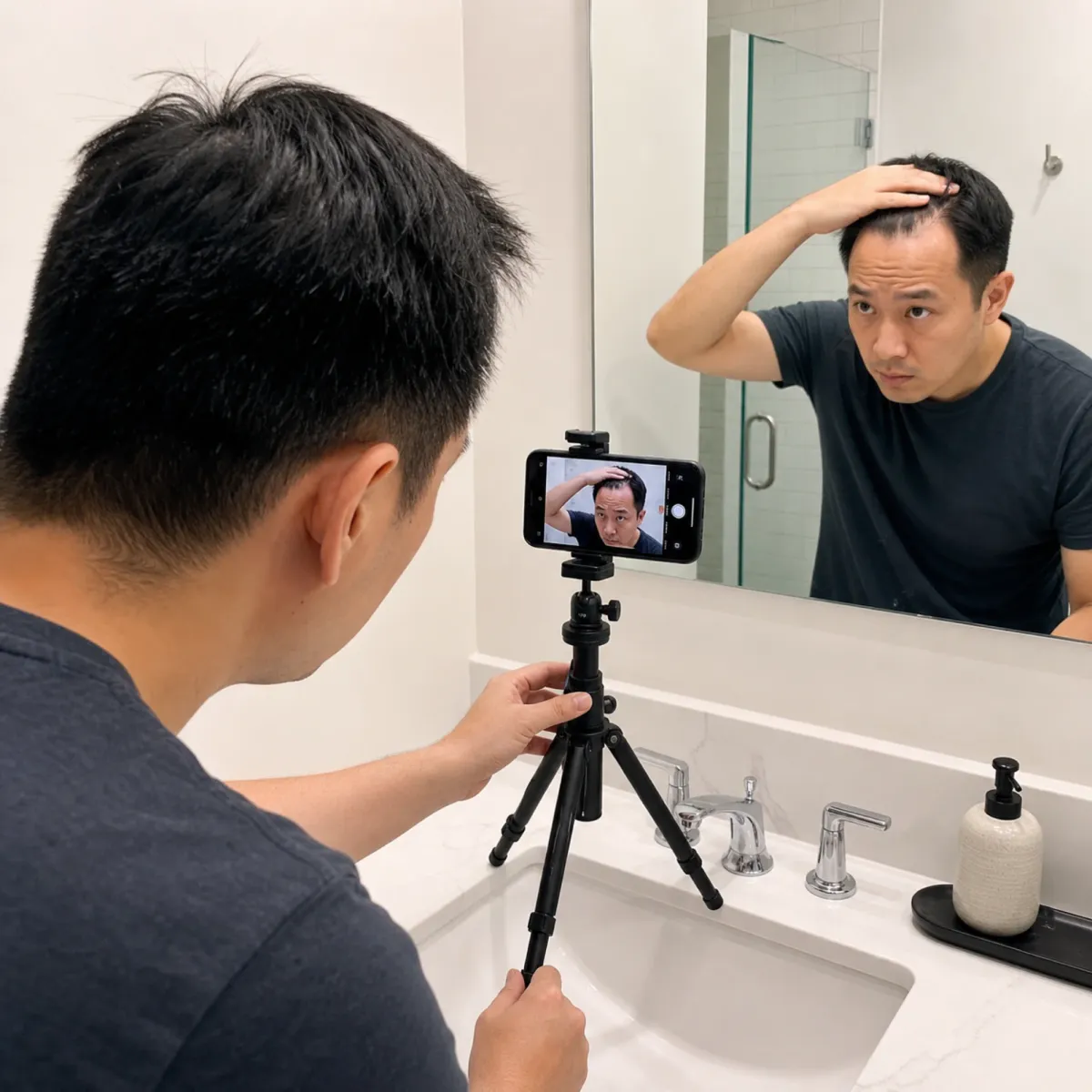
If you try a peptide serum, commit to six months of daily use before judging. Take your own photos under standardized conditions: same room, same lighting, same distance, clean dry hair with no products. A phone timer and a fixed tripod position cost nothing and produce more reliable documentation than any Instagram testimonial.
Frequently Asked Questions
Can a peptide serum actually reverse a receding hairline?
No peptide serum has demonstrated reversal of established hairline recession in a controlled trial. The evidence shows modest improvements in hair cycle ratios and density, mostly at the crown. Peptide serums may slow early-stage thinning, but dramatic reversal claims lack clinical support.
How long do peptide hair serums take to show results?
Four to six months minimum of consistent use before visible changes. Shedding reduction may appear around month three. Anyone claiming growth in under a month is describing a styling effect. Commit at least six months before evaluating.
Are peptide hair serums safer than minoxidil or finasteride?
Clinical trials report zero or near-zero adverse events for peptide serums. Minoxidil causes scalp irritation in some users; finasteride carries a small risk of sexual side effects. Peptide serums have a better safety profile but weaker efficacy data.
Why do so many hair growth products show before-and-after photos?
Visual transformations are the strongest conversion tool in hair loss marketing. Research analyzing over 2,000 Instagram before-and-after photos found 35% were potentially misleading due to inconsistent lighting, changed angles, and styled versus unstyled hair. Algorithms amplify dramatic images regardless of quality.
Which peptide hair serum should I start with?
The Ordinary Multi-Peptide Serum ($24) offers the broadest ingredient coverage at the lowest price with six peptide complexes. No consumer serum discloses concentrations, so you cannot verify the dose matches clinical trials. Treat a peptide serum as one part of a broader approach including scalp health optimization and, if warranted, a dermatologist conversation.
Medical Disclaimer
This article is for informational and educational purposes only and is not medical advice, diagnosis, or treatment. Always consult a licensed physician or qualified healthcare professional regarding any medical concerns. Never ignore professional medical advice or delay seeking care because of something you read on this site. If you think you have a medical emergency, call 911 immediately.