Your Hair Follicles Run on Copper — And They're Probably Not Getting Enough
Copper peptides are everywhere in hair restoration marketing right now, but the science predates the Instagram ads by decades. In 1973, biochemist Dr. Loren Pickart exposed aging human liver tissue to a specific tripeptide bound to copper and watched the tissue respond as if it were younger, producing proteins at rates characteristic of cells decades younger. That molecule was GHK-Cu. The fifty years of research that followed expanded far beyond liver tissue.
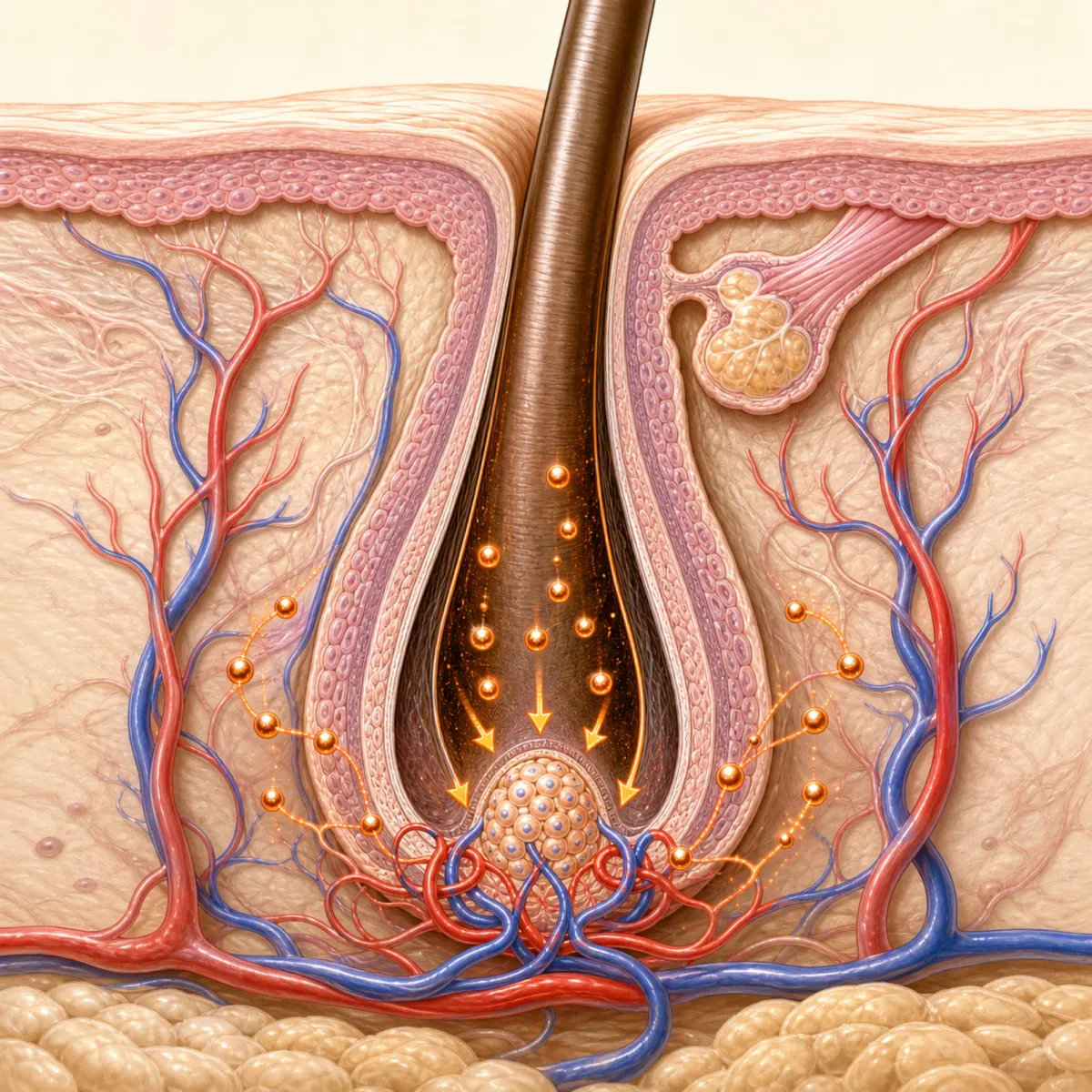
The connection to hair sits in a specific cell type called dermal papilla cells, or DPCs. Think of DPCs as the project managers of your hair follicles — they send the growth signals, coordinate nutrient delivery, and determine whether a follicle stays active or goes dormant. Copper peptides interact with these cells in ways that other hair growth compounds do not: they affect gene expression at a broad scale rather than targeting a single pathway.
Pickart's subsequent research revealed that GHK-Cu doesn't just nudge a few genes. It modulates the expression of over 4,000 genes in human fibroblasts — roughly 31.2% of the human genes studied. Many of these genes govern tissue repair, collagen production, inflammation control, and blood vessel formation. For hair follicles, that broad genomic reach translates into multiple simultaneous effects: better blood supply to the scalp, stronger structural proteins around the follicle, reduced inflammatory damage, and direct stimulation of the cells that trigger growth cycles.
There's a timing problem, though. GHK levels in human plasma drop from roughly 200 ng/mL at age 20 to about 80 ng/mL by age 60 — a decline that lines up uncomfortably well with the age-related thinning most people experience. Whether that correlation is causal remains debated, but it explains why topical copper peptide application has attracted so much research attention: the idea is to restore locally what the body is producing less of systemically.
GHK-Cu Has Been Studied Since the Ford Administration. Here's What Held Up
GHK-Cu stands for glycine-histidine-lysine bound to a copper ion. It occurs naturally in human blood, saliva, and urine. The peptide was the first copper complex studied for tissue regeneration, and its research trail stretches across wound healing, skin aging, lung repair, and hair restoration.
The hair-specific evidence starts with what happens at the cellular level. At concentrations of 0.5 micrograms per milliliter, GHK-Cu upregulates IGF-1 expression by 2.3-fold and VEGF by 1.9-fold in dermal papilla cells (p < 0.001). IGF-1 drives cell proliferation in the follicle bulb. VEGF stimulates new blood vessel formation, building better plumbing to feed growing hair. The combined effect favors thicker, more actively cycling follicles.
The Wnt/beta-catenin pathway matters here too. GHK-Cu activates this signaling cascade, which promotes the transition from telogen (resting phase) to anagen (active growth phase). When beta-catenin accumulates in the nuclei of dermal papilla cells, it flips the switch that tells dormant follicles to start producing hair again. Minoxidil, by comparison, works through a completely different mechanism — vasodilation via potassium channels — which is why some researchers see GHK-Cu as complementary rather than redundant to existing treatments.
Clinical data moved beyond the petri dish in 2016. A randomized, double-blind, placebo-controlled trial at Kyungpook National University tested a topical spray combining GHK peptide with 5-aminolevulinic acid on 45 men with pattern baldness (Norwood-Hamilton II through V). After six months, the low-dose group gained 71.5 hairs per square centimeter — 7.4 times the gain in the placebo group (p < 0.05). The high-dose group gained 52.6 hairs per square centimeter. Zero adverse events were reported across all three groups.
The Dose Paradox: In the 2016 trial, the lower dose (50 mg/mL) outperformed the higher dose (100 mg/mL). This biphasic pattern — where more isn't better — shows up repeatedly in copper peptide research and has practical implications for product selection.
A separate 24-week randomized controlled trial involving 60 participants found that applying 1% GHK-Cu serum twice daily increased hair-shaft density by 12% and reduced daily shedding by 15% (p < 0.01). These are modest numbers compared to the 2016 combination study, which makes sense — GHK alone versus GHK paired with a mitochondrial booster (5-ALA) would be expected to produce different magnitude effects.
The skin data is relevant because it tells us about GHK-Cu's broader tissue effects. In a trial of 71 women using GHK-Cu facial cream for 12 weeks, researchers documented increased skin density, reduced laxity, and improved clarity. GHK-Cu outperformed vitamin C and retinoic acid for collagen production in a thigh-application study (70% improvement versus 50% and 40%, respectively). This matters for hair because scalp health and follicular collagen networks use the same biological machinery.
AHK-Cu Arrived with Bold Claims and a Thin Resume
AHK-Cu replaces the glycine in GHK-Cu with alanine, creating a synthetic tripeptide — alanine-histidine-lysine bound to copper. That single amino acid swap changes how the molecule interacts with cell receptors and, according to cosmetic marketing, makes it specifically optimized for hair follicle stimulation.
The evidence base for AHK-Cu in hair comes down to one primary study. In 2007, researchers led by Pyo at Seoul National University tested AHK-Cu on 240 human hair follicles harvested from 10 healthy volunteers. At concentrations ranging from 10⁻¹² to 10⁻⁹ molar (picomolar to nanomolar range), AHK-Cu significantly stimulated hair follicle elongation over a 12-day culture period (p < 0.001). Dermal papilla cells treated at the same concentrations proliferated at significantly higher rates (p < 0.001), with the strongest effect at 10⁻⁹ molar.
The anti-apoptotic data from Pyo's study drew the most attention in hair restoration circles. At 10⁻⁹ molar concentration, AHK-Cu reduced caspase-3 activity by 42.7% and PARP cleavage by 77.5% after 72 hours (both p < 0.05). It also shifted the Bcl-2/Bax ratio toward cell survival — Bcl-2 (the pro-survival protein) went up while Bax (the pro-death protein) went down. AHK-Cu was preventing the programmed death of hair follicle cells at concentrations so low they're measured in trillionths of a molar.
But the same study revealed a critical caveat. At 10⁻⁷ molar, AHK-Cu inhibited hair follicle growth by 81.5%. The concentration window between "stimulates growth" and "kills growth" spans just two orders of magnitude. This biphasic dose-response curve means getting the concentration wrong doesn't just fail to help. It actively damages follicles.
The Procyte Corporation patented peptide-copper complexes for hair growth in 1996, with AHK:Cu showing superior topical activity compared to hydrophobic peptide-copper complexes in mouse models. The patent documented hair regrowth regions of 0.5 to 5.0 square centimeters following intradermal injection, with active growth appearing 14 to 20 days post-injection. However, patent filings are not peer-reviewed research — they establish utility for commercial protection, not clinical efficacy.
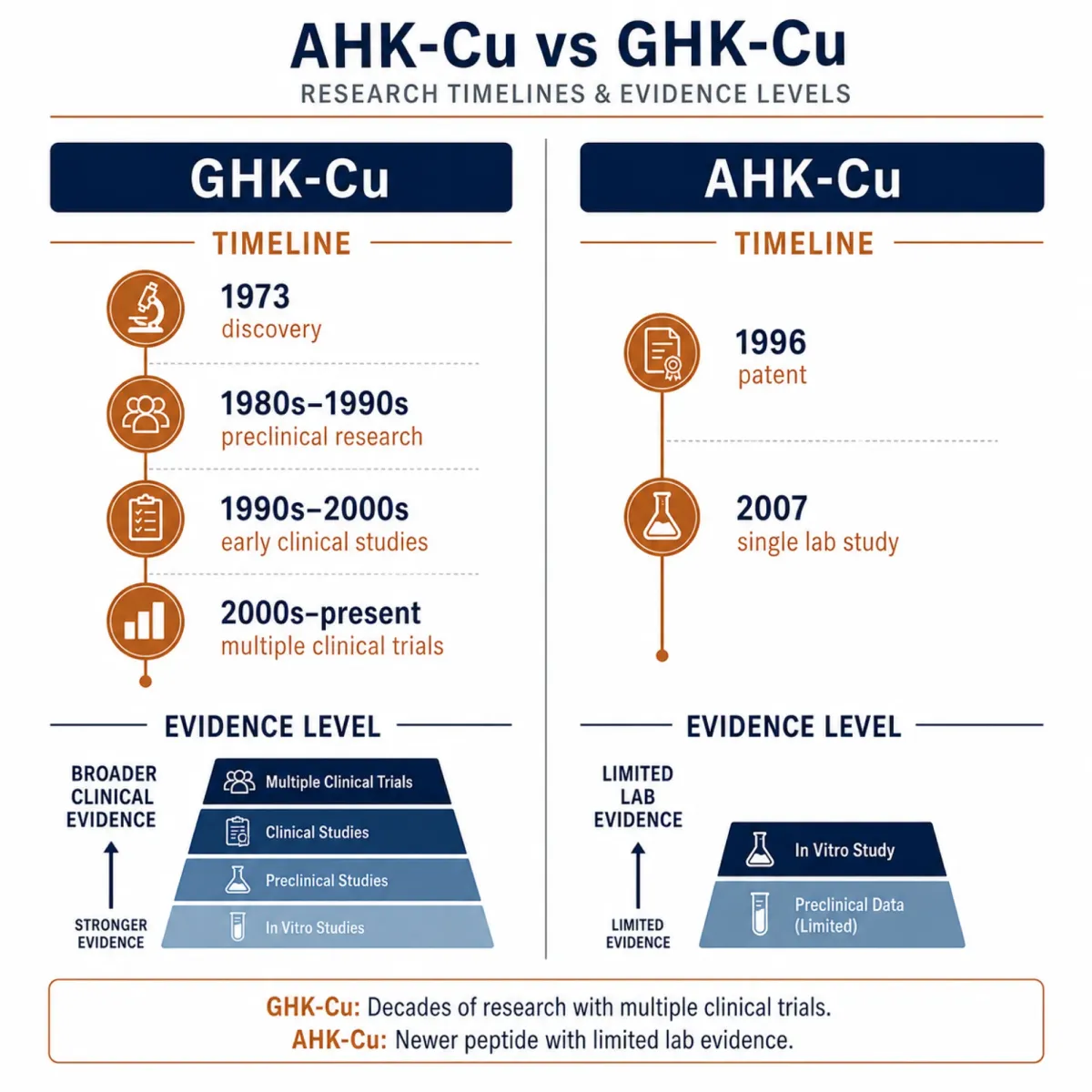
The gap between the Pyo lab study and a clinical trial on actual human scalps has never been closed for AHK-Cu. The molecule went from a single in-vitro/ex-vivo study and a patent filing to commercial hair products without the intermediate step of randomized controlled trials on living people. Cosmetic companies marketing AHK-Cu for hair are extrapolating from lab data, which is legal (cosmetics don't require clinical trials) but scientifically incomplete.
The One Amino Acid That Separates Them Changes More Than You'd Expect
Both molecules are tripeptides — three amino acids in a chain — chelated to a copper ion. They share histidine and lysine at positions two and three, which handle the copper binding. The difference sits at position one: glycine in GHK-Cu, alanine in AHK-Cu.
| Property | GHK-Cu | AHK-Cu |
|---|---|---|
| Full name | Glycyl-Histidyl-Lysine Copper | Alanyl-Histidyl-Lysine Copper |
| First amino acid | Glycine (simplest amino acid, no side chain) | Alanine (one methyl group side chain) |
| Origin | Naturally occurring in human plasma | Synthetic, engineered variant |
| Estimated half-life | ~4 hours | ~8-10 hours |
| Typical product concentration | 0.5-2% | 0.3-1% |
| Primary research focus | Wound healing, skin aging, hair, tissue repair | Hair follicle stimulation |
| Years of published research | 50+ years (since 1973) | ~18 years (since 2007) |
The alanine substitution in AHK-Cu adds a methyl group that glycine lacks. In protein chemistry, that's a small structural change, but it affects two properties that matter for topical hair products: stability and receptor interaction. AHK-Cu's estimated half-life of 8 to 10 hours roughly doubles GHK-Cu's 4-hour half-life, which means the molecule persists longer before enzymatic degradation breaks it down. For a scalp serum applied once or twice daily, that longer window of activity could translate to more sustained follicle contact.
The flip side is that GHK-Cu's shorter half-life exists because it's a natural molecule the body has evolved to process. GHK-Cu is released during tissue injury as a wound-healing signal and cleared on a natural cycle. AHK-Cu, as a synthetic analog, doesn't have that evolutionary context — the body treats it as a foreign peptide, and the longer half-life partly reflects the fact that enzymatic breakdown systems aren't as efficient at clearing it.
At the receptor level, the methyl group on alanine creates slightly different binding geometry compared to glycine's hydrogen. Some cosmetic scientists argue this makes AHK-Cu more targeted in its follicle interactions, but no published study has directly measured comparative receptor binding affinities between the two molecules on dermal papilla cells. That's a claim based on structural chemistry inference, not experimental data.
Both peptides show the same biphasic dose-response pattern: effective at very low concentrations, inhibitory at higher ones. This shared behavior suggests the core mechanism — copper delivery to follicular cells — is similar, with the amino acid substitution modifying delivery kinetics rather than fundamentally changing what happens once copper reaches its target.
The Evidence Gap Between These Two Peptides Is Enormous
Evaluating copper peptides for thinning hair requires separating what's been demonstrated from what's been assumed, and the disparity between GHK-Cu and AHK-Cu is stark.
| Evidence Category | GHK-Cu | AHK-Cu |
|---|---|---|
| Randomized controlled trials (hair) | Multiple (2016 Lee et al. n=45; 24-week RCT n=60) | None |
| In vitro / ex vivo hair studies | Several, spanning decades | One primary study (Pyo 2007, n=240 follicles) |
| Animal studies | Multiple (wound healing, tissue repair models) | Mouse model in 1996 patent only |
| Gene expression data | 4,000+ genes mapped (Pickart) | Limited to Bcl-2/Bax and caspase pathways |
| Head-to-head comparison studies | vs. minoxidil (2022) | None vs. any comparator |
| Long-term safety data | Decades of cosmetic use, clinical trials | No published safety studies |
GHK-Cu's strongest hair evidence comes from two randomized controlled trials. The 2016 Lee et al. trial (n=45) showed a 7.4-fold improvement over placebo in hair density after six months using GHK peptide combined with 5-ALA. The 24-week trial (n=60) using 1% GHK-Cu alone produced a 12% density increase and 15% shedding reduction. A 2022 comparison study found GHK-Cu at 0.5% outperformed 3% minoxidil over 16 weeks, with a 22% increase in hair count density.
AHK-Cu's entire hair evidence rests on Pyo's 2007 laboratory study. That study was well-designed for what it was — it used proper controls, statistical analysis, and measured multiple relevant endpoints. But it tested follicles in a culture dish, not on human heads. The gap between "stimulates isolated follicles at picomolar concentrations" and "regrows hair when applied topically to a living scalp" involves absorption, metabolism, concentration maintenance, and interaction with the complex biology of actual scalps — none of which has been tested for AHK-Cu.
The 2021 pilot study that sometimes gets cited for copper tripeptides used only 6 participants (3 per group), combined the serum with radiofrequency treatment, and reported no statistical significance testing. It's a proof-of-concept pilot, not evidence of efficacy.
A fair reading of the current evidence: GHK-Cu has demonstrated hair growth benefits in actual humans across multiple properly designed trials. AHK-Cu has demonstrated hair follicle stimulation in a lab setting with no clinical follow-up. Both show biological plausibility. Only one has cleared the clinical evidence bar that matters for people deciding where to spend their money.
How to Pick the Right Copper Peptide Without Overpaying for Marketing
Product selection comes down to what you're trying to accomplish and how much unproven science you're comfortable betting on.
If thinning hair is your primary concern and you want the safest evidence bet, GHK-Cu stands on firmer ground. Multiple clinical trials have demonstrated measurable hair density improvements in humans. The typical effective concentration range is 0.5% to 2%, and products at these levels have established safety profiles. GHK-Cu also benefits your scalp's broader tissue health — collagen networks, blood vessel density, inflammatory balance — which creates a better environment for follicles even beyond the direct growth stimulation.
If you want to try AHK-Cu specifically, you're essentially an early adopter. The lab data from Pyo's study is genuinely interesting — the anti-apoptotic effects at picomolar concentrations are striking. But you're applying a molecule that has never been tested for efficacy on a living human scalp, and the concentration window between "helpful" and "harmful" is narrow. Products combining both peptides exist, which may be a reasonable hedge, though published research on their combined effects is limited.
| Scenario | Better Choice | Why |
|---|---|---|
| General thinning, want proven results | GHK-Cu | Multiple human clinical trials support efficacy |
| Already using minoxidil, want to add something | GHK-Cu | Different mechanism (Wnt pathway vs. vasodilation); potentially complementary |
| Want the longest-acting topical option | AHK-Cu | ~8-10 hour half-life vs. ~4 hours for GHK-Cu |
| Scalp health + hair + skin aging | GHK-Cu | Broadest evidence base across tissue types |
| Willing to try emerging science | AHK-Cu or combination | Lab data is promising; clinical confirmation pending |
Concentration matters more than most marketing suggests. Both peptides follow biphasic dose-response curves where higher concentrations can inhibit the very growth you're trying to stimulate. The 2016 clinical trial showed the lower dose outperforming the higher dose for GHK-Cu, and Pyo's lab work documented that AHK-Cu at 10⁻⁷ molar suppressed growth by 81.5%. Products advertising the highest peptide concentrations aren't necessarily more effective. They may be counterproductive.
Avoid layering copper peptides with high-strength vitamin C (ascorbic acid), aggressive AHAs or BHAs, or potent retinoids in the same application step. Low-pH actives can destabilize the copper-peptide bond, reducing efficacy. Apply them at different times of day if you use both.
Adverse events across GHK-Cu trials have been limited to mild, transient redness in fewer than 5% of participants. AHK-Cu has no published safety data from human use — no reported problems is not the same as evidence of safety. People with Wilson's disease, a genetic copper metabolism disorder, should avoid all copper peptide products.
Frequently Asked Questions
Can I use AHK-Cu and GHK-Cu together for hair?
Some products combine both peptides, and the approach has theoretical merit — GHK-Cu provides broad tissue support while AHK-Cu may offer more targeted follicle stimulation. However, published research on their combined effects is limited. If you combine them, watch the total copper peptide concentration, since both follow biphasic dose-response curves where more can mean less.
How long before I see results from copper peptide serums?
Clinical trials with GHK-Cu showed modest gains at month one, with substantial improvements appearing between months three and six. The 2016 Lee et al. trial documented peak hair density gains at the six-month mark. Hair grows in cycles, and shifting follicles from resting to active phase takes time. Expect at least three months of consistent use before evaluating whether a product works for you.
Is AHK-Cu actually better than GHK-Cu for hair?
Not based on current evidence. AHK-Cu is marketed as hair-specific, but its only published research is a single 2007 lab study on isolated follicles. GHK-Cu has multiple randomized controlled trials demonstrating hair growth in living humans. AHK-Cu may eventually prove effective on scalps, but that work hasn't been done yet.
Do copper peptides work for female pattern hair loss?
Most clinical trials have enrolled men with androgenetic alopecia. The biological mechanisms — dermal papilla cell stimulation, angiogenesis, Wnt pathway activation — are not sex-specific, and the Pyo 2007 lab study used follicles from both male and female donors. A 2021 pilot study with mixed hair loss types showed some improvement, but robust evidence specifically for female pattern thinning is lacking.
Are copper peptide concentrations above 2% more effective?
No — and they may be worse. Both AHK-Cu and GHK-Cu demonstrate biphasic responses where excessive concentrations inhibit growth. AHK-Cu at 10⁻⁷ molar reduced follicle growth by 81.5% in lab testing. Stick with products in the established effective ranges: 0.5-2% for GHK-Cu, 0.3-1% for AHK-Cu.
Medical Disclaimer
This article is for informational and educational purposes only and is not medical advice, diagnosis, or treatment. Always consult a licensed physician or qualified healthcare professional regarding any medical concerns. Never ignore professional medical advice or delay seeking care because of something you read on this site. If you think you have a medical emergency, call 911 immediately.