
A 45-Year-Old Artist Couldn't Paint for 30 Minutes Without Checking His Phone
In 2022, Stuart Semple hit a wall. The Bournemouth-based artist found himself unable to work for more than half an hour before his hand drifted from brush to smartphone. The infinite scroll of Instagram had trained his brain to expect constant stimulation, and the quiet concentration that painting demanded felt physically uncomfortable. So he did something that felt radical for a middle-aged creative professional: he locked his phone in a drawer and sat with the discomfort. He described it as building a muscle for tolerating boredom.
Three years later, Semple has replaced takeout with home-cooked meals, Instagram with long-form writing on Substack, and emails with handwritten letters. "I find the rewards for doing difficult things are absolutely massive," he told the BBC. "I grow, I get better at things and I expand."
Semple is part of a growing cultural shift that has picked up a very internet-native label: friction-maxxing. The concept is straightforward. Instead of letting technology sand every rough edge off daily life, you deliberately choose the harder, slower, more analog version of a task. Read a physical book instead of watching a YouTube summary. Navigate by road signs instead of GPS. Call a friend instead of asking ChatGPT.
Writing in Fortune, one commentator defined friction-maxxing as "the deliberate rejection of seamless convenience -- the transactional optimization that virtually every consumer-facing company has ruthlessly pursued for a decade." Kathryn Jezer-Morton, writing in The Cut, framed it differently: it is about rebuilding our collective tolerance for "the vagaries of being a person living in a world with other people in spaces that are impossible to completely control."
That second definition matters more. Friction-maxxing is not a digital detox. A detox implies something temporary -- a cleanse you endure before returning to old habits. Friction-maxxing is a permanent recalibration. The goal is not to eliminate technology but to stop outsourcing every cognitive and social task to a screen, because the evidence is mounting that the outsourcing itself comes with costs we are only beginning to measure.

One in Six People Worldwide Are Lonely, and It Is Costing Us $406 Billion a Year
The friction-maxxing movement did not emerge from nowhere. It grew out of a crisis that the World Health Organization has spent years documenting. In June 2025, the WHO Commission on Social Connection -- co-chaired by former U.S. Surgeon General Dr. Vivek Murthy -- released a report with numbers that should have dominated headlines for weeks. One in six people worldwide now experiences persistent loneliness. That loneliness is linked to an estimated 100 deaths every hour -- more than 871,000 deaths per year.
The economic damage shows up in unexpected places. In the United States alone, loneliness manifests on corporate balance sheets as absenteeism, costing $406 billion annually. But the health toll runs deeper than missed workdays. The WHO report found that people who are lonely are twice as likely to develop depression, and that loneliness increases risk of stroke, heart disease, diabetes, and cognitive decline. Lonely teenagers are 22% more likely to receive lower grades.
Young people are disproportionately affected. Between 17% and 21% of people aged 13 to 29 reported feeling lonely, with the highest rates among teenagers. The paradox is obvious: this is the most digitally connected generation in human history, yet they report feeling more isolated than their parents did at the same age.
The WHO Commission report prompted the first-ever World Health Assembly resolution on social connection in May 2025, urging member states to treat social isolation as a public health priority alongside obesity and tobacco use.
The sentiment data from younger generations reinforces this picture. Pew Research Center data from 2024 shows that 48% of American teenagers now view social media's effects as mostly negative -- up from 32% just two years earlier. And 44% have actively cut back on their smartphone use. They are not waiting for policy solutions. They are voting with their thumbs.
Think of it like nutrition. We spent decades engineering food to be maximally convenient -- removing the friction of preparation, cooking, and even chewing. The result was an obesity crisis. The digital equivalent is playing out with our social and cognitive lives: we engineered away the friction of connecting, creating, and thinking, and now we are seeing the metabolic consequences for our brains and our relationships.
Your Brain's Reward System Was Built for Struggle, Not Scrolling
The neuroscience behind friction-maxxing has more substance than the TikTok trend would suggest. Psychologist Gloria Mark at the University of California, Irvine has spent years tracking attention spans using stopwatches and specialized software. Her research across office workers, students, and software developers found that the average time someone spends focused on a screen before switching tasks dropped from about two and a half minutes in 2004 to 47 seconds by 2016. We are not just distracted. We have trained ourselves to be distracted.
Mark draws a distinction between two types of well-being that maps directly onto the friction-maxxing argument. Hedonic well-being is about pleasure, happiness, and comfort -- the quick dopamine hit of a like, a swipe, a two-second video. Eudaimonic well-being is about meaning and self-realization, and it almost always requires effort. "Technology is leading us toward a light, hedonic kind of well-being full of quick thrills," Mark told the BBC. "The problem is that we're neglecting a eudaimonic approach, which leads to deeper fulfilment."
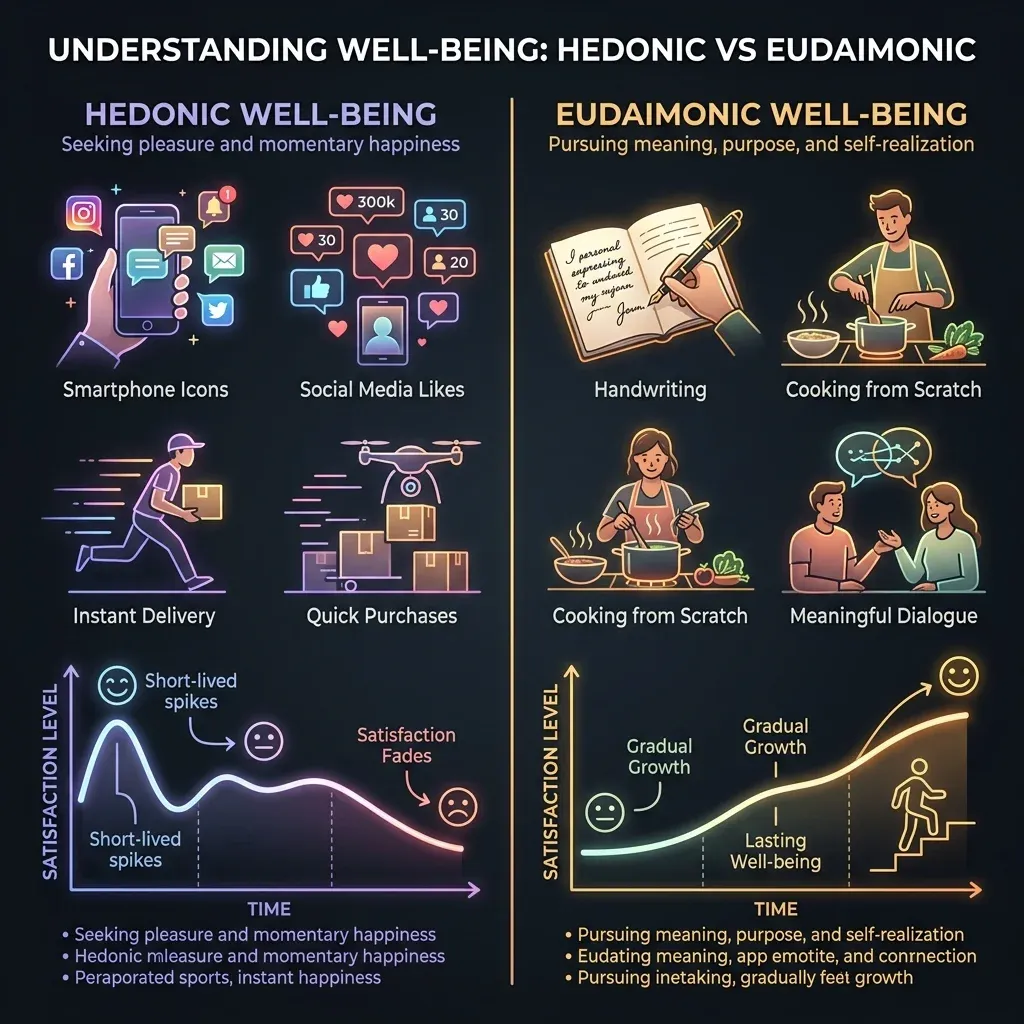
Researchers have identified something called the "Effort Paradox" -- brain scan studies show that the part of the brain processing rewards is more active when the payoff requires effort to achieve. The effect has been documented in children, adults, and even pigeons. In one experiment, mice that had to work harder for their food continued choosing that food over an easier option and appeared to enjoy it more. Your brain does not just tolerate difficulty. Under the right conditions, it prefers it.
You have probably experienced this yourself without having a name for it. Researchers call the human version the "Ikea effect" -- a series of experiments found that people who assembled their own furniture valued it as highly as professionally made pieces. The act of building something, despite the cursing at Allen wrenches, fulfilled a core psychological need: proving to yourself that you are competent. Ordering the same shelf pre-assembled does not scratch that itch.
Psychiatrist Srini Pillay, author of Tinker, Dabble, Doodle, Try, argues that friction-maxxing works because it forces a different mode of cognitive engagement. Writing by hand before typing "helps slow down thought, deepens encoding and personalises messages," he told the BBC. Reading primary sources instead of AI-generated summaries exposes you to original thinking that requires -- and rewards -- more reflection.
Mark puts it bluntly: our brains operate on a "use it or lose it" principle. Animal studies show that effortful learning literally keeps new neurons alive, and human research consistently finds that cognitively stimulating activities -- instruments, puzzles, reading, games -- preserve cognitive function as we age. Every time you let an app do something your brain used to handle, you are skipping a rep at the cognitive gym.
From Yarn Kits to Landlines: The Analog Economy Is Booming
The cultural shift from abstract concept to measurable economic force happened fast. At the dawn of 2026, influencers across multiple countries simultaneously declared it "the year of the analog lifestyle." But the spending data suggests this is more than a hashtag.
Arts and crafts retailer Michael's reported that searches for "analog hobbies" on its website increased 136% in six months. Sales of guided craft kits climbed 86% in 2025, with the company projecting another 30% to 40% growth in 2026. Searches for yarn kits -- a category the company's chief merchandising officer called part of the "grandma hobbies" revival -- shot up 1,200% in 2025.
Retro tech is riding the same wave. eBay reported that iPod searches increased more than 1,200 times per hour globally between January and October 2025. Third-generation iPods saw a 50% increase in average sale price compared to 2023, with iPod Nanos up 60% and iPod Classics up 40%. People are paying premium prices for devices that do less, because doing less is the point.
The broader market projections are substantial. Market Research Future projects the global craft supplies market will grow from $42.83 billion in 2025 to $64.95 billion by 2035. Meanwhile, the social media blocker app market -- apps like Opal that help users scale down consumption -- is projected to grow from $1.47 billion to $5 billion over the same period.
| Analog Market Indicator | Metric | Source |
|---|---|---|
| Michael's "analog hobbies" searches | Up 136% in 6 months | CNN/Michael's |
| Guided craft kit sales (2025) | Up 86% | CNN/Michael's |
| Yarn kit searches (2025) | Up 1,200% | CNN/Michael's |
| iPod searches on eBay (Jan-Oct 2025) | Up 1,200x/hour globally | LA Times/eBay |
| Global craft supplies market (2025 to 2035) | $42.83B to $64.95B | Market Research Future |
| Social media blocker apps (2025 to 2035) | $1.47B to $5B | Fortune/Vertu Research |
Physical spaces dedicated to analog experiences are scaling too. Unplugged, the UK's first digital-detox cabin company, expanded from a handful of locations in 2020 to over 50 by 2026. Offline Club, which launched in Amsterdam as a tech-free community space, now operates in 19 cities. Tinder -- a company whose entire business model is digital connection -- has started beta testing an in-person events tab offering pottery classes, raves, and bowling nights.
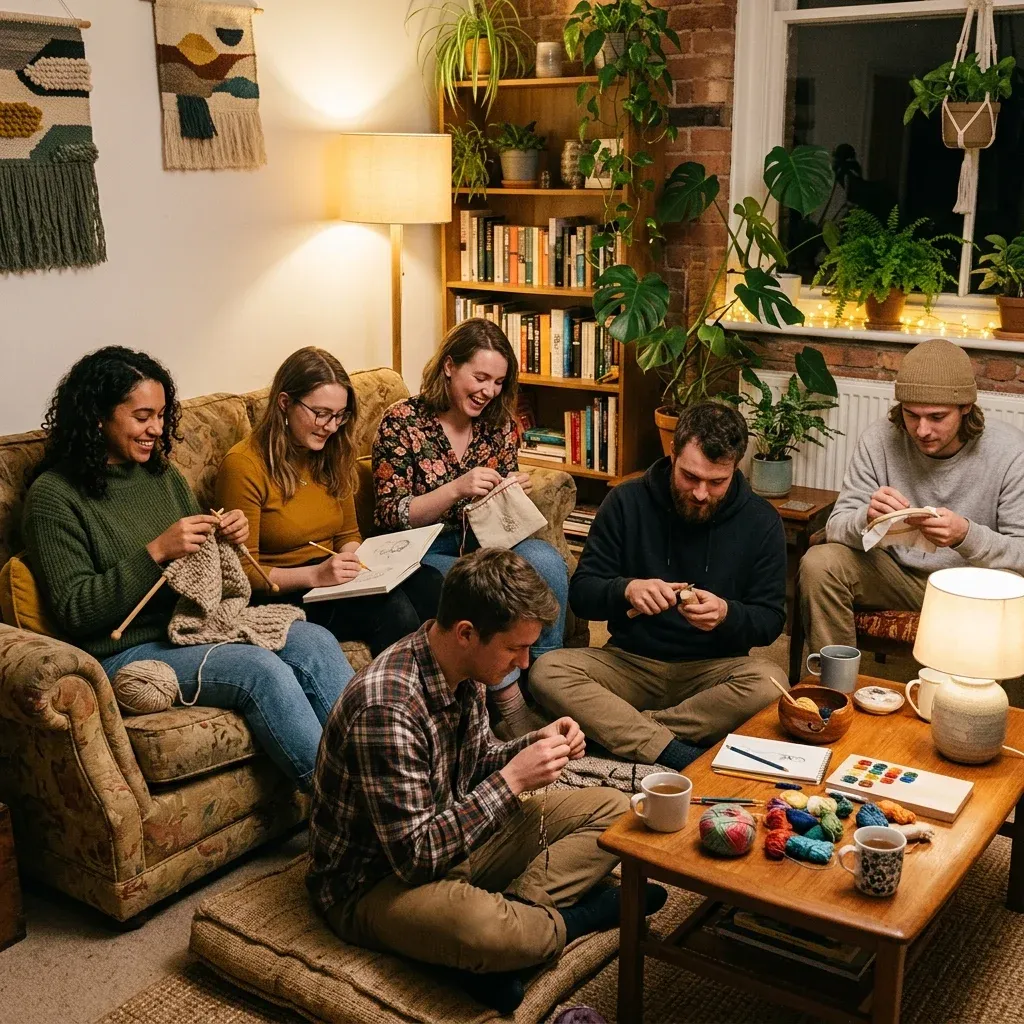
Shaughnessy Barker, a 25-year-old in Penticton, British Columbia, represents the committed end of the spectrum. She bought a landline adapter for home and uses a "dumb phone" app when she goes out. She hosts tech-free craft nights and wine nights, writes notes by hand, and limits computer time strictly. "If you want to get a hold of me," she told her friends, "call me or write me a letter."
Handwriting Lights Up Your Brain in Ways That Typing Cannot
The most concrete scientific evidence for analog over digital comes from studies comparing handwriting to typing -- and the findings are not subtle.
In a study published in Frontiers in Psychology, neuroscientists Audrey Van der Meer and Ruud Van der Weel at the Norwegian University of Science and Technology fitted 36 university students with 256-channel EEG caps and asked them to either write words by hand with a digital pen or type them on a keyboard. When writing by hand, brain connectivity patterns were "far more elaborate" than when typing, with widespread coherence in theta and alpha frequencies across parietal and central brain regions. Those specific connectivity patterns are the ones neuroscience has linked to memory formation and encoding new information.
The mechanism is physical. When you write by hand, your brain processes a complex stream of visual and proprioceptive feedback from the precisely controlled movements of forming each letter. The spatiotemporal patterns from those hand movements contribute extensively to connectivity patterns that promote learning. When you type, every key press is essentially the same simple finger movement, and the brain responds accordingly -- with less engagement.
A 2025 review article in PMC by Marano, Kotzalidis, and colleagues synthesized neuroimaging evidence from multiple studies and reached the same conclusion: handwriting activates a broader network of brain regions involved in motor, sensory, and cognitive processing, while typing engages fewer neural circuits and results in more passive cognitive engagement. The review noted that despite typing's advantages in speed and convenience, handwriting remains important for learning and memory retention.
Van der Meer and Van der Weel urged that children "from an early age, must be exposed to handwriting activities in school to establish the neuronal connectivity patterns that provide the brain with optimal conditions for learning."
The screen time research paints a complementary picture. A 2025 CDC study analyzing data from 1,952 teenagers aged 12 to 17 found that those with four or more hours of daily non-schoolwork screen time were more likely to experience depression symptoms, anxiety symptoms, infrequent physical activity, weight concerns, and irregular sleep routines. The study used self-reported data from the National Health Interview Survey-Teen, one of the first nationally representative surveys to ask teenagers directly rather than relying on parent reports.
The OECD's December 2025 analysis reinforced these findings at a global scale. Surveying 14,611 people across 14 countries, researchers found that individuals spending more than five hours per day on screens for personal purposes showed "markedly higher odds of poor well-being outcomes" compared to moderate users at one to three hours daily. The combination of heavy screen use with loneliness was particularly toxic, compounding the likelihood of poor mental health.
A 2024 study of more than 7,000 adults in England found that people who engaged in crafting or the creative arts were more likely to report significantly higher life satisfaction, a greater sense that life is worthwhile, and increased happiness. The analog activities themselves -- not just the absence of screens -- appear to generate measurable well-being benefits.
| Study | Finding | Sample |
|---|---|---|
| Van der Meer & Van der Weel (PMC, 2024) | Handwriting produces far more elaborate brain connectivity than typing | 36 university students, 256-channel EEG |
| CDC NHIS-Teen (2025) | 4+ hours screen time linked to depression, anxiety, poor sleep | 1,952 US teens aged 12-17 |
| OECD Digital Well-being (2025) | 5+ hours personal screen time = higher poor well-being odds | 14,611 people across 14 countries |
| England crafting study (2024) | Crafting/creative arts linked to higher life satisfaction | 7,000+ adults |
| Rosen et al. (2018) | People unlock phones 60+ times/day, 220 minutes total | 216 participants over 56 days |
The Friction That Helps vs. the Friction That Just Annoys You
Here is where I need to pump the brakes, because the research on digital detoxes is genuinely mixed, and anyone selling friction-maxxing as a cure-all is oversimplifying the science.
Larry Rosen, a research psychologist at California State University, Dominguez Hills who has studied technology's effects on cognition for decades, told the BBC that friction-maxxing is a "kitschy idea" that has been around for a long time but is unlikely to work as a standalone solution. "I hate to be a naysayer, but we have dug a huge hole for ourselves and that hole is replete with all of our technology," he said. His view: friction-maxxing is only useful if it helps people manage their tech use rather than letting tech control them.
The OECD's 2025 analysis adds important nuance. While screen time clearly correlates with worse well-being at high levels, sleep deprivation, financial hardship, and low physical activity are all stronger predictors of poor well-being than screen time alone. Smashing your iPhone will not fix a sleep deficit or a bank account problem.
And digital detox studies themselves show contradictory results. A 2014 study found that restricting screen time at a five-day nature camp improved preteens' emotional and social intelligence. But a 2019 study of university students found the opposite: participants actually felt lonelier after abstaining from social media for one week. For people whose primary social connections exist online -- the isolated, the disabled, those in rural areas -- removing digital tools can make things worse, not better.
The practical takeaway is that friction-maxxing works best as a selective strategy, not a blanket policy. Natalia Khodayari, a postdoctoral researcher in psychiatry at UC Davis, told the LA Times that the goal is "a desire to rebalance time and energy and reduce distractibility and related stress" -- not to eliminate technology.
Here is what the research actually supports as productive friction:
| Friction Type | What to Do | Why It Works |
|---|---|---|
| Handwriting | Write notes, lists, or journal entries by hand before going digital | Activates broader brain networks, deepens memory encoding |
| Phone-free meals | Stack phones at center of table during dinner | Removes attention competition, improves conversation quality |
| In-person classes | Choose a physical class over an app-based alternative for one activity | Social connection + embodied learning + accountability |
| Analog hobbies | Knitting, cooking from scratch, gardening, board games | Active engagement reduces stress; crafting linked to higher life satisfaction |
| Tech breaks | 15-minute phone-free intervals during the workday | Cultivates sense of autonomy over attention |
| Navigation without GPS | Use a paper map or road signs for familiar routes | Preserves spatial memory and wayfinding skills |
Rosen's own research offers a minimal effective dose. Even 15-minute tech breaks can cultivate a greater sense of autonomy -- the feeling that you are choosing to use your phone rather than being pulled toward it by habit. That is a much lower bar than going full Luddite, and the evidence suggests it works.
Anna Lembke, professor of psychiatry at Stanford, frames it as an opportunity cost problem. "There are enormous opportunity costs to engagement on these platforms that suck people in, where they end up spending way more time than they plan to or want to," she told the LA Times. The friction you add does not need to be dramatic. It just needs to create a pause between impulse and action -- enough space for you to ask whether this particular screen interaction is worth what it displaces.

Jonathan Haidt's work on The Anxious Generation adds a parenting dimension. He argues that granting children more autonomy while delaying smartphone access builds resilience, coping skills, risk assessment, and critical thinking. Having kids pay with cash, meet friends for pizza instead of communicating through Snapchat, or figure out a problem without immediately Googling it -- these are forms of productive friction that exercise cognitive and social muscles that frictionless digital life leaves atrophied.
Friction-maxxing is not going to fix loneliness, reverse attention span decline, or replace therapy. But the evidence does support that strategically reintroducing effort into daily routines -- especially physical, social, and creative effort -- produces measurable cognitive and emotional benefits. The key word is strategically. As Gloria Mark puts it: "If people are putting in effort, it makes them more intentional and thoughtful." That is a modest claim, but it is one the science backs up.
Frequently Asked Questions
Is friction-maxxing the same as a digital detox?
No. A digital detox is a temporary break from technology -- like a juice cleanse for your screen habits. Friction-maxxing is a permanent shift in how you approach daily tasks. Instead of eliminating technology entirely, you selectively choose the slower, more effortful version of specific activities: handwriting instead of typing notes, cooking instead of ordering delivery, navigating by memory instead of GPS. The goal is not abstinence but intentionality.
Does handwriting really help you remember things better than typing?
Multiple peer-reviewed studies say yes. A study at the Norwegian University of Science and Technology using 256-channel EEG found that handwriting produces far more elaborate brain connectivity patterns in regions linked to memory formation and learning. A separate 2025 review synthesizing neuroimaging evidence confirmed that handwriting activates broader brain networks than typing, which engages fewer neural circuits. The physical complexity of forming letters by hand appears to be the key mechanism.
How much screen time is actually harmful?
The OECD's 2025 cross-country study of 14,611 people found that five or more hours of daily personal screen time correlated with markedly higher odds of poor well-being, while one to three hours appeared to be a moderate zone. The CDC's study of nearly 2,000 US teenagers found similar patterns at four or more hours. But context matters: what you do on screens, and what screen time displaces, likely matters more than raw hours.
Can going analog actually make loneliness worse?
Yes, for some people. A 2019 study found that university students felt lonelier after one week of social media abstinence. For people whose primary social connections are digital -- those who are geographically isolated, have mobility limitations, or live in communities without accessible third spaces -- removing digital tools without replacing them with in-person alternatives can increase isolation. Friction-maxxing should add analog options, not subtract digital lifelines.
What is the easiest way to start friction-maxxing?
Research psychologist Larry Rosen suggests starting with 15-minute technology-free intervals during your day. UC Davis researcher Natalia Khodayari recommends small, consistent habit changes rather than dramatic overhauls. Moving your phone to another room during meals, keeping a paper notebook for daily lists, or choosing one in-person activity per week over its app equivalent are all low-barrier entry points backed by the available evidence.
Medical Disclaimer
This article is for informational and educational purposes only and is not medical advice, diagnosis, or treatment. Always consult a licensed physician or qualified healthcare professional regarding any medical concerns. Never ignore professional medical advice or delay seeking care because of something you read on this site. If you think you have a medical emergency, call 911 immediately.