Your Lymphatic System: The Silent Cleanup Crew
Most people can name their heart, lungs, and liver without much thought. The lymphatic system? Blank stares. Which is too bad, because this network of vessels, nodes, and ducts quietly handles some of the body's least glamorous but most important work: filtering out waste, ferrying immune cells where they need to go, and keeping fluid levels balanced across your tissues.
Here is the part that tends to surprise people. According to the Cleveland Clinic, roughly 20 liters of plasma seep out of blood capillary walls every day. About 17 liters get reabsorbed directly. The leftover three liters, still carrying cellular debris, proteins, and the occasional stray pathogen, get picked up by tiny lymphatic capillaries and moved through progressively larger vessels until they drain back into the bloodstream near the collarbones.
On its way back, that fluid passes through about 600 lymph nodes scattered from your jaw to your groin. Think of each node as a checkpoint. White blood cells inside them inspect the fluid, neutralize bacteria and damaged cells, and let the cleaned-up lymph continue on its way.
Quick fact: Your lymphatic system also absorbs dietary fats and fat-soluble vitamins through specialized vessels in the gut called lacteals. Without it, nutrients from the food you eat would have no way to reach your bloodstream.

Why Three Liters of Fluid Need a Push
Your cardiovascular system has the heart, a powerful central pump pushing blood at serious pressure. The lymphatic system has nothing like that. Lymph creeps through its thin-walled vessels using borrowed force: the rhythmic pulsing of nearby arteries, skeletal muscles squeezing during movement, and pressure shifts from breathing.
One-way valves inside the larger lymphatic vessels prevent backflow, so the system works a bit like a series of locks on a canal. Each muscle contraction nudges lymph forward through the next valve, and the valve snaps shut behind it. When you sit at a desk for eight hours, skip your morning walk, or sleep in a position that compresses certain vessels, that forward motion slows to a trickle.
When that forward motion stalls, the consequences are real. Research published in the Journal of Manual & Manipulative Therapy describes how impaired lymphatic circulation leads to fluid retention, tissue waste buildup, and weakened immune function. Clinically, this shows up as lymphedema, chronic swelling that most often hits the arms or legs.
This is where the appeal of dry brushing enters the picture. If the system depends on external mechanical stimulation, the reasoning goes, then applying gentle pressure to the skin in the direction of lymph flow should give it a helpful nudge. That logic is not unreasonable. But as we will see, the gap between a plausible mechanism and proven clinical benefit is wider than most wellness blogs suggest.
What Dry Brushing Actually Does to Your Skin and Tissues
Strip away the marketing language and dry brushing is a form of mechanical exfoliation. You take a brush with stiff natural fibers — typically cactus, sisal, or jute bristles — and sweep it across dry, unmoistened skin in firm strokes directed toward the center of the body.
At the surface level, the bristles physically dislodge dead skin cells (corneocytes) from the outermost layer of your epidermis. Cleveland Clinic dermatologist Dr. Shilpi Khetarpal confirms that this mechanical action is genuinely effective for exfoliation: it unclogs pores, smooths rough patches, and temporarily gives skin a brighter appearance thanks to increased surface blood flow.
Below the surface, the picture gets more interesting — and more speculative. The rhythmic friction of dry brushing resembles the distal-to-proximal stroke pattern used in manual lymphatic drainage (MLD), a clinical technique developed by Emil Vodder in the 1930s. MLD involves light, repetitive skin-stretching movements designed to promote interstitial pressure changes that enhance the filling and emptying of lymph vessels. The key word in Vodder's approach, however, is light — significantly lighter than what most people apply with a stiff-bristled brush.
| Effect | Supported by evidence? | Details |
|---|---|---|
| Exfoliation (dead skin removal) | Yes | Mechanical action physically removes corneocytes |
| Temporary improved circulation | Partially | Transient increase in skin blood flow observed, fades within minutes |
| Lymphatic drainage | Unproven | No controlled studies confirm dry brushing accelerates lymph clearance |
| Cellulite reduction | No | Temporary plumping from blood flow; no structural change |
| Detoxification | No | Systemic toxin clearance via skin brushing considered biologically implausible |
The Evidence: An Honest Look
This is the part that wellness influencers tend to skip. Dry brushing is popular. The scientific evidence behind its bigger claims, though, is thin.
A review on News-Medical.net, citing dermatological literature, notes that controlled skin-rubbing studies found only small, temporary bumps in skin temperature and pulse that faded within minutes and never reached statistical significance. Immune markers and C-reactive protein did not change. No clinical data confirm that dry brushing meaningfully speeds up lymph clearance.
That said, the related technique of manual lymphatic drainage does have clinical support, even if the evidence is more modest than practitioners sometimes imply. A systematic review in the Journal of Manual & Manipulative Therapy (Vairo et al., 2009) evaluated MLD techniques in sports medicine and found the best evidence supports their use for reducing edema after acute ankle sprains and wrist fractures. The reviewed RCTs scored 6 or higher on the PEDro validity scale, but the authors noted that overall high-ranking evidence remains limited.
A 2024 review in the British Journal of Community Nursing (Ramadan, 2024) found that while MLD is often recommended as part of lymphedema management, the literature on its efficacy is "often contradictory." The review concluded that MLD may not always be a necessary addition to treatment.
There is also the Japanese practice of kanpumasatsu — a dry towel rubdown that closely mirrors dry brushing technique. A 2023 study published in the Journal of Interprofessional Education & Practice (Komagata, 2023) proposed that this superficial massage stretches the skin in ways that may enhance lymphatic flow, though the author acknowledged that the evidence remains limited and the mechanism has not been clearly documented.
The bottom line: Dry brushing delivers real exfoliation benefits and may offer a gentle nudge to superficial lymphatic flow through mechanical stimulation. But it is not a clinically validated method for lymphatic drainage, detoxification, or cellulite reduction. If you enjoy it and your skin tolerates it, the practice is low-risk. Just calibrate your expectations accordingly.
| Practice | Evidence quality | Best-supported use |
|---|---|---|
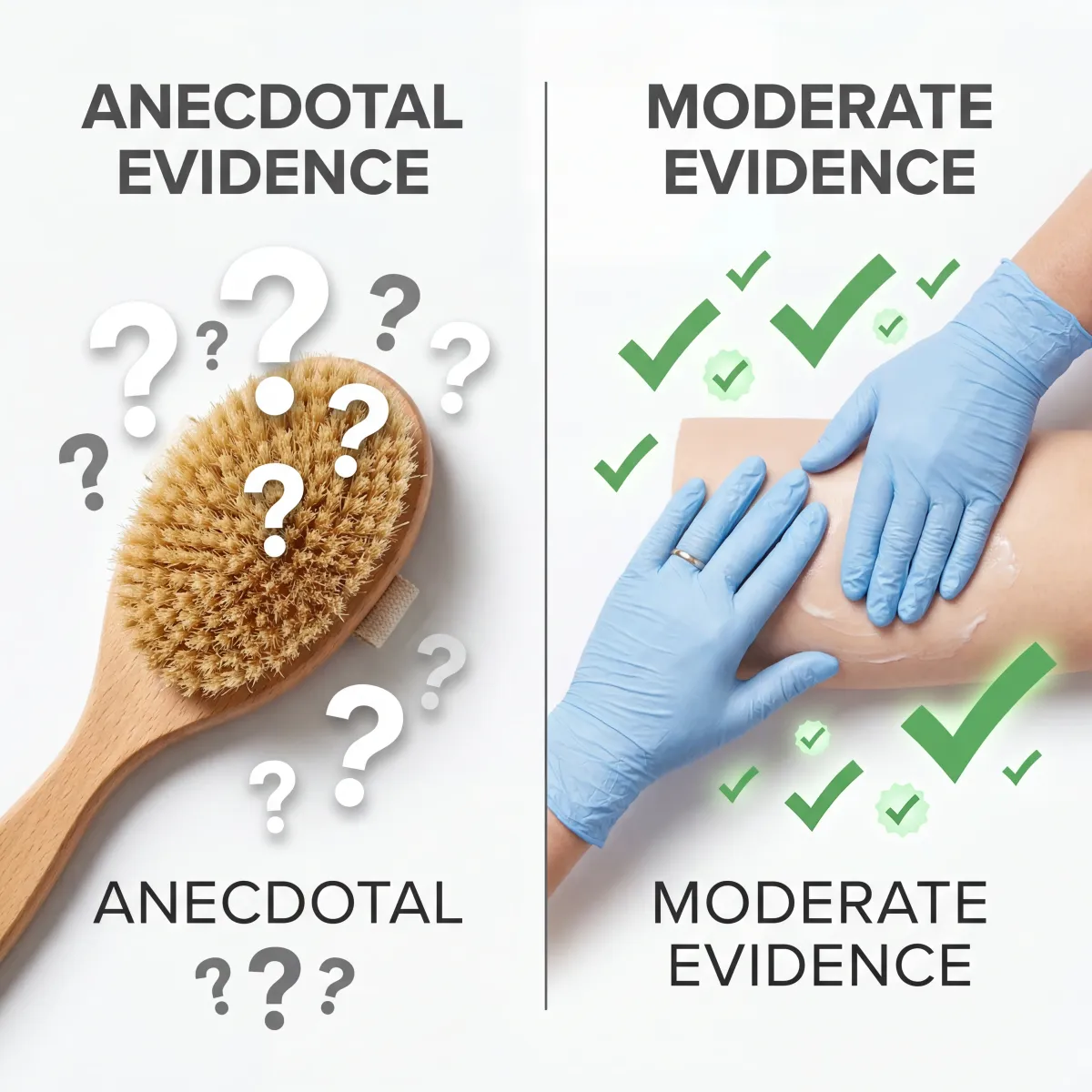
| Dry brushing | Anecdotal / very limited | Skin exfoliation, temporary circulation boost |
| Manual lymphatic drainage (MLD) | Moderate (RCTs exist) | Post-injury edema reduction, lymphedema management |
| Kanpumasatsu (dry towel massage) | Limited (one peer-reviewed study) | Relaxation, possible immune stimulation |
| Exercise | Strong | Lymphatic flow, overall circulation, edema prevention |
| Compression therapy | Strong | Lymphedema management, edema reduction |
Step-by-Step Dry Brushing Technique
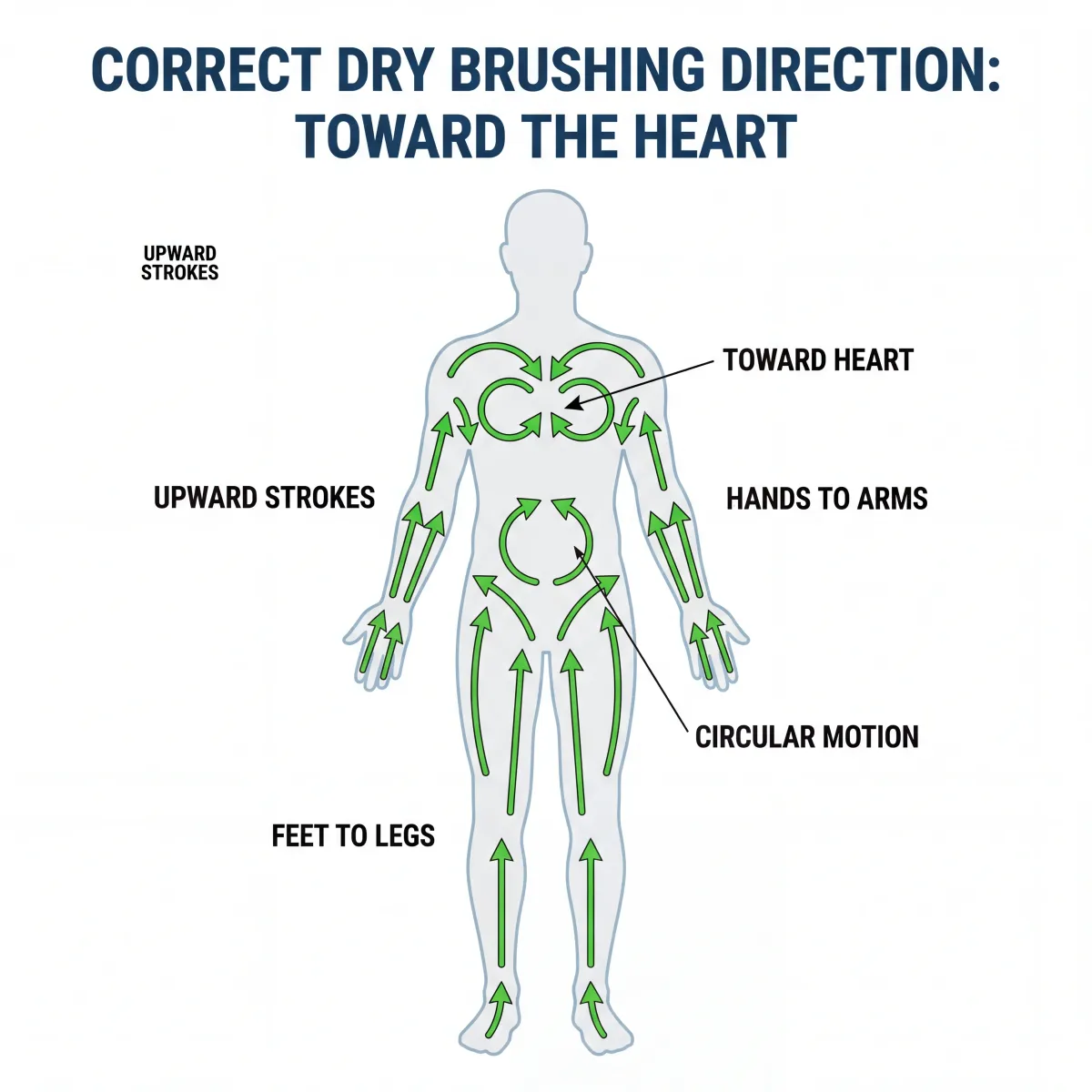
If you want to try dry brushing, doing it correctly matters more than doing it often. The technique borrows its directional logic from the anatomy of the lymphatic system: you brush toward the major lymphatic basins near the heart, where the thoracic duct and right lymphatic duct empty cleaned lymph back into your bloodstream.
What you need: A natural-bristle brush (cactus, sisal, or jute fibers) with a long handle for reaching your back. Avoid synthetic bristles — they tend to be either too harsh or too slippery to provide effective exfoliation. Your skin should be completely dry, and you should brush before showering so you can rinse away the loosened dead skin cells afterward.
The sequence
- Start at your feet. Use long, sweeping strokes up each leg, moving from ankle to knee, then knee to hip. Apply enough pressure to feel the bristles working, but not so much that your skin turns red or feels raw. Five to ten overlapping strokes per area is plenty.
- Move to your hands and arms. Brush from your fingertips up to your shoulders, again using long strokes that travel toward the center of your body.
- Brush your torso. Switch to circular motions on your stomach and lower back. On your chest and upper back, stroke toward the collarbone area where the lymphatic ducts drain.
- Lighten the pressure on sensitive areas. The skin around your abdomen, breasts, inner arms, and neck is thinner. Use gentler strokes or reduce the number of passes.
- Skip your face. Facial skin is too delicate for body-brush bristles. If you want facial exfoliation, use a product designed specifically for it.
- Shower and moisturize. Rinse away dead skin cells with warm (not hot) water, then apply a bland emollient or natural oil to restore your skin's lipid barrier.
The entire session should take three to five minutes. Dr. Khetarpal at Cleveland Clinic recommends brushing no more than once daily. However, many dermatologists suggest a more conservative frequency of one to three times per week, especially if you are new to the practice or have skin that tends toward sensitivity. If you are looking for other recovery practices to pair with dry brushing, contrast therapy combining sauna and cold plunge offers another circulation-focused approach with a growing body of supporting evidence.
| Body area | Stroke direction | Pressure level | Passes |
|---|---|---|---|
| Feet and legs | Upward toward hips | Moderate | 5-10 |
| Hands and arms | Upward toward shoulders | Moderate | 5-10 |
| Stomach and lower back | Circular motions | Light to moderate | 3-5 |
| Chest and upper back | Toward collarbones | Light | 3-5 |
| Neck | Downward toward collarbones | Very light | 2-3 |
| Face | Skip entirely | N/A | N/A |
Common Myths Versus Reality
Dry brushing has picked up some outsized claims along the way. Here is what the practice can actually deliver versus what social media has tacked onto it.
| Myth | Reality |
|---|---|
| Dry brushing detoxifies your body | Your liver and kidneys handle detoxification. Skin brushing does not accelerate the removal of metabolic waste from your bloodstream. Dermatological literature considers systemic toxin clearance via dry brushing biologically implausible. |
| It eliminates cellulite | Cleveland Clinic's Dr. Khetarpal notes that any perceived cellulite reduction is "really just a temporary plumping up of the skin from increased blood circulation." No structural change occurs in the fat deposits or connective tissue that create cellulite's dimpled appearance. |
| Dry brushing drains the lymphatic system | No controlled clinical studies have confirmed that dry brushing significantly accelerates lymph clearance. The technique may provide gentle superficial stimulation, but it is not equivalent to clinical MLD performed by trained therapists. |
| You should brush as hard as possible for maximum benefit | The opposite is closer to the truth. MLD research emphasizes light touch — heavy pressure can strip skin lipids, weaken the moisture barrier, and create microscopic fissures. |
| Dry brushing replaces medical lymphedema treatment | Dry brushing is not a substitute for complex decongestive therapy, which is the clinical gold standard for lymphedema management. |
Who Should Skip the Brush
Dry brushing is fine for most people, but not everyone. Some situations call for skipping it entirely or checking with a doctor first.
Do not dry brush if you have:
- Eczema, psoriasis, or rosacea. Mechanical friction can trigger flare-ups and worsen existing inflammation.
- Open wounds, cuts, scrapes, or sunburns. Brushing broken skin introduces bacteria and delays healing.
- Active skin infections or cellulitis. The infection can spread to surrounding tissue.
- Moles, warts, or raised lesions. Mechanical irritation can damage or inflame these areas.
- Varicose veins. Direct brushing over varicose veins can increase discomfort and potentially cause complications.
- Active cancer treatment or known lymphedema. If you have been diagnosed with lymphedema or are undergoing treatment that affects your lymphatic system, work with a certified lymphedema therapist rather than self-treating. The NCBI notes that secondary lymphedema can result from surgery, trauma, or cancer treatment, and improper manipulation can worsen the condition.
If you experience redness, stinging, burning, or flaking after dry brushing, reduce the frequency or pressure. Persistent irritation means the practice is not right for your skin. Managing your body's stress response is just as important — chronic cortisol elevation can drive inflammation that compounds skin sensitivity.
Complementary Strategies That Support Lymphatic Flow
If you actually want to support your lymphatic system, dry brushing is one option, but not the strongest one. Other approaches have better evidence and pair well with a brushing routine if you enjoy it.
Movement. Lymph depends on muscle contraction to circulate, which makes regular physical activity the most effective thing you can do. Walking, swimming, cycling, yoga: all of them create the muscular pumping that keeps lymph moving. You do not need intense exercise. Gentle movement spread through the day does more than a sedentary afternoon capped with a sprint.
Deep breathing. The diaphragm acts as a pump for the thoracic duct, the body's largest lymphatic vessel. Deep belly breaths create pressure differentials in the chest cavity that draw lymph upward toward the subclavian veins. A few minutes of intentional diaphragmatic breathing can complement the external stimulation of dry brushing.
Hydration. Lymph is mostly water. When you are dehydrated, it gets thicker and moves more slowly. Drinking enough fluids, along with maintaining proper electrolyte levels, keeps lymphatic fluid thin enough to flow well.
Cold exposure. Brief cold water immersion or ending your shower with a 30-second cold blast causes rapid vasoconstriction followed by vasodilation, which can promote fluid movement. Cold plunge and ice bath practices have been studied for their effects on circulation and inflammation, though the lymphatic-specific evidence remains limited.
Professional manual lymphatic drainage. If you have a medical reason to improve lymphatic flow, like post-surgical swelling or diagnosed lymphedema, a trained MLD therapist can provide treatment that is far more precise than anything you can do with a brush at home. MLD uses calibrated light pressure and specific hand movements that bristles simply cannot mimic.
Your skin also benefits from what you put inside your body. Vitamin C, zinc, and the amino acids found in collagen supplements all support skin integrity and the connective tissue where lymphatic vessels sit.
Frequently Asked Questions
How often should you dry brush for the best results?
Most dermatologists recommend one to three times per week. Starting with once a week lets you gauge how your skin responds before increasing frequency. Brushing daily is not harmful for most skin types, but it offers diminishing returns in terms of exfoliation and can gradually weaken the skin's moisture barrier if you are not careful about pressure and aftercare.
Can dry brushing actually help with lymphatic drainage?
The mechanical stimulation of dry brushing may provide a gentle nudge to superficial lymphatic flow, but no controlled clinical studies have confirmed that it significantly accelerates lymph clearance. The practice shares directional principles with manual lymphatic drainage, but MLD uses much lighter pressure and specific hand techniques that a brush cannot replicate. Dry brushing is best understood as a skin care ritual with possible secondary circulatory benefits rather than a lymphatic treatment.
What kind of brush should you use?
Choose a brush with natural fibers — cactus, sisal, or jute bristles are the most common options. A long handle helps you reach your back. Avoid synthetic bristles, which tend to be either too harsh on the skin or too slippery to exfoliate effectively. Replace your brush every six to twelve months, and wash it with mild soap and warm water weekly to prevent bacterial buildup.
Is dry brushing safe during pregnancy?
Generally, gentle dry brushing on the legs and arms is considered safe during pregnancy, and some women find it helps with the feeling of heavy, swollen legs. However, avoid brushing the abdomen as pregnancy progresses and always consult your healthcare provider before starting any new body care routine during pregnancy. If you have pregnancy-related skin conditions like PUPPP or increased sensitivity, skip dry brushing entirely.
Does dry brushing help with keratosis pilaris (those rough bumps on the arms)?
Dry brushing can temporarily smooth the rough, bumpy texture of keratosis pilaris by removing the buildup of dead skin cells around hair follicles. However, it does not address the underlying keratin overproduction that causes the condition. For persistent keratosis pilaris, a combination of chemical exfoliants (like lactic acid or urea creams) and consistent moisturizing tends to produce more lasting results than mechanical exfoliation alone.
Related Articles
- Contrast Therapy: Sauna Plus Cold Plunge for Recovery — Another circulation-focused practice with growing evidence for reducing inflammation and supporting recovery.
- Cold Plunge and Ice Bath Benefits — What cold exposure does to your blood flow, nervous system, and inflammatory response.
- Collagen Supplements for Skin, Joints, and Gut — The structural protein that supports the connective tissue housing your lymphatic vessels.
- Electrolytes: Sodium, Potassium, and Magnesium for Hydration — Proper fluid balance is essential for lymphatic flow — here is how electrolytes play their part.
- Infrared Sauna Health Benefits — Heat therapy and its effects on circulation, detoxification claims, and recovery.
Medical Disclaimer
This article is for informational and educational purposes only and is not medical advice, diagnosis, or treatment. Always consult a licensed physician or qualified healthcare professional regarding any medical concerns. Never ignore professional medical advice or delay seeking care because of something you read on this site. If you think you have a medical emergency, call 911 immediately.