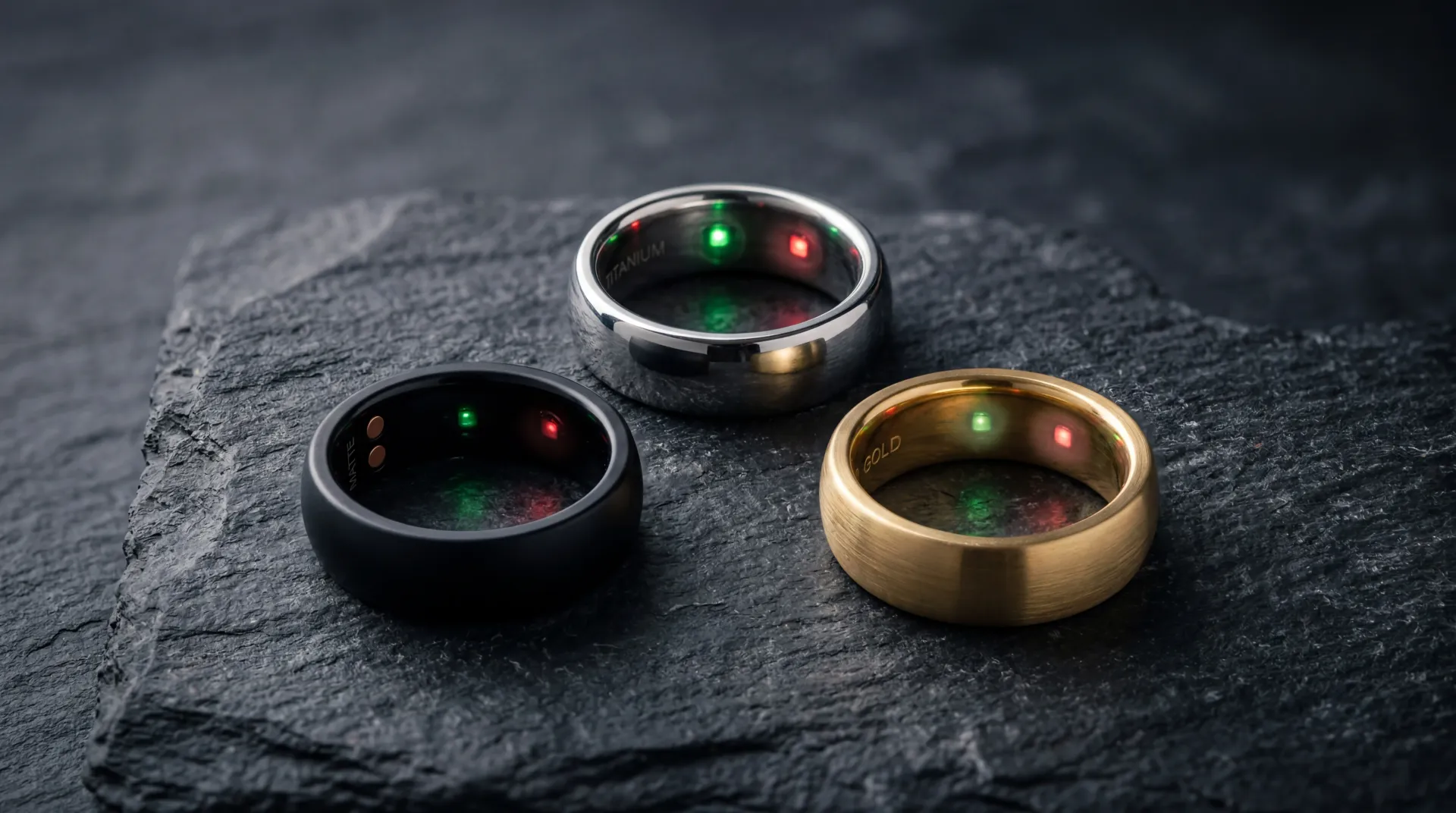
Your finger has something your wrist doesn't
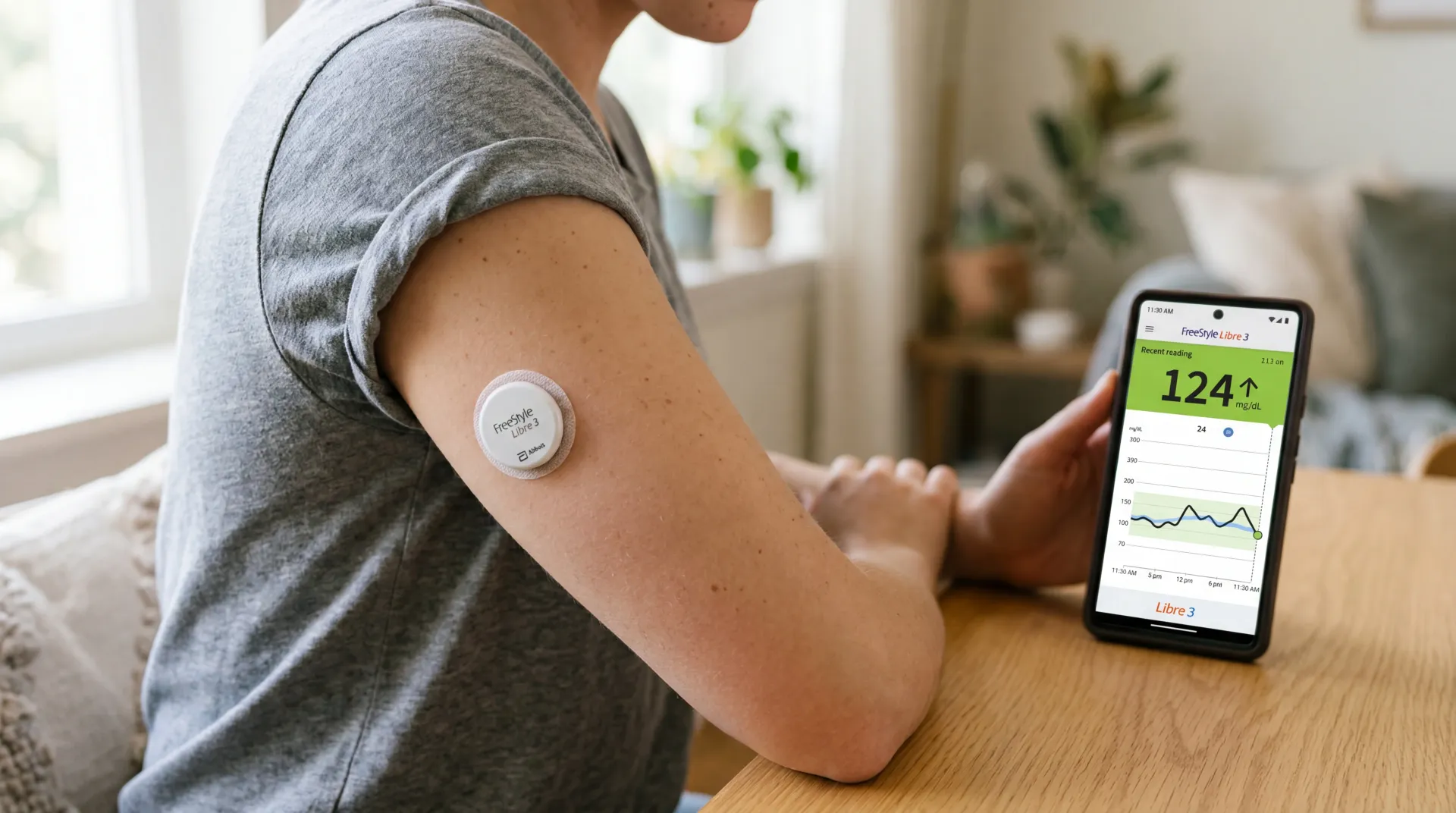
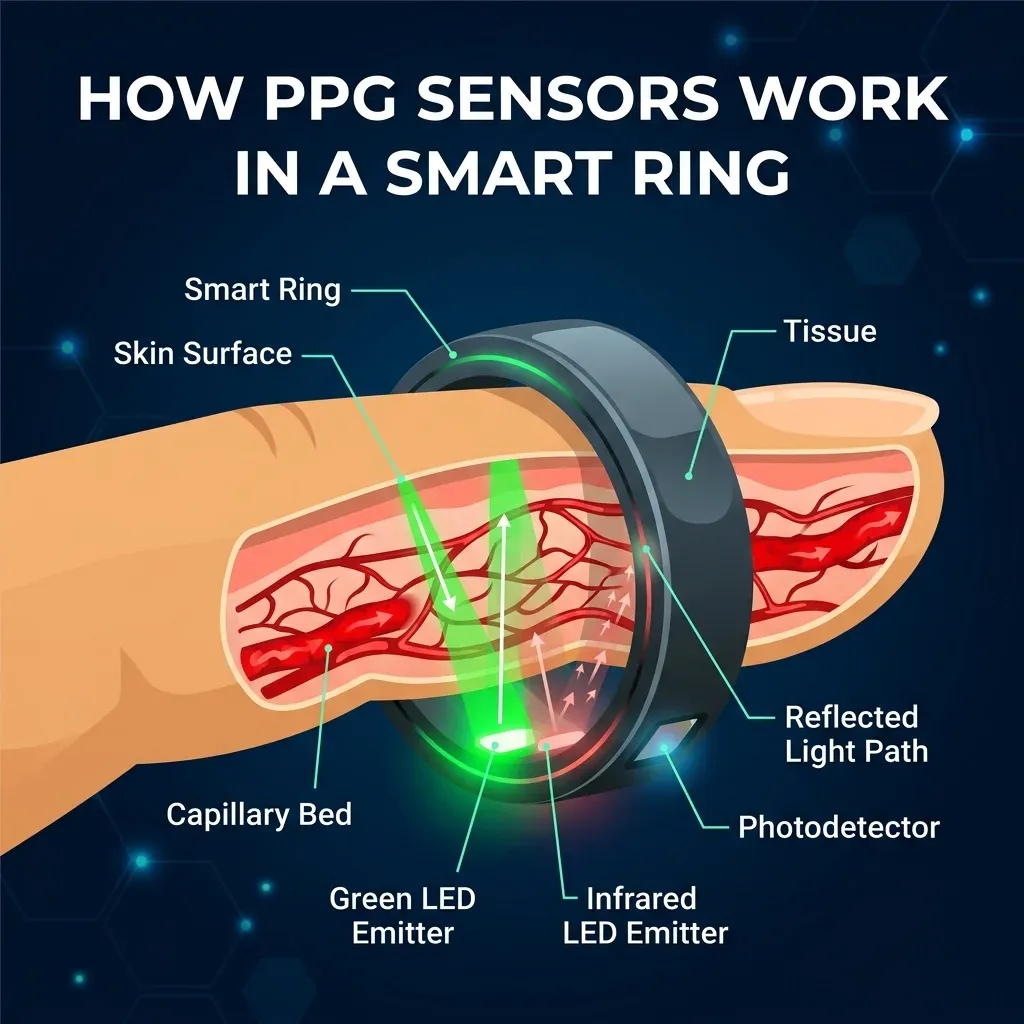
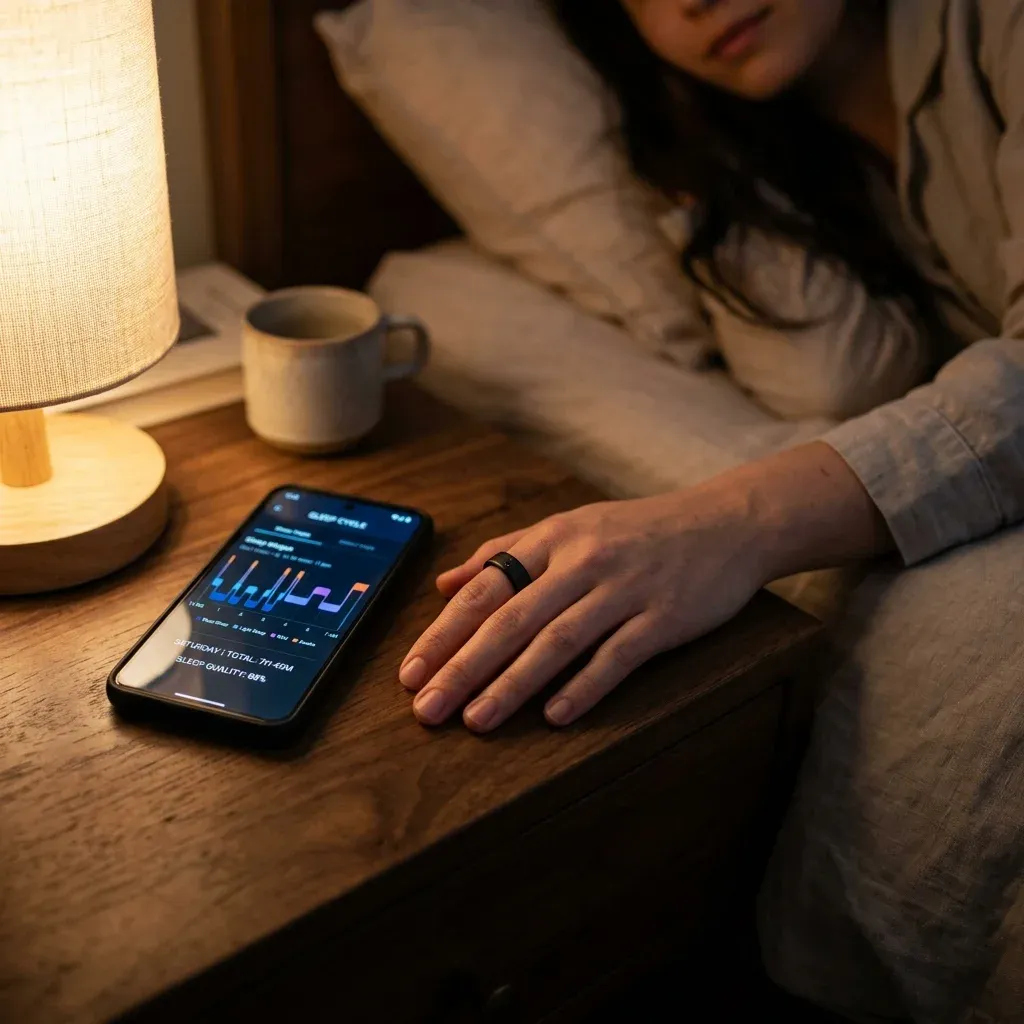
The palmar digital arteries in your fingers sit closer to the surface of your skin and branch into denser capillary networks than the radial artery at your wrist. That anatomical quirk matters because smart rings and smartwatches both rely on the same underlying technology: photoplethysmography, or PPG. Green and infrared LEDs shine light into your skin, and a photodetector reads how much bounces back. Blood absorbs specific wavelengths, so every heartbeat creates a measurable pulse in reflected light. From that raw signal, algorithms derive heart rate, heart rate variability (HRV), blood oxygen saturation, and respiratory rate.
Think of PPG like reading through a window. A wrist-based sensor reads through a foggy window — there's more tissue, more bone, and more tendons between the light and the blood vessels. A finger-based sensor reads through a clearer pane. Researchers at UC Irvine and the University of Turku confirmed this advantage in a validation study of the Oura Ring, finding that finger-based PPG produces a higher signal-to-noise ratio, particularly during sleep when the hand is still.
HRV is where this advantage pays off most. All three devices in this comparison lean on HRV for their recovery and readiness scores. HRV measures the variation in time intervals between heartbeats, and higher variation generally indicates better autonomic nervous system function. Small errors in detecting beat-to-beat intervals compound quickly when calculating metrics like RMSSD (root mean square of successive differences). Sensor placement on the finger rather than the wrist reduces those errors during sleep.
But finger placement has tradeoffs. The ring form factor limits sensor size, battery capacity, and processing power. A 2022 study by Dr. Dean Miller and colleagues at CQUniversity's Appleton Institute validated six wearables simultaneously against polysomnography (the gold standard for sleep measurement) and ECG. For simple sleep-versus-wake detection, all devices performed similarly — ranging from 86% to 89% agreement with the lab equipment. The gap widened when devices tried to classify specific sleep stages (light, deep, REM, wake). Agreement dropped to between 50% and 65%, and no device performed well enough to replace clinical sleep assessment.
That gap between "good enough to track trends" and "accurate enough for diagnosis" defines the entire smart ring category. These devices are useful for identifying patterns over weeks and months — spotting a downward trend in HRV before you feel overtrained, or noticing that alcohol consistently wrecks your deep sleep. They are not reliable for any single night's reading, and none of them should replace a conversation with a doctor.
The Oura Ring 4 redesigned its guts without changing its mission
Oura shipped its fourth-generation ring in late 2024 after four years on the third generation, and most of the changes happened where you can't see them. The three small sensor domes that protruded from the inside of the Gen 3 are gone. In their place, an 18-path multi-wavelength PPG system sits flush against a fully titanium interior. The difference is immediately noticeable when you slide the ring over your knuckle — it goes on and off easier and doesn't catch on skin.
Oura calls the new sensor architecture "Smart Sensing." The system dynamically adjusts which LED pathways are active based on how the ring sits on your finger and what it's trying to measure at any given moment. Oura claims this delivers a 120% improvement in blood oxygen signal quality and a 31% improvement in nighttime heart rate tracking compared to Gen 3. Those are manufacturer numbers and should be treated accordingly, but reviewers have confirmed the practical result: fewer data gaps. Wareable noted zero data gaps in testing, which was a frequent complaint with the Gen 3.
The ring measures 7.90mm wide and 2.88mm thick, weighing between 3.3g and 5.2g depending on size. It is still noticeably thicker than a wedding band, but slimmer than wearing a watch to bed. Water resistance reaches 100 meters, and Oura advertises up to 8 days of battery life. Real-world testing tells a different story: The Guardian got about six days, PCMag measured 7.25 days, and Wareable couldn't push past five days with all features enabled. Expect roughly a week between charges, give or take a day depending on how aggressively you use daytime heart rate tracking.
Where Oura pulls ahead of competitors is in how it presents data. The app organizes everything around three daily scores — Readiness, Sleep, and Activity — with each score decomposed into contributing factors. The Readiness Score, for instance, pulls from previous night's HRV, resting heart rate, body temperature, and prior day's activity load. Over time, it also generates longer-term metrics: cardiovascular age, cardio capacity, stress resilience, and a chronotype profile.
The academic validation backs up the sleep tracking specifically. A 2024 study by Dr. Rebecca Robbins and colleagues at Brigham and Women's Hospital compared the Oura Ring Gen 3 against polysomnography in 35 healthy adults and found 76-79.5% sensitivity for sleep stage classification. The ring was not statistically different from PSG in estimating duration of wake, light sleep, deep sleep, or REM sleep. That is a strong result for a consumer device — though it used healthy subjects, and a 2025 study published in Nature's Scientific Reports found the picture gets murkier in people with sleep disorders, where individual-level accuracy remained highly variable.
The costs add up. The ring starts at $349, and the subscription runs $5.99 per month or $69.99 annually. Without the subscription, you get the three headline scores and not much else. Over three years, that puts your total investment around $559. The battery is not replaceable and Oura doesn't offer a trade-in or recycling program, meaning the ring becomes e-waste when the battery degrades beyond usefulness.
Samsung bet on ecosystem lock-in, and the bet partly pays off
Samsung entered the smart ring market with the Galaxy Ring in mid-2024, and the hardware holds up well for a first-generation product. At 7mm wide and 2.6mm thick, it's measurably slimmer than the Oura Ring 4. The smallest size weighs just 2.3g — light enough that multiple reviewers reported forgetting they were wearing it. The concave design Samsung chose helps resist surface scratches, though CNET's reviewer noticed scuffing on the matte black finish within a week of everyday wear.
The ring packs three sensors — an accelerometer, an optical bio-signal sensor (PPG), and a skin temperature sensor. It tracks heart rate, HRV, blood oxygen, sleep stages, skin temperature changes, steps, and menstrual cycles. Samsung wraps this data into an Energy Score (their readiness equivalent) and sleep coaching features through the Samsung Health app.
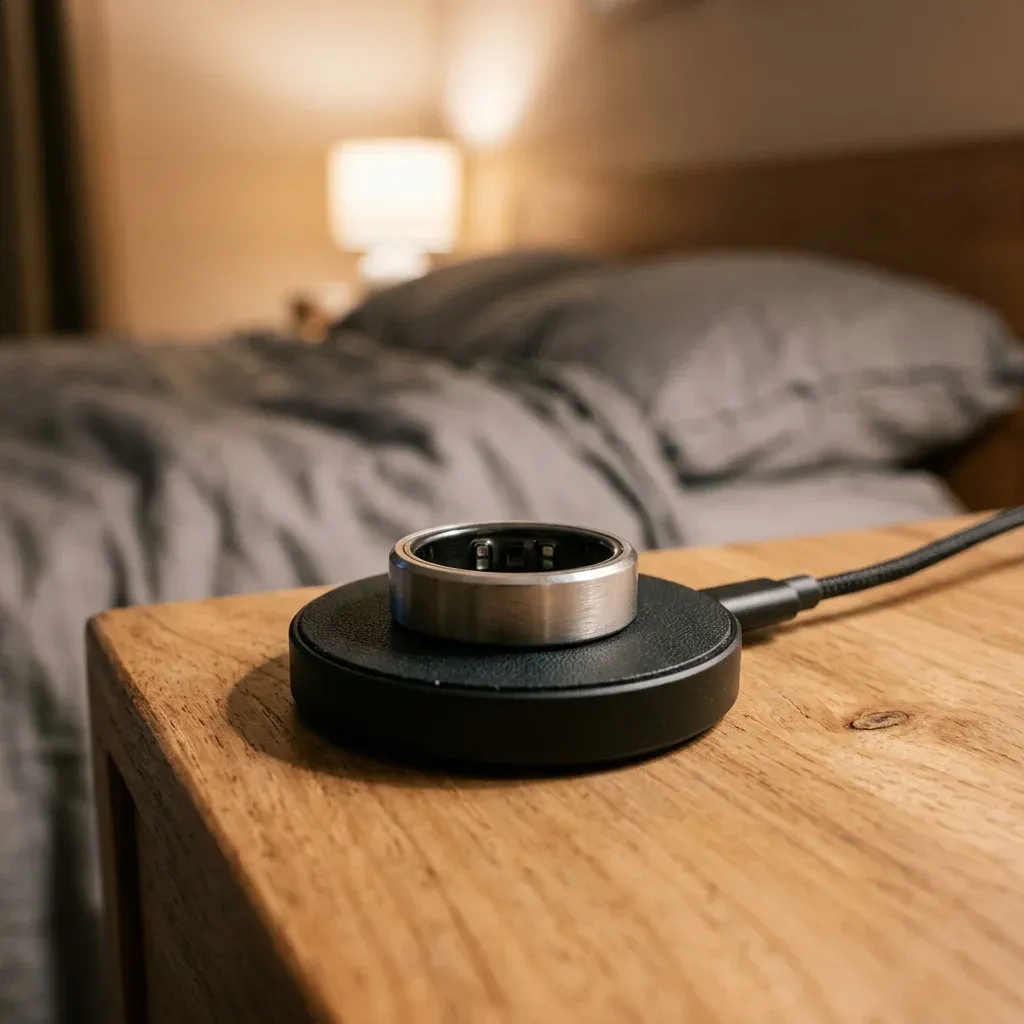
The standout practical feature is the charging case. It holds about 1.5 additional charges, giving you roughly 9-10 days of total use away from an outlet. Battery life in the ring itself runs about 6 days for sizes 5-11, up to 7 days for the larger sizes 12-13. The case also supports reverse wireless charging from a Samsung phone — a convenience the Oura's charging puck can't match.
Sleep tracking is solid but not leading the pack. Wareable found the accuracy comparable to Oura and WHOOP in side-by-side testing, though the Galaxy Ring was more susceptible to signal dropouts, particularly in heart rate and SpO2 tracking. CNET's spot-check comparison with a chest strap found resting heart rate accurate within 2 BPM, which is on par with most smartwatches.
The friction shows up in two areas. First, compatibility: the Galaxy Ring works only with Android phones, and several AI-powered features like the Energy Score and gesture controls require a Samsung Galaxy phone specifically. If you own an iPhone, this ring does not exist for you. Second, fitness tracking is limited: auto workout detection works only for walking and running, and Samsung explicitly recommends against wearing the ring during weight training. That's an honest limitation — barbells and metal dumbbells will scratch any ring — but it means the Galaxy Ring is a passive health tracker, not a workout companion.
At $399 with no ongoing subscription, the Galaxy Ring is the cheapest option long-term among the three. All your health data stays accessible without monthly payments, which Samsung positions as a direct counter to Oura's model. The trade-off is less depth in the insights: the app doesn't match Oura's granularity in sleep analysis, stress tracking, or women's health features.
WHOOP doesn't fit your finger, but it reads your body differently
WHOOP is not a ring. It's a screenless wristband, and it ends up in this comparison because people shopping for screenless health trackers routinely weigh these three options against each other. WHOOP and Oura chase the same buyer: someone who wants continuous monitoring without a smartwatch buzzing at them all day.
The WHOOP 4.0 strap measures 1.7 x 1.1 x 0.4 inches and sits on your wrist. It collects data from a 3-axis accelerometer, 3-axis gyroscope, and PPG sensor, sampling hundreds of data points per second. The device focuses on three scores: Strain (how hard you've pushed your body), Recovery (how ready you are for more), and Sleep (quality and duration of your rest). Everything runs through the WHOOP app — there is no display, no step counter, no clock on the device.
The academic validation for WHOOP's heart rate accuracy is strong. The CQUniversity study found WHOOP 3.0 was 99.7% accurate in measuring heart rate during sleep, outperforming all other wearables tested. For sleep staging, it achieved 86% agreement for sleep-versus-wake detection (kappa=0.44) and 60% for four-stage sleep classification (kappa=0.44) — slightly behind Oura's 89% and 61% but within a competitive range.
WHOOP's differentiator is its Strain model. Rather than tracking steps or calories, it assigns a daily Strain score on a 0-21 scale based on cardiovascular load from all activities. The Recovery score then tells you how much Strain your body can absorb today. The scoring system uses a green/yellow/red framework: 67% or higher means train hard, 34-66% means your performance might be off, below 33% means rest. It's a prescriptive system — rather than just showing data, it tells athletes what to do with it.
The subscription model is where WHOOP becomes polarizing. You don't buy the device outright. The Peak tier runs $239 per year and includes the strap and a wireless battery pack. Monthly plans start at $30/month with a minimum one-year commitment. Over three years, you're looking at roughly $717 for WHOOP versus $559 for Oura. That makes WHOOP the most expensive option in this comparison by a comfortable margin.
Battery life depends on the generation. The WHOOP 4.0 manages 4-5 days, while the newer WHOOP 5.0 stretched to 16.5 days in PCMag's testing. The slide-on battery pack charges the strap without removing it from your wrist, which means zero gaps in data collection. WHOOP Body apparel offers alternative sensor placements on the torso or bicep for activities where wrist movement creates noise — useful for weightlifting, boxing, or CrossFit.
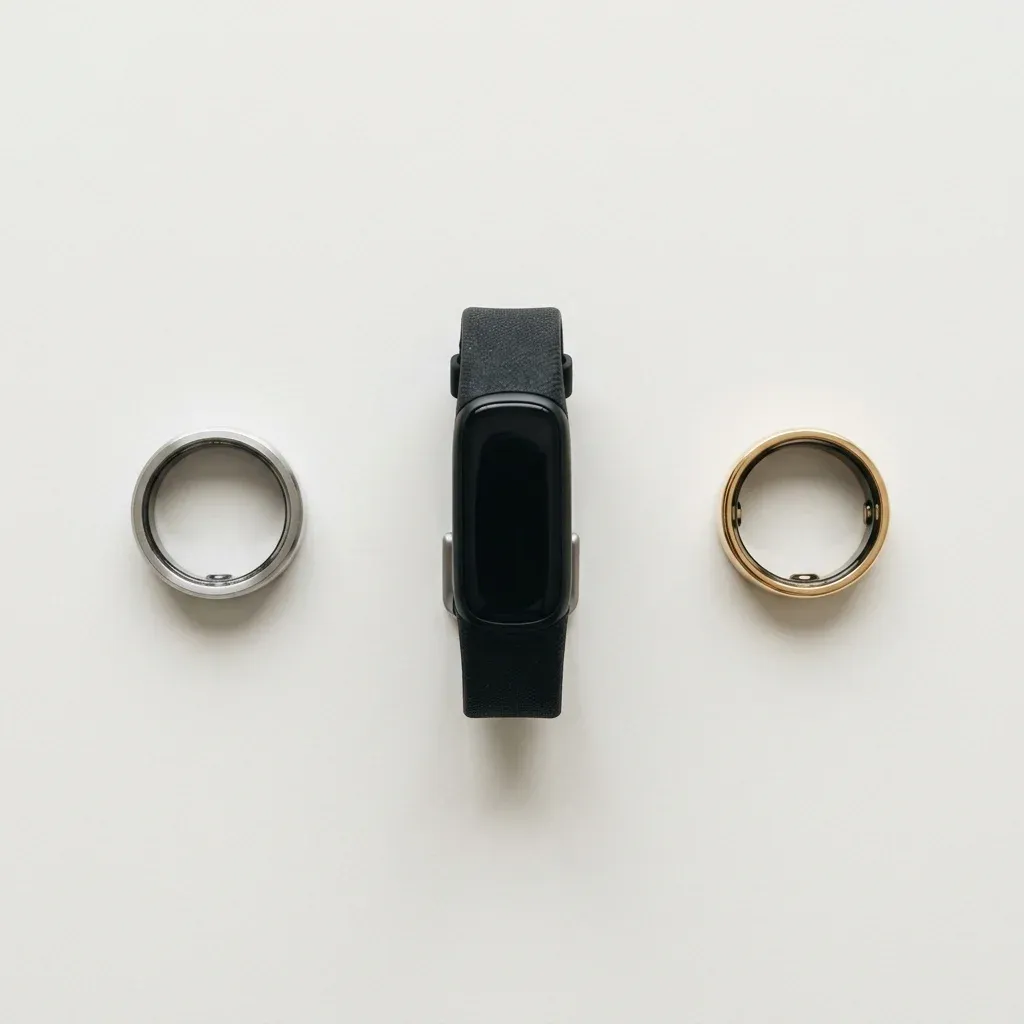
Putting numbers next to each other reveals trade-offs, not winners
| Feature | Oura Ring 4 | Samsung Galaxy Ring | WHOOP 4.0/5.0 |
|---|---|---|---|
| Price | $349 + $69.99/year | $399 (no subscription) | $239/year (device included) |
| 3-year total cost | ~$559 | $399 | ~$717 |
| Form factor | Ring (7.90mm wide, 2.88mm thick) | Ring (7mm wide, 2.6mm thick) | Wristband (1.7 x 1.1 x 0.4 in) |
| Weight | 3.3-5.2g | From 2.3g | Not published |
| Battery life (tested) | 5-7 days | 5-6 days | 4-5 days (4.0) / 16.5 days (5.0) |
| Water resistance | 100m | 10ATM/IP68 | 10m |
| Sleep staging accuracy vs PSG | 61-79.5% (multiple studies) | No PSG validation published | 60% (CQU study) |
| Phone compatibility | iOS and Android | Android only (Samsung for full features) | iOS and Android |
| Auto workout detection | 40+ activities | Walking and running only | All activities (manual logging encouraged) |
| Screen | None | None | None |
| Subscription required | Yes ($5.99/month) | No | Yes (device tied to subscription) |
The comparison table reveals something important: there is no overall winner, because these devices optimize for different things.
Sleep tracking accuracy. Oura has the strongest academic backing. The Robbins et al. study at Brigham and Women's Hospital found Oura Gen 3 was not statistically different from polysomnography for estimating sleep stage durations. The CQU study showed WHOOP performed competitively, particularly for heart rate accuracy at 99.7% during sleep. Samsung has no published PSG validation study, which is a significant gap for anyone who cares about data quality over marketing claims.
Battery life. The WHOOP 5.0 dominates at 16.5 days with its wireless charging pack. Among the rings, Samsung and Oura are roughly equivalent at 5-7 days, with Samsung's portable charging case providing more flexibility. Oura's charging puck is functional but stationary.
Long-term cost. Samsung wins decisively at $399 total. Oura becomes competitive if you plan to keep the ring for three or more years. WHOOP is the most expensive option and gets more expensive with every passing year.
No smart ring or wristband has been validated for clinical use. A 2025 Nature study examining ring trackers in sleep lab patients found that while group-level averages looked acceptable, individual-night accuracy varied too widely for diagnostic use. These are wellness tools, not medical instruments.
The accuracy picture has an uncomfortable detail that manufacturers don't emphasize: wake detection is the weakest link across all devices. The Nature study found wake sensitivity of just 46% for the Oura ring in clinical populations — meaning the ring correctly identified less than half of the time someone was actually awake during the night. This matters because wake-after-sleep-onset (WASO) is one of the most clinically relevant sleep measures, and all three devices struggle with it. If you often toss and turn, these devices will likely tell you that you slept better than you did.
The right pick depends on what annoys you most
Three questions sort most people into the right device.
Do you use an iPhone? If yes, the Galaxy Ring is eliminated. Your choice is Oura or WHOOP. Oura fits more naturally into an iPhone-centric lifestyle given its ring form factor and iOS app quality.
Are you a competitive athlete who trains by heart rate zones and needs daily strain management? WHOOP was built for this use case. Its Strain/Recovery system is more prescriptive than Oura's Readiness Score — it tells you how hard to train today, not just whether you slept well. The WHOOP Body apparel allows sensor relocation for weight training or contact sports. If you train seriously and budget is secondary, WHOOP earns its subscription.
Do you want the deepest sleep and recovery insights without wearing something on your wrist? Oura wins this category. Its sleep staging accuracy is the most thoroughly validated of the three. The app's long-term trend analysis — cardiovascular age, stress resilience, chronotype insights — goes deeper than Samsung's or WHOOP's offerings. Women's health features including cycle tracking, pregnancy monitoring, and Natural Cycles integration are particularly strong compared to competitors.
| If you are... | Consider | Because |
|---|---|---|
| A sleep-focused health optimizer | Oura Ring 4 | Strongest sleep validation data, deepest app insights |
| An Android user who hates subscriptions | Samsung Galaxy Ring | $399 total, no recurring costs, thinnest design |
| A serious athlete managing training load | WHOOP | Strain/Recovery prescriptions, body-worn options for lifting |
| Someone tracking menstrual cycles or pregnancy | Oura Ring 4 | FDA-regulated fertility integrations, temperature-based cycle tracking |
| A casual health tracker wanting the least friction | Samsung Galaxy Ring | Lightest, thinnest, no subscription, portable charging case |
One thing all three devices share: they scratch during weight training, they track sleep better than exercise, and their accuracy degrades for people with sleep disorders or high BMI. Smart rings in particular can lose data if apps aren't synced regularly, and the entire category remains less reliable than a similarly priced GPS running watch for athletic use. Accept these devices for what they are — passive, trend-level wellness monitors that work best when you wear them consistently for weeks — and you'll get genuine value from whichever one you choose.
Frequently Asked Questions
Are smart rings accurate enough to replace a doctor's sleep assessment?
No. While devices like the Oura Ring achieve 76-79.5% sensitivity for sleep stage classification in healthy adults, accuracy drops in people with sleep disorders. A 2025 Nature study found individual-night errors too large for clinical use. Smart rings are wellness tools that track trends over time — they complement professional evaluation but cannot substitute for polysomnography.
Can I wear a smart ring while lifting weights?
You can, but expect scratches. Samsung explicitly recommends against wearing the Galaxy Ring during barbell training. Rings scrape against dumbbells, barbells, and rubber grips, and the firm grip required for lifting creates motion artifacts that reduce heart rate accuracy. WHOOP addresses this with body-worn apparel that moves the sensor to your torso or bicep during lifts.
Which smart ring works with iPhone?
The Oura Ring 4 works with both iOS and Android. The Samsung Galaxy Ring works only with Android phones, and some features require a Samsung Galaxy phone specifically. WHOOP also supports both platforms.
Is the subscription worth it for Oura Ring?
Without the $5.99/month subscription, the Oura Ring shows only three basic scores. The subscription unlocks detailed sleep stage breakdowns, HRV trends, body temperature data, stress tracking, cardiovascular metrics, and the AI Advisor feature. If you're buying the ring for health insights rather than as jewelry, the subscription is effectively mandatory.
How long do smart ring batteries last before needing replacement?
Oura states the Ring 4 battery should maintain at least 80% of original capacity after 500 full charge cycles. With weekly charging, that translates to roughly 7-10 years before noticeable degradation. However, the battery is not replaceable in any current smart ring, and Oura does not offer a trade-in program.
Medical Disclaimer
This article is for informational and educational purposes only and is not medical advice, diagnosis, or treatment. Always consult a licensed physician or qualified healthcare professional regarding any medical concerns. Never ignore professional medical advice or delay seeking care because of something you read on this site. If you think you have a medical emergency, call 911 immediately.