What CBD Extraction Really Means
CBD extraction is the process of separating cannabinoids and other target compounds from hemp plant material, then refining that extract into an ingredient that can be used in oils, capsules, gummies, topicals, or vape liquids. That sounds simple, but every stage changes the chemistry of the final product. The plant variety matters, the moisture level matters, temperature matters, solvent choice matters, and cleanup steps matter.
Most people shopping for CBD only see front-label marketing terms like "CO2 extracted," "full spectrum," or "THC-free." Those phrases are useful, but incomplete on their own. A technically clean extraction can still produce a weak or inconsistent product if raw material quality is poor or if post-processing is sloppy. At the same time, a well-run process can produce highly consistent CBD ingredients that test within spec lot after lot.
It helps to separate two questions. First: does the method efficiently pull cannabinoids and terpenes from biomass? Second: does the manufacturer remove unwanted compounds and prove that with credible testing? Regulatory and public-health agencies repeatedly focus on that second part. The FDA's cannabis and CBD regulatory overview makes clear that composition, contamination, and labeling are central safety issues. Likewise, the National Institute on Drug Abuse summary on cannabis underscores that cannabinoid effects and risks vary by formulation and route of use, not just by one ingredient name on the bottle.
When you see extraction discussed online, a lot of content stops at "which method is best." In reality, each method is a tool. Some are better for broad-spectrum extracts, some are better for very high-purity isolates, and some are better for preserving fragile aroma compounds. What matters is whether the selected tool matches the intended product and is followed by rigorous purification and testing.
Quick reality check: extraction method is important, but quality control after extraction is usually what separates a trustworthy CBD product from a risky one.
That is also why this topic overlaps with your choice between cannabinoid profiles. If you are still sorting through the basics of cannabinoid composition, this explainer on CBD vs. THC differences provides a practical starting point before you dive deeper into production methods.
Raw Material and Prep Decisions That Change Final Quality
Before solvent ever touches the plant, manufacturers make choices that influence yield, flavor, impurity load, and compliance risk. Well-run extraction starts long before extraction day. Biomass is selected, dried, milled, and often decarboxylated under controlled conditions. If any one of those steps is rushed, downstream cleanup becomes harder and more expensive.
For example, excessive moisture can slow extraction and increase unwanted co-extraction of chlorophyll and waxes. Overheated decarboxylation can degrade heat-sensitive compounds and push the profile away from what the product spec calls for. In practical terms, poor prep often means more aggressive refinement later, which can remove both unwanted and wanted compounds at the same time.
A useful way to think about prep is as a risk-transfer decision. You can spend time and control early, or spend more money correcting problems later. The most reliable operators do both: they keep biomass handling tight and still run full-panel QC before release.
Evidence reviews of cannabis processing have highlighted exactly this point: extraction outcome is shaped by material quality, process conditions, and analytical controls as a connected system, not independent steps. A broad technical review in Molecules (PMC) details how extraction variables influence cannabinoid and terpene recovery, while a narrative review in Frontiers in Plant Science (PMC) describes how process parameters and agricultural inputs interact across the value chain.
From a buyer perspective, this upstream complexity is hidden. You only see the finished label and maybe a certificate of analysis. But when two products both say "CO2 extracted" and one performs far better than the other, these prep and process-control differences are usually the reason.
How the Major Extraction Methods Work
There are four extraction families you will see most often in real-world CBD manufacturing: supercritical CO2, ethanol, hydrocarbon, and solventless mechanical methods. None is automatically "clean" or "dirty." Each has a technical role, cost profile, and risk profile.
Supercritical CO2 Extraction
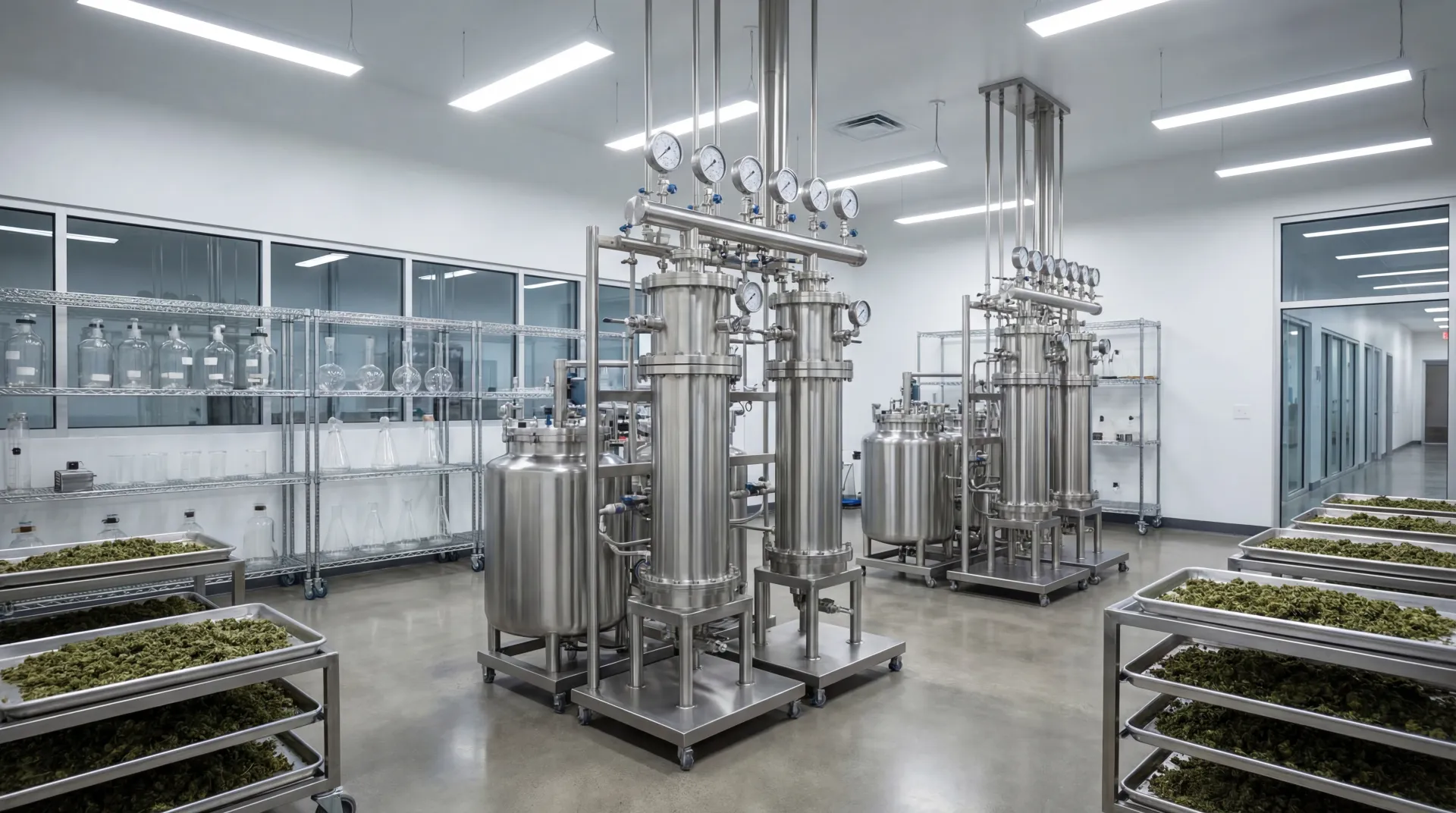
CO2 extraction uses carbon dioxide under controlled temperature and pressure so it behaves as a tunable solvent. Operators can adjust settings to target specific compound ranges and can often separate fractions in stages. CO2 is non-flammable under typical processing conditions and does not leave hydrocarbon residues in the same way butane or propane might if purge steps fail.
That said, CO2 systems are capital-intensive and technically demanding. Precision is the point. If parameters drift, yield and consistency drift too. This method is popular for brands that want a "clean process" story and for facilities that need repeatability at scale.
Ethanol Extraction
Ethanol extraction is efficient and widely used in both mid-sized and large facilities. It can process substantial biomass volume quickly and is often paired with winterization and distillation for refinement. The main tradeoff is selectivity: ethanol can pull cannabinoids effectively, but it can also extract chlorophyll, waxes, and other compounds that require cleanup.
Ethanol is also flammable, so engineering controls, ventilation, and hazardous-location compliance are non-negotiable. In well-run plants, this is manageable. In improvised settings, it is dangerous.
Hydrocarbon Extraction (Butane/Propane Blends)
Hydrocarbon systems can produce terpene-rich extracts and are common in certain inhalable-product workflows. They also carry elevated fire and explosion risk if used outside proper closed-loop equipment and code-compliant facilities. Public-health literature has documented severe injuries associated with informal butane extraction, including burn cases summarized in peer-reviewed reports indexed on PubMed.
In legal, licensed operations, residual solvent limits and batch testing help control this risk. Without that infrastructure, hydrocarbon extraction can become a hazard quickly.
Solventless Mechanical Methods
Solventless approaches include methods like rosin pressing and mechanical separation. These avoid chemical solvents during extraction, which is attractive for some consumers. But "solventless" does not mean effortless, and it does not automatically guarantee higher purity or better consistency. The process can be less scalable for certain product categories, and final composition still depends heavily on input material and process control.
Here is a practical comparison table that buyers and formulators can actually use:
| Method | Best Use Cases | Strengths | Main Limitations | Typical Risk Controls |
|---|---|---|---|---|
| Supercritical CO2 | Scalable broad/full-spectrum extracts, controlled fractionation | Good tunability, no hydrocarbon solvent residue profile, strong repeatability in trained teams | High equipment cost, process complexity | Pressure-system validation, method qualification, batch COA |
| Ethanol | High-throughput crude extraction feeding distillation/isolation | Fast throughput, common industrial workflow, relatively straightforward scaling | Pulls more co-extractives, requires robust cleanup | Winterization SOPs, residual solvent testing, fire code compliance |
| Hydrocarbon | Terpene-forward concentrates in licensed facilities | Strong terpene retention potential, efficient extraction | Flammability risk, residue concerns if purge is poor | Closed-loop systems, classified rooms, residual solvent limits |
| Solventless | Niche premium concentrates, minimal processing story | No added solvent in extraction step, simple concept for consumers | Yield constraints, consistency challenges, still requires testing | Moisture control, temperature control, contaminant testing |
If you are shopping consumer products, connect method to product goal. For example, if you specifically want isolated cannabidiol, extraction is only the front half of the story; downstream purification is what determines whether a product can realistically claim minimal THC. If your goal is broader cannabinoid context, compare that with practical information in this guide to CBD oil vs cannabis oil vs THC oil so the label language lines up with your expectations.
Purification, Refinement, and Lab Testing
Extraction creates a crude mixture. Purification creates a usable ingredient. Most commercial CBD supply chains include one or more of these steps after extraction: winterization (remove waxes/lipids), decarboxylation, distillation, and in some workflows, chromatography. The right sequence depends on whether the target is full-spectrum oil, broad-spectrum oil, or high-purity isolate.
Quality bottlenecks usually appear here, not in extraction headlines. A supplier can run sophisticated extraction equipment and still fail if they do not control residual solvents, heavy metals, pesticides, microbial contamination, and cannabinoid potency variation.
That is why third-party certificates of analysis matter. A COA should include at least cannabinoid potency and contaminant screening, with clear batch identifiers and testing dates. For solvent-related risk, many state frameworks publish explicit analyte panels. California's solvent and processing-compound list is a useful example because it lays out a concrete set of compounds labs screen for in regulated workflows: CDFA solvent and processing compound list (PDF).
The table below summarizes what a practical CBD quality panel should cover before a lot is released:
| Testing Category | What It Confirms | Why It Matters for Consumers |
|---|---|---|
| Cannabinoid profile (CBD, THC, minor cannabinoids) | Label claim accuracy and cannabinoid ratio | Avoids underdosed products and unexpected THC exposure |
| Residual solvents | Whether purge/refinement removed extraction solvents to acceptable limits | Reduces inhalation/ingestion risk from leftover solvents |
| Pesticides | Whether agricultural residues remain in concentrate | Concentrates can amplify upstream contamination if not controlled |
| Heavy metals | Lead, arsenic, cadmium, mercury presence | Chronic exposure risk, especially with regular use |
| Microbial panel and mycotoxins | Biological contamination and fungal toxins | Important for product stability and vulnerable users |
| Terpene profile (when relevant) | Aroma compound distribution and consistency | Useful for full-spectrum products and formulation repeatability |
Consumer takeaway: if the brand cannot provide a recent third-party COA with contaminant data, the extraction method claim should not be your deciding factor. For broader product-risk context, compare with this site guide on known side effects of cannabidiol and evaluate benefit claims with equal skepticism.
Safety and Regulation: Where Many Products Fail
Extraction safety is both an engineering issue and a compliance issue. Hydrocarbon and ethanol systems require strict fire-safety controls. CO2 systems involve high-pressure equipment that must be maintained and operated by trained personnel. Home extraction tutorials rarely capture this reality, and that gap is exactly where injury reports appear.
Burn-center case literature on butane hash oil extraction illustrates how severe those failures can be when extraction is done in unregulated settings, with flash fires affecting both operators and bystanders. That body of evidence is one reason licensed operations rely on closed-loop systems, controlled ventilation, and code-compliant facilities rather than improvised setups.
Regulatory language can also confuse buyers. A product may be marketed as "hemp-derived" while still varying widely in composition and quality. Federal and state frameworks continue to evolve, and enforcement has focused heavily on unsupported medical claims and misbranding. The Federal Register notice on marijuana extract coding and the FDA cannabis/CBD policy page are useful anchors when you want to understand the compliance backdrop behind label claims.
Internationally, toxicology and dependence-risk reviews also matter. The World Health Organization critical review on cannabidiol (PDF) remains a widely cited document in policy discussions, especially around abuse potential and safety framing. It is not a substitute for individual medical advice, but it provides useful context for separating evidence from hype.
Myths vs Facts About Extraction Labels and Purity
CBD extraction is packed with confident claims. Some are true in narrow contexts. Others are oversimplified marketing. Here is a plain-language breakdown:
| Common Claim | Evidence-Based Reality |
|---|---|
| "CO2 extracted" always means superior quality. | CO2 can be excellent, but final quality still depends on biomass quality, operator skill, purification, and complete contaminant testing. |
| Solventless products are automatically safer. | Solventless avoids added extraction solvents, but pesticides, metals, microbes, and potency inconsistency still require testing. |
| Ethanol extraction is low quality. | Ethanol is a mainstream industrial method. With proper refinement and testing, it can produce high-quality ingredients at scale. |
| Residual solvent risk is only relevant for vape products. | Residual solvent control matters across product formats. Acceptable limits and validated testing are still essential for ingestible products. |
| If a label says "third-party tested," that is enough. | You still need the actual batch COA, testing date, lab identity, and full panel details to verify what was tested and what was not. |
In short, extraction method is one line in a longer quality story. The data package around the extract is what turns that story into something you can verify.
How to Choose a Product Based on Extraction Data
If you want a practical way to screen CBD products, use this checklist and stop at the first major red flag:
- Start with product purpose. If you are deciding between cannabinoid profiles, review the practical distinctions in this guide to CBD oil uses, risks, and side effects so your expectations match what the product can realistically deliver.
- Look for extraction transparency. The label should identify method category (CO2, ethanol, hydrocarbon, or solventless), not just marketing language.
- Request a recent COA tied to the exact lot number. If the document is missing, outdated, or incomplete, move on.
- Confirm contaminant panels include residual solvents, pesticides, heavy metals, and microbial markers. Potency alone is not enough.
- Check THC reporting detail. "Non-detect" should include an actual limit of quantitation, not vague wording.
- Compare claims against evidence. If marketing promises broad disease treatment, treat that as a compliance red flag rather than a quality signal.
This checklist will not answer every clinical question, but it quickly separates products with verifiable manufacturing discipline from products built on branding alone.
Frequently Asked Questions
Which CBD extraction method is safest?
No method is universally safest in every setting. In licensed facilities, safety depends on engineering controls, validated procedures, and contaminant testing. CO2 avoids many flammable-solvent concerns, but all methods require trained operation and quality controls.
Does "CO2 extracted" mean there are no contaminants?
No. CO2 extraction can reduce certain solvent-residue issues, but contaminants can still come from upstream cultivation, handling, or poor post-processing. You still need a full-panel third-party COA to evaluate product safety.
Can solventless extraction produce high-quality CBD products?
Yes, it can, especially in niche concentrate formats. But solventless is not a free pass. Product consistency, contaminant burden, and cannabinoid accuracy still depend on material quality and testing discipline.
Why do two CBD oils with the same extraction method feel different?
Because extraction method is only one variable. Differences in cannabinoid ratios, terpene profile, purification depth, formulation, and batch consistency can all change user experience and clinical relevance.
Bottom Line
CBD extraction should be judged like any other technical manufacturing process: by controls, data, and consistency. Method labels are useful context, but they are not quality proof by themselves. The strongest buying signal is a transparent brand that publishes lot-specific COAs with meaningful contaminant testing and realistic claims.
Related Articles
- CBD Oil: Medical Uses, Benefits, Risks, and Side Effects: A practical overview of where evidence is stronger, where it is weaker, and how to read product claims carefully.
- CBD vs. THC: Main Differences: A quick comparison of psychoactivity, legal context, and product selection implications.
- Known Side Effects of Cannabidiol (CBD): Ultimate Guide: A deeper look at adverse effects, interactions, and safety monitoring.
- CBD Oil Benefits: 10 of the Most Widespread Health Benefits: A claim-by-claim review of popular benefit narratives and what the evidence actually supports.
- CBD Oil vs Cannabis Oil vs THC Oil vs Marijuana Oil: Useful for understanding how product naming conventions can hide big chemistry differences.
Medical Disclaimer
This article is for informational and educational purposes only and is not medical advice, diagnosis, or treatment. Always consult a licensed physician or qualified healthcare professional regarding any medical concerns. Never ignore professional medical advice or delay seeking care because of something you read on this site. If you think you have a medical emergency, call 911 immediately.