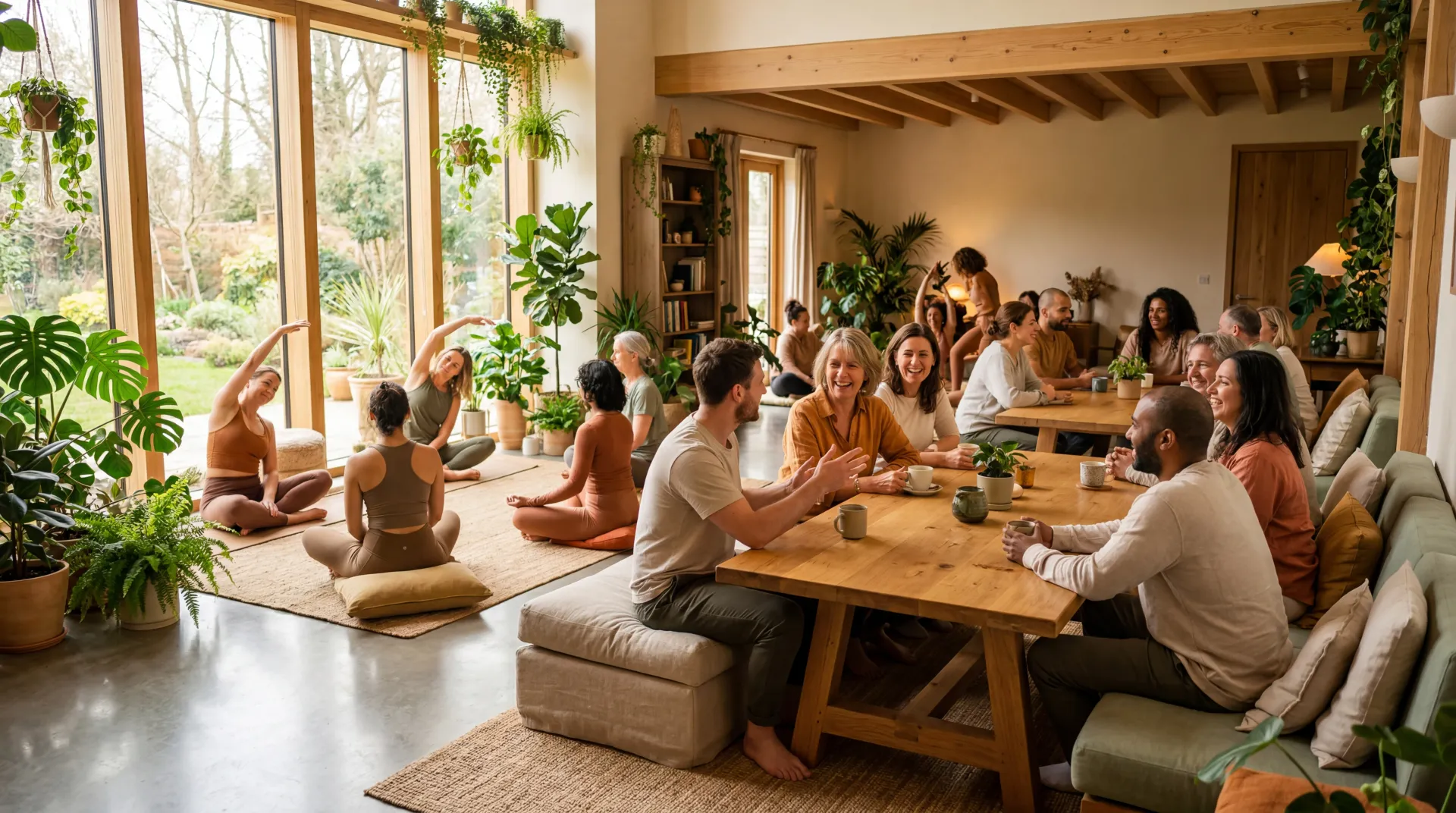
What Ray Oldenburg Got Right About "Third Places" — and What Wellness Got Wrong
In 1989, sociologist Ray Oldenburg published The Great Good Place, a book arguing that democratic societies depend on informal gathering spots — places between home and work where people exchange ideas, form relationships, and feel like social equals. He called them "third places." Coffee shops, barbershops, public parks, diners. Oldenburg identified their defining traits: neutral ground, open to anyone, free from status pressures, with informal conversation as the main activity and most important linking function.
For decades, the wellness industry didn't care about any of this. It was too busy optimizing individuals. Track your macros. Measure your HRV. Hack your sleep. The buzzword was "self-care" — which has accumulated more than 19 million TikTok posts — and the implicit message was that health is a solo project. Buy the right supplement. Download the right app. You, alone, in front of a mirror, getting better.
Meanwhile, the infrastructure Oldenburg wrote about was crumbling. Brick-and-mortar third places have been disappearing for years, squeezed out by rising real estate costs, suburban zoning that bans commercial spaces in residential neighborhoods, and the gravitational pull of screens. The Urban Institute documented how this decline has coincided with rising loneliness and a weakened sense of community well-being across American cities.
The numbers tell a blunt story. About half of U.S. adults report having experienced loneliness, according to the Surgeon General's 2023 advisory. Among younger generations, it's worse: Cigna's 2025 "Loneliness in America" report found that 67% of Gen Z and 65% of millennials feel lonely. A 2024 Harvard survey put it even more precisely — 67% of adults feel socially and emotionally lonely specifically because they are not part of meaningful groups.
So here's the irony: while wellness culture was teaching people to optimize their bodies in isolation, the most powerful health intervention — showing up in a room with other humans — was being quietly defunded, rezoned, and priced out. Oldenburg saw it coming. The wellness industry is about 35 years late to his insight, but it's finally arriving.
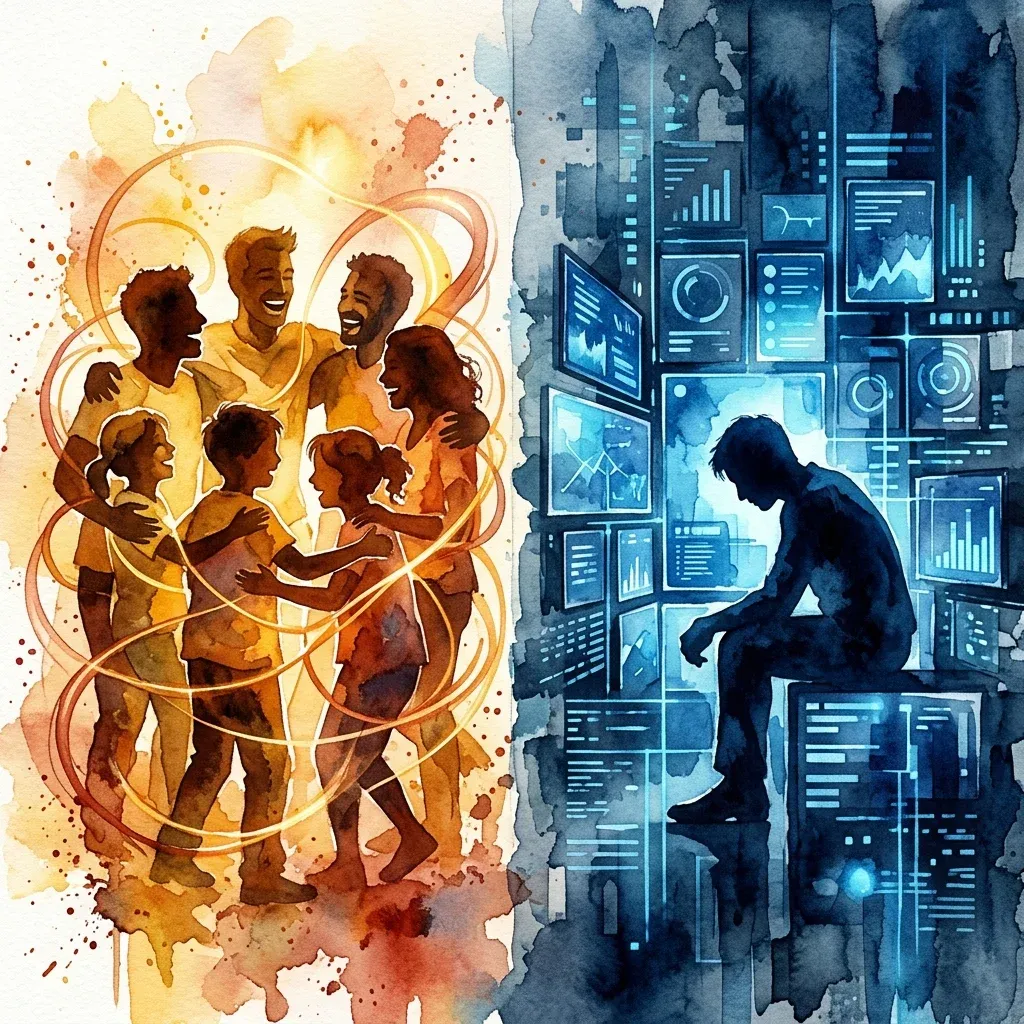
The Biology of Belonging: How Social Connection Lowers Inflammation and Cortisol
When U.S. Surgeon General Vivek Murthy declared loneliness a public health epidemic in 2023, he used a comparison that stuck: loneliness poses health risks equivalent to smoking 15 cigarettes a day. That comparison sounds dramatic until you look at the biology behind it.
Think of your immune system as a security team that can operate in two modes. In "safe mode," it handles routine maintenance — fighting infections, repairing tissue, keeping inflammation at baseline. In "threat mode," it ramps up systemic inflammation as though bracing for a physical attack. Chronic loneliness appears to lock the system into threat mode, even when no actual danger exists.
A study of 222 older adults at Penn State found that both trait loneliness and daily experienced loneliness were associated with elevated C-reactive protein (CRP) — a key marker of systemic inflammation (beta = 0.16, p = 0.02). The research team, led by Jennifer Graham-Engeland, measured loneliness not just through questionnaires but through ecological momentary assessment over 14 days, capturing how lonely people actually felt in their daily lives. Both measures pointed in the same direction: lonelier people had more inflammation circulating in their blood.
This isn't an isolated finding. A meta-analysis by Smith and colleagues in 2020 found a consistent association between loneliness and elevated interleukin-6 (IL-6), another inflammatory marker. And the Evolutionary Theory of Loneliness, developed by John and Stephanie Cacioppo, offers a framework for why: loneliness triggers the hypothalamic-pituitary-adrenal (HPA) axis — the body's stress response system — as though social disconnection itself is a survival threat. Over time, that repeated activation contributes to the kind of chronic low-grade inflammation linked to cardiovascular disease, cognitive decline, and cancer.
But connection doesn't just remove harm — it actively protects. Researchers at the University of Pittsburgh tracked 456 healthy adults over four days using ecological momentary assessment, measuring cortisol — the body's primary stress hormone — at multiple points throughout each day. They found that more socially integrated individuals had steeper cortisol slopes (B = -0.00253, p = .006), meaning their cortisol dropped off more sharply in the evenings as it should. A flatter slope — where cortisol stays elevated rather than declining — has been linked to preclinical atherosclerosis, coronary calcification, and cardiovascular disease mortality.
What counts as "socially integrated" in this context isn't about having a massive friend group. It's about the diversity of social roles a person inhabits — colleague, neighbor, gym buddy, book club member, volunteer. The more social contexts you regularly participate in, the healthier your cortisol rhythm tends to be.
Dr. Michelle Rodrigues at Marquette University explored this further. Her team at the Beckman Institute studied women across age groups and found that working with familiar partners — friends rather than strangers — produced consistently lower cortisol levels regardless of age. "Friendship buffers stress, and that's preserved with age," Rodrigues noted. Her work built on the tend-and-befriend hypothesis, which suggests that social bonding functions as an alternative stress response to the classic fight-or-flight reaction.
The WHO Commission on Social Connection confirmed this picture in its landmark 2025 report: social connection can reduce inflammation, lower the risk of serious health problems, and prevent early death. The same report estimated that loneliness contributes to 871,000 deaths globally each year — roughly 100 per hour. Those aren't deaths from loneliness directly, but from the cascade of biological consequences that chronic disconnection sets in motion: the elevated inflammation, the dysregulated cortisol, the nearly 30% increased risk of premature death, greater risk of stroke and heart disease, and approximately 50% elevated risk of dementia.
What makes this relevant to the third-place conversation: these aren't benefits that require deep therapy or clinical intervention. The cortisol research suggests that simply showing up — being present in a shared space, occupying diverse social roles, engaging in low-stakes interaction — shifts your biology toward health. Your body doesn't need you to have a profound conversation. It needs you to not be alone.
Third Places in 2026: From Pickleball Courts to Breathwork Circles
Forbes named the rise of community wellness as one of its top five wellness trends for 2026. Movement specialist Sarah Aspinall, quoted in that analysis, called it "the era of social health — where community becomes medicine." After years of remote work, self-improvement in isolation, and hyper-digital living, the pendulum has swung back toward group experience.
What's different this time is the form these gatherings take. The traditional third places Oldenburg wrote about — diners, barbershops, church socials — haven't disappeared, but they've been joined by a new category that blends social connection with intentional wellness. Richard Kyte, a professor at Viterbo University who has taught courses on third places for nearly two decades, told CNBC that the term only became mainstream recently, driven by pandemic-era awareness of what isolation costs and the simultaneous realization that many gathering spaces had closed permanently.
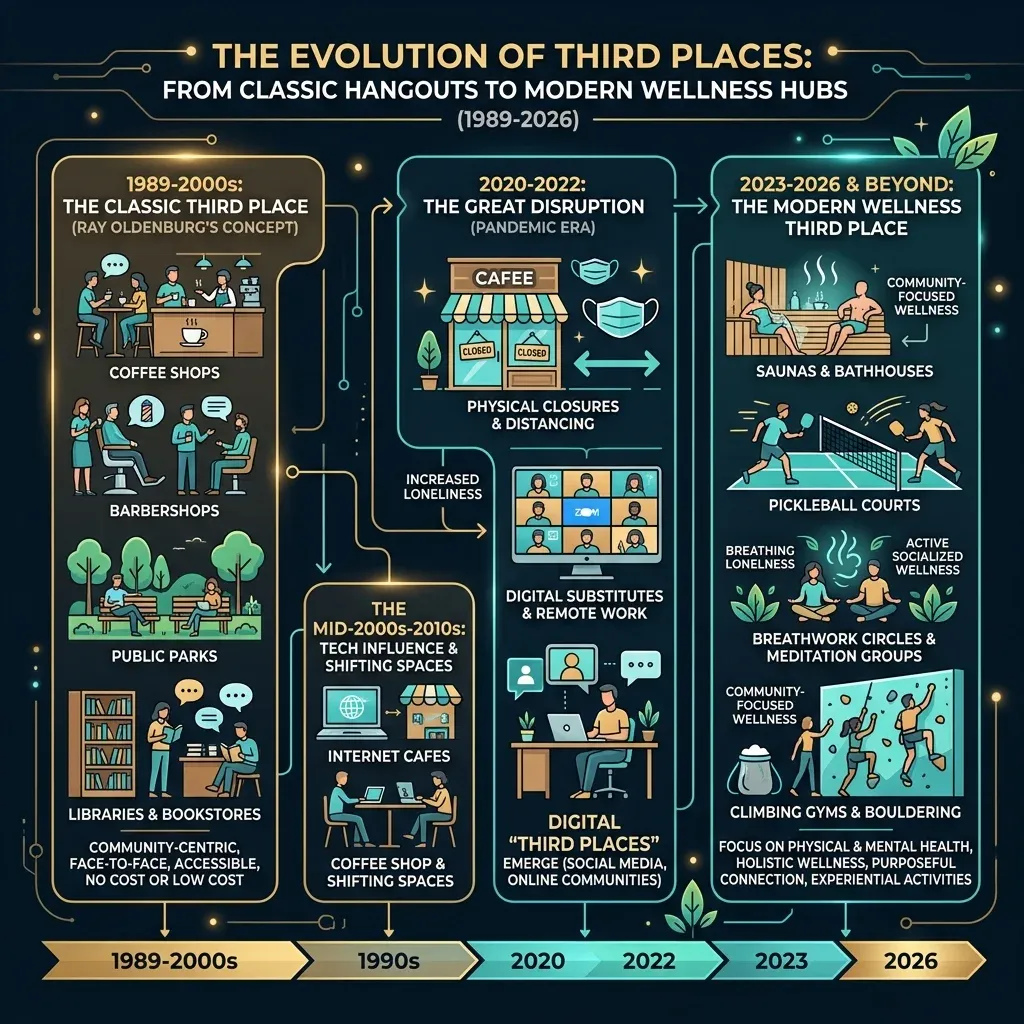
The new wellness third places break into several categories. Roy Ward, writing in Forbes Business Council, described health-focused third places as "the fastest-growing segment" in fitness. Pickleball clubs are multiplying in suburbs. Infrared sauna studios are positioning themselves as social hubs. Climbing gyms function as community centers where the workout is the excuse and the community is the actual product.
In New York City, the wellness club landscape has expanded rapidly. Remedy Place, The Well, Othership, Bathhouse, Majesty's Pleasure, Sage + Sound, and Continuum Club all offer variations on the same idea: health-oriented experiences designed for shared participation rather than solitary optimization. Dr. Jonathan Leary, who founded Remedy Place, frames them as "social substitutions" — places that can stand in for a date, a happy hour, or a get-together without alcohol or late nights working against your body.
Bathhouse, which opened in Brooklyn in 2019, now expects to hit approximately $120 million in run rate revenue by the end of 2026, serving roughly 1,000 customers per day across its two New York locations. Sessions start at $40 for drop-in access to saunas and cold plunges, with plans for seven more locations through 2027. Othership, a competitor with locations in New York and Canada, hosts comedians and live musicians in its saunas — deliberately replicating nightlife dynamics in a wellness setting.
The nightlife crossover is one of the more interesting developments. Clubs are hosting sober raves, festivals are adding morning meditation tents, and bars are serving adaptogenic cocktails alongside craft beer. Ward's observation is sharp: "The person who won't pay $15 for a vodka soda will pay $30 for a sound bath and mocktail experience that delivers connection, wellness and Instagram-worthy moments." Whether you find that liberating or absurd probably depends on your age and zip code, but the market signal is clear.
This trend isn't confined to New York or Los Angeles. Glo30, a membership skincare studio with more than 100 locations, operates primarily in places like Texas, Arizona, and North Carolina. Founder Arleen Lamba schedules all appointments on the hour specifically to create organic social moments — people arriving and leaving at the same time, recognizing each other, forming friendships in the treatment rooms. The model works: Glo30's franchise units in development have grown 67.5% over the past two years.
What separates these spaces from a regular gym or spa membership is the deliberate social engineering. Every design choice — the communal cold plunge, the synchronized appointment times, the live entertainment in the sauna — is optimized for what Beth McGroarty at the Global Wellness Institute calls the hardest business problem of all: "engineering a natural community."
Social Health vs. Social Media: Why Digital Connection Doesn't Count
One of the most persistent assumptions in the loneliness conversation is that digital connection should count as real connection. We have more ways to reach people than at any point in human history. Group chats, video calls, social feeds, collaborative documents, online gaming communities. And yet loneliness rates keep climbing.
A four-week experience sampling study published in Nature's Scientific Reports tracked 411 participants through 9,791 daily questionnaires during COVID-19 lockdowns. The findings were unambiguous: face-to-face communication was far more predictive of mental health than any form of digital communication. Text-based messaging (email, WhatsApp, SMS) showed a meaningful association with well-being — but video calls, despite their richer visual and auditory cues, were only negligibly associated with mental health. The researchers grounded their analysis in Media Richness Theory, which holds that the degree of nonverbal cues and social presence in a communication channel determines its ability to sustain real relationships.
The most counterintuitive result: when participants used both digital and face-to-face communication, they actually felt less connected than when they used face-to-face communication alone. This displacement effect — where digital interactions don't supplement but actually dilute in-person connection — was also observed by Kushlev and colleagues in a separate experience sampling study. The phone in your hand while you're sitting with someone isn't adding to your social health. It's subtracting from it.
| Communication Type | Mental Health Association | Social Presence |
|---|---|---|
| Face-to-face interaction | Strongest positive effect | Full nonverbal cues, physical co-presence |
| Text messaging (SMS, WhatsApp) | Meaningful positive effect | Low — relies on emoji and text tone |
| Video conferencing | Negligible effect | Moderate — visual cues but no physical presence |
| Social media scrolling | Negative association | Near zero — parasocial, one-directional |
The Surgeon General's report cited a study finding that people who used social media for two or more hours daily were more than twice as likely to report feeling lonely. "There's really no substitute for in-person interaction," Murthy stated directly. "As we shifted to use technology more and more for our communication, we lost out on a lot of that in-person interaction."
Americans now spend about 20 minutes per day in person with friends, down from 60 minutes two decades ago. Among young people ages 15 to 24, time spent with friends has dropped by 70%. Those aren't small shifts. That's a demographic that has traded two-thirds of its in-person social time for screen-mediated contact — and the biological research covered in the previous section suggests their cortisol and inflammatory profiles are paying the price.
Harry Taylor, co-founder of Othership, described the dynamic this way in an interview with CNBC: "There's so much social media, which gives us the false perception that there's social engagement and interaction... There's a void in the wake of that social satiation that we all require as humans." Notice his word choices — "false perception" and "void." He's describing a counterfeit: digital platforms mimic the sensation of connection without delivering what your nervous system actually needs.
None of this means digital communication is worthless. Text messaging showed real mental health benefits in the Nature study. Group chats can maintain relationships between in-person encounters. But treating digital and physical social interaction as interchangeable — as though a Zoom call is equivalent to sharing a meal — is a category error that the research flatly doesn't support.

Building Your Social Health Practice: A Practical Framework
If social connection protects your health the way the research indicates, then it probably deserves the same intentionality you give to exercise or nutrition. Not the same rigidity — nobody needs a social interaction macro tracker — but enough structure to prevent it from being the thing that always gets bumped from your schedule.
The cortisol research from the University of Pittsburgh defined social integration as the diversity of social roles in which a person participates. That's a useful frame for thinking about your own social health. The question isn't "how many friends do I have?" It's "how many different social contexts do I regularly occupy?"
Start with an honest inventory. Count the distinct social roles you inhabit in a typical month: friend, colleague, neighbor, teammate, classmate, volunteer, club member, regular at a local business. If you can count three or fewer contexts outside of work and immediate family, your social integration is probably thinner than your biology would prefer.
Social Health Audit: How many distinct social roles do you regularly occupy? Research links greater diversity of social roles — not just more friends — to healthier cortisol patterns and lower inflammation. Three or fewer contexts outside work and family suggests room to expand.
Finding or creating a third place doesn't have to be expensive. The Forbes psychology piece by Mark Travers offers grounded advice: look for spaces where you feel at ease, explore local spots that naturally encourage social interaction (parks, coffee shops, community gyms), choose places aligned with your interests, and look for a sense of belonging — not just proximity to other people.
The evidence points to a few principles that matter more than which specific activity you choose:
| Principle | Why It Works | Examples |
|---|---|---|
| Consistency over intensity | The cortisol benefits come from regular social participation, not occasional intense socializing | Weekly run club, regular coffee shop visits, recurring game nights |
| Physical co-presence | Face-to-face interaction shows the strongest health associations; digital doesn't substitute | In-person classes, community meals, park meetups |
| Low barrier to entry | Oldenburg's original insight: third places work because they're easy to access, not because they're exclusive | Public parks, libraries, free community events, drop-in fitness |
| Role diversity | Occupying different social roles is associated with healthier cortisol patterns | Volunteering, joining a sports league AND a creative group, becoming a regular somewhere |
Research published in the Journal of Service Research found that third places combat loneliness partly through "commercial friendships" — the kind of low-level familiarity you develop with baristas, gym staff, and fellow regulars. These relationships don't feel significant compared to deep friendships, but they're part of the social fabric that keeps isolation at bay. Becoming a "regular" somewhere is itself a form of health intervention.
The tend-and-befriend research from Dr. Michelle Rodrigues offers another practical insight: the cortisol-buffering effects of friendship are preserved with age. This isn't a health habit with diminishing returns as you get older. If anything, it becomes more important, as the study also found that older adults maintain strong social skills for interacting with unfamiliar people — contradicting the common assumption that social withdrawal is an inevitable part of aging.
Group movement deserves its own mention here. Sarah Aspinall's observation that moving together triggers oxytocin and endorphin release, lowering stress and strengthening trust, means that physical activity in a social context delivers benefits that neither exercise alone nor socializing alone can match. If you're going to walk anyway, finding someone to walk with is one of the highest-return changes you can make.
The Business and Policy Case for Community Wellness Spaces
The global wellness market is projected to reach nearly $10 trillion by 2030, according to the Global Wellness Institute. Equinox chairman Harvey Spevak declared that "health is the new luxury." But the more interesting economic story isn't about high-end wellness clubs. It's about whether the health benefits of social connection can be translated into institutional investment — by employers, insurers, and policymakers — at a scale that actually addresses the loneliness epidemic.
At the governmental level, momentum is building. In May 2025, the World Health Assembly adopted its first-ever resolution on social connection, urging member states to develop evidence-based policies and programs to promote positive social connection for mental and physical health. The WHO subsequently launched the "Knot Alone" campaign and called on all member states to make social connection a public health priority. The United Kingdom and Japan have already appointed "loneliness ministers" — dedicated government positions focused on reducing social isolation.
In cities, urban planners are recognizing what Brookings scholars Stuart Butler and Carmen Diaz wrote in their analysis: third places can stabilize neighborhoods and reduce social problems, but they require supportive zoning, transit access, and sustained public investment. Oldenburg himself blamed "unfunctional zoning" that banned commercial establishments in residential areas, leading suburban Americans to rely entirely on cars and malls — environments poorly suited to organic social interaction.
| Investment Level | Action | Example |
|---|---|---|
| Federal/National | Social connection policy frameworks | WHO resolution (2025), U.S. Surgeon General advisory (2023) |
| Municipal | Zoning reform, park investment, transit-accessible public spaces | NYC: $23M for open spaces at public housing; mixed-use zoning |
| Employer | Community wellness benefits, social infrastructure at work | Subsidized third-place memberships, on-site community spaces |
| Individual/Private sector | Wellness third places as businesses | Bathhouse ($120M revenue), Othership, Glo30 (67.5% franchise growth) |
The equity dimension matters and is often overlooked in enthusiasm about wellness third places. The Urban Institute documented that high-poverty neighborhoods in New York City have 21% less park access than wealthier neighborhoods — and that third places can exacerbate existing social divides if access is determined by income. When a cold plunge session costs $40 and membership runs into the hundreds per month, these spaces risk becoming wellness versions of the exclusive social clubs they claim to replace.
Hostile infrastructure — benches designed to prevent sleeping, restricted public restrooms, antiloitering ordinances — actively excludes the people who might benefit most from public third places. Any policy framework that treats community wellness spaces as a public health tool has to contend with who actually gets access.
The promising models address this directly. NYCHA's partnership with NYC Parks is spending $23 million to create open areas and playgrounds at six public housing developments, deliberately targeting communities with the least existing social infrastructure. The Affordable Care Act requires non-profit hospitals to analyze local health needs in their communities — Brookings researchers have argued that hospitals could use this mandate to identify and support third places as part of their community health strategy, since the evidence linking social connection to reduced disease burden is now robust enough to justify the investment.
The private sector's role isn't limited to high-end clubs. Roy Ward argues that the businesses winning in this space are the ones lowering barriers to entry rather than raising them — designing experiences for the "wellness curious," the intimidated, and the "I'll try anything once" crowd rather than the already-converted. "When your retention engine is friendship rather than guilt," he writes, "churn plummets." That's a business insight, but it's also a health one.
Frequently Asked Questions
What exactly is a "third place" and why does it matter for health?
A third place is any informal gathering spot outside your home (first place) and workplace (second place) where you regularly interact with others. Sociologist Ray Oldenburg defined the concept in 1989. The health relevance comes from research showing that people who occupy more diverse social roles — including the casual interactions that happen in third places — tend to have healthier cortisol patterns and lower chronic inflammation. Examples include coffee shops, parks, community fitness centers, libraries, and the newer breed of wellness clubs.
Can online communities provide the same health benefits as in-person third places?
The research suggests they cannot fully substitute. A Nature-published study of 411 participants found that face-to-face communication was far more predictive of mental health than any digital communication, including video calls. Text messaging showed some meaningful benefits, but the overall evidence is clear: physical co-presence provides health benefits that digital interaction does not replicate. That said, digital communication can help maintain relationships between in-person encounters — it's the substitution, not the supplement, that's the problem.
How much social interaction do I need for health benefits?
The research doesn't specify a weekly minimum in hours, but the cortisol studies suggest regularity and role diversity matter more than total time. Rather than asking "how many hours per week," a better question is "how many different social contexts do I regularly participate in?" Even becoming a familiar face at a local coffee shop or joining a weekly walking group adds a social role that may benefit your stress physiology.
Are wellness third places only for wealthy people?
Premium wellness clubs get the most press, but they're not the only option. Public parks, libraries, community recreation centers, church social halls, volunteer organizations, and free community events all function as third places. The equity concern is real — the Urban Institute has documented that low-income neighborhoods have significantly less access to public gathering spaces — which is why policy investment in public social infrastructure matters alongside private-sector growth.
What's the strongest evidence linking social connection to reduced inflammation?
The WHO's 2025 Commission on Social Connection stated that social connection can reduce inflammation and prevent early death, drawing on a large body of evidence. At the study level, Penn State researchers found a significant association between loneliness and elevated CRP (a key inflammation marker) in 222 older adults, while a meta-analysis confirmed a consistent loneliness-IL-6 link. University of Pittsburgh researchers demonstrated that social integration is associated with healthier cortisol rhythms in 456 adults, providing a plausible biological mechanism.
Medical Disclaimer
This article is for informational and educational purposes only and is not medical advice, diagnosis, or treatment. Always consult a licensed physician or qualified healthcare professional regarding any medical concerns. Never ignore professional medical advice or delay seeking care because of something you read on this site. If you think you have a medical emergency, call 911 immediately.