Why GLP-1 Weight Loss Hits Your Skin Harder Than Dieting
The American Society of Plastic Surgeons named "GLP-1 makeovers" a leading plastic surgery trend for 2026, and the numbers back that up. A retrospective study published in Plastic and Reconstructive Surgery - Global Open tracked 134 body contouring referrals at a tertiary center and found GLP-1-associated consultations grew from 3.8% to 19.0% of all referrals in just two years, the fastest growth of any referral pathway. Plastic surgeon Dr. Roy Kim put it bluntly to ASPS: "There will never be another time in history with as many post-Ozempic patients as now and in the near future."
The speed of weight loss is the core problem. In a 68-week clinical trial, participants on GLP-1 receptor agonists lost 14.9% of their body weight compared to 2.4% on placebo. That pace doesn't give skin time to adjust. Think of your skin like a rubber band that's been stretched around a large object for years. Pull the object out slowly, and the band gradually contracts. Yank it out, and the band stays warped.
What makes GLP-1 medications different from simply eating less? The mechanism goes beyond calories. According to a 2025 review in Cosmetics, GLP-1 receptor agonists inhibit adipocyte maturation, which decreases fibroblast activity — the very cells responsible for regenerating your dermis. The medications also indirectly reduce dermal estrogen production by shrinking adipose-derived stem cells. Since estrogen plays a direct role in collagen production and skin thickness, this creates a double hit: you lose volume fast while your skin's repair machinery slows down.
The structural damage is measurable. A 2015 study published in Eplasty used image analysis to compare skin biopsies across three groups and found that collagen density in the papillary dermis dropped from 80% in normal-weight patients to 56% after massive weight loss — a 30% reduction. Collagen fiber thickness was cut nearly in half, from 2.35 to 1.19 micrometers. The elastic fiber network showed significant damage too.
A 2024 prospective study comparing 77 patients confirmed that surgical weight loss patients had significantly lower elastic fiber content in abdominal skin (5.0%) compared to non-surgical weight loss patients (6.8%, p=0.029). The faster and more dramatic the weight loss, the more the damage accumulates. Collagen makes up 80% of your skin's dry weight, so when that scaffolding deteriorates, no amount of moisturizer reaches deep enough to fix it.
One more complication that catches people off guard. According to that same Cosmetics review, if you stop GLP-1 medications and regain weight, the fat doesn't redistribute to its pre-medication pattern. The facial volume you lost stays lost even as other areas fill back in. For people who started these medications primarily for cosmetic weight loss rather than metabolic health, this creates an outcome they didn't anticipate.
If you're also noticing facial volume changes while on a GLP-1, our guide on Ozempic Face covers that specific concern in detail.
What Happens to Your Skin Month by Month After Weight Loss
Most people underestimate how long skin needs to recover after weight loss — and how much the timeline varies. Research from Sami et al. established that some contraction of the skin envelope can be expected for about one year after a stable weight is reached, but little change is likely to occur after that point. That one-year window is your skin's primary recovery period.
There's reason for cautious optimism within that window. The 2024 Hany et al. study found that elastic fiber proportion actually increases as time passes after weight loss intervention (p=0.016). Your skin is actively trying to rebuild its elastic network in the months following weight stabilization. The question is whether you're giving it the raw materials and conditions it needs.
| Timeframe | What's Happening | What to Expect |
|---|---|---|
| Months 1-3 | Initial skin contraction; inflammation subsiding | Skin may appear worse before better as swelling resolves and true laxity becomes visible |
| Months 3-6 | Active collagen remodeling; elastic fiber rebuilding begins | Gradual improvement in mild areas; severe laxity unlikely to resolve |
| Months 6-12 | Peak natural retraction period; fibroblast activity normalizing | Most natural improvement occurs here; realistic assessment of remaining laxity possible |
| After 12 months | Retraction essentially complete | What remains is likely permanent without intervention |
Several factors determine where you land on this spectrum. The key predictors identified across multiple studies include the rate and total amount of weight lost, your age, smoking status, sun exposure history, and genetics. Someone who is 32, lost 40 pounds over 8 months, and doesn't smoke will have a fundamentally different outcome than someone who is 55, lost 90 pounds in a year, and spent decades in the sun.
For small to moderate amounts of weight loss, your skin will likely retract on its own. That's the good news for people who lost 20-30 pounds on a GLP-1. The difficult reality applies to those who lost 50+ pounds rapidly — their skin was stretched longer, the collagen damage is more extensive, and the timeline favors intervention over patience.
Non-Surgical Skin Tightening: Sorting Evidence from Marketing
Walk into any med spa and you'll hear about a dozen devices that promise to tighten skin. Some have genuine clinical evidence. Many don't. Knowing the difference saves money and frustration.
The American Board of Cosmetic Surgery states directly that non-surgical skin tightening is "not effective on more advanced skin sagging, such as pronounced jowling or stretched skin following pregnancy or weight loss." These treatments work best for mild to moderate laxity. If you can grab a handful of loose abdominal skin, non-surgical options alone won't solve the problem.
That said, for people with milder laxity, several technologies have genuine evidence behind them.
Radiofrequency microneedling has the strongest emerging data. A 2025 study in Frontiers in Medicine found that 84.2% of patients showed measurable improvement in skin tone, reduction of erythema, and increased hydration after treatment. The mechanism is well-understood: microneedles penetrate 0.5 to 4.5mm into the skin and deliver radiofrequency energy that creates controlled thermal injury, stimulating fibroblast activity, neocollagenesis, neoelastogenesis, and extracellular matrix remodeling. One finding worth noting: patients who maintained regular home skincare after the procedure saw significantly better results (p=0.003). The treatment works better when you support the healing process.
Monopolar radiofrequency (devices like Thermage) showed an Investigator Global Aesthetic Improvement Score of 73% in one study. It heats dermal layers to trigger collagen repair without needles. Multiple sessions are typically needed.
Microfocused ultrasound (primarily Ultherapy) can penetrate up to 5mm deep. According to research cited in the Cosmetics review, two-thirds of patients saw improvement in skin laxity, cheek tightening, and jawline definition at 90 days. The American Board of Cosmetic Surgery notes that results typically appear within 2-3 months and can last up to one year with good skincare.
Dr. Ardalan Minokadeh, writing in Practical Dermatology, emphasized that histologic studies have demonstrated the ability of biostimulatory agents and energy-based devices to stimulate the production of elastin. These aren't placebo effects — there are measurable cellular changes. But the magnitude of those changes matters. Going from mild laxity to firm skin is achievable. Going from significant hanging skin to tight contours through energy devices alone is not.
| Treatment | Best For | Sessions Needed | Results Timeline | Satisfaction Rate |
|---|---|---|---|---|
| RF Microneedling | Skin texture, mild laxity | 3-4 | 4-12 weeks | 84% improvement |
| Monopolar RF (Thermage) | Mild facial/body laxity | 1-2 | 2-6 months | 73% IGAIS |
| Microfocused Ultrasound | Face, neck, chin | 1-2 | 2-3 months | 66% improved |
| Combination RF/IPL | Multiple concerns | 3-6 | Gradual | High (varies) |
When Body Contouring Surgery Actually Makes Sense
At some point, the honest conversation shifts from "can I avoid surgery" to "is surgery the right call." The data on who actually needs it is sobering. Research shows that up to 96% of bariatric surgery patients report experiencing excess skin, and 88% express a desire for body contouring surgery, with 60% citing abdominal skin as their primary concern. GLP-1 patients experiencing similar total weight loss are heading down the same path.
This isn't purely cosmetic, either. A study cited by Healthline found that 44% of weight loss patients who requested plastic surgery reported skin pain, ulcers, or infections caused by their loose skin. Skin folds trap moisture, create friction, and become breeding grounds for bacterial and fungal infections. When loose skin interferes with physical activity, personal hygiene, or causes recurrent infections, the conversation moves from elective to medically indicated.
Dr. Karen Horton, a board-certified plastic surgeon interviewed by ASPS, expects 2026 to bring increased demand for tummy tucks, arm and thigh lifts, breast lifts, and circumferential body lifts specifically driven by GLP-1 patients. Dr. Kristy Hamilton noted that patients are "increasingly turning to fat transfer for its unmatched dual benefits — long-lasting structural restoration and potent regenerative effects derived from fat's natural stem cell population."
The common surgical options include:
- Abdominoplasty (tummy tuck) — removes excess abdominal skin and fat; the most requested procedure post-weight-loss
- Lower body lift — addresses the belly, buttocks, hips, and thighs in one procedure
- Brachioplasty (arm lift) — removes hanging skin from upper arms
- Medial thigh lift — targets inner and outer thigh skin
- Upper body lift — addresses skin on the breasts and back
Most patients require multiple staged surgeries rather than one procedure. Autologous fat transfer shows 91.1% patient satisfaction at one year post-procedure, though the average fat retention rate is about 46%, meaning roughly half the transferred volume is reabsorbed over time.
Two important caveats. First, patients who had surgical weight loss face a 60-87% higher complication risk from body contouring compared to those who lost weight non-surgically. While GLP-1 falls into the non-surgical category, anyone considering body contouring should discuss their full weight loss history with their surgeon. Second, most surgeons require weight stability for at least 6-12 months before operating. Rushing into surgery while still losing weight or while weight is fluctuating leads to worse outcomes.
Feeding Your Skin: Nutrition That Supports Elasticity
Topical products moisturize the surface, but the dermis — where collagen and elastin actually live — gets its building materials from your bloodstream. Your skin rebuilds from the inside out, and there's real data supporting specific nutritional strategies.
A 2023 meta-analysis pooling 26 randomized controlled trials with 1,721 participants found that oral hydrolyzed collagen supplementation significantly improved both skin hydration (p < 0.00001) and elasticity (p < 0.00001) compared to placebo. Those p-values are about as strong as clinical research gets.
The specific numbers are even more compelling. A placebo-controlled trial of 72 women found that 2.5 grams of collagen peptides combined with vitamin C, zinc, biotin, and vitamin E for 12 weeks produced a 28% improvement in skin hydration, a 26.8% reduction in wrinkle depth, and a 24.8% increase in skin density — all statistically significant compared to placebo (p < 0.0004). These effects substantially persisted four weeks after participants stopped taking the supplement.
The mechanism is straightforward. Collagen peptides are detectable in human blood within one hour of oral ingestion and are deposited directly on the skin. Unlike topical creams that struggle to penetrate past the epidermis, oral collagen peptides reach the dermis through the bloodstream — the layer where the actual structural rebuilding happens.
Beyond collagen supplements, specific nutrients play direct roles in skin repair:
| Nutrient | Role in Skin Health | Food Sources |
|---|---|---|
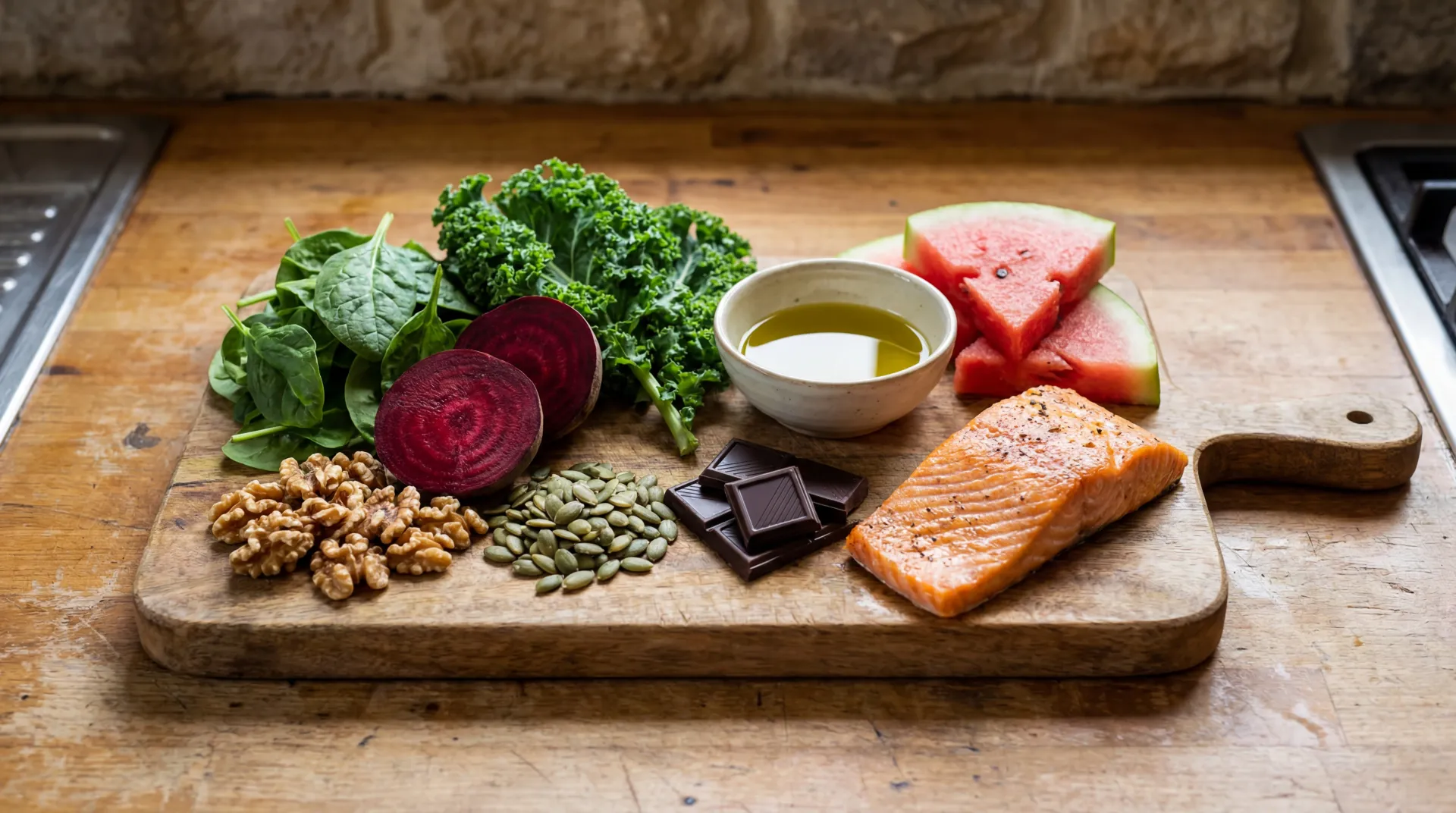
| Protein (proline, hydroxyproline, glycine) | Direct building blocks of collagen synthesis | Bone broth, chicken, fish, eggs, legumes |
| Vitamin C | Required cofactor for collagen synthesis; protects against UV damage | Citrus fruits, bell peppers, strawberries, broccoli |
| Omega-3 fatty acids | Increase skin elasticity; anti-inflammatory effects | Fatty fish, walnuts, chia seeds, flaxseed |
| Zinc | Supports collagen synthesis and wound healing | Oysters, beef, pumpkin seeds, lentils |
| Water | Maintains skin hydration and function | Water, herbal tea, water-rich fruits and vegetables |
An important caveat: no randomized controlled trial has specifically tested collagen supplementation in people with weight-loss-related loose skin. The existing studies were conducted on general aging populations. The biology suggests it should help — damaged collagen scaffolding plus oral collagen building blocks is a logical pairing — but the specific magnitude of benefit for post-GLP-1 skin remains an open question.
One thing the evidence does support: sunlight, smoking, environmental pollution, alcohol abuse, and nutrient deficiency all accelerate collagen loss. Rebuilding collagen while exposing your skin to these stressors cancels out much of the effort.
Protecting Your Skin While You're Still Losing Weight
If you're currently on a GLP-1 medication and still losing weight, you have more control over the outcome right now than you will later.
The single most controllable factor is the rate of weight loss. Multiple studies confirm that faster weight loss produces more loose skin. You can't fully control how fast GLP-1 medications work, but you can discuss dosing with your prescriber. Some physicians titrate doses more gradually specifically to give skin time to adapt.
Resistance training serves double duty. Lean muscle mass decreases while on GLP-1 medications, but current evidence indicates that strength and muscle function can be preserved with resistance training and appropriate protein intake. Muscle fills space that fat previously occupied. Building or maintaining muscle while losing fat means less empty volume for skin to drape over. The Physical Activity Guidelines for Americans recommend strength training at least twice per week — and for GLP-1 patients, that minimum should be treated as a floor, not a ceiling.
For a deeper dive into protecting muscle mass while on these medications, see our guide on how to prevent muscle loss on GLP-1 medications.
The factors you can't change — age, genetics, and how long you carried excess weight — still matter. Someone who has been obese for 20 years has different collagen reserves than someone who gained weight over 3 years. Younger skin has more active fibroblasts and recovers more readily. Neither of these is in your control, but knowing where you stand helps calibrate expectations.
The factors you can change:
- Don't smoke. Smoking reduces collagen production and damages existing collagen. If you're trying to preserve skin quality while losing weight, smoking is working directly against you.
- Protect against sun exposure. Chronic sun exposure reduces both collagen and elastin production. Sunscreen and UV-protective clothing matter more during weight loss than at any other time.
- Prioritize protein intake. GLP-1 medications suppress appetite, which often means protein intake drops. Aim for at least 1.2-1.6 grams per kilogram of body weight daily to supply collagen building blocks.
- Stay hydrated. Dehydrated skin has less elasticity and recovers more slowly.
- Start collagen supplementation early. Based on the 12-week supplementation data, starting during weight loss rather than waiting until after gives your skin a longer runway for repair.
Dr. Minokadeh raised an important unanswered question in Practical Dermatology: whether cosmetic interventions should begin around the onset of GLP-1 treatment or later when patients are closer to their goal weight. There's no consensus yet. Some practitioners start biostimulatory treatments like PRP or microneedling during weight loss to keep collagen production stimulated. Others prefer to wait until weight stabilizes to avoid treating a moving target. Ask your dermatologist what approach they recommend for your specific situation.
Frequently Asked Questions
How much weight loss typically causes loose skin?
There's no single threshold because the answer depends on your age, genetics, how long you carried the excess weight, and how fast you lost it. In general, people who lose 50+ pounds — especially rapidly — are more likely to experience noticeable loose skin. For losses under 30 pounds, most people's skin retracts naturally within 6-12 months. GLP-1 medications increase the risk because the weight comes off faster than with diet alone.
Will my skin tighten on its own after I stop losing weight?
Your skin has about a one-year window of active contraction after reaching a stable weight. During this time, elastic fibers gradually rebuild. For moderate weight loss, natural retraction often produces acceptable results. For larger losses (50+ pounds) achieved rapidly, meaningful improvement happens but significant laxity typically remains.
Do collagen supplements actually help with loose skin after weight loss?
A meta-analysis of 26 clinical trials found strong evidence that oral collagen improves skin hydration and elasticity. A specific RCT showed 28% improvement in hydration and 25% improvement in skin density after 12 weeks. The catch: these studies were done on aging skin, not post-weight-loss skin specifically. The biology is promising, but the direct application hasn't been tested in clinical trials yet.
How much does body contouring surgery cost after GLP-1 weight loss?
Costs vary widely by procedure, surgeon, and location. A single abdominoplasty typically runs $6,000-$12,000. Most GLP-1 patients who pursue surgery need multiple staged procedures — a full body contouring plan can total $20,000-$50,000. Insurance may cover portions if the loose skin causes documented medical problems like recurrent infections or skin breakdown. Panniculectomy (removal of the abdominal pannus) is more likely to be covered than purely cosmetic procedures.
Can I prevent loose skin entirely while taking Ozempic or Mounjaro?
Complete prevention is unlikely if you're losing a large amount of weight. You can reduce the severity by maintaining resistance training, eating adequate protein, supplementing with collagen, protecting your skin from sun damage, avoiding smoking, staying hydrated, and working with your prescriber on gradual dosing. These measures help but don't eliminate the risk entirely for significant weight loss.
Medical Disclaimer
This article is for informational and educational purposes only and is not medical advice, diagnosis, or treatment. Always consult a licensed physician or qualified healthcare professional regarding any medical concerns. Never ignore professional medical advice or delay seeking care because of something you read on this site. If you think you have a medical emergency, call 911 immediately.